
Six Questions: Christopher Badell

I know a lot of interesting people. Some I’ve worked with, some I’ve met while traveling the world, some just owe me money. My name may be on the website, but it seems kind of boring if I’m the only person whose voice is heard here. So I’m bringing some of my friends to the site, as time permits. I’m not a podcasty kind of guy, so I’m keeping things simple: one guest, six questions.

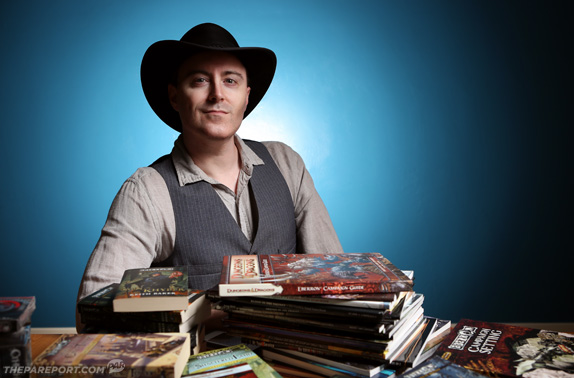
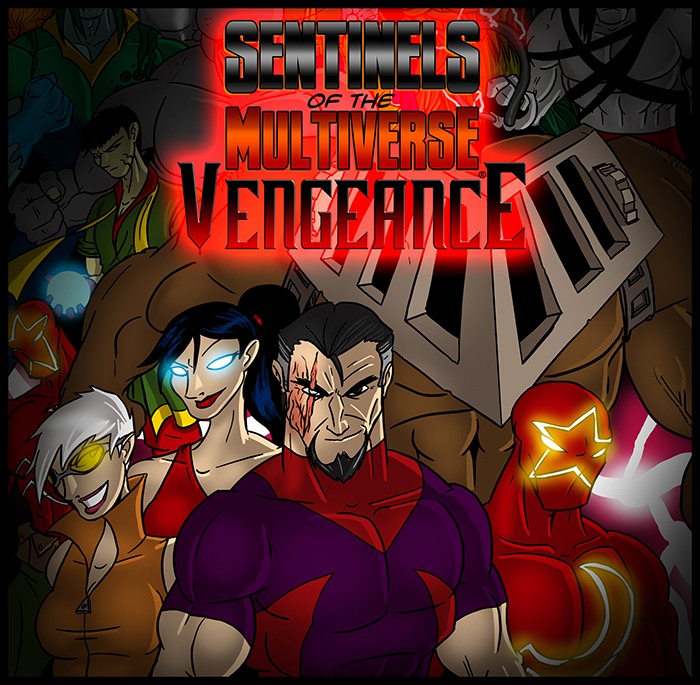
I met CHRISTOPHER BADELL on a secret island in the Caribbean (well, OK, not so secret), but I’d encountered his brainchild Sentinels of the Multiverse well before that. Sentinels is a cooperative card game in which players take on the role of a superhero team working together to bring down a nefarious master villain. One of the things I really enjoy about the game is its attention to continuity. The flavor text of the cards is made up of quotes from the various comics featuring these heroes… except, of course, that none of these comics actually exist (yet). With just these quotes, Sentinels manages to suggest a rich backstory for the characters and world, which makes it far more interesting to play the characters; as a comic nerd, I also appreciate the many homages found throughout this universe. But here’s Christopher… 

What’s your secret origin?

Three decades ago, on a dark stormy night in Maracaibo, Venezuela, a dark-eyed child was born. It’s pretty much all been downhill since then. I got taller and beadier and fought crime!

Really, the interesting origin story is that of Greater Than Games, which is what happens when three friends, each of whom excels in their particular field, get together and make a thing happen. I’ve always told stories and made up games for my friends to play, Adam is a fantastic artist who has been growing in his drawing as long as I’ve known him (which is a LONG time), and Paul is a clever businessman who loves games and gaming and works damn hard to make our dreams become realities. The lines that crossed to bring this company about are pretty crazy, and without the coincidences that brought us together, none of this would have ever happened.

But I’ve said too much already. I don’t want to make it too easy on our greatest nemeses!

Tell me about Sentinels of the Multiverse. What inspired you, both in tone and design? What do you consider the greatest strengths of the design? What would you change if you were starting over from scratch?

As I’d hinted in our origin story, Sentinels of the Multiverse is only possible because of the cooperative synergies between Adam, Paul, and I. Which is appropriate for what came out of that, really. Adam and I have been friends for almost 20 years, and we’ve always been into comic books and games – especially cooperative games! So, a few years ago, we were hanging out and bemoaning the fact that we had never played a good superhero tabletop game. We wanted something that made you really feel like you were playing as a hero of epic proportions! And then we wrote one. It was pretty quick from initial concept to execution. Shortly after making the game on index cards, just for us to play with friends, I played the game with my friend Paul, and the rest is history.

As to the inspiration, it really came down to loving the stories told in our favorite comic books and wanting to recreate that feeling in a game form. Stories of group of heroes working together against a terrible foe in a bizarre environment, like we would read in stories of the X-Men or the Avengers. The best part of those teams is the ensemble cast and how they interact with each other, which is what I love about Sentinels. I am proud of how much we captured the feeling of the team being more than just the sum of its parts. The synergies and the unfolding stories at the table as well as the gameplay that really puts you in the place of a super-powered hero are what I was shooting for – and I feel like we hit it square on the head.

If I were starting over from scratch…? I’d make the Enhanced Edition of Sentinels of the Multiverse the first time. The Sentinels of the Multiverse community is super awesome and let us rebuild the game only a year after it came out, which was good and necessary, but that rebuild definitely did all the things I wanted to do in the first place. We learned a LOT in that first year and a half, and I think the products we make now really reflect that quick learning curve.

You’re sentenced to be trapped in the Phantom Zone for eternity. What three graphic novels do you take with you?

Oof. Yikes. Hmmm, let’s say the Dark Phoenix Saga, Batman: The Killing Joke, and House of M. But then, I’d also sneak a pile of notebooks and pens with me. Really, as long as I could write infinitely, I’d have plenty of stories to keep me company.

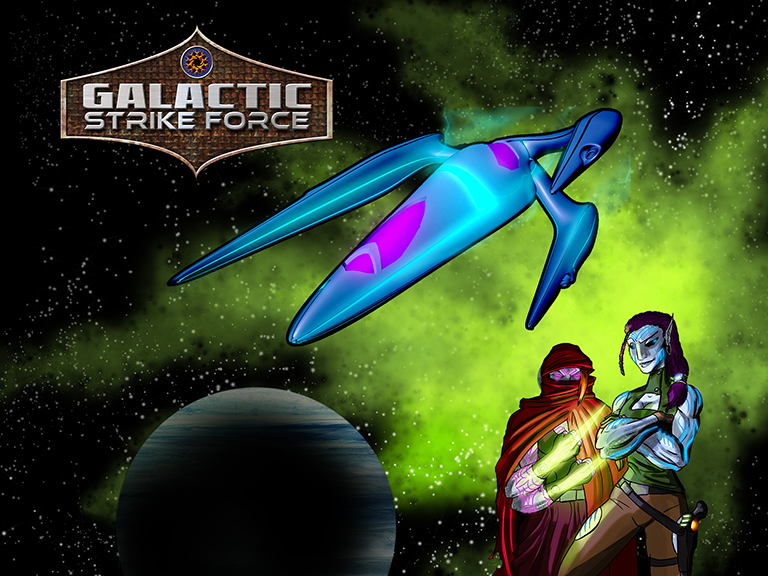
You’ve just launched a Kickstarter for an entirely new game, Galactic Strike Force. Tell me about it.

It’s SUPER EXCITING! With Sentinels of the Multiverse, the players all take the roles of heroes facing a powerful villain in a crazy environment. Galactic Strike Force is a group of scoundrels, such as smugglers, bounty hunters, and space pirates, all joining forces against an overwhelming opposition force in a science-fantasy setting. This poor rag-tag team is the last ditch effort to save the galaxy – you have very few resources and fewer friends, and if you’re going to save the galaxy, you’ve gotta work together! The story that makes it go is a blast, and the characters and ships we’ve put together are a ton of fun.

The gameplay is card based, but it feels like the unholy child of a deck building game and a tactical wargame, as you’re upgrading your ship and learning new tricks, but then taking that ship and those tricks into battle against opposition ships. It’s really a ton of fun, especially with more players! One thing that I was very interested in was making the gameplay equally enjoyable for any number of players. With just two, you get the feeling of a couple of wingmates taking down an opposing fleet through hit and run maneuvers. However, if you have a table of six, you can really go head to head, and different people can take different roles, like scouting, tanking, etc. That said, the Opposition forces scale well, and they’re MEAN.

We’ve got lots of updates going on over on the Kickstarter, so definitely go check it out!


You’re a scarred veteran of many Kickstarter campaigns. What lessons have you learned? Any advice for people planning to launch a campaign of their own?

Find your audience before launching your campaign. Be open with your information – make sure people know what you’re doing and why you’re doing it. Build a community.

Have a plan for how you will run your campaign. Make use of the entire time. Don’t blow it all on the main page on day 1. You have thirty days (don’t run a campaign for longer than thirty days without a damn good reason) and you should use all of those days. Update often, and make your updates beefy.

Make what you love because you love to make it, not because you want to monetize it. Be passionate about it, and share that passion with anyone and everyone.

What’s next after Galactic Strike Force? 

Well, immediately after Galactic Strike Force, we go full-bore into production of Sentinels of the Multiverse: Vengeance, which we teased a good deal with our Shattered Timelines Kickstarter. It’s not just another expansion to Sentinels of the Multiverse – it’s a standalone game that can be played with the existing SotM stuff, but also adds a lot of new things. New heroes, villains, and environments in fancy box that will supplement the Enhanced Edition box nicely, and it gives you a whole new way to play Sentinels of the Multiverse!

Also, we’re going to Australia this summer for PAX AUS, and Germany again this fall for Essen! Not to mention Origins and Gen Con and PAX Prime… whew! Convention season is nearly upon us!

Oh, and on top of all that, we’ve got a few other Secret Projects that we’ll be talking about later this year. And even more plans for next year!


Six Questions: Monica Valentinelli

Editor? Writer? Game designer? Power behind the scenes? MONICA VALENTINELLI is all of these things and more. She wears so many hats it’s sometimes hard to see her beneath them. Recently, she added a new hat to the collection when she took on the role of brand manager (and writer) for MWP’s new Firefly RPG. Somehow she found time in her busy schedule to answer six questions!

What was the first roleplaying game you played? How did you get from there to where you are today?

The first roleplaying game I played was Shadowrun. From there, I went on to a few other games like Vampire: the Masquerade and a lot of board, card, and video games. I didn’t really get back into RPGs until I re-discovered them through small press games like Obsidian: the Age of Judgement and A/State. That’s how I got started writing for games; I edited and wrote some fiction for Obsidian, then I went on to write a few frenetic, ethereal pieces for Noumenon, which is a game inspired by Franz Kafka’s Metamorphosis. I loved the variety that small press/independently-owned games had to offer and it was a good way for me to learn the business and figure out what I wanted to do next – much like I’ve done with fiction. The other thing that really helped, was reading, reviewing, and playing lots and lots of games for FlamesRising.com. Critiques are a great way of studying the medium you’re writing for; I highly recommend it.

My work with small presses has been a mixed bag. I’ve dived into really fun projects, but over a half dozen or so have never seen the light of day – some bigger than others, too. All the while, I was balancing day job concerns. I’m guessing that’s a familiar story for anyone who’s ever written a story or designed games. There are the things you want to do, and then there’s the jobs you have to take. So, the work I’ve done in the industry has been married to what I had time to do, what matched my skill set and, eventually, who I wanted to work for. I started writing for White Wolf after I won a fiction contest and put together a one-scene scenario for the new World of Darkness. I put some feelers out to write other game fiction with other, larger companies, but right now my games plate is full.

You’re the Firefly brand manager for Margaret Weis Productions. MWP released the Serenity RPG in 2005. How will the Firefly game differ from Serenity? Why are you excited to be working on the line?

This is a hilarious question. I just wrote about this in a blog post titled “Ain’t No Better Place In The ‘Verse…” for Creative Directions. I’m going to be giving semi-regular updates there to keep people apprised of what’s happening for the line. Here’s what I said about the differences between the two games:

“The new Firefly RPG, which is based on the hit Fox television series by Joss Whedon, is scheduled for a 2013 release; the system(s) are currently in development. Margaret Weis Productions did put out a game based on the Serenity movie produced by Universal Studios in 2005. The system for that game was a science fiction flavor of Cortex Classic.”

Why am I excited to be working on the line? Besides the fact that it’s Firefly? :-) I’ve been working on this property as a consultant now for six months or so. In every conversation we’ve had, the fans and the show have been at the forefront of those discussions. How do we create a game that’s uniquely Firefly? How do we make Cortex fans of new and classic systems happy? How do we balance business and licensing aspects with creativity? Working on this line is like putting a puzzle together, to best serve a multitude of audiences, address concerns, and produce a great game. The nerd in me is very happy that I have such a beautiful Gordian knot to untangle.

What makes the ‘Verse an interesting setting for games?

In my opinion, the ‘Verse resonates with fans because even though the stories occur in a science fiction context – it’s a very human place to be. We don’t really see the devastation caused by the Unification War, but we know it happened and witness its effects on the characters, much like many of us may not remember World War II, but understand or feel its long-term ramifications. Using that as an example, though, it’s not necessarily the ‘Verse by itself that’s compelling, it’s the characters and how they work together to survive regardless of where they live. If you live in the Core, maybe things aren’t as great as they seem. Once we get out into the Black, we’re not fighting aliens, we’re facing each other.

At the end of the day, though, no matter how gorgeous any setting is, I feel good games always recognize that both the player and the group need to have something to do. It’s not just about what character you play, it’s also about why your crew is together. What’s the point of sitting around the table if you’re not connected? In my mind, this is why Firefly is perfect for gaming, because the further the crew ventures out into the ‘Verse, the more jobs they take, and the more they need each other to make it through.

When you’re not creating and editing games, you write fiction. What inspires you as a writer? What’s your favorite story you’ve written?

I was a storyteller long, long before I discovered gaming. I started writing fiction when I was 9 and specialized in writing while at university. The possibility of all the stories out there and the gift they provide us is what inspires me. The potpourri of cultures, of different lifestyles and ways to be, the history of what has come before and the potential of what will be – there is no end to what can be done or how or why. I love, love, love, love to build worlds and write about characters that resonate within these environments, highlighting the best and worst in all of us, whether that’s to frighten, inform, or entertain.

My favorite story is the one that I haven’t written yet. I realize this is a non-answer and somewhat meta, but as someone who’s obsessed with her art, it’s an honest statement. I never stop honing my craft and, while I need motivation and a cheering section like many writers out there, I’m always looking forward to what’s new.

If I had to pick one, though, I’d say I had a ton of fun with a vampire noir tale edited by Robin Laws dubbed “Fangs and Formaldehyde.” You see, in my vampire world, if the bloodsuckers get too emotional? They die. In point of fact, it’s very messy and involves blowy uppy noises and large splatters. Cue evil laughter in 3… 2… 1… Anyway, this story appeared in an anthology titled New Hero Volume 1, and that book is available from Stone Skin Press.

Tell me about The Queen of Crows, and where you want to go with it.

The Queen of Crows was one of the first enhanced e-books published with reader extras. It takes place in the late 1850s right before the Civil War and is a story about a Navajo shaman who must make a terrible choice. Because it was an experiment, I stuck to a short story instead of a novel, to see what readers thought. I was pleasantly surprised by the very positive reception, because writing about Native Americans, even in an alternate history context, is taboo – especially for, as one reader put it, a “blonde woman.” But, this story is a teeny, tiny piece of a much larger world of magic, mystery, and intrigue. I built that world on a timeline reaching back to the dawn of time. This story here is the origin of a key player in the Violet War to come. Not only do I have an urban fantasy novel set in modern day times, but I also have several pieces of short fiction and an outline for an RPG.

So what happened? Well, remember that time versus money thing I told you about? Yep, that was part of the reason why this project stalled. Living up to my namesake, the Queen of Perfect Timing, the release preceded the iPad by a few months. Needless to say, formatting images for the iBookstore and eBooks was part of the challenge, as the technology physically couldn’t match my vision at the time. Even now, it’d have to be an app or require a lot of programming to make it fit. That’s the downside to coming up with something cool; once you make it, limitations will throw you off-kilter.

Confession time. When I’m worried about work, my creativity is swallowed up by a plethora of bad Cthulhu jokes and abysmal reality checks. Now that I’m having fun? I’m diving in with abandon and can visit make-believe land more often. Business plan was activated in January; I’ve got a great group of readers and a ton of initiatives in the works like updating the VioletWar.com website, etc.

It’s scary, sure, but I’m really hoping people will dig these stories and this world in particular.

What are you looking forward to in the months ahead?

I’m trying not to! I’m really grateful I have the projects I do, because I had a dry spell (coupled with nights ending in obligatory fist shaking at the universe) and it turned me into a sea slug. I don’t think there is anything harder for someone who wants to make something – no matter what that “thing” is – for a living. The fiscal realities, coupled with the knowledge and time involved, can cause a person to go mad. At the same time, I don’t want to focus on that aspect with my readers, either, because that undervalues them. My job is to give them the best stories and games I can, and give them a reason to revisit my work again.


Six Questions: Kenneth Hite

I know a lot of interesting people. Some I’ve worked with, some I’ve met while traveling the world, some just owe me money. My name may be on the website, but it seems kind of boring if I’m the only person whose voice is heard here. So I’m bringing some of my friends to the site, as time permits. I’m not a podcasty kind of guy, so I’m keeping things simple: one guest, six questions.

KENNETH HITE is a man of many talents, and a keeper of secrets no one should know. You may have played one of his many games, read one of his books, or listened to him and Robin D. Laws talk about stuff. If not, you should do all of these things, right now. Here’s the man himself…

You’ve been creating games for over thirty years. How did you fall into the dragon-eat-dungeon world of RPG design? What do you consider to be your finest piece of work?

I started out creating games, as you note, for my own game group: D&D and then CALL OF CTHULHU, which became my One True Love. I ran lots of other stuff, too, but those were the bigs. One of my old CALL OF CTHULHU players, Don Dennis, eventually got a gig at Iron Crown, which got him a playtest copy of the first draft of Chaosium’s magical-conspiracy NEPHILIM RPG. He thought to himself: “You know who should see this? Mister Magical Conspiracy CALL OF CTHULHU Doofus.” and sent it to me. I sent Chaosium around 10,000 words of back-sass and got the response: “Is it okay to include your comments in the next draft? And what’s the next book you want to write for us?” That response, by the way, was from Greg Stafford His Own Damn Self.

So that started me off. Right around then, Steve Jackson bought the proposal for GURPS ALTERNATE EARTHS that I’d been badgering him about at GenCon for the last four years or so, and suddenly I was a twice-published author with two hungry game lines to feed.

My finest piece of work? They’re all beautiful and I love them all very much, of course, but I certainly hope my finest piece of work is my most recent one: NIGHT’S BLACK AGENTS, my vampire spy thriller RPG from Pelgrane Press. That said, the original-series STAR TREK RPG from Last Unicorn was my own perfect nine-toed baby. It looked like it fell through a thirty-year time warp from 1968. Oh, now see what you’ve done. You’ve made DAY AFTER RAGNAROK cry. There, there, little setting book. I won’t let the bad man in the hat hurt you.


Your Cthulhu 101 is an excellent introduction to the Cthulhu mythos. Where The Deep Ones Are and The Antarctic Express introduce children to cosmic horror. Trail of Cthulhu is an award-winning roleplaying game that draws players into the world of H.P. Lovecraft. What draws you to Lovecraft’s work?

First and foremost, he’s just an amazingly good writer. The power of his mythology, and the sure-footedness with which he constructs his stories, get me every time. But I think Lovecraft enjoyed, and I enjoy, seeing the world in the same way: as pieces and fragments of a larger story, one by turns terrifying and wondrous. Lovecraft called this feeling “adventurous expectancy,” and I get that same feeling from both Lovecraft and from things he enjoyed like astrophysics, or travel, or urban life, or research. I feel a great sort of sympathy to Lovecraft, in terms of how his brain determined story and fantasy to work, and on other levels as well. We both love architecture, and both feel stark terror at the modernist sublime. We’re both autodidacts, and share our tribe’s love of the weird fact that confounds and reveals in equal measure. Obviously, we have our differences, too — he didn’t drink and he had weird dirigiste politics, for example — but as writers and readers of the weird I think we’re simpatico.


Lovecraft said that the strongest kind of fear is fear of the unknown. Unlike Lovecraft’s typical protagonists, the people who play Lovecraftian RPGs are often well-versed in the Mythos… and they are expecting frightening things to happen. What advice do you have for GMs trying to bring real suspense to their horror campaign? 

I should send you to a page ref in GURPS HORROR for this, if I really wanted to move product. (Roughly pp. 131-134.) But to put it another, less four-pages-long way, the key to suspense is, precisely, that your audience expects frightening things to happen. Hitchcock used the example of a bomb going off after ten minutes of talk about baseball. You’re watching a movie, the guys are talking baseball, a bomb goes off — that’s shock. Same exact movie, but you add a minute of footage ahead of time showing a bomb being planted under the table — now, it’s suspense. Your audience — in this case, your players — need to know something horrible is happening in order to sense the horror either in the uncanny events around them OR in the absence of such events. With completely unfamiliar horrors, you’re a little bit lost; this is why HPL stories have such long, detailed buildups so that you can get completely into the head of the protagonist. With a very familiar horror, it can lose some of its strength (although even a vampire can still be terrifying — LET THE RIGHT ONE IN demonstrates that) but that same familiarity can allow the players to sense the horror’s approach. The Mythos, right now, is at the perfect point: just familiar enough that you can spook the players with familiar spoor, but just unknown enough that really, almost anything might be inside that abandoned barn.


You have seven thousand books in your personal library. What are a few books you think every gamer should read?

Every gamer? Regardless of genre or style of play? I’d say they should read Thucydides’ PELOPONNESIAN WAR, to get a sense of how history, politics, and war work, and how to turn them into a compelling story. They should read Northrop Frye’s ANATOMY OF CRITICISM, to get a sense of how to break down stories and symbols, core elements of RPGs. And they should read Jane Austen’s PRIDE AND PREJUDICE, because everyone should read it, it being the best novel in English. Also, it illuminates characters, dialogue, social engagement, and how to depict killing-free crises.

All that said, Charles Nicoll’s THE RECKONING, about the murder of playwright-spy-occultist Christopher Marlowe, is the greatest-ever RPG sourcebook that doesn’t actually happen to be an RPG sourcebook, so check that out, too.


Tell me about Night’s Black Agents. What makes an evening of Night’s Black Agents different from playing in the World of Darkness or Delta Green?

In NIGHT’S BLACK AGENTS, you play burned spies in today’s shadow world who discover a vampire conspiracy — and worse, it discovers that you’ve discovered it. So it’s hunt or be hunted, kill or be killed, as you use your training and tradecraft to find, hunt, and destroy the vampires while running from their own pawns, Renfields, and monsters. The elevator pitch I use is “It’s the Bourne trilogy if Treadstone were vampires.”

The difference between NIGHT’S BLACK AGENTS and the World of Darkness is that you don’t play the monster, you play the good guys. Also, while the stereotypical WoD game is about maneuvering for position inside a shadow world of monsters, the standard NIGHT’S BLACK AGENTS game is about maneuvering to destroy a shadow world of monsters. I except, of course, HUNTER: THE VIGIL, which differs from NIGHT’S BLACK AGENTS primarily in not assuming that the main heroes are really, really badass.

As far as DELTA GREEN goes, its primary difference with NIGHT’S BLACK AGENTS is the difference between Lovecraft and Howard: doom versus daring. There are also surface differences: DG agents are usually still government operatives, while the default NBA game assumes the agents are freelancers. But given that NIGHT’S BLACK AGENTS, like TRAIL OF CTHULHU, is a GUMSHOE game, you could certainly play a DELTA GREEN game with the NIGHT’S BLACK AGENTS rules and use TRAIL OF CTHULHU for the Mythos component. (There’s a drift in the back of the NBA corebook designed to let you play spies vs. Mythos games, in fact.)


The phone rings. A producer with $100 million and the connections to get any actors you want is ready to make a movie based on Night’s Black Agents, but you have to lay out the story in the next five minutes. What’s the plot, and who are your stars?

Mossad sniper Natalie Portman and her hacker/sidekick have an operation in the Syrian desert go very wrong when the guy she’s supposed to shoot doesn’t die and suddenly Mossad isn’t taking her calls and someone who knows the Mossad recognition codes tries to kill her and does kill her sidekick by biting his throat out. So she has to recruit help from other sources: an intuitive-eidetic MI5 analyst (Benedict Cumberbatch), a versatile techie thief (Clive Owen), and a badass fighter (Priyanka Chopra), each of whom she assists in defeating vampires in a thrilling set-piece. From clues gathered at each set-piece, the analyst figures out that the vampires are all working for “The Old Man,” a legend in the former KGB, his old archnemesis during the last bit of the Cold War. So they mount a big operation to take down “The Old Man,” who is of course a vampire lord (Max von Sydow) living in obscene luxury somewhere in Eastern Europe. After killing like a million of his army of Renfields, and losing Clive and Priyanka in the fight, Natalie puts a Clive-designed vampire-killing round through the Old Man — only to be betrayed by Benedict Cumberbatch at the last. He, of course, was the Old Man’s rival vampire — his analytical skills come from centuries of practice. Natalie somehow survives (dives into a big tank of blood, masking her scent) and the last scene is her, racking another anti-vampire round into her rifle, sighted in on Benedict Cumberbatch.


Six Questions: Jonathan Liu

I know a lot of interesting people. Some I’ve worked with, some I’ve met while traveling the world, some just owe me money. My name may be on the website, but it seems kind of boring if I’m the only person whose voice is heard here. So I’m bringing some of my friends to the site, as time permits. I’m not a podcasty kind of guy, so I’m just keeping things simple: one guest, six questions.

I met JONATHAN LIU while working on The Doom That Came To Atlantic City. Jonathan writes for Wired’s GeekDad blog,which examines everything from games to stellar phenomena – after all, when is the best time to tell your children about the inevitable heat death of the universe? Recently Jonathan put up a Kickstarter for a game of his own… a Kickstarter that’s slightly unusual in that he warns you to think twice about supporting it.

So Jonathan… What’s your secret origin? How did you get to be the geek… and dad… you are today?

Well, I read a lot as a kid. That’s probably the biggest contribution to my geekiness; that and ’80s cartoons. I didn’t grow up playing D&D because it wasn’t allowed, but I did make up my own “mazes” on graph paper and led my friends through them. They were based entirely on my own very limited knowledge of what RPGs actually involved. Fast forward to a few years ago, and a friend introduced me to Settlers of Catan and Carcassonne, and I was hooked. I dove into the world of modern board games and haven’t looked back.

As for the “dad” part: I’ve been a dad for just over nine years now. When we first moved to Portland for my wife’s residency, I quit my job(s) and had about six months to prepare to be a full-time dad and house-husband. I’ve been doing it ever since, and it’s a great gig. We’ve got two daughters now and a third one on the way.

Tell me about GeekDad. What does “Geek” mean to you? What are your goals with the blog?

For me, being a geek means being really passionate about things. Sometimes that means taking things a little too far or a little too seriously, but a geek loves to dig into things and explore the world. I personally tend to have broad interests rather than deep interests, which may be less “typically” geeky. I like a little taste of everything, but it means that on any given topic I may not be as informed as others. It’s that whole Jack-of-all-trades thing.

GeekDad has been a really fun way to share my passions, particularly books and board games. I could talk about those two topics forever, it seems. When I joined the GeekDad team I hadn’t seen a lot of board game coverage on the site already, and I’m very pleased to have added board game coverage as a pretty regular part of the site now. What I love about GeekDad is that, beyond being a blog, it’s a community of geeky parents that I’ve gotten to know both online and in real life. I love being able to share with both them and our readers things that I think are really cool. While I do cover releases from major publishers, I also love having a platform to highlight lesser-known projects by people who don’t have a huge marketing budget and name recognition.


As a reviewer for GeekDad, you’ve played more games than I can shake a stick at. You introduced me to Geistes Blitz and Flowerfall. What are a few of your favorite games?

I’m always hesitant to pick favorites, because there are SO many that I enjoy. But for the past few years I’ve tried to compile lists (with the help of my fellow GeekDad writers) of our favorites reviewed on the site. A few of my favorites from the past few years are Catacombs, which combines a dungeon crawl with a disc-flicking dexterity game; and Escape, a real-time cooperative game about getting out of a cursed temple before it collapses. For thematic “Ameritrash” games, my favorite is the Last Night on Earth series, and for multi-hour Eurostyle, I’d probably go with Agricola. And Carcassonne, one of the games that re-ignited my interest in board games, is still one that I play the most, albeit on the iPad usually.

Here’s a few of GeekDad’s best of lists…

The Best Board Games of 2010

The Best Board Games of 2011

The Best Board Games of 2012


As a Geek DAD, what do you look for in a game? What are some games that you like as a Geek, but fail the test as a dad?

Well, my kids are 9 and 6 now, and that three years can make a big difference in the sorts of games they can play. For instance, the 6 year old is still working on reading but the 9 year old has no trouble with it. On the other hand, we’ve found that my younger daughter is pretty good at basic arithmetic and can keep up with her sister there. For my kids I’m usually looking for games that have a shorter rulebook, something that I can explain quickly so we can get down to playing, rather than a long list of details—they love playing games, but they’ll lose interest in a long explanation.

I also love cooperative games with kids—it teaches a different type of gameplay. I do think it’s important for kids to learn not to take competition personally, but with younger kids it’s harder to separate the gameplay from the non-game relationship. (Heck, it’s hard for some adults, too.) Cooperative games let everyone play to win without bashing the other players, which can be really refreshing for family games.

I think playing games can be educational in itself, so I don’t feel that a game has to be overtly “educational” to have value. Certainly I don’t mind if there’s a bit of math and reading involved, but games that are marketed as educational are often more like flash cards or trivia questions with a thin veneer of game. I’d rather play things that are fun, and then figure out what lessons arise from the gameplay.

As for things that I like that don’t pass the dad test … honestly I think for the most part it’s just a matter of waiting until the kids are old enough to appreciate the game or when I feel they can handle a particular theme. For instance, I’m not going to play as many games that have a lot of backstabbing and “take that” because they’re not quite mature enough for that yet. But when I see that they can be good sports about it, then I’ll break those out. Likewise, they don’t mind games with some monsters (like Castle Panic, for instance) but the more realistically-depicted they are the less they enjoy them. While they don’t mind a zombie-themed game like Zombie Dice, Last Night on Earth would freak them out because of all the photos in the game.


You don’t just play games, you’re making one. You’re running a Kickstarter for a game called Emperor’s New Clothes. What’s the game about? Why should I lay my money down? 

The game is based on the classic Hans Christian Andersen tale, about a vain Emperor who gets fooled by a couple of swindlers. Eventually the entire town is roped into the hoax, pretending to see something that isn’t there, until a child points out that the Emperor, in fact, has no clothes. I wanted to create a game that paralleled the story, one that incorporates a scam that works because other players agree to play along. Although it’s not exactly a role-playing game, it does rely heavily on storytelling and imagination rather than being simply a matter of rolling dice and playing cards. Our gimmick is our special printing process, Regulated Optical Operator Screenprinting (ROOS), which makes the game appear invisible to those who probably won’t enjoy the game. Thus, the game is sort of self-selecting: players who can see the ROOS to play the game will enjoy it; players who can’t see the ROOS can ignore it.

For that reason, my Kickstarter campaign is rare in that I’m not encouraging everyone to pledge for it. I want everyone to check it out, and then see for themselves if the game is right for them. If it looks blank to you in the photos, then it will most likely look blank to you when it arrives, so you should probably hold off. However, if you enjoy the photos of the game and gameplay video, then you’ll probably have a very good time playing the game.

What are you looking forward to in 2013?

I’m looking forward to the end of the emotional roller coaster that is a Kickstarter campaign! I’m also excited about (in no particular order): the upcoming birth of our third child, my first trip to Gen Con, and finding time to actually play all of these Kickstarter-funded board games that are starting to show up on my doorstep.

Six Questions: John Kovalic

Today I’m talking with JOHN KOVALIC. If you don’t know who John is, you are clearly a Cylon spy; please report to the nearest airlock. John has illustrated over a hundred games, including hits like Apples to Apples and Munchkin. His comics include Dork Tower and Doctor Blink: Superhero Shrink. He’s even appeared in The National Enquirer. He is a living legend, at least if it’s a legend about a cartoonist accidentally ending up in an embarrassing story in the Enquirer. But I’ll let him speak for himself.

You’ve been producing Dork Tower for over fifteen years. In addition to chronicling the experiences of a community of gamers, Dork Tower has introduced the world to the milliwheaton and revealed the horrifying truth behind Dinosaur Train. How did Dork Tower get started, and how has it changed over the years?

Dork Tower began in 1996, when I was talking with Shadis magazine editor DJ Trindle at GenCon. I’ve been a gamer since the mid-1970s. By the mid-90s, I was working for the Wisconsin State Journal, sneaking in games reviews when I could. I even talked my way into going to GenCon on their dime.

Knights of the Dinner Table had just left Shadis, and DJ said they needed a new comic strip. A geeky gamer comic strip. Needed skill sets don’t come more gift-wrapped than that.

Over the years, Dork Tower changed in about the same way that gaming itself has changed. The characters still represent the same basic Gaming Types that they always have. But their fandoms have grown. Along with mine. I suppose it’s a bit harder, these days, as the basic “Oh my god! GAMERS!” trope has been done to death. But the challenge is enjoyable.

A close friend is moving to McMurdo Station, and the only thing he can take to keep his spirits up are three Dork Tower strips. Which three do you recommend?

Oh, lord. “You have thousands of children. Which is your favorite?” OK. You get the first three off the top of my head, then.

ONE: The “Hey, Marcia! Come and see the Satanist” strip from the early days is one people love, but I always considered the “Are Dark Elves into Leather” strip more of a personal favorite because it defined Igor’s character early on and set the tone for Dork Tower.

TWO: “Matt and Gilly’s Big Date,” from the “Dork Covenant” collection. This won an Origins award, and I’ve always thought it was sort of a sweet little story.

THREE: I’ve been trying different formats out with the online comic strip, recently. And it’s been a lot of fun. If you know what Dinosaur Train is, I’d go with this one. If not, here’s one with “Gilly the Perky Goth on Fake Geek Girls” I was really happy with.

Confession: I know that wasn’t, technically, three.

Carson the Muskrat first appeared in Wild Life, the comic you created for the Daily Cardinal. What was the story behind Wild Life, and what’s your personal affinity for muskrats?

Wild Life actually didn’t start in the Cardinal. By the time I got to the UW-Madison, it had already appeared in the Millfield Newspaper, the Queen Mary College- London newspaper and the UW-Parkside Ranger. After I graduated from the UW, it went on to run in the Wisconsin State Journal in the late 80s, and was picked up for national syndication by Chronicle Features in the early 90s.

My mom had written a comic strip for a kids’ paper back in the States called My Weekly Reader. I’d grown up on comics and learned to read with comic books. I was always sketching, and writing comics in the back of my school notebooks. When we moved back to England, I just decided to show these to the school newspaper, as it seemed the sort of thing a cartoonist should do. School newspapers are seldom picky, and the rest is history.

Little-known fact: “Wild Life” was named after the old Wings album of the same name. I’ve no idea why I did this: it’s not a favorite album by any means. The 1970s were odd.

As to why a muskrat, I also have no idea. In the early days, Carson looked more like a badly-drawn sheep. “Muskrat” sounded funny, though. I finally saw a muskrat when I moved to Wisconsin. It is hugely inconvenient of them not to look like Carson at all.

Another little-known fact: Carson is named after Johnny Carson. Nobody ever asks that, anymore, as “Carson” seems to have become a common first name, possibly after entire generations named their kids after the Tonight Show host. But there you have it.

You’ve created the art for dozens of games, from Apples to Apples and Munchkin to Kobolds Ate My Baby! What was the first game you ever played? What do you enjoy playing today?

My first real gaming love was when I was in England. School friends played World War II wargames with 1/72nd scale Airfix kits and figures, and I was hooked. At a model shop in Bristol, I stumbled across a copy of SPI’s Panzer 44. That called to me immediately and I was soon seeking out all sorts of wargames. It was on a trip to Games Workshop – then a small general gaming store in London – that I discovered the fabled Little White Box set of Dungeons and Dragons.

I try and play as much as I can, but the traditional wargames get the shortest shrift anymore: I simply don’t have time for them. As far as roleplaying goes, I think Pathfinder is magnificent (thus the upcoming Munchkin Pathfinder fills me with fanboy glee). But, if I have to be honest, Call of Cthulhu’s still my main love. I should also mention I’m finding Kenneth Hite’s Trail of Cthulhu brilliant, though! I’m hoping Marc Miller’s Traveller Kickstarter returns that RPG to its former glory. In all of gaming, the Traveller Imperium is my hands-down favorite.

I play a lot of Euro-style games and party games, too.

Castle Panic, Forbidden Island, and X-Wing were three games I played a lot last year. As far as miniatures gaming is concerned, it’s Flames of War, Bolt Action, Man-O-War and Warhammer Fantasy are my mainstays this year.

Of course, I still love playing Munchkin. I’ve only ever won one game of it, though. The latest Out of the Box games, like FAUXcabulary and Snake Oil, are terrific returns to form.

Speaking of Kobolds Ate My Baby!, you’re currently involved in the Kickstarter campaign for the new color edition of KAMB. What’s your favorite thing about working with kobolds? Can you give us any hints as to what Kovalicness may lurk behind the secret doors KAMB’s stretch goals?

By far and away, my favorite thing about the Kobolds is that they’re just so darned fun to draw. I was very happy with how they turned out: I don’t often get to redesign characters from the ground up. Chris and Dan, of 9th Level Games, are terrific to work with, as well.

As far as hints go, we have tremendous secret guests lined up, and some stretch goals that will take the Kobolds into 3-D deliciousness. Posibly pewter. Possibly plushie.

The first huge stretch goal – the “More Things to Kill and Eat” supplement – was unlocked after only a few days. Jim Zub (of the Skullkickers and Pathfinder comics fame) was also announced as a guest writer for another stretch-goal that was met.

There’s a hugely cool collaboration with another company we may be able to announce, soon. It’s all very exciting. There’s so much fun stuff happening, it’s breathtaking. But hard to keep track of. We were just thrilled to see the new edition fund in the first day: everything else is gravy. Incredibly, mind-blowingly cool gravy.

What are you looking forward to in 2013?

Time off?

Other than that…everything! I’m working on four big projects that take me well away from my comfort zone. The first has already been announced and is being released in May: ROFL!, my new party game, is being published by Cryptozoic. I think it’s the best I’ve ever designed. Plus, the folks at Cryptozoic just fab. If you ever get a chance to work with them, I’d highly recommend it.

I can’t really talk about the other big projects yet, though I may have dropped a hint or two on my Twitter feed. Puppets may be involved in one of them.

Then, of course, there’s the regular stuff: the new Dork Tower trade paperback, Munchkin Pathfinder, Out of the Box new releases, a graphic redesign for a game I love from a Dutch company, and other things I’m certainly forgetting.

 Hum. 2013 seems busier than it did five minutes ago…

Six Questions: David Malki!

Today’s guest is DAVID MALKI! David is the creator of Wondermark, a hard-hitting webcomic that tackles the tough issues other comics are afraid to face, like Bibliophibians, Bears in Ill-Fitting Hats, and the proper collective noun to refer to a group of bogeymen (a “scamper”). Wondermark recontextualizes 19th century artwork with hilarious results, and if you aren’t familiar with it, you should check it out right now. We’ll wait right here until you get back.

 What is The Story of Malki? How did you get to where you are today?

I made a lot of rash decisions! I didn’t have any idea of how hard anything was, so I just blazed forward in glorious ignorance, not realizing that I was attempting the impossible. So anyway here I am!

Tell me about Wondermark. How did it get started?

I decided I wanted to try doing comics in a different way from most other people. There’s a beauty in old artwork that’s extremely evocative, and it’s all out of copyright besides. And as a bonus, the original artists aren’t around anymore to ask permission from. So I decided I would try making comics in a collage style to see if it would work! TURNS OUT: IT DOES.

I like to think that Wondermark occupies a universe parallel to our own, where everyone speaks their mind, has the perfect rejoinder to any situation, has fabulous fashion sense, and can bolt any manner of things together to make glorious elaborate nonsense contraptions. I don’t know if I’d want to live in that world — it’s a bit dangerous as well. But I sure like looking in on it.

One of Wondermark’s recurring characters is the alien Gax, a dapper gentleman who happens to have the neck and head of a brontosaurus. Where did Gax come from, and what’s the secret of Gax appeal?

When you make comics using found art, you’re limited to the kind of art you can find. This means that it’s hard to have recurring characters — you either have to find multiple pictures of the same person (occasionally possible in the case of political cartooning, but not otherwise common) or re-use the same pictures all the time, which can get boring. However, I found that you can re-use ANIMAL faces as often as you like without it seeming repetitive.

So at one point I decided that the alien creature Gax — a throwaway gag at first — could become a recurring character, because his face was easy to mold into new expressions, and also because I established that he was a shapeshifter, so he could look like anything and it’d still make sense. The secret of his appeal is that he speaks his mind and has impossible physiology.

Tell me about Machine of Death.

Machine of Death, most simply, is a collection of short stories, all by different authors, that asks the question, “What if there was a machine that could predict how you die? What would it mean for the world?” Each author started with that premise, and then spun out a different story exploring some facet of that idea. It’s a really diverse and compelling book — we read almost 700 submissions, and picked our favorite 34 — and it became an independent bestseller, shooting all the way to #1 on Amazon the day it was released. Now, it’s been spun off into a card game as well as a second volume of more stories, both of which will be coming out this summer.

Machine of Death started as an idea, became a book, and now it’s going to be a card game. As Gloom players know, I’m a fan of storytelling games that involve coming up with creative ways for people to die. The Machine of Death card game is up on Kickstarter, and has shot past its funding goals. Tell me why I should get on board today! 

I ain’t here to convince you! If you watch our hot video and read the description, and decide it’s not your bag, then stay far away from it. But if you like absurdity and weaving absurd yarns and laughing with your friends about IMAGINARY MURDER, it’s right up your alley. It’s a simple game, light on strategy and high on nonsense, that provides a construct to tell funny stories with your friends and imagine the increasingly-ridiculous deaths of bizarre individuals. Also, if you back it during the Kickstarter, you’ll get bonus decks of literally HUNDREDS of extra cards by many of the top names in webcomics — included totally free, only during the funding period.

You kick a can and a djinni pops out. It promises to grant three wishes, but the only sort of wish it can grant is to turn books published before 1950 into movies. What three books do you choose?

1. The New Century Standard Letter-Writer, by Alfred B. Chambers (1900). This is ostensibly a book of correspondence etiquette that also can be read as an incredibly bizarre psychoanalysis of its author, as he presents increasingly-specific template letters for such typical situations as “Marriage Proposal to a Young Lady to whom the Writer has Never Been Introduced” (p.124); “From a Father to a Gentleman, Forbidding him to Pay any Further Attentions to his Daughter” (p.148); “From a Lady to her Fiancé Breaking Off Their Engagement on Account of his Coldness” (p.169); et cetera, et cetera.

2. The Flying Girl, by L. Frank Baum writing as Edith Van Dyne (1911). Just a really great adventure book about a couple of teens inventing and building an airplane in their garage. A good snapshot of the early days of aviation and, unlike 98% of the youth-adventure novels published in the era, a super fun, engrossing, well-written book on its merits.

3. A Bad Boy’s First Reader, by Frank Bellew (1881). This is a parody of a children’s book that manages to be just deadpan enough that you think it’s real and just weird enough that you can’t believe it could possibly be real. Possibly the only children’s book of the Victorian era to include the phrase “Isabella will grow up to be a wise woman…if she does not die of cerebrospinal meningitis.”

Six Questions: James Ernest

I know a lot of interesting people. Some I’ve worked with, some I’ve met while traveling the world, some just owe me money. My name may be on the website, but it seems kind of boring if I’m the only person whose voice is heard here. So I’m bringing some of my friends to the site, as time permits. I’m not a podcasty kind of guy, so I’m just keeping things simple: one guest, six questions.

Today I’m talking to JAMES ERNEST. James is best known as the brain behind Cheapass Games, and has brought all kinds of fun to the world in the form of dozens of games, including Kill Doctor Lucky, Lord of the Fries, and the recently re-released Unexploded Cow. He’s a juggler, an author, a short film director, and he likes to beat people up. 

You wake up and find that a major Hollywood studio has made a movie out of your life— CHEAPASS: The James Ernest Story. What’s the gist of it, and who plays you?

A brave game designer survives against all odds to make a living sitting in his basement answering emails and buying photography equipment. Starring Leonardo DiCaprio and Kate Winslet, both as me.

Speaking of movies, you’ve just started a Kickstarter campaign about making them. Tell me about Deadwood. Any hints about possible stretch goals?

Deadwood is a board game about making movies. Everyone plays a terrible actor on a Western movie backlot, and the goal is to get rich and famous enough to increase your status and get hired for better roles. Which will make you even richer and famouser.

My hope is to raise more money than I could possibly need and use the rest for (a) the betterment of all Mankind (b) to print some other Cheapass Games, and (c) for a weekend in Las Vegas that I am already looking forward to regretting. So far our only stretch goal is to make the game itself better by adding more scene cards (for more variety). But I can be creative if I have to.

This isn’t your first Kickstarter. What lessons have you learned from Unexploded Cow and the other projects you’ve been involved in?

What I’m trying this time is to “keep it simple.” The pledge awards are pretty straightforward, each contains all the goodies from the previous level, and there’s a reasonable upper limit on the higher level awards. I wouldn’t say that I’ve “learned” anything yet, but that’s what I’m trying this time around.

When it comes to game design, do you have a basic philosophy? What defines a James Ernest game?

I like to be entertained by games, and I’m not entertained by solving math problems better than my friends. So I like games where I can do a little roleplaying, tell a little story, be a little silly while I’m playing. Dry “Euro” games leave me cold, but overcomplicated “Ameritrash” games also don’t do it for me. I guess I like a game with a strong theme and simple rules. But doesn’t everyone? :)

You’re going to be trapped for eternity in a bar with a duck, a hammer, and three games. What three games do you take with you? Assume that the duck is actually a pretty good gamer.

Well, despite what I said about light games with good themes, if I only have three games to play forever, they are Poker, Button Men, and The Very Clever Pipe Game. Although I hear the duck loves Gloom:) Actually, if I get only one game, it would be Lou Zocchi’s amazing “Game-Sided Die,” which is a single gigantic die with one face for every tabletop game in the world.

What’s next after Deadwood?

Actually, I have no idea. We just released Unexploded Cow, and we are printing three games together before Deadwood actually ships: Veritas, Fish Cook, and Captain Treasure Boots. After Deadwood, I think I will spend the Fall promoting the games I have, and designing / testing the 2014 lineup.

There’s a good chance that Captain Park’s Imaginary Polar Expedition will get a deluxe upgrade, though I don’t know if it will be a true “Deluxe” requiring a Kickstarter, or just a game in the new Cheapass box. I’m also trying to get a remake of Girl Genius: The Works on the schedule, but that means a big art commitment from Studio Foglio.  And there are some other older games that I know I want to redo: Witch Trial, US Patent #1, and the Spy Game to name a few.

Did you notice we were on io9 this week? They listed US Patent #1 as the #10 top Science Fiction Board Game of all time. So we put up a free PDF of the thing, since it’s long out of print.

Six Questions: Anne Wheaton

You may know Anne from her appearance on TableTop. But you SHOULD know Anne from her work with #VandalEyes, which she created along with Bonnie Burton. VandalEyes is a crusade to bring googly eyes to things that need googly eyes. It’s been an inspiration to Jenn and I; here’s one of Jenn’s creations.

But let me let Anne speak for herself…

What’s your story?

At 23 years old, I had already been married, divorced and was living on my own as a single parent with two little boys. I put myself through cosmetology school at night while working as a waitress during the day. It was the hardest time of my life but I wouldn’t trade it for anything. It made me a motivated, hard working, independent person. When I was 26, I met a 23 year old named Wil at a New Year’s Eve party a mutual friend of ours was having. We started dating, eventually got married and spent several years working our asses off to keep our family above water while my ex-husband tried his hardest to pull us all under. It is unfortunate that he spent the boys’ childhood doing that but Wil and I raised two fantastic young men out of that situation.

What was the inspiration for #VandalEyes?

As a kid, I would put googly eyes on crafts. I loved how it seemed to bring things to life. I hadn’t done anything with googly eyes in years and was re-introduced to them by Bonnie Burton when she stayed with us while filming an episode of Table Top in December 2011. I was instantly reminded how much I loved them when she put them on a few things around my house so I got my own supply. I came up with #VandalEyes on Twitter before attending a convention in Anaheim in January 2012 because I thought it was a funny way to tag vandalizing things with googly eyes. People always tell me they didn’t get what it meant for a long time until actually saying it out loud. Did I mention I like puns?

What are a few of your favorite #VandalEyes achievements?

The one that made me laugh so hard I had tears down my face was putting quarter sized googly eyes on Levar Burton at San Diego Comicon in 2012. He was so funny about putting these ridiculous eyes on but having a very serious face. On a different note, I am really proud of creating (with the help of my husband because I am the opposite of technology savvy) VandalEyes.net along with Bonnie Burton. We were posting so many pictures of our own that it seemed to inspire others to do the same. Pictures were constantly being sent to us on Twitter so we decided having a website where all of these pictures could be shared needed to happen. I love clicking on the archive link on the site and seeing page after page of all the pictures posted from all over the world all together. It is hilarious!

If you could vandaleyes anything in the world, what would it be?

The Statue of Liberty with appropriate sized eyes. Now THAT would be a tourist attraction for sure.

You star in an episode of Tabletop, playing Ticket to Ride with Wil, Colin Ferguson, and Amy Dallen. What’s your favorite game?

I love Scrabble. I don’t care about the score, I just love word games. I always play Scrabble when I get together with my girlfriends. It’s our time to visit with each other, have some good food and wine and play a game at our own pace. I’m not a very competitive person. It’s more about spending the time together doing something we all enjoy. I was playing Words with Friends but I had too many games going at once and the pressure to play my turn was too much so I stopped. I’d rather wait and play face to face. Bananagrams and Boggle are fun ones too.

As a Scrabble aficionado, is Words With Friends: The Boardgame a logical way to bring the online audience to the boardgaming world, or a money-grabbing abomination?

It does seem weird to me to make a board game version of Words With Friends but it kind of makes sense. When I first started playing Words With Friends it was really hard to get used to the board because I was so used to the Scrabble board. The generation of people introduced to Scrabble because of playing Words With Friends first must feel the same way about the Scrabble board. I suspect the board game was created to appeal to them which is fine. Scrabble really helped me learn words and learn how to spell when I was a kid. If anything, this is just helping a new generation do the same!

What are you looking forward to in 2013?

In December 2012, I retired from my 17 year career as a hairdresser. Tendinitis in my shoulder and both wrists made it painful and not enjoyable anymore. Plus, I was feeling like I wanted to do something else with my life. We do a lot of fundraising for charities so we decided to start our own charity foundation to fund various projects we have wanted to do for a few years. Within a week of retiring as a hairdresser, I was already working on our first project. It is so fun and so fulfilling to be doing this. We’re keeping each project a secret until it’s completed so this first project will be ready to reveal this upcoming August.

Since our kids are grown and out of the house, this also gives me the opportunity to travel with Wil more. We kind of did things in reverse of most couples. We started out raising kids so we feel like we’re in that honeymoon stage people have when they first get married.Still being relatively young and having the time to spend with our friends and family and have vacations just the two of us has been unbelievably awesome. I always tell people to make your marriage a priority while you’re raising kids because someday those kids will be out of the house. The relationship with your spouse lasts a lifetime so put in the effort!

Six Questions: Javier Grillo-Marxuach

I know a lot of interesting people. Some I’ve worked with, some I’ve met while traveling the world, some just owe me money. My name may be on the website, but it seems kind of boring if I’m the only person whose voice is heard here. So I’m bringing some of my friends to the site, as time permits. I’m not a podcasty kind of guy, so I’m just keeping things simple: one guest, six questions.

This week I’m talking with JAVIER GRILLO-MARXUACH. Javi is the creator of one of my favorite television shows ever: The Middleman. He also wrote the comic the show was based on, and has done writing for such diverse shows as Lost, Charmed, Medium, The Pretender, and many more. He’s written comics! He’s created short films! He is one of the smartest people in the room, and if you’re not familiar with his work, you should get right on it.

What’s your story? Do you already know how it’s going to end, or are you just making it up as you go and hoping you get renewed for another season?

Though some days it feels like my story is the product of a writers room where lunch has not yet arrived, everyone is snapping at each other in hypoglycemic shock, the ratings arrived wrapped in fish and the dailies have become indelible proof that our once-irresistible-but-now-crotchety, dialogue-rewriting leading man has been spending too much time at the craft services table…those days aside, my story is pleasantly open-ended and I have made my peace with the truth that such uncertainty is far more conducive to fun, surprising opportunities than a relentless drive toward a dramatic conclusion.

You’ve worked on a host of shows and comics, but you’ve also created your own original characters and stories, such as The Middleman and Ramiel: The Wrath of God. What inspires your original work?

Let me answer this question with my favorite anecdote from the set of The Middleman. I was hanging out with our leading lady – Wendy Watson herself – Natalie Morales, and the actor who played her boyfriend Tyler – Brendan Hines. We were shooting the second-to-last episode and I answered a question about Brendan’s character by telling him that “Tyler is me on my best day.” Natalie looked at me in abject shock and horror and exclaimed that “But you said Wendy was also you!” I replied that indeed, she was. Natalie followed that up with the slightly repulsed statement “But… Wendy and Tyler are having sex!” In the difficult and awkward pause that ensued, I realized that there is probably no better way to summarize the relationship of creators and their work.

Tell me about The Middleman. How would you sum it up for a complete newb? What makes it unique?

It’s like having your brain smashed with a slice of lemon wrapped around a large gold brick. No, wait, that was a Pan-Galactic Gargle Blaster. They blend. OK, The Middleman…it’s basically a brightly-colored superhero fantasia where good is rewarded with victory and sustaining friendships, where doing the Right Thing results not in burden, compromise and tragedy, but in knowledge, wisdom and renewed optimism, and in which evil is not an unstoppable force without end, but the simple consequence of a lunk-headed refusal to behave with what we shamelessly earnest sentimentalists refer to as “simple human decency.” Those of us who made the show, quite simply, went to work every day with the humble goal of creating a televisual version of the Platonic Ideal of the Fisher Price garage we all had as children: an endlessly playful structure full of bright and shining things all leading to a good time. Whether we succeeded is up to you – the viewer – to decide.

The Middleman can always be counted on for a colorful exclamation, be it “Mutual of Omaha!” or “Eyes without a face!” What’s your favorite Middle-expression, and what was your criteria for coming up with them?

Because The Middleman transformed himself from a snot-punchin’ hellion into a clean-livin’ man who renounced profanity, the scripts continually called for more – and more colorful – expressions to articulate what ordinary people would normally do with an expletive. To fill that need, we had a dedicated white board in the writer’s room for Middleman exclamations (coming up with them became such a pervasive obsession that, to this day, the writers will email me new ones on a regular basis, even though the show has been off the air for some four years). You know, it’s hard to have a bad day at work when every time you turn your head in a certain direction, you see a board full of bon-mots like: Abs of Steel! Band of Brothers! Lhasa Apso! Land of the lost! Abe Lincoln’s mule! Breakfast of champions! Misfits of science! Easy-bake oven! Gods and monsters! Corinthian leather! Non-dairy creamer! Star 69! Door number three! My little pony! – and, of course – In-a-gadda-da-vida! As for my favorite Middle-exclamation, I have to say that while most recently, I truly enjoyed having the Big Green Cheese exclaim “Sons of Anarchy!” (in my traditional Christmas card Middleman short story that I do for the fans), I prefer the sheer elegance of simplicity to be found in heaving out a good, loud “OH PHOOEY!”

We met at a D&D game. How did you get into gaming, and what do you enjoy about it?

Dungeons and Dragons is like geek Esperanto: a shared language for people who love living out loud in a realm of imagination. I got into it when I was ten and the first edition came out…and it was like nerd-nirvana for me and my friends (that and VCRs and the Atari 2600). I love the social aspect of role-play gaming, the creativity, and – of course – the Mountain Dew and pizza. The best way I can describe D&D is how I explained it to the five year-old son of my current Dungeon Master…the little guy asked “what’s D&D?” and I said “you know how you have a video game system? It’s like that, only your dad is the console and the television.”

What are your plans for 2013?

I am incredibly blessed and lucky in that I get to do for a living something that I love dearly. Someone in my position should never take that for granted, so I plan on doing exactly what I always do, make things and hope they get out to anyone who might enjoy them: I have a new comic series “Unfathomable” coming out in the summer through APE Entertainment (the best way I can describe the premise is “Transformers with fish”)…I am also creating a pilot for the SyFy channel and doing some work on a new series created by Naren Shankar of “Star Trek: The Next Generation” – with whom I worked on seaQuest – and Luc Besson, who directed “The Fifth Element” among many others. Truly, all I want is to continue to have the privilege and opportunity to put these weird little objects from my mind into the world and see if they survive!

Six Questions: Ryan Macklin

I know a lot of interesting people. Some I’ve worked with, some I’ve met while traveling the world, some just owe me money. My name may be on the website, but it seems kind of boring if I’m the only person whose voice is heard here. So I’m bringing some of my friends to the site, as time permits. I’m not a podcasty kind of guy, so I’m just keeping things simple: one guest, six questions.

Today I’m talking to RYAN MACKLIN. You may know Ryan from his blog or his podcast, Master Plan (by curious coincidence, the most recent episode of Master Plan is an old interview with me!). As a game designer, Ryan is everywhere you want to be. He’s been involved in the design and development of a host of games ranging from the Leverage RPG, the Dresden Files RPG, A Penny for my Thoughts and more. He’s contributed a series pitch to Robin D. Laws‘ Hillfolk system, and has a piece in the Cortex Plus Hacker’s Guide. Beyond any of these, he’s just released an entirely new system of his own design. It’s called  MYTHENDER, it lets you bake Odin’s ravens into a pie, and it’s absolutely free. So what are you waiting for? Follow that link and check it out. And then come back and see what Ryan has to say about it!

Ryan Macklin, what’s your Master Plan?

As you might imagine, I get this question often. My answer for it has changed over time. I’ve joked about world domination (as have some of my guests on Master Plan), but right now the truth is: my Master Plan is to survive and help a few people along the way. And when it comes that second bit, I take a shotgun approach: I write on my blog about the creative process to help those who are new to it. I speak openly about struggles with mental health in the gaming community to help those who need to hear someone tell their story. And I suppose that even games I make help people to enjoy a moment in time, either to unwind or to think about something they wouldn’t otherwise.

This holiday season, I saw you run a game in which the players set out to crush Santa and hear the lamentation of his reindeer. Now that experience is available to everyone. Tell me about MYTHENDER.

Man, Mythender. My pitch is always: DO YOU WANT TO STAB THOR IN THE FACE?

That question has changed in visual meaning since Chris Hemsworth’ take on the Marvel character. SO THANKS UNIVERSE. Anyway, it’s my take on the idea of what truly mythic stories are about: power and hubris.

Much of the design is focused around two things: the emotional brain will hook deeper into language and tactile elements than the rational brain will in mathematical puzzles. And because the game is about telling a story of raging power and corruption, the emotional brain takes priority. So all the things in the game are worded deliberately to trigger a certain emotional space, and the large number of dice the game requires is about feeling the weight of your power in your hand and feeling how that diminishes when you’re hit.

I wanted to make a game the fulfilled the promise I thought Exalted had, and I wanted to play with ideas in Nobilis. I just didn’t realize I would be doing them in the same game. Of course, I’ve pretty much down the “here’s the pitch for game designers” for the last two paragraphs. So, BACK TO LET’S STAB ODIN IN HIS GOOD EYE and try to not become gods in the process, lest our friends End us.

What do you consider to be your finest creation?

That’s a damned hard question. If we stick to gaming, then when it comes to mechanical engines, certainly Mythender. The Game Creation chapter of Fate Core is my finest bit on campaign creation advice/procedure. Or the $15,000 I helped make in a few days for someone’s cancer treatment bills. But I’m hedging by breaking down into categories and whatnot, and the real answer is none of those.

Truthfully, there’s an uncomfortable finality in “finest.” So I’ll say my finest creation is years ahead, at minimum. It’s the one I’m chasing, the one bends like reeds in the wind, whose flaws are like cherry blossoms–for if nothing can be perfect, then let ones flaws be intentional and desirable.

After you die, you are dispatched to a special level of the afterlife in which you must run RPGs for the rest of eternity. What three systems do you take with you?

Mythender, because it amuses me. And I think implied in this answer is “all the stuff to run the game,” which means I’ll have a couple hundred d6s of various colors, as well as two different styles of tokens. So that’s awesome.

Man, it’s hubris to mention two games I’ve been involved in, but I really like what we did with Fate Core. Only I would probably want to also take Cortex Plus. They’re similar enough that I wouldn’t want to take both, so I guess I would take Fate Cor…tex Plus. Sure, I’ll make that hack before I die, so that it exists.

And finally, whatever is the most recent game from Jason Morningstar at the time of my death. If there is a god, that game would be Nine Roosevelts Against the Impossible.

You worked on the Leverage RPG, and you’re currently working on Margaret Weis Productions’ Cortex Plus Hacker’s Guide. Tell me about the Guide and your piece of it.

Well, I can do better; you can actually read a rough draft of my article on my blog: http://ryanmacklin.com/2011/11/hacking-stress-in-cortex-plus/

But it’s a treatise on language design in games. I have both a mathematical and creative writing background, so I feel like I can say with a decent amount of authority that language design is a stronger and more important component to creative game mechanics than the math. Some people call this “theme,” which is fair. And for those who would say “what about visuals?” I agree — that’s another aspect of communication/language/whatever you want to call it.

Anyway, my article is about showing how changing what you call Stress traits in Smallville can do for your game. Since in Smallville, how you suffer and deal with detriment is prescribed with language, that’s a really fascinating hack point that I think few considered.

A freak wormhole drops you into Gen Con 2018. What do you find there?

First of all, me without my pants on. PUT YOUR DAMN PANTS ON, FUTURE SELF.

I ohh and ahh at the next iteration of board games that make deckbuilders look antiquated. Like, I can’t fathom what that is, but knowing it’s there excites me right now. And the number of vendors selling phone/tablet games at Gen Con is pretty awesome.

Naturally, I swing by the very impressive booth that Daniel Solis has for his games, and I remark about how I’m entirely unsurprised at his success.

Leonard Balsera is sitting at the bar waiting for me, with a “where have you been, you bastard?” look and a manhattan waiting for me.

Later, after the exhibit hall winds down, I will come up to you and ask you what sort of wizard you are that you knew this would happen. I would beg you to show me the way home. But not without a few pages of notes I’ve taken about upcoming trends in gaming. Still, I intentionally don’t look at anything I’ve worked on — spoilers, after all.