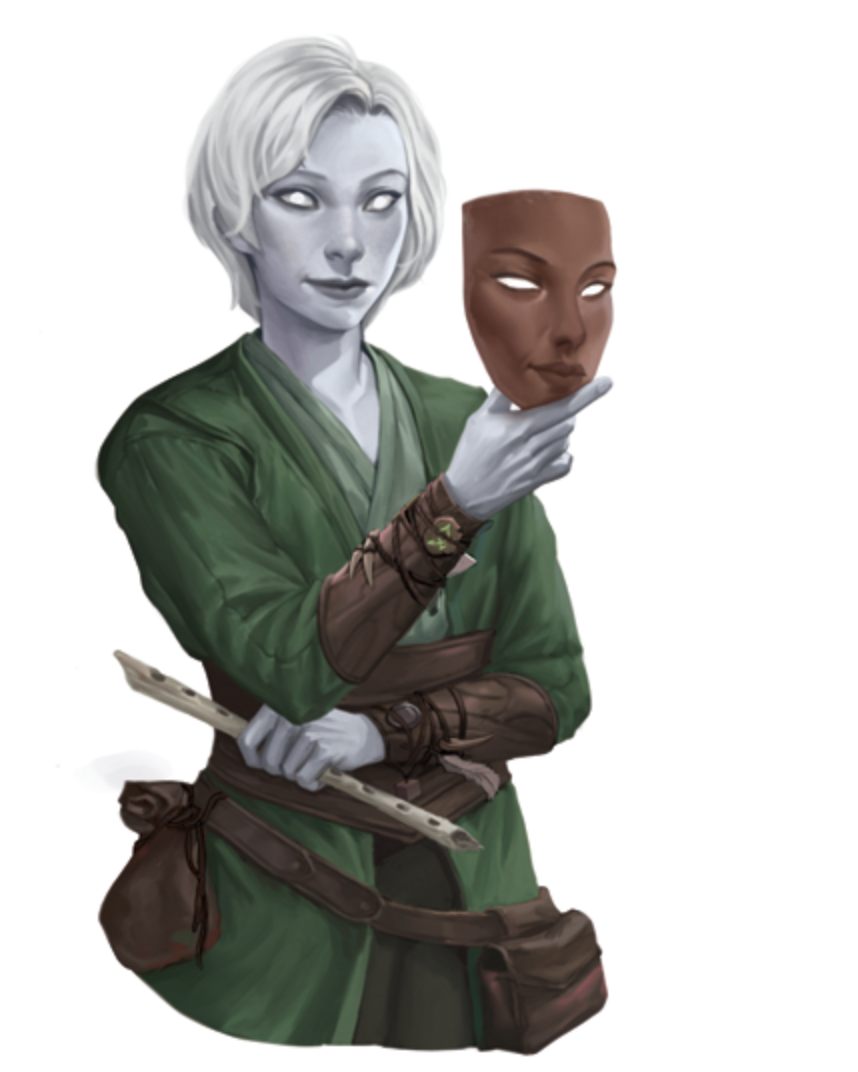
Long ago there was a woman named Jes, and she had one hundred children. Her rivals conspired against her and swore to kill her children. Jes begged the Sovereigns for help, but their only answer was the wind and rain. In the depths of her despair, a lonely traveler took her hand. “I will protect your children if they follow my path. Let them wander the world. They may be shunned and feared, but they will never be destroyed.” Jes agreed, and the traveler gave her his cloak. When she draped it over her children, their old faces melted away and they could be whoever they wanted to be. And so it remains. Though the children are shunned by all, the gift of the Traveler protects them still.
The story of the Children of Jes is known across Khorvaire, even in communities that have never actually seen a Changeling. It’s known even in Riedra, despite the official doctrine teaching that Changelings are far along the Path of Inspiration. Korranberg scholars have concluded that Jes was an arcane lord of Ohr Kaluun who transformed her allies into Changelings in order to survive the Sundering of Sarlona. But no one knows exactly how she accomplished this feat. Recently, Tavis Tarlian d’Sivis gave a lecture in which he proposed that the story of the Children of Jes is the magic Jes used—that through a feat of epic magic Jes embedded this story into the collective unconscious, and that it is the story that sustains and empowers the Changelings. This theory explains why Changelings are Fey creatures—inherently magical, vulnerable to Magic Circle and other effects that target Fey—despite being both mortal and native to Eberron. Changelings aren’t spirits of Thelanis, but they are sustained by the magic of their story, and this makes them Fey for purposes of spells.
This theory also explains another curious aspect of Changelings. The Changeling ability to shift shape is well known. But there’s a secondary aspect of this gift that goes beyond the physical transformation. While a Changeling is using their shape-shifting power, their natural charisma is dramatically enhanced. This helps a Changeling trying to deceive others while maintaining a disguise, but it also improves a Changeling’s talent for diplomacy or performance… and most notably, it doesn’t matter what form the Changeling takes. It’s easy to see how a Changeling could intimidate a foe more easily if they assume a terrifying form. But the simple fact is that a Changeling’s charisma is enhanced while they are using their shapeshifting, regardless of what form they take; a Changeling receives this edge even if the only thing they change is their own eye color or hair length. Tavis Tarlian’s theory is that when a Changeling engages their gift of Shape-Shifting, they draw upon the power of the Tale of Jes—a cloak of pure Fey energy that enhances their ability to manipulate the people around them. The fact that divination spells don’t register it as a magical effect is explained by the fact that it’s not manipulating the forces used in arcane science; it’s empowered by the story. An interesting side effect of this is that most changelings always have their Shape-Shifting engaged, so as to gain the benefits of this glamour. Even those who chose to appear in their natural form—which many that live in Changeling communities choose to do, rather than hide their true nature—will change minor details about their appearance, just as a human might use mundane cosmetics. Because of this, Changelings encountered in their true natural forms, with no glamour whatsoever, often seem especially drab and colorless.
In this article I go into detail about the customs that people have developed to identify supernatural imposters. The people of the Five Nations often wear distinctive accessories and use familiar phrases or in-jokes with friends—things that will draw attention to an imposter who doesn’t have the proper hat or respond in the right way to a running gag. These customs are a casual safety net; if I showed up somewhere without my distinctive hat, people who know me won’t immediately assume that I’m a Changeling, but they might watch me more closely, consciously or subconsciously waiting to see if there’s anything else about me that doesn’t add up. Typically, these sorts of fears are what a skilled imposter can soothe with a Deception check—cursing about how they lost their hat, or saying how exhausted they are—with the result of the Deception check determining whether these explanations are convincing enough to overcome any initial suspicion. However, there is a simple, reliable tool that can be employed if suspicions go too far: the Detect Evil and Good spell reveals the presence of Fiends and Fey. Most Vassal priests begin their services with a ritual of welcoming—which includes casting Detect Evil and Good, reassuring parishioners that they are safe among friends. Churches dedicated to the Silver Flame are often shielded by the Hallow spell, but this is usually only set to defend against Aberrations, Undead and Fiends, as malevolent Fey aren’t a widespread problem in most of the Five Nations. On the other hand, Ghallanda enclaves typically are Hallowed against Fiends, Fey, Undead, and Aberrations—as malign Fey are a significant threat in the Talenta Plains. The Wandering Inn generally has a Cloaker (see below) on hand who can make exceptions for benevolent Fey, be that Changelings or Blink Dogs, and it’s possible a Ghallanda enclave will have such a specialist as well. Most people know that Changelings aren’t inherently evil, and when a Changeling is part of a Vassal community the priest expects them to show up on the initial detection ritual; but these situations can prove challenging for a Changeling working undercover.
CHANGELINGS BEYOND THE CHILDREN
The Children of Jes are a true-breeding species who pass their changeling nature on to their offspring. The vast majority of Changelings in Khorvaire and Sarlona are descended from Jes, even if they haven’t maintained any sort of cultural connections to the Children and their traditions. However, there are a few other forms of Changeling in Eberron. In the same way that the energies of Mabar can produce a Tiefling, the influence of Thelanis can transform an unborn child into a Changeling. In the past, this has led to tales of faeries abducting children and leaving Changelings in their place—but the truth is that the child was just born as a Changeling. Planetouched Changelings rarely pass their Changeling traits to their children, though it can happen. Within Khorvaire, the Talenta Plains are the only nation with a significant population of planetouched Changelings. Rarer still are Masquers: minor spirits of Thelanis who’ve become dislodged from their stories and drifted into the mortal world. Some Masquers are thrilled to be mortal and embrace an entirely mundane life, while others yearn to become the heroes of their own stories—to matter in a way they never did in Thelanis. A Masquer’s ability to Shape-Shift reflects their tenuous tie to reality, and it’s possible that a Masquer who creates a truly remarkable story might eventually shift species and fully embody the character they’ve created.
WHAT IS THIS?
Forge of the Artificer updates the Eberron species first introduced to fifth edition in Rising From The Last War. This update makes a number of mechanical changes to Changelings. They now have the Fey creature type rather than being Humanoids. They can shift between Small and Medium forms. And, most notably, Shape-Shifter says “While shape-shifted with this trait, you have Advantage on Charisma checks.” The change in creature type is significant, since it means Changelings can be detected in ways that previously wouldn’t reveal them. And getting Advantage on Charisma checks while shape-shifted has that odd aspect: Why would changing your eye color or some other minor cosmetic change give you advantage on Performance checks? I wanted to explore the impact of these changes and to reconcile them with previous lore. As I said in Chronicles of Eberron, I don’t have an issue with shifting Changelings to having the Fey creature type; I like the idea that they are shaped by story and that this causes magic to treat them like Fey. To me, this is also the key to explaining “advantage while shapeshifted”—that there is a magic tied to shapeshifting beyond the physical change. But the key point here is that most Changelings have no tie to Thelanis. They are mortal creatures and native to the Material Plane. They have no ties to Archfey (… Unless Jes herself has become a native Archfey!) and immortal Fey spirits don’t consider the Children to be kin. They are affected by Detect Evil and Good, Hallow, Magic Circle, and other effects that target Fey. However, again, they are mortal creatures tied to the material plane. If targeted by Dismissal or similar effects that normally return a Fey creature to “it’s home plane,” it’s up to the DM to decide whether the Changeling returns to the spot they were banished from, or if they are instead transported to a location that is somehow vital to their own personal story. Of course, it’s always up to the DM and players to decide which rules they wish to use. If you want to have Humanoid Changelings, a simple approach is to say that the Children of Jes are still Humanoids, and it’s only the planetouched Changelings and Masquers that have the Fey creature type.
TOOLS OF DECEPTION
Changelings who wish to conceal their Fey nature have many options. Here’s two to consider.
The Cloaker is a mystical specialization originally developed by the Children of Jes, found among the Tyrants of Sharn, the Cabinet of Faces, and similar organizations. Some Cloakers are Adepts drawing on the blessings of the Traveler; others are Magewrights who use arcane techniques. Any Cloaker can cast Minor Illusion at will. Depending on their skill, a Cloaker can cast two or three of the following spells as rituals: Invisibility, Nondetection, Nystul’s Magic Aura, and Pass Without Trace. All of these can be useful for smugglers or anyone making a living through deception; Nystul’s Magic Aura is the one that allows a Changeling to enter a Hallowed space as if they weren’t Fey.
The Changeling Cameo is a magic item that conceals a Changeling’s true nature as long as they maintain a particular form. Creating a Changeling Cameo involves developing a persona and then imbuing that identity into the Cameo. While Cameos are considered to be uncommon items in terms of power, it takes years to imbue a persona into a Cameo and they are rarely sold. Cameos are often heirlooms passed down within families, or personas created by Changeling organizations like the Tyrants and the Cabinet of Faces; an adventurer with ties to such an organization might be provided with a Cameo suited to a particular mission. A DM could allow a Changeling adventurer to begin with a single Cameo, allowing them to conceal their nature while using this favored form. If so, DM and player should work together to develop the persona and its history within the character’s family. Was the Cameo given to the adventurer by a beloved relative? Did the character steal it instead of waiting to inherit it? How has the persona been used in the past?The Changeling Cameo is intentionally limited. It’s not supposed to be a perfect solution, and a changeling can’t just create a Cameo every time they come up with a new personality; it offers a path past obstacles but with the restriction of working with the existing persona. As a DM I might consider allowing a player character to create a Cameo during the course of a campaign without spending years on it; player characters are remarkable. But I’d still require them to spend at least a few adventures developing the persona and playing that role without the benefits of the Cameo—really developing the persona and making it feel like a real individual—before I’d let them complete the Persona. If they need something faster, they can invest in a Ring of Mind Shielding or get a Cloaker to cast Nystul’s Magic Aura. A Cameo should have a story; someone put a lot of time and effort into bringing that persona to life.
Changeling Cameo
Wondrous Item, Uncommon
A Changeling Cameo is an item of jewelry (typically a brooch or a ring) that bears the image of an individual, and which is imbued with their persona. This is an imprint that includes the individual’s name, appearance, species, creature type, alignment, and a broad sense of their personality and mannerisms. When a Changeling is wearing a Cameo, they can sense the details of the persona within it and can use their Shape-Shifting to become that individual. While the Changeling maintains that form, they register as that individual to all forms of magic. However, this effect only lasts as long as the bearer plays the role. If the bearer takes an action that is deeply at odds with the personality of the Cameo—for example, they’re in the form of a bully but they show great compassion—then the connection to the Cameo is cut off and can’t be reestablished for 24 hours.
SIDEBAR: ADEPTS AND PRIESTS
In Eberron, player characters are remarkable. Relatively few NPCs have the full capabilities of a player character class; those that do are themselves remarkable. One aspect of this is that most priests aren’t clerics or paladins. They don’t need those powers to provide spiritual guidance to their community—and those that do possess the powers of a Cleric are likely to be called to greater things. However, just because they aren’t clerics doesn’t mean that priests can’t cast spells. Divine Magic is part of the Wide Magic of life in the Five Nations. Adepts are the divine equivalent of Magewrights; most are capable of casting a small number of cantrips, and some can cast Divine spells as rituals. The powers of an Adept are drawn from faith, and Thrane is the only one of the Five Nations where they are especially widespread. But devout priests are often Adepts, and deeply religious communities—such as Seeker communities in Karrnath—may include a number of adepts. Here’s a few examples of Adept specialties…
- Oracle: Guidance. Ritual Only: Augury (up to a week away), Divination (1 hour casting)
- Preacher: Guidance, Thaumaturgy. Ritual Only: Ceremony, Detect Evil and Good
- Warden: Sacred Flame, Word of Radiance. Ritual Only: Detect Evil and Good, Protection from Evil and Good (1 hour duration)
These are just a few possibilities. The Warden is a good example of a spellcasting Templar or a basic Exorcist. The Preacher is a typical community priest, who will start a service with Detect Evil. Like Magewrights, most Adepts can only cast spells as rituals, but those rituals may be superior to the standard form of the spell—in particular, an Oracle can use Augury to get a sense of events that could still be a week in the future… and while a Warden can only cast Protection from Evil and Good as a ritual, they can maintain concentration on it for an hour.
Thanks to my Patreon supporters, who make articles like this possible! I do two live Q&A sessions every month for patrons, and the next one is this weekend.
Thanks, Keith. Changeling cameos seem invaluable for inherited personas.
An additional explanation for the Charisma Check Advantage is that their mutable physiology makes them especially adept at utilizing the subconscious body language inherent to social interactions. They aren’t magically reading/controlling minds, but their ability to respond with a superhuman library of nonverbal cues would give them an advantage when communicating.
Side note: Forge of the Artificer took out the “until you die” line about staying in the shape-shifted form. I wonder whether that’s an oversight or if it’s a deliberate buff to Shape-Shifting because it prevents your true identity from being revealed during a mid-combat death. Thoughts?
Forge of the Artificer took out the “until you die” line about staying in the shape-shifted form. I wonder whether that’s an oversight or if it’s a deliberate buff to Shape-Shifting because it prevents your true identity from being revealed during a mid-combat death. Thoughts?
At first I thought the same thing. But if you look at the Rules Glossary of the 2024 Player’s Handbook, the general definition of Shape-Shifting specifies that creatures revert to their natural form upon death. So this clause wasn’t removed from the Changeling description as a buff; it was removed because that’s the default rule of Shape-Shifting and so it doesn’t need to be mentioned in the Changeling description. Here’s the relevant text from the Glossary (emphasis added).
Shape-Shifting
If an effect, such as Wild Shape or the Polymorph spell, lets you shape-shift, its description specifies what happens to you. Unless that description says otherwise, any ongoing effects on you—conditions, spells, curses, and the like—carry over from one form to the other. You revert to your true form if you die.
I had a changeling who hated her powers and kept a permanent identity as a major silver flame believer since she was a child. She’s her own (messed-up) person, so the cameo doesn’t fit. What should I do to continue this character? Just say she’s immune to hallow by casters she agrees with?
I actually updated the article to remove the idea that Silver Flame churches are Hallowed against fey. Overall, malevolent fey aren’t that widespread a threat, so I think it’s OK to drop them from the list; Undead, Aberrations, and Fiends are all greater concerns to the CotSF.
I ended up just homebrewing an alternate version of them that kept them as Humanoids without the Charisma advantage benefit, and instead gave them a feature I called Protean Dodge; a once-per-long rest ability to reroll a failed Dex save by pushing your shapechanging to its limits, at the expense of your cover; it will be obvious to any onlookers when you use the ability that this is not your true form if you are disguised.
Haven’t tested it out yet, but my changeling player seems to think it’s a cool tradeoff; will you prioritize your own safety, or commit to your assumed role even if it means taking that Fireball to the face?
That’s a fun approach! I think 4E gave Changelings the ability to get advantage on an attack by shapeshifting to an unsettling form — as with your Protean Dodge, giving the question of whether you’re willing to reveal your true nature for an immediate advantage.
I know one of the playtest versions of changelings for 5e had a similar ability! I considered just using that, but I like the idea of it being a defensive ability that potentially sacrifices a different sort of protection.
The concept of Changeling Cameos and the idea that they’re valuable heirlooms is really interesting.
Do you think that concept could work as a way to bring something like a re-flavored Crown of Lies into Eberron, but with the emphasis of the item shifted from perfect lying to perfect shapeshifting? A rare/legendary item, maybe connected to the Traveler, that lifts away various limitations on a changeling’s ability to shapeshift, and lets them fully shift into a much wider array of forms. Thoughts?
As a Legendary item, why not? I’ve already suggested something similar with the idea of Changeling Menageries—Changelings who use the mechanics of Druids, but with the idea that Wild Shape is an extension of their Changeling Shape-Shifting.
How would you approach the lore for / surrounding such an legendary item?
Also, would other non-changeling races know of Changeling Cameos and what they can achieve in regards to fooling magic or detection? Or would they be a closely guarded secret?
If they do know, how would they view the cameos? On one hand, the cameos would be capable of fooling detection magic, but it only works as long as the Changeling actually embodies that persona, so it’s not like a good aligned cameo could be used to do evil… Unless it’s kept around purely as cover, i guess.
How would you approach the lore for / surrounding such an legendary item?
I’m afraid I don’t have time to build something out here, but this is the sort of question I answer on my Patreon.
Also, would other non-changeling races know of Changeling Cameos and what they can achieve in regards to fooling magic or detection? Or would they be a closely guarded secret?
I don’t see any reason for Cameos to be common knowledge. I don’t think they’d be a DEEP DARK SECRET that Changelings are trying to hide from the rest of the world, but I also see no reason that Changelings would discuss them with outsiders. So I’d say, for example, that intelligence agencies like House Phiarlan and the Citadel would know about them from practical experience, but the average person on the street wouldn’t know about them. They’re an extension of Personas, which are part of the culture of the Children of Jes, but again, I don’t think the average citizen of the Five Nations knows anything about Changeling customs.
Great article. I was wondering, are there any changeling nobles/noble families? Or has the prejudice and distrust of changelings resulting in them being lacking or even absent in the nobility of the Five Nations? And are there any canon/kanon ones?
Also, beyond the communities in the Lhazaar Principalities and Droaam, are there any places where changelings are particularly common (or likely to be open about their species)? I imagine they might have been more commonplace in Cyre, and maybe even Aundair, Zilargo and Breland.
Are there any places where changelings are particularly common (or likely to be open about their species)? I imagine they might have been more commonplace in Cyre, and maybe even Aundair, Zilargo and Breland.
Breland and Aundair have the largest populations of changelings, and most major cities in both nations have changeling communities that are open about their species. In Sharn, changelings are noted as having a significant presence in Lower Dura and Lower Tavick’s Landing.
Recent DnD player and even more recent to Eberron. Great setting. I really became interested in Changelings for the obvious reasons and I’ve been reading up everything that I can about them. Would love to learn more about their origins in Sarlona when possible. I had noticed reading some of the material that the Inspired use them as spies and what not but there’s always some kind of vague reference about some kind of innate psionic/psychic aspect to their mind. I read the article where you stated Dopplegangers were supposed to be some “higher trained form of Changeling” rather than just a monster. Was there a plan to give Changelings some sort of persistent mind reading capability that never translated well into the mechanics but sort of played out in the story to some degree? I envisioned following this pattern, the concept of an ultimate Changeling. One that could replicate not just the cosmetic aspects but functional ones as well. Even changing your organs to more youthful versions attaining immortality. Certainly broken as a player character but as a high end NPC boss being able to become a fully fledged sorcerer one turn, and then a barbarian the next and a druid after etc would be an ultimate challenge. They’d be a sort of fey nexus of all potential possibilities.
Also I always wondered if Changelings had a way to confirm they are who they claim to be among their own kind. Changelings can impersonate anyone they see…I assume this means John the Changeling could impersonate Mike the Changeling in order to trick Luke the Changeling. So how could Luke know he’s talking to Mike? I thought maybe some kind of password or signal, but those could likewise be replicated and stolen if observed. The idea of a “hand shake beneath the veil” began to form. Two Changelings shake hands and through a mixture of movement and even texture based Skin Cant develop a unique handshake specific to those two people. It’s like when two people dance and there’s just a natural flow of action and reaction. Nobody could really replicate it even if they observed it, nor could you really describe it in words. It would be a unique pattern between each interaction. Had you considered anything similar like this?
Doppelgangers have always been part of D&D. One of the aspects of Doppelgangers is the ability to detect thoughts. Typically this is just called out as something that helps them deceive others, but to me it’s a crucial aspect of the their culture. Because as a doppelganger, your shape is constantly changing… but your THOUGHTS remain constant. So as I see it, doppelgangers don’t recognize each other visually; they recognize each other mentally.
When I created Eberron, my original plan was to present doppelgangers as a playable species. But at the end of the day, the abilities doppeglangers possessed were too powerful for a 1st level character. Thus, we introduced changelings, who have SOME of the abilities of doppelgangers. They don’t have full Detect Thoughts, but they (originally) had a bonus to Sense Motive (what’s now Insight) and Bluff (which is now Deception) based on the idea that they have LATENT telepathy, which could potentially be developed to doppelganger levels.
So the short form is that I don’t think Changelings rely on visual appearance to recognize one another; they rely more on INSIGHT, recognizing the mannerisms, body language, and the like. Because it is absolutely possible for John the Changeling to disguise themself as Mike the Changeling. We’ve given multiple canon examples of important changelings who are actually identities shared by a group of changelings. So in the example, Mike the Changeling is actually an imaginary person created by Luke and John and either one of them may use Mike when dealing with other changelings. There’s no absolute innate way for a changeling to see through this disguise — but Insight would be the key, because Insight tracks the elements of identity that go beyond the visual cues.
While there’s no universal secret handshake used by all changelings, the Children of Jes have a language called Skin Cant that allows them to share messages with other changelings through patterns of scars and tattoos. But again, that’s a specific cultural thing, and a planetouched changeling from the Talenta Plains wouldn’t know Skin Cant.
I particularly love the idea of connecting Changelings to Stories – in particular, I like to imagine a child being raised on stories of a persona, all told in third person, hearing about their parent’s best friend and the things they’ve done, and they become like an uncle or aunt to them. And when they get ready to go out into the world, their parent gives them the cameo of that persona, and it’s like getting to bring your uncle/aunt with you. No matter where you go, a bit of your family is with you, because you can hold them in your hand and become them.
This is absolutely how I see it!
Great stuff connecting to the rules updates, thanks Keith!
Would a cameo fool Truesight? It’s not “a form of magic” per se (and True Seeing just gives the target Truesight).