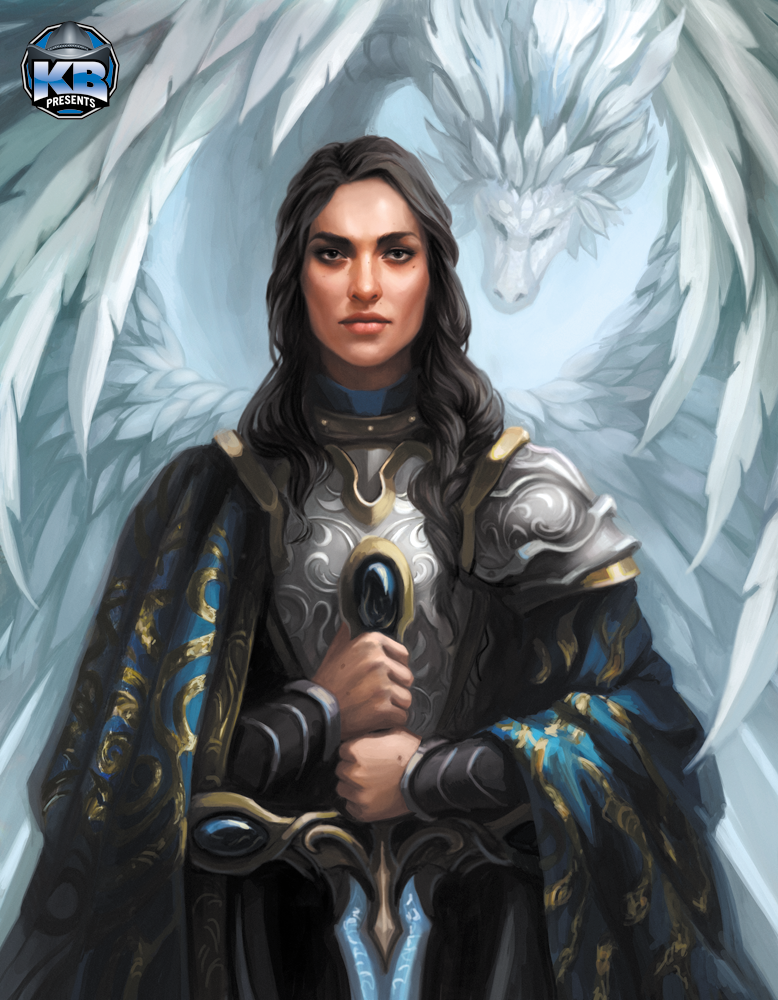
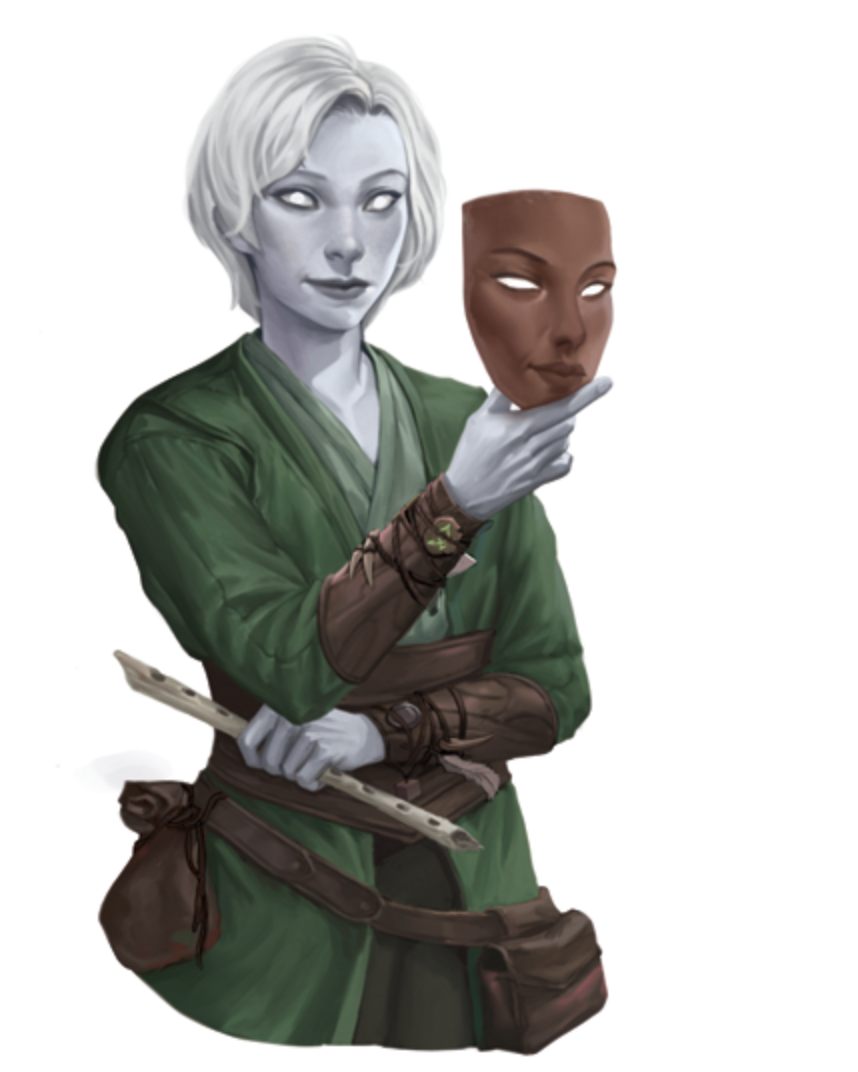
Image by Julio Azevedo, used with permission of Visionary Productions
Every month, my Patreon supporters post questions that I answer in my live Q&A sessions. However, sometimes a question demands a longer answer. This month, someone asked…
Who is the most dominant vampire in Sharn, and what can you tell us about them?
Something to keep in mind is that Eberron is a world where people KNOW vampires exist. Champions of Dol Arrah, templars of the Silver Flame, and the Aereni Deathguard—not to mention, say, the bold adventurers of Clifftop—all actively hunt vampires. Given this, I think that there’s been a few powerful vampires over the centuries that have spread their influence through Sharn only to be uprooted and destroyed; the city isn’t teeming with vampires. Canonically, the Sharn: City of Towers sourcebook mentions two vampires currently in residence in Sharn. One is an undercover operative of the Emerald Claw who keeps a low profile, supporting visiting EC forces rather than leading operations herself. The other is Calderus. Sharn: City of Towers tells us this.
Far beneath the towers of Sharn, in the lost regions of the Depths, lies the ancient psionic vampire Calderus. From within her hidden crypt, Calderus wields significant power in the City of Towers. Though she rarely leaves her sanctuary, she rules the Servants, a network of enslaved vampires and dominated pawns of various races. This network of spies and agents operates as her eyes, ears, and hands in the city, advancing her plots and gathering intelligence that adds to the vampire lord’s significant storehouse of information.
That’s ALL that the sourcebook says. We don’t know how old Calderus is, how powerful she is, what “psionic” means here or how she came to be a psionic vampire, how long the Servants have been active, or even what ancestry Calderus is. She’s an idea, but a vague one. Given that, there’s lots of different things you could do with Calderus. Here’s a few possibilities.
Heir of Dhakaan
Calderus is a hobgoblin vampire. She was sired by the Dirge Singer Iraala and tasked to help with the internal security of the Empire. She watched over the great city of Ja’Shaarat, and during the Xoriat Incursion she personally faced the daelkyr Dyrrn the Corruptor. Calderus survived the battle but was left comatose, and was interred in a fortified crypt. What no one knew was that Dyrrn had cast Calderus’s mind into Xoriat. For thousands of years she fought her way through the horrors Dyrrn had set in her path. Her spirit finally forced its way through the horrors and returned to her body a few centuries ago, only to find that the city had risen and fallen many times while she slept. Calderus’ travails left deep scars on their mind, but the experience unlocked vast telepathic power. As a vampire, Calderus has no connection to the Uul Dhakaan and it was obvious to her that the Empire has fallen. So she’s built her own new network of power, watching the Chaat’oor and contemplating what to do with her. In the last few decades she’s encountered the Shaarat’khesh and learned of the Heirs of Dhakaan. But again, Calderus’s time in Xoriat twisted her. She is paranoid and distrusts the Kech Dhakaan. The laws of Dhakaan maintained that no vampire could be Marhu, and it was in service to Dhakaan that she suffered incalculable torments at the hands of Dyrrn. Besides which, Dyrrn defeated her; if any Dhakaan survived, they might be in league with the Daelkyr, or even unwitting tools of them. The upshot of this is that Calderus has no desire to aid the Kech Dhakaan or to restore the empire. Calderus serves only Calderus. She may in fact act against the Shaarat’khesh, exposing their plans. At the same time, she hates Dyrrn and the daeelkyr; she could point adventurers toward Cults of the Dragon Below. But Calderus serves only herself and her own interests. She has no peers, and all other creatures are cattle to her. Perhaps the Kech Nasaar could regain her trust, if it served the story… or perhaps she would seek to slay her sire and seize control of the Nasaar.
The First Mind Seed
When the Dreaming Dark first engaged with the material plane, it recognized the potential in Sarlona—seeing the dominos it could trigger to set off the Sundering. But it took generations to set the Sundering in motion, and in that time agents of the Dark explored other options. Calderus was an influential priest in the first iteration of Sharn, and the first human of Khorvaire to be infected with a mind seed by the quori Tirashana. When the Sundering went into effect, Calderus was forgotten. Left on her own, she developed her own ambitions. But she knew that she would never be free as long as Tirashana could reach her in her dreams. And so she arranged to become a vampire—murdering her elf sire soon after her transformation. Her victory was short-lived; she was caught in the collapse of Sharn during the War of the Mark and buried in the depths. But she survived, and when the city rose again, Calderus was part of it. If you embrace this vision of Calderus, the idea is that the Servants are a powerful force within Sharn and that Calderus has been active throughout its history—but her only interest is maintaining that influence. Sharn is her kingdom, even if no one realizes the power she wields. She has pulled strings, bringing families together, causing and ending feuds, all without anyone knowing. The Boromar Clan prospered because Calderus wished it; now Calderus is deciding whether to intervene in its conflict with Daask, or whether she’s tired of the halflings. But she has a new concern: The Dreaming Dark is now active in Khorvaire, and Tirashana herself has interests in Sharn. To some degree, Calderus IS Tirashana. She knows how the quori thinks and can anticipate her actions, and this has allowed the vampire to evade her notice. But Calderus is terrified of drawing the attention of il-Lashtavar. She won’t fight the Dreaming Dark directly; but she could provide subtle assistance to a group that’s dealing with Tirashana and her agents.
These are both fine ideas. Both provide an explanation for why they’re psionic vampires, and how they could have been around for a long time without attracting too much attention. You could certainly use one of these options in your campaign. But neither of these are the option *I’d* use for Calderus. Let’s look behind door number three.
Lady Calderus
Sharn: City of Towers says that Calderus has a hidden crypt in a lost region of the Depths—the forgotten ruins of past incarnations of Sharn. She was buried there, it’s true, but not in a crypt. A few years ago, a group of adventurers sponsored by Morgrave University explored a new path leading to ruins of Breggor’s Sharn, the city that collapsed in the War of the Mark. One of the explorers had an aberrant dragonmark, and an accident involving shifting rubble shed some of his blood… and few drops were sufficient to wake Calderus.
Calderus was there when the city was destroyed. In life, she bore a dragonmark with a strong connection to Mabar. In the final moments of her life, Calderus drew on the full power and potential of her dragonmark, something she’d always been afraid to do. She fueled that act with her own life force, and even as she died she unwittingly bound her soul to the Eternal Night—siring herself as a new form of vampire. Although she survived, she was completely drained and slumbered amidst the rubble… until those drops of aberrant blood woke her. She woke hungry, consuming the man who’d unwittingly restored her. She turned the other adventurers into her thralls, the first of her servants. She had them address her by her name, Calderus, for she was certain no one would recognize it. In her first life, she had abandoned the name early on, and taken another; allies and enemies alike knew her as the Lady of the Plague.
As a vampire, Calderus essentially possesses an Apex Aberrant Mark. In the same way that Erandis Vol’s Mark of Death connects her to Dolurrh, Calderus’s mark of plague and vermin lets her draw on the power of Mabar. But as Erandis discovered, dragonmarks don’t work for the undead. Calderus died when she unleashed her death curse upon Sharn. A few powers of her mark remain. She still retains the ability to summon and control vermin, and this has expanded to allow her to control her humanoid victims in the same way she controls rats. This is what’s interpreted as her “psionic” power: Calderus can see through the eyes of her victims and even dominate them completely if she chooses. But she has lost her power over plagues, the power that could level cities. And she faces a challenge: the only blood that fully sustains her is the blood of people who bear aberrant dragonmarks.
This version of Calderus only awoke a few years ago, and she is still gathering her servants. She is still new to the modern age, and has much to learn… and she is still sorting out her own goals. The first thing she did was to have her servants comb the rubble-choked area of her “tomb”. One thing was missing: the body of her beloved Halas Tarkanan. It’s possible they were separated in the collapse, but Calderus is convinced her lover somehow survived the destruction of Sharn and is desperate to find more as to what became of him. She despises the Dragonmarked Houses and yearns for vengeance against them, but she wants to be VERY careful not to reveal her existence to them. And she’s torn in that she has sympathy for those who carry aberrant dragonmarks, but she has to consume them to survive. She’s watching House Tarkanan, and may be helping it in subtle ways… but she’s also picking off its weaker members one by one to feed her endless appetite. The halfling girl Zae has an aberrant dragonmark that lets her communicate with rats, an echo of Calderus’s own power. It’s possible that Zae has become the Renfield to Calderus’s Dracula, that Zae serves as the mortal eyes and ears of the vampire within House Tarkanan. Alternately, Zae could in fact be connected to the SAME mark as Calderus—and under the right circumstances, she could steal the power completely and become the new Lady of the Plague. If this is possible, it could mean that someone else in the world has the earthshaking power of Halas Tarkanan. Regardless of this, Lady Calderus is spreading her network of servants, seeking to gain information and influence, and particularly trying to find information about the fate of Halas Tarkanan and to find ways to take vengeance on the Twelve… while also struggling with her own hunger for aberrant blood. Unlike Erandis Vol, Calderus doesn’t particularly want to restore her dragonmark; spreading plagues was more of a nightmare than a gift.
If I had more time, I’d create a full, unique stat block for Calderus. But I don’t have that time for that right now. So as a placeholder I’d say that Calderus has the power of a Vampire Umbral Lord with a few modifications, reflecting the fact that she is the founder of her own strain of Vampirism…
Calderus and her spawn aren’t harmed by running water, but they’re vulnerable to fire.
Calderus and her spawn can’t assume mist form or perform a Shadow Escape, but they can take the form of a swarm of rats or insects. Such a swarm can break up and flee in multiple directions, and as long as a single component of the swarm returns to the vampire’s tomb, the vampire can reform. In the case of Calderus herself, if she’s fully slain she might still return as a disease and be reborn in the body of the first person to die from this disease.
Calderus and her spawn exert influence over rats, insects, and other forms of vermin. If you’re using Sharn: City of Towers, Calderus could command Rancid Beetle Swarms and Roach Thralls.
Calderus is psychically connected to all of her spawn and to anyone affected by her Sanguine Drain. She can communicate with any of these victims telepathically, and can cast Detect Thoughts or Beast Sense on them at will at any range. She can fully possess and control any of her spawn, though this doesn’t change the stat block of the victim in any way. This provides an opportunity for adventurers to interact with Calderus at a relatively low level; they can encounter servants working for one of her spawn, who serves as a host for Calderus despite being much weaker.
Overall, the point of this Calderus is that she has no ties to any of the major power groups in Eberron and is still quite unfamiliar with the modern age. She is actively spreading her network of servants, and adventurers can conflict with her as she does this. But at the end of the day, Calderus isn’t trying to take over the world. She hates and fears the Dragonmarked Houses, and wants a strong enough power base to protect herself against them; this is the primary purpose of the Servants. Calderus wants to know what became of Halas Tarkanan. She wants to assist House Tarkanan but isn’t willing to risk revealing herself to them—all the more so because she needs to consume aberrants to survive. She doesn’t yet KNOW what her end game is—though she would love to see the Twelve burn.
So: who’s the most powerful vampire in Sharn? It’s one of these three… but only the DM knows which one! Thanks as always to my Patreonsupporters for asking interesting questions and making these articles possible.
Musical paragon Bela “The Banshee” d’Phiarlan, depicted by Matthew Johnson!
When the elves of old settled the land they’d named Aeren’s Rest, they were scarred by all that they had lost. Setting aside those slain by the giants and those left behind, many elves died over the course of the journey—including Aeren, the visionary who guided them to their new home. The refugees wanted to make sure they never suffered such losses again, but disagreed on how to pursue this goal. Eventually, three major factions emerged. The Tairnadal sought to become avatars, living anchors for the spirits of their lost champions. The Vol believed that traditional necromancy was the answer, and they settled near the most powerful Mabaran manifest zone on the island. The Mendyrian thought the energies of Irian could be harnessed to preserve someone beyond death without subjecting them to the hunger of Mabar. In time, this would produce the Undying Court. Each of these factions rallied others to their side.
So where were my ancestors? They were everywhere. Before the fall of Xen’drik, my kin served as a bridge between the scattered and disparate elves, carrying news between different communities and cultures. We continued that work on Aeren’s Rest. We were equally at home in Shae Deseir and Shae Cairdal, and we sang songs of the patron ancestors to the warriors assembled in Var-Shalas. We sought to remind them of their common history and the bonds that united them. In this, we failed. When the line of Vol was destroyed, we chose to leave Aeren’s Rest behind. Still, people ask: Vampires, Deathless, Revenant Blades; how do the Phiarlan preserve their heroes? My people had no need to pursue such methods, for our champions were already immortal: we preserved them in song and story, and kept them alive with paint and stone. We don’t need to keep our ancestors trapped in idols or bound to rotting flesh; they are with us still, guiding us with their words and songs.
When dealing with House Phiarlan, keep one thing in mind: out of all of the Dragonmarked Houses, Phiarlan is the most beloved by the general populace. It is the greatest source of entertainment, a ray of sunshine in a gloomy world. The finest authors, the most popular musicians, the celebrated actors—they’re all part of House Phiarlan. The Mark of Shadow lets its bearer weave wonders with their imagination, using illusions to create music and bring stories to life. In the eyes of the public, the elves of House Phiarlan are artists, imagineers, and entertainers, all working to make the world a little more magical.
Of course, there is another side to House Phiarlan. The spies and assassins of the Serpentine Table linger in the shadows. But the services of the Table aren’t available or obvious to the general public. As far as a commoner is concerned, Phiarlan’s only business is the Entertainers and Artisans Guild (also known as the Eagle, inspired by the EAG acronym). And the simple fact is that the majority of Phiarlan heirs solely work as artisans or entertainers. For most Phiarlans, their devotion to their craft isn’t just a cover; it’s their joy and their life’s work. It’s not that the typical Phiarlan diva is also a spy. It’s that a Serpentine spy can gain access to a location by serving as part of the diva’s entourage, or if necessary by impersonating the diva; Disguise Self is one of the simplest powers of the Mark of Shadow. There are a handful of Serpentine agents who are legitimately superstars as well as spies; but most of Phiarlan’s artists and entertainers are exactly what they claim to be. The catch is that the heirs of the House know about the Serpentine Table and are obligated to assist the Table if called upon—providing information, access to supplies or locations, or even assisting an agent who needs to temporarily impersonate them.
So when creating a Phiarlan character, the first question to consider is their relationship to the Serpentine Table. Are they an active agent of the Table? Are they a civilian whose skills or position make them a frequent asset for the Table? Are they an artist who has little relevance for the Table—or potentially, an objector who refuses to assist it? An heir who refuses to cooperate with the Serpentine Table is likely to be cut off from the Eagle—which might explain why they’re living the life of an adventurer—unless they’re so good that the guild is willing to put up with their insubordination. With that said, a tenuous connection with the Serpentine Table can be an excellent hook for a Phiarlan adventurer. They aren’t part of the Table, so they don’t have regular duties or access to resources that would be unbalancing for a player character. But at any time, a Table connection can step out of the shadows with enigmatic instructions. Deliver this package at midnight. Go to this party with your friends and see who the Count talks to. You’re going to be the entertainment at Saidan Boromar’s birthday party. They don’t have clearance to know why they’re doing the things they’re doing… but an heir of the House must always be ready to serve the Table when it calls.
As a Phiarlan heir, beauty is your birthright. You’ve been trained in the arts of motion and music since childhood, and whatever you do, you do it with grace. If you’re proficient with Performance or an artistic tool, your talents may be obvious; but you don’t have to have Performance to perform. Performance is a catch-all proficiency, covering acting, storytelling, music and dance. But other proficiencies can be used to reflect narrow disciplines: Acrobatics for dance and artistic gymnastics; Deception for acting; Persuasion for storytelling. Beyond this, consider how your class and its abilities reflect your artistic talents. Bard and Monk are clear enough. But as a Fighter you may be demonstrating an ancient martial art preserved since Xen’drik; every strike you make is beautiful. A Phiarlan Barbarian could flavor their “rage” as a war dance, reducing damage not through sheer endurance but by evading the full blow. As a Wizard, you might have planned on a career providing special effects for theatrical performances; what led you to learn battle magic? Whatever path you choose, think about how you bring beauty into the world and what you love about your art. At the same time, you’ve been trained to always observe—both to appreciate beauty but also to gather information, never letting a secret slip by you. You’re an artist, but you never know when you’ll be called upon to be a spy.
THE MARK OF SHADOW
Humans often equate the word shadow with darkness. For the Phiarlan, shadow refers to shadows of reality—the insubstantial images of illusion. The simplest power of the Mark of Shadow is the ability to cast Minor Illusion at will, weaving images or sounds. This basic gift is reflected in the heir’s bonuses to Dexterity (Stealth) and Charisma (Performance) check; an heir can instinctively draw on shadows when hiding or use subtle illusion to improve a performance. Beyond these intuitive bonuses, the power of illusion is something Phiarlan heirs use constantly and casually. An heir seeking to draw attention will conjure a star into their raised hand. One telling a joke might add laughter or a sting to the punchline. When giving directions, an heir can manifest a floating map; when telling a story, they can add sound effects, music, or distinctive voices. The second ability all Dragonmarked heirs possess is Invisibility. Every heir with the Mark of Shadow can become invisible for up to an hour each day. This is a powerful defensive tool; a Phiarlan who’s threatened can turn invisible and retreat. It’s a fantastic gift for a stagehand, who can move around on stage to add elements to a performance without being seen. Phiarlans also use Invisibility when they desire privacy. A Phiarlan at a boring party might use their skills to liven things up—or they might turn invisible and read a book in the corner. When someone disappears at a social occasion without bidding farewell, it’s known as a “Phiarlan Goodbye.”
Disguise Self is a Spell of the Mark almost all Shadow heirs gain access to. While this can be used for impersonation—it’s a workhorse spell for Serpentine agents—heirs use it in many ways. Phiarlan actors can use the spell to assume the shapes of the characters they play, reducing the need for costuming and allowing multiple actors to easily share a role. Other Phiarlans use Disguise Self not to deceive others, but rather to enhance their own appearance—transforming clothing, adding makeup, styling hair in impossible ways. A Phiarlan might be disheveled and still in their pajamas, but with Disguise Self they can greet guests perfectly coiffed and elegantly dressed. For Phiarlan musicians, this can allow dramatic costume changes in the middle of a performance. Phiarlan heirs learn a host of simple applications of Disguise Self that function much like social media filters—minor cosmetic enhancements for particular situations.
Beyond Disguise Self, there are two paths of Spells of the Mark. Player characters gain access to all of the spells, but most Phiarlan heirs can only use one of two sets of the spells. Those who are most extroverted generally have access to Silent Image, Darkness, Major Image, Hallucinatory Terrain, and Seeming. These gifts are incredibly useful for theatrical work; when enhanced by focus items, Hallucinatory Terrain and Seeming allow a stage master to weave a set and costumes from shadow. Conversely, introverted heirs usually develop the ability to cast Pass Without Trace, Clairvoyance, Greater Invisibility and Mislead. Such heirs may be drawn into the work of the Serpentine Table, but this path is also common for artists who prefer painting, sculpting, or writing to the company of others; the Mark gives them the power to avoid unwanted distractions.
At first glance, Clairvoyance is an outlier. Most Spells of the Mark allow the heir to project visions from their imagination into the world. Clairvoyance does the reverse; it allows them to draw images or sounds from the world into their minds. While Clairvoyance has obvious value to a spy, it’s a gift often manifested by Phiarlan artisans. Painters replicating scenes will often use Clairvoyance to refer to the inspiration from the comfort of their studios. Other artists often have a particular place that serves as a source of comfort or relaxation. A Phiarlan writer may “go to their quiet place” when dealing with writer’s block.
One thing to keep in mind when dealing with House Phiarlan is that its heirs wove shadows long before they possessed the Mark of Shadow. The ancient Phiarlans who traveled across Xen’drik were often accomplished Bards who relied on Invisibility to evade their enemies and who used illusions to enhance their tales. The Mark of Shadows granted innate abilities to Dragonmarked heirs, but the Phiarlans had been working with illusions for tens of thousands of years before it appeared. Phiarlan heirs who don’t manifest the Dragonmark can train at the Demesne of Shadow to learn traditional techniques for summoning illusions; because of this, there’s less of an inherent gap between marked and unmarked heirs than you see in some Houses.
Phiarlan Verbal and Somatic Components. Whether they are casting Spells of the Mark or bardic magic, heirs of House Phiarlan usually make spellcasting a performance. Verbal components require the caster to speak in at least a normal speaking voice, and somatic components require the caster to have a free hand. But these components don’t have to be limited to chanting or gestures. A Phiarlan heir can sing their spells, weaving words of power into their songs. Their gestures can be part of a full dance, or they can just be graceful motions performed with hypnotic rhythm. When the legendary Elorrenthi blinded the King of Fire with her dancing, this was the working of a spell woven into a perfect performance. With that said, a key aspect of components is that they are always clearly recognizable as being tied to spellcasting. A Phiarlan doesn’t hide the fact that they’re casting Enthrall with their song or weaving a Major Image as they dance; they just make the casting a beautiful thing.
Kanon vs Canon. The only change I’ve suggested to the canon Mark of Shadow is the addition of Seeming as a possible Spell of the Mark. Mislead is a fantastic spell for an adventurer or assassin, but Seeming is exceptionally useful for a company of actors. A player character with the Mark of Shadow must choose whether they have access to Seeming or Mislead; the feat only grants one of these spells. I do have another house rule tied to House Phiarlan. The House Phiarlan Heir background provided in Forge of the Artificer is a good background for an agent of the Serpentine Table, but it doesn’t provide proficiency with Performance or an instrument, which most Phiarlan heirs should possess. Because of this, I would allow someone who wants to play a typical Phiarlan heir to take the Entertainer background but replace the Musician feat with the Mark of Shadow.
FOCUS ITEMS
House Phiarlan has developed a host of tools that channel the powers of the Mark of Shadow. Some of these are designed to enhance an heir’s ability to entertain, while others are tools crafted for the Serpentine Table and its agents. Many of these duplicate the effects of existing magic items, though they require the user to possess the Mark of Shadow. The Cloak of Shadows is Phiarlan’s version of the Cloak of Elvenkind, while Tialaen Trumps are a form of Deck of Illusions. Two of the House’s most important magic items are both variations of the Crystal Ball. The Serpentine Mirror is a massive mirror—typically 3 to 4 feet across—which displays images on the surface of the mirror. The Serpentine Table has over a dozen of these Mirrors, including two with the Mind Reading feature. The Mirror of the Mind—a Serpentine Mirror with the Telepathy feature—is one of the greatest treasures of the house. It’s possible that the Mirror of the Mind was kept in a secret facility in Cyre, in which case it may have been lost in the Mourning; if this is the case, the House is surely desperate to recover it. While the Serpentine Mirrors are tools of espionage, House Phiarlan and House Cannith worked together to develop another variation of Crystal Ball: the Crystal Theater. A Crystal Theater is a small orb that can scry on a specific location or anchoring focus item; when attached to a Projector Stand, it can cast that image onto a larger surface. This allows audiences to watch theatrical events that are occurring on distant stages. This is a relatively new development, and a Crystal’s images are often a little jerky or fuzzy; crystal shows aren’t yet threatening the popularity of live performances, but offer an alternative for people who can’t afford to attend live shows. Crystal Theaters and Serpentine Mirrors can only be operated by an heir who has the ability to cast Clairvoyance using the Mark of Shadow.
Here’s a few other examples of Phiarlan focus items.
Instruments of the Bards: Elorrenthi Rod
Wondrous Item, Uncommon (Requires attunement by a Bard with the Mark of Shadow)
This item is a Thurimbar Rod designed to channel the power of the Mark of Shadow. A creature that attempts to play the Rod without being attuned to it must succeed on a DC 15 Wisdom saving throw or take 2d4 Psychic damage.
You can play the instrument to cast one of the following spells: Color Spray, Faerie Fire, Fly, Invisibility, Levitate, Mirror Image, Protection from Evil and Good. Once the instrument has been used to cast a spell, it can’t be used to cast that spell again until the next dawn. The spells use your spellcasting ability and spell save DC.
Scrystone
Wondrous Item, Rare (Requires attunement by a creature with the Mark of Shadow)
When a creature holding this crystal uses the Mark of Shadow to cast Clairvoyance, the spell is enhanced in the following ways.
The duration is increased to one hour (Concentration).
The maximum range of the sensor is increased to 10 miles.
The spell allows the caster to both see and hear through the sensor.
The caster may communicate telepathically with a willing creature perceived through the Scrystone, provided that they either know the creature personally or that the creature is carrying a Shadow Eye.
A Scrystone is a disk of glass inlaid with silver, with a small siberys dragonshard embedded in the center. Scrystones are sometimes concealed within false books or otherwise disguised so that the bearer can use the stone in a public space without drawing attention.
Shadow Eye
Nonmagical Item
Shadow Eyes are designed to assist Phiarlan scrying operations. A Shadow Eyeis a shadow of glass with a single hair embedded within it; Eyes are created in pairs, which are bound together by a sympathetic link. This isn’t an active magical effect and a Shadow Eye doesn’t register as magical to Detect Magic or similar effects. However, someone who possesses a Shadow Eye can use Clairvoyance or Scrying (including casting these spells through an item, such as a Serpentine Mirror) to target the Eye that’s linked to the one in their possession, provided it’s within range of the spell. Thus, if a Shadow Eye is planted in King Boranel’s bedroom, an heir with the linked Eye can spy on the king even if they aren’t personally familiar with the location.
Shadow Shaper
Ring, Uncommon
When a creature wearing this ring uses the Mark of Shadow to cast Minor Illusion, they may choose to increase the duration of the effect to 1 hour. However, when cast in this way, the cantrip requires Concentration.
Stagemaster’s Crown
Wondrous Item, Uncommon (requires attunement by a creature with the Mark of Shadow)
A Stagemaster’s Crown is a plain leather band embroidered with silver thread and holding a single small siberys shard; it’s worn as a headband. A creature wearing a Stagemaster’s Crown gains the following benefits.
When they cast Hallucinatory Terrain, they can use it on unnatural environments (such as walls and furniture). This can change the outward appearance of an object but it can’t make things invisible. So in a room with a chair and a Karrnathi banner, the chair could appear to be a throne and the banner could be changed to be a Brelish banner—but the spell can’t make the chair vanish.
When they cast Seeming, the duration is extended to 24 hours.
Thunderous Amulet
Wondrous Item, Common
While wearing this amulet, a creature that possesses the Mark of Shadow can amplify their voice to up to three times its normal volume.
The seal of House Phiarlan, depicted by Matthew Johnson.
THE HISTORY OF HOUSE PHIARLAN
The traditions of House Phiarlan are older than any human civilization. The elf rebellion against the giants wasn’t the work of a monolithic force. While many of the elves were enslaved by the giants, others had scattered across Xen’drik. Some were nomadic warbands, laying the path for the modern Tairnadal. Some established strongholds, such as the wizards and necromancers of the Qabalrin. In this time, “phiarlan” was a job, not a family. “Phiarlan” roughly translates to “spirit keeper”—not spirit as in ghost, but rather morale or hope. Phiarlans traveled across Xen’drik, evading the giants and serving as a bridge between the elf communities. Phiarlans carried news and trade goods, but beyond that, they carried stories and songs. They learned the artistic traditions of each subculture and shared them with other elves, seeking to strengthen bonds between the scattered communities. Phiarlans helped to set the uprising in motion, and over the long course of the war they played a vital role in coordinating actions, maintaining the morale of the rebels, and resolving disputes that could have fractured the elf alliance. The iconic phiarlan was a true Bard, wielding arcane magic; they used illusions to confound and evade enemies, and also in the artistic performances that inspired their allies. They facilitated communication using Sending as well as physically traveling between communities. In addition to working with the elves, the phiarlans used their gifts to spy on the giants—slipping invisibly through Sulat strongholds or blending in with Cul’sir laborers; and so they learned to spy as well as to entertain. In some cases they did both. The legendary Elorrenthi was so skilled in her craft that she earned the patronage of the titan Haskar, allowing her to move freely throughout the Group of Eleven.
When the visionary Aeren foresaw the cataclysm coming to Xen’drik, they called on the phiarlans to spread the word and rally as many elves as possible to construct a fleet and flee. Five phiarlans answered the call: Tialaen, Elorrenthi, Shol, Thuranni, and Paelion. Together with their families and followers, these champions guided elves from across Xen’drik to Aeren’s hidden harbor. For a moment, the elves moved as one; but once they reached Aerenal, they scattered into factions. Eventually, three major forces took root: the Tarnadal in the north, the Line of Vol in the south, and the alliance that produced the Undying Court in the center. The phiarlans chose not to claim territory or to build a city of their own. Instead, they continued the work they’d been doing for thousands of years: traveling between the disparate communities, sharing news and telling stories. They performed the works people wanted to remember, sharing tales of Vadallia and Cardaen with the Tairnadal, retelling the fall of the Heart of Siberys in Shae Deseir, and playing the great works of the Mendyrian and the Tolaen in Shae Cairdal and Pylas Zirinth. But they also took pains to share the pieces beloved by other lines—to sing Qabalrin funerary songs to the Melideth and to tell tales of Falaen the Silence to the Jhaelian. Not only did they want these things to be remembered, they sought to fight the growing division between the three factions—to remind all the elves of Aerenal of their common roots and ancestors. In pursuit of this goal, the phiarlans shared songs and stories with the common people… but they also shared secrets with the leaders of the Lines, believing that the best way to foster unity was to bring these into the light. And so things continued for thousands of years, through the rise of the Undying Court and the Vol’s vampire cabinet, through assaults from Argonessen and clashes with Dhakaan. Time and again, the phiarlans helped to defuse tensions before conflicts could arise. And then… the Dragonmarks appeared.
The appearance of the Mark of Death and the Mark of Shadow had less impact in Aerenal than those Dragonmarks that manifested on mainland Khorvaire. The Line of Vol were already exceptional necromancers, and phiarlan Bards already wove illusions into their performances. Where for many of the Houses the Dragonmarks allowed them to do things that were impossible without the Mark, for the Phiarlans the Mark of Shadow simply made things easier and widespread throughout the family. Where in the past a phiarlan might spend a century training to be a Bard, now half of the heirs had the ability to cast illusions without any training at all. So the Dragonmarks were a remarkable gift that made the work of the Phiarlans easier, but they didn’t change the work the families were doing in Aerenal or the services they offered. The same was true for the Line of Vol. But the appearance of the Dragonmarks was a mystery and a source of suspicion and fear. Why were these particular lines chosen to carry these Marks? What greater power was involved? And surely this was exacerbated by a sense of jealousy. The followers of the Undying Court believed their creation was the defining achievement of the elves. They already despised the Line of Vol for challenging this belief—having the Vol manifest what seemed to be a connection to the Prophecy was salt in this wound. It was the Paelions who discovered Vol’s alliance with the Emerald Claw, experiments designed to take Dragonmarks to that theoretical next level; and when they revealed this to the Sibling Kings, it was the excuse they needed to act. The phiarlans sought to intervene and to mediate, but the Undying Court and its allies from Argonnessen would not be dissuaded. In the aftermath, the phiarlans felt that they had utterly failed in their longstanding purpose; worse still, they feared that they would now be targeted by those who feared their Dragonmarks. The leaders of the five Phiarlan families gathered around their Serpentine Table and made the decision: they must leave their homeland behind and carve out a new destiny on Khorvaire. Knowing that they were traveling into an unstable future where they would have to create new traditions, they chose to formalize their long-standing loose arrangements. They initially declared themselves to be the Line of Phiarlan; within a century, they would become House Phiarlan.
The Phiarlan exiles arrived in Korranberg, where they received a warm welcome from House Sivis. The gnomes were thrilled to study a new Dragonmark, and delighted by the entertainment Phiarlan offered. The gnomes already had a knack for illusion, and the Phiarlans adopted the Thurimbar Rod at this time. However, it was precisely because of this overlap that the elves saw more opportunity among the young human nations. They had raised some capital selling Aereni artifacts in Korranberg, and invested this to create a theater and academy in what would come to be called Wroat—a precursor to the modern Demesne of Motion. This served as an anchor point for the elves. From this base, teams of Phiarlans wandered across Khorvaire, gathering information and learning the artistic traditions of the human cultures. While there were those who distrusted the elves, in time they became celebrated entertainers welcome in most communities. Their first great setback came in -2190 YK. Breggor Firstking of Wroat took offense at a Phiarlan depiction of the siege of Shaarat and razed the first Demesne. The elves fled Wroat, but wherever they went they shared tales of Breggor’s cruelty and revealed his secret shames, mocking his obsession with the city he called Sharn. In the play “The Beggar King” a guilt-wracked Breggor finally throws himself off the tallest tower in his city… but within House Phiarlan it’s commonly accepted that it was the assassin Rol Paelion who flung Breggor into the Dagger.
House Sivis helped the Phiarlans regroup and rebuild, drawing them into its alliance with Cannith and Deneith. The House spread its roots wider, establishing theater enclaves in the largest cities of the time. Phiarlan continued to establish its reach and reputation, and launched the Carnival of Shadows as a traveling show. During the War of the Mark, Phiarlan played a minimal role in combat operations—but its wide web of performers served as an invaluable source of intelligence for the House forces. It was at this time that the House formally established the Serpentine Table. Phiarlans had served as spies and assassins as far back as Xen’drik. But now that the shape of the House was changing—moving away from the traveling bard and placing a greater emphasis on theatrical work and static entertainment—they saw the value in maintaining a dedicated corps of spies, and in selling information. In Aerenal the phiarlans used their secrets to maintain a balance between the factions. In Khorvaire, the Serpentine Table would be a business; but they would choose their clients carefully. The House thrived over the centuries. Phiarlan productions were the pinnacle of entertainment. Any quality tavern sought to have a Phiarlan musician in residence, or at least one trained by the House. And most powerful nobles had a court musician as a source of entertainment, but also for those chosen few, as a liaison between the leader and the Serpentine Table.
House Phiarlan worked with Galifar Wynarn in his campaign of unification. The Shol provided battlefield musicians. Tialaen and Elorrenthi excelled at providing intelligence. And Paelion and Thuranni urged Galifar to employ their heirs to assassinate his enemies. Galifar was reluctant to win his crown through such ignoble means, and he warned the House that it should never assassinate any head of state, even those who were his enemies; should he discover such a thing had occurred, he would do everything in his power to see Phiarlan destroyed. This edict held in the centuries that followed, though some monarchs of Galifar were willing to use a Paelion blade to remove a lesser threat. This changed when Queen Hala ir’Wynarn sought to break the close ties between Phiarlan and the crown, seeing the elves as a corrupting force no ruler should rely upon. It was Hala who created the Citadel, as an intelligence gathering force devoted to Galifar and adhering to strict moral codes… though later rulers removed many of Hala’s restrictions, and even established the King’s Shadows as an order of royal assassins.
House Phiarlan prospered in the centuries that followed. It expanded the role of the Entertainers and Artisans Guild, training and licensing musicians and artists across Galifar. The Serpentine Table took part in noble intrigue and feuds between Dragonmarked lords… and some of those vendettas occurred inside the House. There had been tension between Paelion and Thuranni before the Phiarlans even came to Khorvaire. Thuranni maintained that Paelion had made a terrible mistake in exposing the plans of the Line of Vol; Paelion asserted that Thuranni had always unfairly favored Vol, that Thuranni was jealous of Paelion skill, that Thuranni really needed to bathe more frequently so their enemies wouldn’t smell them coming, and that was just the beginning of it. The Last War exacerbated these tensions. While the House served all nations, leaders within the House often accused one another of having favorites. This came to a bloody breaking point in 972 YK. The Thuranni and the Paelions were the two lines that specialized in assassination. In 972 YK, Lord Elar Thuranni d’Phiarlan slew Lord Tolar Paelion d’Phiarlan and his family, and Thuranni heirs across Khorvaire murdered Paelions in a brilliantly coordinated assault. Lord Elar claimed that Paelion was preparing a brutal strike of its own, that they planned to assassinate all of the monarchs of the Five Nations and the leaders of the Dragonmarked Houses—including their Phiarlan cousins. Baron Elvinor Elorrenthi d’Phiarlan said that even if these claims were true, such kinslaying could not go unpunished; the entire line of Thuranni was declared excoriate. Elar defied Elvinor’s judgment and declared that Thuranni was henceforth its own House; a number of the lesser Phiarlan families chose to take Thuranni’s side. Elvinor considered a war with Thuranni, but the Phiarlan Lords Seneschal counseled against it. Perhaps Elar’s claims were true and his actions were justified, they said; beyond that, there’s no question that none wished to start a full scale war with the line that specialized in assassination. Let our rivalry play out on stage and in song, they said; but let no more Phiarlan blood be said.
At least… that’s the story the Barons tell. Some whisper that it’s a carefully crafted fable. In truth, they say, Elvinor and Elar are the closest of allies. They have plans for the future of the Houses of Shadow that Paelion would never accept. In this model, Elvinor supported the slaughter of the Paelions. Even the schism itself is part of the plan. Phiarlan was growing stagnant; splitting the House into two distinct brands, allowing for dramatic artistic conflict, would engage the public and invigorate the heirs. Only the DM knows which tale is true—if Elvinor d’Phiarlan and Elar d’Thuranni are the bitterest rivals or secret allies. And if they are allies, only the DM knows what pieces of their plan have yet to unfold.
This is an excerpt of the full article available to my Patreon supporters. This is just a third of the full article, which includes the structure of the House, Phiarlan customs, families, character and adventure hooks, and more Focus Items!
Tira Miron from Exploring Eberron, by Katarina Poliakova
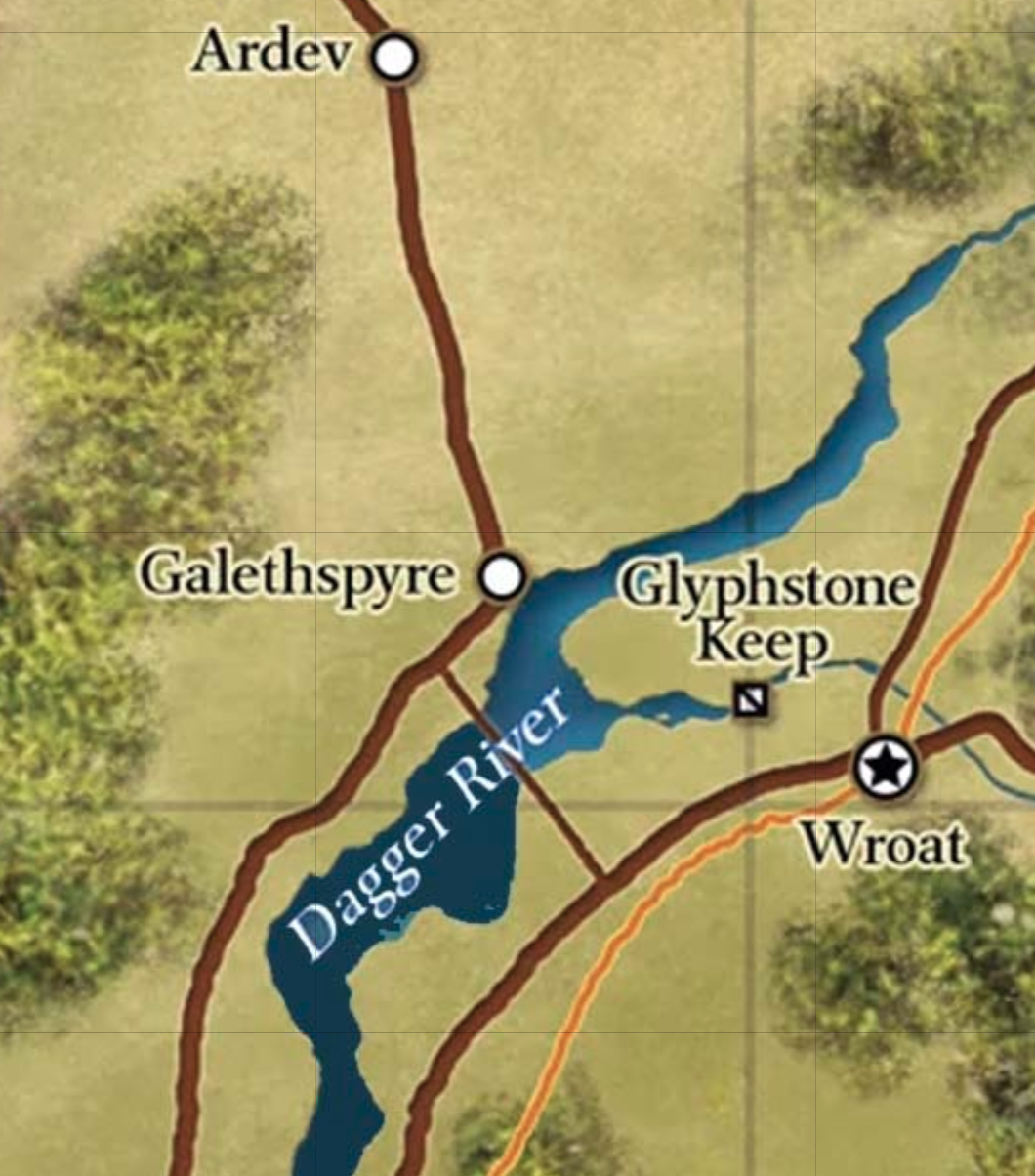
Who were the first humans on Khorvaire to worship the Silver Flame? Those of you well-versed in history may have jumped in to say The Ghaash’kala in the Demon Wastes! and indeed, that is a Flamic tradition far older than any of the Five Nations. But the question was who were the first humans to worship the Silver Flame? The answer is the inhabitants of Galethspyre, a port town on the Dagger River. The people of Galethspyre came from the Sarlonan nation of Khalesh, whose folk had long called on the power of the Great Light to help them fight against supernatural evil. Few Khaleshites joined in the colonization of Khorvaire, but one expedition did make its way along the southern coast of Khorvaire and up the Dagger River. The leader of this expedition was the priestess Galeth, and she was guided by visions of a beacon of light. Galeth finally found what she sought: a spire of blue stone overlooking the Dagger, nearly six hundred feet in height. The spire is an artifact of the Age of Demons, infused with the power of the Silver Flame. Galeth could sense the celestial energies within the stone, and she knew that it would protect her people from evil. And so they settled the town that came to be known as Galethspyre. At the time, there was considerable tension between Khalesh and the other nations of Sarlona, especially the Vassal missionaries of Pyrine; as a result, the people of Galethspyre largely kept to themselves as Wroat rose around them. They traded with other settlements, becoming a prominent textile center—Galethspyre is the original source of the famous “Brelish Blue” dye—but never sought to spread their faith or to engage in the crusading behavior that had characterized Khalesh. They knew they were safe in the light of the Spire, and sought to make their town a bastion against the forces of evil abroad in the world. By the time Breland was born, people had largely forgotten their ties to Khalesh and Pyrine. The tension between Vassals and the people of the Spire faded, and the faith of Galethspyre spread to other villages in western Breland. But it remained a quiet faith focused on resisting the influence of the Overlords and drawing on the Great Light to defend the innocent from evil. The faithful are encouraged to live virtuous lives, to be ever watchful for supernatural threats, and to work together to defend their communities.
When the Church of the Silver Flame rose in Thrane, it spread rapidly. The people of Thrane didn’t just want to defend their own families and villages; they raised an army of templars and sought to establish garrison-temples across the Five Nations. They built the Cathedral of the Cleansing Flame in Sharn and sought to recruit templars in every nation. Some of those who answered the call were entirely new converts inspired by the tale of Tira Miron. Others were people of the Spire. The Galeth—the title given to the spiritual leader of Galethspyre—declared that the Great Light of the Spire and the Silver Flame of the Church were one and the same, and the ‘Spired were proud to serve as templars and priests. But they still held to the quiet practicality of the Spire traditions, used Old Common in their rituals, and taught their traditions for resisting the Overlords. They were devoted to fighting evil, but held to their Brelish practicality. This became apparent when the Last War broke out. Those most devoted to the Keeper and the Church immigrated to Thrane. Those templars who remained largely fell into two camps: those who had joined the church driven less by faith and more by greed and a desire for influence, and those whose faith in the Flame was grounded firmly in Breland—the people of the Spire. This can be seen today in Sharn. The Cathedral of the Cleansing Flame is a direct arm of the Church of Thrane, but it is riddled by corruption and graft. On the other hand, Coldflame Keep is a garrison temple that holds only a handful of templars compared to its height, but those who serve there are devoted to fighting evil; what’s not mentioned is that their faith is rooted in Galethspyre.
The key point here is that the ‘Spired acknowledge the Keeper and maintain the basic standards of the Church.Most outsiders can’t tell the difference between the ‘Spired and devotees of the Church of Thrane. The ‘Spired wear Brelish Blue, use Old Common phrases in their prayers (even though most of the faithful don’t speak the language), and wear a thin silver teardrop instead of a silver arrowhead; the teardrop shape is reminiscent of the Spire. Their core beliefs are the same—defend the innocent from supernatural evil—but the people of the Spire place great emphasis on personal honesty and common sense, and are less aggressive in seeking out evil beyond their own communities.
With this in mind, we’ve now identified three distinct sects of the Silver Flame in the Five Nations
The Church of Thrane. Established in Flamekeep following Tira’s sacrifice and the binding of Bel Shalor, this is the primary manifestation of the faith in Khorvaire. It has a strict hierarchy and a standing army—the templars—dedicated to defending the innocent from supernatural evil. Followers are encouraged to establish local militias ready to defend their communities and use archery as a devotional practice. Faithful are encouraged to listen to the Voice of the Flame and to beware the temptations of the Shadow in the Flame. They stand ready to lay down their lives to defend all innocents from supernatural threats, regardless of their faith; this is seen in the Silver Crusade, where Thrane templars went west to defend Aundairian Vassals from werewolves. The Keeper of the Flame is the spiritual leader of the faith. The Church is now the government of Thrane, though followers of the Church in other nations can maintain their loyalty to their own leaders. The Church of Thrane has always been tolerant of variant beliefs, just as it considers all mortals to be innocent regardless of their faith. As such, it has welcomed People of the Spire and Puritans and allowed them to serve as templars and priests within the Church hierarchy while maintaining their local beliefs, as long as those beliefs don’t directly oppose the doctrine of the Church.
The People of the Spire. Established in Pre-Galifar Breland by Khaleshite settlers. ‘Spired respect the Keeper of the Flame and serve as templars, but they are also devoted to the Galeth and place more faith in the Spire of Galethspyre than in the font in Flamekeep. They encourage the faithful to stand ready to defend their communities from supernatural threats, but archery isn’t a devotional practice; their favored weapon is the spear. They are vigilant against the influence of all of the Overlords; the Shadow in the Flame is just one of these. While they do believe that the faithful should oppose all supernatural evil, the primary duty of the faithful is to defend their own communities; ‘Spired resist the idea of dramatic actions such as the Silver Crusade. Many of their rituals use Old Common, and it is possible that there is a hidden line of Shulassakar guiding the people of the Spire.
The Pure Flame. Established in western Aundair in the wake of the Silver Crusade. Founded by Aundairians who had endured decades of terror at the hands of lycanthropes, the followers of the Pure Flame see it not as a shield to defend the innocent but as a sword to smite evil. While the core principles are the same, Puritans advocate aggressively rooting out evil and are the one branch of the faith that turns that aggression against mortal evil rather than focusing on the supernatural. This resulted in the infamous inquisition of the Lycanthropic Purge and the death of countless innocent shifters. It can also be seen in the brutal actions of Archbishop Dariznu in Thaliost. Puritans encourage the formation of militias to defend (and police) communities, but aren’t devoted to the practice of archery and lack the discipline of Thrane templars; they are more likely to rely on the hue and cry and zealous mobs, and their favored weapon is the torch (or club). The followers of the Pure Flame revere the Keeper of the Flame as the spiritual leader of the Church, but they believe that the Cardinals are weak and corrupt and prevent the Keeper from wielding the Flame as it should be used. They largely see the theocracy of Thrane as a manifestation of this corruption. The appointment of Archbishop Dariznu as governor of Thaliost was an effort by Thrane to win the loyalty of the Puritans, and a large number of followers of the Pure Flame—many of whom were displaced from their original homes by the Eldeen uprising—have settled in Thaliost.
The Silver Flame has few followers in Karrnath; in Cyre, most followers of the Silver Flame were tied to the Church of Thrane. Meanwhile, we have a number of traditions beyond the Five Nations. The Ghaash’kala orcs of the Demon Wastes revere Kalok Shash, the Binding Flame, and have their own Voice that guides them. The Masvirik’Uala draw on the Light in the Land in their fight against the Poison Dusk. However, the Church of Thrane has no direct contact with the Ghaash’kala or the Masvirik’uala, and those two sects know nothing of Flamekeep and its Keeper.
Why are we talking about Galethspyre? Every month, my patronscan ask me questions. This month someone asked How do the people of Breland, who are typically Vassals, feel about the fact one of their larger towns is a bastion of Silver Flame worship? Has the mainstream faith in Thrane tried to take action against Galethspyre? Answering those questions directly: Galethspyre has been devoted to its faith before Breland was called “Breland.” It’s nothing new and beyond which, the Vassals of Breland aren’t especially zealous. It was a point of tension in pre-Galifar Wroat centuries ago, but in the modern day there’s no concerns with it. This further explains WHY there’s not a lot of tension against the Silver Flame in Breland; most Brelish templars are ‘Spired rather than directly serving the Church of Thrane. Meanwhile, there ARE Brelish representatives of the Church of Thrane—such as Ythana Morr in Sharn—but they are often pragmatic folk who are driven by greed and a desire for influence as much as by faith. As for the second part of the question, the mainstream faith of the Church of Thrane is tolerant of variant beliefs, and people of the Spire have long served as Church templars and priests in Breland. It’s a point of tension that ‘Spired believe the theocracy distracts the Church from its true mission, and the ‘Spired refused to serve Thrane during the Last War, but they still supported the Church and the divine mission of the Silver Flame. If anything, I’d say that the Church of Thrane is more concerned about the corruption in the Brelish branch of the Church than it is in the ‘Spired, who are at least devoted to their faith.
WHY DOES THIS MATTER?
When you create any character tied to the Silver Flame, pause for a moment to think about which branch of the faith they follow. The Church of Thrane is the mainstream faith with the widest following and deepest pockets. It’s a tolerant and compassionate faith that seeks to defend all innocent people regardless of belief, but this mission is now complicated as it’s tied to the theocratic government of Thrane. This has also led to greed and graft weakening some branches of the Church, especially in Breland. On the other hand, Breland has its own homegrown branch, thePeople of the Spire, whose followers strive to be virtuous and to oppose evil, but who are more reserved than the Church of Thrane; they defend their own, but aren’t starting a crusade to defend strangers. The People of the Spire have traditions tied to a wider range of Overlords and lore that goes directly back to Khalesh; they are less familiar with Bel Shalor but may have some surprising nuggets of information about other Overlords. And the Pure Flame is the most intolerant and aggressive branch of the faith, the most likely to pursue what is seen as mortal evil and the most likely to produce a rampaging mob. If you’re playing a Paladin of the Silver Flame, are you an aggressive Puritan, a compassionate servant of the Keeper, or a pragmatic ‘Spired?
This also adds the mysterious hook of the Galethspyre itself. This is a Couatl artifact from the Age of Demons. Is there an Overlord bound beneath it? Could the Spire release couatls, or perform other miracles? Are there Lords of Dust conspiring to destroy the Spire? Beyond that, is there a secret line of Shulassakar in Galethspyre? Is the Galeth herself a disguised serpent-person? Is the Galeth guarding a cache of artifacts from ancient Khalesh—the tools of ancient crusaders waiting to be used again?
I hope you find something useful here. Thanks to my Patronsfor their ongoing support, which makes articles like this possible—the first article on House Phiarlan will be posted on Patreon later this week!
You’re right, Lord Ruken. We’re talking about a great deal of gold. But there are a few things that only you know. Only you know the fervor of your enemies and how far they would go. Is there anyone who might scry upon you, seeking to pry your secrets from your private conversations? Is there anything in your home you truly can’t afford to have stolen? Is it possible that someone hates you so much that they might seek to kill you… or to harm you by harming those you love? Only you know these things, my lord… and only you know what peace of mind is worth to you.
The heirs of House Kundarak are often maligned as being paranoid, always suspecting the people around them of coveting their fine possessions. This is a foolish fabrication. But there are two factors that play into this stereotype. The first is Kundarak’s great wealth. Most of the houses became wealthy because of their success. But the Kundarak lords were wealthy long before they became a House, possessing riches greater than any western king. There have always been those who have sought to steal Kundarak gold, whether through force or guile. So if Kundarak heirs look at the world around them with a little suspicion, it’s because history has given them good reason to be cautious. Beyond that, those who carry the Mark of Warding feel an inherent urge to protect the things that matter to them. Heirs of House Sivis love words. Those who carry the Mark of Making are often tinkering with something. And the dwarves who bear the Mark of Warding are always ready to protect the things they love. The Mark of Warding seals and shields, but it also allows its bearer to create deadly traps that will punish those who trespass against them. Kundarak won’t just keep you from touching their things; they’ll leave you with a bloody stump for daring to make the attempt. These threads run through the psyche of every Kundarak heir: pride in what they possess and what they have accomplished, and a fierce instinct to protect what they love and to punish those who would try and take it.
While some might expect Kundarak heirs to be avaricious, the truth is often the opposite. Some of the greatest philanthropists in the history of the Five Nations have been Kundarak viceroys, and heirs of the house are often generous with their friends. Kundarak teaches its heirs to be sharp in matters of business, to cut to the heart of a situation and identify its risks. But the House also teaches its children that a life driven solely by the pursuit of wealth is as cold as a copper coin. A Kundarak heir always considers the costs of things, and anyone who knows a Kundarak dwarf has probably had a moment when their friend has stepped in to haggle on their behalf or to warn them of a possible scam. But this is because what the heir values most is friendship. Kundarak heirs won’t waste gold, but they aren’t afraid to spend it on things that truly matter, including helping their friends and creating fine memories. Likewise, Kundarak dwarves usually have treasures, whether those are heirlooms passed down to them or things they’ve worked to acquire. Some of these things would be seen as treasures by anyone; many heirs appreciate art, jewelry, and goods of the highest quality. But others have more of a personal value. A copper tankard that’s the last surviving mug made by a distant ancestor. A rare book of poetry by a poet who’s still unappreciated long after their death, but which the dwarf loves. A silver coin they struck as a child, when their mother took the mint. Beyond this, every Kundarak heir has something they dream of acquiring. This is a game that starts among children, as heirs declare what wonders they will one day possess, and these desires are refined as they grow. This could be a title, a family, an estate… but most heirs have something very concrete in mind, whether it’s an artifact or a piece of art. So in making a Kundarak heir, consider: What treasures do you possess, and what do you yearn to obtain? What do you value above all else, and what would you do to protect the things that you love?
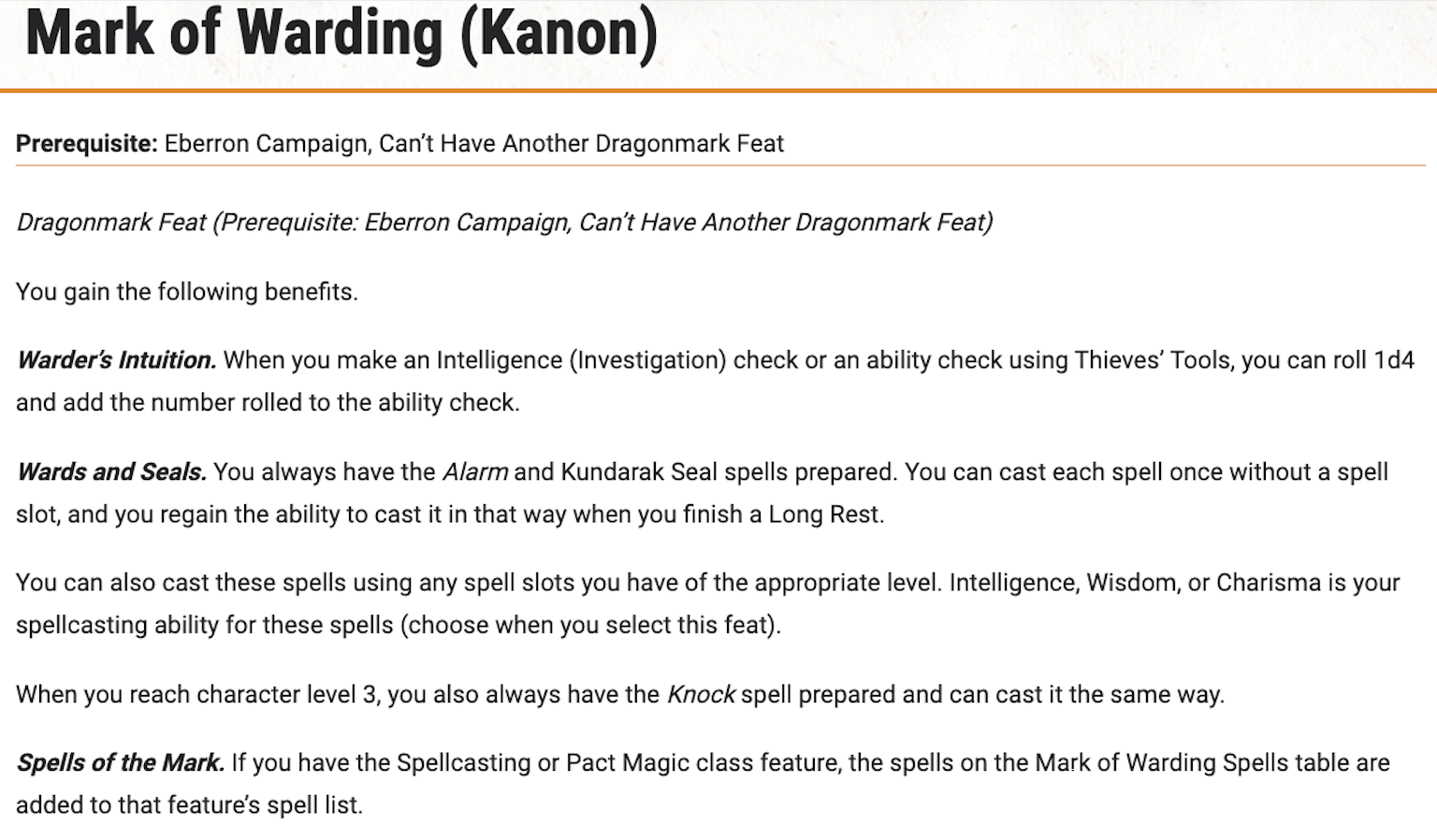
Note: The version of the Mark of Warding presented here differs from what is presented in Forge of the Artificer. This is the version I am using in my campaign, but it is not official! My reasons for these changes are described later in this article.
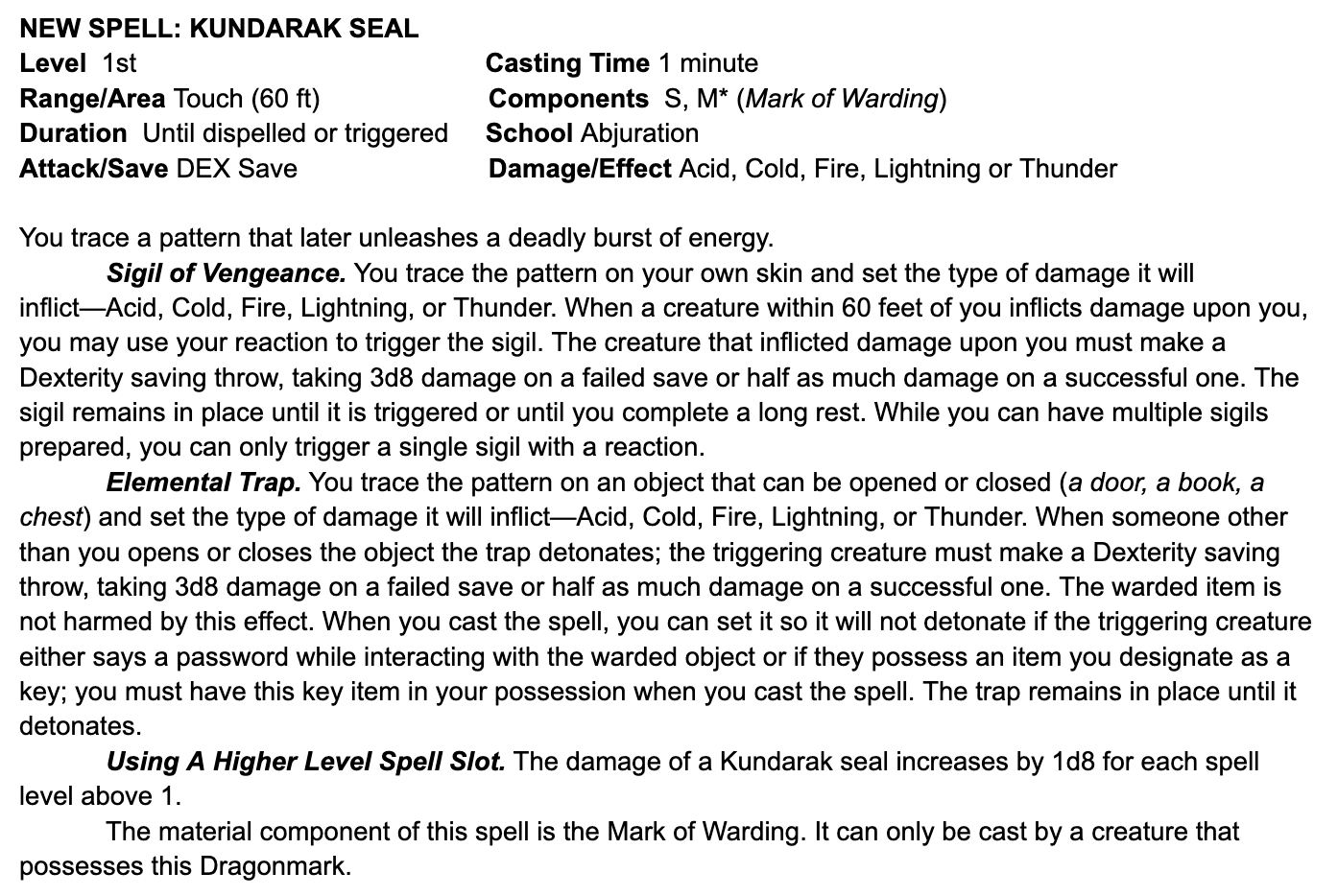
When an heir of House Kundarak first manifests the Mark of Warding, they are placed in isolation while they master its first two gifts. The first of these is a peaceful source of comfort: the ability to set an Alarm. As a ritual spell, this can be cast at any time. The heir studies the space or the portal they wish to ward, and imagines energy flowing from their dragonmark to fill that space. While there is no actual sentience to an Alarm spell, most Kundarak heirs imagine a guardian—crafting the story of the spirit that serves and protects them. The heir traces the patterns of the Mark of Warding in the air and murmurs instructions to their guardian (the somatic and verbal components of the spell), thanking the spirit for its service and telling it whether to respond to intrusion by warning the heir directly or making a noise. For most Kundarak heirs, this is a comfortable experience; it makes them feel protected and secure. Heirs with a newly manifested Mark are encouraged to cast Alarm over and over, warding everything in sight. This power poses no danger to anyone. But the second gift of the Mark of Warding is another matter entirely, and this is the reason new heirs must be isolated. Every heir can feel the power of the Mark promising protection. If they let instinct guide them and trace the pattern of the Mark, power flows through the Mark and into that seal, burning with the determination to protect and to punish. This is the Kundarak Seal, the first step toward a Glyph of Warding. It can be placed on anything that can be opened or closed—a door, a window, a chest—or on the heir’s own skin. With time and training, an heir can weave safeguards into the seal, setting a word of safe passage or choosing when to trigger the seal on their skin. But in those first days these traps pose a danger to everyone; a playful shove is enough to trigger a Sigil of Vengeance and injure or kill a friend. Foundlings with the Mark of Warding are rare, and often have tragic tales of loved ones harmed by an Elemental Trap before the heir mastered their powers. This isn’t a danger for long. Once an heir understands this gift, they can contain a Sigil of Vengeance until they choose to unleash its power; most heirs start each morning by tracing the mark on their skin and setting that ward against enemies. This is something everyone knows about Kundarak heirs—You strike a blow against them, and they’ll blast you with vengeance. It’s something that gives Kundarak bankers and negotiators confidence when dealing with strangers: you harm me at your peril.
Further gifts of the Mark of Warding offer both sides of a coin, as heirs learn both how to protect the things they love and how to bypass protections. An experienced heir can seal anything that can be opened, weaving an Arcane Lock; but they also possess the power to Knock, opening any door. They have an intuitive knack for using Thieves’ Tools to create traps and locks as well as to remove them; they can set deadly wards, but they also have a talent for Investigation and for mystically finding traps. Warding-marked heirs often have a fondness for puzzles; there is an intuitive satisfaction that comes from opening a look or unraveling a mystery.
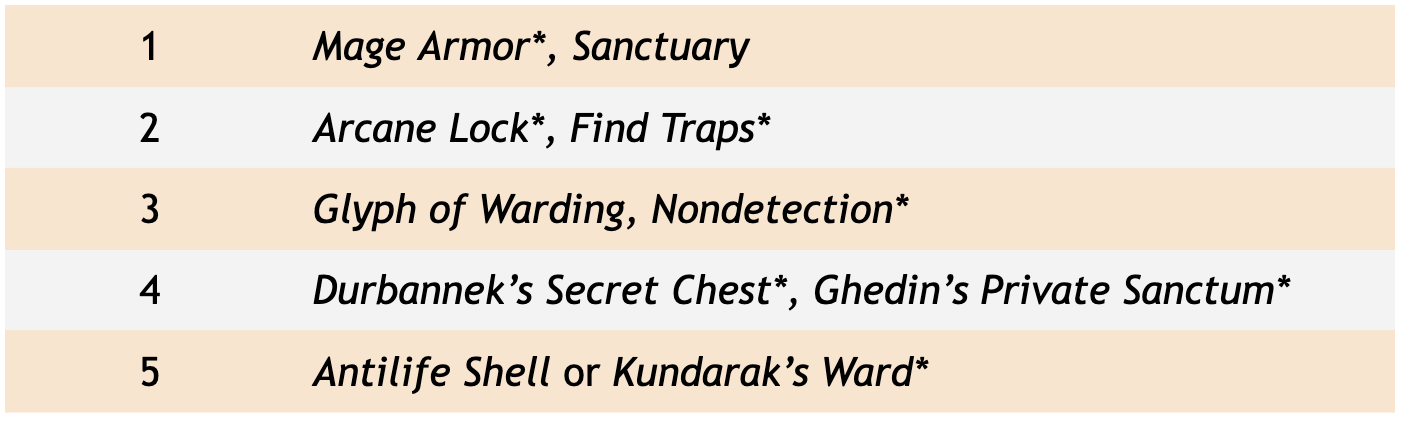
Player characters and remarkable NPCs can master both powers of the Least Mark of Warding, but most heirs only learn one of its two paths. Those drawn to the path of Wards gain the ability to cast Nondetection and Private Sanctum. These allow the heir to shield objects, people, or places from divination magic, and also to prevent teleportation into or out of a particular space. Private Sanctum can be made permanent, and most long-established prisons have Kundarak wards that prevent teleportation. Those who follow the path of Seals gain access to Glyph of Warding and Secret Chest. These heirs are the trapsmiths of the House, weaving Glyphs into security systems for valued clients.
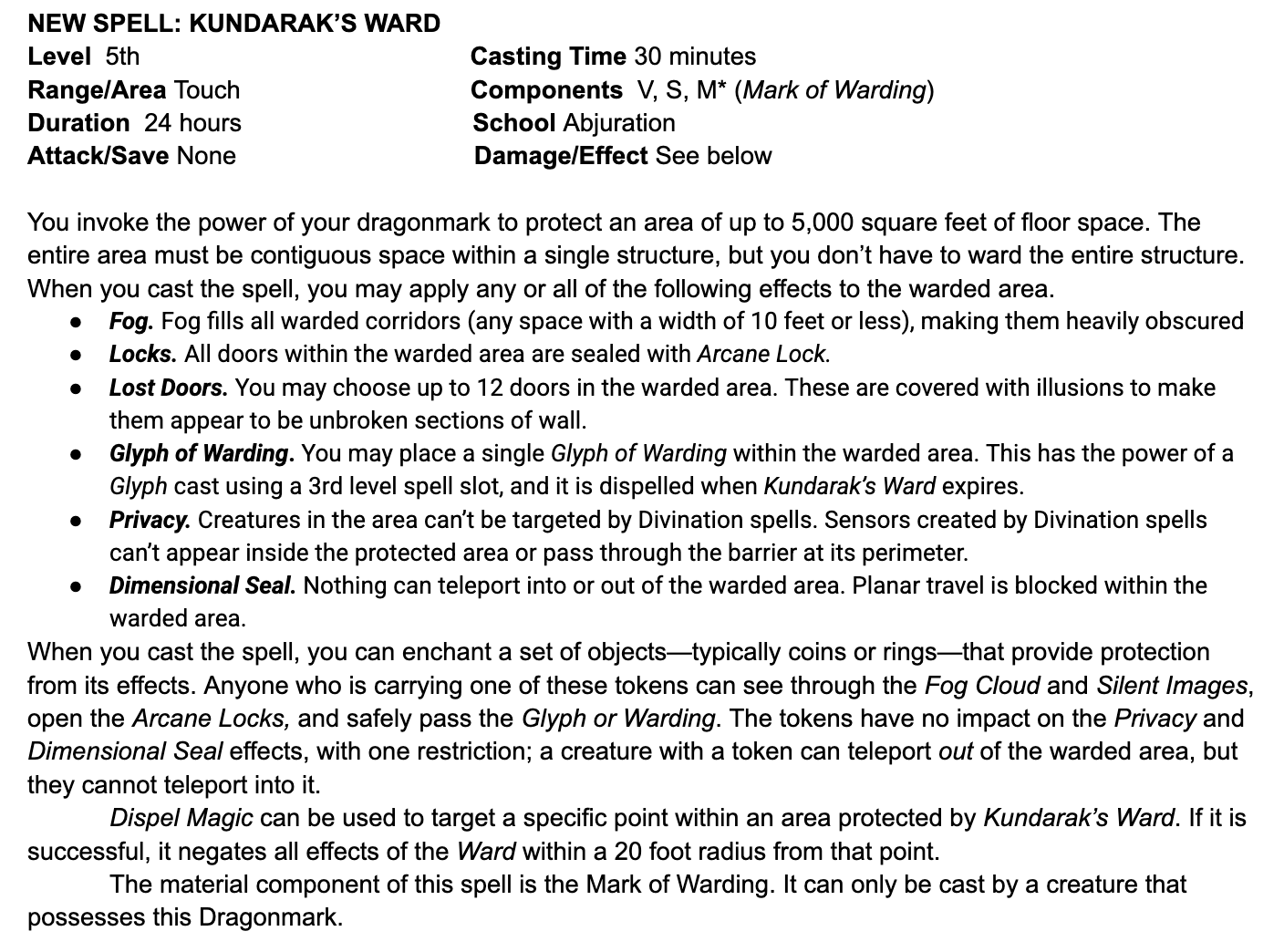
The final gift of the Greater Mark is one that even player characters have to choose between. The rarer of the two options is the ability to cast Antilife Shell, keeping all living things from approaching the Warding heir. Those with this gift often worked with House Deneith during the last war; a Warding heir could shield a Siege Staff crew and keep them from being overrun. Heirs with this power are rare and as the war went on, the use of Warforged constructs and Karrnathi undead reduced its value, but there were still times when these wars played a key role in a battle. The more common gift of the Greater Mark is Kundarak’s Ward—a power that weaves Private Sanctum, Arcane Lock, and Glyph of Warding together to protect a stronghold. Many noble estates have Housewards that maintain Kundarak’s Wards. With that said, when an heir casts Kundarak’s Ward they choose which effects to implement. Most nobles don’t want to have their hallways filled with fog!
Durbannek’s Secret Chest and Ghedim’s Private Sanctum are identical to Leomund’s Secret Chest and Mordenkainen’s Private Sanctum, just using the names of the Kundarak families who specialized in these spells in the early history of the House.
Kanon vs Canon. Most of the time I prefer to hold to current canon, but I’ve made a significant number of changes here. The core abilities remain the same; what I’ve swapped are the spells. My goal here is to work with the original idea of the Mark, the services Kundarak provides, and what feels logical and cohesive to me. Specifically…
Forge of the Artificer assigns Mage Armor to the base mark and Armor of Agathys as a spell of the Mark. Mage Armor is fine, but it’s useless for adventurers who use medium or heavy armor, so I shifted that to be the Spell of the Mark and replaced Armor of Agathys with Kundarak Seal. Kundarak Seal draws on Fire Trap (which was part of the 3.5 Mark) but adds the idea that you can use it to trap YOURSELF. This is similar in concept to Armor of Agathys and Hellish Rebuke—you hurt someone who hits you—but you have to cast it in advance. It keeps the idea of Elemental Trap as a service Kundarak heirs can provide, but Sigil of Vengeance is likely to be more useful for the typical adventurer.
The typical adventurer has more use for Knock than Arcane Lock, and both are useful for the House businesses, so I made Knock the spell provided by the base feat and Arcane Lock the Spell of the Mark.
I swapped Nystul’s Magic Aura with Find Traps because to me, Magic Aura is more about deception than protection, and that’s not something that is reflected in the other spells of the mark. Meanwhile, Find Traps establishes that the Mark of Warding gives its bearers a broad affinity for traps, which is reflected by the Intuition with Thieves’ Tools and is one of their main fields of business. Just as the Mark allows you to lock and unlock things, it makes sense to me that it can help you find traps as well as to set them.
I replaced Magic Circle with Nondetection because Nondetection was an original spell of the mark in 3.5 and because it’s consistent with Private Sanctum—establishing that the Mark can ward against divination—while there’s no other Mark effects that feel aligned to Magic Circle (such as Hallow or Protection From Good And Evil).
I swapped Faithful Hound with Private Sanctum because I previously assigned Faithful Hound to Ghallanda. While Faithful Hound isn’t a bad option for Warding, Private Sanctum is consistent with Nondetection and it fit to me that Ghallanda could set a spectral blink dog to guard your door while Kundarak would ward a wider area.
Guards & Wards was a key feature of the Mark of Warding in its original incarnation. Aside from being a 6th level spell, the standard Guards & Wards goes kind of over the top (There’s spiderwebs in every staircase! There’s confusion spells at every intersection!), and I wanted to tone that down a little — and since the Mark now includes Private Sanctum, it made sense to weave that in. So Kundarak’s Ward is a watered down Guards & Wards with added functionality from Private Sanctum. Notably, it doesn’t have the “Cast every day for a year to make permanent” clause; it’s maintained by Housewards, but you can’t make it permanent.
FOCUS ITEMS
The ability to cast Glyph of Warding or Knock once per day is a useful trick, but if you’re going to make a living as a locksmith or selling security systems, you need to be able to produce these effects more frequently and to provide services that will last. Someone poor and in a hurry can pay a Kundarak Warden to cast Glyph of Warding on their door, but once the spell is triggered it will disperse. If you want to create a Glyph that will last—an ongoing security system for a noble or a prison—you need to use focus items.
The two most common Kundarak focus items are Warden’s Wares and Sealing Pigments. Warden’s Wares are a specialized form of Thieves’ Tools; they are treated as Thieves’ Tools for purposes of tool proficiency, but Kundarak heirs can use them to construct magical traps as well as to disarm them. Sealing Pigments are infused with powdered siberys dragonshards. When an heir creates a long-term security system they trace its patterns with Sealing Pigments. The Pigments become invisible after the work is complete, but the power remains in place. Long term Kundarak traps often have some sort of focal point as well. Rather than being a glyph, a trap that dispels magic could be a metal plate engraved with the image of a beholder that opens its central eye when the trap is triggered. Sealing Pigments are still used in the creation of this trap, but it’s not just a pattern of paint.
Traps and security systems are the primary products of House Kundarak, and these are discussed in greater detail in the sidebar that follows this section. Here’s a few other Kundarak focus items.
Adamant Chest
Wondrous Item, Uncommon
The Adamant Chest is a Tiny model of chest forged from adamantine and set with a sliver of siberys shard. If someone uses the Adamant Chest as a material component when casting Durbannek’s Secret Chest with the Mark of Warding, they can summon a 3’ x 2’ x 2’ chest from the Ethereal Plane. This chest has the durability of adamantine and is sealed with an Arcane Lock; the Adamant Chest serves the key. Casting the spell allows the bearer of the Mark of Warding to summon this chest or to send it back to the Ethereal Plane, but the chest is bound to the Adamant Chest, not to a specific caster; anyone with the Mark of Warding who gains possession of the Adamant Chest can use it to access the associated chest. There is no risk of the spell expiring and the chest being lost in the Ethereal Plane, and an heir can cast the spell with a different material component to summon their own personal chest.
Keycharm
Wondrous Item, Common
A Keycharm is a simple amulet, typically worn around the neck or kept in a pocket. When someone with the Mark of Warding casts Alarm, Arcane Lock, Glyph of Warding, Kundarak’s Ward or the Elemental Trap function of Kundarak Seal, they can choose to link the spell to a Keycharm in their possession. If they do this, whoever carries the Keycharm is considered to be the caster of the spell. They are aware of the location of the spell effect and can choose to end the spell or bypass its effects. Most of these spells give the caster an option to set a password or to create objects that serve as keys; the Keycharm just takes that a step further, allowing the caster to give full ownership of the spell to the bearer of the Keycharm.
Houseward
Wondrous Item, Rare
A Houseward is a heavy block of lead and stone engraved with arcane sigils. An heir with the Mark of Warding can sense the presence of any Houseward within 20 feet and can target the ward with any of the following spells: Alarm, Ghedin’s Private Sanctum, or Kundarak’s Ward. When cast in this way, the spell doesn’t require concentration and the duration is increased by a factor of 28—allowing a spell that would normally persist for a single day to last for an entire month. If a Houseward is destroyed, the spells it is maintaining dissipate. For this reason, Housewards are typically buried beneath the floor of the location they are protecting, or embedded in the base of a statue.
Locksmith’s Ring
Wondrous Item, Uncommon (Requires attunement by a creature with the Mark of Warding)
The Locksmith’s Ring is a large iron ring with a single embedded siberys dragonshard; it’s often used as a keyring, but there is no actual need for it to carry other keys. While attuned to the Locksmith’s Ring, a creature with the Mark of Warding can cast Arcane Lock or Knock as a ritual; however, doing so requires 100 gp worth of refined eberron dragonshards, which are consumed by the ritual.
THE HISTORY OF HOUSE KUNDARAK
The ancient history of the dwarves of the Ironroot Mountains is preserved solely in stories—tales passed down and embellished over the course of generations, stories that vary depending which clan is telling them. According to the talespinners of Clan Mroranon, King Mror sent twelve heroes to the surface world so they could prove themselves worthy of inheriting his kingdom. He also sent the master mason Kundarak to help build their halls and to protect them from harm. The bards of Clan Soldorak tell a different story. They say King Mror was a tyrant who banished the twelve heroes, fearing that they would overthrow him… and that Kundarak was the warden who sealed the gates to the Realm Below and made sure the heroes would never return. Every clan has its own twist on the tales, but in every one of them Kundarak stands apart. In most tales Kundarak is a protector who helps the heroes build their mountain fortresses. But some clans say those keeps were first made as prisons, and that Kundarak only relented because the clans became too strong to be held under lock and key. Narathun ‘spinners say that when Mror sent the heroes to the surface, he gave their greatest treasures to Kundarak with instructions that they should be restored to the clan leaders when they proved their worth. But, say the Narathun, greedy Kundarak refused to return these treasures. According to these stories, House Kundarak is still holding onto legendary artifacts tied to each clan founder—awesome treasures hidden in its deepest vaults.
The truth of these tales is buried in the past. But a few things are certain. The early Ironroot clans weren’t exceptional miners, and they were divided by bitter feuds; they spent most of their energy and resources fighting one another, as well as the Jhorash’tar Orcs. Clan Kundarak remained neutral in these conflicts, helping every clan build fortifications—and the Kundarak dwarves were expert miners. While the other clans largely didn’t tap their natural resources until the period known as Korran Hal, Kundarak dwarves always spent as much time below the earth as they did above it. Early in their history, Kundarak had two important subterranean holdings. The first is Aur-Hal, the “Blessing of Gold”—a gold mine beneath Korunda Gate that was the original source of the clan’s wealth. Aur-Hal remains in operation to this day, but it is shrouded in mystery. Kundarak has never allowed outsiders into its oldest mine. Some believe that the original mine was tapped out long ago—but that the Aur-Hal tunnels contain an entrance to a demiplane that is the actual source of Kundarak’s gold. Others claim that there is a dragon in the depths—that the gold of Aur-Hal all comes from this Greatwyrm’s hoard, and that this creature is the true master of House Kundarak. The truth is hidden beneath a maze of tunnels and centuries worth of wards. But one thing is certain; the house still draws gold up from the depths. A second deep holding of note is Bal Ulok, the “Great Pit.” This is the oldest continually operating prison on Khorvaire. The prisoners held in Bal Ulok generally weren’t criminals; instead, they were members of the ruling clans who ran afoul of more powerful members of their clan, or hostages whose sentence was part of the terms of a temporary truce between feuding rivals. Occasionally, dwarves targeted by a relentless enemy voluntarily chose to dwell in Bal Ulok; there was no safer place in the Ironroot Mountains. While Dreadhold is now considered to be Kundarak’s most secure prison, Bal Ulok is still in operation and offers luxurious confinement for noble prisoners.
While the scholars of the Twelve believe that the Mark of Warding first appeared around the same time as the Mark of Making, there’s no way to be certain. The dwarves remained isolated in their mountain holds as new civilizations spread across the lands below. This changed with the rise of the Kingdom of Galifar. Prince Karrn subdued the Ironroot Mountains in the name of his father, and it was the flow of tribute that opened the floodgates to trade and communication with the clans. House Sivis was quick to investigate this new territory, and they were thrilled to discover a new mark within the mountains. House Sivis and House Kundarak formed a quick bond that remains one of the strongest alliances among the Twelve, and it was from this union that the Banking Guild was born. Kundarak’s vast wealth provided the capital, but it was Sivis that understood the markets and the math, and Sivis scribes who maintained the ledgers and drew up letters of credit and loans. Sivis helped Kundarak establish the Korunda Mint and convinced Galifar to accept its coins throughout the kingdom. Over the next century, the Banking Guild spread across Galifar. While the Twelve worked to suppress unpleasant details, Kundarak and its allies took aggressive action to undermine or assimilate rivals.
While the Banking Guild was the driving force of House Kundarak, the Warding Guild played a noteworthy role in the early history of the House. Centuries before the rise of Galifar, Karrn the Conqueror established a prison colony in the Lhazaar Principalities on a barren island he called Blackrock. King Galifar I saw the value of a distant, secure prison—a place to hold hostages and rivals too valuable to kill but too dangerous to be kept close at hand. Prince Karrn’s battles in the Ironroot Mountains demonstrated Kundarak’s talent for constructing fortifications and defensive magic. Working through House Sivis, Galifar I arranged for Kundarak dwarves to build a proper prison on Blackrock—a prison that would eventually be rechristened as Dreadhold. This comes to another interesting aspect of House Kundarak: its land. The Korth Edicts were put in place before Kundarak joined the Twelve. While Kundarak was willing to respect the edicts in regard to its holdings in the Five Nations, the dwarves had no intention of surrendering Kundarakhold or their precious mines. After long negotiations they were allowed to “purchase” Kundarakhold from Galifar for a lump payment. After the death of Galifar I and King Cyre, Kundarak also negotiated an agreement that gave the House dominion over the island of Dreadhold, as long as they continued to serve Galifar and secure its prisoners.
For the last eight centuries, House Kundarak has been a vital part of the economic foundation of Galifar. Along with House Sivis, it’s one of the most trusted and reliable houses. Kundarak investments have funded countless projects and expeditions. While its services have largely remained consistent, Kundarak continues to work with the Twelve in pursuit of new advances in security. The most dramatic development occurred in the last century. Like the other Mror Clans, House Kundarak began exploring the realms below the Mror Holds over the last century. They have kept their discoveries hidden, but in 960 YK Lord Morrikan declared that he was withdrawing his forces from the depths and fortifying all gates to Sol Udar, saying that the dangers of further exploration outweighed the risks involved. Four years later, the Twelve unveiled the Kundarak Vault Network. This leaves a few critical questions in the hands of the DM: What did House Kundarak find in Sol Udar? Did they ACTUALLY seal the gates, or is that a public lie to conceal continued operations in the depths? Does the demiplane tied to the Vault Network have ties to Daelkyr or an Overlord? Most of all… Is it safe?
The Last War had relatively little impact on House Kundarak. All nations made use of Kundarak services and sought Kundarak investments and loans during the war. The one twist that has shaken the House is the rise of the Aurum. Before the rise of Galifar, Kundarak alone carried out extensive mining in the Ironroot Mountains. But Prince Karrn’s victory over the dwarves actually led them to dig deeper, setting in motion the age known as Korran Hal, Korran’s Blessing. All of the clans found wealth beneath their feet. And over the last century, with the Mror claiming full independence from fallen Galifar, many Mror nobles have become more active in engaging with the rest of the world. Kundarak is still the most trusted name in banking, but Mror investors are taking opportunities that would once have surely fallen to Kundarak. Antus ir’Soldorak has established his own mint producing coins of Soldorak gold. While these actions have yet to have a serious impact on Kundarak profits, it’s a concerning development for the House.
What Happens Next?
House Kundarak seeks stability. It strives to protect an image of absolute security and reliability. As such, it’s not a House that takes dramatic actions—or at least, when it does, it seeks to keep them quiet. Here’s a few seeds to work with.
The Heist. There’s countless opportunities for adventurers to be pitted against Kundarak. This could be driven by simple greed, seeking to plunder a Kundarak bank purely for the gold it holds. But villains bank with Kundarak, and there’s many reasons adventurers could need to plan a heist. Perhaps someone is unjustly imprisoned in Dreadhold and the adventurers need to get them out—or perhaps they just need to deliver a message to a prisoner. Maybe the adventurer’s arch rival has a crucial item in a Kundarak demiplane vault—can the adventurers get the key and the password and get it on the surface, or do they actually need to find a way to enter the vault demiplane itself?
Inheritance. One of the player characters discovered that they’ve inherited the contents of an Adamant Chest stored in a distant bank. How quickly can the adventurers get to the bank? What is in the Chest? Is it just a useful item or gold or could it be dangerous secrets? If the adventurer is an Artificer, this inheritance could be an arcane prototype created by a rival, with the note that they believe House Cannith is going to have them killed to prevent them from completing this paradigm-shifting invention—will the adventuring Artificer finish what they started?
What Lurks Beyond The Vault? The Kundarak Vault Network is located in a demiplane, and the House needs to know more about it. The adventurers are hired to enter a portal below Korunda Gate and explore the realm beyond… what will they find? And if given the opportunity, will they plunder any of the vaults?
Your Mission, If You Choose To Accept It… A dying spy thrusts a crumpled paper into the hands of an adventurer—the key and password to a Kundarak vault. This contains information about a dangerous plot and an artifact that must be kept out of enemy hands. But it’s unclear who the spy was working for and who exactly the adventurers are going up against. Will they dive into this shadow war or leave it alone?
Storage Wars. Perhaps, if a Kundarak demiplane vault is left unpaid for over a decade, the House will hold an auction for a select group of bidders. The adventurers have a chance to obtain the contents of one or more vaults. Perhaps they only hold junk. Maybe they hold valuable treasures. Or perhaps they hold dangerous secrets, the answers to unsolved crimes, or things that were buried and never meant to see the light of day. How much are you willing to spend to find out?
Would you like to know more? This is just a third of what I’ve written about House Kundarak. The full article includes the structure and customs of the House, details about its nine major families, and an extensive look at the Kundarak Vault Network and the sorts of traps, seals, and other services Kundarak provides. The full article is available to people who support me on Patreon, along with access to monthly Q&As (and the opportunity to ask questions!).
Stonespeaker “Sora” Sahra Sorralyn d’Sivis, art by Matthew Johnson!
Members of the jury, the case before you is clear. This is no simple accident, no story of a merchant unwittingly purchasing faulty goods and passing them on. Benn Grennel performed the ritual that charged his tokens with an aura that could deceive simple divination, making the coins appear to be properly enchanted. But this isn’t a simple case of fraud, no. If Grennel’s tokens were supposed to protect the bearer from evil spirits or bad luck, we might just urge the buyer to beware. But Grennel was selling feather tokens, and now five people are dead. The defense may argue that ‘Sharn Chicken’ is a dangerous pastime, that those who participate inherently accept risks. But this argument falls flat when it reaches those innocents killed and injured when the Telrin brothers fell from the sky. The Telrins may have been fools. But it was Benn Grennel who set these tragic events in motion when he chose to sell false feather tokens. The dead cry out for justice, members of the jury, and only you can see it done.
For those who carry the Mark of Scribing, language is a dance. Whether spoken aloud or written on the page, there is a beauty to the way that words fit together. Every conversation is delightful, and there is joy to be found simply in writing a sentence. Consider the paths typically chosen by Sivis heirs. The barrister delights in crafting an argument, in finding the words that will see justice done. The translator takes the words that are keeping people apart and builds a bridge to bring them together. The stonekeeper sends words whistling across the world, carrying knowledge to people in distant cities.
All Sivis heirs love language, but most have an innate affinity for either written or spoken words. Those who prefer speech love to be around other people, to have a chance to engage in conversation. There’s a popular stereotype of the Sivis heir who never stops talking, who feels a need to fill every moment of silence with new words, and this has some basis in reality. But there are also Sivis heirs who love to listen as well as speak; such an heir will happily sit in a crowded room and never say a word, enjoying the conversations of those around them. On the other hand, heirs who prefer the written word are often solitary, preferring the company of books and scrolls to people. Among these heirs, some love to read and delight in the endless knowledge waiting to be discovered. Others prefer to write, bringing new words into the world—whether creating stories to entertain, recording facts to enlighten, or working with numbers and balancing books. When making a Sivis character, consider where you fall on this spectrum. Are you a gnome who likes to talk to a gnome who likes to talk? Are you working on the great Khorvairian novel, or recording facts for the benefit of future generations?
House Sivis is best known for facilitating communication. Speaking Stones are a crucial part of everyday life, playing a vital role in commerce, politics, and civilian life. But Sivis heirs do far more than just operate Speaking Stones. The arcane mark of a Sivis Notary is the standard for assuring the authenticity of a document. Sivis accountants count coins across Khorvaire. Sivis mediators and barristers settle disputes, whether through conversation or in court. And as bearers of the Mark of Scribing, House Sivis has long driven the publishing industry. If a business deals with words, there’s likely a Sivis heir tied to it somewhere.
House Sivis helped establish the structure that most of the Dragonmarked Houses have adopted, the system of baron, viceroys, seneschals, and enclaves. For Sivis heirs, bureaucracy is a delightful puzzle to play with. Because of this, the structure of House Sivis is more complex than any other House. The Sivis guilds, families, and enclaves all have countless small positions and honors that can be easily gained or lost; competition over these titles is a delightful game. The exact rules of this game are hard for outsiders to follow, and it’s up to the DM and players to decide exactly what titles a Sivis adventurer is eligible for and what they must do to maintain them. Just keep in mind that every Sivis heir is part of a greater game, and know that the stonekeeper taking your message isn’t just a stonekeeper; that’s Lord Canto Corralyn d’Sivis, Second Stonekeeper of Ardev, Gilded Listener and Keeper of the Month for five months running. Lord Canto isn’t a Wordsmith yet, but he’s really trying to make fetch happen!
As a House that regularly handles the secrets of others, it is vital for House Sivis to maintain its reputation for neutrality, integrity, and security. House Sivis doesn’t share the contents of the messages it sends. For a little extra gold, you can work with a stonekeeper trained to forget your message as soon as it’s been sent. Of course there’s conspiracy theories—House Sivis preserves every message ever sent! They can even spy on messages YOU send when you cast your own Sending spells! They’re just a front for the Trust—or, it’s the Trust that’s a front of House Sivis! But over a thousand years of service, House Sivis has managed to maintain the public’s confidence in the confidentiality of its services. There’s no proof that Sivis is tied to the Trust, but the house arm known as Oversight fills much the same role within the House itself. Oversight protects Sivis secrets from all threats, protecting the House from prying eyes and swiftly dealing with any Sivis heir who threatens the reputation of the House!
Note: The version of the Mark of Scribing presented here differs from what’s presented in Forge of the Artificer. This is the version I am using in my campaign, but it is not official! My reasons for these changes are described later in this article.
While this Dragonmark is called the Mark of Scribing, a more accurate term would be communication. Comprehend Languages is the most basic gift of the Dragonmark, and the one that is typically used during the Test of Siberys. Any bearer of the Mark of Scribing can cast Comprehend Languages as a ritual; given time, any word will surrender its meaning to a Sivis heir.
Scribing is a key element of the Dragonmark. Everyone who carries the Mark of Scribing has the ability to inscribe a mystical sigil on any surface. This arcane mark is as unique as a fingerprint. The heir doesn’t choose the design of their arcane mark; they touch the surface and draw on the power of the Dragonmark, and their arcane sigil appears. House Sivis keeps a record of the arcane mark of every known heir, so documents can be tracked. After mastering their arcane mark, Sivis heirs learn who to imbue writing with arcane energy. The simplest trick is the explosive rune, an unstable glyph that immediately explodes in a burst of energy. By working more carefully, an heir can weave stable, safe illusions onto a page, creating Illusory Script. Those with a talent for this work become scroll scribes, crafting permanent Spell Scrolls. However, even those who can’t produce permanent scrolls can learn to temporarily bind magic to ink. Known as Santor’s Swift Scribing, this gift allows a Sivis heir to jot down exactly the spell needed for a difficult situation.
Beyond scribing, the Mark grants a range of powers associated with the spoken word. All those who carry the Mark of Scribing have the ability to cast their words onto the wind, sending a message to any location within ten miles. This is the fundamental principle harnessed by the Speaking Stone. The Stone allows messages to be sent much faster and farther, but it draws on that key power of Whispering Wind. This power played a crucial role in the Last War; while Speaking Stones aren’t extremely mobile, scouts accompanied by a Sivis heir could use Whispering Wind to report back to their commanders. Heirs with the Lesser Dragonmark gain the gift of Tongues; not only can they understand any language, they can speak to any creature. Silence reverses this, allowing a Sivis heir to prevent communication within their sphere of influence. And then there is the remarkable power of Command. When using this, a Sivis heir draws on their Dragonmark and speaks a single word—a word in a language that no one knows, yet everyone understands. Sivis scholars believe Command allows the caster to momentarily speak the language of the Progenitors themselves; it resonates on such a primal level that the creature targeted by the word is compelled to obey.
The most dramatic powers of the Mark of Scribing go beyond mere words. Sending allows the caster to instantly transmit a message over any distance, while Telepathic Bond lets an heir forge a mental link between a group of individuals. Both of these gifts bypass language, allowing the recipients to directly understand meaning. Some Sivis heirs are able to reverse this, scrambling a creature’s internal communication and blocking their ability to understand their own thoughts; this manifests as Confusion. While Telepathic Bond is the power most often associated with the Greater Mark of Scribing, there have been a handful of individuals throughout the history of House Sivis who have instead learned how to communicate with others through the medium of dreams. Because of the rarity of this gift, it has never been incorporated into the services offered by the house, but Tasker’s Dream is always searching for heirs with this ability.
Kanon vs Canon. In general I prefer to work with existing canon, but it’s important to me that the Dragonmarks feel consistent and support the role of the House within the world. House Sivis was built on two spells that don’t exist in Fifth Edition. Arcane Mark drove the idea of Sivis notaries, while Whispering Wind was the foundation for the Speaking Stones—with the idea that the Speaking Stone carries the message faster and farther, but it’s still working off the basic effect of Whispering Wind. Beyond this, the canon Mark of Scribing feat feels significantly more limited than many others. Compare Scribing to Sentinel. Sentinel gets bonuses to Insight and Perception, two consistently useful skills; Scribing gets History and Calligraphy. Sentinel gets Shield, a spell that’s useful in almost every adventure; Scribing gets Comprehend Languages and Magic Mouth, again both very situational. So, looking at key changes…
I’ve expanded Gifted Scribe to include Cartography and Forgery, and added Tool Proficiency with one of these. They’re all situational, and compared to Making having a bonus with ALL Artisan’s tools, it feels reasonable to me.
I replaced Message with Sivis Sigil. While I like Message, I feel that Arcane Mark is an iconic part of Sivis; and I added the Explosive Rune element to give it a little practical punch.
In the base feat, I replaced Magic Mouth with Whispering Wind, and replaced Animal Messenger with Magic Mouth on the Spells of the Mark list. Animal Messenger is something that makes sense for the Mark of HANDLING. Whispering Wind has specific elements that mirror its expansion by the Speaking Stone: a short message delivered to a particular location. This further means that with the base feat, any Sivis Heir can notarize (Sivis Sigil), translate (Comprehend Languages), or send a message over a distance (Whispering Wind).
In the Spells of the Mark, I replaced Arcane Eye with Santor’s Swift Scribing. I don’t see what Arcane Eye has to do with words. Swift Scribing gives a Sivis heir a fun, versatile effect that is driven by the act of SCRIBING. It’s inspired by Tasha’s Bubbling Cauldron and Rary’s Mnemonic Enhancer.
Finally, I added the option of Telepathic Bond at 5th level, with the idea that it’s the standard gift of the Mark. Dream is interesting, but assigning it as the sole power of the Greater Mark is problematic on many levels. If Sivis had access to Dream as a standard ability of the Mark and had it for thousands of years, I’d expect it to play a major role in the House and in history, and we’d need to sort out how Sivis dreamshapers had interacted with the quori. I like it as a rare gift and interesting new development, but Telepathic Bond is a simpler spell that fits well with the other gifts of the Mark.
FOCUS ITEMS
The Speaking Stone is to House Sivis what the Lightning Rail is to House Orien—a vital tool that drives the core business of the House. But Sivis has developed a number of tools associated with communication. A few examples…
A Listening Stone appears to be a standard spellshard. However, when activated by a creature with the Mark of Scribing, it records conversations as words on the shard. When activating the shard, the user decides whether it will record all speech that originates within 10 feet of the stone, or just the speech of the creature holding the stone.
A Sivis Slate is a sheet of metal. If a creature uses a Lyrriman Quill or a Scribes Pen to write on the Slate and then places the Slate on a sheet of paper or similar material, they can take a magic action to duplicate the contents of the slate on the page below. They can also use a magic action to clear the current contents of the Slate.
A Wordbinder is a pillar of metal and engraved wood. When a Sivis Slate is placed on the Wordbinder, it can be used to transfer the contents to multiple pages simultaneously; this is the basis of Sivis printing.
The Sharn enclave has been experimenting with Echoers. A central Singer works off the premise of Whispering Wind, but rather than directing sound to a single location, the Singer produces multiple gusts that deliver the sound to nearby Echoers, which serve as repeaters transmitting the sound to additional Echoers. In addition to drawing on the Mark of Scribing, the Singer relies on the manifest zone of Sharn to amplify the winds; currently the system is limited to the City of Towers.
Here’s a few additional items.
Calculating Lenses
Wondrous Item, Common
These spectacles allow a Sivis heir to apply the principles of Comprehend Languages to numbers as well as words. While wearing these glasses, a creature with the Mark of Scribing can take a Magic item to perfectly perform basic mathematical operations involving numbers they can see. The Lenses can hold a small range of numbers on the surface of the crystal lenses, allowing the wearer to retain the results of calculations until they can be transferred to another surface.
Lyrriman Quill
Wondrous Item, Uncommon
If you possess the Mark of Scribing, you can use this pen to write on any surface; it draws vivid, purple-blue lines reminiscent of a Dragonmark. You decide whether the writing is visible or invisible, but any creature with the Mark of Scribing can always see the writing. Any creature with the Mark of Scribing can use a magic action to touch invisible writing created with a Lyrriman Quill and render it visible. If you use the quill to write on a living creature, the writing fades after 7 days.
If you use a Lyrriman Quill while creating a Spell Scroll, the time required to create the Scroll is cut in half.
The seal of the Notaries Guild, depicted by Matthew Johnson.
THE HISTORY OF HOUSE SIVIS
During the golden age of the Empire of Dhakaan, the region south of the Howling Peaks and west of the Seawall Mountains was a seat of knowledge. The city that preceded Korranberg was the site of the Imperial archives and the greatest college of the Duur’kala. This area was hit especially hard during the final days of the Daelkyr incursion. While Dyrrn the Corruptor prepared the ritual that would destroy the Dar bond to the Uul Dhakaan, two other Daelkyr unleashed devastating linguistic assaults on this area. Belashyra released a curse that caused written words to evolve, every document twisting into its own unique cypher. And the Crawling Queen, Valaara, released wasp-like creatures the Dhakaani named volaaganti, “word eaters.” The venom of the Volaaganti infects the victim with a new language that replaces all previous languages known by the victim. Every Volaaganti queen possesses a unique language—unique to each queen, not just to her lineage—so as the word-wasps spread across the region they broke down the common language of the Empire and created countless lesser tongues. Even as the Kapaa’vola broke the bond that united the Dhakaani, the word eaters destroyed the shared language of the Seawall Dar and the shifting script severed them from their records. Amid this chaos, the forces of Xoriat butchered the bulk of the Dar population of the region. When the Gatekeeper seals bound the Daelkyr in Khyber, most of their creations retreated into the depths with them. But all that remained of the Dar were ruined cities and vaults full of twisted words.
This is what the gnomes inherited—the foundation of what is now Zilargo. During the Age of Dhakaan the gnomes hid in the depths of the Shimmerwood Forest and dark corners of the Seawall Mountains. In the centuries following the downfall of Dhakaan, the gnomes emerged and laid claims to the Dar ruins. Three distinct city-states rose in the region, each one an alliance of powerful houses. In Korranberg, House Sivis held Raat Tohesh, the subterranean facility that had once been the college of the Duur’kala. The vaults of the Raat Tohesh held countless precious secrets, but all were warped by the shifting script of Belashyrra. The wordsmiths of House Sivis had three specialities. On one side, Sivis translators picked apart the endless ciphers of the shifting script so scribes of the House could duplicate anything of value. And on the other side, Sivis interpreters and mediators worked together to facilitate communication in a region scarred by the word eaters. While the gnomes managed to exterminate the Volaaganti, the struggle left every house and many families speaking languages with no common roots—languages shaped by Xoriat rather than natural evolution. Skilled translators and interpreters were in high demand, and the gnomes of House Sivis had a remarkable gift for linguistics.
House Korran was the greatest power within Korranberg; they had claimed the ruins of the Imperial Archives, which Dorius Alyre used as the foundations of his legendary library. Sivis and Korran had long been involved in a linguistic arms race, each digging deeper into their Dhakaani vaults in search of valuable secrets. When Loran Lyrriman Sivis developed the Mark of Scribing, it was thought to be a singular wonder—the influence of Syrania or a blessing from one of the Thousand Gods. Then Sahra Syrralan Sivis manifested the Mark of Scribing, soon followed by Magys Magan. As soon as it was confirmed that the Mark could be passed on, House Korran desperately sought to make matches with House Sivis in order to inherit this blessing, but they were too late. House Sivis recognized the treasure that had fallen into its lap, and had no intention of sharing. Sivis was happy to sell the services of its scribes to the great houses of Korranberg, but they jealously guarded their remarkable gift. Sivis interpreters had long been considered to be the best in service; now they were invaluable. It was a dangerous road, to be certain. The other houses of Korranberg were jealous, and more than once an alliance of families contemplated the destruction of House Sivis. The leaders of House Sivis were able to deflect this by emphasizing their own absolute neutrality and lack of ambition—declaring that they wished to be useful to all, while holding dominion over none. With that said, many scholars believe that Sivis interpreters may have used their positions to carefully exacerbate conflicts among the other Houses, ensuring that they’d focus hostility on these perceived enemies rather than the neutral Sivis. It’s a hard thing to prove, however, as most historical documents from that time were recorded by Sivis scribes…
So House Sivis flourished, but there was always the lingering fear that the jealousy of their peers would boil over into deadly action. It was at this time that the news of other Dragonmarked families began to trickle in. Gnome merchants brought news from Aerenal of the rise and fall of the Line of Vol, and soon after that the Phiarlan elves came to Khorvaire. Tarlian sages were fascinated by the mystery of the Dragonmarks, while the Lyrrimans saw a value in allying with other Dragonmarked before they too suffered the fate of the Line of Vol. Sivis envoys traveled across Khorvaire, seeking out other Marks. They quickly formed an alliance with Cannith and Deneith. The Twelve wouldn’t be formally recognized until after the War of the Mark, but the Lyrrimans established the blueprint for the alliance—as well as convincing the leaders of Deneith and Cannith to follow their example and restructure themselves as Houses. Sivis continued its aggressive outreach program, drawing in Orien, Jorasco, Lyrandar, and Ghallanda. It was also in this period that Sivis enacted its most ambitious project yet: the development and dissemination of the Common tongue. Blending elements of the trade language of the Sarlonan immigrants with a handful of the House languages of the gnomes and some entirely artificial structures, House Sivis created a language that was remarkably easy to learn and spread. Sivis heirs taught Common across Khorvaire. With the aid of Deneith, Canith, and Ghallanda, Common spread quickly—first as a trade language, but steadily taking root and edging countless regional languages which are now all but forgotten. Today, almost everyone in the Five Nations speaks Common; few have any idea that it was a Sivis invention.
The next chapter in the history of House Sivis has been expunged from the annals of history. Accounts of the period 600 to 700 years before the rise of Galifar go into great detail about the leadership of Vown and Denieth, the families that rallied the Houses to fight the War of the Mark. But these chronicles—copied and spread by Sivis scribes—say remarkably little about the actions of House Sivis in this time. The details have been buried, but a scholar who carefully studies the record can see the shape formed by the absences and draw a simple conclusion: House Sivis was responsible for the War of the Mark. Sivis leaders believed the Houses needed a shared enemy to cement their alliance, and concluded that by vilifying the Aberrant Dragonmarks they could also cast the House Marks as the “True” Dragonmarks. It was Sivis that promoted the idea that the House Marks were blessings of Siberys while Aberrant Marks were the curse of Khyber. Aberrant Dragonmarks are dangerous, and many of those carrying such marks endured tragedy before mastering their powers. A handful of cases were truly horrific; the Lady of the Plague was responsible for thousands of deaths. Sivis seized on these stories, exaggerating them and spreading them, turning legitimate fear into deadly panic. During the War of the Mark, most commoners gladly helped Deneith forces track down Aberrant forces, because they truly believed the Sentinels were protecting them from a terrible threat… and that is the work of House Sivis.
It’s possible the leaders of House Sivis didn’t realize what they were setting in motion. Perhaps they only meant to bolster the reputation of the “True” Marks. Certainly, it was Cannith and Deneith that outfitted the Sentinels and initiated hostilities. What is certain is that it was House Sivis that set events in motion, and that they felt a need to expunge the record of their actions. It’s up to the DM to decide if the leaders of House Sivis buried their deeds because they were ashamed of the outcome—or if they were proud of their work and simply wished to conceal the extent of their influence. There’s no obvious parallels to this whispering campaign in the subsequent history of House Sivis, so it’s possible that they truly were horrified by what they’d done and swore never to take such an action again. Certainly, the subsequent history of House Sivis has no obvious parallels to this terrible action. Throughout the history of Galifar, House Sivis was known for its absolute reliability and neutrality, showing no signs of ambition. House Sivis has been a helpful partner to many other Houses. It played a key role in bringing House Kundarak and House Tharashk into the Twelve. Sivis has been closely aligned with House Kundarak since its inception, but every House employs Sivis scribes and accountants. Likewise, Sivis is so trusted that commanders and kings used its services for secret communications during the Last War. Most people believe that House Sivis is absolutely dedicated to its work. And perhaps this is the case. Perhaps the War of the Mark is a single shameful moment in history, one that drove the House to a better place. Or perhaps they’ve simply gotten better at concealing their manipulations, and they simply haven’t left such obvious footprints with their subsequent actions.
While House Cannith loves to take the spotlight, House Sivis has played a vital role in ensuring the prosperity of the Twelve. House Sivis has always sought ways to improve the fortunes of all Houses, and Sivis mediators are always working to resolve disputes between Houses and enclaves. House Sivis has also long sought to learn more about the Dragonmarks themselves. While it’s House Cannith that builds most focus items, Sivis sages play a crucial role in research and theoretical development. House Sivis is known for its constant internal intrigues, but it has been a solid, reliable partner to the other Houses in the Twelve… or so it seems.
Looking to recent history, the most crucial date in the history of House Sivis is the 3rd of Olarune, 783 YK. This is the day that Tasker Torralyn d’Sivis tested the first pair of Speaking Stones, dramatically amplifying the range and speed of a Sivis heir’s Whispering Wind. Six years later, House Sivis opened its first message stations; some say that the world became a smaller place that year. In 998 YK Speaking Stones are an important part of everyday life, and the Sivis think tank known as Tasker’s Dream is working to find a way to do for Sending what Tasker did for Whispering Wind.
House Sivis remained scrupulously neutral throughout the Last War. While Zilargo was a strong ally of Breland, there’s no evidence that House Sivis showed any special favor to the Bear. Most major fortifications of all nations maintained Sivis message stations, and Sivis Whisperers could accompany scouts, using Whispering Wind to send reports back to a command post. But Sivis leadership has no love of war and harbors no doubts that it will prosper in peacetime, and the House celebrated the signing of the Treaty of Thronehold.
What Happens Next?
House Sivis has always been a stable house that takes pride in the reliability and security of its services. Traditionally, it channels its love of intrigue into internal rivalries—but those rivalries are friendlier than those seen in House Cannith, and heirs are careful not to threaten the overall stability of the House with their schemes. But there’s always the possibility for adventure; here’s a few seeds to work with.
The Rival. The heirs of House Sivis are always competing for titles and honors within the House. If an adventurer is part of the House, they should work with the DM to develop their nemesis—a Sivis heir they’ve been competing with since childhood. This rival doesn’t want to hurt the adventurer, but they want to embarrass them or to outshine them. Any meeting should be a duel of words and wits; who said it best? In addition, the DM could drop secondary goals into an adventure that are irrelevant to anyone except the heir. If the adventurers are exploring a Dhakaani ruin, the Sivis heir might know that there’s a standing bounty on any records of unknown Duur’kala songs. If the heir can find any songs, they’ll earn recognition in the House. But their rival also wants this honor! Might the rival show up in the ruin themselves? Will they try to steal whatever the adventurer finds? Or might they have even planted a fake song in the ruins that will embarrass the adventuring heir if they turn it in without noticing? An important element here is that however bitter it might get, this is still a friendly rivalry. Neither rival wants to actually hurt the other; if the rival was to die, the game would be over!
Language is a Virus. Working with House Vadalis, a member of Tasker’s Dream manages to recreate the Volaaganti. Anyone stung by a Volaaganti has all of their known languages replaced by a single new language. When the Volaaganti breaks free from containment, chaos ensues. Adventurers arrive in a small town to find that all of the inhabitants are speaking an alien language; if there’s multiple strains of Volaaganti, there could be competing languages within the populace. Can the adventurers find a way to contain the Volaaganti? Can the effects of their venom be reversed? What happens if the adventurers themselves are stung by different Volaaganti and divided by language?
The Bond. Tasker’s Dream pays one of the adventurers to field test a new form of Telepathic Bond—a version of the spell that should last for a week. The adventurer has a telepathic bond with a Sivis sage, who will provide commentary and advice over the course of an adventurer. Initially, this may be annoying or useful; the sage has expertise in History and Arcana and could provide helpful advice. The twist is that the sage is kidnapped by a Cult of the Dragon Below who intends to twist the Telepathic Bond, using it to spread Dyrrn’s corruption. The adventurers have to rescue the sage before it’s too late. But they have no idea where the cult is; to find it, they must decipher the clues the Sage can send through the bond.
Here There Be Demons. Sivis cartographers are always eager to fill in blank spaces on their maps. Adventurers could be hired to explore a dangerous region Sivis has yet to fully explore—part of the Demon Wastes, the Watching Wood of Droaam, the Black Pit of Breland, or somewhere equally dangerous. Adventurers might have to defend a team of cartographers accompanying them into danger. On the other hand, Sivis could provide the adventurers with a scrying focus that allows the cartographers to study and record details of the adventurers’ surroundings without endangering the gnomes.
Dangerous Dreams. Occasionally, an heir of the Greater Mark of Scribing develops the ability to manipulate dreams. Tasker’s Dream has been trying to harness this gift—but something has gone terribly wrong. A dreaming heir is in a coma, and the sages are concerned that their dream is expanding—pulling other sleepers in and leaving them comatose as well. Is this the work of the Quori or a curious Night Hag, or is it the dreamer themselves who seeks to craft an empire in Dal Quor? Tasker’s Dream needs adventurers to utilize experimental magic that should allow them to enter the dreamer’s nightmare—but no one knows how death in the dream will affect them!
That’s all for now. But this excerpt is only a third of the full article, which includes Sivis Customs, the Structure of the House, a look at all twelve of its founding families, and more! If you’d like to see the full article — as well as to take part in my live Q&As, the next of which is on December 27th—check out my Patreon!
Long ago there was a woman named Jes, and she had one hundred children. Her rivals conspired against her and swore to kill her children. Jes begged the Sovereigns for help, but their only answer was the wind and rain. In the depths of her despair, a lonely traveler took her hand. “I will protect your children if they follow my path. Let them wander the world. They may be shunned and feared, but they will never be destroyed.” Jes agreed, and the traveler gave her his cloak. When she draped it over her children, their old faces melted away and they could be whoever they wanted to be. And so it remains. Though the children are shunned by all, the gift of the Traveler protects them still.
The story of the Children of Jes is known across Khorvaire, even in communities that have never actually seen a Changeling. It’s known even in Riedra, despite the official doctrine teaching that Changelings are far along the Path of Inspiration. Korranberg scholars have concluded that Jes was an arcane lord of Ohr Kaluun who transformed her allies into Changelings in order to survive the Sundering of Sarlona. But no one knows exactly how she accomplished this feat. Recently, Tavis Tarlian d’Sivis gave a lecture in which he proposed that the story of the Children of Jes is the magic Jes used—that through a feat of epic magic Jes embedded this story into the collective unconscious, and that it is the story that sustains and empowers the Changelings. This theory explains why Changelings are Fey creatures—inherently magical, vulnerable to Magic Circle and other effects that target Fey—despite being both mortal and native to Eberron. Changelings aren’t spirits of Thelanis, but they are sustained by the magic of their story, and this makes them Fey for purposes of spells.
This theory also explains another curious aspect of Changelings. The Changeling ability to shift shape is well known. But there’s a secondary aspect of this gift that goes beyond the physical transformation. While a Changeling is using their shape-shifting power, their natural charisma is dramatically enhanced. This helps a Changeling trying to deceive others while maintaining a disguise, but it also improves a Changeling’s talent for diplomacy or performance… and most notably, it doesn’t matter what form the Changeling takes. It’s easy to see how a Changeling could intimidate a foe more easily if they assume a terrifying form. But the simple fact is that a Changeling’s charisma is enhanced while they are using their shapeshifting, regardless of what form they take; a Changeling receives this edge even if the only thing they change is their own eye color or hair length. Tavis Tarlian’s theory is that when a Changeling engages their gift of Shape-Shifting, they draw upon the power of the Tale of Jes—a cloak of pure Fey energy that enhances their ability to manipulate the people around them. The fact that divination spells don’t register it as a magical effect is explained by the fact that it’s not manipulating the forces used in arcane science; it’s empowered by the story. An interesting side effect of this is that most changelings always have their Shape-Shifting engaged, so as to gain the benefits of this glamour. Even those who chose to appear in their natural form—which many that live in Changeling communities choose to do, rather than hide their true nature—will change minor details about their appearance, just as a human might use mundane cosmetics. Because of this, Changelings encountered in their true natural forms, with no glamour whatsoever, often seem especially drab and colorless.
In this article I go into detail about the customs that people have developed to identify supernatural imposters. The people of the Five Nations often wear distinctive accessories and use familiar phrases or in-jokes with friends—things that will draw attention to an imposter who doesn’t have the proper hat or respond in the right way to a running gag. These customs are a casual safety net; if I showed up somewhere without my distinctive hat, people who know me won’t immediately assume that I’m a Changeling, but they might watch me more closely, consciously or subconsciously waiting to see if there’s anything else about me that doesn’t add up. Typically, these sorts of fears are what a skilled imposter can soothe with a Deception check—cursing about how they lost their hat, or saying how exhausted they are—with the result of the Deception check determining whether these explanations are convincing enough to overcome any initial suspicion. However, there is a simple, reliable tool that can be employed if suspicions go too far: the Detect Evil and Good spell reveals the presence of Fiends and Fey. Most Vassal priests begin their services with a ritual of welcoming—which includes casting Detect Evil and Good, reassuring parishioners that they are safe among friends. Churches dedicated to the Silver Flame are often shielded by the Hallow spell, but this is usually only set to defend against Aberrations, Undead and Fiends, as malevolent Fey aren’t a widespread problem in most of the Five Nations. On the other hand, Ghallanda enclaves typically are Hallowed against Fiends, Fey, Undead, and Aberrations—as malign Fey are a significant threat in the Talenta Plains. The Wandering Inn generally has a Cloaker (see below) on hand who can make exceptions for benevolent Fey, be that Changelings or Blink Dogs, and it’s possible a Ghallanda enclave will have such a specialist as well. Most people know that Changelings aren’t inherently evil, and when a Changeling is part of a Vassal community the priest expects them to show up on the initial detection ritual; but these situations can prove challenging for a Changeling working undercover.
CHANGELINGS BEYOND THE CHILDREN
The Children of Jes are a true-breeding species who pass their changeling nature on to their offspring. The vast majority of Changelings in Khorvaire and Sarlona are descended from Jes, even if they haven’t maintained any sort of cultural connections to the Children and their traditions. However, there are a few other forms of Changeling in Eberron. In the same way that the energies of Mabar can produce a Tiefling, the influence of Thelanis can transform an unborn child into a Changeling. In the past, this has led to tales of faeries abducting children and leaving Changelings in their place—but the truth is that the child was just born as a Changeling. Planetouched Changelings rarely pass their Changeling traits to their children, though it can happen. Within Khorvaire, the Talenta Plains are the only nation with a significant population of planetouched Changelings. Rarer still are Masquers: minor spirits of Thelanis who’ve become dislodged from their stories and drifted into the mortal world. Some Masquers are thrilled to be mortal and embrace an entirely mundane life, while others yearn to become the heroes of their own stories—to matter in a way they never did in Thelanis. A Masquer’s ability to Shape-Shift reflects their tenuous tie to reality, and it’s possible that a Masquer who creates a truly remarkable story might eventually shift species and fully embody the character they’ve created.
WHAT IS THIS?
Forge of the Artificer updates the Eberron species first introduced to fifth edition in Rising From The Last War. This update makes a number of mechanical changes to Changelings. They now have the Fey creature type rather than being Humanoids. They can shift between Small and Medium forms. And, most notably, Shape-Shifter says “While shape-shifted with this trait, you have Advantage on Charisma checks.” The change in creature type is significant, since it means Changelings can be detected in ways that previously wouldn’t reveal them. And getting Advantage on Charisma checks while shape-shifted has that odd aspect: Why would changing your eye color or some other minor cosmetic change give you advantage on Performance checks? I wanted to explore the impact of these changes and to reconcile them with previous lore. As I said in Chronicles of Eberron, I don’t have an issue with shifting Changelings to having the Fey creature type; I like the idea that they are shaped by story and that this causes magic to treat them like Fey. To me, this is also the key to explaining “advantage while shapeshifted”—that there is a magic tied to shapeshifting beyond the physical change. But the key point here is that most Changelings have no tie to Thelanis. They are mortal creatures and native to the Material Plane. They have no ties to Archfey (… Unless Jes herself has become a native Archfey!) and immortal Fey spirits don’t consider the Children to be kin. They are affected by Detect Evil and Good, Hallow, Magic Circle, and other effects that target Fey. However, again, they are mortal creatures tied to the material plane. If targeted by Dismissal or similar effects that normally return a Fey creature to “it’s home plane,” it’s up to the DM to decide whether the Changeling returns to the spot they were banished from, or if they are instead transported to a location that is somehow vital to their own personal story. Of course, it’s always up to the DM and players to decide which rules they wish to use. If you want to have Humanoid Changelings, a simple approach is to say that the Children of Jes are still Humanoids, and it’s only the planetouched Changelings and Masquers that have the Fey creature type.
TOOLS OF DECEPTION
Changelings who wish to conceal their Fey nature have many options. Here’s two to consider.
The Cloaker is a mystical specialization originally developed by the Children of Jes, found among the Tyrants of Sharn, the Cabinet of Faces, and similar organizations. Some Cloakers are Adepts drawing on the blessings of the Traveler; others are Magewrights who use arcane techniques. Any Cloaker can cast Minor Illusion at will. Depending on their skill, a Cloaker can cast two or three of the following spells as rituals: Invisibility, Nondetection, Nystul’s Magic Aura, and Pass Without Trace. All of these can be useful for smugglers or anyone making a living through deception; Nystul’s Magic Aura is the one that allows a Changeling to enter a Hallowed space as if they weren’t Fey.
The Changeling Cameo is a magic item that conceals a Changeling’s true nature as long as they maintain a particular form. Creating a Changeling Cameo involves developing a persona and then imbuing that identity into the Cameo. While Cameos are considered to be uncommon items in terms of power, it takes years to imbue a persona into a Cameo and they are rarely sold. Cameos are often heirlooms passed down within families, or personas created by Changeling organizations like the Tyrants and the Cabinet of Faces; an adventurer with ties to such an organization might be provided with a Cameo suited to a particular mission. A DM could allow a Changeling adventurer to begin with a single Cameo, allowing them to conceal their nature while using this favored form. If so, DM and player should work together to develop the persona and its history within the character’s family. Was the Cameo given to the adventurer by a beloved relative? Did the character steal it instead of waiting to inherit it? How has the persona been used in the past?The Changeling Cameo is intentionally limited. It’s not supposed to be a perfect solution, and a changeling can’t just create a Cameo every time they come up with a new personality; it offers a path past obstacles but with the restriction of working with the existing persona. As a DM I might consider allowing a player character to create a Cameo during the course of a campaign without spending years on it; player characters are remarkable. But I’d still require them to spend at least a few adventures developing the persona and playing that role without the benefits of the Cameo—really developing the persona and making it feel like a real individual—before I’d let them complete the Persona. If they need something faster, they can invest in a Ring of Mind Shielding or get a Cloaker to cast Nystul’s Magic Aura. A Cameo should have a story; someone put a lot of time and effort into bringing that persona to life.
Changeling Cameo
Wondrous Item, Uncommon
A Changeling Cameo is an item of jewelry (typically a brooch or a ring) that bears the image of an individual, and which is imbued with their persona. This is an imprint that includes the individual’s name, appearance, species, creature type, alignment, and a broad sense of their personality and mannerisms. When a Changeling is wearing a Cameo, they can sense the details of the persona within it and can use their Shape-Shifting to become that individual. While the Changeling maintains that form, they register as that individual to all forms of magic. However, this effect only lasts as long as the bearer plays the role. If the bearer takes an action that is deeply at odds with the personality of the Cameo—for example, they’re in the form of a bully but they show great compassion—then the connection to the Cameo is cut off and can’t be reestablished for 24 hours.
SIDEBAR: ADEPTS AND PRIESTS
In Eberron, player characters are remarkable. Relatively few NPCs have the full capabilities of a player character class; those that do are themselves remarkable. One aspect of this is that most priests aren’t clerics or paladins. They don’t need those powers to provide spiritual guidance to their community—and those that do possess the powers of a Cleric are likely to be called to greater things. However, just because they aren’t clerics doesn’t mean that priests can’t cast spells. Divine Magic is part of the Wide Magic of life in the Five Nations. Adepts are the divine equivalent of Magewrights; most are capable of casting a small number of cantrips, and some can cast Divine spells as rituals. The powers of an Adept are drawn from faith, and Thrane is the only one of the Five Nations where they are especially widespread. But devout priests are often Adepts, and deeply religious communities—such as Seeker communities in Karrnath—may include a number of adepts. Here’s a few examples of Adept specialties…
Oracle: Guidance. Ritual Only: Augury (up to a week away), Divination (1 hour casting)
Preacher: Guidance, Thaumaturgy. Ritual Only: Ceremony, Detect Evil and Good
Warden: Sacred Flame, Word of Radiance. Ritual Only: Detect Evil and Good, Protection from Evil and Good (1 hour duration)
These are just a few possibilities. The Warden is a good example of a spellcasting Templar or a basic Exorcist. The Preacher is a typical community priest, who will start a service with Detect Evil. Like Magewrights, most Adepts can only cast spells as rituals, but those rituals may be superior to the standard form of the spell—in particular, an Oracle can use Augury to get a sense of events that could still be a week in the future… and while a Warden can only cast Protection from Evil and Good as a ritual, they can maintain concentration on it for an hour.
Thanks to my Patreon supporters, who make articles like this possible! I do two live Q&A sessions every month for patrons, and the next one is this weekend.
Who’s going to have the most miserable holiday? In my game Gloom, each player controls a family of lovable misfits. By playing cards and telling stories, you establish the tragic tale of your family. Your goal is to have your characters suffer miserably and die, while keeping your opponents happy and healthy. But beware! Your rivals will do all that they can to cheer up your unfortunate family. In many games, you compete to be the last one standing; in Gloom, you want to go out in style. The game uses transparent cards, which stack on the characters as their stories evolve… all the way to their ultimate and always untimely deaths.
With The Gloomiest Timeline, you get a copy of Gloom signed by yours truly; The Gloom Chronicles, which provides a new way to experience the game; and Tabletop Gloom, a promotional expansion that’s never been sold in stores!
The Grief Case gets you a sturdy case to hold all your misery, along with a special Gloom enamel pin. It doesn’t come with the game itself. But it does come with a personal inscription from me inside the lid! I can inscribe it to a friend or enemy, or I can write a haiku! The choice is yours.
To learn more—and to see our other holiday deals—check out the Twogether website! And while you’re there, check out the other games I’ve worked on over the last few years, including Illimat and our newest release, Jerry Garcia’s Cosmic Journey!
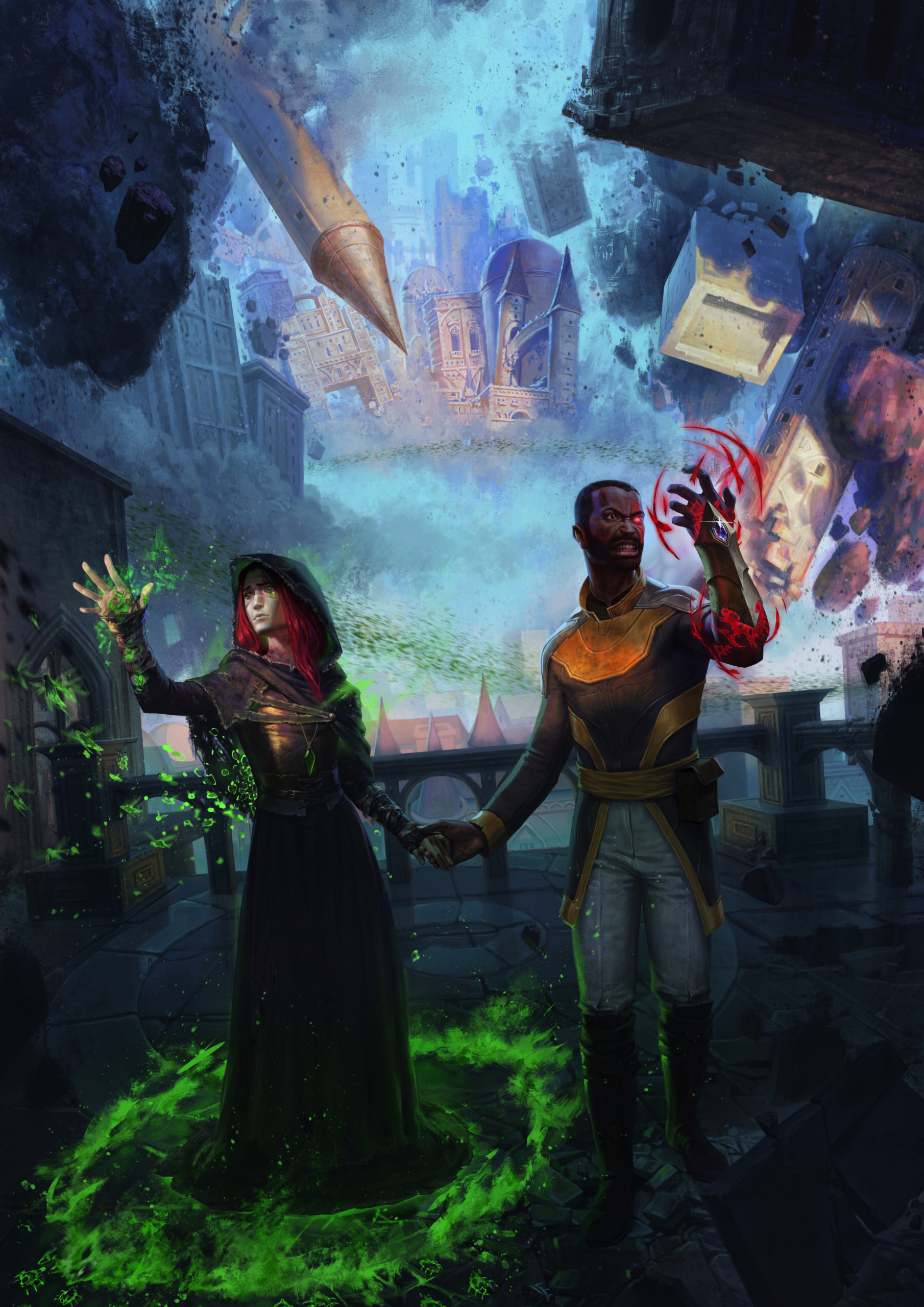
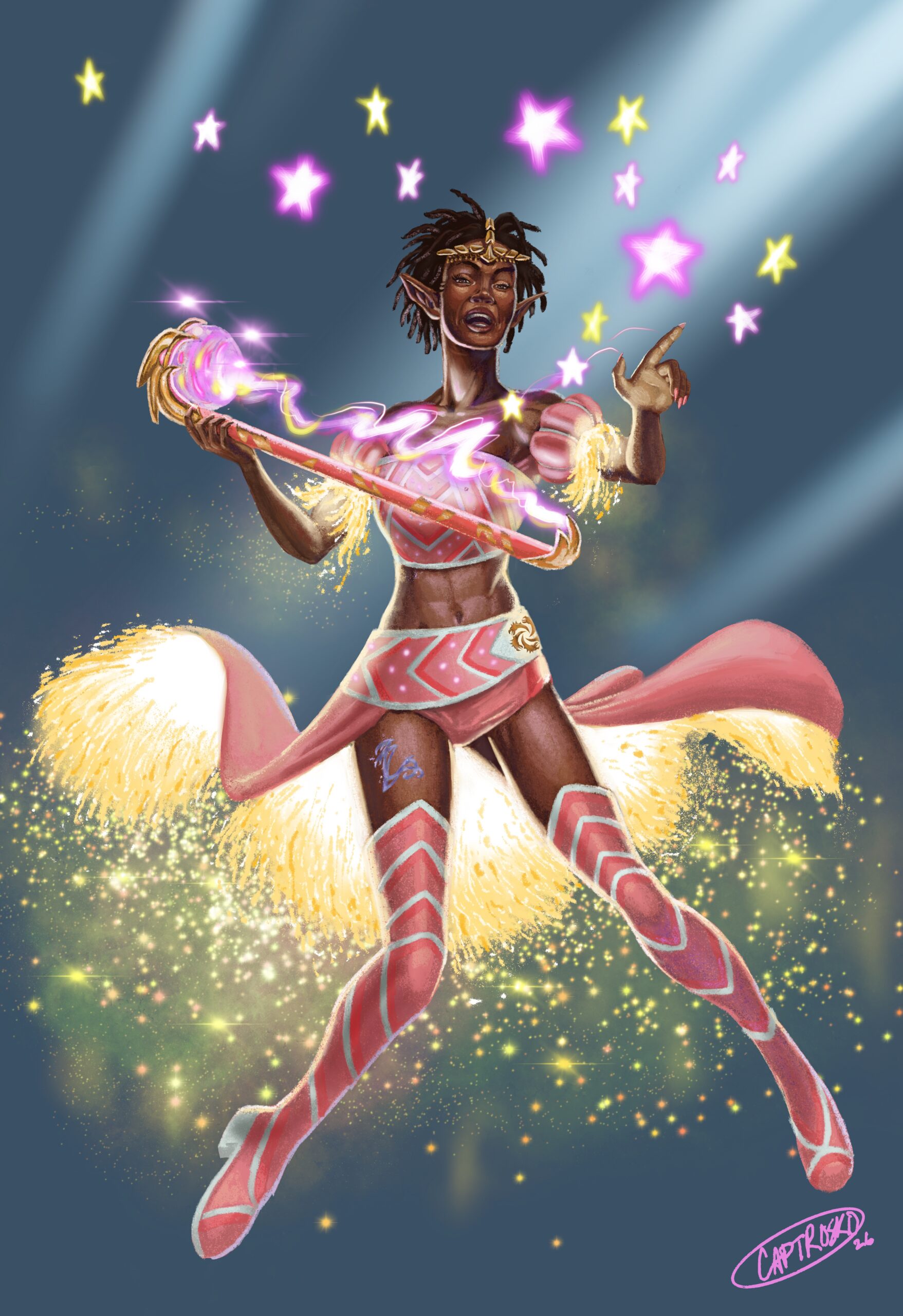
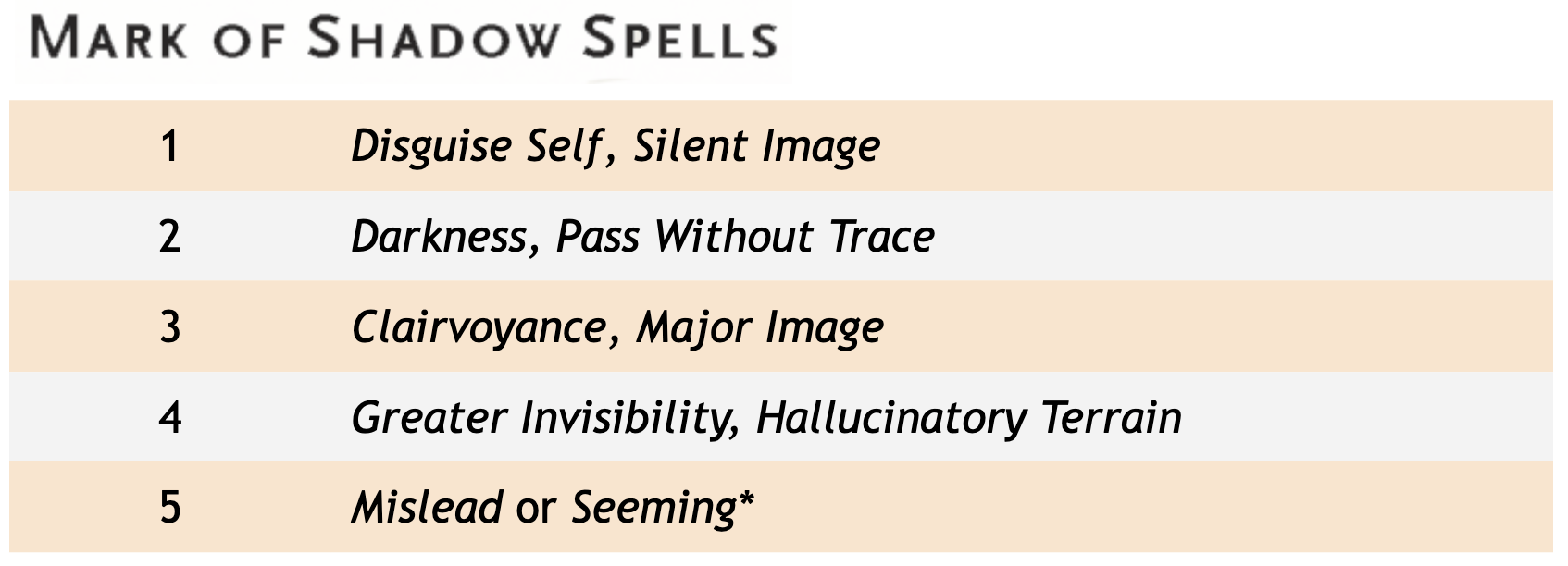

 Unlock with Patreon