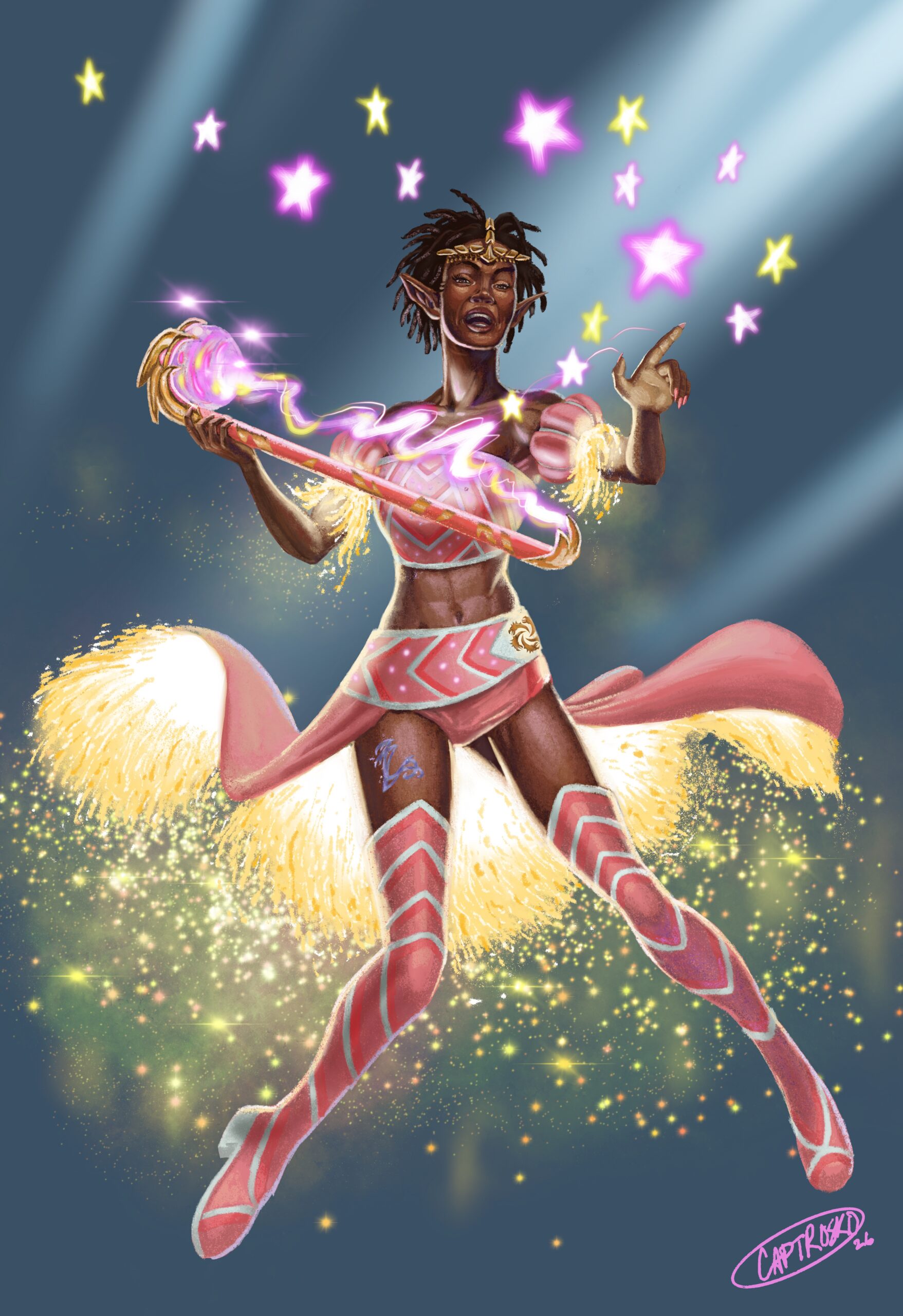
Musical paragon Bela “The Banshee” d’Phiarlan, depicted by Matthew Johnson!
When the elves of old settled the land they’d named Aeren’s Rest, they were scarred by all that they had lost. Setting aside those slain by the giants and those left behind, many elves died over the course of the journey—including Aeren, the visionary who guided them to their new home. The refugees wanted to make sure they never suffered such losses again, but disagreed on how to pursue this goal. Eventually, three major factions emerged. The Tairnadal sought to become avatars, living anchors for the spirits of their lost champions. The Vol believed that traditional necromancy was the answer, and they settled near the most powerful Mabaran manifest zone on the island. The Mendyrian thought the energies of Irian could be harnessed to preserve someone beyond death without subjecting them to the hunger of Mabar. In time, this would produce the Undying Court. Each of these factions rallied others to their side.
So where were my ancestors? They were everywhere. Before the fall of Xen’drik, my kin served as a bridge between the scattered and disparate elves, carrying news between different communities and cultures. We continued that work on Aeren’s Rest. We were equally at home in Shae Deseir and Shae Cairdal, and we sang songs of the patron ancestors to the warriors assembled in Var-Shalas. We sought to remind them of their common history and the bonds that united them. In this, we failed. When the line of Vol was destroyed, we chose to leave Aeren’s Rest behind. Still, people ask: Vampires, Deathless, Revenant Blades; how do the Phiarlan preserve their heroes? My people had no need to pursue such methods, for our champions were already immortal: we preserved them in song and story, and kept them alive with paint and stone. We don’t need to keep our ancestors trapped in idols or bound to rotting flesh; they are with us still, guiding us with their words and songs.
When dealing with House Phiarlan, keep one thing in mind: out of all of the Dragonmarked Houses, Phiarlan is the most beloved by the general populace. It is the greatest source of entertainment, a ray of sunshine in a gloomy world. The finest authors, the most popular musicians, the celebrated actors—they’re all part of House Phiarlan. The Mark of Shadow lets its bearer weave wonders with their imagination, using illusions to create music and bring stories to life. In the eyes of the public, the elves of House Phiarlan are artists, imagineers, and entertainers, all working to make the world a little more magical.
Of course, there is another side to House Phiarlan. The spies and assassins of the Serpentine Table linger in the shadows. But the services of the Table aren’t available or obvious to the general public. As far as a commoner is concerned, Phiarlan’s only business is the Entertainers and Artisans Guild (also known as the Eagle, inspired by the EAG acronym). And the simple fact is that the majority of Phiarlan heirs solely work as artisans or entertainers. For most Phiarlans, their devotion to their craft isn’t just a cover; it’s their joy and their life’s work. It’s not that the typical Phiarlan diva is also a spy. It’s that a Serpentine spy can gain access to a location by serving as part of the diva’s entourage, or if necessary by impersonating the diva; Disguise Self is one of the simplest powers of the Mark of Shadow. There are a handful of Serpentine agents who are legitimately superstars as well as spies; but most of Phiarlan’s artists and entertainers are exactly what they claim to be. The catch is that the heirs of the House know about the Serpentine Table and are obligated to assist the Table if called upon—providing information, access to supplies or locations, or even assisting an agent who needs to temporarily impersonate them.
So when creating a Phiarlan character, the first question to consider is their relationship to the Serpentine Table. Are they an active agent of the Table? Are they a civilian whose skills or position make them a frequent asset for the Table? Are they an artist who has little relevance for the Table—or potentially, an objector who refuses to assist it? An heir who refuses to cooperate with the Serpentine Table is likely to be cut off from the Eagle—which might explain why they’re living the life of an adventurer—unless they’re so good that the guild is willing to put up with their insubordination. With that said, a tenuous connection with the Serpentine Table can be an excellent hook for a Phiarlan adventurer. They aren’t part of the Table, so they don’t have regular duties or access to resources that would be unbalancing for a player character. But at any time, a Table connection can step out of the shadows with enigmatic instructions. Deliver this package at midnight. Go to this party with your friends and see who the Count talks to. You’re going to be the entertainment at Saidan Boromar’s birthday party. They don’t have clearance to know why they’re doing the things they’re doing… but an heir of the House must always be ready to serve the Table when it calls.
As a Phiarlan heir, beauty is your birthright. You’ve been trained in the arts of motion and music since childhood, and whatever you do, you do it with grace. If you’re proficient with Performance or an artistic tool, your talents may be obvious; but you don’t have to have Performance to perform. Performance is a catch-all proficiency, covering acting, storytelling, music and dance. But other proficiencies can be used to reflect narrow disciplines: Acrobatics for dance and artistic gymnastics; Deception for acting; Persuasion for storytelling. Beyond this, consider how your class and its abilities reflect your artistic talents. Bard and Monk are clear enough. But as a Fighter you may be demonstrating an ancient martial art preserved since Xen’drik; every strike you make is beautiful. A Phiarlan Barbarian could flavor their “rage” as a war dance, reducing damage not through sheer endurance but by evading the full blow. As a Wizard, you might have planned on a career providing special effects for theatrical performances; what led you to learn battle magic? Whatever path you choose, think about how you bring beauty into the world and what you love about your art. At the same time, you’ve been trained to always observe—both to appreciate beauty but also to gather information, never letting a secret slip by you. You’re an artist, but you never know when you’ll be called upon to be a spy.
THE MARK OF SHADOW
Humans often equate the word shadow with darkness. For the Phiarlan, shadow refers to shadows of reality—the insubstantial images of illusion. The simplest power of the Mark of Shadow is the ability to cast Minor Illusion at will, weaving images or sounds. This basic gift is reflected in the heir’s bonuses to Dexterity (Stealth) and Charisma (Performance) check; an heir can instinctively draw on shadows when hiding or use subtle illusion to improve a performance. Beyond these intuitive bonuses, the power of illusion is something Phiarlan heirs use constantly and casually. An heir seeking to draw attention will conjure a star into their raised hand. One telling a joke might add laughter or a sting to the punchline. When giving directions, an heir can manifest a floating map; when telling a story, they can add sound effects, music, or distinctive voices. The second ability all Dragonmarked heirs possess is Invisibility. Every heir with the Mark of Shadow can become invisible for up to an hour each day. This is a powerful defensive tool; a Phiarlan who’s threatened can turn invisible and retreat. It’s a fantastic gift for a stagehand, who can move around on stage to add elements to a performance without being seen. Phiarlans also use Invisibility when they desire privacy. A Phiarlan at a boring party might use their skills to liven things up—or they might turn invisible and read a book in the corner. When someone disappears at a social occasion without bidding farewell, it’s known as a “Phiarlan Goodbye.”
Disguise Self is a Spell of the Mark almost all Shadow heirs gain access to. While this can be used for impersonation—it’s a workhorse spell for Serpentine agents—heirs use it in many ways. Phiarlan actors can use the spell to assume the shapes of the characters they play, reducing the need for costuming and allowing multiple actors to easily share a role. Other Phiarlans use Disguise Self not to deceive others, but rather to enhance their own appearance—transforming clothing, adding makeup, styling hair in impossible ways. A Phiarlan might be disheveled and still in their pajamas, but with Disguise Self they can greet guests perfectly coiffed and elegantly dressed. For Phiarlan musicians, this can allow dramatic costume changes in the middle of a performance. Phiarlan heirs learn a host of simple applications of Disguise Self that function much like social media filters—minor cosmetic enhancements for particular situations.
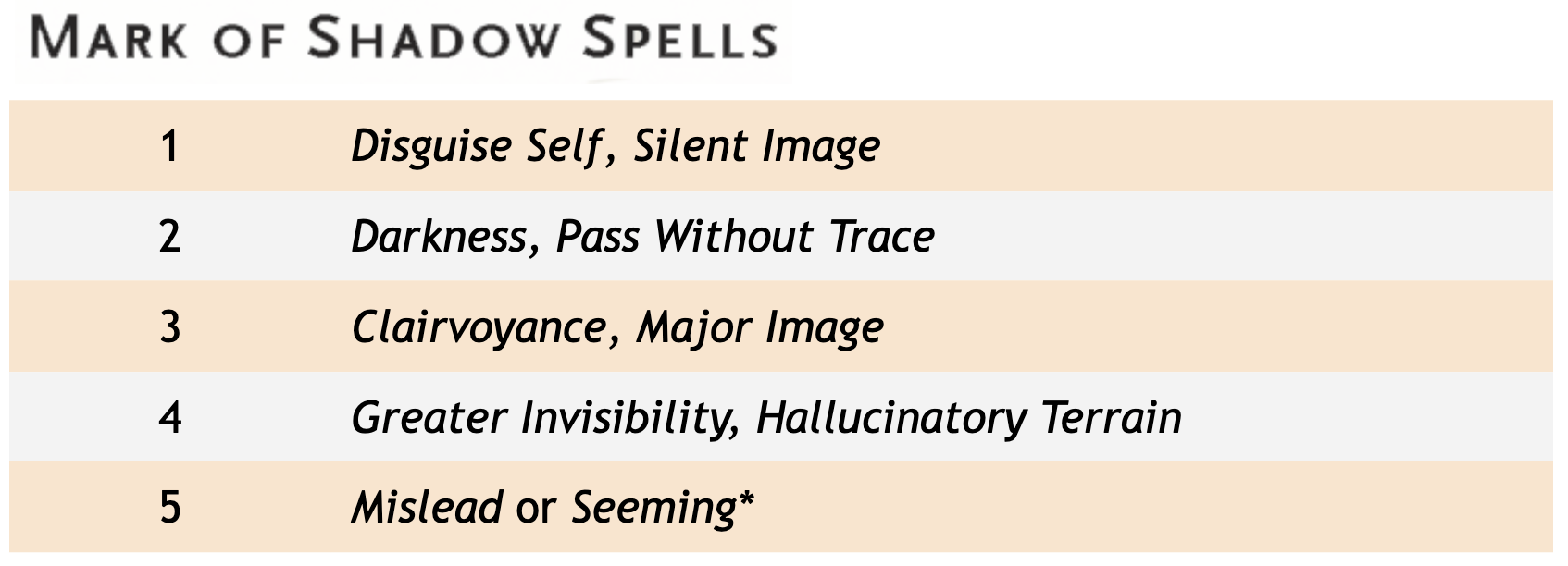
Beyond Disguise Self, there are two paths of Spells of the Mark. Player characters gain access to all of the spells, but most Phiarlan heirs can only use one of two sets of the spells. Those who are most extroverted generally have access to Silent Image, Darkness, Major Image, Hallucinatory Terrain, and Seeming. These gifts are incredibly useful for theatrical work; when enhanced by focus items, Hallucinatory Terrain and Seeming allow a stage master to weave a set and costumes from shadow. Conversely, introverted heirs usually develop the ability to cast Pass Without Trace, Clairvoyance, Greater Invisibility and Mislead. Such heirs may be drawn into the work of the Serpentine Table, but this path is also common for artists who prefer painting, sculpting, or writing to the company of others; the Mark gives them the power to avoid unwanted distractions.
At first glance, Clairvoyance is an outlier. Most Spells of the Mark allow the heir to project visions from their imagination into the world. Clairvoyance does the reverse; it allows them to draw images or sounds from the world into their minds. While Clairvoyance has obvious value to a spy, it’s a gift often manifested by Phiarlan artisans. Painters replicating scenes will often use Clairvoyance to refer to the inspiration from the comfort of their studios. Other artists often have a particular place that serves as a source of comfort or relaxation. A Phiarlan writer may “go to their quiet place” when dealing with writer’s block.
One thing to keep in mind when dealing with House Phiarlan is that its heirs wove shadows long before they possessed the Mark of Shadow. The ancient Phiarlans who traveled across Xen’drik were often accomplished Bards who relied on Invisibility to evade their enemies and who used illusions to enhance their tales. The Mark of Shadows granted innate abilities to Dragonmarked heirs, but the Phiarlans had been working with illusions for tens of thousands of years before it appeared. Phiarlan heirs who don’t manifest the Dragonmark can train at the Demesne of Shadow to learn traditional techniques for summoning illusions; because of this, there’s less of an inherent gap between marked and unmarked heirs than you see in some Houses.
Phiarlan Verbal and Somatic Components. Whether they are casting Spells of the Mark or bardic magic, heirs of House Phiarlan usually make spellcasting a performance. Verbal components require the caster to speak in at least a normal speaking voice, and somatic components require the caster to have a free hand. But these components don’t have to be limited to chanting or gestures. A Phiarlan heir can sing their spells, weaving words of power into their songs. Their gestures can be part of a full dance, or they can just be graceful motions performed with hypnotic rhythm. When the legendary Elorrenthi blinded the King of Fire with her dancing, this was the working of a spell woven into a perfect performance. With that said, a key aspect of components is that they are always clearly recognizable as being tied to spellcasting. A Phiarlan doesn’t hide the fact that they’re casting Enthrall with their song or weaving a Major Image as they dance; they just make the casting a beautiful thing.
Kanon vs Canon. The only change I’ve suggested to the canon Mark of Shadow is the addition of Seeming as a possible Spell of the Mark. Mislead is a fantastic spell for an adventurer or assassin, but Seeming is exceptionally useful for a company of actors. A player character with the Mark of Shadow must choose whether they have access to Seeming or Mislead; the feat only grants one of these spells. I do have another house rule tied to House Phiarlan. The House Phiarlan Heir background provided in Forge of the Artificer is a good background for an agent of the Serpentine Table, but it doesn’t provide proficiency with Performance or an instrument, which most Phiarlan heirs should possess. Because of this, I would allow someone who wants to play a typical Phiarlan heir to take the Entertainer background but replace the Musician feat with the Mark of Shadow.
FOCUS ITEMS
House Phiarlan has developed a host of tools that channel the powers of the Mark of Shadow. Some of these are designed to enhance an heir’s ability to entertain, while others are tools crafted for the Serpentine Table and its agents. Many of these duplicate the effects of existing magic items, though they require the user to possess the Mark of Shadow. The Cloak of Shadows is Phiarlan’s version of the Cloak of Elvenkind, while Tialaen Trumps are a form of Deck of Illusions. Two of the House’s most important magic items are both variations of the Crystal Ball. The Serpentine Mirror is a massive mirror—typically 3 to 4 feet across—which displays images on the surface of the mirror. The Serpentine Table has over a dozen of these Mirrors, including two with the Mind Reading feature. The Mirror of the Mind—a Serpentine Mirror with the Telepathy feature—is one of the greatest treasures of the house. It’s possible that the Mirror of the Mind was kept in a secret facility in Cyre, in which case it may have been lost in the Mourning; if this is the case, the House is surely desperate to recover it. While the Serpentine Mirrors are tools of espionage, House Phiarlan and House Cannith worked together to develop another variation of Crystal Ball: the Crystal Theater. A Crystal Theater is a small orb that can scry on a specific location or anchoring focus item; when attached to a Projector Stand, it can cast that image onto a larger surface. This allows audiences to watch theatrical events that are occurring on distant stages. This is a relatively new development, and a Crystal’s images are often a little jerky or fuzzy; crystal shows aren’t yet threatening the popularity of live performances, but offer an alternative for people who can’t afford to attend live shows. Crystal Theaters and Serpentine Mirrors can only be operated by an heir who has the ability to cast Clairvoyance using the Mark of Shadow.
Here’s a few other examples of Phiarlan focus items.
Instruments of the Bards: Elorrenthi Rod
Wondrous Item, Uncommon (Requires attunement by a Bard with the Mark of Shadow)
This item is a Thurimbar Rod designed to channel the power of the Mark of Shadow. A creature that attempts to play the Rod without being attuned to it must succeed on a DC 15 Wisdom saving throw or take 2d4 Psychic damage.
You can play the instrument to cast one of the following spells: Color Spray, Faerie Fire, Fly, Invisibility, Levitate, Mirror Image, Protection from Evil and Good. Once the instrument has been used to cast a spell, it can’t be used to cast that spell again until the next dawn. The spells use your spellcasting ability and spell save DC.
Scrystone
Wondrous Item, Rare (Requires attunement by a creature with the Mark of Shadow)
When a creature holding this crystal uses the Mark of Shadow to cast Clairvoyance, the spell is enhanced in the following ways.
The duration is increased to one hour (Concentration).
The maximum range of the sensor is increased to 10 miles.
The spell allows the caster to both see and hear through the sensor.
The caster may communicate telepathically with a willing creature perceived through the Scrystone, provided that they either know the creature personally or that the creature is carrying a Shadow Eye.
A Scrystone is a disk of glass inlaid with silver, with a small siberys dragonshard embedded in the center. Scrystones are sometimes concealed within false books or otherwise disguised so that the bearer can use the stone in a public space without drawing attention.
Shadow Eye
Nonmagical Item
Shadow Eyes are designed to assist Phiarlan scrying operations. A Shadow Eyeis a shadow of glass with a single hair embedded within it; Eyes are created in pairs, which are bound together by a sympathetic link. This isn’t an active magical effect and a Shadow Eye doesn’t register as magical to Detect Magic or similar effects. However, someone who possesses a Shadow Eye can use Clairvoyance or Scrying (including casting these spells through an item, such as a Serpentine Mirror) to target the Eye that’s linked to the one in their possession, provided it’s within range of the spell. Thus, if a Shadow Eye is planted in King Boranel’s bedroom, an heir with the linked Eye can spy on the king even if they aren’t personally familiar with the location.
Shadow Shaper
Ring, Uncommon
When a creature wearing this ring uses the Mark of Shadow to cast Minor Illusion, they may choose to increase the duration of the effect to 1 hour. However, when cast in this way, the cantrip requires Concentration.
Stagemaster’s Crown
Wondrous Item, Uncommon (requires attunement by a creature with the Mark of Shadow)
A Stagemaster’s Crown is a plain leather band embroidered with silver thread and holding a single small siberys shard; it’s worn as a headband. A creature wearing a Stagemaster’s Crown gains the following benefits.
When they cast Hallucinatory Terrain, they can use it on unnatural environments (such as walls and furniture). This can change the outward appearance of an object but it can’t make things invisible. So in a room with a chair and a Karrnathi banner, the chair could appear to be a throne and the banner could be changed to be a Brelish banner—but the spell can’t make the chair vanish.
When they cast Seeming, the duration is extended to 24 hours.
Thunderous Amulet
Wondrous Item, Common
While wearing this amulet, a creature that possesses the Mark of Shadow can amplify their voice to up to three times its normal volume.
The seal of House Phiarlan, depicted by Matthew Johnson.
THE HISTORY OF HOUSE PHIARLAN
The traditions of House Phiarlan are older than any human civilization. The elf rebellion against the giants wasn’t the work of a monolithic force. While many of the elves were enslaved by the giants, others had scattered across Xen’drik. Some were nomadic warbands, laying the path for the modern Tairnadal. Some established strongholds, such as the wizards and necromancers of the Qabalrin. In this time, “phiarlan” was a job, not a family. “Phiarlan” roughly translates to “spirit keeper”—not spirit as in ghost, but rather morale or hope. Phiarlans traveled across Xen’drik, evading the giants and serving as a bridge between the elf communities. Phiarlans carried news and trade goods, but beyond that, they carried stories and songs. They learned the artistic traditions of each subculture and shared them with other elves, seeking to strengthen bonds between the scattered communities. Phiarlans helped to set the uprising in motion, and over the long course of the war they played a vital role in coordinating actions, maintaining the morale of the rebels, and resolving disputes that could have fractured the elf alliance. The iconic phiarlan was a true Bard, wielding arcane magic; they used illusions to confound and evade enemies, and also in the artistic performances that inspired their allies. They facilitated communication using Sending as well as physically traveling between communities. In addition to working with the elves, the phiarlans used their gifts to spy on the giants—slipping invisibly through Sulat strongholds or blending in with Cul’sir laborers; and so they learned to spy as well as to entertain. In some cases they did both. The legendary Elorrenthi was so skilled in her craft that she earned the patronage of the titan Haskar, allowing her to move freely throughout the Group of Eleven.
When the visionary Aeren foresaw the cataclysm coming to Xen’drik, they called on the phiarlans to spread the word and rally as many elves as possible to construct a fleet and flee. Five phiarlans answered the call: Tialaen, Elorrenthi, Shol, Thuranni, and Paelion. Together with their families and followers, these champions guided elves from across Xen’drik to Aeren’s hidden harbor. For a moment, the elves moved as one; but once they reached Aerenal, they scattered into factions. Eventually, three major forces took root: the Tarnadal in the north, the Line of Vol in the south, and the alliance that produced the Undying Court in the center. The phiarlans chose not to claim territory or to build a city of their own. Instead, they continued the work they’d been doing for thousands of years: traveling between the disparate communities, sharing news and telling stories. They performed the works people wanted to remember, sharing tales of Vadallia and Cardaen with the Tairnadal, retelling the fall of the Heart of Siberys in Shae Deseir, and playing the great works of the Mendyrian and the Tolaen in Shae Cairdal and Pylas Zirinth. But they also took pains to share the pieces beloved by other lines—to sing Qabalrin funerary songs to the Melideth and to tell tales of Falaen the Silence to the Jhaelian. Not only did they want these things to be remembered, they sought to fight the growing division between the three factions—to remind all the elves of Aerenal of their common roots and ancestors. In pursuit of this goal, the phiarlans shared songs and stories with the common people… but they also shared secrets with the leaders of the Lines, believing that the best way to foster unity was to bring these into the light. And so things continued for thousands of years, through the rise of the Undying Court and the Vol’s vampire cabinet, through assaults from Argonessen and clashes with Dhakaan. Time and again, the phiarlans helped to defuse tensions before conflicts could arise. And then… the Dragonmarks appeared.
The appearance of the Mark of Death and the Mark of Shadow had less impact in Aerenal than those Dragonmarks that manifested on mainland Khorvaire. The Line of Vol were already exceptional necromancers, and phiarlan Bards already wove illusions into their performances. Where for many of the Houses the Dragonmarks allowed them to do things that were impossible without the Mark, for the Phiarlans the Mark of Shadow simply made things easier and widespread throughout the family. Where in the past a phiarlan might spend a century training to be a Bard, now half of the heirs had the ability to cast illusions without any training at all. So the Dragonmarks were a remarkable gift that made the work of the Phiarlans easier, but they didn’t change the work the families were doing in Aerenal or the services they offered. The same was true for the Line of Vol. But the appearance of the Dragonmarks was a mystery and a source of suspicion and fear. Why were these particular lines chosen to carry these Marks? What greater power was involved? And surely this was exacerbated by a sense of jealousy. The followers of the Undying Court believed their creation was the defining achievement of the elves. They already despised the Line of Vol for challenging this belief—having the Vol manifest what seemed to be a connection to the Prophecy was salt in this wound. It was the Paelions who discovered Vol’s alliance with the Emerald Claw, experiments designed to take Dragonmarks to that theoretical next level; and when they revealed this to the Sibling Kings, it was the excuse they needed to act. The phiarlans sought to intervene and to mediate, but the Undying Court and its allies from Argonnessen would not be dissuaded. In the aftermath, the phiarlans felt that they had utterly failed in their longstanding purpose; worse still, they feared that they would now be targeted by those who feared their Dragonmarks. The leaders of the five Phiarlan families gathered around their Serpentine Table and made the decision: they must leave their homeland behind and carve out a new destiny on Khorvaire. Knowing that they were traveling into an unstable future where they would have to create new traditions, they chose to formalize their long-standing loose arrangements. They initially declared themselves to be the Line of Phiarlan; within a century, they would become House Phiarlan.
The Phiarlan exiles arrived in Korranberg, where they received a warm welcome from House Sivis. The gnomes were thrilled to study a new Dragonmark, and delighted by the entertainment Phiarlan offered. The gnomes already had a knack for illusion, and the Phiarlans adopted the Thurimbar Rod at this time. However, it was precisely because of this overlap that the elves saw more opportunity among the young human nations. They had raised some capital selling Aereni artifacts in Korranberg, and invested this to create a theater and academy in what would come to be called Wroat—a precursor to the modern Demesne of Motion. This served as an anchor point for the elves. From this base, teams of Phiarlans wandered across Khorvaire, gathering information and learning the artistic traditions of the human cultures. While there were those who distrusted the elves, in time they became celebrated entertainers welcome in most communities. Their first great setback came in -2190 YK. Breggor Firstking of Wroat took offense at a Phiarlan depiction of the siege of Shaarat and razed the first Demesne. The elves fled Wroat, but wherever they went they shared tales of Breggor’s cruelty and revealed his secret shames, mocking his obsession with the city he called Sharn. In the play “The Beggar King” a guilt-wracked Breggor finally throws himself off the tallest tower in his city… but within House Phiarlan it’s commonly accepted that it was the assassin Rol Paelion who flung Breggor into the Dagger.
House Sivis helped the Phiarlans regroup and rebuild, drawing them into its alliance with Cannith and Deneith. The House spread its roots wider, establishing theater enclaves in the largest cities of the time. Phiarlan continued to establish its reach and reputation, and launched the Carnival of Shadows as a traveling show. During the War of the Mark, Phiarlan played a minimal role in combat operations—but its wide web of performers served as an invaluable source of intelligence for the House forces. It was at this time that the House formally established the Serpentine Table. Phiarlans had served as spies and assassins as far back as Xen’drik. But now that the shape of the House was changing—moving away from the traveling bard and placing a greater emphasis on theatrical work and static entertainment—they saw the value in maintaining a dedicated corps of spies, and in selling information. In Aerenal the phiarlans used their secrets to maintain a balance between the factions. In Khorvaire, the Serpentine Table would be a business; but they would choose their clients carefully. The House thrived over the centuries. Phiarlan productions were the pinnacle of entertainment. Any quality tavern sought to have a Phiarlan musician in residence, or at least one trained by the House. And most powerful nobles had a court musician as a source of entertainment, but also for those chosen few, as a liaison between the leader and the Serpentine Table.
House Phiarlan worked with Galifar Wynarn in his campaign of unification. The Shol provided battlefield musicians. Tialaen and Elorrenthi excelled at providing intelligence. And Paelion and Thuranni urged Galifar to employ their heirs to assassinate his enemies. Galifar was reluctant to win his crown through such ignoble means, and he warned the House that it should never assassinate any head of state, even those who were his enemies; should he discover such a thing had occurred, he would do everything in his power to see Phiarlan destroyed. This edict held in the centuries that followed, though some monarchs of Galifar were willing to use a Paelion blade to remove a lesser threat. This changed when Queen Hala ir’Wynarn sought to break the close ties between Phiarlan and the crown, seeing the elves as a corrupting force no ruler should rely upon. It was Hala who created the Citadel, as an intelligence gathering force devoted to Galifar and adhering to strict moral codes… though later rulers removed many of Hala’s restrictions, and even established the King’s Shadows as an order of royal assassins.
House Phiarlan prospered in the centuries that followed. It expanded the role of the Entertainers and Artisans Guild, training and licensing musicians and artists across Galifar. The Serpentine Table took part in noble intrigue and feuds between Dragonmarked lords… and some of those vendettas occurred inside the House. There had been tension between Paelion and Thuranni before the Phiarlans even came to Khorvaire. Thuranni maintained that Paelion had made a terrible mistake in exposing the plans of the Line of Vol; Paelion asserted that Thuranni had always unfairly favored Vol, that Thuranni was jealous of Paelion skill, that Thuranni really needed to bathe more frequently so their enemies wouldn’t smell them coming, and that was just the beginning of it. The Last War exacerbated these tensions. While the House served all nations, leaders within the House often accused one another of having favorites. This came to a bloody breaking point in 972 YK. The Thuranni and the Paelions were the two lines that specialized in assassination. In 972 YK, Lord Elar Thuranni d’Phiarlan slew Lord Tolar Paelion d’Phiarlan and his family, and Thuranni heirs across Khorvaire murdered Paelions in a brilliantly coordinated assault. Lord Elar claimed that Paelion was preparing a brutal strike of its own, that they planned to assassinate all of the monarchs of the Five Nations and the leaders of the Dragonmarked Houses—including their Phiarlan cousins. Baron Elvinor Elorrenthi d’Phiarlan said that even if these claims were true, such kinslaying could not go unpunished; the entire line of Thuranni was declared excoriate. Elar defied Elvinor’s judgment and declared that Thuranni was henceforth its own House; a number of the lesser Phiarlan families chose to take Thuranni’s side. Elvinor considered a war with Thuranni, but the Phiarlan Lords Seneschal counseled against it. Perhaps Elar’s claims were true and his actions were justified, they said; beyond that, there’s no question that none wished to start a full scale war with the line that specialized in assassination. Let our rivalry play out on stage and in song, they said; but let no more Phiarlan blood be said.
At least… that’s the story the Barons tell. Some whisper that it’s a carefully crafted fable. In truth, they say, Elvinor and Elar are the closest of allies. They have plans for the future of the Houses of Shadow that Paelion would never accept. In this model, Elvinor supported the slaughter of the Paelions. Even the schism itself is part of the plan. Phiarlan was growing stagnant; splitting the House into two distinct brands, allowing for dramatic artistic conflict, would engage the public and invigorate the heirs. Only the DM knows which tale is true—if Elvinor d’Phiarlan and Elar d’Thuranni are the bitterest rivals or secret allies. And if they are allies, only the DM knows what pieces of their plan have yet to unfold.
This is an excerpt of the full article available to my Patreon supporters. This is just a third of the full article, which includes the structure of the House, Phiarlan customs, families, character and adventure hooks, and more Focus Items!
I like that the Phiarlans weren’t so hidebound that they didn’t accept the Zil gnomes offering them their own fancy magic item instruments in the form of their own focus item version of a thurimbar rod. It shows that they’re distinct from the Aereni and Tairnadal in embracing a new magic technology that makes their performances better or easier.

“The Shadow”
https://www.youtube.com/watch?v=nJjhtQiUzRY
I’m sorry, it had to be done 😛
I like that the Phiarlans weren’t so hidebound that they didn’t accept the Zil gnomes offering them their own fancy magic item instruments in the form of their own focus item version of a thurimbar rod. It shows that they’re distinct from the Aereni and Tairnadal in embracing a new magic technology that makes their performances better or easier.