You’re right, Lord Ruken. We’re talking about a great deal of gold. But there are a few things that only you know. Only you know the fervor of your enemies and how far they would go. Is there anyone who might scry upon you, seeking to pry your secrets from your private conversations? Is there anything in your home you truly can’t afford to have stolen? Is it possible that someone hates you so much that they might seek to kill you… or to harm you by harming those you love? Only you know these things, my lord… and only you know what peace of mind is worth to you.
The heirs of House Kundarak are often maligned as being paranoid, always suspecting the people around them of coveting their fine possessions. This is a foolish fabrication. But there are two factors that play into this stereotype. The first is Kundarak’s great wealth. Most of the houses became wealthy because of their success. But the Kundarak lords were wealthy long before they became a House, possessing riches greater than any western king. There have always been those who have sought to steal Kundarak gold, whether through force or guile. So if Kundarak heirs look at the world around them with a little suspicion, it’s because history has given them good reason to be cautious. Beyond that, those who carry the Mark of Warding feel an inherent urge to protect the things that matter to them. Heirs of House Sivis love words. Those who carry the Mark of Making are often tinkering with something. And the dwarves who bear the Mark of Warding are always ready to protect the things they love. The Mark of Warding seals and shields, but it also allows its bearer to create deadly traps that will punish those who trespass against them. Kundarak won’t just keep you from touching their things; they’ll leave you with a bloody stump for daring to make the attempt. These threads run through the psyche of every Kundarak heir: pride in what they possess and what they have accomplished, and a fierce instinct to protect what they love and to punish those who would try and take it.
While some might expect Kundarak heirs to be avaricious, the truth is often the opposite. Some of the greatest philanthropists in the history of the Five Nations have been Kundarak viceroys, and heirs of the house are often generous with their friends. Kundarak teaches its heirs to be sharp in matters of business, to cut to the heart of a situation and identify its risks. But the House also teaches its children that a life driven solely by the pursuit of wealth is as cold as a copper coin. A Kundarak heir always considers the costs of things, and anyone who knows a Kundarak dwarf has probably had a moment when their friend has stepped in to haggle on their behalf or to warn them of a possible scam. But this is because what the heir values most is friendship. Kundarak heirs won’t waste gold, but they aren’t afraid to spend it on things that truly matter, including helping their friends and creating fine memories. Likewise, Kundarak dwarves usually have treasures, whether those are heirlooms passed down to them or things they’ve worked to acquire. Some of these things would be seen as treasures by anyone; many heirs appreciate art, jewelry, and goods of the highest quality. But others have more of a personal value. A copper tankard that’s the last surviving mug made by a distant ancestor. A rare book of poetry by a poet who’s still unappreciated long after their death, but which the dwarf loves. A silver coin they struck as a child, when their mother took the mint. Beyond this, every Kundarak heir has something they dream of acquiring. This is a game that starts among children, as heirs declare what wonders they will one day possess, and these desires are refined as they grow. This could be a title, a family, an estate… but most heirs have something very concrete in mind, whether it’s an artifact or a piece of art. So in making a Kundarak heir, consider: What treasures do you possess, and what do you yearn to obtain? What do you value above all else, and what would you do to protect the things that you love?
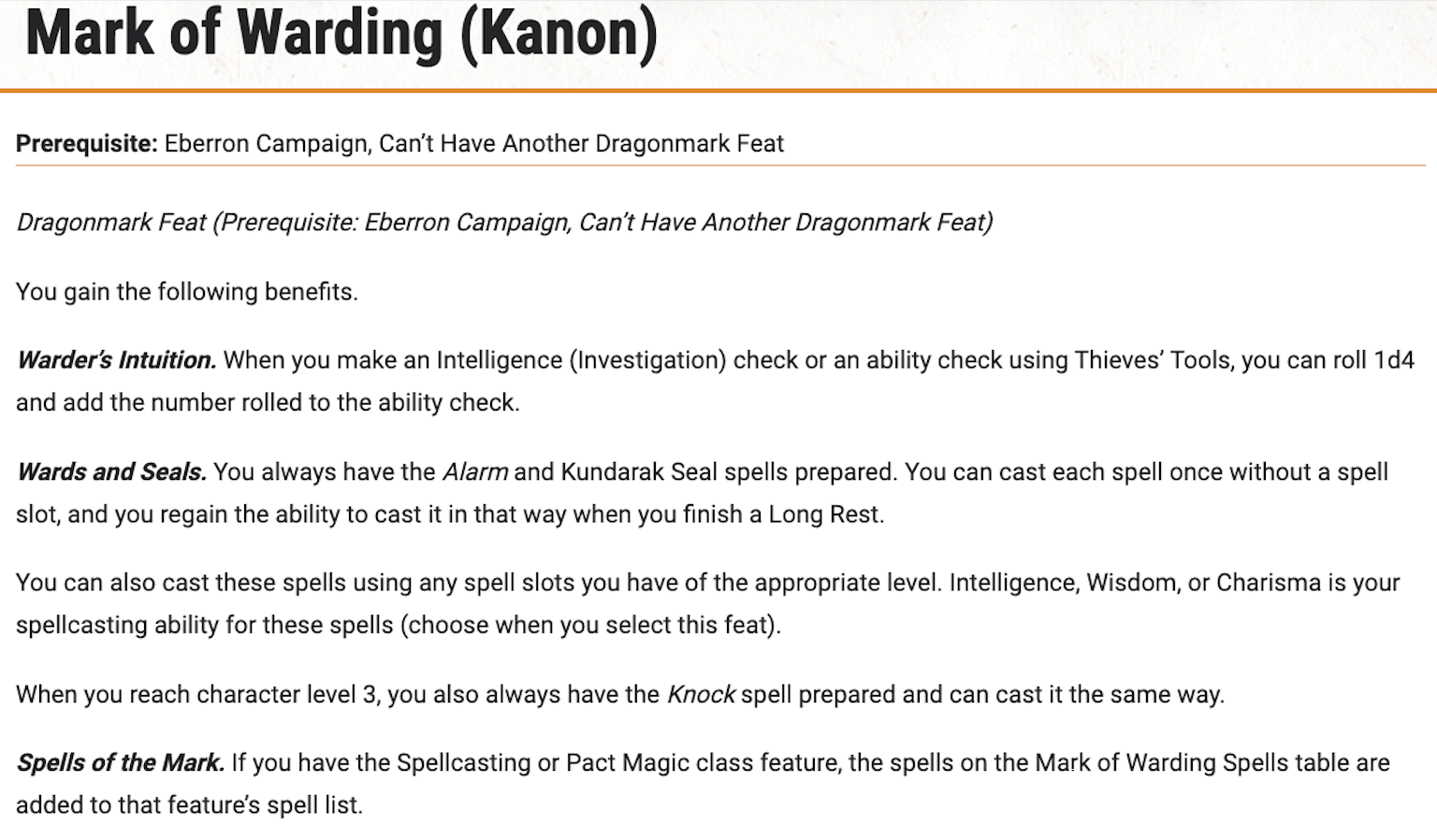
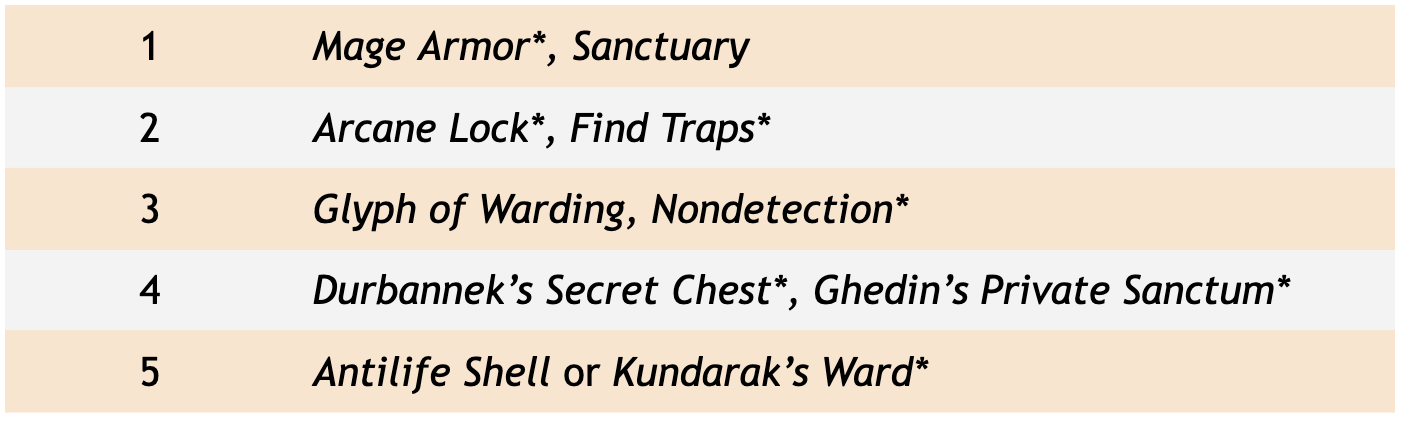
Note: The version of the Mark of Warding presented here differs from what is presented in Forge of the Artificer. This is the version I am using in my campaign, but it is not official! My reasons for these changes are described later in this article.
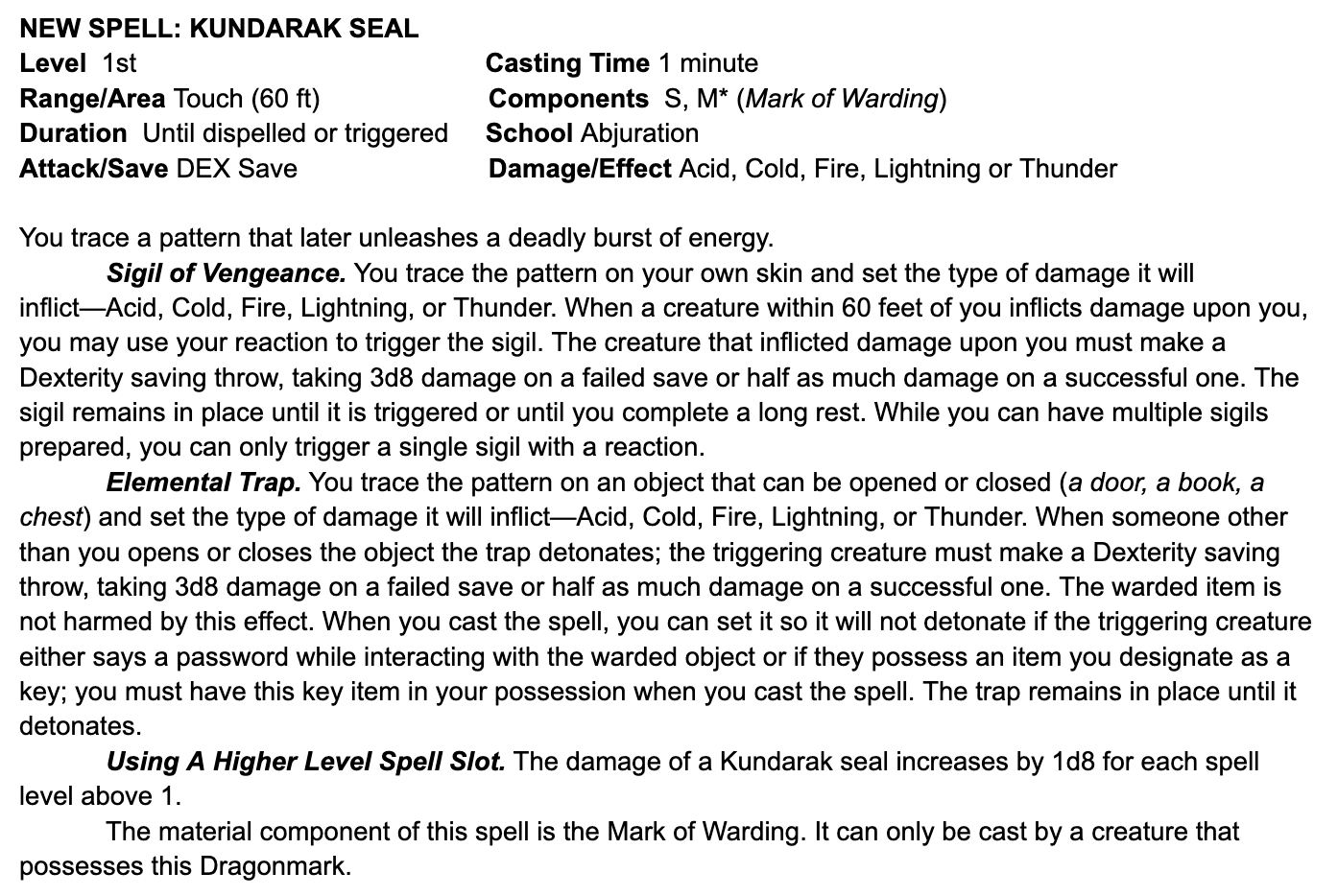
When an heir of House Kundarak first manifests the Mark of Warding, they are placed in isolation while they master its first two gifts. The first of these is a peaceful source of comfort: the ability to set an Alarm. As a ritual spell, this can be cast at any time. The heir studies the space or the portal they wish to ward, and imagines energy flowing from their dragonmark to fill that space. While there is no actual sentience to an Alarm spell, most Kundarak heirs imagine a guardian—crafting the story of the spirit that serves and protects them. The heir traces the patterns of the Mark of Warding in the air and murmurs instructions to their guardian (the somatic and verbal components of the spell), thanking the spirit for its service and telling it whether to respond to intrusion by warning the heir directly or making a noise. For most Kundarak heirs, this is a comfortable experience; it makes them feel protected and secure. Heirs with a newly manifested Mark are encouraged to cast Alarm over and over, warding everything in sight. This power poses no danger to anyone. But the second gift of the Mark of Warding is another matter entirely, and this is the reason new heirs must be isolated. Every heir can feel the power of the Mark promising protection. If they let instinct guide them and trace the pattern of the Mark, power flows through the Mark and into that seal, burning with the determination to protect and to punish. This is the Kundarak Seal, the first step toward a Glyph of Warding. It can be placed on anything that can be opened or closed—a door, a window, a chest—or on the heir’s own skin. With time and training, an heir can weave safeguards into the seal, setting a word of safe passage or choosing when to trigger the seal on their skin. But in those first days these traps pose a danger to everyone; a playful shove is enough to trigger a Sigil of Vengeance and injure or kill a friend. Foundlings with the Mark of Warding are rare, and often have tragic tales of loved ones harmed by an Elemental Trap before the heir mastered their powers. This isn’t a danger for long. Once an heir understands this gift, they can contain a Sigil of Vengeance until they choose to unleash its power; most heirs start each morning by tracing the mark on their skin and setting that ward against enemies. This is something everyone knows about Kundarak heirs—You strike a blow against them, and they’ll blast you with vengeance. It’s something that gives Kundarak bankers and negotiators confidence when dealing with strangers: you harm me at your peril.
Further gifts of the Mark of Warding offer both sides of a coin, as heirs learn both how to protect the things they love and how to bypass protections. An experienced heir can seal anything that can be opened, weaving an Arcane Lock; but they also possess the power to Knock, opening any door. They have an intuitive knack for using Thieves’ Tools to create traps and locks as well as to remove them; they can set deadly wards, but they also have a talent for Investigation and for mystically finding traps. Warding-marked heirs often have a fondness for puzzles; there is an intuitive satisfaction that comes from opening a look or unraveling a mystery.
Player characters and remarkable NPCs can master both powers of the Least Mark of Warding, but most heirs only learn one of its two paths. Those drawn to the path of Wards gain the ability to cast Nondetection and Private Sanctum. These allow the heir to shield objects, people, or places from divination magic, and also to prevent teleportation into or out of a particular space. Private Sanctum can be made permanent, and most long-established prisons have Kundarak wards that prevent teleportation. Those who follow the path of Seals gain access to Glyph of Warding and Secret Chest. These heirs are the trapsmiths of the House, weaving Glyphs into security systems for valued clients.
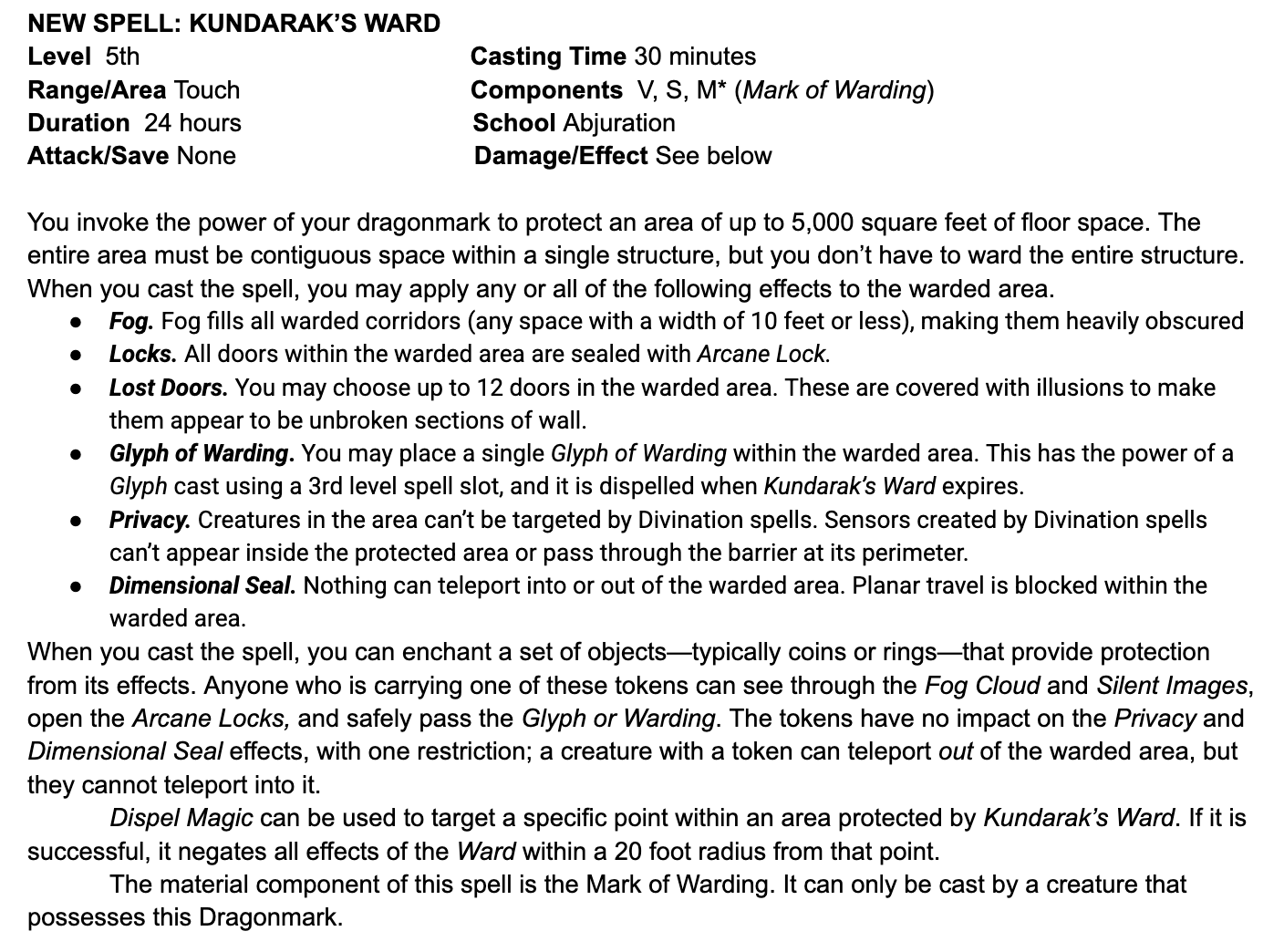
The final gift of the Greater Mark is one that even player characters have to choose between. The rarer of the two options is the ability to cast Antilife Shell, keeping all living things from approaching the Warding heir. Those with this gift often worked with House Deneith during the last war; a Warding heir could shield a Siege Staff crew and keep them from being overrun. Heirs with this power are rare and as the war went on, the use of Warforged constructs and Karrnathi undead reduced its value, but there were still times when these wars played a key role in a battle. The more common gift of the Greater Mark is Kundarak’s Ward—a power that weaves Private Sanctum, Arcane Lock, and Glyph of Warding together to protect a stronghold. Many noble estates have Housewards that maintain Kundarak’s Wards. With that said, when an heir casts Kundarak’s Ward they choose which effects to implement. Most nobles don’t want to have their hallways filled with fog!
Durbannek’s Secret Chest and Ghedim’s Private Sanctum are identical to Leomund’s Secret Chest and Mordenkainen’s Private Sanctum, just using the names of the Kundarak families who specialized in these spells in the early history of the House.
Kanon vs Canon. Most of the time I prefer to hold to current canon, but I’ve made a significant number of changes here. The core abilities remain the same; what I’ve swapped are the spells. My goal here is to work with the original idea of the Mark, the services Kundarak provides, and what feels logical and cohesive to me. Specifically…
- Forge of the Artificer assigns Mage Armor to the base mark and Armor of Agathys as a spell of the Mark. Mage Armor is fine, but it’s useless for adventurers who use medium or heavy armor, so I shifted that to be the Spell of the Mark and replaced Armor of Agathys with Kundarak Seal. Kundarak Seal draws on Fire Trap (which was part of the 3.5 Mark) but adds the idea that you can use it to trap YOURSELF. This is similar in concept to Armor of Agathys and Hellish Rebuke—you hurt someone who hits you—but you have to cast it in advance. It keeps the idea of Elemental Trap as a service Kundarak heirs can provide, but Sigil of Vengeance is likely to be more useful for the typical adventurer.
- The typical adventurer has more use for Knock than Arcane Lock, and both are useful for the House businesses, so I made Knock the spell provided by the base feat and Arcane Lock the Spell of the Mark.
- I swapped Nystul’s Magic Aura with Find Traps because to me, Magic Aura is more about deception than protection, and that’s not something that is reflected in the other spells of the mark. Meanwhile, Find Traps establishes that the Mark of Warding gives its bearers a broad affinity for traps, which is reflected by the Intuition with Thieves’ Tools and is one of their main fields of business. Just as the Mark allows you to lock and unlock things, it makes sense to me that it can help you find traps as well as to set them.
- I replaced Magic Circle with Nondetection because Nondetection was an original spell of the mark in 3.5 and because it’s consistent with Private Sanctum—establishing that the Mark can ward against divination—while there’s no other Mark effects that feel aligned to Magic Circle (such as Hallow or Protection From Good And Evil).
- I swapped Faithful Hound with Private Sanctum because I previously assigned Faithful Hound to Ghallanda. While Faithful Hound isn’t a bad option for Warding, Private Sanctum is consistent with Nondetection and it fit to me that Ghallanda could set a spectral blink dog to guard your door while Kundarak would ward a wider area.
- Guards & Wards was a key feature of the Mark of Warding in its original incarnation. Aside from being a 6th level spell, the standard Guards & Wards goes kind of over the top (There’s spiderwebs in every staircase! There’s confusion spells at every intersection!), and I wanted to tone that down a little — and since the Mark now includes Private Sanctum, it made sense to weave that in. So Kundarak’s Ward is a watered down Guards & Wards with added functionality from Private Sanctum. Notably, it doesn’t have the “Cast every day for a year to make permanent” clause; it’s maintained by Housewards, but you can’t make it permanent.
FOCUS ITEMS
The ability to cast Glyph of Warding or Knock once per day is a useful trick, but if you’re going to make a living as a locksmith or selling security systems, you need to be able to produce these effects more frequently and to provide services that will last. Someone poor and in a hurry can pay a Kundarak Warden to cast Glyph of Warding on their door, but once the spell is triggered it will disperse. If you want to create a Glyph that will last—an ongoing security system for a noble or a prison—you need to use focus items.
The two most common Kundarak focus items are Warden’s Wares and Sealing Pigments. Warden’s Wares are a specialized form of Thieves’ Tools; they are treated as Thieves’ Tools for purposes of tool proficiency, but Kundarak heirs can use them to construct magical traps as well as to disarm them. Sealing Pigments are infused with powdered siberys dragonshards. When an heir creates a long-term security system they trace its patterns with Sealing Pigments. The Pigments become invisible after the work is complete, but the power remains in place. Long term Kundarak traps often have some sort of focal point as well. Rather than being a glyph, a trap that dispels magic could be a metal plate engraved with the image of a beholder that opens its central eye when the trap is triggered. Sealing Pigments are still used in the creation of this trap, but it’s not just a pattern of paint.
Traps and security systems are the primary products of House Kundarak, and these are discussed in greater detail in the sidebar that follows this section. Here’s a few other Kundarak focus items.
Adamant Chest
Wondrous Item, Uncommon
The Adamant Chest is a Tiny model of chest forged from adamantine and set with a sliver of siberys shard. If someone uses the Adamant Chest as a material component when casting Durbannek’s Secret Chest with the Mark of Warding, they can summon a 3’ x 2’ x 2’ chest from the Ethereal Plane. This chest has the durability of adamantine and is sealed with an Arcane Lock; the Adamant Chest serves the key. Casting the spell allows the bearer of the Mark of Warding to summon this chest or to send it back to the Ethereal Plane, but the chest is bound to the Adamant Chest, not to a specific caster; anyone with the Mark of Warding who gains possession of the Adamant Chest can use it to access the associated chest. There is no risk of the spell expiring and the chest being lost in the Ethereal Plane, and an heir can cast the spell with a different material component to summon their own personal chest.
Keycharm
Wondrous Item, Common
A Keycharm is a simple amulet, typically worn around the neck or kept in a pocket. When someone with the Mark of Warding casts Alarm, Arcane Lock, Glyph of Warding, Kundarak’s Ward or the Elemental Trap function of Kundarak Seal, they can choose to link the spell to a Keycharm in their possession. If they do this, whoever carries the Keycharm is considered to be the caster of the spell. They are aware of the location of the spell effect and can choose to end the spell or bypass its effects. Most of these spells give the caster an option to set a password or to create objects that serve as keys; the Keycharm just takes that a step further, allowing the caster to give full ownership of the spell to the bearer of the Keycharm.
Houseward
Wondrous Item, Rare
A Houseward is a heavy block of lead and stone engraved with arcane sigils. An heir with the Mark of Warding can sense the presence of any Houseward within 20 feet and can target the ward with any of the following spells: Alarm, Ghedin’s Private Sanctum, or Kundarak’s Ward. When cast in this way, the spell doesn’t require concentration and the duration is increased by a factor of 28—allowing a spell that would normally persist for a single day to last for an entire month. If a Houseward is destroyed, the spells it is maintaining dissipate. For this reason, Housewards are typically buried beneath the floor of the location they are protecting, or embedded in the base of a statue.
Locksmith’s Ring
Wondrous Item, Uncommon (Requires attunement by a creature with the Mark of Warding)
The Locksmith’s Ring is a large iron ring with a single embedded siberys dragonshard; it’s often used as a keyring, but there is no actual need for it to carry other keys. While attuned to the Locksmith’s Ring, a creature with the Mark of Warding can cast Arcane Lock or Knock as a ritual; however, doing so requires 100 gp worth of refined eberron dragonshards, which are consumed by the ritual.
THE HISTORY OF HOUSE KUNDARAK
The ancient history of the dwarves of the Ironroot Mountains is preserved solely in stories—tales passed down and embellished over the course of generations, stories that vary depending which clan is telling them. According to the talespinners of Clan Mroranon, King Mror sent twelve heroes to the surface world so they could prove themselves worthy of inheriting his kingdom. He also sent the master mason Kundarak to help build their halls and to protect them from harm. The bards of Clan Soldorak tell a different story. They say King Mror was a tyrant who banished the twelve heroes, fearing that they would overthrow him… and that Kundarak was the warden who sealed the gates to the Realm Below and made sure the heroes would never return. Every clan has its own twist on the tales, but in every one of them Kundarak stands apart. In most tales Kundarak is a protector who helps the heroes build their mountain fortresses. But some clans say those keeps were first made as prisons, and that Kundarak only relented because the clans became too strong to be held under lock and key. Narathun ‘spinners say that when Mror sent the heroes to the surface, he gave their greatest treasures to Kundarak with instructions that they should be restored to the clan leaders when they proved their worth. But, say the Narathun, greedy Kundarak refused to return these treasures. According to these stories, House Kundarak is still holding onto legendary artifacts tied to each clan founder—awesome treasures hidden in its deepest vaults.
The truth of these tales is buried in the past. But a few things are certain. The early Ironroot clans weren’t exceptional miners, and they were divided by bitter feuds; they spent most of their energy and resources fighting one another, as well as the Jhorash’tar Orcs. Clan Kundarak remained neutral in these conflicts, helping every clan build fortifications—and the Kundarak dwarves were expert miners. While the other clans largely didn’t tap their natural resources until the period known as Korran Hal, Kundarak dwarves always spent as much time below the earth as they did above it. Early in their history, Kundarak had two important subterranean holdings. The first is Aur-Hal, the “Blessing of Gold”—a gold mine beneath Korunda Gate that was the original source of the clan’s wealth. Aur-Hal remains in operation to this day, but it is shrouded in mystery. Kundarak has never allowed outsiders into its oldest mine. Some believe that the original mine was tapped out long ago—but that the Aur-Hal tunnels contain an entrance to a demiplane that is the actual source of Kundarak’s gold. Others claim that there is a dragon in the depths—that the gold of Aur-Hal all comes from this Greatwyrm’s hoard, and that this creature is the true master of House Kundarak. The truth is hidden beneath a maze of tunnels and centuries worth of wards. But one thing is certain; the house still draws gold up from the depths. A second deep holding of note is Bal Ulok, the “Great Pit.” This is the oldest continually operating prison on Khorvaire. The prisoners held in Bal Ulok generally weren’t criminals; instead, they were members of the ruling clans who ran afoul of more powerful members of their clan, or hostages whose sentence was part of the terms of a temporary truce between feuding rivals. Occasionally, dwarves targeted by a relentless enemy voluntarily chose to dwell in Bal Ulok; there was no safer place in the Ironroot Mountains. While Dreadhold is now considered to be Kundarak’s most secure prison, Bal Ulok is still in operation and offers luxurious confinement for noble prisoners.
While the scholars of the Twelve believe that the Mark of Warding first appeared around the same time as the Mark of Making, there’s no way to be certain. The dwarves remained isolated in their mountain holds as new civilizations spread across the lands below. This changed with the rise of the Kingdom of Galifar. Prince Karrn subdued the Ironroot Mountains in the name of his father, and it was the flow of tribute that opened the floodgates to trade and communication with the clans. House Sivis was quick to investigate this new territory, and they were thrilled to discover a new mark within the mountains. House Sivis and House Kundarak formed a quick bond that remains one of the strongest alliances among the Twelve, and it was from this union that the Banking Guild was born. Kundarak’s vast wealth provided the capital, but it was Sivis that understood the markets and the math, and Sivis scribes who maintained the ledgers and drew up letters of credit and loans. Sivis helped Kundarak establish the Korunda Mint and convinced Galifar to accept its coins throughout the kingdom. Over the next century, the Banking Guild spread across Galifar. While the Twelve worked to suppress unpleasant details, Kundarak and its allies took aggressive action to undermine or assimilate rivals.
While the Banking Guild was the driving force of House Kundarak, the Warding Guild played a noteworthy role in the early history of the House. Centuries before the rise of Galifar, Karrn the Conqueror established a prison colony in the Lhazaar Principalities on a barren island he called Blackrock. King Galifar I saw the value of a distant, secure prison—a place to hold hostages and rivals too valuable to kill but too dangerous to be kept close at hand. Prince Karrn’s battles in the Ironroot Mountains demonstrated Kundarak’s talent for constructing fortifications and defensive magic. Working through House Sivis, Galifar I arranged for Kundarak dwarves to build a proper prison on Blackrock—a prison that would eventually be rechristened as Dreadhold. This comes to another interesting aspect of House Kundarak: its land. The Korth Edicts were put in place before Kundarak joined the Twelve. While Kundarak was willing to respect the edicts in regard to its holdings in the Five Nations, the dwarves had no intention of surrendering Kundarakhold or their precious mines. After long negotiations they were allowed to “purchase” Kundarakhold from Galifar for a lump payment. After the death of Galifar I and King Cyre, Kundarak also negotiated an agreement that gave the House dominion over the island of Dreadhold, as long as they continued to serve Galifar and secure its prisoners.
For the last eight centuries, House Kundarak has been a vital part of the economic foundation of Galifar. Along with House Sivis, it’s one of the most trusted and reliable houses. Kundarak investments have funded countless projects and expeditions. While its services have largely remained consistent, Kundarak continues to work with the Twelve in pursuit of new advances in security. The most dramatic development occurred in the last century. Like the other Mror Clans, House Kundarak began exploring the realms below the Mror Holds over the last century. They have kept their discoveries hidden, but in 960 YK Lord Morrikan declared that he was withdrawing his forces from the depths and fortifying all gates to Sol Udar, saying that the dangers of further exploration outweighed the risks involved. Four years later, the Twelve unveiled the Kundarak Vault Network. This leaves a few critical questions in the hands of the DM: What did House Kundarak find in Sol Udar? Did they ACTUALLY seal the gates, or is that a public lie to conceal continued operations in the depths? Does the demiplane tied to the Vault Network have ties to Daelkyr or an Overlord? Most of all… Is it safe?
The Last War had relatively little impact on House Kundarak. All nations made use of Kundarak services and sought Kundarak investments and loans during the war. The one twist that has shaken the House is the rise of the Aurum. Before the rise of Galifar, Kundarak alone carried out extensive mining in the Ironroot Mountains. But Prince Karrn’s victory over the dwarves actually led them to dig deeper, setting in motion the age known as Korran Hal, Korran’s Blessing. All of the clans found wealth beneath their feet. And over the last century, with the Mror claiming full independence from fallen Galifar, many Mror nobles have become more active in engaging with the rest of the world. Kundarak is still the most trusted name in banking, but Mror investors are taking opportunities that would once have surely fallen to Kundarak. Antus ir’Soldorak has established his own mint producing coins of Soldorak gold. While these actions have yet to have a serious impact on Kundarak profits, it’s a concerning development for the House.
What Happens Next?
House Kundarak seeks stability. It strives to protect an image of absolute security and reliability. As such, it’s not a House that takes dramatic actions—or at least, when it does, it seeks to keep them quiet. Here’s a few seeds to work with.
- The Heist. There’s countless opportunities for adventurers to be pitted against Kundarak. This could be driven by simple greed, seeking to plunder a Kundarak bank purely for the gold it holds. But villains bank with Kundarak, and there’s many reasons adventurers could need to plan a heist. Perhaps someone is unjustly imprisoned in Dreadhold and the adventurers need to get them out—or perhaps they just need to deliver a message to a prisoner. Maybe the adventurer’s arch rival has a crucial item in a Kundarak demiplane vault—can the adventurers get the key and the password and get it on the surface, or do they actually need to find a way to enter the vault demiplane itself?
- Inheritance. One of the player characters discovered that they’ve inherited the contents of an Adamant Chest stored in a distant bank. How quickly can the adventurers get to the bank? What is in the Chest? Is it just a useful item or gold or could it be dangerous secrets? If the adventurer is an Artificer, this inheritance could be an arcane prototype created by a rival, with the note that they believe House Cannith is going to have them killed to prevent them from completing this paradigm-shifting invention—will the adventuring Artificer finish what they started?
- What Lurks Beyond The Vault? The Kundarak Vault Network is located in a demiplane, and the House needs to know more about it. The adventurers are hired to enter a portal below Korunda Gate and explore the realm beyond… what will they find? And if given the opportunity, will they plunder any of the vaults?
- Your Mission, If You Choose To Accept It… A dying spy thrusts a crumpled paper into the hands of an adventurer—the key and password to a Kundarak vault. This contains information about a dangerous plot and an artifact that must be kept out of enemy hands. But it’s unclear who the spy was working for and who exactly the adventurers are going up against. Will they dive into this shadow war or leave it alone?
- Storage Wars. Perhaps, if a Kundarak demiplane vault is left unpaid for over a decade, the House will hold an auction for a select group of bidders. The adventurers have a chance to obtain the contents of one or more vaults. Perhaps they only hold junk. Maybe they hold valuable treasures. Or perhaps they hold dangerous secrets, the answers to unsolved crimes, or things that were buried and never meant to see the light of day. How much are you willing to spend to find out?
Would you like to know more? This is just a third of what I’ve written about House Kundarak. The full article includes the structure and customs of the House, details about its nine major families, and an extensive look at the Kundarak Vault Network and the sorts of traps, seals, and other services Kundarak provides. The full article is available to people who support me on Patreon, along with access to monthly Q&As (and the opportunity to ask questions!).
 Unlock with Patreon