

Members of the jury, the case before you is clear. This is no simple accident, no story of a merchant unwittingly purchasing faulty goods and passing them on. Benn Grennel performed the ritual that charged his tokens with an aura that could deceive simple divination, making the coins appear to be properly enchanted. But this isn’t a simple case of fraud, no. If Grennel’s tokens were supposed to protect the bearer from evil spirits or bad luck, we might just urge the buyer to beware. But Grennel was selling feather tokens, and now five people are dead. The defense may argue that ‘Sharn Chicken’ is a dangerous pastime, that those who participate inherently accept risks. But this argument falls flat when it reaches those innocents killed and injured when the Telrin brothers fell from the sky. The Telrins may have been fools. But it was Benn Grennel who set these tragic events in motion when he chose to sell false feather tokens. The dead cry out for justice, members of the jury, and only you can see it done.
For those who carry the Mark of Scribing, language is a dance. Whether spoken aloud or written on the page, there is a beauty to the way that words fit together. Every conversation is delightful, and there is joy to be found simply in writing a sentence. Consider the paths typically chosen by Sivis heirs. The barrister delights in crafting an argument, in finding the words that will see justice done. The translator takes the words that are keeping people apart and builds a bridge to bring them together. The stonekeeper sends words whistling across the world, carrying knowledge to people in distant cities.
All Sivis heirs love language, but most have an innate affinity for either written or spoken words. Those who prefer speech love to be around other people, to have a chance to engage in conversation. There’s a popular stereotype of the Sivis heir who never stops talking, who feels a need to fill every moment of silence with new words, and this has some basis in reality. But there are also Sivis heirs who love to listen as well as speak; such an heir will happily sit in a crowded room and never say a word, enjoying the conversations of those around them. On the other hand, heirs who prefer the written word are often solitary, preferring the company of books and scrolls to people. Among these heirs, some love to read and delight in the endless knowledge waiting to be discovered. Others prefer to write, bringing new words into the world—whether creating stories to entertain, recording facts to enlighten, or working with numbers and balancing books. When making a Sivis character, consider where you fall on this spectrum. Are you a gnome who likes to talk to a gnome who likes to talk? Are you working on the great Khorvairian novel, or recording facts for the benefit of future generations?
House Sivis is best known for facilitating communication. Speaking Stones are a crucial part of everyday life, playing a vital role in commerce, politics, and civilian life. But Sivis heirs do far more than just operate Speaking Stones. The arcane mark of a Sivis Notary is the standard for assuring the authenticity of a document. Sivis accountants count coins across Khorvaire. Sivis mediators and barristers settle disputes, whether through conversation or in court. And as bearers of the Mark of Scribing, House Sivis has long driven the publishing industry. If a business deals with words, there’s likely a Sivis heir tied to it somewhere.
House Sivis helped establish the structure that most of the Dragonmarked Houses have adopted, the system of baron, viceroys, seneschals, and enclaves. For Sivis heirs, bureaucracy is a delightful puzzle to play with. Because of this, the structure of House Sivis is more complex than any other House. The Sivis guilds, families, and enclaves all have countless small positions and honors that can be easily gained or lost; competition over these titles is a delightful game. The exact rules of this game are hard for outsiders to follow, and it’s up to the DM and players to decide exactly what titles a Sivis adventurer is eligible for and what they must do to maintain them. Just keep in mind that every Sivis heir is part of a greater game, and know that the stonekeeper taking your message isn’t just a stonekeeper; that’s Lord Canto Corralyn d’Sivis, Second Stonekeeper of Ardev, Gilded Listener and Keeper of the Month for five months running. Lord Canto isn’t a Wordsmith yet, but he’s really trying to make fetch happen!
As a House that regularly handles the secrets of others, it is vital for House Sivis to maintain its reputation for neutrality, integrity, and security. House Sivis doesn’t share the contents of the messages it sends. For a little extra gold, you can work with a stonekeeper trained to forget your message as soon as it’s been sent. Of course there’s conspiracy theories—House Sivis preserves every message ever sent! They can even spy on messages YOU send when you cast your own Sending spells! They’re just a front for the Trust—or, it’s the Trust that’s a front of House Sivis! But over a thousand years of service, House Sivis has managed to maintain the public’s confidence in the confidentiality of its services. There’s no proof that Sivis is tied to the Trust, but the house arm known as Oversight fills much the same role within the House itself. Oversight protects Sivis secrets from all threats, protecting the House from prying eyes and swiftly dealing with any Sivis heir who threatens the reputation of the House!
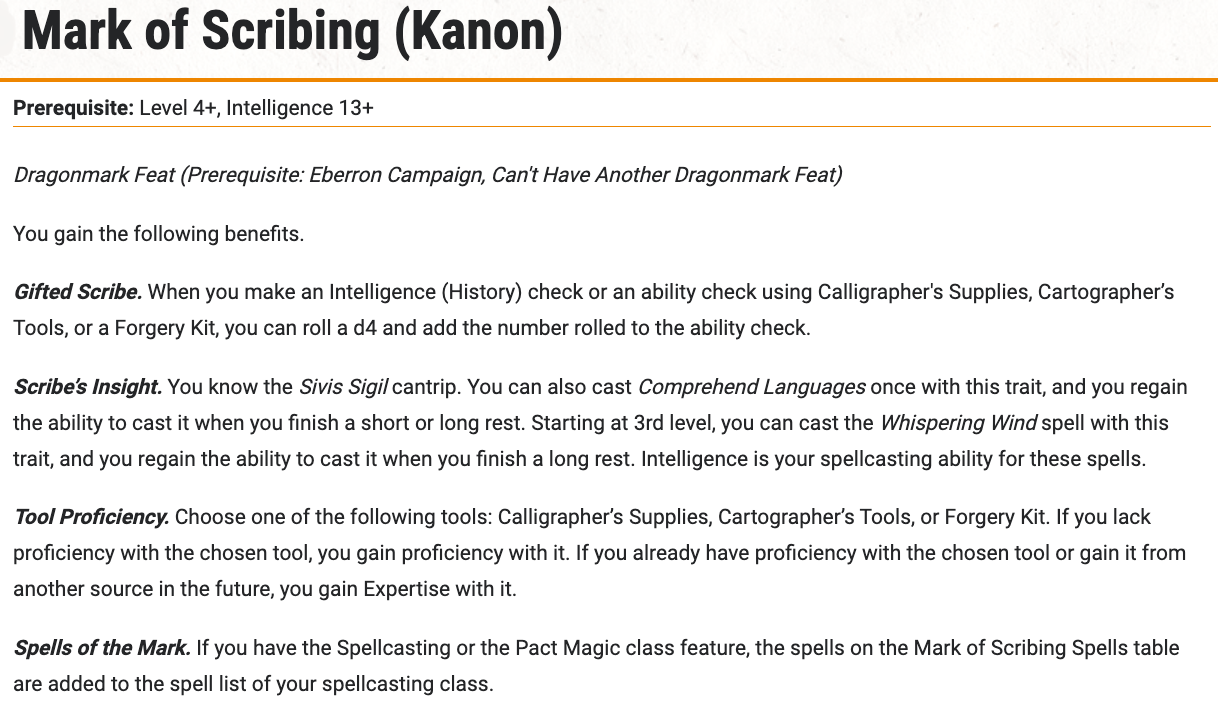
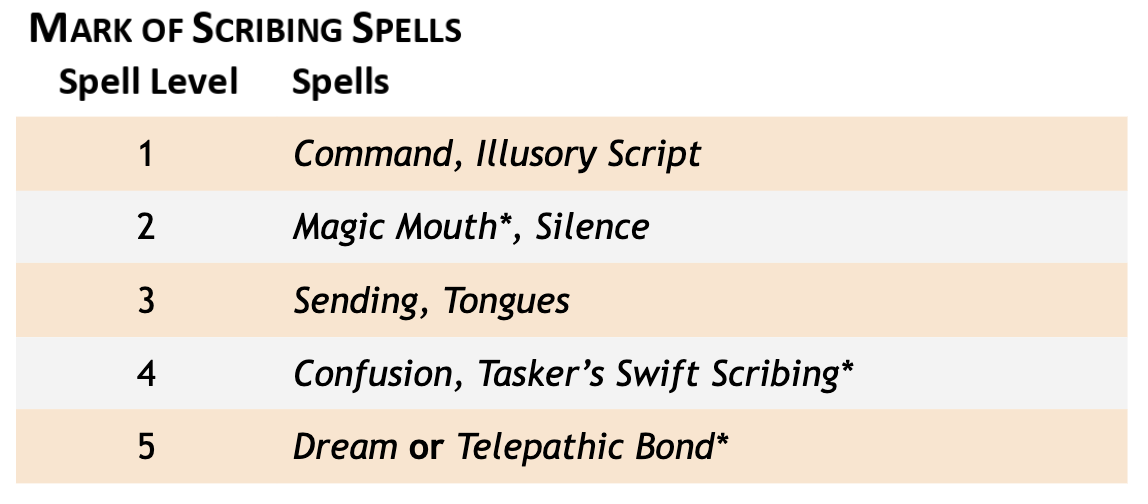
Note: The version of the Mark of Scribing presented here differs from what’s presented in Forge of the Artificer. This is the version I am using in my campaign, but it is not official! My reasons for these changes are described later in this article.
While this Dragonmark is called the Mark of Scribing, a more accurate term would be communication. Comprehend Languages is the most basic gift of the Dragonmark, and the one that is typically used during the Test of Siberys. Any bearer of the Mark of Scribing can cast Comprehend Languages as a ritual; given time, any word will surrender its meaning to a Sivis heir.
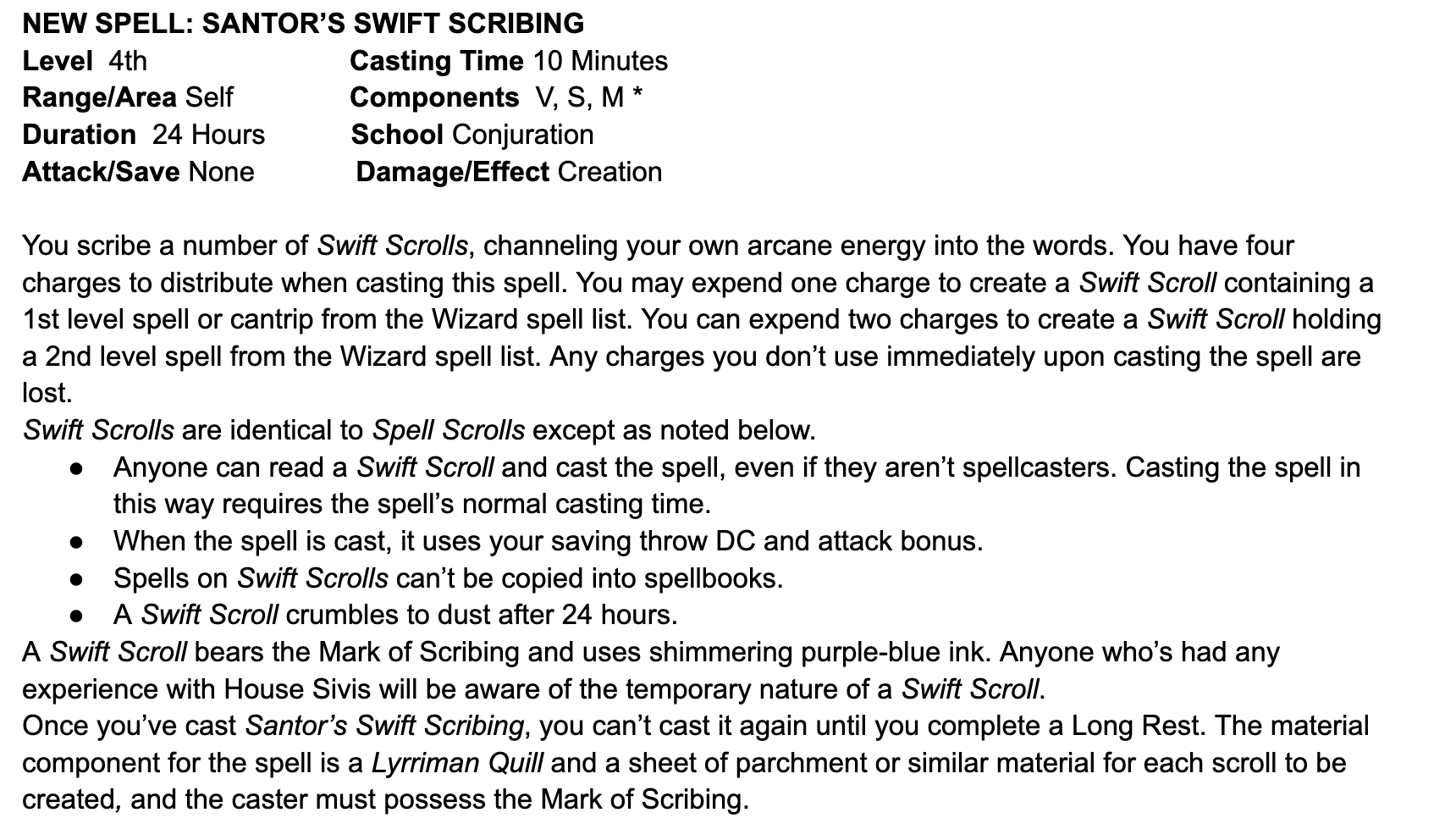
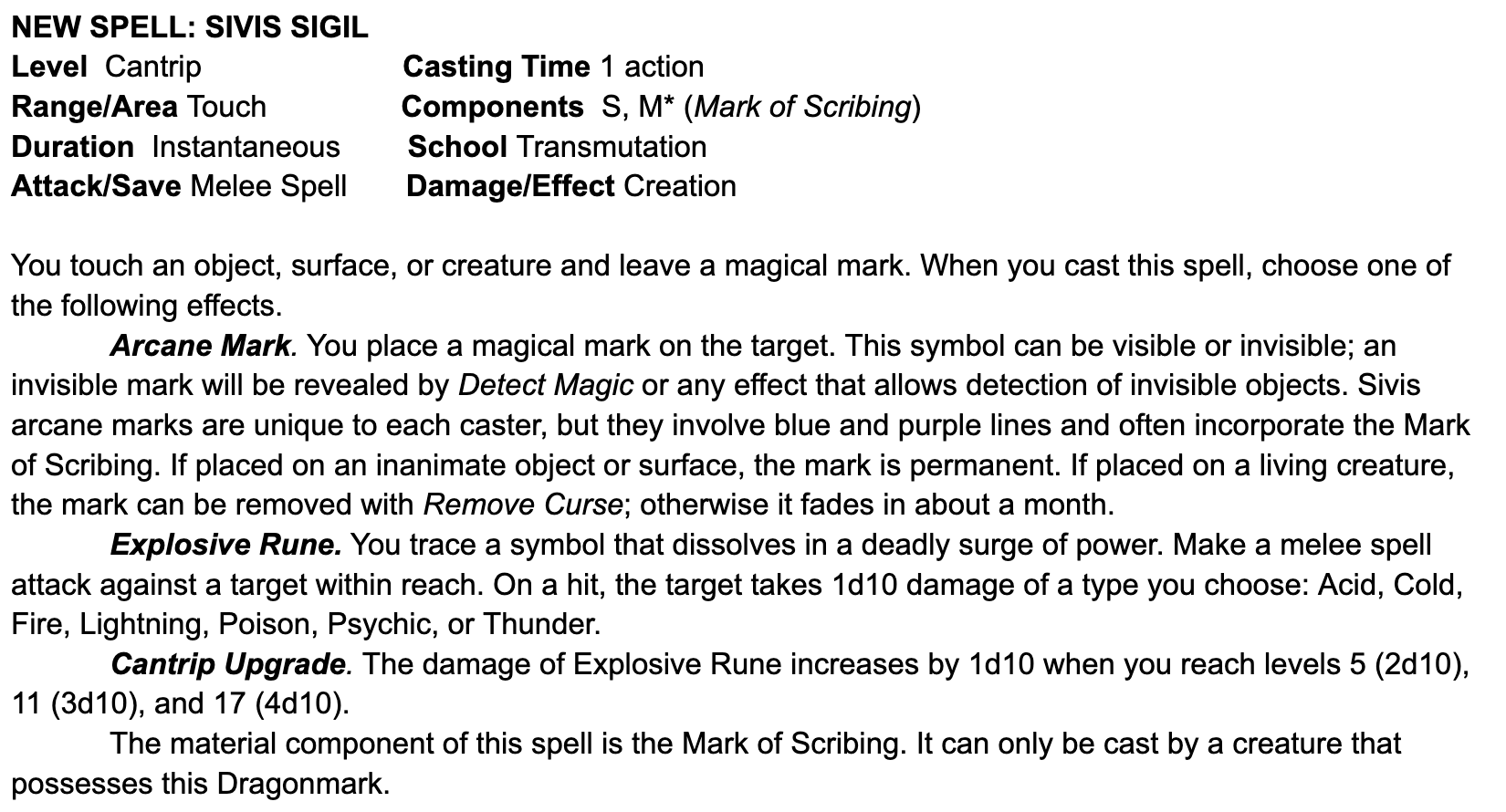
Scribing is a key element of the Dragonmark. Everyone who carries the Mark of Scribing has the ability to inscribe a mystical sigil on any surface. This arcane mark is as unique as a fingerprint. The heir doesn’t choose the design of their arcane mark; they touch the surface and draw on the power of the Dragonmark, and their arcane sigil appears. House Sivis keeps a record of the arcane mark of every known heir, so documents can be tracked. After mastering their arcane mark, Sivis heirs learn who to imbue writing with arcane energy. The simplest trick is the explosive rune, an unstable glyph that immediately explodes in a burst of energy. By working more carefully, an heir can weave stable, safe illusions onto a page, creating Illusory Script. Those with a talent for this work become scroll scribes, crafting permanent Spell Scrolls. However, even those who can’t produce permanent scrolls can learn to temporarily bind magic to ink. Known as Santor’s Swift Scribing, this gift allows a Sivis heir to jot down exactly the spell needed for a difficult situation.
Beyond scribing, the Mark grants a range of powers associated with the spoken word. All those who carry the Mark of Scribing have the ability to cast their words onto the wind, sending a message to any location within ten miles. This is the fundamental principle harnessed by the Speaking Stone. The Stone allows messages to be sent much faster and farther, but it draws on that key power of Whispering Wind. This power played a crucial role in the Last War; while Speaking Stones aren’t extremely mobile, scouts accompanied by a Sivis heir could use Whispering Wind to report back to their commanders. Heirs with the Lesser Dragonmark gain the gift of Tongues; not only can they understand any language, they can speak to any creature. Silence reverses this, allowing a Sivis heir to prevent communication within their sphere of influence. And then there is the remarkable power of Command. When using this, a Sivis heir draws on their Dragonmark and speaks a single word—a word in a language that no one knows, yet everyone understands. Sivis scholars believe Command allows the caster to momentarily speak the language of the Progenitors themselves; it resonates on such a primal level that the creature targeted by the word is compelled to obey.
The most dramatic powers of the Mark of Scribing go beyond mere words. Sending allows the caster to instantly transmit a message over any distance, while Telepathic Bond lets an heir forge a mental link between a group of individuals. Both of these gifts bypass language, allowing the recipients to directly understand meaning. Some Sivis heirs are able to reverse this, scrambling a creature’s internal communication and blocking their ability to understand their own thoughts; this manifests as Confusion. While Telepathic Bond is the power most often associated with the Greater Mark of Scribing, there have been a handful of individuals throughout the history of House Sivis who have instead learned how to communicate with others through the medium of dreams. Because of the rarity of this gift, it has never been incorporated into the services offered by the house, but Tasker’s Dream is always searching for heirs with this ability.
Kanon vs Canon. In general I prefer to work with existing canon, but it’s important to me that the Dragonmarks feel consistent and support the role of the House within the world. House Sivis was built on two spells that don’t exist in Fifth Edition. Arcane Mark drove the idea of Sivis notaries, while Whispering Wind was the foundation for the Speaking Stones—with the idea that the Speaking Stone carries the message faster and farther, but it’s still working off the basic effect of Whispering Wind. Beyond this, the canon Mark of Scribing feat feels significantly more limited than many others. Compare Scribing to Sentinel. Sentinel gets bonuses to Insight and Perception, two consistently useful skills; Scribing gets History and Calligraphy. Sentinel gets Shield, a spell that’s useful in almost every adventure; Scribing gets Comprehend Languages and Magic Mouth, again both very situational. So, looking at key changes…
- I’ve expanded Gifted Scribe to include Cartography and Forgery, and added Tool Proficiency with one of these. They’re all situational, and compared to Making having a bonus with ALL Artisan’s tools, it feels reasonable to me.
- I replaced Message with Sivis Sigil. While I like Message, I feel that Arcane Mark is an iconic part of Sivis; and I added the Explosive Rune element to give it a little practical punch.
- In the base feat, I replaced Magic Mouth with Whispering Wind, and replaced Animal Messenger with Magic Mouth on the Spells of the Mark list. Animal Messenger is something that makes sense for the Mark of HANDLING. Whispering Wind has specific elements that mirror its expansion by the Speaking Stone: a short message delivered to a particular location. This further means that with the base feat, any Sivis Heir can notarize (Sivis Sigil), translate (Comprehend Languages), or send a message over a distance (Whispering Wind).
- In the Spells of the Mark, I replaced Arcane Eye with Santor’s Swift Scribing. I don’t see what Arcane Eye has to do with words. Swift Scribing gives a Sivis heir a fun, versatile effect that is driven by the act of SCRIBING. It’s inspired by Tasha’s Bubbling Cauldron and Rary’s Mnemonic Enhancer.
- Finally, I added the option of Telepathic Bond at 5th level, with the idea that it’s the standard gift of the Mark. Dream is interesting, but assigning it as the sole power of the Greater Mark is problematic on many levels. If Sivis had access to Dream as a standard ability of the Mark and had it for thousands of years, I’d expect it to play a major role in the House and in history, and we’d need to sort out how Sivis dreamshapers had interacted with the quori. I like it as a rare gift and interesting new development, but Telepathic Bond is a simpler spell that fits well with the other gifts of the Mark.
FOCUS ITEMS
The Speaking Stone is to House Sivis what the Lightning Rail is to House Orien—a vital tool that drives the core business of the House. But Sivis has developed a number of tools associated with communication. A few examples…
- A Listening Stone appears to be a standard spellshard. However, when activated by a creature with the Mark of Scribing, it records conversations as words on the shard. When activating the shard, the user decides whether it will record all speech that originates within 10 feet of the stone, or just the speech of the creature holding the stone.
- A Sivis Slate is a sheet of metal. If a creature uses a Lyrriman Quill or a Scribes Pen to write on the Slate and then places the Slate on a sheet of paper or similar material, they can take a magic action to duplicate the contents of the slate on the page below. They can also use a magic action to clear the current contents of the Slate.
- A Wordbinder is a pillar of metal and engraved wood. When a Sivis Slate is placed on the Wordbinder, it can be used to transfer the contents to multiple pages simultaneously; this is the basis of Sivis printing.
- The Sharn enclave has been experimenting with Echoers. A central Singer works off the premise of Whispering Wind, but rather than directing sound to a single location, the Singer produces multiple gusts that deliver the sound to nearby Echoers, which serve as repeaters transmitting the sound to additional Echoers. In addition to drawing on the Mark of Scribing, the Singer relies on the manifest zone of Sharn to amplify the winds; currently the system is limited to the City of Towers.
Here’s a few additional items.
Calculating Lenses
Wondrous Item, Common
These spectacles allow a Sivis heir to apply the principles of Comprehend Languages to numbers as well as words. While wearing these glasses, a creature with the Mark of Scribing can take a Magic item to perfectly perform basic mathematical operations involving numbers they can see. The Lenses can hold a small range of numbers on the surface of the crystal lenses, allowing the wearer to retain the results of calculations until they can be transferred to another surface.
Lyrriman Quill
Wondrous Item, Uncommon
If you possess the Mark of Scribing, you can use this pen to write on any surface; it draws vivid, purple-blue lines reminiscent of a Dragonmark. You decide whether the writing is visible or invisible, but any creature with the Mark of Scribing can always see the writing. Any creature with the Mark of Scribing can use a magic action to touch invisible writing created with a Lyrriman Quill and render it visible. If you use the quill to write on a living creature, the writing fades after 7 days.
If you use a Lyrriman Quill while creating a Spell Scroll, the time required to create the Scroll is cut in half.
THE HISTORY OF HOUSE SIVIS
During the golden age of the Empire of Dhakaan, the region south of the Howling Peaks and west of the Seawall Mountains was a seat of knowledge. The city that preceded Korranberg was the site of the Imperial archives and the greatest college of the Duur’kala. This area was hit especially hard during the final days of the Daelkyr incursion. While Dyrrn the Corruptor prepared the ritual that would destroy the Dar bond to the Uul Dhakaan, two other Daelkyr unleashed devastating linguistic assaults on this area. Belashyra released a curse that caused written words to evolve, every document twisting into its own unique cypher. And the Crawling Queen, Valaara, released wasp-like creatures the Dhakaani named volaaganti, “word eaters.” The venom of the Volaaganti infects the victim with a new language that replaces all previous languages known by the victim. Every Volaaganti queen possesses a unique language—unique to each queen, not just to her lineage—so as the word-wasps spread across the region they broke down the common language of the Empire and created countless lesser tongues. Even as the Kapaa’vola broke the bond that united the Dhakaani, the word eaters destroyed the shared language of the Seawall Dar and the shifting script severed them from their records. Amid this chaos, the forces of Xoriat butchered the bulk of the Dar population of the region. When the Gatekeeper seals bound the Daelkyr in Khyber, most of their creations retreated into the depths with them. But all that remained of the Dar were ruined cities and vaults full of twisted words.
This is what the gnomes inherited—the foundation of what is now Zilargo. During the Age of Dhakaan the gnomes hid in the depths of the Shimmerwood Forest and dark corners of the Seawall Mountains. In the centuries following the downfall of Dhakaan, the gnomes emerged and laid claims to the Dar ruins. Three distinct city-states rose in the region, each one an alliance of powerful houses. In Korranberg, House Sivis held Raat Tohesh, the subterranean facility that had once been the college of the Duur’kala. The vaults of the Raat Tohesh held countless precious secrets, but all were warped by the shifting script of Belashyrra. The wordsmiths of House Sivis had three specialities. On one side, Sivis translators picked apart the endless ciphers of the shifting script so scribes of the House could duplicate anything of value. And on the other side, Sivis interpreters and mediators worked together to facilitate communication in a region scarred by the word eaters. While the gnomes managed to exterminate the Volaaganti, the struggle left every house and many families speaking languages with no common roots—languages shaped by Xoriat rather than natural evolution. Skilled translators and interpreters were in high demand, and the gnomes of House Sivis had a remarkable gift for linguistics.
House Korran was the greatest power within Korranberg; they had claimed the ruins of the Imperial Archives, which Dorius Alyre used as the foundations of his legendary library. Sivis and Korran had long been involved in a linguistic arms race, each digging deeper into their Dhakaani vaults in search of valuable secrets. When Loran Lyrriman Sivis developed the Mark of Scribing, it was thought to be a singular wonder—the influence of Syrania or a blessing from one of the Thousand Gods. Then Sahra Syrralan Sivis manifested the Mark of Scribing, soon followed by Magys Magan. As soon as it was confirmed that the Mark could be passed on, House Korran desperately sought to make matches with House Sivis in order to inherit this blessing, but they were too late. House Sivis recognized the treasure that had fallen into its lap, and had no intention of sharing. Sivis was happy to sell the services of its scribes to the great houses of Korranberg, but they jealously guarded their remarkable gift. Sivis interpreters had long been considered to be the best in service; now they were invaluable. It was a dangerous road, to be certain. The other houses of Korranberg were jealous, and more than once an alliance of families contemplated the destruction of House Sivis. The leaders of House Sivis were able to deflect this by emphasizing their own absolute neutrality and lack of ambition—declaring that they wished to be useful to all, while holding dominion over none. With that said, many scholars believe that Sivis interpreters may have used their positions to carefully exacerbate conflicts among the other Houses, ensuring that they’d focus hostility on these perceived enemies rather than the neutral Sivis. It’s a hard thing to prove, however, as most historical documents from that time were recorded by Sivis scribes…
So House Sivis flourished, but there was always the lingering fear that the jealousy of their peers would boil over into deadly action. It was at this time that the news of other Dragonmarked families began to trickle in. Gnome merchants brought news from Aerenal of the rise and fall of the Line of Vol, and soon after that the Phiarlan elves came to Khorvaire. Tarlian sages were fascinated by the mystery of the Dragonmarks, while the Lyrrimans saw a value in allying with other Dragonmarked before they too suffered the fate of the Line of Vol. Sivis envoys traveled across Khorvaire, seeking out other Marks. They quickly formed an alliance with Cannith and Deneith. The Twelve wouldn’t be formally recognized until after the War of the Mark, but the Lyrrimans established the blueprint for the alliance—as well as convincing the leaders of Deneith and Cannith to follow their example and restructure themselves as Houses. Sivis continued its aggressive outreach program, drawing in Orien, Jorasco, Lyrandar, and Ghallanda. It was also in this period that Sivis enacted its most ambitious project yet: the development and dissemination of the Common tongue. Blending elements of the trade language of the Sarlonan immigrants with a handful of the House languages of the gnomes and some entirely artificial structures, House Sivis created a language that was remarkably easy to learn and spread. Sivis heirs taught Common across Khorvaire. With the aid of Deneith, Canith, and Ghallanda, Common spread quickly—first as a trade language, but steadily taking root and edging countless regional languages which are now all but forgotten. Today, almost everyone in the Five Nations speaks Common; few have any idea that it was a Sivis invention.
The next chapter in the history of House Sivis has been expunged from the annals of history. Accounts of the period 600 to 700 years before the rise of Galifar go into great detail about the leadership of Vown and Denieth, the families that rallied the Houses to fight the War of the Mark. But these chronicles—copied and spread by Sivis scribes—say remarkably little about the actions of House Sivis in this time. The details have been buried, but a scholar who carefully studies the record can see the shape formed by the absences and draw a simple conclusion: House Sivis was responsible for the War of the Mark. Sivis leaders believed the Houses needed a shared enemy to cement their alliance, and concluded that by vilifying the Aberrant Dragonmarks they could also cast the House Marks as the “True” Dragonmarks. It was Sivis that promoted the idea that the House Marks were blessings of Siberys while Aberrant Marks were the curse of Khyber. Aberrant Dragonmarks are dangerous, and many of those carrying such marks endured tragedy before mastering their powers. A handful of cases were truly horrific; the Lady of the Plague was responsible for thousands of deaths. Sivis seized on these stories, exaggerating them and spreading them, turning legitimate fear into deadly panic. During the War of the Mark, most commoners gladly helped Deneith forces track down Aberrant forces, because they truly believed the Sentinels were protecting them from a terrible threat… and that is the work of House Sivis.
It’s possible the leaders of House Sivis didn’t realize what they were setting in motion. Perhaps they only meant to bolster the reputation of the “True” Marks. Certainly, it was Cannith and Deneith that outfitted the Sentinels and initiated hostilities. What is certain is that it was House Sivis that set events in motion, and that they felt a need to expunge the record of their actions. It’s up to the DM to decide if the leaders of House Sivis buried their deeds because they were ashamed of the outcome—or if they were proud of their work and simply wished to conceal the extent of their influence. There’s no obvious parallels to this whispering campaign in the subsequent history of House Sivis, so it’s possible that they truly were horrified by what they’d done and swore never to take such an action again. Certainly, the subsequent history of House Sivis has no obvious parallels to this terrible action. Throughout the history of Galifar, House Sivis was known for its absolute reliability and neutrality, showing no signs of ambition. House Sivis has been a helpful partner to many other Houses. It played a key role in bringing House Kundarak and House Tharashk into the Twelve. Sivis has been closely aligned with House Kundarak since its inception, but every House employs Sivis scribes and accountants. Likewise, Sivis is so trusted that commanders and kings used its services for secret communications during the Last War. Most people believe that House Sivis is absolutely dedicated to its work. And perhaps this is the case. Perhaps the War of the Mark is a single shameful moment in history, one that drove the House to a better place. Or perhaps they’ve simply gotten better at concealing their manipulations, and they simply haven’t left such obvious footprints with their subsequent actions.
While House Cannith loves to take the spotlight, House Sivis has played a vital role in ensuring the prosperity of the Twelve. House Sivis has always sought ways to improve the fortunes of all Houses, and Sivis mediators are always working to resolve disputes between Houses and enclaves. House Sivis has also long sought to learn more about the Dragonmarks themselves. While it’s House Cannith that builds most focus items, Sivis sages play a crucial role in research and theoretical development. House Sivis is known for its constant internal intrigues, but it has been a solid, reliable partner to the other Houses in the Twelve… or so it seems.
Looking to recent history, the most crucial date in the history of House Sivis is the 3rd of Olarune, 783 YK. This is the day that Tasker Torralyn d’Sivis tested the first pair of Speaking Stones, dramatically amplifying the range and speed of a Sivis heir’s Whispering Wind. Six years later, House Sivis opened its first message stations; some say that the world became a smaller place that year. In 998 YK Speaking Stones are an important part of everyday life, and the Sivis think tank known as Tasker’s Dream is working to find a way to do for Sending what Tasker did for Whispering Wind.
House Sivis remained scrupulously neutral throughout the Last War. While Zilargo was a strong ally of Breland, there’s no evidence that House Sivis showed any special favor to the Bear. Most major fortifications of all nations maintained Sivis message stations, and Sivis Whisperers could accompany scouts, using Whispering Wind to send reports back to a command post. But Sivis leadership has no love of war and harbors no doubts that it will prosper in peacetime, and the House celebrated the signing of the Treaty of Thronehold.
What Happens Next?
House Sivis has always been a stable house that takes pride in the reliability and security of its services. Traditionally, it channels its love of intrigue into internal rivalries—but those rivalries are friendlier than those seen in House Cannith, and heirs are careful not to threaten the overall stability of the House with their schemes. But there’s always the possibility for adventure; here’s a few seeds to work with.
- The Rival. The heirs of House Sivis are always competing for titles and honors within the House. If an adventurer is part of the House, they should work with the DM to develop their nemesis—a Sivis heir they’ve been competing with since childhood. This rival doesn’t want to hurt the adventurer, but they want to embarrass them or to outshine them. Any meeting should be a duel of words and wits; who said it best? In addition, the DM could drop secondary goals into an adventure that are irrelevant to anyone except the heir. If the adventurers are exploring a Dhakaani ruin, the Sivis heir might know that there’s a standing bounty on any records of unknown Duur’kala songs. If the heir can find any songs, they’ll earn recognition in the House. But their rival also wants this honor! Might the rival show up in the ruin themselves? Will they try to steal whatever the adventurer finds? Or might they have even planted a fake song in the ruins that will embarrass the adventuring heir if they turn it in without noticing? An important element here is that however bitter it might get, this is still a friendly rivalry. Neither rival wants to actually hurt the other; if the rival was to die, the game would be over!
- Language is a Virus. Working with House Vadalis, a member of Tasker’s Dream manages to recreate the Volaaganti. Anyone stung by a Volaaganti has all of their known languages replaced by a single new language. When the Volaaganti breaks free from containment, chaos ensues. Adventurers arrive in a small town to find that all of the inhabitants are speaking an alien language; if there’s multiple strains of Volaaganti, there could be competing languages within the populace. Can the adventurers find a way to contain the Volaaganti? Can the effects of their venom be reversed? What happens if the adventurers themselves are stung by different Volaaganti and divided by language?
- The Bond. Tasker’s Dream pays one of the adventurers to field test a new form of Telepathic Bond—a version of the spell that should last for a week. The adventurer has a telepathic bond with a Sivis sage, who will provide commentary and advice over the course of an adventurer. Initially, this may be annoying or useful; the sage has expertise in History and Arcana and could provide helpful advice. The twist is that the sage is kidnapped by a Cult of the Dragon Below who intends to twist the Telepathic Bond, using it to spread Dyrrn’s corruption. The adventurers have to rescue the sage before it’s too late. But they have no idea where the cult is; to find it, they must decipher the clues the Sage can send through the bond.
- Here There Be Demons. Sivis cartographers are always eager to fill in blank spaces on their maps. Adventurers could be hired to explore a dangerous region Sivis has yet to fully explore—part of the Demon Wastes, the Watching Wood of Droaam, the Black Pit of Breland, or somewhere equally dangerous. Adventurers might have to defend a team of cartographers accompanying them into danger. On the other hand, Sivis could provide the adventurers with a scrying focus that allows the cartographers to study and record details of the adventurers’ surroundings without endangering the gnomes.
- Dangerous Dreams. Occasionally, an heir of the Greater Mark of Scribing develops the ability to manipulate dreams. Tasker’s Dream has been trying to harness this gift—but something has gone terribly wrong. A dreaming heir is in a coma, and the sages are concerned that their dream is expanding—pulling other sleepers in and leaving them comatose as well. Is this the work of the Quori or a curious Night Hag, or is it the dreamer themselves who seeks to craft an empire in Dal Quor? Tasker’s Dream needs adventurers to utilize experimental magic that should allow them to enter the dreamer’s nightmare—but no one knows how death in the dream will affect them!
That’s all for now. But this excerpt is only a third of the full article, which includes Sivis Customs, the Structure of the House, a look at all twelve of its founding families, and more! If you’d like to see the full article — as well as to take part in my live Q&As, the next of which is on December 27th—check out my Patreon!
 Unlock with Patreon