Dragonmarks: The Dragonmarked Houses, pt 2

As always, this material represents my own personal opinions; it’s not canon and may contradict canon sources. I still don’t have any new information about official Eberron support in D&D Next, but I hope to have news soon.

I’ve talked about the Dragonmarked Houses and Aberrant dragonmarks before. Before getting to the current questions, I want to bring up a key point from the earlier article.

The power of the houses comes from the fact that they offer services that are unavailable elsewhere, at least on the scope and scale they can provide. While some houses do work to eliminate competition, for many of their services there simply isn’t significant competition. While clerics can heal, there aren’t a lot of spell-casting priests in Eberron, and they generally have a divine calling and a purpose in the world; it’s not viable to fully replace Jorasco healing houses with clerics. Likewise, while an individual spellcaster could learn and cast sending, that’s trivial compared to the network of Sivis speaking stones that deliver thousands of message each day. Magic is a form of science, and new discoveries require innovation; and it’s always easier to create a tool that enhances an existing power than to make one that generates the same effect from nothing.

So it is a default assumption of the setting that people simply haven’t found a way to create magic items that duplicate the effects of most dragonshard focus items without the need for a mark. In 4E, I suggest restricting many rituals to the Dragonmarked to reflect this. Groups like the Arcane Congress are always working on this, and your PC might be an innovator who can make some of these effects no one has until now. But the key point is that while the houses are monopolies, this is often because no one knows how to replicate what they can do on an international scale; only a few have to actively deal with serious competition.

What would happen to Eberron if all the Dragonmarks suddenly went dormant?

It would be a serious blow to the culture of the Five Nations. Swift long distance communication relies on Orien and Sivis. Orien and Lyrandar are cornerstones of mass transit and freight. Loss of Jorasco removes basic medical services, which would likely lead to plagues. Between loss of transit and Lyrandar weather control, you’d probably end up with famines when crops fail or food can’t be delivered. Loss of Cannith brings mass production of common goods and primary creation of magical goods to a halt. Breaking the Kundarak vault system suddenly cuts many people off from their wealth, which could seriously impact some nobles. If you look at my list of restricted rituals in 4E, suddenly those rituals just don’t exist in the world.

Now, it’s not the end of magic or civilization. You’ve still got magewrights out there; check this article for examples of services magewrights provide. The lamplighters who keep the streets lit aren’t using dragonmarks to do it. Some standard magical services would remain intact. Furthermore, there ARE skilled wizards and artificers outside of the houses. Nobles would still have access to some of those old services by hiring the best independent mages money can buy. But much of the system that provides magical services to the middle class would fall apart, and people would have to implement mundane systems to take their place.

Aundair would be in a strong position because of the Arcane Congress and the general effort to bring arcane magic into everyday life. Thrane has the highest percentage of divine casters and would thus have the best ability to counter the loss of Jorasco healing. Karrnath has a decent war magic program, but would be hurt by the loss of things like communication, transportation, and weather control.

I get the impression that the houses are everywhere, and if you open a business that’s within their “domain”, you either have to join the house or get stomped on. If my character starts a mercenary Company, would they have to eventually join with house Deneith? The problem with that, is that, if my character don’t possess a dragonmark or family within that house, he’ll only be able to climb so far within it.

First: It is entirely possible to operate a business without being affiliated with a house. There’s many independent mercenary companies, many smiths who don’t work for Cannith, many inns that aren’t tied to Ghallanda. One wizard who can cast Sending doesn’t pose a threat to House Sivis; it’s only if he actually comes up with a way to offer service on the same scale that they do that he becomes a real threat.

So, one independent mercenary company of 100 people based in Sharn doesn’t pose a threat to Deneith. But an independent mercenary army of 10,000 people with branches in multiple cities DOES pose a threat to Deneith, and they would attempt to stop it or assimilate it before it reached that level.

With that said, assimilation is always the preferred path. Most houses would rather just get a share of your profits that wipe you out. As described in Dragonmarked, Guild membership comes in three flavors. Most businesses are licensed. They pay a small percentage of profits and vow to uphold guild standards, and in exchange they get to show the guild stamp. So the average inn isn’t OWNED by Ghallanda, but it’s licensed by Ghallanda; the seal of the Hosteller’s Guild is an assurance that you won’t get food poisoning, be killed in the night, etc. Bound businesses are essentially franchises, and the nature of the services they offer are dictated by the guild. So an inn licensed by Ghallanda can serve whatever food it wants, as long as the quality meets Guild standards; but a Gold Dragon Inn has to serve the same core menu as all other Gold Dragon Inns.

So back to you: You want to start a mercenary company. You could be entirely independent and do your own thing, and as long as you don’t seriously threaten Deneith’s business they’ll leave you alone. However, you might find that clients pass you up and hire licensed Deneith mercenaries instead, because the Deneith seal assures them that the soldiers meet Deneith standards of training and discipline, and because they can go to the house for compensation if the mercs fail to perform. And if you decide to be licensed by Deneith, they aren’t going to try to limit your success; they’ll even send work your way. They’ll simply expect a share of your profits.

The houses do work to maintain their monopolies, but they’d rather be making money from you than spending money crushing you. They’ll only take ruthless action if they truly see you as a mortal threat to their overall success.
How do the different houses respond to a dragonmark going from least to lesser, lesser to greater, etc? There are system reasons why it happens, but does anyone in the game world have theories? Does anyone do anything to try to encourage/suppress the progression?

Well, now we venture into the realm of house rules. MECHANICALLY, marks are clearly delineated into four sizes. We have pictures of each of those four sizes. However, I personally don’t believe that you go to sleep with a Least Mark and wake up with a Lesser. I believe that marks grow organically over time. So take three people with Least Marks and they might all be different sizes and shapes – all clearly recognizable as somewhere between Least and Lesser, but different stages of development. You know you’ve reached the next stage when you are capable of performing the magic associated with the next stage, or using a focus item that requires that level of mark.

Now, that doesn’t change the question of why people think Marks grow and what affects someone’s potential. Most people believe it’s largely genetic, and that a child whose parents have powerful marks will be more likely to develop a powerful mark of their own; this also ties to the belief that children of two houses will develop aberrant marks. However, there are any number of other theories, ranging from diet and mental exercise to planar alignment and the influence of the Prophecy.

Which houses meddle in their members’ love lives, and why?

In dealing with this, it’s vitally important to remember that houses aren’t monolithic  entities. Every house is made up of multiple families; the Shadow Schism that created House Thuranni was a civil war between the Phiarlan families. The different Cannith factions are likewise largely divided along family lines. So with this in mind, I’ll give you some reasons, but interfering with your love life is something that’s more likely to be done based on the policies of your FAMILY than your house. One Cannith family may go out of its way to arrange political alliances or bring new blood into the house; if you’re the best artificer of the age & not dragonmarked, they’d like to convince you to marry into the family. Meanwhile, a different Cannith family may strictly forbid people marrying outside the house. Now, why might they interfere?

  • Dragonmarks. You’ve got a Siberys mark. You think we’re going to let you  waste that on unmarked trash? Elaydren Vown has a greater mark, and we’ve already made arrangements.
  • Race. You may love this elf, but think of your children. If they aren’t fully human, there is no chance they will manifest a mark. Will you damn them for your own selfish desire?
  • Politics. We have an opportunity to secure a connection with the Brelish aristocracy/end the feud with the Vowns/Arcane Congress etc. We’re not letting you waste yourself on some guttersnipe ex-soldier.
  • Recruitment. Flega is the finest artificer in the Five Nations. We need to bring her into the house, and you’re going to do it.
  • Prejudice. Your father was killed in the attack on Shadukar. I’ll see you excoriated before you sleep with a Thrane.

Vadalis is highly likely to arrange marriages for marks. Tharashk is remakably liberal and sees outside marriage as a good way to increase its influence. But beyond that, it’s really about your personal family.

Dragonmarks are seen only on the peoples living on Khorvaire. Why are there none on the goblin race, who lived before humans?

Good question. And why do they appear on half-orcs but not full orcs? And why not on gnolls or shifters or changelings? Nothing about the marks is clear. Bear in mind that they didn’t all appear at once; marks appeared on the Aereni and Talenta Halflings more than five centuries before they appeared on humans, and more than TWO THOUSAND YEARS before the Mark of Finding appeared on half-orcs. Who’s to say that the goblins won’t suddenly manifest a mark no one’s seen before?

And, of course, one answer is that the marks have only appeared at certain times and on certain races because they are an experiment of, say, the Daelkyr; they are actively picking and choosing who gets what mark.

Is there any reason why Greater Aberrant marks aren’t as common any more? Is the ‘bloodline’ that much weaker or another reason?

No one knows for certain. The common belief is that the strongest bloodlines were wiped out in the War of the Mark and that strength is simply gone from the world. But aberrant marks have never been strictly tied to bloodline, so it’s a little odd. So a secondary question would be “Why are aberrant marks becoming more common now?” I’ll give you a few possible answers for that:

  • The Mourning has wounded nature and increased the number of aberrant marks.
  • It’s a sign of the increased power of an overlord.
  • It’s dictated by the Prophecy.
  • It’s the work of the Daelkyr.
  • It’s just natural; the aberrant lines were weakened in the War of the Mark, and now it’s finally regaining strength.

If another house started to form, under what kind of mark do you think would be new and novel?

I’d probably start by saying that there’s been a changeling Dragonmark for over a century, but unlike most marks they can hide it by shapeshifting, so no one KNOWS about the changeling Dragonmarked House. I’d also consider the idea of the goblins developing a mark. With that said, I like the 13-1 structure… so what I might do is to have one of these two races develop the Mark of Death. There’s only 13 marks; the elves had their time with the Mark of Death; now it’s moving to another race. Is this a sign? Will the other marks start migrating too? If it’s about how long they’ve been around, the Mark of Shadow and the halfling marks would be the next to go…

Are there any houses /marks you would redesign or replace if you could? Any reason why, or ideas to that effect?

I’ve never been happy with the mechanics for aberrant dragonmarks; I’d change those if I had the opportunity. And I’ve already redesigned the relationship between marks and rituals in 4E, as noted in the previous articles. As for the houses themselves, I’m generally happy with them. I don’t think Orien has ever had the attention it deserves, and I could see doing more with Vadalis and eugenics. In general, I’d love to look at ALL of the houses in more detail, but I’m happy with the fundamental concepts.

I wonder what it’s like for non-creepy Vadalis who just want to breed a better pig.

Which is most of them. For that matter, magebreeders are only a small segment of the house; most heirs are ranchers, teamsters, veterinarians, handlers, jockeys, and more; people who love working with animals and whose animals can do amazing things.

Which house do you think has most potential as an outright villain? Would your answer be different for adventure v. campaign?

Certainly. Again, I think Vadalis has a lot of long-term potential because magebred humans are creepy (and an extremely logical source of homegrown Inspired for the Dreaming Dark to use). Lyrandar has tremendous ambition. And hello, by canon (which you can of course ignore) Zorlan d’Cannith of Cannith East is a seeker of the Blood of Vol; you could easily make him an ally of the Emerald Claw.

What is Cannith East’s greatest strength?

In my opinion? War. Cannith South specializes in warforged and manufacturing, but I’ve always considered Cannith East to be the arms specialists. They may not have manufacturing facilities to match South, but their unique form of ingenuity is building better weapons. Aside from that, they’ve been experimenting with undead, so consider the weird things you can do with that.

If all marks of a kind are the same, what about the Draconic Prophecy? Not every Mark of Making can indicate the same destiny, can it?

Not at all. First of all, speaking GENERALLY, the prophetic significance of dragonmarks isn’t tied to the individual; it’s about patterns. Think of dragonmarked individuals as tarot cards or runes. Someone who knows the Prophecy may walk into a bar, say “OK, I see Greater Storm, Lesser Making, and three of Least Healing. Which means… it’s going to be a bad day.” That bad day may not even involve any of the marked individuals; they’re just signposts for someone who knows how to read them. Having a Dragonmrk doesn’t automatically mean that YOU are significant to the Prophecy; in means that you are now a tea leaf others can use to read it. If you ARE personally significant to the Prophecy, your mark will be one of the things that identifies you, but it won’t be the only thing.

Do you think there is tension or rivalry between houses Tharashk and Medani given how both work with inquisitives?

Certainly. However, one issue here is that Medani is a very subtle house; its services also overlap with Deneith when it comes to bodyguards. Medani is the warning guild. Its specialty is counterintelligence and predictive work. You hire a Deneith bodyguard when you want muscle at your side; you hire Medani for defense when you want them to identify and neutralize the threat before it actually manifests. The same is true of inquisitives. Tharashk inquisitives are more of your classic private eyes. They are the people the innkeeper will hire to find out who stole his valuables, or who’s dating his wife. Medani’s inquisitives deal with more complex problems and generally, wealthier clients. They’re who you call in to negotiate with a blackmailer – or to prevent blackmail when you’re vulnerable but it hasn’t happened yet. Think someone might have spies watching you, or an assassin after you? Hire Medani. Short form: Medani inquisitives handle complex cases for wealthy clients; Tharashk inquisitives solve basic problems for a broader client base.

Likewise, Tharashk’s monstrous mercenaries overlap with Deneith, but don’t really fill the same space. Most of Deneith’s best clients won’t turn to ogres and gnolls instead of Deneith’s reliable forces.

While Tharashk is stepping on toes, it’s also the best source for the single most valuable resource in the magical economy: dragonshards. As a result, while Deneith and Medani are rivals with Tharashk, they don’t really want to get into an all-out feud with the house, and many other houses are willing to support Tharashk in conflicts.

I wonder why house Phiarlan does not seek to outlaw Thuranni. After all, both houses have the same dragonmark.

Among other things, because they are family. The Shadow Schism only occurred a few decades ago. The Mark of Shadow has been around for thousands of years, and elves themselves live for centuries. There are still members of the Thuranni families in House Phiarlan and vice versa. They are now professional rivals, and the wounds of the schism run deep for some; but they are still brothers and sisters. What they have largely done is divide up Khorvaire, so for the most part they aren’t directly competing in the same territories.

Moreover, why do not the sentinel marshals or national authorities imprison and prosecute those they know are killers from Thuranni? Granted, in the shadow war there is a place for spies and assassins, but an overt assassin organization should be frowned upon by the populace, and despite their alibies, many are aware of the true business of house Thuranni.

First, it’s the same principle as the Mafia or other major organized crime organizations: you may KNOW they do bad things, but can you actually catch them doing them? And as the Captain of the local city watch, do YOU really want to make a personal enemy of a family of professional assassins? Someone who starts a crusade to bring down Thuranni assassins will immediately become a target. Beyond that, their “alibis” are more than just alibis. You say that many people should be aware of the “true business” of Thuranni. But assassination ISN’T the “true business” of Thuranni. The Shadow Network is a guild of entertainers and artists, including many of the finest performers in Khorvaire. While the Network supports the covert ops that the house engages in, this doesn’t change the fact that the day-to-day business of the house is entertainment. As a normal person on the street, you can’t simply go to a Thuranni enclave to hire a spy or assassin; you go to the enclave to purchase art, to take classes (in music, acting, or other forms of art), or to engage the services of entertainers. If you want those other services, you have to know the right channels to take, and they will reach out to YOU.

With that said, if a Thuranni assassin just walked up on the street and stabbed the Mayor of Sharn in front of witnesses, Sentinel Marshals and Dark Lanterns WOULD be dispatched to bring them in (or simply kill them). Being in Thuranni isn’t a license to break the law. Again, it’s like organized crime in our world. You can get away with it if you’re careful and play by the rules that have been established, but if you’re clumsy you will get caught and pay the price.

Now for a perennial question…
Also, what happened to Cyre, really? You must have a personal Canon, right?

As I just said at DragonCon, no… I actually don’t. To me, the Mourning is much more powerful as a mystery. Once the answer is defined, it is possible to predict if it can happen again and whether it can be harnessed. Once that information becomes public, it will completely change the balance of the cold war between the Five Nations. I like the current balance of power, so I’ve never felt a need to run a campaign in which the answer is found. Meanwhile, I can think of a dozen answers that all could be true. One appears in The Fading Dream. But it could have been a Cannith weapon, possibly tied to trying to harness the power of an Overlord; or it could have been the release of an Overlord; or it could have been the natural result of using too much war magic; or it could have been the harbinger of Xoriat coming back into alignment with Eberron for the first time in thousands of years; or it could have been the beginning of the end that the Children of Winter have been talking about; or it could have been Khyber Herself finally straining against Eberron’s bonds; or it could have been a creation of the Lord of Blades, building a new homeland for his people, and he’s just about got Mourning Mk II ready to go; or… you get the idea.

I’ve always felt like the reason presented for the Mourning in The Fading Dream was not, in fact, the reason, so much as it was the “tea leaves” that indicated an event in the Prophecy was about to occur… I have always felt like the physical cause of the Mourning was still undetermined in the Thorn continuity.

The cause of the Mourning is DEFINITELY undetermined in the Thorn continuity. The Eladrin have advanced a theory, but Thorn herself doesn’t buy it. With that said, you are exactly right: this is exactly the way Prophetic manipulation would work. There could be an aspect of the Prophecy that says something to the effect of “If the Silver Queen wounds the Unknown Prince, his land shall share his pain.” Meanwhile, the Mourning itself could be caused by a Cannith weapon malfunction. What the Prophecy does is says “If event A occurs, event B will follow.” To us, there is nothing directly relating these two things – but the Prophecy lets you control one by controlling the other.

This last question is something of a spoiler for my novel The Son of Khyber. Skip over it if that concerns you.

The Son of Khyber appears in another novel prior to his appearance in The Son of Khyber. What happened between the two appearances?

If it’s not entirely clear, the individual in The Son of Khyber ISN’T the same person you’ve encountered before; he’s another soul occupying that person’s body. He’s the spirit of an aberrant leader from the War of the Mark, an ancestor of the body he occupies. He made his way back to Khorvaire, found House Tarkanan, and essentially took over. The house was a small organization, and the Son of Khyber has significant experience as a military leader, more knowledge of aberrant marks and especially aberrant focus items than anyone in the modern age, and a mark that’s more powerful than any modern aberrant. Having stepped out of time as the aberrants were being hunted down, he was pretty driven to turn things around.

Now, the other side of this coin is what happened to the original spirit that occupied that body, and that’s a good question. I had thought about him and his Jorasco companion making an appearance in The Fading Dream, as Taer Lian Doresh is both on Dal Quor and Eberron, but it was too much to fit in. But he’s still around on Dal Quor, and you can be sure his other companions are trying to get him back.
Dragonmarks: The Daelkyr and their Cults

In days to come I’ll be talking about GenCon, Gloom, and Phoenix. But it’s been a few months since I wrote anything about Eberron. When I started the Dragonmarks I focused on specific topics, and I wanted to get back to that. So today I’m talking about the Daelkyr and the Cults of the Dragon Below. As always, everything here is just my opinion. It may contradict present or future canon sources and is not official in any way. With that said…

Eberron has its fair share of apocalyptic villains. The Lords of Dust serve fiendish Overlords who ruled the world in the dawn of time and wait to be released to rule it again. The Dreaming Dark uses our dreams as tools to enslave us. Then there are the Daelkyr. Eight thousand years ago, the Daelkyr came through from the plane of madness, and by the time they were bound in Khyber they’d brought down the Empire of Dhakaan. Unlike the Overlords, the Daelkyr are still active in Khyber. You could go down into the underworld and meet one. Their stats in the 3.5 ECG don’t even seem that impressive, really. So what’s up with the Daelkyr? Why bother with them when you have the more powerful and ancient Lords of Dust around? What do they bring to a story?

First of all, what are the Daelkyr?

The Daelkyr are powerful entities from Xoriat, the plane of Madness. They aren’t the most powerful denizens of Xoriat; they are simply the mightiest to have shown any interest in other planes. They are immortal outsiders, not creatures of flesh and blood. The slightest touch of a daelkyr can sicken or warp organic creatures, and its mere presence can cause temporary madness. Peering into the mind of a Daelkyr can cause permanent insanity. This speaks to the fundamental difference between the Daelkyr and all those other forces: we don’t understand them. The others make sense to us. The Dreaming Dark wants to control the world because that’s the only way they can secure the survival of their culture. The Lords of Dust want to free their masters and restore their primal dominion over the world. The Daelkyr… we just don’t know. At the end of the day we don’t know what they want or how they intend to achieve it. We know what’s keeping them at bay – the seals created by the Gatekeepers – but we don’t know why the Daelkyr haven’t already broken those seals or what would happen if they did. Unlike the Overlords, the Daelkyr are free to move about in Khyber. They have armies of aberrations and cults scattered across the world. Why haven’t they taken more active measures to secure their release? Are the mightiest Daelkyr working together, or are they working at cross purposes? Why is it that their cults often follow completely different creeds and are quite often entirely unaware of one another? Again, at the end of the day, we don’t know. We know they are down in Khyber. We know the power they possess. But we don’t know what they want or what they are doing.

A common theory is that the Daelkyr aren’t actually soldiers or conquerors: they are scientists and artists. They don’t actually have any interest in ruling the world or in destroying it; they are simply interested in changing it. They took the goblins of Dhakaan and created dolgaunts, dolgrims, and dolgarrs from them and then sent those creatures back against the empire. It could be that this conflict was all they wanted… they didn’t actually CARE about who won, they simply wanted to watch the goblins fight these twisted mockeries of their own kind and see what impact that had. And in the end, it wasn’t the military force of the Daelkyr that destroyed the empire; it was the seeds of madness, the rivalries created, the erosion of faith in tradition, the cults, and all the myriad other long-term effects that brought down Dhakaan. The Daelkyr wounded the empire with brute force, but it was the infection over time that killed it… which may have been their goal all along.

Meanwhile, they DIDN’T make any sort of dolgaunt equivalent from orcs; instead they just spawned a host of cults that linger to this day. Yet many of those cults don’t directly revere or serve the Daelkyr themselves. Again, it seems like change was more their goal than destruction.

Part of the point here is that the release of a Daelkyr is not likely to be anywhere near as apocalyptic as the release of an Overlord. It’s something that would have dramatic effects on a region – but it could conceivably go unnoticed by the world at large for years. Heck, there could be a free Daelkyr at large right now.

Let’s look at a few questions.

Was the daelkyr’s humanoid appearance always part of the concept?

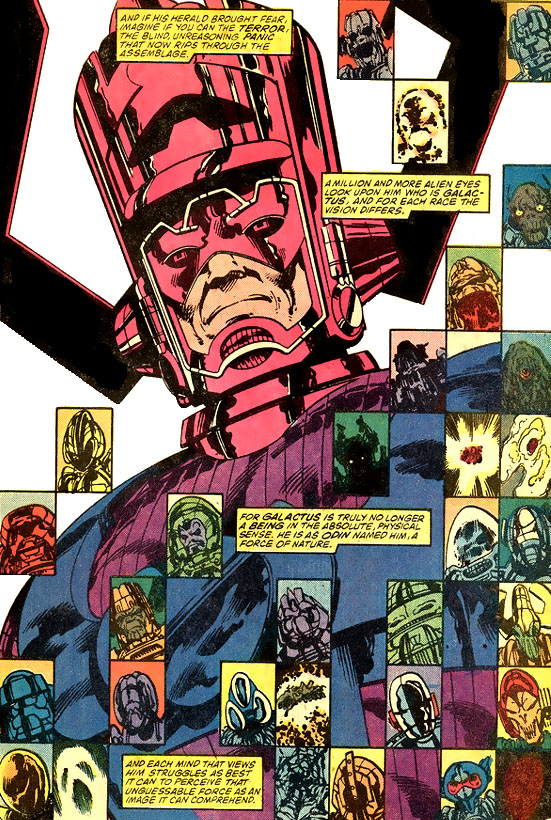
The Daelkyr are often depicted as attractive, androgynous humanoids clad in organic armor. Some wonder “why do they look human, when they originally fought goblins?” In my opinion, this appearance doesn’t remotely reflect the true nature of the Daelkyr; it is simply something the human brain puts together to make some sort of sense of what it’s facing. As such, a goblin might see some sort of handsome goblinoid wearing the skins of its enemies, and a warforged might see an imposing construct clad in the rusting remnants of other warforged. I’m inspired by this image of Galactus from back in the day…

Bear in mind that a Daelkyr can cause confusion at will – which is to say, it can break your mind just by thinking about you. Given that, the idea that different people may see Daelkyr differently is a fairly minor thing.

With that said, I also believe that different named Daelkyr will have unique appearances. We’ve shown Kyrzin (Prince of Slime) as a vaguely humanoid slime with human limbs embedded in it. I’d expect Belashyrra (Lord of Eyes) to be associated with eyes. With that said, I WOULD be more inclined to make Belashyrra some sort of humanoid as opposed to, say, a giant beholder. Daelkyr do carry symbionts designed to be used by humanoids. They may not look HUMAN, but I think they manifest in a humanoid shape.

How high is the Daelkyr threat level compared to the overlords?

As described above, I don’t consider the Daelkyr to be as IMMEDIATE an apocalyptic threat as the Overlords. The release of the Daelkyr won’t mean instant devastation; the main thing is that once those seals are broken, you may never be able to fix them again. The conflict between the Dhakaani and the Daelkyr lasted for centuries, and I wouldn’t expect things to be different now. A released Daelkyr wouldn’t destroy the world… but it WOULD start changing the region around it, and might eventually fling an army of aberrations at the country next door, spread plagues or waves of madness, or otherwise do things that could harm tens of thousands of people or break the existing balance of power.

(The Daelkyr) are a little difficult to use in a campaign as the main villains because they are not as strong, manipulative, or great in number as the overlords…

I’ll touch on influence in a moment, but speaking to “strength”, there’s a few things. First, bear in mind that a Daelkyr should never be found alone. They create monsters, madness, and bizarre diseases as a hobby, and have had eight thousand years to indulge in this. Belashyrra has a battalion of beholders, not to mention dolgaunts, mind flayers, and anything else you care to create. And if you want to say that Belashyrra has bred an army of 100,000 beholders and has it sitting under Sharn right now… than he does.

Second: Don’t be limited by the stats that are presented. First of all, Daelkyr are like demon princes. All of the major ones – Belashyrra, Kyrzin, Dyrrn the Corruptor, Orlassk – should be unique individuals with their own powers. Second, more than any other creature in D&D, Daelkyr should break the rules. The fundamental rule of the Daelkyr is that we don’t understand them. As powerful as the Overlords are, they are part of Eberron. They are embodiments of concepts that shape our world. The Daelkyr are something else entirely. They don’t belong here. Having magic or other fundamental rules warp around them is entirely in keeping with them as a concept.

Aside from the fact that direct magical effects may not work as you expect, feel free to assign powers to Daelkyr that simply have no grounding in standard mechanics. For example, it’s said that Belashyrra can see through anyone’s eyes. Maybe that’s exaggerated; maybe it’s the literal truth. Maybe he can blind anyone he wants – anywhere, anytime – or swap your sight with someone else, so suddenly you’re seeing the world through the eyes of an orc shaman in the Shadow Marches. Meanwhile, the Marchers say that Kyrzin has influence over anyone who’s suffering from excessive mucus. Maybe a faerie tale… maybe not. Again, the key with the Daelkyr is that we DON’T KNOW. This is enhanced by their alien attitude and uncertain goals. If the Dreaming Dark could see through everyone’s eyes, they would use it to further their known agenda. Belashyrra COULD do lots of useful things with this gift, and simply chooses not to. Why?

How much day-to-day influence do the Daelkyr actually have, and why? As opposed to mere personal might?

This ties to the question above: We don’t know, because we don’t know what they want, and we don’t know what they are capable of. It’s possible that anyone who’s got a cold is an unwitting agent of Kyrzin, and that anyone who’s got eyes is an unwitting spy for Belashyrra. Beyond this, ANYONE WHO’S CRAZY MAY BE CRAZY BECAUSE OF THEM. And “crazy” is a very broad term, as I’ll discuss when we get to the cults.

Furthermore, the Daelkyr can always create new things we’ve never seen before. Someone asked if the Daelkyr could actually be responsible for Dragonmarks. Why not? The Daelkyr specialize in creating and modifying lifeforms. They get to break the rules. They could have created the dragonmarks as a weird living way of embodying the Prophecy that the dragons and fiends still can’t really understand… and the aberrant dragonmarks are a weird variant of that experiment. This could relate to the Cult project in my City of Towers novel… and could mean that they could create new dragonmarks, move them onto new races, etc.

So the short form is “How much influence do they have? Well, how much influence do you WANT them to have?” The key here is that a campaign in which the Daelkyr are the villains should feel entirely different from one dealing with the Dreaming Dark or the Lords of Dust. it doesn’t HAVE to revolve around the release of a Daelkyr; it could revolve around the emergence of a new sort of dragonmark, an attack by an army of previously unknown aberrations, the killing spree of a single bizarre serial killer, the spread of a horrible plague… or all of these things stitched together in a strange and unexpected tapestry.

I find that horror is difficult to pull off without visual aid.

This needs to be the subject of its own blog post, but the trick here is that the gooey symbionts are really the least frightening thing about the Daelkyr. What’s far more frightening is the fact that you don’t know what they are, what they want, or what they can do to you. Say you are looking in the mirror one morning, and just for a moment you see Belashyrra looking back at you. What does it mean? Perhaps a small eye-shaped dragonmark-like tattoo then appears on your hand. What does it mean? Perhaps you start having telepathic intuitions about the motives of people around you. They save you from an ambush, but… what does it mean? Then you hear about another fellow who had the same mark, and who ended up killing his friends and family and disappearing… and no one knows why. The fear here isn’t VISUAL at all; it’s the fact that you are touched by something you don’t understand, you don’t know why, you don’t know what to do about it, and you don’t know what’s going to happen next.

Similarly, when dealing with the powers of the Daelkyr, think about what they actually are and what can make them horrifying. A Daelkyr can use confusion at will. But what does it mean to be “confused”? Does it take you back to the most horrible time in your life when you were surrounded by enemies? Does it make you watch helplessly while your body blunders around on its own? When it uses Feeblemind, it is stripping away your ability to speak, to understand language, to do anything you once could do… the idea of that, of being conscious but unable to communicate, unable to remember how to use a sword or cast a spell… that’s more horrifying to me than any gooey monster. The horror of the Daelkyr is the things you CAN’T fight with a sword… and the fear of what might be coming next.

Why don’t the Daelkyr team up and free themselves, like, right now?

I’ve answered this above, but I’ll reiterate it here… THIS IS A QUESTION DAELKYR SCHOLARS HAVE BEEN ASKING FOR CENTURIES. It may be because they don’t care about being imprisoned. Perhaps it’s because they are immortal and know that the seals will all break in 999 YK when Xoriat finally becomes coterminous again, and they don’t mind waiting. Perhaps it’s because they can do everything they want to do WHILE being imprisoned. Or perhaps it’s because they are engaged in a series of feuds so esoteric and strange that we don’t even know they are going on!

Was the Undying Court ambivalent to the daelkyr invasion of the Dhakaani empire? Or busy with some other pressing business at the time?

Short answer: The power of the Undying Court is concentrated in Aerenal. They undoubtedly took action to defend Aerenal from the incursion. The Dhakaani had already fought the Tairnadal and driven them from Khorvaire, so there was no love between elf and goblin; even if the Court had the power to help Dhakaan, it’s not much of a surprise that they chose to focus on their own defense.

Is there any evidence to support the claim that the daelkyr were refugees seeking asylum in Eberron and that the Dhakaani empire was the one to initiate hostilities, forcing the daelkyr to respond in self defense?

None at all. You may be thinking of the theory that the Quori were refugees seeking asylum in Eberron when they were attacked by the Giants; there’s a fair amount of evidence suggesting that, and more important, neither culture survived to the present day, so there’s no way to verify it. Meanwhile, we have the Gatekeepers, Heirs of Dhakaan, and the Daelkyr themselves as multiple living threads attesting to the hostile intent and actions of the Daelkyr. With that said, it can be argued that the Daelkyr don’t consider collapsing civilizations and warping creatures into new forms to be a hostile act.

Are there Gatekeepers corrupted by the Daelkyr?

Certainly. “Gatekeepers corrupted by the Daelkyr” is an entirely valid foundation for a Cult of the Dragon Below. Consider the link above.

The question about the Undying Court’s reaction (or absence thereof) to the Daelkyr invasion of the Dhakaani Empire reminds me of one that’s been bugging me for some time. Did the Daelkyr only target Khorvaire for their invasion – and within Khorvaire, only the south-west in and around the Shadow Marches and some of the border areas? I’ve read that the chokers may have been formed from halflings, so strikes into the Talenta Plains may have happened – but what of Xen’drik, Argonessen, or Sarlona – who, in the absence of Gatekeepers, would have been defenseless?

As far as has been mentioned in canon, the Xoriat incursion was limited to Khorvaire; notably, there’s no mention of it having targeted Sarlona at all, and even the problems of the Umbragen came after the Daelkyr were trapped in Khyber. They struck across Khorvaire; in addition to the Talenta Plains example, they also wiped out the Dwarven civilization that once existed below the Ironroot Mountains. Looking to the question of why they’d do this when there were other, easier targets… the Shadow Marches has an unusually large number of manifest zones to Xoriat, and this is part of what made the incursion possible in the first place. Bear in mind that there were no Gatekeepers in Khrovaire when the Daelkyr attacked; they were formed in response to the incursion, and if the Daelkyr had attacked Sarlona Vvaraak would have gone there. But most of all, bear in mind that the Daelkyr weren’t looking for a defenseless place. They weren’t trying to claim territory; they were (as best as we can tell) interested in transforming the world. Today, Dhakaan has fallen, and we have dolgaunts and dolgrims, derro beneath the mountains, cults of the Dragon Below, chokers in the shadows… it’s not clear that they are unsatisfied with the outcome. As noted in the other Dragonmark, they don’t seem to be working very hard to break the seals. Having dropped seeds of madness into Eberron, they may simply be watching as those seeds spread, waiting until the time is right for the next phase.


Now let’s move from the Daelkyr to the Cults of the Dragon Below. A few people asked variations of the same question…

“Why would anyone find the Cults attractive, given their obviously ‘wrong’ nature?”

Because if you’re in the cult, it doesn’t seem “wrong.” Imagine that you wake up one morning with the sudden realization that you are the reincarnated soul of King Arthur, and that you have to save the world from the new Modred. You have the ability to see the auras of the other Knights of the Round Table, and so you start gathering them together – and they in turn see you as their king. You even find Merlin dwelling in the sewers, and he whispers to you of your missions. This is a perfect model for a Cult of the Dragon Below. The cultists don’t see that “Merlin” is a mind flayer, or that “Excalibur” is a bizarre sword formed from muscle and bone; they see it as the most perfect sword ever formed. Because they are insane. It may be a extremely subtle madness, and “King Arthur” may be a brilliant and charismatic leader. But he’s still convinced that he IS King Arthur, when in fact he’s just some random soldier holding a gooey sword and talking with a mind flayer. To you as an outsider it seems “wrong.” For him, it is his destiny and a quest that will determine the fate of the world.

This is why Cults rarely work together. They are driven by delusions and don’t necessarily share any sort of common creed. One cult embraces the aberration and sees symbionts as a way to improve on weak flesh; another doesn’t even see symbionts AS symbionts, instead seeing them as amazing glittering treasures.

The Cults seem to be an avenue for the desperate and insane, why would a rational person of means who join the Cults?

See above. “King Arthur” could be one of the greatest generals of the Five Nations, in charge of thousands of troops. He could also be an amazing strategist and extremely rational person… except for the part where he thinks he’s King Arthur. Just because you’re insane doesn’t mean you’re desperate, and “insane” can mean MANY different things. Poor and desperate people might turn to a cult willingly because they see it as a source of power or a means of survival. But madness can strike anyone, anywhere. And that’s not even getting into the fact that Kyrzin could technically spread a cult by using the common cold.

Why do people join the Cults? It seems like their core tenet is that everyone’s going to die, but the faithful die faster.

Game mechanics sort of imply all cults are some what uniform. How much variation is there? Can they hate each other?

Blood of Vol seems like a morally-ambiguous church (at least in terms of followers) -Why was Dragon Below not written similar?

I want to address these together. I’ve already talked about the fact that a Cult can appear anywhere, anytime, and that their creeds can vary dramatically. However, we also have the established, long-term cults that you find in places like the Shadow Marches. There’s a few sources on these:

Touched By Madness” is an article in Dragon Magazine (back when it was a magazine) that discusses a variety of cults.

The Gibbering Cults are described in this article on the Daelkyr Kyrzin. Gibbering Cults cultivate gibbering beasts, and when a member of the cult grows sick or elderly, they feed them to the family beast. They believe that the soul lives on in the beast, and that they can hear its wisdom when they listen to the beast. Beyond this, they aren’t innately evil. They aren’t going to feed YOU to the family beast, because you don’t deserve it. Some gibbering families may be crazed killers; others might seem just like you and me – provided you stay out of the basement. Really, it’s not that different from the Undying Court.

The Inner Sun cults are mentioned in this Eye on Eberron article. Here’s a quote:

Collectively, the Cults of the Dragon Below are anything but monolithic. Creeds vary wildly from one group to another, and cults spring up spontaneously; sometimes a madman has a vision that infects the minds of those around him. A few common threads of thought, however, appear in similar forms across cult lines. One shared precept is that the world is an imperfect place. Khyber sought to perfect it—to eliminate pain, suffering, death and all other woes—but the other dragons turned on her, and when Eberron couldn’t defeat Khyber, she trapped her.

The second element of this credo concerns the realm of the Inner Sun. It is the belief that a paradise exists within Khyber, a place where people can escape the suffering of everyday life. Most of the cults that subscribe to this belief consider the Vale of the Inner Sun to be a place that can be reached only after death, often coupled with the requirement that one must earn passage to the vale by spilling the blood of worthy enemies. This perceived duty has been the motivation behind the acts of many murderers and vicious Marcher clans.

Many of these hereditary cults aren’t LOOKING for new members. You join one by being born into it, and it makes sense to you because that’s how life has always been. But you could certainly play a half-orc barbarian raised in an Inner Sun cult who’s joined the party looking to kill enough worthy foes to earn his way to the Vale… and he could end up being a great and noble hero, despite this belief.

How do cults operate in Sharn, and what arm of law enforcement rides herd on them?

The point of the Cults is that it’s hard to monitor them because a new one can pop up anywhere and the lack of a common creed makes it difficult to identify. So the Blackened Book is investigating the weird summonings going on in Ashblack, while the Citadel is looking into this whole King Arthur thing, and none of them have noticed the gibbering family living in Fallen.

How would you suggest using a Cult of the Dragon Below as allies to the PCs instead of antagonists?

Don’t make it obvious that they ARE a Cult of the Dragon Below. Again, that Gibbering family may be fine, decent, helpful people who just happen to be getting ready to feed grandma to the gibbering mouther in the basement. Or try this: there’s a cult that is convinced that they must steel their minds and souls to face a terrible threat. They believe that there are CREATURES LIVING IN OUR DREAMS and trying to control us. They are actually going around assassinating people because “Their minds have been consumed by dream-monsters”; they also have some awesome monk disciplines tied to this training. The leader of the cult is, in fact, a mind flayer, but he doesn’t eat anyone’s brains; instead, he “consumes their fears”, a process that does actually seem to strengthen will without harmful side effects; he also helps them operate without sleeping, to avoid the dream monsters, and it’s his training that helps them spot the “corrupted”. He tells the adventurers that he bears their kind no ill will and simply seeks to keep the dream-monsters from consuming the mind of the world. SO… is this all on the level? Is the mind flayer actually training people to oppose the Quori? Are they actually assassinating mind seeds? Or are they in fact just totally misled and crazy, assassinating entirely innocent people?

When did the cults start to take hold? Were there giants and elves/drow that venerated the Dragon Below or did worship of the horrors get footing only after the Xen’drik cataclysm?

Well, cults that literally worship KHYBER have existed long before the Xoriat Incursion. as for Xoriat-inspired cults, we haven’t mentioned any specifically, but there’s no reason some couldn’t have existed before the arrival of the Daelkyr; in fact, it would be logical for there to have been a cult in the Dhakaani era that laid the groundwork for the arrival of the Daelkyr in the first place.

If the Gatekeepers didn’t stop the Daelkyr invasion, how would it have changed Eberron as a game system? Would it have been akin to, say something like Dark Sun or Ravenloft?

Sure, or Gamma World. The ultimate goal of the Daelkyr is to reshape the world, and once they are done they’d likely move on to another world (as noted in the suggestion that the Gith are survivors from another world claimed by the Daelkyr). It would be a world filled with aberrations, madness, strange powers, and the like – both flora and fauna would definitely be affected.

Dolgrim, Dolgaunts, etc, are obviously the goblinoid aberrations – if I wanted to create other races’ aberrations, what is the guiding principle regarding a “corrupt” race? Dolgrims and Dolgaunts don’t seem much like goblins and hobgoblins except in size.

There is no “guiding principle”. It’s going to depend entirely on what daelkyr you’re dealing with. Kyrzin likes slimes and disease. Belashyrra has a fondness for eyes. Orlassk likes stone and petrification. Dyrrn just likes corruption in any form, mental or physical. As noted above, DRAGONMARKS could be the result of Daelkyr “corruption”. A Daelkyr may choose to create something designed to inspire fear or horror in others… or it may design something strange and bizarre that it simply finds pleasing or necessary for its goals. The Dols were created to serve as soldiers and unleashed on the Dhakaani. They were designed to horrify the Dhakaani and to be effective soldiers. Dragonmarked humans could have been engineered as a way to control the Prophecy (or they could have nothing to do with the Daelkyr – don’t get me wrong). Any form of manipulation is appropriate.

What part, if any, do the Lords Of Dust play in the formation of the cults?

What part do you want them to play? If it furthers the goals of their Overlord, a Lord of Dust might well set a cult in motion. The Daelkyr are weaker than the Overlords, and certain Overlords (such as the Voice in the Darkness) don’t see the Daelkyr’s actions as any sort of threat to their goals. Beyond this, of course, there are some “Cults of the Dragon Below” that are entirely dedicated to the Overlords as opposed to being influenced by the Daelkyr.

Why did Vvaraak teach the orcs to fight the daelkyr? Wasn’t Darguun militarily the more capable power? Will of the Prophecy?

It could have been driven by the Prophecy. it could be that the Daelkyr already had too much influence over the Dhakaani for Vvaraak to reach them. I’m inclined to say that the Dhakaani were simply too entrenched in their own cultural traditions to abandon them and embrace some bizarre tree-hugging dragon’s weird religion. The Dhakaani knew exactly how to handle the situation: steel, military discipline, and the magic of the Duur’kala. If some barbarian orc wants to go pray to moss or the “great earth dragon” – frankly, that sounds like the exact sort of madness our enemy is spreading.

Since the Silver Flame opposes supernatural threats, does the Church of the SF have alliances with gatekeepers against Daelkyr?

The Gatekeepers are almost entirely unknown outside of the Shadow Marches, and given some of the CotSF’s issues with Droaam aren’t entirely trusting of the Church; overzealous followers of the Pure Flame might well see orc mystics as a problem, not a solution. With that said, the Church of the Silver Flame seeks to protect the innocent from all supernatural threats, and the Daelkyr are certainly a supernatural threat. So I think that Jaela would find common ground with Maagrim’Torrn if they ever met, and I think most true followers of the Flame would help Gatekeepers if they faced aberrations together, but Thrane and the Shadow Marches are far away.

Can an exorcist of the SF repel the Daelkyr and Xoriat beings?

An exorcist’s Flame of Censure affects “outsiders with the evil subtype”. As a result, it WILL work against a Daelkyr – an evil outsider – but won’t work against a dolgaunt. Aberrations aren’t really the province of the Flame; it’s used to dealing with fiends, undead, and the like, and the point of aberrations is that they are fundamentally more alien than even a demon; aberrations are the things we don’t understand, things that don’t follow natural law.

Dragonmarks 3/4: The Lords of Dust

I’m pulling a few answers from other weeks, and I’ll continue to do so as time allows so this can be a comprehensive source for all of my Q&A discussions of the Lords of Dust and the Overlords. So check back in a few days and I may have expanded it! As always, these answers are just my opinions and may contradict canon sources… though to the best of my knowledge, I’ve written most of the canon sources on the Lords of Dust!

There are a number of decent sources of information on the Lords of Dust. I recommend the Eberron Campaign Guide (4E) and Dragon 337. With that said, let me try to clarify some of the common points of confusion right away.

The Lords of Dust is an alliance of fiends—mostly rakshasa, as they are the most common native fiends of Eberron—who serve the interests of the fiendish overlords of the Age of Demons. There were originally approximately thirty of these overlords. Their power was equivalent of that of gods in most other settings. Most exerted influence over a region akin to a large modern nation, but some had more subtle influence reaching across the entire world. Overlords are part of the very fabric of reality, and they cannot be destroyed any more that you can destroy death or treachery. They can only be bound, and that only with the guidance of the Prophecy. The only known force capable of binding them is the Silver Flame, which was created by the sacrifice of the Couatl host, a sacrifice that created an immortal force of light to contain the immortal force of darkness.

The overlords of the Age of Demons are the most powerful entities that exist in the setting. An individual overlord is equivalent in power to il-Lashtavar (the force behind the Dreaming Dark) or the entire Undying Court. A question worth asking is, if they are so incredibly powerful and had hordes of demons on top of it, how did the war of the Age of Demons last so long? It lasted for centuries… why didn’t the overlords just win?

There’s a few answers. The first is that it wasn’t a “war” in the sense we think of it. Some of the overlords—like Rak Tulkhesh and Katashka—fielded armies that could be fought in a traditional battle. Some sought to directly control and enslave dragons, titans, and other creatures. But with many of them, the “war” was simply existence. They are immortal. Their fiendish servants are immortal. They don’t NEED to conquer you. They just do what they do. A battle against Tul Oreshka is a battle against madness; having more soldiers doesn’t help you win a fight. The Voice in the Darkness “wins” when you succumb to madness; she doesn’t need to occupy your city if she occupies your mind.

Got that? Now add to this the fact that for the most part, the overlords were neither friends nor allies. They are not human in any sense of the word: they are primal entities who shape reality by virtue of existing. Far from being friends, many of them actually fought one another; when you are an incarnation of strife or discord, that’s kind of what you do. One of the main reasons they were finally defeated is because their opponents were able to target them individually or use their existing rivalries against them. And bear in mind that absolute immortality and nigh-omnipotence breeds a lot of overconfidence.

After they were bound, their surviving servants eventually recovered and began laying plans to free their masters. Eventually this brought them in conflict with one another. The Lords of Dust aren’t a monolithic force; they are more like the United Nations, with each member of the Council of Ashtakala representing the interests of a different overlord. They don’t all share resources, and three different Lords of Dust may all have personal agents in the same court. The purpose of the Council is at best to exchange favors and at worst to try to keep the Lords from interfering with one another’s plans accidentally (key word: accidentally. Intentional interference happens). The Wyrmbreaker calls the council together and explains that he’s going to be doing something that involves a group of heroes and will probably kill the Queen of Aundair. The Shadowsword explains that he has plans involving Aurala, but based on his insights into the Prophecy, perhaps Durastoran could achieve the same results with the death of Kaius III—and he’d be happy to lend some agents to that cause. Perhaps the Wyrmbreaker agrees, perhaps he doesn’t, perhaps he agrees but still plans to see to it that Aurala dies.

The next thing is to understand what it takes to release an overlord. It’s nothing so simple as breaking a seal or melting a ring. The conditions for the release of an overlord are different for each one, and involve a long-term manipulation of the Prophecy. In the case of the Aurala death above, we’re not just talking about Aurala’s death; it would be trivial for one of the Lords of Dust to make that happen. Instead, it’s that a particular hero (the son of a particular person, herself the daughter of a particular person, born in particular circumstances) must kill a beloved ruler on a particular day with a particular weapon, and must do so believing they are serving a greater good but in fact be wrong. So the Lord of Dust not only can’t kill the ruler, they actually have to make sure that the person who does the killing doesn’t know why they are doing it. Some of the overlords’ release conditions have nothing to do with one another; others are actually overlapping or contradictory, so actions cannot be taken to free one without directly screwing with another. This can result in Lords of Dust helping heroes. The problem is, if a Lord of Dust is helping you, you can be certain it’s somehow benefiting them.

If an Overlord is released, it generally won’t return at full power. It will take time for its power to grow.  Bel Shalor was released, and wreaked havoc in Thrane for almost a year before he was finally bound again by the sacrifice of Tira Miron. It wasn’t the end of the world; it was simply a year of utter terror for the people of Thrane. Of course it’s possible that Bel Shalor intended this all along as a way of infecting the Silver Flame, and thus his release wasn’t as devastating as it could be. But generally, the immediate release of an Overlord will affect an area of a few miles, spreading out until it encompasses a nation or more. The impact will also greatly depend on WHICH Overlord is released. An incarnation of madness or war will cause immediate violence or insanity. An elemental force like Dral Khatuur would cause a new ice age. But an incarnation of tyranny or betrayal may have a very subtle effect that takes years to really be noticed. It’s entirely possible that the Mourning was caused by the release of an Overlord, and that there are continuing effects that people simply haven’t identified. Essentially, the effect of an Overlord’s release is up to the DM. It could have instantly apocalyptic effects, or it could be a slow cancer that eats away at the region over time.

Tied to this, I once had a PC warlock in my campaign who was actually a willing agent of an overlord. The idea behind his character was that it was inevitable that an overlord would eventually be released… but his overlord would at least keep society intact in a form that people could live in, as opposed to dissolving it into chaos, war, or ice. Life in the domain of his overlord might be endless tyranny and oppression and tears of blood, but it’s far better than what you’d get from Tul Oreshka or Rak Tulkhesh. He didn’t LIKE the future he believed was coming, but he believed that ONE of them had to get out eventually, and his was the best option.

So bearing all that in mind…

Is there a list of all the rajahs already published somewhere? With the rajahs theme, location and where to find the full writeup?

I’ve never done it. However, Lord Gore at the WotC forums put together this list, which may be the most comprehensive around; I’ve updated it with Overlords mentioned since it was written.

  1. Bel Shalor, the Shadow in the Flame (Tamor Hills, Khorvaire) ECG page 29
  2. Dral Khatuur, the Heart of Winter (Frostfell) female overlord Druid 25/Sorcerer 15/Frost MageFb 10 Death, ColdFb, WinterFb unpublished
  3. Eldrantulku the Oathbreaker (unknown) NE male overlord rogue 15/sorcerer 15/mindbenderCAr 10 CorruptionBoVD, Trickery Dragon 337 pages 63, 69-70
  4. Katashka the Gatekeeper (Lair of the Keeper, Khorvaire) LE male overlord cleric 8/wizard 8/true necromancerLM 14 Deathbound, UndeathECS DoE page 36, Dragon 337 page 70, ECG page 30
  5. Rak Tulkhesh, the Rage of War (Khorvaire) NE male overlord fighter 15/blackguard 10/cleric 15 Destruction, War; Dragon 337 pages 65, 70; ECG page 31
  6. Ran Iishiv the Unmaker (Korrandar, Sarlona) SoS page 12
  7. Sakinnirot the Scar that Abides (Stormreach, Xen’drik) CoS page 156
  8. Shudra the Fleshrender (Mel-Aqat, Xen’drik) PGtE page 155, TFoW page 127
  9. Sul Khatesh the Keeper of Secrets (Arcanix, Khorvaire) LE female overlord wizard 36/archmage 4 Knowledge, Magic CoS 89, Dragon 337 pages 60, 68; ECG pg 31
  10. Tiamat, the Daughter of Khyber (Pit of Five Sorrows, Argonnessen) DoE page 9
  11. Tul Oreshka, the Truth in the Darkness (unknown) CE female overlord bard 20/wizard 10/loremaster 10 Madness, ShadowECS Dragon 337 pages 64, 70
  12. Masvirik the Cold Sun (Haka’Torvhak, Q’Barra); Dungeon 185 (DDI)
  13. Unnamed (Krertok Peninsula, Sarlona) SoS page 12
  14. Unnamed (Sustrai Mor, Sarlona) SoS page 91
  15. Unnamed (Tempest’s Isle, Lhazaar Principalities) PGtE page 99 possibly a rajah
  16. Yad-Raghesh (The Vale of the Fallen Rajah, Argonnessen) colossal two-headed overlord DoE page 50 “dead”
  17. The Spinner of Shadows (Xen’drik), DDO

I believe that Sul Khatesh is the only one that’s received a complete 3.5 writeup, in Dragon 337. I’ll also note that I prefer the term overlord to rajah. “Rajah” tends to get subsumed into “rakshasa rajah”—and while the overlords rule the rakshasa, they are not themselves rakshasa.

For you, how many overlords do exist? There is 17 listed, that’s all? There is a couple more? 17 more? A hundred more?

According to the Eberron Campaign Guide (page 30), “approximately thirty fiendish overlords are bound in Khyber.”

How big is the area of influence of an overlord?

Thirty overlords once held dominion over all of Eberron. A fully empowered overlord can easily hold dominion over an entire nation. However, it will take time for a released overlord to regain its full power. Its immediate dominion would cover a few miles, and would then quickly grow until it covered an entire nation or more.

If Katashka is made free, how long until the effects(pests, deaths, undead hordes) are sensed in the Talenta Plains? And Q’barra? Or Xen’drik/Sarlona?

That’s entirely up to you. You could decide that Katashka’s influence spreads quickly and that within days wights are crawling out of cemeteries across the world. Or you could decide that his power is growing slowly and won’t expand exponentially until Mabar’s next coterminous phase.

What if more than one overlord is released. Would they ally or make war on one another?

It entirely depends on what overlords they are. The Voice in the Darkness doesn’t do alliances. The Oathbreaker will, but there’s no question that any alliance with him will end in betrayal. And in some cases there’s no real basis for alliance—Rak Tulkhesh wants endless war, while Dral Khatuur simply wants to freeze everything in her reach. Some might fight, but such a feud might be even worse for mortals in the disputed territory than an alliance.

Are the overlords friendly to each other enough to releasing some or all of the other still bound ones? If Bel Shalor breaks his bonds, he will stride to Aundair and try to release Sul Khatesh, or he will just make sure she never gets free?

First, Bel Shalor can’t stride to Aundair and release Sul Khatesh. For Sul Khatesh to be released, the conditions of her Prophecy must be met. It doesn’t matter how much raw power Bel Shalor brings to bear; releasing an overlord is delicate work. Now, would he TRY to? Possibly. Bel Shalor in particular is a devious force, and has clearly learned a thing or two from his imprisonment. He might well see the value in releasing as many of the other overlords as possible, where Tul Oreshka just wouldn’t bother. On the other hand, there are certainly rivalries and some overlords might work against one another. It’s been noted that Dral Khatuur has no love for any of the others, and as a result she doesn’t have representatives on the Council of Ashtakala.

How common is the knowledge about how their prison works or where each of of then is between the overlords? Does every overlord know how to break free? Or how to break other free?

Extremely uncommon, no, and no. The secrets are all held in the Prophecy. It likely took thousands of years of study before any rakshasa figured out the secrets of releasing their master, and there may well be ones whose release conditions have never been identified. One thing to bear in mind is that the Prophecy is a living thing that constantly shifts as the future becomes the present. So Rak Tulkhesh can be released if X, Y, and Z happen. If you remove Z from the equation—by destroying the person who was supposed to have a child or the sword that child was supposed to use—the universe will simply recalculate and find a new way to solve for Z; and all the scholars who knew the original answer will have to keep studying until they figure it out. This is what the Chamber does: seek to identify paths that will release Overlords and eliminate them, while the Lords of Dust find paths that will release them. It’s a never ending conflict, even though it rarely comes to a demon and a dragon fighting one another.

What should the response of the Argonessen dragons be if an overlord is released?

Rebinding an overlord is just as difficult as releasing one, and in the same way, brute force is no answer. Bel Shalor wreaked havoc for a year in Thrane before Tira defeated him. Do you think Argonnessen just didn’t know or care? They knew; they simply had no path to rebind him, so they stayed far away. They may well have helped Tira without her knowing it. Just as it doesn’t help Sul Khatesh to have a rakshasa kill Queen Aurala, it doesn’t help Argonnessen if an army of dragons defeats Bel Shalor; he’d just reform tomorrow. So Argonnessen would get to work trying to find an answer to the problem, and trying to isolate themselves from the impact of the release. But brute force—even all the magic of Argonnessen—is no answer to the release of an overlord.

Of course it’s possible they would take action to contain the impact of a release. If the Rage of War gets out and transformed the Five Nations into a raving army of bloodthirty reavers, the dragons might sink their boats before they can reach Argonnessen. But this won’t stop Rak Tulkhesh.

And what about Aerenal? Are they safe against one overlord? Two? How long could take to the free overlord to crack the island defenses?

The Undying Court is essentially an artificial overlord. As such, it would be able to stave off the hostile influence of another overlord for a time, but as noted above, it would also depend on the form that influence takes. Tul Oreshka drives mortals mad. Rak Tulkhesh drives them to war. Aerenal could keep Rak Tulkhesh from infecting the elves, but they can’t stop him from flinging hordes of reavers at the island. And if you had an alliance of overlords, who knows?

Realizing that the bonds of the Daelkyr have to be maintained, and with the chaos brought by one or more released overlords, is safe to assume that sooner or later they would falter, and the mad gods would spill in Eberron again. How could they interact with the acting overlord(s)?

Daelkyr are small potatoes next to overlords. Bear in mind that the daelkyr aren’t even the toughest things in Xoriat; they’re just the toughest things that have any interest in other planes. Beyond that it depends on the overlord in question. The Voice in the Darkness might welcome the daelkyr. Rak Tulkhesh doesn’t care who’s fighting as long as someone is. An overlord who actually wants to exert dominion over mortals and have some semblance of civilization—an incarnation of Tyranny, for example—would need to deal with the daelkyr to keep them from wrecking that. But many overlords might just incorporate the daelkyr into their plans.

And Sarlona? What would be the Dreaming Dark response to an age of demons again?

Pretty much any free Overlord will mess things up for the Dreaming Dark. However, the Dreaming Dark has never been noted as having expert knowledge of the Prophecy, which means a) they don’t have lots of warning about it and b) they don’t really know what to do to deal with it. And remember, fiends don’t dream. Again, the Dreaming Dark was active when Bel Shalor spent a year free in Thrane. Most likely they would keep their distance while studying the situation and trying not to panic about it. They might provide aid to whoever proves to have a chance to bind it. But a Riedran army won’t help. Thought they may not know that—so if you WANT them to, you could have them panic and do something dramatic, simply so it can fail awesomely. Heck, a confrontation between the Dreaming Dark and an overlord might be just what it takes to push Dal Quor into the next age… which could be the best thing that could possibly happen, if the next age of Dal Quor is one of light.

If a Lord of Dust was killed, would the death be for good (akin to killing a demon in the Abyss) or would it reform somewhere?

In Eberron, immortal spirits cannot be destroyed. Unless they are bound, they will always reform. This is true of every immortal from rakshasa to devils to quori. Depending on the type of immortal, it may not retain its memories after death and reincarnation. This is true of quori, and it’s why the Dreaming Dark seeks to exterminate the Kalashtar quori – so they can be reintegrated and reborn as part of il-Lashtavar. With rakshasa, weaker ones generally lose memories, while strong ones (such as the Council of Ashtakala) will generally reform with memories intact. Now, there are ways to ensure that you destroy the memories, and ways to delay that reincarnation, and the key there is to know your Prophecy. Kill the Wyrmbreaker with normal steel on a Tuesday and he’ll be back by Thursday. But if the Son of Seven Sorrows kills him with a silver sword forged in the tears of the Keeper under the light of a new moon, he might be dead for a year and a day. Which is to say, a DM should always feel free to come up with interesting circumstances under which it is possible to effectively kill a fiend.

Are there angelic or good aligned counterparts to the overlords?

If you mean “Is there an incarnate force that’s called something like ‘The Cuteness of Kittens’?” No, there isn’t. If you mean “Is there any sort of native celestials on Eberron,” there WERE: the couatl. They were never as powerful as the Overlords, and were more on par with the rakshasa… and they sacrificed themselves to create the Silver Flame. On some level you could say that the Silver Flame is the good counterpart to the Overlords, which is why it can bind them; it’s simply less concrete and more abstract.

Why is this? Look to the progenitor myth. Khyber killed Siberys and was in turn imprisoned by Eberron. The Overlords are Khyber’s children, and like Khyber, are forces of evil that cannot be vanquished, only bound. Eberron doesn’t produce incarnate spirits like the Overlords: her children are mortal. So Eberron DID create a thing that embodies the cuteness of kittens: she created kittens. Meanwhile, Siberys would be the source of native celestials, and he did create some, like the couatl – but they were created from the blood of Siberys after his defeat, and thus lack the power of the victorious Khyber.

From a purely practical worldbuilding standpoint, there’s a simple reason for this. Eberron is designed to be a world that needs heroes. All the powerful forces of good are limited. Jaela Daran is a child whose power is limited beyond Flamekeep. Oalian doesn’t leave the Greenheart. When evil rises, the world needs you; there is no ultimate good force that can step in and solve the problem for you. The Silver Flame can empower you to solve the problem, but it can’t solve the problem for you.

Is there not even a single surviving Couatl?

I believe we have a few places in canon where there are still couatl who were left behind to watch over things. And there are of course the Shulassakar, the feathered yuan-ti. Beyond this, the fact that the couatl are gone from the word doesn’t mean that they can’t play a role–it means that they need your help to do it. Tira Miron was aided by a couatl, but it didn’t help her in corporeal form; it empowered her and advised her spiritually. In D&D 3.5 this is called divine channeling; I don’t know if 4E ever did a version of it. Essentially, it’s a form of possession that doesn’t actually control the person being possessed, instead granting them additional powers. The premise is that this isn’t something just anyone can do; Tira’s faith and courage made it possible, and it’s what defines her as the Voice of the Silver Flame — her ability to hear the Flame when others did not. So the couatl CAN affect the world, but only through the medium of heroes. Which comes back to that basic premise of Eberron: there are no forces of good that can solve the problem alone. They need you.

On the other hand, the Silver Flame preaches that it will one day cleanse the world from all evil, and naturally that involves the lords of dust, which entails that they are not truly invincible.

This idea comes from Faiths of Eberron. I didn’t work on that book, and I don’t agree with the idea. To me, the key of the Silver Flame is that you don’t fight because you think the battle can be won: you fight because it is that battle which makes the world a better place. There’s no end condition: it is an eternal struggle. There will always be a need for champions. There will always be a need for courage and sacrifice. Evil can’t be permanently vanquished, because good and evil are choices people make. You can’t eliminate lying from the world, because every time someone speaks they have the choice to lie. You can teach that person the value of honesty. You can encourage them to tell the truth. But if you truly eliminated their capacity to lie, you have taken away their free will, and how is that a good thing? This is the lesson of the Overlords. They will always be there, just as the potential for war, death, and treachery will always be there. Through our actions, we hold them at bay, both physically and in the human heart. Through courage and virtue, we show people the proper path and inspire them to be better than they are, to ignore the tempting whispers of evil. And when a noble soul dies their spirit joins the Flame, where it continues to hold evil at bay and strengthen those who fight it.

In several tales heroes tend to be inspired by higher noble powers and realize that they are still fragile and prone to temptation (this is well reflected by Eberron’s handle of alignments), and just as the lords of dust embody several aspects of evil (war…), there ought to be embodiments of goodness.

The Silver Flame is a positive source of spiritual power. It is a source of inspiration. But unlike the Overlords, it cannot act alone: it needs to act through champions. Again, this is part of what defines it as good; it cannot enforce its nature on others, but rather they must choose it. Rak Tulkhesh makes people fight. Katashka revels in death. There is no entity that forces you to be good; there are simply powers that can strengthen you if you choose to be good, just as it was Tira’s courage and virtue that allowed the couatl to empower her.

In my eyes, the fact that virtuous behavior is a choice is what makes it truly virtuous. If it is enforced–whether by a supernatural agency or a mortal power–it loses its meaning. The followers of the Silver Flame don’t do what they do because they expect to win and utterly eliminate all evil forever; they follow the precepts of the Flame because doing so is what makes the world a better place.

This is in marked contrast to the Blood of Vol, many of whose followers believe that they can some day eliminate the concept of death from the world; one can well ask what that would actually mean, and if in so doing they would also eliminate new birth. But that’s another topic. Meanwhile, you might want to consider the following…

Could the place of an Overlord be usurped, or could a person rise to become an overlord? For example, if Erandis Vol decided that her destiny was to achieve actual dominion over death, could she rise to become the embodiment of the concept of death, or failing that, usurp the place of Katashka as the gatekeeper of death?

Anything is possible. We have said that there are members of the Lords of Dust who don’t want to free their Overlord masters, but rather to usurp their power. If it’s possible for a rakshasa to do it, than it’s presumably possible for a human to do it; you’ve just got an interim step of becoming an entity of incarnate spirit like a rakshasa. With that said, you don’t have to usurp the power of an Overlord to become an embodiment of a concept. Erandis Vol wishes to become the Queen of Death (and bear in mind, she’s been working at it for thousands of years and has a unique spiritual basis for being able to do it–the Mark of Death–so clearly this isn’t a casual thing). However, I don’t think this requires her to displace Katashka. The Overlords embody horrible things. That doesn’t mean they govern them. Katashka embodies our fears of death and the horror of the undead. He can enslave the spirits of the dead and bind them to his service in the mortal world. But as he is part of this world, he doesn’t govern the fate of the dead in the worlds beyond. Rak Tulkhesh gains strength from strife, and when free he can create strife. But again, he only has dominion over the rage of war… he has nothing to do with a just conflict.

So the question you have to ask, is do you want to become an Overlord… a finite entity who can be bound and whose dominion is limited… or do you want to become a Sovereign, whose power is unbound and touches all it inspires? The Sovereign Host maintains that Dol Dorn and Dol Arrah can be found any time a blade is drawn, and that Onatar is there in every forge. Tied to the previous answer, the Sovereigns don’t take incarnate form; they inspire and act through mortal vessels. When you create something new, Onatar (or the Traveler) is with you. When you fight, Dol Dorn is with you. And, of course, when you choose to do evil in war, the Mockery is with you. But even the Mockery isn’t finite in the way an Overlord is.

People have sought to become Sovereigns before. The founder of the Library of Korranberg sought to displace Aureon as lord of knowledge. According to the draconic faith of Thir (as discussed in Dragons of Eberron), this is possible; when a new being takes on the mantle of a Sovereign, the previous one ascends to greater realms. Myths suggest that the first Sovereigns were ascended dragons who fought the Overlords in the first age. So there’s mythical precedent for it; it’s just a question of what it takes, and what it actually means if you succeed, since Sovereigns don’t manifest after ascension.

Is there any connection between Katashka the Gatekeeper and other prominent undead-themed entities (eg Vol and her followers).

Not according to canon. However, you could always decide that Katashka is connected to all negatively empowered undead, whether they know it or not… and that Vol, Kaius, and other influential undead are all secretly pawns in the Overlord’s plans. This certainly seems like a fine approach for starting with the Emerald Claw as a heroic tier threat, moving to Vol herself in paragon, and then bringing Katashka in as the true epic threat. For those wanting to know a little more about Katashka, check out Dragon 337 or this Eberron Expanded article.

Any idea what Overlord you would place under Sharn? Some of the details of Fallen (the improvement of which was a major goal of a paladin in one of my games) seems to imply something malign is buried below the city.

By canon, the spiritual force of evil in Sharn isn’t tied to an Overlord; it’s tied to the fact that it’s a dumping ground for Syrania where fallen angels… AKA Radiant Idols… are left to rot. My novel The Son of Khyber specifically addresses the idea of a malign spiritual force tied to Fallen. With that said, you could decide that the reason Sharn is such a great place for dumping angels – aside from being a manifest zone – is due to the presence of an Overlord.

Why could Siberys be killed, but Khyber only imprisoned? Or could Khyber be killed by (only) Eberron or an alive Siberys?

Assuming you take the myth at face value, there’s a few reasons. First, Khyber employed treachery, taking Siberys by surprise. Second, because that is what Khyber is: destruction. Treachery. Corruption. Evil. Eberron, on the other hand, is Life. Destruction isn’t in her nature. So she deals with Khyber by imprisoning him through creation–by building the world around Khyber, creating a living prison to hold her sibling at bay. One point I’ll make is that despite the power of Khyber’s children, their number is limited. They may never die, but if there are thirty overlords today, there will never be thirty-one tomorrow. Eberron’s children may be mortal, but they have the power of creation, and that’s something Khyber lacks. So again, Eberron didn’t create an immortal, stagnant overlord called the Cuteness of Kittens; she created kittens, and new kittens are born every day.

Of course, the progenitors and the myth are symbols as much as anything else. The triumph of Khyber explains why evil can exist in the world. Destruction cannot defeat creation, which is why Khyber can never escape Eberron; however, it can corrupt creation, as made manifest in the Age of Demons. The defeat of the demons shows that mortal life can choose a better path – that virtue can hold evil at bay – but as noted above, it can never be defeated eternally.

Meanwhile, it’s worth noting that the Ring of Siberys is the primary source of arcane energy; as such, even in death Siberys gives people the tools to change the world. They must decide whether to use them wisely.

Do you consider the DDO semi-released Overlord, The Spinner of Shadows, a good example of the demonstration of Overlord power? For non-DDO players, she is imprisoned by the Silver Flame magic, and is basically invulnerable, have some powerful poison that infects you on contact, and can summon an infinite number of demons and spiders to do her bidding. The objective of the quest is recovering parts of the Silver Flame magic that was “eaten” by some magically-altered spiders specifically to counter it, and redo the wards. If you lure her too close to the flame wards, she is weakened enough to run in fear for a few seconds.

There’s no such thing as a reasonable display of overlord power. You say yourself that she’s “semi-released.” So anything could be a reasonable display of power based on the conditions of that release. Rak Tulkhesh could turn an entire country into sociopathic killers. But if he’s “semi-released”, maybe he can only do that to things he can touch through an avatar. In other words, sure, I think this is a perfectly reasonable way to use an overlord in a form that it can be tangibly interacted with in an MMORPG. And I really appreciate DDO’s efforts to work with the existing mythology of the overlords when they could just call the Spinner Lolth and do anything they wanted. But it’s not like you need to use this as a guideline for the release of a different overlord, because it really can take whatever form fits your story.

Dragonmarks 11/1: Sports, Holidays, and More!

Time for more Eberron questions!

Are there any Khorvairian analogs to real world holidays or festivals, say if we wanted a Christmas themed game?

It depends what you mean by “direct” analogs. There’s no Santa Claus or Easter Bunny in canon Eberron. With that said, there are some holidays that could be used to give a game a similar favor. A few examples:

  • Wildnight (18-19 Sypheros). The festival of the Fury, a time when passions run high and people cast aside inhibitions. Blend Mardi Gras with a divinely inspired bacchanal and you’re on the right track.
  • Long Shadows (26-28 Vult). Three nights when the Shadow reigns supreme. Most stay indoors by the fire, but it is a time for minions of darkness to take to the streets and celebrate. If you want a Halloweenish tradition, you could say that some people choose to dress as monsters to frighten their friends… though that’s a dangerous game on a night when true monsters are abroad.
  • Boldrei’s Feast (9 Rhaan). A time for a community to come together and strengthen its ties. Certainly a time in which people give thanks, if you take my meaning. Also a traditional day for elections and government appointments.
  • The Ascension (1 Sypheros). The most important celebration in the calendar of the Church of the Silver Flame, the Ascension commemorates Tira’s sacrifice and transformation into the Voice of the Flame.

All of these are described on pages 30-32 of Sharn: City of Towers, along with ten other holidays and festivals.

We rarely hear of “sports” in fantasy. Are bloodless sports a big Eberron thing? Breland Monarchs vs Karrnath Bats” style?  

Funny you should ask, as some sports are covered on pages 32-33 of Sharn. The sport that’s received the most coverage is The Race of Eight Winds, an annual aerial race that involves eight different species of flying creatures. Combat is allowed in the Race, so it’s not entirely bloodless. However, combat isn’t the focus, and many riders will do their best to avoid it; it’s simply the case that if you’re the Griffon, you’ve got a better chance of beating the Pegasus by literally beating the pegasus than you do outflying it. There are certainly bloodless races – pegasus versus pegasus, for example – as well; the Ro8W is simply the biggest sporting event of the year.

As for team events, the only one that’s been mentioned by name is hrazhak (Sharn, page 32), a team sport with its roots among the Eldeen shifters. Again, this is a full-contact sport, but the goal of the game isn’t the elimination of the opposition and only natural weapons are allowed; it’s a rough game, but I wouldn’t define it as a bloodsport. Because of the nature of the game, human players will be at a disadvantage; however, it could still be something that could gain popularity and become a national sport.

There could easily be other organized sports, but none have been mentioned in canon that I’m aware of.

I was wondering, can a half-elf born of elf and human in Eberron develop either half-elf dragonmark, if any at all?

Well, anyone can develop any Dragonmark, if the Prophecy turns that way. However, per canon and tradition, the only way to manifest a dragonmark is if the person with the mark is part of a bloodline that already carries the mark. So the question here is whether the union of a human and half-elf has the potential to produce a human child, or if all the children will be Khoravar. If a human-Khoravar union can produce a human child, then this simply means that the human parent of your half-elf character has a connection to the house in question somewhere down the line.

Note that if a half-elf/human union can produce a human child, this wouldn’t allow a human to develop the mark of Storm, any more than a Tharashk orc can develop the mark of Finding; it’s just latent in his bloodline.

Also, do half-drow have a place in Eberron?

Sure. In my novel The Shattered Land, the protagonists employ a half-drow guide named Gerrion in Stormreach. It’s simply the case that because there is so little interaction between drow and other species there aren’t very many half-drow, and thus they aren’t a cultural force the way the Khoravar are.

Keith, I’ve been enjoying your take on 4e Eberron (which I’m calling Eberron 4.K) but I’m trying to deal with the cost of rituals. Magewrights can learn one or two rituals but how do they handle component costs? I’ve been thinking of the lamplighters, walking around Sharn with Continual Light rituals and re-casting every 24 hours but the ritual is 20 gold or a healing surge. Adventurers can pay that but that’s something like the annual income of the average laborer to power one lamp.

That’s a case of the ritual being poorly designed for Eberron. You’re right; there’s no way people are paying 20 gp/day to keep a streetlight going. I think the answer lies in the streetlamp itself. The ritual allows you to place a continual light on ANYTHING. I can make my boot glow… but it only lasts for an hour. Now think of it as oil. I can pour oil on my boot and set it on fire, and it will provide light for a little while until it burns up the boot. However, if I use that same amount of oil in an oil lantern, it’s going to last far longer, because it’s a tool designed for that purpose.

So, in the case of Continual Light, what I’d say is that the streetlights are designed with dragonshard “wicks” that hold and channel the power of the ritual for an extended period of time. You pay the base cost to start it up the first time; from that point forward, you have a mini-version of the ritual that simply uses a pinch of residuum to keep it going. So the typical lamplighter is going around recharging, but only spending a small amount – which would come from municipal taxes. The “recharge” ritual isn’t a full ritual in its own right, it’s something anyone who knows Continual Light can perform.

As for the general costs of rituals (like arcane lock), the Magewright would simply have to charge enough for her services to cover the cost of the components and generate a profit.

What if dragonmarks started popping in the real world?

I don’t think there’d be a vast immediate impact. Bear in mind that much of what gives the dragonmarks their power is the tools that are designed to focus and channel that power. On its own, the Least Mark of Making lets you cast Mending once per day. That’s handy to be sure, but it’s the ability to use things like the creation forges that makes the mark a true force to be reckoned with. The marks have been around in Eberron for over a thousand years, but their influence has grown considerably over the last few centuries as the houses have developed superior tools and techniques; I’d expect the same if they appeared here.

Dragonmarks 10/3: Eberron and 13th Age

I’m going to try out a new feature on Friday. But today, let’s get right to the question.

If you were to run an Eberron game using 13th Age, what would you use for Icons?

Some of you may be saying “What’s 13th Age, and why does it need Icons?” So let’s clear that up. 13th Age is a new roleplaying system developed by Rob Heinsoo and Jonathan Tweet, with a little bit of help from yours truly in the very beginning. The Icons are central part of the default setting of the game and of the system itself. The Icons are thirteen powerful NPCs who exert a tremendous amount of influence on the world, and who in many ways embody central themes. The High Druid is a force of nature, while the Archmage and the Emperor are forces of civilization and order. The Priestess speaks for all the deities of light, while the Diabolist traffics with all manner of dark forces.

OK: there’s some powerful people in the world. What makes this central to the game? Why would you need to have Icons if you wanted to use the 13th Age system to play Eberron? During character creation, you get three points to spend on connections to Icons, and these connections define your character’s background and affect ongoing gameplay. Consider the following example:

Lyssa Calton sets her connections as Emperor 2 (positive), Lich King 1 (negative). Discussing things with the GM, she works out the idea that she comes from a powerful noble family in the Dragon Empire, and that her ancestors were instrumental in one of the Lich King’s worst defeats. As a result, he has laid a curse on her family: whenever someone of her bloodline dies, they become undead servants of the Lich King. Right from the start, this gives the GM lots of hooks to work with. Lyssa obviously will want to find a way to break the curse. Family honor calls on her to oppose the Lich King. And in the meantime, due to the position of her family, she might be called on to serve the Empire in some way, or used as a pawn in a scheme to dethrone the Emperor.  However, these relationships can also have in-game effects on the fly. For example, when the adventurers are stopped by an Imperial patrol, Lyssa could see if her connection with the Emperor allowed her to influence the guards and command their assistance. And while the relationship with the Lich King is a negative one, she can still be creative with it; perhaps the curse can allow her to infiltrate a band of undead, as they already perceive her as one of them.

So: a relationship with an Icon helps define a character and drive a story, but it is also a concrete in-game tool in the character’s arsenal. If you’re using the system in Eberron, you’re going to what something to take its place. What will it be?

It’s not a simple question. In many ways, Eberron was intentionally designed NOT to have figures like the Icons. There’s no clear equivalent to the Archmage or the Emperor; all the human rulers are about equal in power (well, except Queen Diani of Thrane). Keeper Jaela is the most powerful priestess, and yet in many ways Krozen matches her in influence… and where the Priestess of 13th Age speaks for all the gods of light, Jaela is tied only to the Silver Flame. There is no one Elf Queen or Dwarf King.

Given this, I think the best choice is to try to address the underlying role of the Icons—defining the background of your character and giving you influence within the game. With that in mind, I think the list has to be based on your campaign. Who do you see as the major players? Consider the following.

Hands of the Twelve: From start to finish, this campaign is going to revolve around the Dragonmarked houses: their internal rivalries, the balance of power between the houses and broken Galifar’s nobility, the growing power of House Tarkanan and the aberrant dragonmarks. Each house has its personal agendas; as the PCs rise in power, they will need to decide whether to embrace that goal and bring it to pass, or whether to change the direction of their house. The Icons are each of the individual dragonmarked houses, the Twelve as an institution, and House Tarkanan. Each character is a member of one of the houses they are tied to and bears the dragonmark of that house; when they use the mark in a creative way, use Icon relationship dice to determine how effective it is. When a player takes a point of relationship with a house, she should also pick an individual who’s her personal patron/ally/enemy/rival in that house; this puts a human face on things in addition to reflecting a connection to the house as a whole.

Return of the Host: The Sovereigns and Six Don’t manifest in the world directly. But following the Mourning, they can no longer sit idly by – so they have chosen mortals to serve as their hands in the world. Here the Icons are the gods of the Sovereign Host and the Dark Six; you could choose to add in other divine or immortal forces, such as the Silver Flame or Undying Court. Relationships reflect alliances or feuds, and these don’t have to all be on the obvious sides; while a Player Character may serve Aureon, it’s possible that he has angered Dol Arrah and the Shadow. Alternately, an artificer could be chosen by both Onatar and the Traveler; over the course of his adventures, he will have to decide which path to follow, and bear the consequences of that choice.

Lords of Sharn: The DM has declared that the entire campaign is going to be set in Sharn. As a result, the Icons for the campaign are on a much smaller scale that you’d normally expect. Instead of the Prince of All Thieves, you can have the Boromar Clan and Dassk as Icons. Even here, the GM should decide who the major players are going to be: by the book, Daask, House Tarkanan, the Boromar Clan, and the Tyrants are all influential criminal forces; however, she may decide that the Boromar Clan is the only one that is going to get full recognition as an Icon, and that a relationship with the Boromar Clan reflects overall ties to the criminal underworld. Similarly, I’d pick one or two dragonmarked houses (probably Cannith and Tharashk, personally) as worthy of being Icons in the campaign; you don’t want to dilute the list by offering too many choices, and you can use this relationship to determine influence with allied houses. So following this, my personal Sharn list might be:

  • The City Council
  • The City Watch
  • The King’s Citadel
  • Morgrave University
  • The Boromar Clan
  • House Cannith
  • House Tharashk
  • House Tarkanan
  • The Church of the Silver Flame
  • The Sovereign Host
  • The Blood of Vol/Order of the Emerald Claw
  • The Aurum
  • A Nation (Choose one)

I’ve thrown on “A Nation” as a way of suggesting a character with a strong connection to a nation’s government – from a gnome who’s got friends in the Zil embassy to a Brelish nobleman. Tarkanan and Tharashk could be pulled if you didn’t plan on having a lot of dragonmarked hijinx, but I think that they each bring good story potential to the table.

As with the Dragonmarked example, I’d have each character choose a specific ally/patron/rival/ally to be the face of each Icon they choose. They have ties to the Silver Flame – are they agents of the corrupt hierophant or of a more lowly but dedicated priest?

There may seem to be some significant gaps here. What about the Chamber? The Lords of Dust? The Dreaming Dark? The list of possible Icons goes on and on. In part, I dropped these because the longer the list, the less impact each Icon has. Another reason to drop these groups is because they are secretive. Part of the point of the Icons is that everyone knows who they are and that their names alone carry influence; with the Lords of Dust, a player character tied to their schemes probably won’t even know it for a long time, let alone have an opportunity to do name dropping.

In general I encourage you to decide which groups will be the most influential in your campaign. Yes, the Lords of Dust and the Chamber are both powerful forces capable of exerting global influence. But do you want them to do so in this campaign? An Icon chosen by a player character will potentially play a role in every session – are you prepared to use the potential Icon in that way? Just as a player’s choice of Icons defines their personal story, your choice of Icons defines the story of the campaign. If the Daelkyr are available as an Icon choice, people should expect them to have an impact; if you’re not interested in that, don’t put them on your list.

I’m not sure I 100% agree with choosing a specific patron, personally… while an Icon may be killed, the advice given was that that should probably be a very major event, maybe even a campaign conclusion. This would still apply to a house or organization falling. It doesn’t really apply if your patron is a lowly priest.
Perhaps I wasn’t clear. When I suggest choosing a patron, it’s not to have that patron serve as the Icon. A lowly priest doesn’t serve the same role as the Priestess. However, the same can be said of Ythana Morr – and the fact that she is technically the leader of the Silver Flame in Sharn doesn’t mean she’s the one who’s going to be the best story match for your character. The ICON in this case is the Church of the Silver Flame. That is the force you are connected to; you should establish the basis of that connection; and it’s your connection to that entire organization that should be taken into account when you use your relationship dice, not the patron. The patron is simply a bonus, in part to make up for the fact that these organizations DON’T have a single face; again, Ythana’s no more the true face of the Silver Flame in Sharn than Flamebearer Mazin Tana, and as you say, the death of either one of them won’t be the end of the Silver Flame in Sharn; if you lose your rival, I’d just sit down with you and pick a new ally/rival/patron tied to the force. For example, say you’ve got Mazin as an ally, and because of the work you do together he dies; you might now gain an enemy in Ythana Morr because your work has been exposed, or perhaps Mazin’s daughter will blame you for his death.

So again: the ENTITY is taking the role of the Icon, and you need to define your history and relationship with that entity. The idea of adding an individual – whether a patron, rival, friend, or enemy – is simply a further way to develop the history of your character. In particular, if you look to the Hands of the Twelve idea, the point is that three characters could all be from House Cannith and make that their most important relationship – but they may all have secondary relationships with different individuals in the house.

I noticed you didn’t address one (I think common) campaign type, though: The international intrigue game.

Correct, because it’s not a question with an easy answer; it’s what I was covering with the last paragraph of the first answer. I feel it is important to limit your list of icons to around 10-15, both for the sake of the players and the story. If I simply listed every possible force that COULD be considered an icon, it would be way over that; in the Thronehold nations alone you hit that number, and that’s not including churches, dragonmarked houses, groups like the Emerald Claw or Aurum, or potentially the more secretive manipulators. As such, I really feel that you need to decide which of these forces are the REAL movers and shakers in this campaign. A global game may involve every nation in some form. But are Q’barra and the Lhazaar Principalities actually as significant or influential in the story you envision as Thrane or Aundair? Will the faith of the Sovereign Host actually play an Iconic role? For that matter, will the Church of the Silver Flame play a role that isn’t covered by, say, Thrane or Aundair? Do you want the Twelve as a single Icon, or do you want to pick one or two houses that are going to be particularly important to the action of the campaign?

So let’s look at ONE EXAMPLE of a political intrigue game.  I’m going to use this list of Icons.

  • Aundair
  • Breland
  • Cyre
  • Karrnath
  • Thrane
  • Darguun
  • Droaam
  • The Eldeen Reaches
  • Valenar
  • House Cannith
  • House Thuranni
  • The Aurum
  • Blood of Vol/Emerald Claw
  • Church of the Silver Flame
  • The Lord of Blades

This campaign is going to focus on the cold war between the Five Nations and the threat of a new war, which will be assured if the mystery of the Mourning is solved. Droaam, Darguun, and Valenar will all have active roles, and the potential of open conflict with any of the three is possible; the relationship between Aundair and the Eldeen Reaches will also be an issue. The Church of the Silver Flame will have a role to play outside of Thrane; for example, a Brelish character could be a respected templar with a significant relationship with the Church yet who opposes the theocracy in Thrane. While all of the dragonmarked houses will be involved, only two will have major roles. Cannith may be critical in solving the Mourning, and with war on the horizon, every nation is trying to forge stronger ties with the House of Making. Meanwhile, Thuranni is going to be acting as a significant opposing force to the national intelligence agencies… but who are they working for? As noted before, the Chamber and Lords of Dust are both involved in this campaign, but both are deep enough behind the scenes that I’m not including them as Icons.

Players don’t actually have to have a relationship with a nation to be from that nation. A relationship implies a close tie to the powers and interests of that nations. A tie to Breland may make the player a noble, a ranking agent of the Citadel, a prominent member of the anti-monarchy movement… or of course, it could mean that he’s made powerful enemies in that nation or has some other form of negative relationship there.

But I could easily come up with an entirely different campaign model. One point I’ll make is that 13th Age only runs through character levels 1-10; In planning a campaign story, you’re not looking for a 30-level arc.

What do you think should happen with Icons that are secretive, like say the Scar that Abides?

Personally, I don’t consider them to be “Icons.” I was involved in the early concepting stages of 13th Age, when the list of Icons was being developed. One of the possibilities we considered was an evil force in the underworld that was the source of aberrations, not unlike the Daelkyr. Ultimately we decided that while such a thing might exist, it didn’t fit the role of “Icon.” While it might have a significant role within the world as a threat, people couldn’t interact with it directly; only a few of the other Icons interacted with it, and even then not directly (little possible beyond “hold it at bay”) and there was little possibility of friendly interaction. Could you have a story/background tie with it? Sure. You’re a half-blood aberration. Your family was killed fighting the aberrations. But overall, its impact on the world is one-sided and limited. By contrast, the Lich King’s impact on the world is obvious; he has history with the other Icons; and it is actually possible for other forces to negotiate with him or interact with him or his lieutenants. Someone could form a temporary alliance with him; the Dragon Empire could decide to go to war against him; the Archmage could reveal that the Lich King is his father; the Prince of Shadows might have the Lich King’s heart in a chest.

So in other words, secret forces can be part of backgrounds and they can be tied to unique things whether they are Icons or not. They could be just as powerful or even more powerful than the Icons. But for me, the purpose of an “Icon” is that it shapes the world both in its own right and through its constant interactions with other Icons. Looking to the Diplomacy game, having Aundair, Thrane, and the Church of the Silver Flame as separate Icons shows that you’re dealing with the way all three of these affect one another as separate forces. It may be that the Chamber and the Lords of Dust are pulling the strings of all three of them – but if none of them KNOW it, then the story as the world perceives it remains about the interaction between church and nations, and those are what I’d choose as my Icons.

But your mileage may vary! It’s just a question of what it means to be an Icon.

Dragonmark 9/26: What Makes A Monster?

There’s lots of good questions in the queue, but this one demands a response, so let’s get to it!

How do you interpret the motivations/background of monsters or aberrations as predisposing them to evil, given that they’re free-willed, and therefore should be good as often as evil, civilized as often as barbarous, given an normal statistical spread?

Before I go farther, if you haven’t read this post on Alignment in Eberron, I suggest you start there. Because it’s good to get on the same page as to what I mean when I say “evil.”

Back? OK. The answer is easy: I don’t interpret the motivations or backgrounds of monsters as predisposing them to evil or savagery. One of the phrases I use to describe Eberron is that it’s a place where “the bad guys aren’t always monsters, and the monsters aren’t always bad guys.” I want my fantasy worlds to feel logical… and as such I believe that for the most part, any creature that possesses free will and human-par intelligence should have the same diversity you find in humans and should be affected by the same factors – culture, history, environment, and so on. I say “for the most part”, because in a magical world a non-human species could have any number of abilities that should have an effect on culture; a telepathic race in which each city has a gestalt personality might have diversity between its city-group-minds, while the individuals within a city are virtually identical.

But taking Eberron, let’s look at a few examples:

Humans. Just as a starting point, I’ll note that humans aren’t innately good or civilized. The majority of the barbarians of the Demon Wastes are human. The people of the Lhazaar Principalities come in a wide variety of flavors; many lack “modern amenities” people are used to in Sharn and Fairhaven; and thrive by preying on others. They are generally civilized because they share common cultural roots – so where you have tribal cultures among the orcs and halflings, all the humans of Khorvaire are descended from Sarlonan cultures advanced enough to seek to establish colonies in distant lands (the Demon Wastes being a special case).

Orcs. The orcs of Khorvaire began as a tribal/primal culture and had no interest in abandoning their traditions for a more industrial culture. The Daelkyr incursion and the arrival of Sarlonan refugees both changed things and created new cultural groups. Looking at the orcs today, you can see…

The Gatekeepers: The first druids of Khorvaire. It was the orcs who awakened the greatpine we now know as Oalian, and orcs who trapped the daelkyr in the depths.

-The Ghaash’kala:The orcs of the Demon Wastes worshipped the Silver Flame long before Tira Miron was ever born. They hold the Labyrinth against the Carrion Tribes; they are unknown to the people of the Five Nations, but they have helped safeguard the lowlands for thousands of years.

– The Marcher Clans and House Tharashk: A blended culture formed from the bond between humans and orcs. House Tharashk is a thriving and ambitious house, with both humans and orcs among its leaders.

The Marcher Tribes maintain a simpler way of life, because they see no need to change it. They are divided among those influenced by the Gatekeepers (more “good”) and the Daelkyr (more “evil”).

-The Jhorash’tar are descended from similar roots as the Marcher Tribes. I don’t consider their conflict with the dwarves as something that makes them “evil”; it’s the same sort of struggle over contested territory humans have had time and again in our world.

Goblins. I don’t have time to go into paragraph overviews, but the spectrum is clear enough. The Dhakaani are a sophisticated civilization that once dominated Khorvaire, and which is more advanced in certain areas than humanity (though weaker in others, in part due to the lack of dragonmarked houses). The Ghaal’dar are a developing nation, on par with many of the Lhazaar Principalities. There are isolated savage tribes – just as with humans. And then you have the city goblins you can find in Sharn, who aren’t that different from humans. Their behavior is partially dictated by poverty, partially dictated by prejudice (which in turn helps create the poverty). Their biology affects certain things: races with darkvision have an easier time living underground. Both the Ghaal’dar and Dhakaani are very militant cultures, which can create a more ruthless environment in which lawful evil individuals have an easier time than, say, chaotic good; but that’s a cultural thing, and a chaotic evil goblin is going to have just as difficult a time in a Dhakaani clan.

Medusas. Read this article. A key quote: “Despite their worship of the Shadow, medusas are no more inherently evil than humans or elves. Some are arrogant and proud, believing that their deadly gaze places them above mundane creatures. Others respond to the fear they encounter every day by despising those who fear them, a path that often leads to evil alignments. But many enjoy the same pleasures that humans do, and seek out song, good company, and the satisfaction of hard work.” Cazhaak Draal is a small kingdom, due to the low fertility of the medusa race, but it is as sophisticated as any nation in the Five Nations; Councilor Kilk of Sharn has petitioned the city council to employ medusa architects and stonemasons.

Droaam Overall. So if monsters aren’t all savages, why was Droaam a savage land before the hags came to power? First, it wasn’t entirely a savage land. Cazhaak Draal has been around for centuries. The gnolls of the Znir Pact have a history stretching back to Dhakaan; they’ve just held to their ancestral lands and traditions. The tielflings of the Venomous Demesne trace their roots to Ohr Kaluun. It’s simply the case that these cultures were small, isolated, and surrounded by savagery. That savagery comes in the form of creatures like ogres and trolls, who are a) carnivorous and b) not as intelligent as humans (or orcs, or goblins). They aren’t genetically disposed towards EVIL as such… but lower intelligence means they are less likely to develop tools of civilization, and when you have incredibly strength you might as well use it. An ogre’s gotta eat, and if he can intimidate a bunch of kobolds into making sure he gets his food, great. Meanwhile, it’s difficult for a carnivorous species to support the large population base of a city – which leads to small tribes and villages. The Daughters solved this problem by introducing grist. Otherwise, you simply couldn’t maintain the troll/worg/etc population you currently see in the Great Crag or Graywall.

So: if monsters aren’t monsters, why are they monsters? If you haven’t already read it, you might want to check out The Queen of Stone, which is set in Droaam and features a number of monstrous characters. Sheshka – the queen of stone herself – addresses this very point. Consider: Humans do a great job of fearing and hating humans for relatively minor things – differences in skin color, religion, language, political views, or simply because you’re on the land I want to have. And fundamentally, as two humans, we have a lot in common. Now, let’s expand those difference. You’re a mammal and I’m a reptile. I have living hair which serves both as a sensory organ, a natural weapon, and a form of body language – when I talk to you, it’s really disturbing and alien to me, because your hair just sits there; it’s not expressing emotion or anything. And where you say “Wouldn’t someone with a petrifying gaze be a great ally?” I’ll counter with “If you’re sitting in a room with this creature who has different religious views, a completely different form of body language, unknown customs, and who can kill you by looking at you, are you going to feel completely at ease?” Fear is a major wedge; the difficulty in common cultural ground is another. We have first contact sometime. We don’t speak the same language. You look like a scary thing, someone panics and gets petrified, we all panic and now you’re a monster of legend. Even looking just to humans and goblins: you look alien; you smell alien; you have sharp teeth; you can see in the dark and I can’t. All that is creepy on a gut level even we aren’t divided by class struggle, religion, or geopolitical differences.

So TODAY there are people trying to bridge that gap. The Queen of Stone is about exactly that. And in The Shadow Marches you’ve had humans and orcs living side by side for ages. But why do humans and monsters not get along? The same reasons humans and humans don’t get along, magnified by vast biological differences.

Of course, that’s “monsters.” You also mentioned aberrations. These are a specific and very different case. A good first step here is to look at this Eberron Expanded article. The short form is that with a medusa you can say “What would it be like if I could petrify people and had living hair?” With a troll, you can get the basics – tremendous strength, low intellect, regenerates, carnivorous – and try to put yourself in its big shoes. Aberrations, on the other hand, are entirely alien in both biology and outlook. Mind and body are twisted, either by Khyber or Xoriat. They aren’t incarnate ideas as immortals are, and they DO have free will; Xorchyllic is a mind flayer pursuing his own agenda, while the 3.5 ECS notes “A few (beholders) have abandoned the path of aggression for philosophy and reflection.” Nonetheless, whenever I deal with aberrations – from dolgaunts to gibbering mouthers – I try to emphasize that they don’t think like us. Their logic appears to be madness. It may be a structured, ordered madness that can produce amazing things; mind flayers and beholders are far more intelligent than most humans. But nothing about them is human, physically or mentally. Add to this the fact that a great many aberrations were specifically designed either to be living weapons or as bizarre works of art. Why is a dolgaunt innately aggressive? Because it was genetically engineered to be a soldier. A medusa’s gaze is an amazing thing, but it is ultimately a product of natural evolution in Eberron – a biological means of harnessing the ambient magical energy of the world. While the powers of a mind flayer were engineered by the daelkyr; it was designed to dominate and destroy minds.

That’s my rant. I’d love to hear your thoughts and stories. What have you done with monsters in Eberron (or anywhere else)?

ADDENDUM: New questions!
If sharp teeth and dark vision are enough to disturb humans, what about half-elves, elves, gnomes and dwarves? There is hardly any canon prejudice against them and they are treated as full citizens of the nations they are part of… Granted, they have Dragonmarked houses backing them, but still…

If you look through the setting, there are a number of places where humans do discriminate against “demihumans”. Riedrans consider most demihumans to be inferior creatures. The Valenar are widely distrusted and disliked since they betrayed Cyre, while changelings face ongoing prejudice in most nations. Shifters suffered during the Purge because of their race and still have issues with Aundairians and the Church of the Silver Flame. Warforged face many challenges. One of the points of the Shadow Marches is that it’s a place where orcs and half-orcs mingle with humans without prejudice. House Lyrandar is called out as providing the Khoravar with a bastion in world where they are often outsiders.

With that said, let’s compare some elves from the dragonmarked houses to a city goblin and a hobgoblin from Darguun.

• The elves are, for all intents and purposes, humans with pointed ears. Their eyes are slightly larger than ours, their features slightly more angular. But their teeth are the same as ours. Their skin comes in the same tones as ours. They have noses. Overall, they generally behave in a manner similar to humans when it comes to dress and hairstyles.
• By contrast, the goblinoids have skin tones that are never found on humans. They have sharp, protruding teeth, virtually no noses, and entirely different body posture and proportions. Put that goblin next to a halfling or gnome; which of the three could you possibly mistake for a human child? And note that the snouty noses and protruding teeth are also going to mean that their facial expressions will be very different from those of humans. Elves, gnomes, dwarves, and halflings should all have similar expressions and thus be easy for you to subliminally pick up on moods; goblins will be innately alien. And the same will be true in reverse for the goblin.
• Working off 3.5, elves have low-light vision while goblins have darkvision. My point isn’t that you look at a goblin and you’re afraid because he can see in the dark; he’s not wearing a sign that says “I have darkvision.” But his darkvision is going to affect the way in which he interacts with his environment – notably where he lives. A goblin can live in a pitch-black cave; even an elf needs light down there. So the environment of the goblin feels alien. Though over the course of time, it also plays to the bogeyman element and a child’s fears: goblins could come in the night and you’d never see them. Which ties to…
• With the exception of the Valenar’s recent and swift annexing of Cyre, humans have never fought a war with elves. On the other hand, Khorvaire was the land of the goblins until humans drove them into the dark places and enslaved them. It’s been quite some time since goblins were slaves, thanks to Galifar; but their original relationship with humanity was an antagonistic one. Combine this with the fact that most city goblins still live in poverty, and you have fuel for people to fear that goblins hate them or want their things. Now again, layer on top of this their fundamentally inhuman appearance (big teeth!) and their ability to creep around in the dark. In recent years, add in the whole Darguun-seized-from-Cyre thing and you’re sure to get fallout there, even on city goblins whose families have been part of Galifar for centuries.

These same principles hold true for most of the demihuman races; they are closer to humanity than the “monstrous humanoids.” With that said, my point is that humans manage to fear and hate humans for things far more trivial than the differences between human and goblin… and I think this holds true both for demihumans and humans themselves in Eberron. A ritually scarred barbarian from the Demon Wastes, an artificially decomposed Aereni, a masked halfling dinosaur rider, a Valenar warrior… all of these will get a different reception from most citizens of the Five Nations than a member of their race who is dressed in national clothing and whose accents and mannerisms conform to cultural norms. Inhuman physicality simply magnifies these things. A wealthy goblin dressed in Davandi fashions who speaks with an impeccable Brelish accent will have an easier time in Sharn than that D-Waste barbarian.

ONE MORE THOUGHT… one of the comments raises the point that existing monsters are good villains in part because they are “mysterious.” For me, there is certainly a place in the a game for evil that is truly alien and unknowable, and for me this is the point of the daelkyr and their closest allies. Their very presence leads to madness and twists us into strange reflections of ourselves. They aren’t trying to kill us because they hate us. They don’t seem to want or need anything that we have. They are simply here to destroy us because, apparently, it’s their nature – or because there is something we don’t understand.

Likewise, there is a place for creatures that are simply and irredeemably malevolent by nature. Take evil lycanthropes as an example. Their aggression is not something they choose. They are driven by a curse that forces them to prey on the weak and innocent, to become the embodiment of all that we fear about wolves lingering in the woods. It’s not a choice. They don’t have the option of showing mercy. The curse drives them to kill, and there is little room for any sort of quarter in such a conflict… hence the attempted purge of lycanthropy.

But while there is a place in stories for both these forces, in general I prefer villains whose motives AREN’T mysterious. I think it’s more interesting when you can understand what’s driving the villain, especially if it’s a reasonable thing. Down below I talk about the Dhakaani warlord who is infuriated by humans robbing the tombs of his ancestors and by the fact that humanity has driven the goblins from their ancestral homelands. YOU may not have done these things (well, unless you robbed a tomb), but can you blame him for being angry about them? He simply wants justice for his people. That places him in opposition to you, and there may not be any way to find a peaceful resolution to the problem. But he’s not fighting you because he’s “evil”; he’s fighting you because of politics, history, and the needs of both your cultures. For me, that makes a more interesting story than fighting the unreasoning creature-made-for-war.

Dragonmarks 6/6: Droaam and the Daughters of Sora Kell

Droaam is one of my favorite places in Eberron, and The Queen of Stone is my favorite of my novels. Eberron in general explores the impact arcane magic might have on the development of civilizations; I like thinking about the sort of things monsters could accomplish if they put their supernatural abilities to practical use (such as the troll-sausage Grist Mills that feed the masses of Droaam). Needless to say, anything I write in this article is merely my opinion. If you’re looking for canon material, check out the follow.

Dragonshard: The Daughters of Sora Kell, part one

Dragonshard: The Daughters of Sora Kell, part two

Backdrop: Graywall

Eye on Eberron: Daask

Now on to the questions…

Who, exactly, is Sora Kell?

Sora Kell is described in this Dragonshard article. She is an exceptionally powerful night hag. Bear in mind that in Eberron, night hags are native outsiders that are peers of the Lords of Dust; the 3.5 ECS says “Night hags have been around since the Age of Demons, where they often served as ambassadors and messengers between the fiends and the dragons.”

Sora Kell’s full powers and purpose are intentionally left unclear. However, she has been wandering the planes for tens of thousands of years, and is the best known of all of the night hags; she’s no one to be trifled with. Of course, she hasn’t been seen for at least a century. Is she trapped? Dead? Or sipping a cool drink in Risia?

The following two questions are related…
Alongside that, what exactly are her daughters motives, in your version of Eberron, at least?

And…

What is the role of the Daughters of Sora Kell in Eberron? How have you used them?

As with many things in Eberron, the Daughters are intentionally mysterious. Why have they founded Droaam? There are many possible answers. The second question is the critical one: what role do you want them to play in your game? Do you want them to be villains or enigmatic allies? Because their motives will be whatever you need to fit that role. So let’s look at a few possible roles the Daughters can play.

KATRA WANTS A CROWN

Why did the Daughters create a nation? The same reason any ruler creates a nation – to gain power and influence over others. And Droaam is only the beginning. There are more monsters in the world than anyone knows. Creatures hidden in high mountains and deep caves, things that have been long forgotten. Even as Daask builds its power in the cities of the Five Nations, emissaries of the Daughters are finding the scattered monsters of Khorvaire. And when the time is right, they will rise to challenge humanity.

If you go this route, there are a number of questions to consider. Does House Tharashk know about Katra’s ambitions, and do they support them? Is she a friend or enemy of the Daelkyr? We’ve already seen her allied with the anti-Daelkyr Xorchyllic, so she might be stealing other aberrant forces from Khyber. Does she want to conquer the Five Nations, or would she be content with a larger kingdom that claims the outer regions – uniting the Shadow Marches and Droaam into one entity, and seeking to absorb the Eldeen Reaches and Demon Wastes?

This is a good route if you just want the Daughters to be an aggressive force in the world; on the other hand, there’s certainly a lot of those to choose from.

AGENTS OF PROPHECY

Sora Teraza brought the Daughters together. One possibility – as described later in this post – is that Teraza is following her own agenda. Another is that all of the Daughters are united behind her. She may still be half-mad or bound to her visions, but there is a purpose behind it… a goal that all three of the Daughters believe to be worthwhile. A few possibilities to consider:

  • Sora Kell is trapped. The Daughters don’t care about temporal power, but they do care about their mother – and they need the resources of a nation in order to free her. Following the intricacies of the Prophecy, there’s a few ways this could go. It could be that they need the power of the Kingdom of Monsters… or it could be that they actually need the strength and talents of a group of heroes, who will rise to the occasion if they have an enemy to fight. So Droaam could in fact be a stalking horse. They create it, set it up to challenge Breland precisely because that’s what it will take for a group of PCs to do what it takes to bring down Droaam… and in the process, get the power, weapons, and information they need to face the Overlord or Daelkyr who has imprisoned Sora Kell.
  • The Daughters are already legends. But they want to become something more. They want to be vestiges – immortal entities that will live on in Dal Quor after their defeat. This requires them to enter the world stage and draw the spotlight… and ultimately, it requires them to be defeated by the greatest heroes the world has ever known. So once again, they might choose to make Droaam a threat the players must oppose… but in the end, they WANT to lose the fight. They just want to make sure it’s a battle that will resonate throughout history.
  • They want to save the world. They know about the Lords of Dust, the Quori, the Daelkyr, and whatever other world-ending threats are out there in your campaign. Through Teraza’s knowledge of the Prophecy, they know that they personally can’t defeat the great threat. But they can HELP defeat it – by battling its lesser forces when the time is right, and again by honing or advising the heroes who CAN defeat it. This is a good approach if you want the Daughters to occasionally help the players, and for them to find Daask fighting the Cults of the Dragon below or Lords of Dust. Of course, a key point here is that the Daughters aren’t doing this to help HUMANS. They’re doing it to save THEIR people. Which brings us to the next idea…

MONSTERS FOR THE ETHICAL TREATMENT OF MONSTERS

Most of the monstrous races of Khorvaire have never had an easy time of things. The Dhakaani goblins conquered any who challenged them and drove the rest into the dark places. Humans are even worse. They fear the children of the Shadow. Humans are jealous of the wondrous gift of the harpy’s voice and the ogre’s strength. Always divided, the monstrous races have never been able to forge a kingdom to match those of the humans. Until now…

Under this idea, the Daughters simply believe that the monstrous races deserve better than they have gotten. They want to create a kingdom not simply for the sake of gaining power, but because it is the only way that the ogre and troll can break free of the cycle of savagery. They see the amazing potential of a nation in which monsters use their gifts for mutual benefit, and they want to make that reality. Their efforts to be recognized by the Thronehold powers are absolutely legitimate; they know it will take many attempts, but they’ll keep working at it. As for Daask, they’re simply Sora Katra’s answer to the Dark Lanterns or Royal Eyes of Aundair. She doesn’t want a war – but she realizes that one way to avoid war is to have power that cannot be ignored. In this role, the Daughters truly are benevolent leaders who want to create a kingdom of monsters that is the equal of any on Sarlona or Khorvaire. They don’t want war, but they’ll fight if they have to.

These are just a few ideas. If you’ve used them in a different way, talk about it in the comments!

If one of the three perished, would a new member be recruited or would the Coven dissolve?

It depends who died. I think Maenya is the most expendable. She’s the bogeyman, but Katra could find something else to play that role… though the death of Maenya would be a blow to the image of the Daughters and likely invite challenges from other warlords. Teraza’s death would change nothing in the short term, because she takes no obvious leadership role; however, without her guidance to help Katra outmaneuver enemies, the nation could fall. The one surely indispensible sister is Katra. She is the charismatic voice that unites the common people of Droaam, and the cunning schemer who outwits the warlords and keeps them in line. Maenya doesn’t have the subtlety and patience, and in my campaign Teraza is too unpredictable.

With that said, Sora Kell could easily have more daughters. She wandered the planes; perhaps she has a daughter in Shavarath, another in Khyber, and a third in Dal Quor (remember, night hags deal with dreams!). Three is a magic number, and the current triumvirate is well suited to the job at hand. But if one or more of them dies, you could always have new daughters show up to fill the void.

In fact, since I doubt the story will ever go anywhere, I’ll point out that in the Eye of the Wolf comic, Sora Katra calls Greykell “sister” at the end, and hey, her name is GreyKELL. Coincidence?

Is the government the coven created effective enough to hold to Drooam together if someone else were to usurp it?

The government? Not at all… not yet, at least. The Daughters maintain power with Katra’s cunning and charisma, Maenya’s intimidation, and Teraza’s prescience. If an individual or new cabal can fill that void with equal talent, they could keep it going, but it’s absolutely a cult of personality and personal power. As it stands, the government of Droaam would never last without the Daughters or someone of equal power behind it.

With that said, I don’t think it would dissolve completely; it would fracture into smaller alliances. There are definitely warlords who have seen the value of unity and who could cannibalize pieces of what the Daughters have created. For example, the Grist Mills could be maintained, and whoever holds those would have considerable power. But I don’t think the infrastructure alone is enough to enforce order on the entire region.

For me, Sora Teraza can be almost omnipotent. As a DM, I dislike that because why does she need adventures? Can’t she do it?

This ties back to the role/motive question. But let’s look at a few ways to deal with the potential unbalancing power of Teraza’s vast oracular abilities. Here’s a few ways to handle Teraza.

  • She is for all intents and purposes insane. She can’t actually judge what facts are important and what aren’t. Thus, the things she decides to tell her systems about are largely random, as are her personal actions.
  • Teraza knows one single path of the Prophecy/future – and it is her absolute duty to ensure that the future takes that path, or to correct it should it shift from it. That path includes very specific things: for example, in Olarune 999 YK, one of the PCs will kill Sora Maenya and claim the Sword of Dol Azur. She will defend her sisters and oppose the players if this is the correct time for her to do that; but at the appropriate times, she will actually aid the PCs over her sisters. Alternately, she will encourage her sisters to manipulate or employ the PCs, because again, that’s the path the future takes. Could she do it, whatever it is? Perhaps. But she can’t, because that’s not the path the future takes. Essentially, she is a prisoner of her own knowledge. She knows what happens in the future, and she is bound to make sure that things happen exactly that way, even if the method or outcome isn’t ideal. It’s the way she perceives the world; the way that things have to be.
  • Teraza is, in fact, Sora Kell herself. She has been stripped of much of her power by some sort of enemy or curse. She pretends to be mad or bound by various constraints to help keep her children from realizing who she is and the degree to which she is using them; she is manipulating Katra just as much as Katra is manipulating the warlords of Droaam. All of her schemes are leading towards her getting her power back. This is tied to the Prophecy. She’s got more freedom to maneuver that the option above, but there’s still a limited set of prophetic paths that lead to her powers being restored. So again, why doesn’t she reveal the PC’s plans to stop Daask? Why does she encourage Katra to use them in a particular scheme? Why doesn’t she tell Katra about Tzaryan Rrac’s treacherous plot? Because all of these things are steps on the path that will lead to her regaining her powers – and she is prepared to sacrifice her daughters to achieve that.

Essentially, Teraza’s powers are a plot device. The Daughters cannot be surprised if you don’t want them to be surprised. They can predict things no one else can. But they can easily be surprised if you do want them to be surprised, because there are many possible reasons for why Teraza might not share knowledge with her sisters even if she has it.

Another alternative is to say that the PCs can hide themselves from Teraza’s vision by following a different path of the Prophecy. Essentially, there is a way the future is supposed to unfold, and if they don’t KNOW what to do, the PCs will follow it. But if they work with someone else who understands the Prophecy – like a Chamber patron – they can basically get a map of actions Teraza won’t see.

How much leeway do the individual warlords have when it comes to fighting their fellows, before the DoSK step in?

In MY campaign? Not much. That’s part of why you serve the Daughters: they protect you from the other warlords. You can do what you like WITHIN your allotted territory – and bear in mind that when the Daughters handed out territory, it’s not like everyone in that territory was already completely united under the warlord in question. The Daughters backed a warlord and said “If anyone from another domain crosses this line, we’ll do something. If you cross this line, we’ll do something. Stay in the lines, maintain order however you like, send us our tribute, and everyone will be happy.”

This also ties to the goblin and kobold population of Droaam. Traditionally these races are often abused by the more powerful creatures. In Graywall and the Great Crag, the Daughters see that they are treated fairly in exchange for their labor – and they have given Kethelrax the Cunning a territory of his own. If a goblin can make it to the Great Crag, he can join the workforce of the Daughters and live a pretty good life. But the Daughters don’t tell Rhesh Turakbar how to treat his goblins. They won’t return any goblins that flee from his domain and reach the Crag – but neither will they demand that he treats his goblin population the way that they treat theirs.

What are some ways the Daughters might go about helping their mother? (I am looking for some potential plot hooks here)

This depends what sort of help Mom needs. Let’s consider some ideas.

  • Prisoner of Baator. Sora Katra wanders the planes. As described in the recent Eye on Eberron, Baator is a planar prison – easy to get into, hard to get out. The Daughters could be working on an Eldritch Machine (requiring Daask to gather rare components, etc) that will actually blast open the spiritual walls of Baator – freeing Sora Kell, but also unleashing a host of devils into the world. In this, they could be working with Asmodeus’ warlocks. Alternately, Asmodeus might be the one holding Sora Kell captive. In this case, the Daughters could be engaged in a campaign targeting infernal cults. Perhaps only a hero with a connection to the divine can breach the walls of Baator; this would result in the Daughters advising or helping the divine characters among the party. Of course, Katra might “help” a paladin by sending a wyvern to attack him, because any paladin who’s going to someday face Baator will have to bathe his blade in wyrmsblood before his 24th year (or what have you).
  • Lost in Nightmares. Same as above, but it’s Dal Quor that’s the issue. Daask might come to the aid of the players when they are fighting the Dreaming Dark, or the party may find Daask fighting a seemingly innocent force only to later discover that force had been compromised by the Dreaming Dark. While she’s not a night hag, Katra might have artifacts allowing sufficiently powerful adventurers to engage in lucid dreaming and face the quori directly.
  • Something Unpleasant. Sora Kell is alive and living beneath the Great Crag. However, she is crippled and needs a serum made from the blood of five kings to restore her strength. The Daughters are building their power, and when the time is right they will go after it – likely pursuing these kings one at a time. Bear in mind that this doesn’t have to mean “current leaders of the Five Nations”; feel free to explore the potential meaning of “king.”

Beyond this, they could have to arrange for the planes to become coterminous ahead of schedule, which could cause all kinds of magical fallout; acquire mystical tomes from Korranberg or Arcanix, or even from the dreams of sages at either place. That’s a fairly random assortment, but hopefully there’s something there to spark an idea.

The Daughters of Sora Kell have been mentioned more than once to be beings straight out of legend. Are there any tales about the pre-Droaam Daughters that you’ve expounded upon in your head or in your game?

The Queen of Stone mentions a few of these. Needless to say, I don’t have room to go into detail, but to throw out a few short ideas for you to play with…

SORA MAENYA is the classic bogeyman. In Aundair and the Eldeen Reaches, parents warn their kids that Maenya loves nothing more than the taste of a misbehaving child. She is renowned for her strength and appetite; I like to say that she can crush a giant with her bare hands, and eat the whole thing and still be hungry. She is the trophy-taker; she binds her victims’ souls to their skulls and keeps them as mementos. While she can appear as a terrifying brute, she is as capable of subtlety as her sisters and enjoys playing with her prey, and her shapeshifting abilities play into that. In The Queen of Stone, there’s a story where a ragged refugee comes seeking help from a garrison of soldiers. When the man who lets her in goes on patrol, he returns to find that all of his friends have been eaten and the bones carefully stacked for him.

SORA KATRA is more subtle. One tale I’ve referenced a few times is that she “weaves curses on her loom.” While she lacks Teraza’s oracular abilities, she knows a great many things and possesses many ancient treasures, and she loves nothing more than a contest of wits. Thus, I see her tales as often dealing with people who ask her for help, seek to steal from her, or challenge her to a contest… and these things rarely end well. If you follow Once Upon A Time, take Rumpelstilskin and multiply him a few times, and you get Sora Katra. She’s a master schemer, a player of games, and she loves to play with heroes. At the same time, she has her bogeyman side as well; in The Queen of Stone, there’s a reference to a child’s tale in which she comes to steal the fingerbones of children who lie.

SORA TERAZA is the most mysterious. A phrase I often use concerning her is “Some say she knows when every man will die; some say she decides it.” I’ve suggested that she has a library in the Great Crag filled with books that are the lives of special people… made from their actual lives and bound in their skin. But there’s essentially no stories of her before Droaam. Which is, of course, something you could play up if you like the idea that she’s actually Sora Kell!

Did Sora Kell intervene ever with the Royal Family of Galifar? She’s a fable, but fables in Eberron can be real. Are there records or stories of her interacting with major figures since the founding of the Kingdom?

Certainly. I’d say that Sora Katra has also interfered with various nobles, though they likely brought it on themselves in some way or another. The Dragonshard that mentions Sora Kell says there’s been no confirmed sightings of her for over a century, meaning that there were confirmed sightings before that. What did she do? This falls into the category of “Over a thousand years, all SORTS of interesting things should have happened in Galifar!” In the Thorn of Breland books I talk about the dragon Sarmondelaryx slaying the first Prince Thrane, something that’s never mentioned anywhere else. So what did Sora Kell do? What do you WANT her to do? Perhaps Sora Kell promised to teach Aundair powerful magic if the princess would give up her first child – did she do it? Is the history of Arcanix ultimately tied to the teachings of Sora Kell? Perhaps Sora Katra gave Wroaan of Breland a ring that would make all who heard her believe her words – but the ring couldn’t be removed, and forced its wearer to always tell the truth. In short, yes, they certainly interacted with important people over the centuries.

Droaam has a large giant population (ogres, ogre-magi, etc) and speakers of Giantish. Is this a legacy of the age of Giants?

Personally, I consider Goblin to be the Common tongue of prehuman Khorvaire, spread across the continent by the Empire of Dhakaan. As a result, in my campaign I have orcs and most other monstrous species speak Goblin, reserving Giant for those with a direct connection to Xen’drik (like Gorodan Ashlord). Ogres and Ogre-Magi are technically immigrants from Sarlona. Of course, since that occurred many many centuries ago, I typically have them speaking Goblin, having abandoned their original languages over the course of generations; however, you could find those that speak Giant (looking back to distant distant ancestors) or more likely Riedran, the old Common tongue of eastern Sarlona.

Have there ever been any other monstrous nations like modern-day Droaam? Considering that Khorvaire saw lots of empires before humans ever set foot on the continent, I think its only fair to assume that the Daughters of Sora Kell haven’t been the first monsters with ideas of a unified nation.

It depends how you define “unified nation.” To name just a few, gnolls, orcs, goblins, medusas, and sahuagin all have civilizations that predate Droaam – some by centuries, some by millennia. In some cases these rose to great heights and fell completely. In others, they simply remained self-contained. Neither the medusas nor gnolls ever sought to dominate others; however, they are both pre-existing political entities who allied with the Daughters, but who could easily return to their old ways if the Daughters fell. And while we’re discussing monstrous civilizations, let’s not forget giants and dragons!

With several demonic forces (i.e. Turakbar) in Droaam what is the status of druidic/primal society there?

We’ve never discussed it. I see no reason not to have a primal faction among the Dark Pack, though I’d probably create an entirely new sect as opposed to drawing on one of the existing ones. There’s a significant orc population in Droaam, and some among them could follow the ways of the Gatekeepers or another sect. Heck, you could add a druidic sect to the medusas that communes with serpents and creatures of the deeps. With that said, when it comes to people-who-don’t-like-demons, the force I’d call out is the Znir Pact. They broke with their ancestors’ demon-worshipping ways long ago, and I could see them having a secret order that seeks to prevent fiendish forces from gaining a foothold in the region again. It would have to be a VERY secret order, as the Pact is renowned for its neutrality… but I personally like the idea of a secret order of gnoll demon-hunters policing the warlords from the shadows.

Above and beyond the typical worship of the Six and the image of the Shadow as the Father of Monsters, are there any cults and sects of the Sovereigns and/or Six in Droaam? Do they have unique theological traditions (ala the masks of the Mror)?

The Graywall Backdrop I linked to at the start of this post has a whole section on religion; here’s a brief quote.

“…little religious solidarity exists in Graywall. A host of tiny shrines are scattered throughout Bloodstone and Little Graywall, and they represent the deities of different clans and races. The minotaurs of the north are united in worship of the Horned Prince, but each clan has their own representation of this demon overlord and believes all others to be flawed. The Last Dirge harpies revere the Song of Passion and Rage—an interpretation of the Fury—while the Stormsinger harpies venerate the Stormsong, an aspect of the Devourer. The asymmetric icons of the Traveler hold hidden messages for doppelgangers who pass through Graywall. The Znir gnolls worship no deity or demon, instead raising piles of stones to reflect the idols shattered by their ancestors.”
The article goes into more detail about the role of the Shadow and the way that the people of Droaam view the religions of the east. The key point is that Droaam is made up of a range of very diverse cultures, and religion reflects that.

Prior to The Last War and the creation of Droaam, would the aforementioned Gnoll and Medusa civilizations have had treaties with Galifar? Could some of them even have fought alongside Galifar himself in ages past?

The medusas only laid claim to Cazhaak Draal in 778 YK; prior to that their civilization was entirely subterranean and had no meaningful contact with the surface world. So unlikely on that front. Gnolls could be a possibility, though I’m not sure I’d see anything so formal as a treaty. Legally speaking, Breland laid claim to the entire southwest, but it never had the people or need to actually occupy what is now Droaam or the Shadow Marches. Most likely there were some clashes between explorers and gnolls which resulted in a general recognition of “Don’t cross this line and we’ll ignore you.” I do think you might have had a Brelish prince with a personal guard of Znir gnolls – a little like the Byzantine emperors’ Varangian Guard.

Does Droaam have any allies amongst those Nations recognized by the Treaty of Thronehold?

By canon, no. Their strongest political ally is House Tharashk.

Does House Vadalis have any major stakes in operations based in Droaam?

Not by canon, but it seems like something that would be interesting to develop. Vadalis would surely be interesting in things like wyvern breeding stock and the like, not to mention a chance to work with Cazhaak Draal’s basilisk wranglers. It’s mainly a question of what Vadalis would offer in return and how Tharashk would feel about it, since Tharashk has been a loyal ally.

You remind us that Night Hags deal in dreams. How would this effect the opinion of them amongst other creatures that are tied to Dal Quor, such as the Kalashar and the Inspired? Are the competitors for domination of dreams? Are they allies in establishing the power of dreams over mortals or in free dreams in the turning of the age?

The Quori are the native spirits of Dal Quor. They reign over the stable heart of the plane, which is defined by il-Lashtavar. However, that stable heart is surrounded by an ever-shifting borderland comprised of mortal dreamscapes. The Quori are powerful in these regions, because Dal Quor is their home. But they aren’t omniscient or omnipotent. They can’t monitor EVERY dream. The renegade quori hid out in these border realms for quite some time before they ran out of boltholes and merged with the kalashtar. The Gates of Night introduced the draconic eidolon – a composite entity formed of the souls of dead dragons – as a powerful force that exists in the border regions of Dal Quor.

So the short form? The night hags generally walk in the border realms. They are interested in the dreams of individuals but as currently defined don’t seek to use dreams to manipulate the world; they’re more likely to distill a particular nightmare to use as an ingredient in a potion than to try to start an uprising in Breland. The hags are old and powerful, and described as often serving as mediators between powerful forces of different planes; as such, I would suspect that most of them have established treaties with the quori. They won’t approach the heart of the realm. They won’t interfere with any dream the Quori have marked as being of great import. And in return, the Quori will stay out of their way in other dreams.

One point: The night hags are among the only entities who know all about the previous ages of Dal Quor. That information could be quite valuable to both kalashtar and Quori, if the hags care to share it. So that would be a good explanation for why the Dark would imprison Sora Kell, if you decide they have.

You mentioned that the Night Hags deal with Dreams and served as messengers and ambassadors during the Age of Fiends. Could the Hags have allies in Sarlona (Possibly in the Horned Shadow) and how exactly do they Dream/travel to Dal Quor?

The Night Hags are native fiends of Eberron. The idea is that where the Couatl were the native celestials (good spirits) and the rakshasa were native fiends (evil), the Night Hags have always been essentially unaligned. I should call out the fact that in comparison to couatl and rakshasa, there are far, far fewer Night Hags; I might even limit them to a dozen… well, thirteen originally, but Sora Kell’s gone missing… 😉 In fact, if you did say there were only thirteen, I’d go so far as to say that each was recognized as a favored envoy to a particular plane; they all could travel to Dal Quor with special ease, but one among them has a particular strength in dreams. Perhaps that’s Sora Kell; or perhaps she’s got stronger ties to Thelanis, reflected in the faerie tale nature of her daughters.

In any case: COULD a Night Hag have allies in Sarlona? Sure, if you want them to. But by canon, the idea is that the Night Hags aren’t schemers in the same way as the Lords of Dust or the Inspired. They are more interested in eldritch studies mortals can’t comprehend; in walking the planes and gathering wonders; or for that matter in studying the interplay between the great powers of the multiverse. Frankly, I could see a Night Hag still acting as a neutral envoy between the Devourer of Dreams and the Council of Ashtakala, or continuing to negotiate between dragon and fiend as she did at the dawn of time. The 3.5 ECS says this about Night Hags:

“Today, they remain as the impartial mediators, and adventurers who wish to deal with outsiders or other realms may wish to seek out a night hag—although they can be quite difficult to find. The motivations of the night nags remain mysterious and unclear. They may simply enjoy their role as ambassadors, watching the tapestry of history unfold across the planes.”

As for how a Night Hag gets to Dal Quor, she doesn’t dream as mortals do. When a mortal dreams, their spirit goes to Dal Quor. A Night Hag simply goes there physically, stepping between the planar wall. Note that the Night Hags of Eberron are generally more powerful than the default night hag in the Monster Manual, as they are ancient. Like all fiends, they are immortal; if one is killed it will be reincarnated. So if you want a weak night hag, you can simply say that it’s a recent reincarnation and hasn’t yet rebuilt its skills and power.

What did/do the Dragons and Rakshasa think of the Hags during and after the Age of Demons?

The Night Hags were a neutral force that carried messages between the dragons, couatl, and rakshasa. I don’t see that anyone would have a changed opinion about them as a species; I could see there being strong opinions about individuals, IE Sora Hekla is the one Night Hag who betrayed the trust place in her and is hated by all dragons.

The next two points will likely be moved into a Goblin/Darguun post once one exists, but since it doesn’t, here they are.

Concerning goblins, apart from the way in which Darguun was created, what are the reasons why they so reviled and disliked by others? Outright discrimination (this would apply to non-Darguun goblins, I guess)? Disagreement with the slavery favored by some in Darguun?… or, perhaps, rejection of cruel practices that were rampant in Dhakaan, which are attributed to current goblinoids. Despite being an Empire, I have the idea that Dhakaan may have favored cults of the dark six, oppression and murders of other races (gnomes?…)

First of all, if you haven’t read the Dragonshard about the Heirs of Dhakaan, I’d recommend it. Next, I’ll tell you what NOT the cause of human prejudice against goblins – it’s got nothing to do with any sort of Dhakaani practices. The Empire of Dhakaan fell more than a thousand years before humans even came to Khorvaire, and the average human knows nothing about it.

Next… I wouldn’t say that goblins are universally reviled. In The Queen of Stone, Thorn and Toli have more issues with the Thrane delegation than with the Darguuls; and in The Dreaming Dark trilogy, there’s a Cyran goblin (NOT a Darguul mercenary, a local Cyran goblin) serving with Daine’s unit. But here’s a few issues that can drive human-goblin prejudice, on both sides…

  • The goblins were here first. Humanity claimed their land. Most major cities are built on goblin foundations. So that doesn’t breed love between the two races.
  • Add to that the fact that those first humans enslaved the goblins. Galifar I freed these slaves, but you still have the fact that humans came from Sarlona, took the goblins’ lands, drove some of them into mountains and caves and enslaved the rest.
  • Combining the two previous factors, goblins (specifically GOBLINS, as opposed to goblin-hobgoblin-bugbears) are found in most major cities of the Five Nations. However, they are typically trapped in a cycle of poverty that often drives them to menial labor or crime – which creates an image of the “dirty untrustworthy goblin”.
  • And finally: put a goblin next to a halfling. The halfling LOOKS LIKE A LITTLE HUMAN. Heck, halflings are cute. They have the same skin tones as humans. The same general capabilities as humans. While goblins – skin tone, posture, eye color, teeth – all alien to humans. If you go by 3.5 rules, they have darkvision… which may seem like a trivial difference, but think what it means to have goblins creeping around in deepest dark, able to see you when you can’t see them. Think of all the prejudice WE’VE created over skin tone and then consider just how physically different the goblin is. Layer on cultural guilt; fear that the goblin wants revenge; economic disparity; religious differences (yes, many worship the Dark Six)… and it’s not surprising that relations between humans and goblins are often uncomfortable.

But for what it’s worth, I’d say the typical Cyran veteran probably hates Valenar elves just as much as goblins.

Regarding the question on hatred against goblins, I portray racial tension as having something to do with the empire of Dhakaan, because I tell players that despite its having ended well before humans arrived in Khorvaire some historical records and oral traditions passed on from gnomes who felt oppressed by the goblins depicted them as cruel, reason why humans began to distrust them. Concerning this, I remember that in James Wyatt’s storm dragon the characters discuss religion in Dhakaan, and Mit Davandi described many Dhakaani aspects in the legacy of Dhakaan.

Midian Mit Davandi is a Korranberg scholar, so it’s no surprise that he’s well-versed in Dhakaani history… and when you are actually interacting with the Kech Volaar, it’s a very relevant thing. And OF COURSE you should do what you want in your campaign. Frankly, our difference is more semantic than anything else. I have no issue with humans disliking goblins because of their history; I just don’t think that should go all the way back to Dhakaan, which is sort of like saying “I hate Italians because they used to crucify people.” My point is that it’s not like there was some vast cultural vacuum between Dhakaan and the present day, and Dhakaan is the only goblin culture the people have to choose from when forming an opinion. Sure, gnomes didn’t get along with the Dhakaani. But you know who else they didn’t get along with? The Ghaal’dar. In fact, they’ve likely fought with Ghaal’dar clans in just the last few centuries.

Even though the Daelkyr were defeated, they mortally wounded the empire. The Daelkyr are the lords of madness and corruption, and they planted seeds of madness among those they fought. The empire splintered into pieces. Traditions were forgotten as generals promoted the worship of strange gods, and others sought to destroy these vile cultists. Within centuries, the empire had collapsed into savagery. Various groups rose and fell in this ocean of barbarism. These are the goblins humanity encountered: an aggressive race engaged in seemingly endless (and largely pointless) battles, unable to stand against humanity because they couldn’t form a united front. Among the many clans, you could find slavers (as you still do today) and those who flayed the skins of their victims to honor the Mockery (as some still do today). So, my key point here when I say we’re arguing semantics: I have no issues with one aspect of human prejudice being “Goblins are violent savages. Look at their history! They’d cut your throat in the night. They’d flay your skin and wear it as a cloak. They even enslave one another. And their cities are all ruins – clearly they’re little better than beasts.” Historically you can find examples of all of these things. But look FURTHER back in their history, and you find Dhakaan, a disciplined and civilized culture where all the goblins species were united; a culture with remarkable artistic and philosophical achievements; and even accomplishments in metallurgy and certain aspects of magic that humanity hasn’t yet matched.Frankly, I think the typical man on the street is more likely to scoff at the idea of what the Dhakaani accomplished than to base his current opinions on it.

Darguun was founded by the tribes of the Ghaal’dar. We’ve never said how long the Ghaal’dar have existed (I don’t think – unless Don has) but I wouldn’t say that they’ve existed in anything resembling their current form for more than a thousand years, if that. The Marguul are probably only a century or two old as a culture. As seen in the novels, they have their own codes of honor, and they have held onto certain things like the use of chain weaponry. But they aren’t Dhakaani, and even what THEY know of the Dhakaani is largely muddled and mixed up.

Then we have the Heirs of Dhakaan. When the empire was collapsing into madness, a few leaders recognized what was happening. They rounded up those they could trust and sealed themselves away in deep dark places, and there they preserved the culture of their people. It’s only recently – less than thirty years – that the Dhakaani clans have emerged into the world, and they’ve kept a low profile. For the people of Darguun, this is sort of like having Leonidas and his Spartans suddenly pop up and say “Oh, we just faked our deaths. We’re back now. Wow, you guys all look like a bunch of wimps… Don’t worry, we’ll whip you into shape once we’ve decided who’s going to be in charge.” While there are those among the Ghaal’dar who take some pride in the idea of their ancient glory and who have trained with chain weapons and the like, when an actual Dhakaani chainmaster walks in the room, it’s a little like being the guy who plays with a foam katana with his friends and bumping into an actual samurai. Needless to say, Midian Mit Davandi can tell you all about that chainmaster – what his clan is, the way his chain was forged, and so on. But the average guy on the street in Breland has no idea of the difference between the Ghaal’dar, the Dhakaani, and the Marguul… let alone between the Kech Volaar and the Kech Sharaat. And they don’t have to. They know that the goblins beyond the Five Nations have long had a history of violence and have fought both humans and gnomes; they know that the goblins fought in the war only to break their word, turn on the Cyrans, and claim their land; they know that goblins engage in practices like slavery (we’ll ignore the whole goblins-used-to-be-slaves-of-humans part for now…). I’d think that’s enough to make most people feel uncomfortable when a hobgoblin warrior walks in the room.

With that said, we have the NON-Darguul/Dhakaani goblins…

City Goblins. The goblins who have lived alongside the citizens of Galifar since before the kingdom was founded. Here’s a quote from Sharn: City of Towers…

Sharn was built from the ruins of Shaarat, which was built atop old Duur’shaarat. All of these cities had one thing in common: Goblins. Malleon the Reaver enslaved the goblins of Duur’shaarat and forced them to build his city. King Galifar I offered the goblins freedom in exchange for their service as soldiers and laborers. For many of the goblins, there was little difference between life as a slave and life as a free laborer, but over the centuries some learned valuable trades and established their own businesses. While the goblins were officially citizens of Galifar, few humans enjoyed their company, and they found themselves congregating in Malleon’s Gate.

Some goblins resort to crime or grift. But many do seek to live honest lives; again, I’ll point to the goblin scout in The Dreaming Dark. Looking to the relationship between these goblins and their cousins from other nations, Sharn says this:

The relationship between the “city goblins” and these (immigrants from Darguun) is not entirely amicable; the Ghaal’dar bugbears and hobgoblins are used to dominating the goblins of Darguun, while the goblins of Sharn value their independence and rights as citizens.

And going back to the scout in TDD, he’s a soldier in the Cyran army. Not a Darguul mercenary; a Cyran citizen fighting for his nation. So just saying, many (though not all) city goblins DO consider themselves to be Brelish or Aundairian or what-have-you. Of course, many humans still look at them and say “stinking goblins” – but they’re a legitimate part of the society.

The Goblins of Droaam. In most of the world, “goblin” means “the three related species of goblin, hobgoblin, and bugbear.” In Droaam, “goblin” means “little creatures who have been oppressed by larger creatures for a very long time” – specifically, kobolds and goblins. A goblin in Graywall feels more kinship with a kobold than a bugbear, because for the last few centuries kobolds and goblins alike were enslaved by ogres, trolls, and other larger creatures. My point is that these goblins have no cultural ties to Darguun, Dhakaan, or bugbears/hobgoblins in general.

As with all things, these are just my opinions. Other RPG writers and novelists have presented things in other ways, and there’s nothing wrong with making Dhakaan something people are more familiar with. But personally, I think the Dhakaani were as admirable a culture as any that exists in present day Khorvaire. They’re extremely militaristic and make the Karrns look like party people, but the social relationship they established between the goblin races is certainly better than we’ve seen since; they had many remarkable achievements; and in the end, they sacrificed their lives to save the world from the Daelkyr. Not only did they not worship the Dark Six, they didn’t worship ANY gods. Meanwhile, since the empire fell, there have been and still are violent goblin slavers who worship the Dark Six and do horrible things to their enemies, and the goblins did just seize a human territory and conquer it through treachery. I just don’t think you have to look back thousands of years to come up with reasons for hostility.

Dragonmarks 5/31: The Dwarves

Before going any further, I’d suggest that readers take a look at the current canon online material about the dwarves:

The Dwarves of the Mror Hold, Part One

The Dwarves of the Mror Hold, Part Two

Another thing to check out is The Shard Axe by Marsheila Rockwell, which examines Mror dwarves in more detail than any other novel I know of.

With that out of the way and the standard disclaimers – this isn’t canon, just my personal opinion – let’s get started.

Each race in Eberron seems to try and subvert some aspects of that race’s traditional fantasy stereotype while upholding others. These subversions seem the least pronounced in the cases of the dwarves, possibly because they’ve gotten the least air time. Which aspects of the dwarven stereotype did you try to play straight and which did you try to subvert?

First, I agree with you on both counts. The dwarves and the Mror Holds have received considerably less attention than Zilargo, Aerenal, or the Valenar, and the ways they differ from their cousins in other settings are subtler than those of the elves, gnomes, or orcs. So: what are the distinctive elements of the dwarves of the Mror Holds?

I cut my teeth on The Hobbit as a child. One particular phrase stuck with me…

As they sang the hobbit felt the love of beautiful things made by hands and by cunning and by magic moving through him, a fierce and a jealous love, the desire of the hearts of dwarves.

This was something I wanted to reflect in the the Mror dwarves. They are a very material people. More than any other nation, they are a people who love material things. Some have asked why we gave the Mark of Making to humans instead of dwarves; one reason is because at the fundamental base of things, I see humans as being innovators… while dwarves are hoarders. The word treasure is a verb as well as a noun – to value something highly and preserve it carefully. Treasure is a part of Mror culture in a way you don’t see anywhere else. Quoting the Dragonshard pt 2:

Humans often see the Mror dwarves as greedy and vain. The truth is more complicated. Most Mror dwarves appreciate fine workmanship in a way that few others can comprehend; the dwarves will literally fall in love with objects. Looking at a beautiful goblet, a dwarf sees the toast he will share with his wife (when he finds her). A Mror dwarf can tell stories about every valuable object he owns, either looking to the past he has shared with his treasure or the future he expects to have.

Beyond this, the Mror see personal appearance as far more than simple vanity. A dwarf’s accoutrements reflect his wealth and thus, his power, but they also indicate his appreciation of beauty, his judgment, and his intelligence. A poorly dressed merchant has a hard time in business. If he cannot judge the worth of his own clothes, who will trust his merchandise? As a result, a Mror dwarf may spend more on his clothing, armor, jewelry, and weapons than on his home. The Mror are stoic and content to endure physical discomfort and hardship. Sleeping on stone is preferable to wearing drab clothing.

This ties to the fact that I’ve always seen the dwarves as the nouveau riche of Eberron. Until recently a significant portion of their revenue went to Galifar. Now Galifar is broken, and the dwarves are continually expanding their mines and recovering new relics from the depths. My thought has always been that the Mror Holds are per capita one of the richest nations in Khorvaire. This ties to Kundarak as the bank of Khorvaire: they are the kingdom of gold. Sure, the dwarf fighter is hard drinking and loves to fight… but he drinks from the finest goblet you’ve ever seen and has diamonds in the haft of his axe spelling out its name. In a sense you can think of them as rap stars, wanting every possession to have a story and make a statement.

This connects to another element: I’ve always seen the Mror Holds as the true heart of the Aurum. This young conspiracy seeks to use its wealth to supplant both kings and the established economic powerhouses of the dragonmarked houses. While it has members from all nations, the Mror Holds are both a center for vast wealth and a place that has only just come into its own. Essentially, its guild lords are looking out at the world and seeing that the Dragonmarked houses have stacked the deck; if they want to achieve their dreams, they need to level the playing field. Hence, the Aurum. Now, that makes the Aurum sound a little more malevolent than it might; many members of the Aurum simple wish to enjoy their wealth and influence. But the Mror Holds is its heart, and it is there where the Concordians seek to forge a new kingdom with their gold.

Feuds are a major part of the history of the Mror Holds; if there’s a place for the Hatfields and McCoys, this is it. As the Dragonshards note, when making a PC, think about the feuds you have inherited and discuss them with the DM; these can and should play out in the wider world.

A final element I’ll mention is the idea that the dwarves are heirs to a fallen kingdom. Part one of the Dragonshard speaks of the fact that the ancestors of the Mror Dwarves were in fact exiles from the great kingdom below the mountains… and that when they finally returned, they discovered this kingdom had been destroyed in the Xoriat incursion. So like the goblins, the dwarves are heirs to a kingdom that is far more impressive than what we have today. There are untold treasures beneath their feet, and techniques of metallurgy and smithcraft waiting to be rediscovered. There are ancestors to be avenged. But where do you begin? What threats lie below? And are there ancient secrets that are best left forgotten? The fact that on some level the dwarves don’t know their history is critical; they don’t know what happened to the kingdom after their ancestors were banished, or who their ancestors were prior to those crimes.

What was dwarves worship of the Sovereigns like before being absorbed into the Host’s mainstream? Do unique aspects of Dwarven worship survive?

To my mind, close analogues to Kol Korran, Dol Dorn, Aureon, and Onatar have always been a part of dwarven tradition. Kol Korran is the giver of gold, both he who sows the mountains and who guides the tongue of the merchant. Aureon is the First King and the Shaper of Laws, he who taught Onatar how to weave spells into steel… while Onatar finds the beauty in bare metal and stone. You’ll note that the Fist of Onatar and Korran’s Maw are both geographical features in the Mror Holds. They all have Mror names, but I think those names are close enough to the common to be recognizable, just as you have Ourelon instead of Aureon in Xen’drik. So essentially, the main thing the missionaries of the Sovereign Host did was to convince them to work in the other Sovereigns and to accept the common names.

I will say that one of the players in my DDN playtest wanted to work drinking into her cleric’s story. So we developed a sect tied to Dol Dorn and Olladra – the battle brewers, who seek to distil the divine into their ale and give strength to warriors through their drink. Her holy symbols were her tankards (she had three, each used for different sorts of spells) and worked the brew into the cosmetic description where possible. Again, this speaks to the dwarves being less completely-different-from-every-dwarf-stereotype than some of the other races in Eberron, but it was fun to play with.

In any case, yes, I do think unique aspects of dwarven worship survive. I think their iconography follows a different style than that of the Five Nations. They may have the Octogram around, but I also see engraved masks wrought in a distinctly dwarven style. Kol Korran’s mask is formed from gold, with coins beaten together, while Dol Dorn’s mask is one of hammered blades. Onatar’s priest wears a mask of raw iron, while Aureon’s is formed from broken crowns. When you speak to the masked priest, you face the gaze of the god: choose your words wisely.

Usually, dwarven culture is seen as very traditional and martial on fantasy settings, but Eberron sees them more like a financial corporation thanks to the influence of House Kundarak. Do you have any ideas on how to incorporate dwarves outside the M’ror Holds that make them feel more dwarven and not so just citizens of the nation they happen to be in?

This ties to the following…

I’d like to hear a little more about dwarves – especially the difference between “Galifar” dwarves, dragonmarked houses, and the clans of the Mror Holds.

So far I’ve been talking about the Mror dwarves. “Galifar” dwarves are those who spread across the kingdom when Karrn came to their land. Galifar forbid the practice of slavery, so dwarves were able to find work – and there are things they excelled at. The foundations of Sharn were laid by dwarven hands, as were many of the great cities of Galifar. So on the one hand you may have Galifar dwarves who have clung to their roots in the mountains, who have held to the old feuds. But I see many of the dwarves as having fully embraced their new homes and developing even more patriotic spirit than the humans around them. To the dwarf born in Sharn, this truly is his city. You? You just live in it. His ancestors quarried the stone and raised the towers. Their blood is in every block. If you wanted to expand this, you might actually see Galifar dwarves having less loyalty to a nation, and more to a specific city. A Sharn dwarf doesn’t care about Breland overall; he cares about Sharn, because that’s the city of his ancestors. While a dwarf whose ancestors laid the cornerstones of Wroat thinks Sharn is somewhat shabby… but WROAT, that’s a true work of art.

Meanwhile the Kundarak dwarves have always stood apart from the others. When you look to history, they weren’t exiles like the ancestors of the Mror; they were the wardens, the guardians set to keep the exiles from returning. Once that duty was discharged they were free to pursue their own destiny, one they believe to be larger than the land of exiles. Essentially, I see the Kundarak as being the proudest of the proud – the only dwarves who can look at their family tree without the faintest trace of shame. They are fierce warriors, but they fight to defend what must be protected rather than in pursuit of vendettas or aggression. They see the value in unity, and in forcing a foe to exhaust himself against your shield before you cut him down.

In Dragonmarked, it states that there are 6 hereditary non-Kundarak bloodline chieftains of the House, but later states that Lord Kundarak is chieftain for his own bloodline. Does that mean that there are 7 chieftains in total, or is Lord Kundarak supposed to be counted as part of the 6? On a related note, later in that section it states that there are 9 bloodlines within House Kundarak.

I see this as an editing error. There are nine bloodlines. Each bloodline has a chieftain. Lord Kundarak is both the Kundarak chieftain and the lord of the house.

How does the kundarak banking works? Any merchant can enter in a enclave, drop his coins and get then at another?

It depends if he’s using the vault network or the banking system. The simplest answer is to have his gold turned into a letter of credit (notarized by Sivis), which can be turned back into gold at another bank by anyone. This has the advantage that it can be given away, and the disadvantage that it can be stolen. Otherwise, he can set up an account just like in our world; instead of computers, records are maintained using the vault network and Sivis messenging. Large transactions can only be performed at major banks, where you’ll have the equivalent of an Eye of Aureon to confirm identity; clerks may also require a strand of hair, so that the person making the withdrawal can later be tracked if identify theft proves to be involved. In any case, security is more elaborate than this, but you get the idea.

Traditional Dwarves are “Scottish” in speech, what are Eberron Dwarves’ real-world allegory, typically?

I’ve never assigned a real-world analogue to the dwarves of Eberron; this one is up to you.

Assuming the legends about Dwarves coming from the Frostfell are true, then would you find massive dwarvish fortresses there?

Funny you should mention that. Twice now I’ve written pieces for the Frostfell that have fallen by the wayside – once for the print edition of Dragon, and once for the 4E ECG. Let me see if I can find a way to get that published, or be authorized to post it here.

Also: what was your idea on what happened to Clan Noldrun? C’mon, I know you have one, share it!

Like the Mourning, I think this is a great place to explore your own ideas. But personally, I think it’s a great way to use the Derro – having adventurers find the sunken hold now populated by these twisted and deviant descendants of the first Noldrun dwarves. This could be the work of an overlord, or it could be the daelkyr responsible for the original destruction of the Deep Kingdoms; the derro are to dwarves as the dolgrims are to goblins.

Of course, you could always say that they became duergar, then pick up all the Underdark rising materials and replace the word “drow” with “duergar”, and suddenly POW, it’s Noldrun Rising!

There was one thing that I didn’t see, but might be worth addressing: in Eberron, as far as I can determine, dwarves lack the typical fixation on excessive facial hair. There aren’t enough illustrations to back this up, but it looks like most dwarves either have well-trimmed beards and/or mustaches, or are clean-shaven.

Eberron art generally does depict Mror and Kundarak dwarves as having short, well groomed beards. With that said, I have no problem with having families or clans who prefer longer beards; I’d just emphasize that these are equally well groomed. I could see a Soldorak lord braiding his beard and mustaches with gold thread and beading them with diamonds, and sneering “My BEARD is worth more than your castle!” to some Karrnathi count.

Bonus Dragonmark: Zilargo vs House Cannith!

This began as a question on the Dragonmarked post, and was expanded in questions from the WotC forums. While it deals with a dragonmarked house, it’s also about Zilargo and its goals and reach, and given the scope of it I decided to move it to its own post. Even more than usual, this is MY Eberron. It’s not that you missed all of this in the books; this is my take on these things and how they make sense to me. So, with that said…

I have always been curious as to why the Zils bind the elementals and not Cannith? It seems from nearly every Eberron source that Cannith has the top Artificers and Wizards, from above it sounds like you believe that the Mark of Making sound give them a HUGE advantage in this area. Plus it doesn’t seem to be magic that would be all that complex for Cannith to pull off, Cannith did create a new sentient race, creation forges, and genesis forges for goodness sake!

I’ve underlined the key point here. It’s related to the last question in this post – the fact that in Eberron, magic is treated like science. One of the key points here is that different forms of magic are as diverse as different fields of science. You can be the best metallurgist in the world; that doesn’t somehow make you an amazing biologist. The priests of the Blood of Vol are experts at necromancy. No one’s come close to matching Mordain’s understanding of transmutation. And the Zil are Khorvaire’s foremost experts on alchemy. And strange as it sounds, elemental binding is a highly magical form of alchemy; it’s based on understanding the elemental nature of things and the ways in which the elements interact. Cannith excels at creation. They are the house of Making. The Genesis forge is a tool that allows production of finished goods from raw materials. The creation forge assembles warforged. Cannith plays a role in the creation of the focus items used by most other houses – but they can’t create those items alone; they need the unique magicks of the other houses.

Don’t get me wrong: Cannith has alchemists. In 4E, it’s a possible benefit of the Mark of Making, and it’s something we’ve mentioned as a focus of Cannith West. I’m just saying that in my mind, it’s a Zil specialty – something they developed before the first Cannith tinker developed his mark, and the secret weapon they’ve always had. It ties into everything from their exceptional love of poison to the weapons they sold to Breland during the war. The Zil can’t pull together an army to match any of the Five Nations, but they’ve got many a basement vault full of wildfire! Quoting the ECG entry on Zilargo: “Though the gnomes committed few troops to the war effort, their alchemical and elemental weapons were devastatingly effective, and Zil spies were said to provide substantial intelligence to Breland.”

I read somewhere that the Zils brought back the technique from Xen’drik and reverse engineered it, which is silly to me since if a bunch gnomes can reverse engineer a thousnd year old relic, the Cannith should have no problem reverse engineering the actual working device they see everyday.

The first part is a misunderstanding. The Zil didn’t simply find a Sulatar firesled and say “Oh! Why don’t we do that?” Zil binding isn’t a copy of Xen’drik techniques. Rather, the discovery in Xen’drik was like Newton’s apple – the inspiration that helped a genius make a mystical breakthrough, which built on the pre-existing alchemical traditions of the Zil. You’ll note the Sulatar don’t have airships, and they’ve had their form of binding for thousands of years; they are stuck at a more limited level of development.

As for the second part: Why doesn’t Cannith just reverse engineer the object in front of them? Because it’s more complex than just taking apart the gears of a watch. Cannith can look at an airship and say “OK, that’s clearly a class three ward; that’s a omega level elemental. We can create the ward, we can summon an elemental… but how in Onatar’s name are they getting the damn thing to interact with the ship?” Think of it as building a nuclear reactor. If you don’t understand the science behind it, you’re going to have some trouble just understanding what the components are for. And even if you do figure out the science, you still need fissionable material – which brings us back to the fact that the Zil are the best alchemists in Khorvaire. There is a secret to Zil binding that Cannith can’t crack; essentially, it’s the Philosopher’s Stone – a substance that can only be created using Zil alchemy. Then you get to the fact that the Zil do have one of the most efficient network of assassins in Khorvaire and they are very willing to kill to keep their nation’s monopoly on elemental binding.

So short form: You can be absolutely sure that Cannith has tried to crack the elemental binding code, and that more than one Cannith research team has met with an unfortunate end in the process thanks to the Trust (those substances are very volatile – it’s too bad the workshop blew up!). For now, it’s easier for Cannith to continue to do the things they do best and that the Zil cannot match than to fight to master every field of science.

Now moving on the the WotC forum expansion of this discussion…

If a Cannith heir cracked the method of binding elementals, what would the fallout of that be?  Would it spark a Hatfield-McCoy type feud?  What side (if any) would any nations or other Dragonmarked Houses take?

This was clarified…

I meant a scenario where Cannith figures out how to bind elementals, so the house as a group knows.  Thinking about it I would think the gnomes would be powerless to do anything about it.  Not that they couldn’t try an assassination or two, or even succeed.  But politically NO ONE else can afford to alienate themselves with House Cannith, nations need them in case the current cold war ever goes hot, and the dragonmarked houses need them for items to keep their competitive advantage.  On the other hand no one really needs Zilargo.

Before I answer the question of what Zilargo could do if Cannith fully mastered elemental binding, I want to look at what it would take to get to that point. Let’s talk about that “Philosopher’s Stone” I mentioned above. Essentially, there’s two vital things you need to do to make elemental binding work. You need to understand the techniques of binding the elemental – but you also need the right substance to bind that elemental to, and that is a substance that simply doesn’t exist in nature: A Khyber dragonshard altered through alchemical techniques. And bear in mind that one of the things Zilargo is noted for is its mines. So, posit this:

  • While Zilargo is publicly known for its jewel mines, its deep mines are one of the richest existing sources of Khyber shards in Khorvaire.
  • The Zil have developed the technique for transforming Khyber shards into suitable vessels for elemental binding.
  • They have built up a considerable stockpile of these altered shards.

So Cannith doesn’t just have to learn how to bind the elementals to the altered shards and integrate those shards into the control systems of an enchanted object; it has to learn how to manufacture the shards themselves and build up a sufficient supply to use in its initial tests and eventual production runs (or, of course, acquire them from Zilargo). Can it do this? Certainly, given enough time. As noted, Cannith artificers are exceptionally talented. Once they know what they need, they can hire House Tharashk to search for new sources of suitable Khyber shards. But this is not something that could possibly happen over night. They have to learn enough of the one technique simply to know they need the unknown shards; they have to learn what the base shards are, and figure out how to synthesize the philosopher’s stone; they have to develop a mine that produces the base shards. And because magic operates like science, this is going to require trial and error. It’s going to require tests, and facilities constructed for testing.

In short, it really is very much like a new nation deciding to develop a nuclear weapons program in our world. It’s absolutely possible, if you have scientists who understand the concepts, if you can build the facilities required, and if you can acquire sufficient fissionable material… but even once you’ve done these it will take time for you to put it all together. And in the meantime, the Zil will likely use the same techniques modern nations use to deal with new nations developing nuclear weapons.

Diplomacy. Remember the Zil maxim: five words can stop a thousand swords. They’ve got sticks and carrots. Until it has its own program, Cannith does rely on Zilargo for their elemental tools. The Zil can threaten an embargo, or offer better terms if Cannith will stand down. Then there is the other currency of the Zil: Information. You can bet that the Zil have been gathering dirt on all the leaders of the Dragonmarked houses. They don’t need to assassinate a Cannith leader if they can ruin him by exposing his secrets (say, an illegal creation forge being maintained under a certain major city)… or alternately, they can offer to ruin one of his rivals, which given Cannith’s political situation could be quite valuable. Carrot and stick. Beyond this, there’s the issue of what nation would choose to take the side of the Zil over Cannith. Well, none would voluntarily. But again, what sort of stick can the Trust bring to bear? Say they tell Kaius III “We know your secret, and we’ve liberated a certain prisoner from Dreadhold. Tell Cannith you don’t support their elemental research and that you won’t purchase elemental goods from them, or we’re going to make the political situation in Karrnath very interesting.” Last but not least, don’t forget that Zilargo produces the most trusted chronicles. Does Cannith really want the Korranberg Chronicle delving too deeply into its questionable business practices?
Sabotage. ​No one understands binding and the techniques involved as well as the Zil. So, no one is as well qualified as they are to sabotage a developing program while leaving few traces. I’ll point to the computer virus used to interfere with the centrifuges in the Iranian nuclear program; that’s the sort of subtlety you’d get from the Zil.
Assassination. ​Personally, I think they’d try diplomacy before assassination, because they’d rather have Cannith as an ally than an enemy. But if it’s a matter of eliminating a program in early development, and if it can be pinned on someone else (Aundair, the Lord of Blades, Dragons, Lords of Dust, whatever) they are certainly very very good at it. I’ll point to Madra Sil Sarin in Sharn: City of Towers – one of the highest level characters in the city, an assassin who always wears rings of sustenance and invisibility, receiving her orders via a telepathic bond with her superiors; she’s a deadly ghost.

This brings us to a vital question: ​Just how close IS House Sivis to the Trust? ​The recent Trust Eye on Eberron suggests the following possible adventure hook: The adventurers discover evidence that the current Proctor is a Sivis lord and that House Sivis has secretly controlled the Trust for centuries. Personally, that’s what I play with. Which helps address the question of Zilargo’s influence and just how effective the Trust is at gathering information: they’re tapping the phone lines. This has a few impacts. Set aside Zilargo negotiating with House Cannith: what you’d get is Sivis negotiating with them. And Sivis can threaten an embargo of its own; loss of long-distance communication is a serious blow. Neither house would want to lose the services of the other, but this leads us to the question: just how important is it to Cannith to have this secret? As it stands, they can get elemental binding services from the Zil. If they are talking about starting a shadow war with one of Khorvaire’s deadliest leagues of assassins and potentially alienating Sivis and breaking the Twelve… is it worth it? Even if in the end they’d win – is it worth the cost of the struggle?

Let’s assume it is, and lets assume they DO make it through all these hurdles, figure out the techniques, and start producing their own bound elemental goods. What can Zilargo do at that point? They certainly can’t engage in open war. As you say, no one is going to completely sever ties with Cannith to maintain relations with Zilargo. But again, what the Zil have always excelled at is subterfuge and intrigue. Go back up to the point on Diplomacy and consider what I said about Kaius. They don’t have to threaten Cannith if they can threaten all of its customers. They don’t have to demand that people break ties with Cannith completely as long as they insist people don’t purchase their elemental goods. The short form is that Zilargo’s power is subtle and rarely brought to bear, but if they are pushed to the edge they could do some very destructive things. Could they win a “war” against Cannith? Perhaps not. But is it worth it for Cannith to start that conflict? I don’t think so. Now that we’ve examined the issue in more detail, I think the most likely scenario is that a brilliant PC artificer might crack the first piece of it, and go to the Patriarch with this exciting news… only to have the Patriarch shake his head and say “Forget it. Drop it. We started down this path a century ago and it was a terrible mistake – we’re not going there again.”

Again, that’s just MY take.

On the other hand no one really needs Zilargo.

Well, no one needs Zilargo once Cannith has mastered all their techniques. Until then, they do. Beyond that, remember the other things that Zilargo provides. As noted above, they are the foremost alchemists of Khorvaire. Airships aside, they produce a range of elemental weaponry. They are a source of precious stones, both raw and fashioned. They are a source of information, both secret and through the medium of the chronicles. If Sivis stands with Zilargo, its services are a vital part of modern life. And most of all, it’s all about the damage Zilargo can do if you piss it off. Again, you don’t see the power of the blackmailer until he has reason to blackmail you. Zilargo prefers to keep its power hidden until its needed… but the power is still there.

How could Sivis negotiate with Cannith on this matter? I’m fine with the idea that Sivis runs the Trust, which is really cool, but Sivis relies greatly on the trust of others and their own position of neutrality. If Sivis let it slip that they were connected to the Trust, or far worse, actively feeding information to the Trust, then their business would be devastated. No one is going to use your service if you’re feeding everything they say to an intelligence network.

Really? Let’s look to our world. In the US, the fact of the matter is that the NSA can monitor any phone call. They can do searches for particular words. Meanwhile, Google is dissecting my searches and mails to figure out things I like. And yet… I’m still using my phone. I’m still on Google. In part, because I have nothing to hide. In part, because even if they can, that doesn’t mean they are. And in part, because what else am I going to do? Could I just stop using the phone and the internet? All of this applies to the idea of Sivis and the Trust. How many communications actually DO matter to Sivis or the Trust? Zilargo is a neutral country, and really, the secret of elemental binding is pretty much the only thing they have to protect – which is precisely why it’s a hornet’s nest Cannith shouldn’t kick. Is the tenth lord of Somethingsville having an affair? They don’t really care. Hence the point that if provoked, they potentially have access to vast power… but the odds of them ever using it are very, very low.

And bear in mind, Sivis would never say “Oh, we’re allied with the Trust.” They say something like this. “Merrix, our friends in the Triumvirate have asked us to talk to you about the elemental binding program you’ve got going under Wroat. As you know, elemental binding is a crucial industry for our people, and while we may be mere merchants, we feel a sense of loyalty to our nation and are deeply disappointed you’d seek to undermine them in this way after working together for so long. While we’d never condone such things, we’re concerned as to what consequences this could have for you – we don’t have to tell you how ruthless the Trust can be in protecting our national interests. Perhaps we can work as mediators to solve this problem. If you abandon this effort, we think we can get the Binder’s Guild to lower their rates by 5% for the next 20 years. If not… well, I’m afraid we really can’t support this effort to steal our nation’s one great gift. We’d hate to have to sever our bonds to Cannith South… especially since Jorlanna’s been so reasonable recently.” Note that they’ve said the Triumvirate came to them with the information; not that they passed it along. Spies have all sorts of ways to get information in the world. Heck, perhaps they hired Thuranni.

Another problem is how exactly Sivis is supposed to reveal that they know about Cannith’s experiments, and how they know. You can just threaten to reveal the creation forge in Sharn, but now Cannith knows that Sivis can’t be trusted. They levy their own embargoes against Sivis…

Again, Sivis doesn’t say “The Trust knows because we told them”; they say “We know because the Trust told us.” So first of all, that’s not how the conversation goes. Second… Cannith DOES know that Sivis can’t be trusted. The houses are ALWAYS engaged in this kind of delicate balance. And you are absolutely right about the consequences… that’s what I meant when I said “do they want to break the Twelve” above. If Cannith and Sivis go to outright war, the other houses will have to take sides, and they won’t all choose Cannith. Kundarak is closely tied to Sivis. Tharashk doesn’t rely on Cannith’s services as much as the other houses, and it’s got the biggest aspirations to power; the opportunity to weaken Cannith would be extremely appealing… which in turn means that Deneith would side with Cannith, as they hate Tharashk. Likewise, you’d probably see Lyrandar and Orien on different sides – one trusting Cannith, the other hoping that the gnomes will provide an elemental vessel that doesn’t require Cannith in the equation and generally willing to spit on their own personal rival. This would be terrible for EVERYONE. Which is exactly why I don’t think it’s worth it for Cannith to pursue it, especially at this point in their history. There’s more or less nothing else that would provoke the Zil to this extreme. It’s a service Cannith has access to at a reasonable cost – and again, a simple answer is to use an agreement not to pursue research as a way to drive down the cost of that service. Why kick that hornet’s nest when there’s so many other fields of magic to research?

Beyond that, in the situation described above, I think Cannith would simply fall apart. Assume it’s Jorlanna doing the research; Cannith West has always been the stronghold of Cannith alchemy. Why on Eberron should Merrix back her in this insane civil war when he could just step in and say “I condemn my greedy cousin’s behavior. I am glad to work with the binders of Zilargo in a fair manner, and ask this council of the Twelve to join me in sanctioning Jorlanna and recognizing me as the one true representative of my house.” Soon you have another Shadow Schism, only with House Jorlanna as one no one wants to do business with. And when it comes to spreading rumors, remember that Zilargo and Sivis essentially maintain the press and the phones. The other major player in that game is Ghallanda. But spreading rumors isn’t a Cannith specialty…

All their blackmail and secret hoarding seems like a double-edged sword, because once they reveal ‘what’ they know, they’ve revealed ‘that’ they know, and screwed their own neutrality.

Sivis wouldn’t engage in blackmail. They’d only engage in mediation, and even then only with their business partners, House Cannith. Any action beyond that would be performed by agents of the Trust or Zil diplomats, depending who they are talking to and the nature of the discussion.Which would hardly come as a surprise, any more than the Citadel acting on behalf of Breland. So it’s likely a representative of Zilargo who comes to Kaius and makes that statement. It’s a matter of national security, and Kaius has already shown that he is just as ruthless in his policies; frankly, of all the leaders, he’s the one most likely to appreciate the move.But you’re right; once you make the move, they know that you know and can start coming up with contingencies. So you don’t do it unless you have to. The question is whether Cannith would be foolish enough to push them that far.

There’s only so far you can push someone with blackmail, at a certain point the fact that they have more guns than you is going to come into play.

That depends on your threat. Consider the threat I’ve suggested about Kaius. If they could back that up, how do any of his guns help him? If they can truly unleash that, suddenly half those guns – or more – will be pointed at Kaius. Karrnath is already a highly unstable region; many of Karrnath’s warlords don’t like their king’s policies and would love an excuse for change. You are correct that there’s only so far you can push… so don’t push that far. Note that I never said they’d tell him not to trade with Cannith; I said they’d tell him not to support or purchase any Cannith elemental goods. If Cannith can’t sell those goods, why make them?

I would think that deep down the Zils knew that Cannith would unlock all their secrets someday. After over 2,000 years Cannith are hardly upstarts, and as you said they are pretty sharp. Plus being dragonmarked seems to mean you are chosen by the gods, the multiverse, or random dumb luck to be the apex of something… In accordance with the power of their mark, a dragonshard focus item for crafting alchemical items could likely be developed, further putting the Zils behind. In the end the gnomes remind me of a mom and pap store on main street trying to stay in business selling the same goods against Wal-Mart. They might have a few connections, bring up some zoning issues, appeal to the masses, but in the end are just delaying the inevitable.

As I said in my mind the question isn’t whether Cannith can do it – it’s whether it’s worth the trouble of doing it. Someday it might be. With everything going on – and the house at its weakest moment politically in pretty much its entire history – it doesn’t seem like the best time to be trying to steal the livelihood of a powerful partner.

To be clear: Cannith has the potential to not only learn the secrets of the Zil but to improve upon them. There’s no question in my mind that they could create a dragonshard focus item for converting shards, for example… and that once created, it would be far more efficient than the Zil technique the Zil are using. That’s what gives the houses their power: the dragonmarks simply let them do things others can’t match with mundane techniques. But it’s still a science. You can’t create an entirely new dragonshard focus item overnight; it can take years or even decades to develop a new tool, especially one dealing with an unfamiliar and advanced form of magic. They could do it, but it would be something that would require a research center, a supply of shards, a handful of highly capable artificers, and time. And if you couldn’t keep it hidden from the Trust (and possibly Sivis) throughout that time, you’d have to be able to defend it. The Trust doesn’t have to go to war with the house if they can simply sabotage every effort to create that focus item. And as long as they can, that research effort becomes a costly process. And who’s funding it? Remember, Cannith is on the verge of a three-way schism. You’re Merrix. You’re engaged in a bitter political struggle with Zorlan and Jorlanna. You’re sitting on a big secret that you don’t really want exposed. Is this the best time to devote your resources to a project that a) is likely to be sabotaged; b) duplicates services you CAN buy right now; and c) is likely to cause a very powerful intelligence agency to work to ruin you and aid your two rivals?

Long term? Sure. They CAN do it. But I don’t see it happening until Cannith is reunited and the benefits outweigh the many risks. And as for being dragonmarked meaning you’re chosen by the gods, well, tell it to Erandis Vol. Being destined to be the best at something doesn’t mean things will always work out the way you want them to…

Dragonmarks 5/3: Aberrant Dragonmarks

This began as a side discussion on the Dragonmarked house post, but it’s expanded far enough that I’m moving it to a separate post. Feel free to add questions or comments about aberrant dragonmarks here!

I was always perplexed about the detail of the War of the Mark. First, there is an apparent lack of public opposition to the persecution of aberrants. Hundreds or even thousands of them must have been killed across the continent for no other reason than manifesting the wrong version of the dragonmarks. Of course, the Houses’ propaganda painted them as evil, but there is just that much propaganda can do. Most of those people had families and friends who knew otherwise. I doubt that aberrants have any bigger tendency to become criminals due to destructive powers of their marks than, say, sorcerers, who learn how to cast burning hands and magic missiles.

If you have a moment, there’s someone I’d like you to meet.

She grew up in village in Daskara, not far from the modern city of Sigilstar. She loved the country and taking care of the livestock. When she was 13, her family fell ill with a disease no one had ever seen before. They died, and the plague spread to the rest of the village and their stock. Only two things were unaffected: the rats and the girl. When everyone was dead, she fled to the town of Sarus. You’ve never heard of Sarus, because it doesn’t exist anymore. It was burnt by those who sought to keep the plague from spreading. The rats kept the girl alive, and were the only thing that kept her close to sane. In time she learned to control her power. Even so, she couldn’t bear the burden of the deaths on her conscience. She declared that the girl had died with her family. She was someone new, someone without a name. She was the Lady of the Plague.

Before I continue, have you read any of the following?

* The RPGA adventure The Delirium Stone, in which players actually experience a flashback to the War of the Mark.

* The Children of Khyber Dragonshard article.

* The novels The Son of Khyber or The City of Towers, in which we interact with modern aberrants and get to see some of them. They’re not all bad people. But many of them are strange or disturbing. Little “Junior Lady Of The Plague” Zae who only talks to rats. Brom with his troll’s arm. Crippled Filleon with his deadly touch.

Here’s a quote from the Dragonshard article, describing what it’s like to have a powerful aberrant mark:

You can feel your power festering within you. It’s different for every child of Khyber. One feels a chill no warmth can push away, while another complains of fire burning beneath his skin. An heir with the power of confusion feels the force of madness in his mind, trying to claw its way out and feast on the thoughts of others. Your mark may bring you pain. It may whisper to you as you try to sleep. But it is a part of you.

You say “Why would an aberrant be any more likely to be a criminal than a sorcerer?” The answer is that a sorcerer chooses his path. Sorcery may be a natural talent as opposed to wizardry, but the sorcerer applies himself to its study and chooses the path he wants to follow. The aberrant doesn’t. His power chooses him, and often in a very unpleasant way. If the aberrant has burning hands, odds are good it manifested for the first time when he was angry at someone. Was that in a lover’s quarrel? When he was arguing with a parent? A friend? What death is on his conscience? And whenever he gets angry, can he hold the flames in? Likewise, for a sorcerer the power isn’t a burden; it’s a tool he learns to use. For an aberrant it’s something he must master and control, lest it drive him mad or harm those around him.

Powerful aberrant marks are dangerous to the bearer. They often cause disfigurements or madness. Yes, with training these dangers can be controlled or limited, and that’s something Tarkanan was trying to do. But to your question of “Why didn’t people care? Why did people believe the propaganda?”… look at the Salem witch trials and imagine that these things were unquestionably real. That someone has a livid red mark on their skin and that they burned their mother to death – and that you’ve HEARD the stories about how these people are touched by Khyber, how they are all monsters. Are you going to say “Oh, he didn’t mean it, he just needs to learn to control it. So he killed my wife – mistakes happen.” Or are you going to sending a messenger out to find the nearest Deneith extermination squad? And again, in terms of just how dangerous these marks could be, I’ll note that Halas Tarkanan destroyed a city when he unleashed his mark – and that the curse of the Lady of the Plague still lingers over a thousand years after. Far from trying to STOP the Dragonmarked from persecuting the aberrants, most local authorities were glad they were there.

The aberrant marks seen today – the “least” aberrant marks, if you will – don’t carry the same restrictions or power. You can have an aberrant mark without being a madman or a cripple. And you’re not going to use that mark to destroy a city. But the stories haven’t been forgotten, and the houses simply keep them alive. And now the more powerful marks are starting to return… so what happens next?

So you are basically saying that abberant dragonmarks do tend to make people outcasts and criminals…

Aberrant dragonmarks certainly make people outcasts. They don’t necessarily make them criminals; being outcasts may, however. The point is that there’s a significant difference between having an aberrant mark that produces burning hands and being a sorcerer who can do it. For the aberrant, it begins as a dangerous burden. Some are driven mad. Some inadvertently take actions that lead to their deaths (unleashing burning hands in a public place and getting lynched as a result). Those that survive learn to control their powers – but it’s not an easy or comfortable thing.

But the logical conclusion would be that the society had been trying to deal with this threat long before War of the Mark. If I knew a kid who caused a whole village to die from disease and another kid who torched his mom in anger and they both had those scary red marks on their skin, I would probably vote for a kill-on-sight policy for anyone with a similar mark. I would have had a lynching mob go after such people. And if it were too dangerous, I would call on my liegelord to send a squad of archers and shoot the baddie from a safe distance.

Society would only have to deal with this threat “long before the War of the Mark” if aberrant marks existed in significant numbers long before the War of the Mark… and they didn’t. Mixed marks appeared in small numbers when houses mingled; this is how the houses discovered these existed and how “the threat” became known. At the time the houses set their policy, it was largely the way we have incest laws: mingling the blood of two houses has unsavory results, don’t do it. Then the marks began spreading – yet not tied to lineage or any predictable pattern. The first of these were the equivalent of least marks. Stories begin to spread… but bear in mind that there were no airships, lightning rails, or speaking stones at this time, so word certainly didn’t spread as fast as it once did. A boy burned his mother, and he had a mark like those of the Twelve, but traced in blood. More powerful marks begin to appear, but still nothing on the level of Tarkanan or the Lady of the Plague. People say it’s Khyber stirring in the depths. There are more stories of marks driving their bearers mad, and the deaths that have resulted are sensationalized. Ghallanda spreads the word through the inns. Orien passes it along the trade roads, and Lyranar the seas. Phiarlan sings songs of the unsavory aberrants… and it’s now that the Lady of the Plague appears, and her tale is one that terrifies the public. Families that have been hiding their aberrant kid begin to question their actions. And the marks keep appearing in greater numbers, and becoming increasingly dangerous. Now Deneith-backed squads show up promising to protect people from these unclean children of Khyber – and now is the time that people start calling on them for help, or organizing lynch mobs of their own. But…

… remember that aberrant dragonmarks aren’t predictable. They can appear on anyone at any time. It’s not just “a kid” who has the mark. It could be a soldier. A Duke. A powerful priest. Anyone could get an aberrant mark, and as society turned on the aberrants in fear, those who developed aberrant marks knew exactly what fate awaited them. The boy who burned a parent wouldn’t turn himself in; he would run. The duke would try to conceal his mark, fortify his stronghold and hide from the world. This degree of versatility meant that aberrant forces could have unexpected skills and resources. And then you have Halas Tarkanan. He was a Karrnathi officer before he developed his mark, a brilliant soldier who learned the arts of war at Rekkenmark and the ways of House Deneith from his mother. His forces weren’t solely aberrants; many of his unmarked soldiers stood by him, and he won others to his cause… as well as taking in goblins and other oppressed forces.

My point is – there wouldn’t be enough abberrants hiding out there to form a force capable to wage a regular war under Tarkanan. That would require a sudden surge of aberrant powers similar to what is happening in the world in present-day, which is quite possible actually.

First off, the current surge is far less than what was seen in the century leading up to the War of the Mark. It appears to be starting again, and a DM can take it that way. But at the moment, there’s neither the number or power level seen in the past. In canon sources (remember, novels aren’t canon), no one has been described as possessing an aberrant mark matching the power of Halas Tarkanan or his lieutenants… and it was the power of these marks that kept the aberrant forces alive.

Beyond this, bear in mind that they never fought a “regular war.” You never had formations of aberrant soldiers facing off against dragonmarked house armies. While Halas did his best to provide basic training, the majority of the aberrants were noncombatants, though with their marks they could put up a defense when cornered and forced to fight. Somewhat to my surprise, the best analogy I can think of is Battlestar Galactica. Think of the aberrants as fleets of largely civilian vessels, huddling around an individual like Tarkanan or the Dreambreaker – their battlestar, whose power was singlehandedly great enough to disperse conventional forces. You then have a small group of trained soldiers and people with lesser/greater marks – the vipers of the Battlestar analogy, able to carry out their commander’s will. But they were still always on the run, relying on the raw power of their commanders (and Tarkana’s tactical genius) just to survive, always searching for some lasting sanctuary. They were occasionally able to gather small elite units for their own commando strikes, but they never faced the houses with proper armies. And in the end, despite Tarkanan’s best efforts, they were herded to Shaarat and forced to make a final stand. And again, you can see a little of what that’s like in the RPGA adventure The Delirium Stone.

Is this what’s happening today? Aberrant marks are manifesting in ever-greater numbers, but are they going to reach the same level of power as Tarkanan possessed? And if so, is this a natural cycle? Part of the Prophecy? Or is it being actively manipulated by the Lords of Dust or some other force? That’s up to you…

I’d like to revisit one point…

If I knew a kid who caused a whole village to die from disease and another kid who torched his mom in anger and they both had those scary red marks on their skin, I would probably vote for a kill-on-sight policy for anyone with a similar mark.

Bear in mind that nothing about aberrant marks is predictable. The red and black marks that we’ve shown are the most common sort of aberrant mark, but aberrant marks can take a vast array of forms. The lines of a burning hands mark might be formed from livid scar tissue. An aberrant mark that grants charm person could actually be a shining array of glowing white lines that’s almost hypnotic to look at… while another charm person mark is red and black. Aberrant marks are, well, aberrant. So this helped slow things down. Sure, the kid with the scary scar mark burned his mom, but our daughter’s mark is beautiful. And she’s not hurting anyone, is she? Really?

Ultimately people would decide that yes, the charmer was hurting people – that mind controllers are scary. But again, this combination of diversity and limited long-distance communication added to the amount of time it took for public opinion to form.

In conclusion…

Aberrant marks originally existed in small numbers and low power. In the century leading up to the War of the Mark, they rapidly increased in number and power. There was excellent reason for people to fear the marks. If Tarkanan had been born earlier and been a diplomat instead of a soldier, he might have convinced people that the aberrants weren’t at fault – that if they were taught to control their marks, they could peacefully coexist (though some were, of course, mad or sociopathic). But most of the media of the time was in the hands of the houses, and when the fear was spreading there was no spokesperson for the aberrants. The “war” began as a simple witchhunt and purge. Tarkanan organized survivors into small guerrilla forces with enough firepower to defend themselves as they fled. Ultimately they were caught and erradicated.

In the centuries that followed, aberrant marks appeared in small numbers and only at the lowest level of power. But the stories remained and grew with each telling. People don’t run in terror from aberrants, because it’s been over a thousand years since the Lady of the Plague laid her curse on Shaarat. But they still know the stories, and aberrants are still shunned and treated with suspicion. And now the numbers of marks are growing again, and their power with them. But this is new and unusual. House Tarkanan has noticed it, and it is acting to gather the aberrants. But society as a whole hasn’t yet noticed exactly what’s going on. aberrants are an old bogeyman; even the houses are only just now looking at House Tarkanan and trying to figure out what’s happening.

Moving to more general discussion about the marks…

“Aberrant” seems like it’s shifted in meaning since the setting was originally published, and it was always kind of broad to begin with.

It’s something that was never developed as far as I wanted. I actually had a full system for aberrant marks developed for the Sharn: City of Towers sourcebook, but it ended up being cut for space. It is the case that a number of the SLAs in the original 3.5 sourcebook do NOT, in my mind, qualify for my vision of aberrant marks. I don’t see feather fall or detect secret doors as aberrant marks. To me, a core difference between aberrant and normal dragonmarks is that aberrant marks channel destructive or aggressive forces, while true marks are constructive. With that said, we’ve seen that true marks can be used in aggressive ways – from Lyrandar slamming you with a gust of wind to the Orien assassin teleporting behind you and killing you. But note that when aberrant marks were expanded in Dragonmarked the lists didn’t include superior flight or expanded detection capabilities.

What I’m wondering is if there’s some kind of substantive difference between Aberrant Marks and Mixed Marks. For example, would mixed marks tend to appear more as a mixture of the true marks? And would such a mark exhibit powers that call to mind the two true marks involved? Or is it more like the mixture of the marks corrupts their fundamental nature and creates some bizarre, unrelated effect?

The original idea is definitely the latter. Aberrant marks are entirely unpredictable. If you knew that Orien + Lyrandar = feather fall, then it’s not an aberrant mark anymore; it’s “the Mark of PassageStorms.” The idea of the mixed mark was simply that it was and is the only reliable way to produce an aberrant mark – but that there’s no telling what that mark will be. Likewise, this is part of the 3.5 aberrant mark system in Dragonmarked. You can have charm person as your least power and poison as your lesser power. You might have an aberrant individual who develops powers along a specific theme – all fire, all fear – but unlike the true marks this isn’t a given.

Now again, this is how it’s been presented. If you want to do things differently – and for that matter, play up existing elements like the feather fall aberrant mark – go for it!