Dragonmarks 10/3: Eberron and 13th Age

I’m going to try out a new feature on Friday. But today, let’s get right to the question.

If you were to run an Eberron game using 13th Age, what would you use for Icons?

Some of you may be saying “What’s 13th Age, and why does it need Icons?” So let’s clear that up. 13th Age is a new roleplaying system developed by Rob Heinsoo and Jonathan Tweet, with a little bit of help from yours truly in the very beginning. The Icons are central part of the default setting of the game and of the system itself. The Icons are thirteen powerful NPCs who exert a tremendous amount of influence on the world, and who in many ways embody central themes. The High Druid is a force of nature, while the Archmage and the Emperor are forces of civilization and order. The Priestess speaks for all the deities of light, while the Diabolist traffics with all manner of dark forces.

OK: there’s some powerful people in the world. What makes this central to the game? Why would you need to have Icons if you wanted to use the 13th Age system to play Eberron? During character creation, you get three points to spend on connections to Icons, and these connections define your character’s background and affect ongoing gameplay. Consider the following example:

Lyssa Calton sets her connections as Emperor 2 (positive), Lich King 1 (negative). Discussing things with the GM, she works out the idea that she comes from a powerful noble family in the Dragon Empire, and that her ancestors were instrumental in one of the Lich King’s worst defeats. As a result, he has laid a curse on her family: whenever someone of her bloodline dies, they become undead servants of the Lich King. Right from the start, this gives the GM lots of hooks to work with. Lyssa obviously will want to find a way to break the curse. Family honor calls on her to oppose the Lich King. And in the meantime, due to the position of her family, she might be called on to serve the Empire in some way, or used as a pawn in a scheme to dethrone the Emperor.  However, these relationships can also have in-game effects on the fly. For example, when the adventurers are stopped by an Imperial patrol, Lyssa could see if her connection with the Emperor allowed her to influence the guards and command their assistance. And while the relationship with the Lich King is a negative one, she can still be creative with it; perhaps the curse can allow her to infiltrate a band of undead, as they already perceive her as one of them.

So: a relationship with an Icon helps define a character and drive a story, but it is also a concrete in-game tool in the character’s arsenal. If you’re using the system in Eberron, you’re going to what something to take its place. What will it be?

It’s not a simple question. In many ways, Eberron was intentionally designed NOT to have figures like the Icons. There’s no clear equivalent to the Archmage or the Emperor; all the human rulers are about equal in power (well, except Queen Diani of Thrane). Keeper Jaela is the most powerful priestess, and yet in many ways Krozen matches her in influence… and where the Priestess of 13th Age speaks for all the gods of light, Jaela is tied only to the Silver Flame. There is no one Elf Queen or Dwarf King.

Given this, I think the best choice is to try to address the underlying role of the Icons—defining the background of your character and giving you influence within the game. With that in mind, I think the list has to be based on your campaign. Who do you see as the major players? Consider the following.

Hands of the Twelve: From start to finish, this campaign is going to revolve around the Dragonmarked houses: their internal rivalries, the balance of power between the houses and broken Galifar’s nobility, the growing power of House Tarkanan and the aberrant dragonmarks. Each house has its personal agendas; as the PCs rise in power, they will need to decide whether to embrace that goal and bring it to pass, or whether to change the direction of their house. The Icons are each of the individual dragonmarked houses, the Twelve as an institution, and House Tarkanan. Each character is a member of one of the houses they are tied to and bears the dragonmark of that house; when they use the mark in a creative way, use Icon relationship dice to determine how effective it is. When a player takes a point of relationship with a house, she should also pick an individual who’s her personal patron/ally/enemy/rival in that house; this puts a human face on things in addition to reflecting a connection to the house as a whole.

Return of the Host: The Sovereigns and Six Don’t manifest in the world directly. But following the Mourning, they can no longer sit idly by – so they have chosen mortals to serve as their hands in the world. Here the Icons are the gods of the Sovereign Host and the Dark Six; you could choose to add in other divine or immortal forces, such as the Silver Flame or Undying Court. Relationships reflect alliances or feuds, and these don’t have to all be on the obvious sides; while a Player Character may serve Aureon, it’s possible that he has angered Dol Arrah and the Shadow. Alternately, an artificer could be chosen by both Onatar and the Traveler; over the course of his adventures, he will have to decide which path to follow, and bear the consequences of that choice.

Lords of Sharn: The DM has declared that the entire campaign is going to be set in Sharn. As a result, the Icons for the campaign are on a much smaller scale that you’d normally expect. Instead of the Prince of All Thieves, you can have the Boromar Clan and Dassk as Icons. Even here, the GM should decide who the major players are going to be: by the book, Daask, House Tarkanan, the Boromar Clan, and the Tyrants are all influential criminal forces; however, she may decide that the Boromar Clan is the only one that is going to get full recognition as an Icon, and that a relationship with the Boromar Clan reflects overall ties to the criminal underworld. Similarly, I’d pick one or two dragonmarked houses (probably Cannith and Tharashk, personally) as worthy of being Icons in the campaign; you don’t want to dilute the list by offering too many choices, and you can use this relationship to determine influence with allied houses. So following this, my personal Sharn list might be:

  • The City Council
  • The City Watch
  • The King’s Citadel
  • Morgrave University
  • The Boromar Clan
  • House Cannith
  • House Tharashk
  • House Tarkanan
  • The Church of the Silver Flame
  • The Sovereign Host
  • The Blood of Vol/Order of the Emerald Claw
  • The Aurum
  • A Nation (Choose one)

I’ve thrown on “A Nation” as a way of suggesting a character with a strong connection to a nation’s government – from a gnome who’s got friends in the Zil embassy to a Brelish nobleman. Tarkanan and Tharashk could be pulled if you didn’t plan on having a lot of dragonmarked hijinx, but I think that they each bring good story potential to the table.

As with the Dragonmarked example, I’d have each character choose a specific ally/patron/rival/ally to be the face of each Icon they choose. They have ties to the Silver Flame – are they agents of the corrupt hierophant or of a more lowly but dedicated priest?

There may seem to be some significant gaps here. What about the Chamber? The Lords of Dust? The Dreaming Dark? The list of possible Icons goes on and on. In part, I dropped these because the longer the list, the less impact each Icon has. Another reason to drop these groups is because they are secretive. Part of the point of the Icons is that everyone knows who they are and that their names alone carry influence; with the Lords of Dust, a player character tied to their schemes probably won’t even know it for a long time, let alone have an opportunity to do name dropping.

In general I encourage you to decide which groups will be the most influential in your campaign. Yes, the Lords of Dust and the Chamber are both powerful forces capable of exerting global influence. But do you want them to do so in this campaign? An Icon chosen by a player character will potentially play a role in every session – are you prepared to use the potential Icon in that way? Just as a player’s choice of Icons defines their personal story, your choice of Icons defines the story of the campaign. If the Daelkyr are available as an Icon choice, people should expect them to have an impact; if you’re not interested in that, don’t put them on your list.

I’m not sure I 100% agree with choosing a specific patron, personally… while an Icon may be killed, the advice given was that that should probably be a very major event, maybe even a campaign conclusion. This would still apply to a house or organization falling. It doesn’t really apply if your patron is a lowly priest.
Perhaps I wasn’t clear. When I suggest choosing a patron, it’s not to have that patron serve as the Icon. A lowly priest doesn’t serve the same role as the Priestess. However, the same can be said of Ythana Morr – and the fact that she is technically the leader of the Silver Flame in Sharn doesn’t mean she’s the one who’s going to be the best story match for your character. The ICON in this case is the Church of the Silver Flame. That is the force you are connected to; you should establish the basis of that connection; and it’s your connection to that entire organization that should be taken into account when you use your relationship dice, not the patron. The patron is simply a bonus, in part to make up for the fact that these organizations DON’T have a single face; again, Ythana’s no more the true face of the Silver Flame in Sharn than Flamebearer Mazin Tana, and as you say, the death of either one of them won’t be the end of the Silver Flame in Sharn; if you lose your rival, I’d just sit down with you and pick a new ally/rival/patron tied to the force. For example, say you’ve got Mazin as an ally, and because of the work you do together he dies; you might now gain an enemy in Ythana Morr because your work has been exposed, or perhaps Mazin’s daughter will blame you for his death.

So again: the ENTITY is taking the role of the Icon, and you need to define your history and relationship with that entity. The idea of adding an individual – whether a patron, rival, friend, or enemy – is simply a further way to develop the history of your character. In particular, if you look to the Hands of the Twelve idea, the point is that three characters could all be from House Cannith and make that their most important relationship – but they may all have secondary relationships with different individuals in the house.

I noticed you didn’t address one (I think common) campaign type, though: The international intrigue game.

Correct, because it’s not a question with an easy answer; it’s what I was covering with the last paragraph of the first answer. I feel it is important to limit your list of icons to around 10-15, both for the sake of the players and the story. If I simply listed every possible force that COULD be considered an icon, it would be way over that; in the Thronehold nations alone you hit that number, and that’s not including churches, dragonmarked houses, groups like the Emerald Claw or Aurum, or potentially the more secretive manipulators. As such, I really feel that you need to decide which of these forces are the REAL movers and shakers in this campaign. A global game may involve every nation in some form. But are Q’barra and the Lhazaar Principalities actually as significant or influential in the story you envision as Thrane or Aundair? Will the faith of the Sovereign Host actually play an Iconic role? For that matter, will the Church of the Silver Flame play a role that isn’t covered by, say, Thrane or Aundair? Do you want the Twelve as a single Icon, or do you want to pick one or two houses that are going to be particularly important to the action of the campaign?

So let’s look at ONE EXAMPLE of a political intrigue game.  I’m going to use this list of Icons.

  • Aundair
  • Breland
  • Cyre
  • Karrnath
  • Thrane
  • Darguun
  • Droaam
  • The Eldeen Reaches
  • Valenar
  • House Cannith
  • House Thuranni
  • The Aurum
  • Blood of Vol/Emerald Claw
  • Church of the Silver Flame
  • The Lord of Blades

This campaign is going to focus on the cold war between the Five Nations and the threat of a new war, which will be assured if the mystery of the Mourning is solved. Droaam, Darguun, and Valenar will all have active roles, and the potential of open conflict with any of the three is possible; the relationship between Aundair and the Eldeen Reaches will also be an issue. The Church of the Silver Flame will have a role to play outside of Thrane; for example, a Brelish character could be a respected templar with a significant relationship with the Church yet who opposes the theocracy in Thrane. While all of the dragonmarked houses will be involved, only two will have major roles. Cannith may be critical in solving the Mourning, and with war on the horizon, every nation is trying to forge stronger ties with the House of Making. Meanwhile, Thuranni is going to be acting as a significant opposing force to the national intelligence agencies… but who are they working for? As noted before, the Chamber and Lords of Dust are both involved in this campaign, but both are deep enough behind the scenes that I’m not including them as Icons.

Players don’t actually have to have a relationship with a nation to be from that nation. A relationship implies a close tie to the powers and interests of that nations. A tie to Breland may make the player a noble, a ranking agent of the Citadel, a prominent member of the anti-monarchy movement… or of course, it could mean that he’s made powerful enemies in that nation or has some other form of negative relationship there.

But I could easily come up with an entirely different campaign model. One point I’ll make is that 13th Age only runs through character levels 1-10; In planning a campaign story, you’re not looking for a 30-level arc.

What do you think should happen with Icons that are secretive, like say the Scar that Abides?

Personally, I don’t consider them to be “Icons.” I was involved in the early concepting stages of 13th Age, when the list of Icons was being developed. One of the possibilities we considered was an evil force in the underworld that was the source of aberrations, not unlike the Daelkyr. Ultimately we decided that while such a thing might exist, it didn’t fit the role of “Icon.” While it might have a significant role within the world as a threat, people couldn’t interact with it directly; only a few of the other Icons interacted with it, and even then not directly (little possible beyond “hold it at bay”) and there was little possibility of friendly interaction. Could you have a story/background tie with it? Sure. You’re a half-blood aberration. Your family was killed fighting the aberrations. But overall, its impact on the world is one-sided and limited. By contrast, the Lich King’s impact on the world is obvious; he has history with the other Icons; and it is actually possible for other forces to negotiate with him or interact with him or his lieutenants. Someone could form a temporary alliance with him; the Dragon Empire could decide to go to war against him; the Archmage could reveal that the Lich King is his father; the Prince of Shadows might have the Lich King’s heart in a chest.

So in other words, secret forces can be part of backgrounds and they can be tied to unique things whether they are Icons or not. They could be just as powerful or even more powerful than the Icons. But for me, the purpose of an “Icon” is that it shapes the world both in its own right and through its constant interactions with other Icons. Looking to the Diplomacy game, having Aundair, Thrane, and the Church of the Silver Flame as separate Icons shows that you’re dealing with the way all three of these affect one another as separate forces. It may be that the Chamber and the Lords of Dust are pulling the strings of all three of them – but if none of them KNOW it, then the story as the world perceives it remains about the interaction between church and nations, and those are what I’d choose as my Icons.

But your mileage may vary! It’s just a question of what it means to be an Icon.

Dragonmark 9/26: What Makes A Monster?

There’s lots of good questions in the queue, but this one demands a response, so let’s get to it!

How do you interpret the motivations/background of monsters or aberrations as predisposing them to evil, given that they’re free-willed, and therefore should be good as often as evil, civilized as often as barbarous, given an normal statistical spread?

Before I go farther, if you haven’t read this post on Alignment in Eberron, I suggest you start there. Because it’s good to get on the same page as to what I mean when I say “evil.”

Back? OK. The answer is easy: I don’t interpret the motivations or backgrounds of monsters as predisposing them to evil or savagery. One of the phrases I use to describe Eberron is that it’s a place where “the bad guys aren’t always monsters, and the monsters aren’t always bad guys.” I want my fantasy worlds to feel logical… and as such I believe that for the most part, any creature that possesses free will and human-par intelligence should have the same diversity you find in humans and should be affected by the same factors – culture, history, environment, and so on. I say “for the most part”, because in a magical world a non-human species could have any number of abilities that should have an effect on culture; a telepathic race in which each city has a gestalt personality might have diversity between its city-group-minds, while the individuals within a city are virtually identical.

But taking Eberron, let’s look at a few examples:

Humans. Just as a starting point, I’ll note that humans aren’t innately good or civilized. The majority of the barbarians of the Demon Wastes are human. The people of the Lhazaar Principalities come in a wide variety of flavors; many lack “modern amenities” people are used to in Sharn and Fairhaven; and thrive by preying on others. They are generally civilized because they share common cultural roots – so where you have tribal cultures among the orcs and halflings, all the humans of Khorvaire are descended from Sarlonan cultures advanced enough to seek to establish colonies in distant lands (the Demon Wastes being a special case).

Orcs. The orcs of Khorvaire began as a tribal/primal culture and had no interest in abandoning their traditions for a more industrial culture. The Daelkyr incursion and the arrival of Sarlonan refugees both changed things and created new cultural groups. Looking at the orcs today, you can see…

The Gatekeepers: The first druids of Khorvaire. It was the orcs who awakened the greatpine we now know as Oalian, and orcs who trapped the daelkyr in the depths.

-The Ghaash’kala:The orcs of the Demon Wastes worshipped the Silver Flame long before Tira Miron was ever born. They hold the Labyrinth against the Carrion Tribes; they are unknown to the people of the Five Nations, but they have helped safeguard the lowlands for thousands of years.

– The Marcher Clans and House Tharashk: A blended culture formed from the bond between humans and orcs. House Tharashk is a thriving and ambitious house, with both humans and orcs among its leaders.

The Marcher Tribes maintain a simpler way of life, because they see no need to change it. They are divided among those influenced by the Gatekeepers (more “good”) and the Daelkyr (more “evil”).

-The Jhorash’tar are descended from similar roots as the Marcher Tribes. I don’t consider their conflict with the dwarves as something that makes them “evil”; it’s the same sort of struggle over contested territory humans have had time and again in our world.

Goblins. I don’t have time to go into paragraph overviews, but the spectrum is clear enough. The Dhakaani are a sophisticated civilization that once dominated Khorvaire, and which is more advanced in certain areas than humanity (though weaker in others, in part due to the lack of dragonmarked houses). The Ghaal’dar are a developing nation, on par with many of the Lhazaar Principalities. There are isolated savage tribes – just as with humans. And then you have the city goblins you can find in Sharn, who aren’t that different from humans. Their behavior is partially dictated by poverty, partially dictated by prejudice (which in turn helps create the poverty). Their biology affects certain things: races with darkvision have an easier time living underground. Both the Ghaal’dar and Dhakaani are very militant cultures, which can create a more ruthless environment in which lawful evil individuals have an easier time than, say, chaotic good; but that’s a cultural thing, and a chaotic evil goblin is going to have just as difficult a time in a Dhakaani clan.

Medusas. Read this article. A key quote: “Despite their worship of the Shadow, medusas are no more inherently evil than humans or elves. Some are arrogant and proud, believing that their deadly gaze places them above mundane creatures. Others respond to the fear they encounter every day by despising those who fear them, a path that often leads to evil alignments. But many enjoy the same pleasures that humans do, and seek out song, good company, and the satisfaction of hard work.” Cazhaak Draal is a small kingdom, due to the low fertility of the medusa race, but it is as sophisticated as any nation in the Five Nations; Councilor Kilk of Sharn has petitioned the city council to employ medusa architects and stonemasons.

Droaam Overall. So if monsters aren’t all savages, why was Droaam a savage land before the hags came to power? First, it wasn’t entirely a savage land. Cazhaak Draal has been around for centuries. The gnolls of the Znir Pact have a history stretching back to Dhakaan; they’ve just held to their ancestral lands and traditions. The tielflings of the Venomous Demesne trace their roots to Ohr Kaluun. It’s simply the case that these cultures were small, isolated, and surrounded by savagery. That savagery comes in the form of creatures like ogres and trolls, who are a) carnivorous and b) not as intelligent as humans (or orcs, or goblins). They aren’t genetically disposed towards EVIL as such… but lower intelligence means they are less likely to develop tools of civilization, and when you have incredibly strength you might as well use it. An ogre’s gotta eat, and if he can intimidate a bunch of kobolds into making sure he gets his food, great. Meanwhile, it’s difficult for a carnivorous species to support the large population base of a city – which leads to small tribes and villages. The Daughters solved this problem by introducing grist. Otherwise, you simply couldn’t maintain the troll/worg/etc population you currently see in the Great Crag or Graywall.

So: if monsters aren’t monsters, why are they monsters? If you haven’t already read it, you might want to check out The Queen of Stone, which is set in Droaam and features a number of monstrous characters. Sheshka – the queen of stone herself – addresses this very point. Consider: Humans do a great job of fearing and hating humans for relatively minor things – differences in skin color, religion, language, political views, or simply because you’re on the land I want to have. And fundamentally, as two humans, we have a lot in common. Now, let’s expand those difference. You’re a mammal and I’m a reptile. I have living hair which serves both as a sensory organ, a natural weapon, and a form of body language – when I talk to you, it’s really disturbing and alien to me, because your hair just sits there; it’s not expressing emotion or anything. And where you say “Wouldn’t someone with a petrifying gaze be a great ally?” I’ll counter with “If you’re sitting in a room with this creature who has different religious views, a completely different form of body language, unknown customs, and who can kill you by looking at you, are you going to feel completely at ease?” Fear is a major wedge; the difficulty in common cultural ground is another. We have first contact sometime. We don’t speak the same language. You look like a scary thing, someone panics and gets petrified, we all panic and now you’re a monster of legend. Even looking just to humans and goblins: you look alien; you smell alien; you have sharp teeth; you can see in the dark and I can’t. All that is creepy on a gut level even we aren’t divided by class struggle, religion, or geopolitical differences.

So TODAY there are people trying to bridge that gap. The Queen of Stone is about exactly that. And in The Shadow Marches you’ve had humans and orcs living side by side for ages. But why do humans and monsters not get along? The same reasons humans and humans don’t get along, magnified by vast biological differences.

Of course, that’s “monsters.” You also mentioned aberrations. These are a specific and very different case. A good first step here is to look at this Eberron Expanded article. The short form is that with a medusa you can say “What would it be like if I could petrify people and had living hair?” With a troll, you can get the basics – tremendous strength, low intellect, regenerates, carnivorous – and try to put yourself in its big shoes. Aberrations, on the other hand, are entirely alien in both biology and outlook. Mind and body are twisted, either by Khyber or Xoriat. They aren’t incarnate ideas as immortals are, and they DO have free will; Xorchyllic is a mind flayer pursuing his own agenda, while the 3.5 ECS notes “A few (beholders) have abandoned the path of aggression for philosophy and reflection.” Nonetheless, whenever I deal with aberrations – from dolgaunts to gibbering mouthers – I try to emphasize that they don’t think like us. Their logic appears to be madness. It may be a structured, ordered madness that can produce amazing things; mind flayers and beholders are far more intelligent than most humans. But nothing about them is human, physically or mentally. Add to this the fact that a great many aberrations were specifically designed either to be living weapons or as bizarre works of art. Why is a dolgaunt innately aggressive? Because it was genetically engineered to be a soldier. A medusa’s gaze is an amazing thing, but it is ultimately a product of natural evolution in Eberron – a biological means of harnessing the ambient magical energy of the world. While the powers of a mind flayer were engineered by the daelkyr; it was designed to dominate and destroy minds.

That’s my rant. I’d love to hear your thoughts and stories. What have you done with monsters in Eberron (or anywhere else)?

ADDENDUM: New questions!
If sharp teeth and dark vision are enough to disturb humans, what about half-elves, elves, gnomes and dwarves? There is hardly any canon prejudice against them and they are treated as full citizens of the nations they are part of… Granted, they have Dragonmarked houses backing them, but still…

If you look through the setting, there are a number of places where humans do discriminate against “demihumans”. Riedrans consider most demihumans to be inferior creatures. The Valenar are widely distrusted and disliked since they betrayed Cyre, while changelings face ongoing prejudice in most nations. Shifters suffered during the Purge because of their race and still have issues with Aundairians and the Church of the Silver Flame. Warforged face many challenges. One of the points of the Shadow Marches is that it’s a place where orcs and half-orcs mingle with humans without prejudice. House Lyrandar is called out as providing the Khoravar with a bastion in world where they are often outsiders.

With that said, let’s compare some elves from the dragonmarked houses to a city goblin and a hobgoblin from Darguun.

• The elves are, for all intents and purposes, humans with pointed ears. Their eyes are slightly larger than ours, their features slightly more angular. But their teeth are the same as ours. Their skin comes in the same tones as ours. They have noses. Overall, they generally behave in a manner similar to humans when it comes to dress and hairstyles.
• By contrast, the goblinoids have skin tones that are never found on humans. They have sharp, protruding teeth, virtually no noses, and entirely different body posture and proportions. Put that goblin next to a halfling or gnome; which of the three could you possibly mistake for a human child? And note that the snouty noses and protruding teeth are also going to mean that their facial expressions will be very different from those of humans. Elves, gnomes, dwarves, and halflings should all have similar expressions and thus be easy for you to subliminally pick up on moods; goblins will be innately alien. And the same will be true in reverse for the goblin.
• Working off 3.5, elves have low-light vision while goblins have darkvision. My point isn’t that you look at a goblin and you’re afraid because he can see in the dark; he’s not wearing a sign that says “I have darkvision.” But his darkvision is going to affect the way in which he interacts with his environment – notably where he lives. A goblin can live in a pitch-black cave; even an elf needs light down there. So the environment of the goblin feels alien. Though over the course of time, it also plays to the bogeyman element and a child’s fears: goblins could come in the night and you’d never see them. Which ties to…
• With the exception of the Valenar’s recent and swift annexing of Cyre, humans have never fought a war with elves. On the other hand, Khorvaire was the land of the goblins until humans drove them into the dark places and enslaved them. It’s been quite some time since goblins were slaves, thanks to Galifar; but their original relationship with humanity was an antagonistic one. Combine this with the fact that most city goblins still live in poverty, and you have fuel for people to fear that goblins hate them or want their things. Now again, layer on top of this their fundamentally inhuman appearance (big teeth!) and their ability to creep around in the dark. In recent years, add in the whole Darguun-seized-from-Cyre thing and you’re sure to get fallout there, even on city goblins whose families have been part of Galifar for centuries.

These same principles hold true for most of the demihuman races; they are closer to humanity than the “monstrous humanoids.” With that said, my point is that humans manage to fear and hate humans for things far more trivial than the differences between human and goblin… and I think this holds true both for demihumans and humans themselves in Eberron. A ritually scarred barbarian from the Demon Wastes, an artificially decomposed Aereni, a masked halfling dinosaur rider, a Valenar warrior… all of these will get a different reception from most citizens of the Five Nations than a member of their race who is dressed in national clothing and whose accents and mannerisms conform to cultural norms. Inhuman physicality simply magnifies these things. A wealthy goblin dressed in Davandi fashions who speaks with an impeccable Brelish accent will have an easier time in Sharn than that D-Waste barbarian.

ONE MORE THOUGHT… one of the comments raises the point that existing monsters are good villains in part because they are “mysterious.” For me, there is certainly a place in the a game for evil that is truly alien and unknowable, and for me this is the point of the daelkyr and their closest allies. Their very presence leads to madness and twists us into strange reflections of ourselves. They aren’t trying to kill us because they hate us. They don’t seem to want or need anything that we have. They are simply here to destroy us because, apparently, it’s their nature – or because there is something we don’t understand.

Likewise, there is a place for creatures that are simply and irredeemably malevolent by nature. Take evil lycanthropes as an example. Their aggression is not something they choose. They are driven by a curse that forces them to prey on the weak and innocent, to become the embodiment of all that we fear about wolves lingering in the woods. It’s not a choice. They don’t have the option of showing mercy. The curse drives them to kill, and there is little room for any sort of quarter in such a conflict… hence the attempted purge of lycanthropy.

But while there is a place in stories for both these forces, in general I prefer villains whose motives AREN’T mysterious. I think it’s more interesting when you can understand what’s driving the villain, especially if it’s a reasonable thing. Down below I talk about the Dhakaani warlord who is infuriated by humans robbing the tombs of his ancestors and by the fact that humanity has driven the goblins from their ancestral homelands. YOU may not have done these things (well, unless you robbed a tomb), but can you blame him for being angry about them? He simply wants justice for his people. That places him in opposition to you, and there may not be any way to find a peaceful resolution to the problem. But he’s not fighting you because he’s “evil”; he’s fighting you because of politics, history, and the needs of both your cultures. For me, that makes a more interesting story than fighting the unreasoning creature-made-for-war.
RPGs: Established Settings vs Homebrew Campaigns

The following question came up at one of my panels at PAX. I didn’t have time to address it there, but it’s a great topic and I’d like to hear all of your thoughts on the matter. But hey, as it’s my name on the website, I’ll start with my own…

Do you have any thoughts on the pros and cons of running a game in an established setting versus creating your own setting?

I’ve never actually run a game in any of the established D&D settings aside from Eberron. However, I’ve participated in those settings in other ways. I’ve read books set in the Forgotten Realms, and played Pools of Radiance and Baldur’s GatePlanescape: Torment may be my favorite CRPG, though I didn’t much care for the Blood Wars CCG. I read the initial Dragonlance novels and modules, and experienced Birthright through the strange lens of The Gorgon’s Alliance.

But I’ve never run a game in one of these worlds. I’ve always created my own campaign worlds. Well, unless you count the times I’ve run Call of Cthulhu… or Stormbringer… or the year I spent as a storyteller on a World of Darkness MUSH… or the many campaigns of Over The Edge I’ve run in the default setting of Al Amarja.

Whether you look at the worlds I’ve run in or the ones I’ve simply participated in, for me the preceding paragraphs address one of the biggest draws of an established setting… the ability to participate in it on multiple levels. I’ve never run a game in the Forgotten Realms. But because of the novels I’ve read and the computer games I’ve played, I could sit down with you and have an interesting conversation about the impact of the Time of Troubles or the Spellplague. We can play Lords of Waterdeep together, and even if we’ve never played a game of D&D together, we can both recognize the people and places referenced in the game. A friend of mine told me that his favorite thing about RPGs is that they create a personal mythology shared by a group of friends… a set of stories that bind that group together. When we utilize an established setting, we are sharing that mythology with thousands of tens of thousands of other people. We can draw on the wealth of material that’s been created by others, be it canon or otherwise. This last point is important because many of us are hard-pressed to find the time to come up with this week’s adventure, let alone to develop five different Cults of the Dragon Below or a glossary of the Goblin language. In the shared setting, these things have already been done for us.

So… advantages of the shared setting include the ease of acquiring material with a minimal investment of time; the potential to engage with the world in different mediums (not all established worlds have novels and computer games!); and the opportunity to draw inspiration from existing material, among others.

And yet, one of my favorite things about roleplaying is the opportunity to create and explore new worlds. I like taking an idea and considering the ramifications of it; developing cosmologies and conspiracies; considering paths of history. And most of all, I love seeing where a group of players go with those ideas. Creating a new setting gives you the opportunity to do things that no one else has thought of yet – to offer your players a chance to experience stories that simply can’t be told in Eberron or the Realms. Ravenloft, Planescape, Spelljammer, and Greyhawk all offer completely different experiences; you can certainly come up with one that’s different from all of them.

Playing in an established setting can also be a problem if the players know too much about the world–if the moment you introduce an NPC one of them says “Oh, he’s actually a spy for Cormyr, isn’t he?” and another says “No, no, he’s really a double agent for the Red Wizards.” Worst of all is if the established setting restricts what you can do – if you end up with a player saying “Didn’t you read novel X or sourcebook Y? That’s not how that works.” Obviously this sort of thing won’t happen in your own private world.

With that said, this sort of of thing never has to happen at all… as long as you view an established setting as a source of inspiration as opposed to canon you must abide by. This was what I enjoyed about Over The Edge, and the reason it’s the established setting I’ve used the most; yes, I’ve used the framework of it, but my Al Amarja and yours are sure to be different in many ways. This same principle carried over into Eberron. From the start, we’ve said that Eberron material should be a source of inspiration, but that you should always feel free to make the world your own. Do the gods exist? What caused the Mourning? Where’s the Tarrasque fit in the world? These questions are intentionally open, but even with the things that are defined in canon material I always encouraged people to change whatever they want. Do you want the Kalashtar to be the true evil fighting the virtuous Inspired? Run with it!

You’ll see this same principle in the new setting I’m developing… and I’ll be talking about that in more detail shortly. In creating the world, I want to give you a fascinating framework for creating stories, and a foundation that you can share with other people playing in the world. But I always want you to feel that this is inspiration rather than limitation – that you have room to explore your own ideas, to overwrite canon when it suits your needs, and to share your ideas with others who may prefer them to mine. A shared world gives us a common language and history, not to mention fiction, art, and other sources of inspiration. But at the end of the day, the individual stories will be created at your own table… and you should do whatever you want to make them your own.

Now, to answer the original question… what I enjoy about using established settings is the easy access to material that can add depth to the world, and the ability for my players to come to the table with a deeper understanding of and investment in the world. What I like about creating new worlds is the ability to do something unique and to give my players an experience they can’t get anywhere else. At the end of the day, what I generally end up doing is both: if I use an established setting, I will still change things to make it my own.

How about all of you?

Any Feedback On The Site?

This website is very much a work in progress, and Jenn and I would appreciate any feedback you’d like to give. For example…

1. Do you prefer to have the full text of the latest post on the home page, or the current model of summaries that lets you easily see the last few posts?

2. How does the current layout work on your preferred device? Are there things you would change?

3. Are you likely to use the subscribe-by-email option, or is it all about RSS?

4. Do you prefer to find old posts by tags, categories, or monthly archives?

All suggestions are welcome – help us improve the experience!


Dragonmark 9/13: Cthulhu, Silver Flame, and More!

In the past, my posts have primarily been focused on Eberron. Moving into the future, that’s going to change. Eberron will continue to be a major topic of conversation, but I also want to discuss a broader range of gaming topics… and the new setting we’ve got in the works.

Today, however, I’m going to get to work on the Eberron backlog. There’s more questions than I have time to answer in one post, but don’t worry—I’ll get to everything eventually. As always, these answers are purely my opinions and house rules, and aren’t official in any way.

What are some of the inspirations for Eberron themes and locations (the cold war, Xen’drik and Africa or El Dorado legends?)

This could be a subject for an entire post, and I have other questions I’d like to answer today. So I’m going to keep it relatively concise, and only name a few. As with the countries themselves, there’s relatively few things in Eberron that are inspired by a single event or thing; instead, most draw on a combination of sources. With Khorvaire in the wake of the Last War, you have a touch of the malaise that followed World War One, combined with the cold war inspired by the nuclear bomb after WWII. Xen’drik takes elements from the legend of Atlantis, the writings of Edgar Rice Burroughs, and any number of pulp movies or legends like El Dorado. Dhakaan draws on Rome and feudal Japan, blended with ideas specific to the goblins themselves. The Daughters of Sora Kell draw both on the Baba Yaga stories and the many myths that deal with three mystic sisters.

Beyond these sorts of things, you have elements of the setting that are inspired by elements of D&D itself: if medusas exist as a race, what sort of society would they create? If yuan-ti are serpentfolk, and the feathered serpent couatl are emissaries of the light, why not have feathered yuan-ti? Sending and whispering wind are useful spells for communication – what business model would arise around them?

This just scratches the surface, but again, I this could be the subject of a very long post – and should we reach a time when there’s no other questions, perhaps it will be.

Do you think it is possible to run a proper Eberron campaign using 2E rules?

Why not? I’ve run Eberron using Over The Edge rules. I know people who run it with GURPS and Savage World. It’s certainly possible. 2E uses Vancian magic, so it shouldn’t be too hard to adapt dragonmarks. I’d need to pull out 2E books to figure out how to deal with skills/feats and the degree to which it matters. But I’m sure it could be done without too much trouble.

 You’ve said The Queen of Stone is your favorite Eberron novel written by you. What’s your favorite Eberron game sourcebook penned by you?

Honestly? Probably the 4E Eberron Campaign Guide, simply because it was an opportunity to draw on many of my favorite elements of things I’d written elsewhere (for example, the Lords of Dust section draws on the “Eternal Evil” article I wrote for Dragon) and because it also highlights a few key themes of the setting that slipped by in the 3.5 ECS. So set aside the system and focus purely on the text, and it would be the 4E ECG.

Would your novel series be considered the canon Eberron series?

During the development of the setting, we decided that Eberron novels would serve as a source of inspiration as opposed to changing the setting itself. None of the novels are “canon” in terms of being material you are expected to use in your campaign, or being taken into account in future sourcebooks. For example, Pierce acquires an artifact in The Shattered Land. I present the statistics for that artifact in Secrets of Xen’drik, but never mention Pierce. If you want, you could say that Pierce exists in your version of Eberron and that he found that docent. Or you could have one of your players find Shira, using her depiction in the novel as inspiration for the role she might play in your own.

In terms of what novels are the best introduction to Eberron… I think that taken on its own, City of Towers is a fairly good choice. It brings up a number of critical elements of the setting – Sharn, the Last War, dragonmarked houses – and the appendices are useful for people who’ve never encountered the setting. However, as a series, I think that the Thorn of Breland series is somewhat more unique to Eberron. The themes – espionage in the wake of the Last War, the balance of power between dragonmarked houses and the nobility, aberrant dragonmarks – are tied closely to the setting, while The Dreaming Dark trilogy is a more traditional adventures-travel-the-world-to-fight-a-great-evil story.

As a side note, while the novels don’t transform the world, as authors we do our best to maintain continuity between the novels themselves. For example, when I was writing The Queen of Stone, I talked to Don Bassingthwaite about his plans in The Legacy of Dhakaan, and who would be a logical ambassador to Droaam in the time period of Queen of Stone.

In what ways did Cthulhu Mythos elements inspire & and appear in Eberron?

Good question. As you might have figured out from things like Cthulhu Fluxx and Cthulhu Gloom, I enjoy Lovecraft’s work. It’s certainly something that has influenced Eberron and will surely influence my future work. And really, many of the major villains of the setting has some touch of Lovecraft.

The Dreaming Dark reflect my long love of exploring dreams and the ways they can influence the world; my first published work was an Over The Edge piece called “Dreaming on the Verge of Strife” that could easily be adapted to Eberron. With that said, the idea that there is a strange dreamland you could explore? With a terrible horror at the center that can devour your soul? Filled with nightmare spirits and other terrors? There’s more to the Quori than Kadath, but The Dream-Quest isn’t a bad source of inspiration for Dal Quor adventures.

The Lords of Dust are more concrete in form than most of the Great Old Ones, and draw on mythological figures such as Mahishasura as much as Cthulhu. On the other hand, they are ancient evils older than humanity, waiting for that time when the stars are right and they can rise up and reduce everything to primordial chaos. There’s certainly an element of cosmic horror there… highlighted for Overlords like the Voice in the Night and the Heart of Winter.

The Daelkyr are horrors from beyond time and space. Some people have asked why they look so human, to which I say that they shouldn’t feel limited by the picture; that physical body is merely an aspect of the daelkyr, and may not actually appear the same way to multiple viewers. Instead, focus on the fact that they corrupt all that they touch, that they cause madness with their mere presence, and that in Xoriat they may not have humanoid forms at all.

Essentially, the Overlords are the VAST HORRORS THAT WILL DESTROY EVERYTHING WHEN THEY RISE, and the Daelkyr are so alien that mortals cannot bear their presence without suffering… two different aspects of Lovecraft’s cosmic entities.

Meanwhile, the Cults of the Dragons Below cover the full range of cult archetypes. You have groups like the Finch Family (actually created by Ari Marmell, but certainly in line with my vision), to the wilder cultists and corrupted beings like the people of the Inner Sun.

I have a question regarding the Silver Flame. It is a cosmic force that stretches all across Eberron to hold back the Overlords. However according to Five Nations, Keeper Jaela is only specially empowered by the Flame while she is in the Flamekeep cathedral. What is it that makes that location special? Is Tira Miron as the Voice of the Flame limited in a way the Flame itself is not so that she can only commune with Jaela in a particular place?

Essentially. The Silver Flame has existed since the couatl kindled it with their original sacrifice. The traditions of the Ghaash’kala orcs predate the arrival of humanity on Khorvaire, as do the Shulassakar. However, the Silver Flame can’t speak to all souls. Due to her spiritual nature and nobility, Tira Miron was a suitable vessel for its power – and her sacrifice allowed her to become the Voice of the Flame, speaking to her people. In some ways, Jaela is less the Keeper of the entire Flame and rather the mortal intermediary of the Voice of the Flame… the living conduit that allows the Voice of the Flame to speak to other mortals. Flamekeep isn’t the only place she can commune with Jaela, but it’s the only place she can channel her power to the Keeper. And incidentally, it’s also where Bel Shalor’s power is the strongest, which is why Melysse Miron is stronger there.

Are there other places of power where the Keeper would be equally empowered? Or something else entirely?

There are other places where OTHER Keepers would be equally empowered. While we’ve never spelled it out, I believe that the Ghaash’kala and Shulassakar have their own Voices and Keepers, and likely there are others as well.

Is it far-fetched to think that a follower of the Silver Flame may somehow convert Kaius or forge an alliance with him against the Blood of Vol undead?

Far-fetched? Absolutely. Impossible? No. The feud between Thrane and Karrnath is one of the strongest within the Five Nations. Kaius has already made some unpopular decisions, and even if this didn’t involve a political alliance with Thrane, it would likely be perceived that way. With that said, the purpose of the Silver Flame is to defend the innocent from supernatural evil. The church came to the aid of Aundair during the Purge. If the Emerald Claw/Blood of Vol posed a clear and obvious large-scale threat to innocents, the Church would likely offer its assistance; it’s up to you to decide if Kaius would accept it… and if, as happened in Aundair, this might give the church a stronger foothold in the region.

The Silver Flame is in my opinion the most interesting take on religion in DnD ever, and so would love you to write a novel or short story with a heroic flame paladin, since Eberron novels seem to focus on antiheroes (Thorn, Sabira or Abraxis Wren) but seldom on noble heroes and even less on flamers despite the pulp and heroic elements of Eberron apart from noir ones and the relevance of the Silver Flame.

Have you read Legacy of Wolves by Marsheila Rockwell? That has a Silver Flame paladin as a protagonist. For my part, I’d be interested in writing a story with a more heroic lead, but at this point it’s not up to me. I don’t know what plans WotC has for future Eberron fiction, and without their authorization I can’t write stories in the world.

I`m currently running an Eberron game in the Kingmaker adventure path, in which the characters build up their own nation. I had the campaign set in northern Xen`drik, ignoring that bit about “no maps of the continent” (but it could be on Q`Barra or the Eldeen Reaches). In this regard, how would the other nations react? Maybe the elves would see this as an invasion in their ancestral homeland? The Tairnadal would like to test their might against the newcomers? Cyrans would move to a new land of opportunities? And what about Dragonmark houses?

Personally, my gut for a “new nation” campaign would be to set the adventurers up in charge of a Lhazaar Principality, keeping them in the middle of things and giving lots of room to deal with intrigue and challenges from the surrounding princes. Q’barra is another option, but I prefer to use that for frontier-village Deadwood-style games as opposed to nation-building. But assuming you go with Xen’drik, my immediate thought is that the other nations wouldn’t have a major reaction. Xen’drik is largely perceived as a place that cannot be settled, and I’d think people would say “They won’t last three years” as opposed to “WE MUST STOP THEM NOW!” Now, this would change if you discovered something incredibly valuable all the other nations wanted – say, the largest field of Siberys shards ever seen – but just on its own, I don’t see declaring a nation in Xen’drik as being a cause for war. Dragonmarked houses could certainly be interested, if you seem like a significant enough force to make a real go at it, but they’d also likely want to found your relationship on better terms than the Korth Edicts. As for the Tairnadal, attacking a fledgling settlement seems like a weird way to honor your guerilla-resistance ancestors; I think it would be more likely that the Sileus Tairn might offer to help you in exchange for using your country as a home base in their new campaign against the giants and other challenges of Xen’drik.

PAX Report and future plans!

There’s a lot of things in the oven here at the Bakery. While I was at PAX, I did an interview with the Penny Arcade Report, and it just got posted here, so check that out. Expect to see an Eberron Q&A later in the week, along with an expanded discussion of some of the questions left hanging at the PAX panels… including “Did you announce your next big thing?”

But before it all slips through my mind, I want to take a moment to write about some of the fun things I saw and did at PAX Prime.

GLOOOM IN SPAAAACE!

Who has it worse… Imperial stormtroopers or redshirted ensigns? There’s books devoted to comparing Star Wars, Star Trek, and the other giants of science fiction, but I decided to approach the question in my own way – by designing a set of sci-fi Gloom and seeing who can survive the worst indignities. Can Wesley escape when he’s Targeted by Terminators? What happens when Han Solo Marries Troi’s Mother? While Matt Forbeck’s book shows that it’s technically possible to get something like this published, it’s just something I put together for fun. So if you want to help Data Hook Up on the Holodeck, you’ll have to catch me at a convention to play a round!

ALWAYS/NEVER/NOW

Sunday afternoon I was lucky enough to play a session of Always/Never/Now with creator Will Hindmarch. While I’d heard of Lady Blackbird, I’d never played any game using these mechanics, and I really enjoyed it. For those who don’t know it, this is a simple RPG system which a few key features. Characters have four traits that describe their major abilities; for example, mine were Escapist, Businessman, Burglar, and “Stand-Up Guy.” Each trait has a number of tags – elements that may or may not apply to a particular task associated with that trait. So for “Stand-Up Guy” I had the tags Honest Face, Wit, Guile, Charm, and That Smile. When performing an action with that trait, I’d get an additional die for each tag that applied – so I could be charming in most situations, but I’d have to work to explain how my honest face or That Smile worked over a radio.

Experience is gained through keys. Each character has a set of circumstances that provide experience each time they are met. So one character got an experience point every time other people carried out a plan he’d devised – giving him a concrete, in-game reason to try to be a strong leader. For my part, I got experience every time I made people laugh and when I convinced them of something that wasn’t true.

I had a fantastic time with the system. The keys really drew me into wanting to embrace the character concept as fully as possible… how can I turn this scene into something that will get a laugh? Meanwhile, the trait-tag system helped with the common issue of “I just want to roll Diplomacy – I don’t really want to explain how I’m doing it.” With the tags, the more detail I could add, the more tags I could justify… and it was an intriguing challenge to say “OK, how exactly can I be ‘charming’ here?”

Anyhow, if you’ve never tried the system, I suggest you check it out! A/N/N isn’t out at the moment, but will ultimately be available as a free download. Until then, check out John Harper’s Lady Blackbird!

13TH AGE

Early in 2011, I had the opportunity to work with Jonathan Tweet and Rob Heinsoo, doing some early concepting work on what has now become 13th Age. I’ve been a fan of Tweet’s work ever since Over The Edge, and I had a great time brainstorming icons and oddities with Rob and Jonathan; my favorite contribution are the Koru Behemoths, and I swear it’s a coincidence that they share my name. I was only involved in the initial concepting, and lost touch with the project when I moved to Texas, so PAX was my first opportunity to sit down and play a session with Rob.

The game bears the fingerprints of its designers. Rob calls it his “love letter to D&D”, and there’s certainly a lot of elements that will feel familiar both to D&D players in general and 4E players specifically. I played a gnome bard, and I had the familiar six stats, hit points, a form of healing surge & second wind. At the same time, there are a number of elements that are more flexible and story driven than is typical for D&D. The skill system reminded me of Over The Edge. Rather than having a specific set of twenty skills that all characters choose from, players come up with a certain amount of points to invest in backgrounds for their character. So I might say that as a child I was a Calendrian Pickpocket (and invest 3 points in it), turned that into a career as an Inquisitive (for 4 points), and that I’d always had a knack for Getting Out Of Trouble (3 points). Like the tags in A/N/N, if I can explain how my background applies to a situation, I can use the bonus. So “Inquisitive” fills the role of Search/Perception, but could also be used to justify research, knowledge of local laws, contacts in law enforcement, and so on. Obviously it’s up to the DM to approve backgrounds, so I can’t take 10 points in “Alien Supergod”… but it’s a system that helps me define my character beyond the basic combat abilities of my class.

Backgrounds fill the roles of skills, but if 13th Age has one unique thing, it’s well, one unique thing. One of the most important steps of creating a character is to come up with something truly unique that makes your character one of the most remarkable people in the world. The DM works to weave this into the world and the campaign. For example, the drow sorceress decided that her “mother” actually created her from a dragon’s tooth; as there are four very important dragons in the game, the question of which dragon would be an interesting long-term issue… and in the short term, the sorceress had the chance to exert her influence over a group of lizardfolk we encountered (despite having no concrete mechanical ability to do so). I decided my character was a figment of the imagination of a young boy given power by the nefarious Diabolist… essentially a blend of Twilight Zone’s “It’s a Good Life” and Written By A Kid. Part of my idea was that long term, my backgrounds would actually change; this time around, I had three points of “Pirate King”, but by the next adventure the kid would have changed the story and I’d have some entirely different over the top background, with no memory that it had changed.

I’m not trying to cover every single point of 13th Age here. There’s lots of other interesting things. Google it and you can find out more about the Escalation Die, the Icons, and other elements of the game. And if it sounds like your thing, you might want to take a look at the Kickstarter they’ve got running for the first expansion… back it now and you can get a PDF of the basic rules!

COMING SOON…

I’ve got a big backlog of questions, related both to Eberron and gaming in general. Over the next few days I’ll get to some of those. I’ve got a few more ideas for ongoing features for the site, but I doubt you’ll see any of those until next week. In any case, check back soon… and as always, ask questions below!

Bossy the Cow, Kittens, and more!

This week I transfered my blog from BossytheCow.com to Keith-Baker.com. I immediately received the following email:

Hello, my name is Freya and I am a WoW addict.

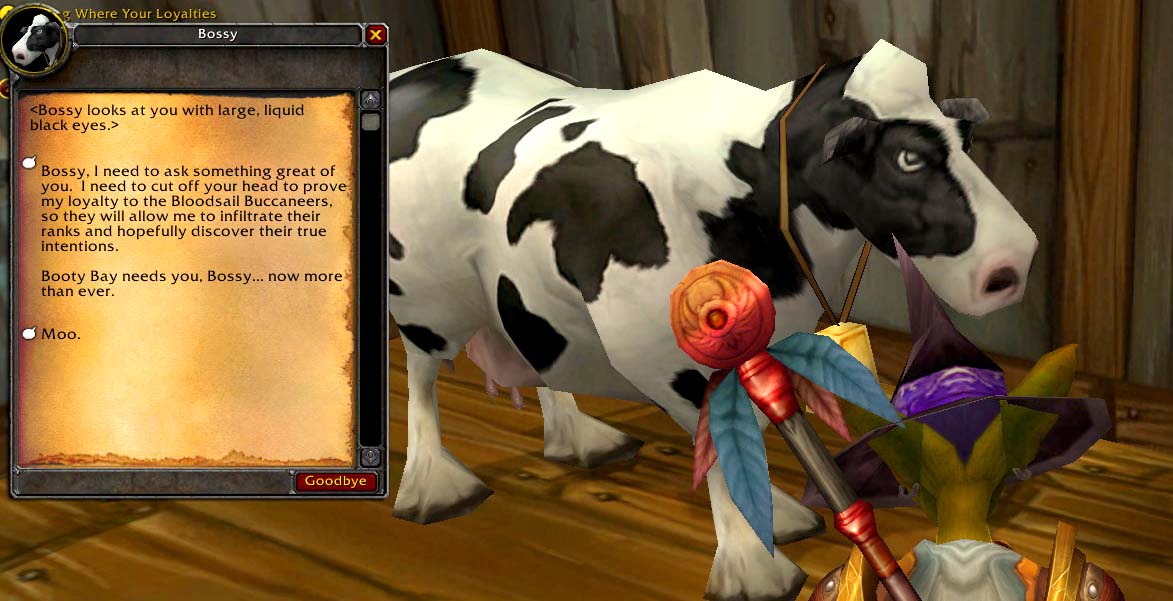
I was once coerced into killing Bossy the Cow by some mean ol’ NPCs. As I’m sure you can understand, I found this to be a horribly traumatic experience. Here is my question: is this the real Bossy, your Bossy, the only Bossy who really matters? If so I shall feel even more like a heel and boycott that quest on any other character I ever run who ventures anywhere near Booty Bay. Ever.

I mean, I once put her image on a cake… Traumatized, I tell you.

Needless to say, this was deeply disturbing to hear. I leapt to the nearest Google search engine and was able to unearth the following image:

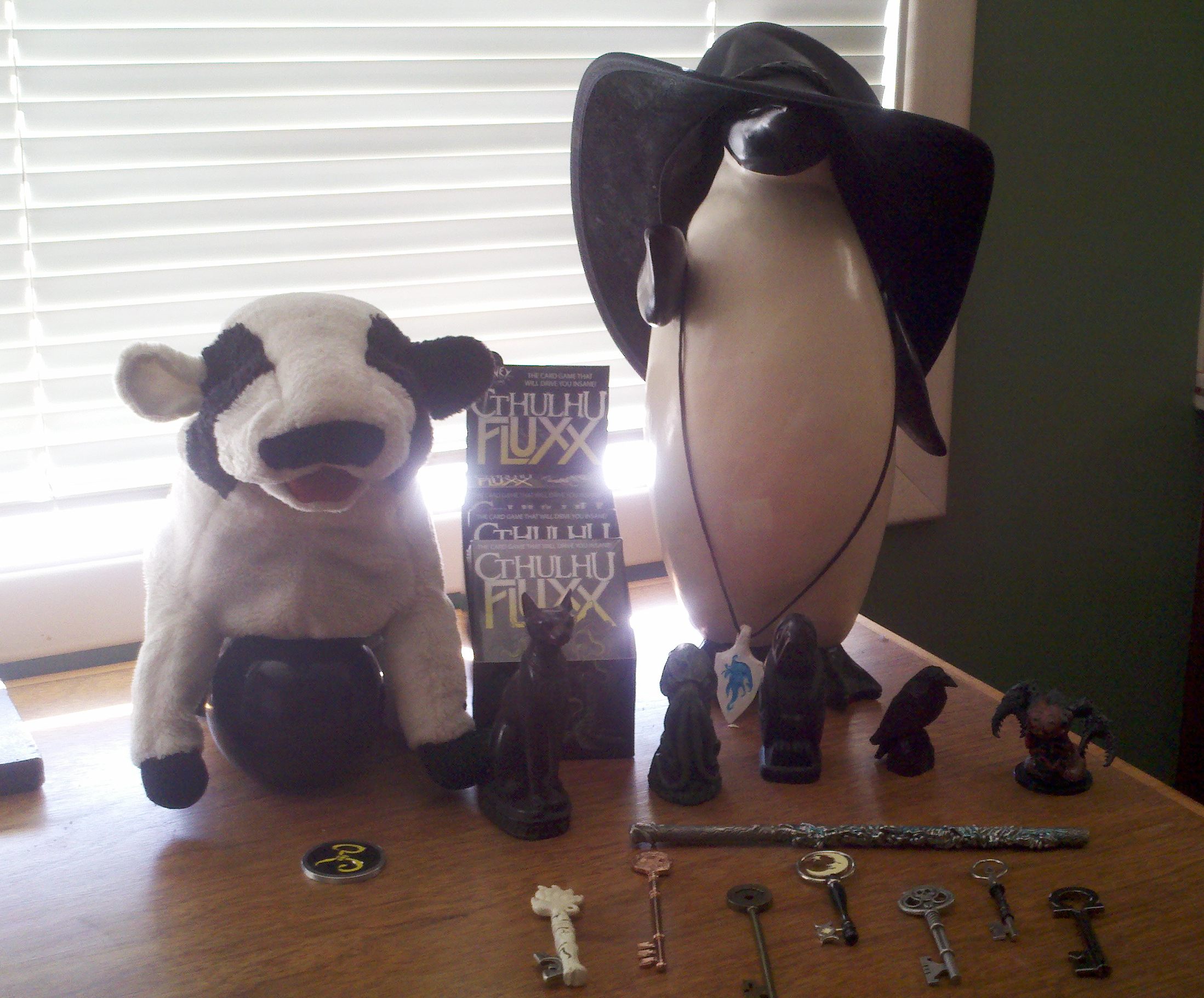
COULD IT BE TRUE? Was this the reason we’d changed websites – because Bossy had been pulled into some sort of terrible trap? I ran to my desk, and to my great relief, found that Bossy was still there.

I asked her about it, and she explained.

“I was moo-nlighting on WoW, kid. It’s not the best role I’ve ever had, but that’s show business. It beats waiting on tables.”

“Wait – when did you get a job?” I said.

“No, literally waiting on a table, kid. It’s not like I’ve got a lot to do.”

So Freya, don’t worry about doing the quest. Just remember, when the Academy Awards come around, who deserves the Best Supporting Bovine in a MMORPG Quest award!

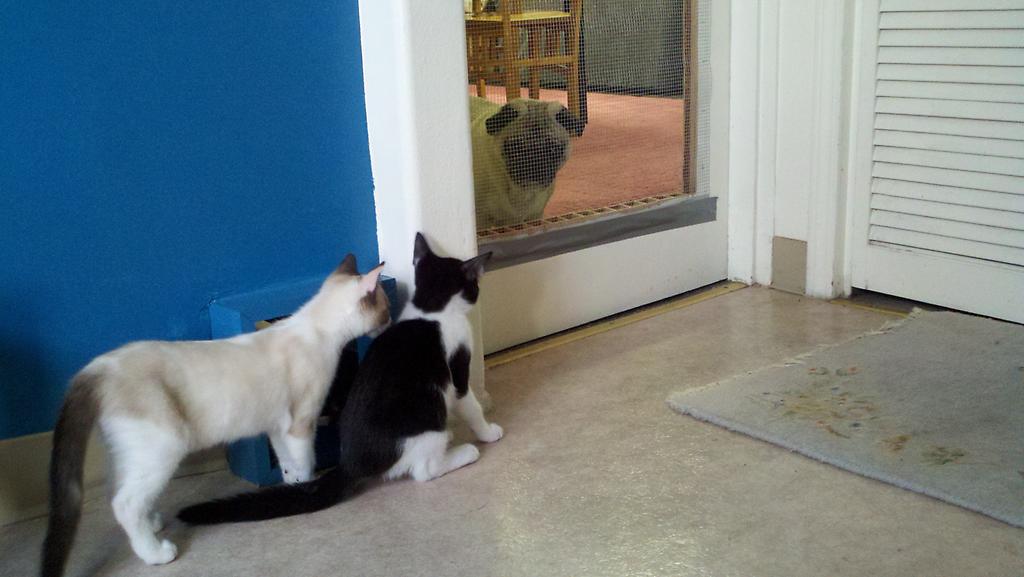
In other news, Jenn and I have expanded our household by two, somewhat to the consternation of Mr Pants:

Our two new kittens are named Fey and Haggis. Jenn observes that it’s like we’re living in an adorable YouTube video stuck on permanent loop!

I’ve gotten a lot of good Eberron questions and some interesting general RPG-related questions over the last few days, and I also want to write about my overall experience at PAX. For now, I’m going to answer a few quick questions – check back for those other topics in the week to come!

Tremendously bummed I missed your panels at PAX – can I find them online anywhere?

As far as I know, they weren’t recorded. If anyone knows otherwise, please fill me in!

Did you announce your cool new project at PAX? Will there be a blog post/press release?

I briefly mentioned my cool new project at my Eberron panel. Our goal is to release at GenCon 2013, so I’m not going into too much detail yet. However, expect to see a blog post here sometime in the next few weeks.

That’s all for today. If you’ve asked questions on other topics, check back – I’ll get to them as soon as I can. If you have new questions or ideas for things you’d like to see here on Keith-Baker.com, let us know below!

Oh, and in Kickstarter news, here’s the latest projects that I’m getting in on… Get Bit and Unexploded Cow (don’t worry… it’s Bossy approved!).

A New Beginning!

While I still have dice and do still travel, it’s not my primary activity at the moment and I want this site to reflect that. So welcome to the new and improved Keith-Baker.com, your home for the latest news on everything Keith Baker and Jennifer Ellis are up to. But this is only the beginning!We’re still getting the site set up, so I’d like to know what you want to see. Are you interested in Q&A posts like those I’ve been doing in the past? Are you interested in hearing more about the projects I’m working on right now? Discussions about gaming with some of my other peers? Would you like to know about a few of my favorite things? Let us know. And if you have questions for the next Q&A – whether about Eberron specifically or gaming in general – ask away!


Dragonmarks 8/9: Lightning Round 5!

It’s time for another Eberron Q&A! Let’s get right to it…

Let’s say that I’ve got a player who really likes games with Nerull. How would you put him in? The Keeper? Lord of Dust?

The thing about the Keeper is that you only interact with him through his cults, and they aren’t even all bad. The Restful Watch believe that Aureon and the Keeper work together to preserve vital souls from Dolurrh so that they can be returned to Eberron in a time of need; in many communities, the RW maintains cemeteries and performs funerary rites. As a result, I’d go with the Lords of Dust, specifically the Overlord Katashka, also known as the Gatekeeper. Lord of death and undeath, Katashka is said to have created the first undead. His mightiest servant is the dracolich Mazyralyx, who some scholars believe is the original inspiration for the myths of the Keeper. Katashka himself is bound, but you can bring Mazyralyx and any number of fiendish and undead servants to bear. Katashka is mentioned on page 30 of the 4E ECG and in this Eberron Expanded article.

Continuing with the theme…

How exactly does a Rajah like Yad-Raghesh ( from Dragons of Eberron, page 50) die?

He doesn’t. That’s the point of Yad-Raghesh’s tale; his apparent death appears to be a shocking, one-of-a-kind victory, but it is later discovered that rather than dying, he has simply spread his spirit across the Vale, transforming it into a pit of corruption that spawns fiends and slowly expands. If Yad-Raghesh was truly “dead”, the blight on the land would pass; it’s the presence of his spirit that keeps it alive and growing.

Now, to be clear: An Overlord can be temporarily killed the standard way – by reducing his hit points below zero. It’s simply that this doesn’t last for long; he returns within a day. In the case of Yad-Raghesh, he didn’t return and thus appeared to have been truly defeated. This turned out to be a false hope. By transforming himself in this way, he at least partially escaped the binding of the Silver Flame; he can’t return to his original form, but his power is continuing to spread while the other Overlords are held in check.

As for what he represents, I would say corruption. He gave up his physical existence to BECOME the corruption he embodied.

Out of all Eberron NPCs, which one would be the most likely to become a Ravenloft Darklord?

I don’t know about “most likely,” but my choice would be Merrix d’Cannith. His great crime? The attempt to create true life, moving beyond the warforged (who can’t procreate) to create something that can truly replace the current people of Eberron. In the Gothic architypes, he’d be a sort of Frankenstein, his realm filled with his imperfect creations – after all, the Dark Powers might let him get close to his goal, but they’d never allow him to succeed.

Suppose you have a player who, for whatever reason, wants part of his PC’s story arc to be romancing a noble. Who would be your best/favourite NPC noble for this role?

I’m still planning to write more about the nobility in the future, but this is more targeted. It depends where your story is set, but I’d personally choose Princess Haydith of Karrnath, who currently resides in Boranel’s court in Breland. According to Five Nations she’s only fifteen, but it’s easy enough to adjust that as you see fit. I think Haybith is an interesting character for a number of reasons. She’s the sister of a king, so certainly an important noble; she’s in a foreign land and thus likely happy to find a new friend or romance; she’s already a political pawn in Kaius’s efforts to promote peace, but she could easily be targeted by those who wish to strike at Kaius himself. And, of course, getting close to Haydith provides an interesting connection to Kaius itself, which could go any number of different ways.

Besides a certain royal prince (already mentioned in the ECG) who are some potential identities behind the mask of Prisoner Deep Fourteen?

Let’s look at the facts. He was sent to Dreadhold by Kaius III. He is being kept alive. His features are hidden. He can’t speak and isn’t allowed to communicate in other ways. So why keep him alive but incommunicado? Here’s a few random ideas, which I am making up at this very moment.

War Wizard. This individual is one of Karrnath’s greatest war wizards, responsible for creating immensely powerful and horrific rituals used in war. He’s wanted for a host of war crimes, and Kaius promptly had him tried and supposedly executed at the end of the war before any other nation could get their hands on him (thus claiming innocence in some of his worst atrocities). However, the fact of the matter is that he wants the man alive so if the war begins again he can bring him back into service. Heck, if you want to go there, you could say that he is the architect of the Mourning itself! Kaius is horrified by the damage the weapon did and doesn’t want his future kingdom devastated like this… but he doesn’t want to kill the one man who knows how to make a second Mourning.

Demon Vessel. During the war, Kaius made deals with a powerful fiend. When it came time for the fiend to collect what was promised to it, Kaius was able to trick it into possessing this mortal body, which was then bound and sent to Dreadhold. If the vessel is killed, the demon will be freed and will take a terrible vengeance on Kaius and Karrnath.

Who’s Your Daddy? According to some myths, a vampire has influence over vampires that it creates. Some superstitious people maintain that slaying a vampire will result in the deaths of those it has sired; even if this isn’t true as a default, a brilliant necromancer could certainly devise sympathetic rituals to strike at a vampire through it’s sire. As for why Kaius III would want a vampire locked away – I’ll leave it to you to figure that out.

Have you ever ran an adventure in Everice or Frostfell? What sort of things might be found there? I can only think of Daelkyr/Quori ruins greatly inspired by At the Mountains of Madness, though I wonder what ideas flow through your head.

I wrote a backdrop set in the Frostfell for the print edition of Dungeon that never ended up seeing the light of day. Rumor has it that some form of it may appear as an Eye on Eberron article. For now, I’ll simply say that my vision of the Frostfell includes old dwarven ruins and the impact of a powerful Overlord of the Age of Demons.

I noticed the other day that, geographically, much of the demon wastes should be rainy, frozen misery. Was this intended?

The Demon Wastes is an unnatural place, due to the presence of buried overlords and close ties to Khyber. So rainy, frozen misery is certainly appropriate; but it also has its share of volcanic activity, burning basalt wastes, and the like.

With House Sivis’ tight standards for authentication, how effective is forgery for your typical hard-working scoundrel?

Difficult. However, based on the principle that science advances with needs, I’m sure that there are tools in existence allowing people who can create arcane marks to (attempt to) forge a Sivis mark. And bear in mind that not all documents in circulation are authenticated by Sivis. Letters of credit and identification papers generally are; but when the innkeeper sends a letter to his brother, he’s not likely to run over to the bank to get it authenticated.

Lightning rail roads are always shown as a single line of stones. How do the trains pass each other?

I don’t believe that the coach needs to ride directly above the rail; it’s about the interaction between the two. as such, I think two trains could slide to the side (using some form of front deflector) and move alongside each other, with the rail in between the two of them, for a short period of time.

I want a villain with an airship. He’d need a Lyrandar pilot. Why wouldn’t the House put a stop to that? At what point would the House personally step in to stop a rogue member assisting a villain?

It would only concern the house if it was somehow causing bad publicity for them. Their initial response would simply be to declare the individual to be a rogue and excoriate, and likely put a bounty on him based on just how much trouble he was causing them; meaning that yay, the player characters can collect an extra reward. I’d only see the house leadership as taking some sort of direct action if the individual became a huge black eye for them – if her actions were causing people to boycott Lyrandar services or the like.

Did the ancient goblins/giants/dragons have artificers? If not, why not? If so, what are some examples of ancient artifice, as opposed to just ancient magic in general?

First off: the artificer is a PC class. I don’t like saying that “Culture X doesn’t have a single individual of class Y”, because PC-class individuals are remarkable people. Just because the ancient dragon culture as a whole didn’t have artificers doesn’t mean that there wasn’t *A* dragon artificer; what I’m going to say is my view of the culture’s approach to magic as a whole. And with that in mind, bear in mind that there’s nothing an artificer can create that can’t be created by some other spellcasting class. The artificer is simply more versatile and efficient. In my opinion, it represents a more industrial approach to the creation of magic items: a focus on magic items as a tool of society, as opposed to a secondary aspect of whatever field of magic the individual pursues. So, looking at each culture:

Dragons of Argonnessen. I don’t see artificers as being a significant part of draconic cultures. Dragons are magic, and their style of magic largely involve learning to channel their own innate power, or using it to create greater effects in the world around them – which is to say, primarily sorcery. Dragons of Eberron talks about loredrakes and divine casters, and loredrakes such as Ourelonastrix obviously unlocked epic level magic lesser creatures haven’t yet mastered – things like the magic used to devastate Xen’drik. But I don’t see artifice as such being a particular interest of dragons.

Giants of Xen’drik. Yes, I believe that there were artificers in Xen’drik. In particular, the Sulat League has been shown as having a very industrial approach to magic, between elemental binding, magebreeding, and the tools and weapons they created. In The Dreaming Dark trilogy you see a number of examples of their artifice, such as the moon-breaker and the chamber of false dreams.

Dhakaani Goblins. No artificers. They have exceptional smiths whose techniques and knowledge of metallurgy allow them to produce magical arms and armor, but a Dhakaani war-smith simply doesn’t have the versatility of an artificer (who can also disable constructs, craft everburning torches, create spell-storing objects, etc). The Dhakaani goblins do know how to create artifacts – Ghaal’Duur, to name one – but as described in the recent Kech Ghaalrac article, “these objects cannot be mass produced; each one is unique and requires rare components to create—the blood of a daelkyr, slivers of Khyber dragonshards imbued with a demon’s essence, and the like.” So again, they have exceptional treasures, but that doesn’t mean that they have a culture that produces artificers; their treasures are made by their smiths and the duur’kala. With that said, if your goal is to find a place where an artificer could learn a new infusion, I could see saying that a PC artificer could learn some sort of new technique by working with the Dhakaani smiths, even if those smiths aren’t artificers.

Was there ever the idea to break up Cannith’s HUGE powerbase and split up the magic stuffs a bit more? Yeah, Cannith is split up three ways that make sense but would it make sense for Denieth to make the Warforged … or have Lyrandar make the airships? Cannith just seems very omnipresent in a world surrounded by magic.

Don’t overestimate Cannith’s power. Cannith produces airships, but it can’t make airships that actually work without the help of both Lyrandar and Zil elemental binders. Cannith created the Kundarak vault network, but it required the assistance of Orien and Kundarak heirs. Cannith is the house of making, and they are the foundation of the magical economy. But many of the critical tools of society require multiple houses to work together. This is the primary purpose of the Twelve: to facilitate this sort of cooperation and create things no house could create alone.

So allowing Lyrandar to create airships on its own would significantly alter the balance of power. As it is, Lyrandar needs Cannith… but Cannith also needs Lyrandar. There are many things – the warforged, wands, etc – that Cannith creates alone, but even there it relies on House Tharashk for the massive amounts of dragonshards required for its work. They are one of the most powerful and influential houses, but there are other houses that can challenge them – especially with the current schism in their ranks.

Maybe you answered this before, but how would you retcon the Silver Flame being the ones to handle resurrection in DDO?

The short answer is that I wouldn’t. City of Stormreach leaves resurrection in the hands of Jorasco, and even there notes that it’s not something they do lightly as many strange mishaps have happened in the past. However, if I had to, I’d start by saying that because of those mishaps Jorasco has finally dropped the service. Then I’d highlight the fact that the Silver Flame in Stormreach is a heretical sect that’s been cut off from Flamekeep for refusing to accept the authority of the theocracy (maintaining that the political ties distract the church from its true mission and breed corruption). Lacking the support of Flamekeep, they may have turned to this as a way to raise the money they need to maintain their mission in Stormreach. One option is to say that they’ll only resurrect people who they consider to be unworthy of joining the Flame, reasoning that thus they aren’t actually robbing the Flame of a soul; another approach is to say that as they are a minority “heretical” sect, they feel the need to keep anyone who might champion their cause alive.

Are there enough kalashtar to form an evil splinter-group, perhaps countered by a group of altruistic Inspired? How about one that has defected & wants to warn the world?

Evil kalashtar? Sure. I think Races of Eberron actually presented a group of Kalashtar who essentially wanted to become full-fledged quori. Kalashtar are mortal creatures; their personalities are influenced by their quori spirits, but at the end of the day, they are unique individuals. An evil kalashtar may be a manic, psychotic individual because of the psychic dissonance between their actions and the beliefs of their connected Quori, but that’s fine for a villain!

“Altruistic Inspired” are a very different story. The kalashtar can come in any flavor because they are mortal. Inspired aren’t. They are immortal embodiments of nightmares. They are literally evil incarnate*. They can change – as the kalashtar quori did – but this is like an angel falling and becoming a demon. An immortal is an idea given form, and if that idea changes, the form will change as well; it’s not something that would go unnoticed, and that transformed spirit would either be eliminated or force on the run, as the kalashtar quori were. Just bear in mind that there is a fundamental difference between mortals and immortals; immortals don’t have as much free will and opportunity for mental evolution as mortals do. This is why the Lord of Dust remains fundamentally the same being he was a hundred thousand years ago; it’s not in his nature to change.

With that said, all quori may be “evil”, but that doesn’t mean they are opposing the players. The primary concern of the quori is preserving Dal Quor. Many highly placed quori believe that they have accomplished that by gaining control of Riedra, and that as long as the kalashtar don’t mess things up, there is no need to take hostile action against Khorvaire… and that in fact, this simply risks disrupting the success they have achieved. Such quori aren’t “altruistic”, but they may see the actions of the Dreaming Dark as running against the best interests of their people, and thus be willing to help the PCs. However, I wouldn’t expect them to take any action that would threaten the quori and Dal Quor as a whole; again, for that to occur, you’d really have to have such a fundamental shift that the spirit is, essentially, a fallen angel (or redeemed fiend).

* As a side note: quori aren’t actually “evil” incarnate. They are the embodiments of the nightmare age, and they feed on (and create) mortal nightmares. The Tsucora quori are tied to fear; the Du’ulora to agression and hate; the Kalaraq to pride and ambition; etc.

That’s all I have time for this week. Feel free to leave more questions below!

Dragonmarks 6/14: Lightning Round 4!

Big week this week, but it may be two weeks before there’s another update; I’m getting ready to move back to Portland and there’s a lot of work to be done! As always, these are my personal thoughts and may not always mesh with canon sources. Take ’em for what they are worth.

Did you sneak any personal data into Eberron? Is “Eberron” the name of a favourite cat as a child? Is Merrix a best friend?

Bear in mind that not all the names are mine; many things changed in the big brainstorming phase when I was working with James Wyatt, Bill Slaviscek, Chris Perkins, and the rest, and many NPCs were developed in that phase. For example, I think it was Bill Slaviscek who came up with the name “Khorvaire”, so maybe someone in his family drove a Corvair. Everyone on the original design team left their marks on the world somewhere.

On my part, the only one that comes to mind is Greykeyll from Eye of the Wolf and City of Towers. In real life, Greykell is my adopted sister. The character in City of Towers essentially is her, dropped into Eberron. When I was developing ideas for the comic and decided to use a Cyran veteran, she seemed like a logical choice – and as I mentioned earlier, her background became much more interesting at that point. And hey, she’s got a great fantasy name!

The real Greykell!

Sharn and Stormreach are two cities that have seen a decent amount of source material. Are there any other cities that you would like to see fleshed out? Which ones and could you elaborate on what is interesting about those places?

I want to see EVERYTHING fleshed out. But I’ll pick out a few specific examples.

Graywall. I got started with this in this Dungeon Backdrop, but it’s one of my favorite cities and I’d love to do more. I love the frontier feel and the chance to explore monsters in a role beyond “the creatures you kill for treasure.” It’s also a great haven for dissidents, deserters, and war criminals. As I like to say, it’s Casablanca with more trolls.

Thaliost. It’s a powder keg right in the heart of the Five Nations, and a chance to take a deeper look at both Aundair and Thrane. it was something that was in the running for a 2012 Dragonshard, but Eston ended up winning the “undeveloped city” slot.

Pylas Talaear. This port city serves as the gateway to Aerenal. We haven’t taken a close look at what daily life is like in Aerenal, and what it’s like for foreigners who visit; I think it would be a great place to explore.

Atur. Ancient stronghold of the Blood of Vol in Karrnath. The crown has distanced itself from the faith, but Kaius still holds court in Nighthold. This is an interesting place to explore the full spectrum of the Blood of Vol and its relationship with Karrnath, and the conflict between the Emerald Claw and other elements of the faith.

Did you have explanation for the day of mourning when you first developed the setting?

No. I had half a dozen explanations that all made sense to me, which is essentially the approach you get with a lot of things in Eberron. To me, the cause of the Mourning was far less important than the impact it had on the world. The unsolved Mourning is what holds the Next War at bay and keeps the world in a cold war, and that interests me far more than an adventure in which people solve it. So here’s a few I considered:

* It was an environmental consequence of the amount of magic being used in the war – both war magic and increased production on the part of the houses. This is one thing driving the ceasefire; until people can be sure that using war magic won’t cause another Mourning, it’s hard to start firing the siege staffs again.

* It was a misfire of a weapon that was being developed, most likely by Cannith. The question then becomes if any of the current Cannith heirs know anything about it, or if all information was lost.

* It was a successful test of a weapon, and whoever did it is waiting to “reload” before they take credit for their actions.

* It was the result of the release of a demon Overlord or Daelkyr, who is currently sitting in the Mournland rebuilding its strength and studying the world. This could be an interesting blend with the Becoming God or Mournland Magebred.

* The Children of Winter are right: it is simply the beginning of the end. Whether or not it was triggered by magic, it is a catastrophic environmental failure that will soon start to spread across the world until the entire world is transformed; at that point, an entirely new world will be created.

* It’s the work of the Sovereigns – a warning to get people to stop and reconsider.

* It’s tied to the appearance of the Feyspires (see The Fading Dream).

… I could continue, but you get the idea. Any of these could be true. And as long as any could be true, people have to proceed as if they are all potential threats.

Some people may say “But in The Gates of Night it’s implied that Lei’s parents know what caused the Mourning! So that means you had an answer!” Well, if you read closely, they don’t say they know WHAT caused the Mourning, they say they know WHO caused the Mourning. They have a specific answer in mind, and it could apply to any of those explanations I’ve given above… and I’ll leave it at that.

If you have a ‘new favorite’ explanation of the day of mourning, and if so, what is it?

Clearly, it’s the Spellplague!

… OK, maybe not.

It’s sometimes mentioned that cultists of the Dragon Below have some kind of “promised reward” in the form of a wonderful place deep within Khyber. Have you ever fleshed out any details about what this promised land would be for them, or is this something that’s intentionally vague and/or subject to change depending on the particular cult?

A key principle of the Cults of the Dragon Below is that they aren’t monolithic in any way. The majority of cultists don’t even think of themselves as “cultists of the Dragon Below”; it’s a label that academics use to cover the diverse range of sects. Common elements are connections to or affection for aberrations; ties to Daelkyr or Overlords; and bizarre beliefs which may actually be schizophrenic in nature. I’ve talked about a sect that believes there’s a glorious kingdom below that you can only reach by paving the path with the blood of enemies. It could be that this is a literal, physical place. Khyber is supposed to include, essentially, demiplanes – there could be some bizarre wonder-world you can only get to through this cavern in the Shadow Marches. Or it could be utter lunacy. This same basic belief could appear in another cult across the nation, especially if it’s tied to the same Overlord or Daelkyr; but that doesn’t imply any communication between the two cults, and it’s possible cult two has an entirely different idea of their paradise… or that their paradise also exists but is a different demiplane.

Were there any other potential races you thought of for Eberron before settling on Changelings, Warforged, and Shifters? Also, regarding Changelings, what are your personal ways for keeping Changeling PC’s in check?

First, you left Kalashtar out of the list, and they were in from day one. Beyond that, there were no other NEW races in the original proposal. It was suggested that goblinoids should be viable characters. As for changeling PCs, it depends what they’re trying to do; I’ve played in quite a few games with changeling PCs without problems. Can you be more specific (in the comments) about exactly what problems you’re having (and what edition you’re using)? Their clothing and equipment doesn’t change, and in a society in which changelings exist people will pay attention to such things. In a city like Sharn, groups such as the Tyrants may actually police their own, as someone passing through and giving changelings a bad name will hurt them in the long term. Beyond that, though, anyone can be a changeling with a hat of disguise or first levelillusion spell – and there they can change clothes, too! Changeling abilities are useful, but they shouldn’t be foolproof – and bear in mind that this is a world where changelings, illusionists, rakshasa and more are simply known fact.

In a real society, the medieval urban elite would be bankers, traders, captains of industry. But in Eberron, industry and trade is dominated by the Dragonmarked. How do hypothetical non-Dragonmarked urban elites compete without the magical edge the Dragonmarked possess?

Not easily, which is why the Houses are typically described as having monopolistic power over their fields of industry. Thus, the simplest way for a non-dragonmarked urban elite to thrive is to run a business sanctioned by one of the houses; this is something described in the Dragonmarked sourcebook. Not every inn is a Ghallanda inn; but if it’s got the Ghallanda seal of approval, you know it’s of quality… and that it gives the house a share of its profits. To be licensed, you need to adhere to house standards (and put up with inspections) and pay your dues. But it’s possible for everyone to profit.

There are other options. You can find a niche that none of the houses cover. While we’ve never mentioned it, it’s possible Cannith has a line of clothes. But they aren’t competing with people like Davandi in the field of high fashion. You could specialize in a particular field; you can’t make smoothies as quickly as someone using a Ghallanda prestidigitation-based blender, but you have a special recipe that makes it worth the wait and higher price. This is the point of, say, The Oaks in Sharn. The food is simply better than you’ll get in the Gold Dragon Inn. But it’s due to the genius of that single chef. You could also possess a resource that the house needs and doesn’t have. The Mror lords are wealthy because they own the gold and steel mines.

I’ve talked about how the houses may bring their power to bear on someone who threatens their monopolies. The thing is, it has to really be a viable threat. Ghallanda doesn’t care if the Oaks is the best restaurant in Sharn; they still make fat dragons every day from all of their restaurants. It’s only if the Oaks’ chef tried to create a national chain and a series of low-end cheap eateries that they’d start to worry. Likewise, Cannith doesn’t need to drive every single smith out of business. However, if you buy from a smith who doesn’t have the Gorgon seal, you don’t know what sort of steel you’re getting!

Considering the masses of Warforged that have been produced , what countermeasures against Warforged have been created? How likely would it be for an influential Individual like Nolan Toranak to find/create them ?

Honestly, the masses of warforged still make up a relatively small number of the total troops fielded during the war. With that said, you don’t need something to be entirely developed to destroy warforged; anything that would be especially effective against armored infantry will work. Heat metal, some sort of corrosive cloud, a swarm of rust monsters… take your pick. And if you’re using 3.5 rules, you have a wide range of inflict damage/disable construct spells you can build into weapons. I don’t think Nolan Toranak could create them, but he could certainly buy them.

What do the leaders of Aerenal think about Xen’drik and the recent trend of expeditions looting all those giant relics? I can’t imagine them to be neutral about this, since they know better than almost anyone else what the ancient giants were capable of.

What are they going to do – blockade the Thunder Sea? There’s more humans than elves. I think the most likely approach would be for them to send their own forces – a specialized unit of the Cairdal Blades – to try to destroy the things they feel are too dangerous to be found. So when your adventurers have just found a really, really cool artifact, have some elves show up who want to destroy it.

What does the Dreaming Dark think of Aerenal? I imagine they must be pretty concerned with the power of the Undying Court, and the fact that the elves will likely know some of the stuff that happened back when the Quori invaded Xen’drik.

Maybe yes, maybe no. The Dreaming Dark seeks to impose order upon the chaotic minds of humanity because mortal dreamers affect Dal Quor. Elves don’t dream, therefore it’s quite likely that their actions have no impact on Dal Quor; and setting aside that tiff with Vol, Aerenal has shown itself to be an incredibly stable society that has barely changed in twenty thousand years. What more could the Quori want from it?Essentially, their best bet is to leave it alone and hope that nothing changes.

As for the elves remembering the Quori invasion, there’s all sorts of issues there.

* It’s not like the elves who founded Aerenal were big on pre-war history. They don’t even have concrete info about the Qabalrin; the line of Vol was just using scraps of Qabalrin lore.

* The exact details of the Quori “invasion” are still very mysterious. While it’s logical to assume that they were seeking to evade the turn of the Age as the current Quori are, it’s entirely possible that they were trying to do this in a non-aggressive manner; the existence of the docent Shira shows the possibility that they simply sought to ESCAPE Dal Quor, but had no desire to conquer the people of Eberron. Another possibility that’s come up is that the giants – who were clearly aggressive – actually sought to conquer Dal Quor, and that the actions of the Quori were in fact self-defense.

* Any way you slice it, that war involved an entirely different age of Dal Quor, and the Quori were nothing like those of the present day. So even if there are elves who kept excellent records, those records describe interactions with a very different culture and species.

How would the Dreaming Dark feel about Warforged , since they do not sleep and therefore dont dream ?

See the above, and for that matter, read The Dreaming Dark trilogy. It was written by this Keith Baker guy – you might have heard of him. It’s out of print, but still available in ebook form: City of Towers, The Shattered Land, and The Gates of Night.

“Do warforged dream of humunculi sheep?” A question that came up in game recently when one character offered to show the warforged character her dreams. The warforged said that “they don’t dream.” Other than a “Blade Runner” type adventure, how do you interpret this concept?

How do *I* interpret it? Well, you might want to check out The Dreaming Dark trilogy. I hear it’s available on Amazon. Now in time for the holidays!

Could Karrnathi skeletons theoretically act autonomously like a warforged or do they require Karrnathi military orders to act?

Karrnathi skeletons can make autonomous decisions based on pre-existing orders. So if a Bone Knight tells his undead regiment “Hold this pass at any cost” and then dies, the regiment is capable of adapting their tactics to deal with whatever new threat comes along. However, they cannot do any of the following:

* Decide that they are sick of holding the pass and want to do something else.

* Conclude that circumstances have changed and that the pass is no longer strategically important.

* Compose poetry while they are waiting.

* Improve their skills – which is to say, gain class levels.

* Have any sort of emotional attachment to anyone or anything in their unit.

Karrnathi undead aren’t like vampires or liches. They can only be made from the corpses of elite Karrnathi soldiers, but a newly risen Karrnathi skeleton is identical to every other Karrnathi skeleton; it has none of the memories of the original soldier. The ritual isn’t some cheap form of raise dead. One way to look at it: a warforged has a soul; Karrnathi undead do not. FOr more on Karrnathi undead and possible dark secrets about them, check out the Fort Bones Eye on Eberron article.

On the Ashbound: do you see there being room in the Ashbound doctrine for members who oppose not arcane magic, but the mundane pollution of Eberron?

Allow me to answer with a quote from the Player’s Guide to Eberron: “To the Ashbound, many things violate the natural order, with arcane magic at the top of the list. The Ashbound see such magic as the epitome of the unnatural, using formulas and rituals to twist the laws of nature and create deadly effects that were never meant to exist. Cities and other physical manifestations of civilization are next on the list, along with structured agriculture and the magebreeding of animals—twisted attempts to reshape the world.”

“Pollution” is just a symptom; civilization is the disease.

How would the Ashbound regard an arcane caster who draws their magic from nature, such as the Pathfinder witch?

That depends. How does it manifest, from a practical in-world standpoint? How does someone looking at the witch recognize that her magic is arcane in the first place, and how can they tell that it comes from a “natural source”? If she is using the verbal, somatic, and material components of a wizard, then the Ashbound will treat her like a wizard. If she looks more like a druid, then most will treat her like a druid; it would take some sort of magehunter who’s actually trained to sniff out arcane magic to recognize her and decide what to do.

What is a cutting disk, what does one look like & how did it come to be a kalashtar weapon?

One is shown here in the hand of the Atavist Lanhareth. The kalashtar prefer curved things to hard angles. In my opinion it was developed as a soulknife weapon long before it was used in steel. As a result, they come in many styles; any soulknife could come up with a different take on it.

If Eberron religions were replaced with Earth religions what would their analogues be?

The Sovereign Host is a pantheistic faith dealing with anthropomorphic deities, and as such could map to any number of Earthly religions. Frankly, the others weren’t intended to mirror Earthly religions and don’t map well at all.

The Church of the Silver Flame doesn’t worship an anthropomorphic deity. It doesn’t believe that its divine power created the world; rather, it believes that this power was created to combat the evil in the world. Add to that the fact that supernatural evil unquestionably exists. The current human church (as opposed to other Flame sects like the Shulassakar) was founded when Tira Miron was empowered by the Flame to defeat Bel Shalor. This is sort of like Godzilla appearing in North America and stomping on Texas and Oklahoma before being defeated by someone who was given a special gun by aliens and invited to join the Galactic Federation of Godzilla Binders. People don’t “worship” the Flame as such; the Flame is a source of power noble people can draw on to protect the innocent from evil, and the Church is the organization that coordinates that (and as the Shulassakar show, you don’t have to be part of the church to form a connection to the Flame). It has as much in common with the Jedi and the Men In Black as it does with Christianity.

The Blood of Vol is based on the question “What just god would allow suffering and death?” – with the conclusion “None, so the gods must be our enemies.” It’s tied to the fact that the people of Eberron KNOW what the afterlife is like, and it’s not pretty. The Elven religions seek to avoid going to Dolurrh; the Silver Flame believes its people join with the Flame; and the Vassals say “Well, we go to Dolurrh, but you just don’t understand what it really is.” The Seekers say “You’re kidding yourself. Dolurrh is extinction. But we have the divine spark within us. We can become gods – and even if we can’t, we will spit in the face of death.” Again, not a very direct map to anything.

Concerning religions, while the Silver Flame is certainly no direct analogue of a real-world religion, to my mind many of its elements are similar to Catholic and Christian elements. Aside from cardinals, the idea of sacrificing oneself for getting rid of evil (Tira Miron, etc.) and the existence of exorcisms are some of them.

Certainly. Note that I said “it has as much to do with the Jedi as Christianity” – which is to say, there are elements of each. The elements you mention are good examples – and bear in mind, long before Tira Miron was born, the Flame itself was formed by the sacrifice of the Couatl; the most fundamental principle of the Flame is noble sacrifice to defeat evil. It’s simply the case that while there are important similarities, there are also some very fundamental differences – people can be blinded by one and not see the other.

Blood of Vol is cult like, individual, secret. How do you reconcile that with a massive Monastery in Atur? How old is that?

I think we have very different views of the Blood of Vol. Have you read the Eye on Eberron article on Fort Bones? One pertinent quote: “The Blood of Vol has had a presence in Karrnath for many centuries, and followers of this faith served under Karrn the Conqueror and Galifar I.” There are many Karrnathi villages where it’s always been the dominant faith for over a thousand years, and in any major Karrnathi city it should be easy to find the neighborhood of the Seekers or the local priest; Atur has long been its urban stronghold. However, it was never endorsed or supported by the royal family, and this is what Kaius did – he made it the religion of the state and gave its priests real political power. Now he’s reversed that, disbanded the orders, and condemned the Emerald Claw. In my campaign, Moranna and Kaius are also using the Seekers as scapegoats for many of Karrnath’s troubles and defeats – why, their dark magics are probably why Karrnath had such troubles with the plagues in the first place, and then they tricked us to relying on them. This is an effort to undercut the power the faith gained during the war and to strengthen Kaius’ support by saying “all our past problems can be blamed on these people, and I’m taking steps to change that.”  So life can be difficult for the faithful. But it’s still not a crime to follow the faith, and most who follow it remain loyal to Karrnath even though their fortunes have changed; the commander of Fort Bones is a seeker.

As for being individual and cult-like, there’s two paths Seekers tend to follow. You have the hermit-like followers who carry out a solitary pursuit of the Divinity Within, which is after all a personal quest. However, most Seekers believe that you CAN’T find the Divinity Within in a human lifespan, which is precisely why they believe the Sovereigns created the curse of mortality – to prevent humans from attaining their true potential and becoming the equals of the Sovereigns. These Seekers hope that their undead martyrs (martyrs in that an undead creature can never attain the Divinity Within, which is tied to the blood and spark of life) and the champions of the church will some day break the chains of death for all people, Seekers and non-Seekers alike. In the meantime, the faith places a very strong emphasis on community. The universe is against us and death is the end. Therefore, hold tight to your friends and neighbors. Present a united front. Every death diminishes us, and we must stand together in the face of this. The most common religious rite is bringing the community together and sharing blood in a basin; this emphasizes that the community is one, and must stand together. I’ll also note that a cleric of the Blood of Vol is more likely to raise the dead than one of the Sovereign Host (who believes that Dolurrh is the gateway to joining the Sovereigns) or the Silver Flame (who believes noble souls strengthen the Flame). The Seeker cleric knows that nothing better is waiting for you, and if he can get you back, he will.

Now, the Order of the Emerald Claw is secret and cult-like. But it’s an extremist sect. Some Seekers support its actions even if they won’t join it; but others despise the Emerald Claw and oppose it when they can.

Where does the Emerald Claw keep finding those gullible kids to be their minions?

Who says they’re gullible? There’s a few different things that drive them.

* The principle of the Blood of Vol is that the ancient undead champions have the wisdom to guide the living towards the Divinity Within and that if anyone can defeat the Sovereigns and free the living from the curse of mortality, it’s them. And what undead champion is mightier than the Queen of Death? The sad part is that by canon, Erandis doesn’t care about that, but hey, they don’t know that. “There is no greater champion than the Queen of Death. She will usher in the new Age of Life.”

* The Blood of Vol came to the aid of Karrnath in its hour of need. Seekers who could have stayed out of harm’s way joined the battle because their priests called on them to do so. They shared secrets of the faith with the king, created Fort Zombie and Fort Bones, helped the nation to survive. Now the King has turned on them and condemned them without reason. He ignores their good works and blames his own failings on them. “My father gave his life for this kingdom! He spilled his blood on its soil! And this king spits upon his sacrifice? i will give MY loyalty to a Queen who will never betray us.”

* Most Seekers don’t actually WANT to be undead. They want the Divinity Within; being a corpse driven by a blood-thirst that cannot be slaked pretty much sucks next to that. However, there are some who are purely driven by a desire for personal immortality and power, and Erandis plays to that. “The Queen of Death has promised that I shall be one of her next blood lords if I succeed at this mission!”

* Kaius’ actions have angered many of the non-Seeker warlords. His efforts to broker a peace are seen as weakness. Many Emerald Claw recruits aren’t seekers at all; they have simply been lured by the idea that this Queen of Death will overthrow Kaius and place their warlord of choice (who might be one of those she’s promised to make a vampire, or even Erandis herself) on the throne of Galifar. “I fight for Karrnath! This lily-white king is sucking the blood from our country – the Queen of Death shall lead us all to victory!”

I could go on, but I do have to do some work that pays bills sometime. But you get the idea.

Are you aware of any 4e conversions of the Master Inquisitive?

Not personally. I’d make it a theme. Have a base ability that helps with investigation and utilities tied to Perception, Insight, and Steetwise (look to the skill powers for inspiration). Not sure about what I’d do with the combat powers, you could tie it to the way they handle Sherlock Holmes in the Downey movies – using Insight to anticipate an opponent’s moves and make a more effective attack.

Do representitives from Adar / Kalashtar not speak to the nations of Khorvaire?  Do they not say ‘Hey guys Riedra is ruled by extra planar denizeniens bent on world (means everyone) domination, we should do something!’   Does no one care?

This is covered in more detail in sources like ​Races of Eberron. To a certain degree, the kalashtar suffer from a level of cultural arrogance; “This is our battle to fight.” There’s also the fact that most of the kalashtar of Adar don’t approve of active warfare in the first place; they believe that it is through their continued passive resistance that they will force the turn of the age, and THIS is what will win the war. if you want to do something to help, stop fighting your wars and letting the quori turn you against one another, because THAT is how they conquered Sarlona. However, there are kalashtar in Khorvaire who want to do more. Some of these might try to raise awareness. But here’s the problems with that:

  • Riedra is a global superpower. It is a valuable ally and trade partner, and many nations received Riedran aid during and since the Last War. In short, nations have good reason to want to keep Riedra as an ally.
  • Riedra has taken no offensive action against any nation in Khorvaire.
  • Riedra asserts that the Adarans are religious fanatics and terrorists, much like the Order of the Emerald Claw – something the common folk of Khorvaire can identify with.
  • The leaders of Riedra are demons trying to enslave us all!” If this is true, why hasn’t Riedra tried to enslave anyone? Even the history of Riedra is one of the common people embracing the Inspired as their saviors, not one of conquest. Beyond this, bear in mind that the leaders of Riedra don’t deny that they are possessed; they simply assert that the spirits that possess them are benevolent ancestors. It’s not particularly different from the Tairnadal or the Undying Court.
  • No-one is especially concerned about having Adar as an ally.
  • The Dreaming Dark is careful to keep its operations entirely separate from Riedran ambassadors, and the Dreaming Dark has no recognized authority in Riedra; if the action can be traced to Riedra at all, it would be something the Inspired could dismiss as criminal.
  • There are mind seeds and quori agents scattered across Khorvaire, some in positions of power. Essentially, the Kalashtar who goes to the Duke and announces his suspicions about a local Dreaming Dark plot may simply be exposing himself to the agents of the Dark.

So: Riedra has in the past shown itself to be a valuable ally to Khorvaire. Adar can’t prove any claims it might make, and drawing itself into the spotlight actually makes it easier for the Dreaming Dark to use propaganda against it. The kalashtar believe that it’s their task to oppose the Inspired. Some feel that they do this simply by surviving and continuing their devotion to the Path of Light. Others seek to identify, expose, and destroy individual operations of the Dreaming Dark (which, remember, more often then not have no obvious connection to Riedra). Experience has shown that it’s more effective to gather a small skilled force – say, a party of adventurers – and handle things directly.

Kalishstar resemeble humans so much, how evident would it be for someone to identify a character as Kalishtar instead of human …

Following 3.5 rules, a kalashtar receives no penalty if it attempts to disguise itself as human. So if they TRY to appear human, it’s not very hard for them to do. If the kalashtar makes no effort to conceal its identity, its mannerisms, appearance (unnatural symmetry, etc), and potentially clothing will make it stand out as unusual, even if the observer isn’t familiar enough with kalashtar to recognize it for what it is.

You mentioned the Duke being controlled by a “mind seed.”

A mind seed is a psychic infection that rewrites the personality of the victim to that of a quori. So the mind seed isn’t controlling the Duke as such; he’s become a willing servant of the Dark.

Aren’t all Kalashtar seen as enemies of the Dreaming Dark? Therefore he wouldn’t even have to talk to the infected Duke, merely be seen by him … or would that Duke necessarily immediately know if someone was Kalishtar or Human by sight?

To address the second part first, if the kalashtar disguises his appearance – wearing a hooded robe, taking some effort to adjust his body language – he can easily pass as human. Beyond that, does the duke actually see every traveler who passes through his domain? However, if he walks up to the duke and says “I am a lightbringer of Adar, and I tell you that there is evil in this place!” – well, the cat-of-light’s out of the bag at that point.

As to the first question: is every kalashtar seen as an enemy? Every kalashtar is connected to a rebel quori, and as such the Dark would be happy to destroy every kalashtar of a line in order to reclaim that spirit. However, on a daily level, not every kalashtar is actively engaged in conflict with the Dreaming Dark, and of those who are the vast majority do so simply by performing the rituals of the Path of Light, which are ever-so-slowly keeping the wheel of the age turning. The net result of this is that yes, the Dark is always a potential threat to a kalashtar, which is why they generally live in Adaran communities and draw little attention to themselves. But in practice, the death of any single random kalashtar is a very very low priority to the Dreaming Dark. So let’s go back to that infected duke. He’s a very valuable tool for the Dreaming Dark and likely engaged in long-term political schemes. He sees some random kalashtar on the street. Risking exposure and the upset of all his plans just to kill some random, possibly harmless kalashtar isn’t remotely worthwhile. On the other hand, if that kalashtar is either drawing attention to himself or directly threatening the operations of the Dark – suddenly it may be worthwhile to risk exposure in order to eliminate him. Of course, they’d try to eliminate him in a way that DIDN’T risk exposure – frame the kalashtar for a crime, for example, so the duke can execute him legally. But if the kalashtar stays in the shadows, keeping a low profile and concealing his true nature from those he doesn’t know, he’s far safer than if he walks around saying “LET ME TELL YOU ABOUT THE DREAMING DARK!” – which is why they don’t do it.

Another way to look at the lightbringers’ approach to the Dreaming Dark is very much Tommy Lee Jones’ statement to Wil Smith in the original Men in Black. Why don’t they tell the world about all the aliens? Because ignorance is what lets these people live their normal, happy lives. If you tell them that there are evil monsters in their dreams they are never going to sleep soundly again, and yet that won’t help one bit in making those dreams safer. The Lightbringers are aware the threat. They will identify it and deal with it. If you’re a capable adventurer, perhaps you can help. But revealing it to the world will only cause panic for no purpose. There’s a certain arrogance to this – they frankly think they can handle this better than you can, paladin of the Silver Flame – but there it is.

Look for more about the Dreaming Dark in an upcoming Eye on Eberron article!

As always, I’d love to hear what you’ve done in your campaign or your thoughts on any of these things. The next Q&A is going to concern the nobility of the Five Nations – feel free to ask questions here!