Happy holidays! Here’s the latest news from KB Presents.
2020 has been a wild ride for KB Presents and we’re excited for things to come!
In July, we released Exploring Eberron, a 247-page book that gave Eberron creator and designer Keith Baker the freedom to write about topics he never had the opportunity before. As extensive as the book is, there is so much more to explore! While working on Exploring Eberron, we were also looking towards the future. An outline for a new book, codenamed FOES, was discussed. In August, we began development work on a project codenamed Fool’s Gold—a PDF product that was planned as the next release. Thomas Bourdon worked on the cover and development began in earnest.
However, inspiration is tricky and you never know when it might strike!
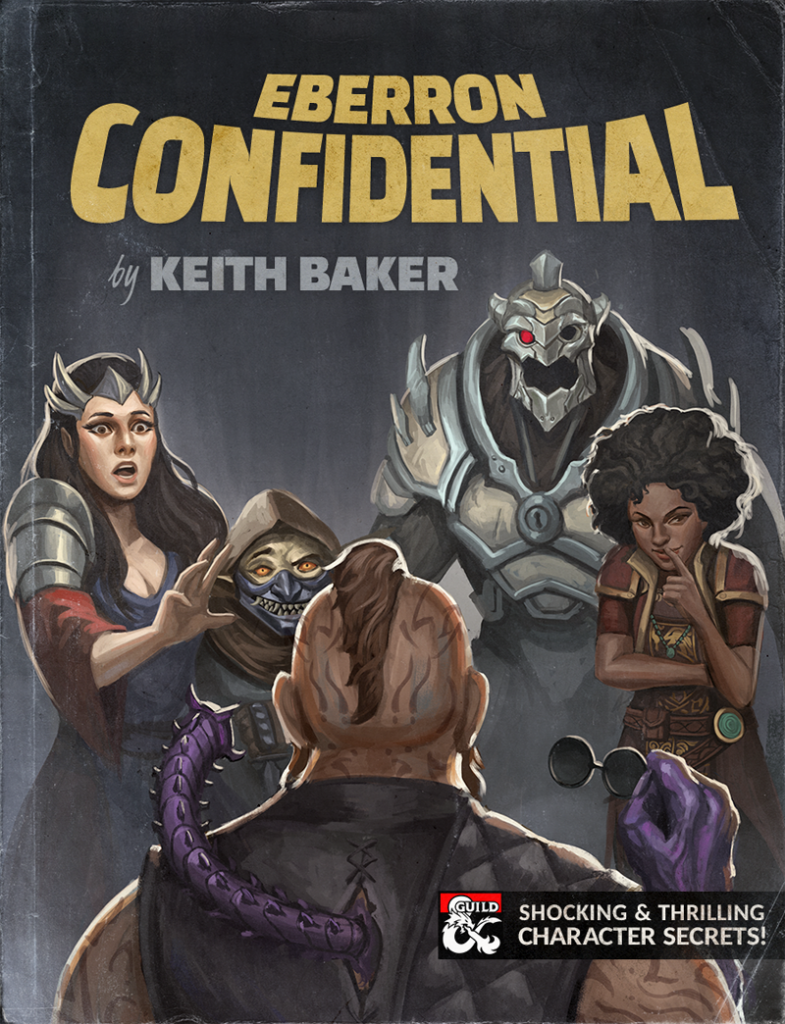
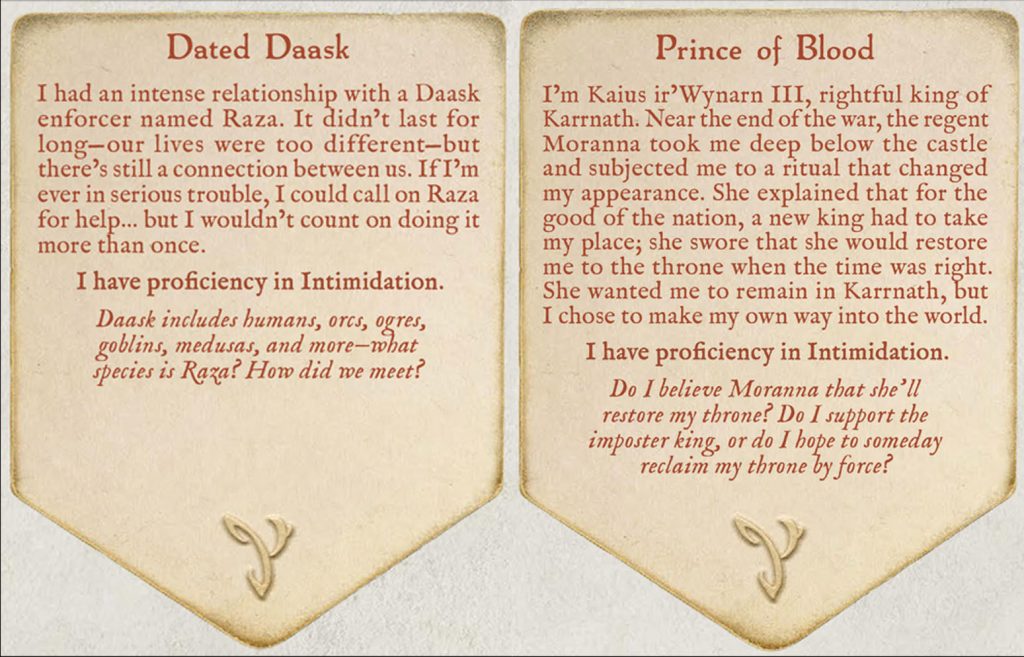
The first idea wasEberron Confidential—a book of character secrets inspired by Icewind Dale: Rime of the Frostmaiden that inserted itself into the production cycle. It launched in November 2020 and is now our second Eberron product on digital shelves.
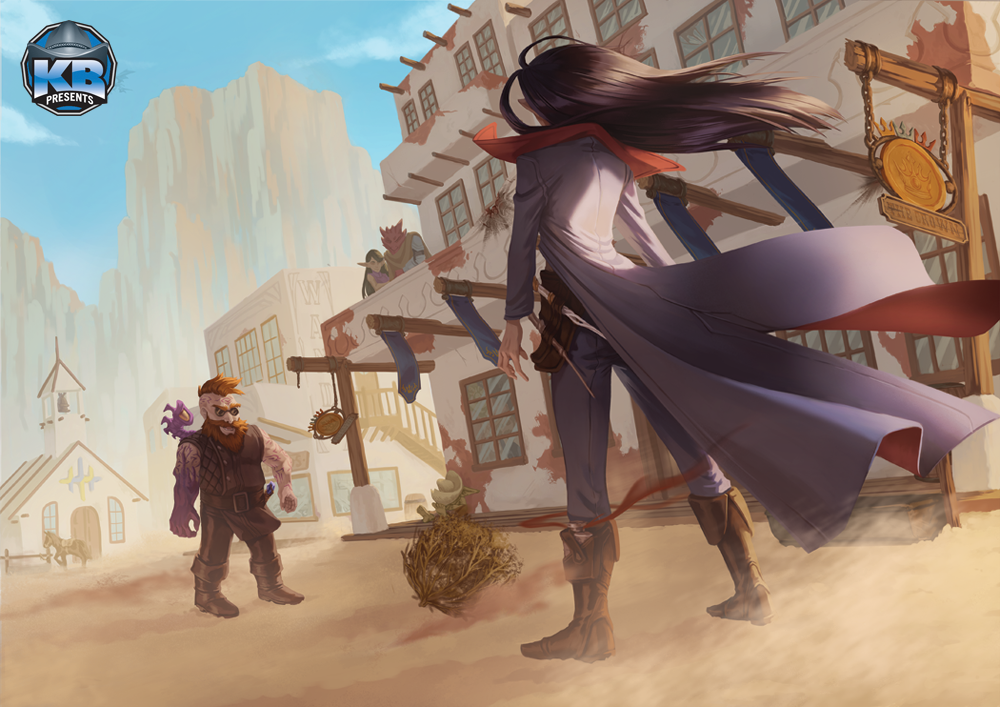
The second idea was Threshold. For years, Keith has run Eberron campaigns set in the jungles of Q’barra. Fans have expressed great interest in this fantasy western approach. In September, we began development on an adventure, codenamed Hunger, that drew on the same principles—but set on the actual western frontier border between Breland and Droaam. Hunger is intended as an ideal starter campaign for new players to the setting. As Project: Hunger grew, Keith decided to run an online campaign in this region, focusing on the town of Threshold. The game will be played with a shifting cast of players drawn from his Patreon supporters. While Project: Hunger is not the focus of this announcement, more information will be forthcoming in 2021.
Which brings us to the announcement! We are proud to reveal Frontiers of Eberron: Threshold, a sourcebook that will provide everything you need to run your own campaign and adventures in the exciting Breland-Droaam border region. In addition to a full chapter focused on the town of Threshold and its denizens, this book will contain expanded locations, power groups, adventures hooks, and monsters that can be found on the frontier, along with a host of character options. It will be available both in PDF and print when it is launched on Dungeon Masters Guild in 2021!
Frontiers of Eberron: Threshold (Project: FRAG) is designed by Keith Baker, supported by the talents of Will Brolley, Laura Hirsbrunner, and Wayne Chang, along with an expanded group of playtesters. In the coming months, we will continue to tease and preview as we always have. You can even get a sneak peek at Threshold by joining Keith’s Patreon.
What about Project: Fool’s Gold? It’s still in development and on the production slate. In fact, we have significantly expanded the scope of Project: Fool’s Gold—now Project: Fool’s Platinum—and it’s scheduled for an early 2022 release.
There are exciting times ahead! Stay tuned and we’ll see you on the frontier!
Arcane magic is a form of science. There are predictable rules that shape reality, and with proper study and force of will, anyone could potentially perform arcane magic. This is what makes arcane magic the foundation of civilization in the Five Nations: it can be taught, and once learned, it is entirely reliable. Arcane magic involves channeling ambient magical energy—the powers of the planes, the emanations of the Ring of Siberys—and focusing it to alter reality. The components of a spell—like verbal incantations, somatic gestures, and focus items—help this process, but the most important element of spellcasting is mental focus. Though a fighter could perfectly duplicate the words and gestures of a wizard, nothing would happen. You must cast the spell in your mind, harnessing and shaping mystical energy, and this is dangerous and exhausting; this is why most spellcasters are limited in how many spells they can cast each day.
Spellcasting using Intelligence is grounded in knowledge and logic. For these characters, casting a spell is like solving an equation—harnessing and carefully channeling the precise quantity of mystical energy required to produce the effect you’re looking for. A wizard may use words of power and mystic gestures to generate power, while an artificer instead relies on tools. But either way, you fundamentally know what you’re doing, which is why both artificers and wizards can prepare new spells each day. Arcane magic is a science, and you’re a scientist.
Exploring Eberron
The idea that arcane magic is a form of science is a fundamental principle of the Eberron campaign setting. It’s something you see in the everyday magic of Khorvaire in 998 YK. We have airships. There are warforged and sending stones. The streets are lit with continual flame. What’s missing is a clear sense of how we got to this point. Imagine that your group of adventurers travels back in time a thousand years and gets caught up in Galifar’s War of Unification. What sort of magic are people using back then? How has magic CHANGED over the course of a thousand years? We’ve called out a few key developments—the first airships went into service in 990 YK, while the first true warforged were developed thirty years ago. What were other key developments? The streets of Galifar are lit with continual flame… But WHEN did that innovation take place, and what were things like before that?
This is an academic discussion, which is why it hasn’t been covered in detail before. What matters most in 998 YK is how things work in 998 YK. If I’m running a modern-day spy thriller I don’t actually NEED to know the history of electric lighting; I just need to know that there is electric lighting. You might decide to do that time travel adventure, but time travel isn’t an integral part of the campaign, and as a general rule we don’t need to know how magic worked a thousand years ago. But it’s still interesting to consider. Beyond that, understanding how magic has evolved helps us to understand how magic can evolve—what we can expect to see in the future. Beyond this, having a clear sense of the state of magic in Khorvaire helps to understand how magic items and spells fit into the game. The rules tell us, for example, that a broom of flying is an ‘uncommon’ item with a flight speed of 50 feet. But they don’t tell us who—if anyone—makes them in Khorvaire or if they need to look like brooms. Even ‘uncommon’ is primarily a description of how powerful the item is and how expensive it should be, if it can even be purchased; it’s up to us to decide if it’s actually uncommon or if it even exists in the world. People often ask me how to add creatures to the world—Where do tabaxi fit into Eberron? How would you add Illumians?—the exact same principle applies to magic items and spells. The fact that we we have rules for something simply means that we COULD use it in the world; it doesn’t mean that it has to be here.
This is a big topic and it’s going to take three articles to cover it. This article is the most abstract, examining the theory of arcane magic within the world. Later in the month, I’ll write about arcane industry—both the role of magic in general industry, and the industry of magic and magic items. The final article will look at the history of magic in Khorvaire, considering how we got to where we are today and where we could go from here. As always, these articles are kanon—what I’m doing do at MY table, regardless of what’s said or not said in an official book. It’s entirely possible something I say here will contradict some aspect of Magic of Eberron, or something you’ve established in your own campaign, and that’s fine in both cases. Eberron lore is intended to be a source of inspiration, not something that limits you; use what’s inspiring, change what gets in the way.
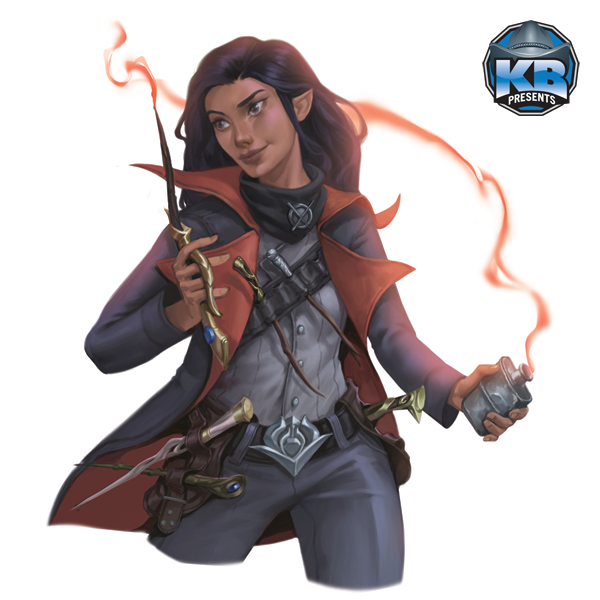
Threshold’s Wandslinger by Julio Azevedo
Principles of Arcane Science
Arcane magic involves the manipulation of vast, ambient mystical energies that permeate Eberron. These forces are largely omnipresent and invisible, not unlike gravity; they’re fundamental elements of the world, and in the course of time most cultures find some way to harness and manipulate them. Like most forms of science, there are different theories about how this science works, and specifically what force is being manipulated.
SIBERYAN THEORY
Siberyan theory is the dominant arcane tradition of the Five Nations. This asserts that arcane magic taps energies that flow from the Ring of Siberys. This power—sometimes called the blood of Siberys—is the same fundamental force the Progenitors used to shape reality; arcane magic essentially reshapes reality to produce the desired result. Certainly, the blood of Siberys can be used to create a fireball; once upon a time, that same power was used to create THE SUN.
Siberyan magic is in some ways the most scientific approach to magic, and can in a sense be seen as analogous to programming; the wizard is rewriting the code that defines reality. Its invocations are words of power that activate specific energies—fire, vast, distance—while its gestures shape and focus those energies. But ultimately, the forces flow through the spellcaster and it is a mental exertion—both intense calculations and an exertion of will—that generates the change. This explains the various limitations of a wizard, both spell slots and spell level. A wizard can look at a spellbook and understand the theory behind a higher level spell. They can gather the right materials, make the appropriate gestures, say the right words. But if they don’t have enough experience and talent, they can’t perform the mental work required; they understand the concept but they can’t do the work required to produce the result. Meanwhile, spell slots reflect the mental and physical toll of spellcasting. While there is no other effect—spellcasters don’t gain levels of exhaustion from casting spells—the idea is that channeling arcane power takes a toll, and their comes a point where you just don’t have it in you to grasp and shape that power. If your spellcaster is completely out of spell slots, you don’t suffer any penalties, but it still means that you are spent, and that’s something you could choose to work into your roleplaying.
Siberyan theory is the most widespread form of magic, used across the Five Nations and in Aerenal. However, it’s a broad field of magic and there are different techniques within it. The wizards of Aerenal and those of Arcanix both use verbal components that invoke the same, fundamental words of power. However, the Aereni techniques are highly formalized and precise—it’s a highly effective technique, but it takes decades to master. Since most humans don’t have decades, Arcanix helps students develop idiosyncratic techniques—to figure out what resonates with them. This works, but the Aereni find it disturbingly sloppy and haphazard.
The commonly accepted theory is that arcane energy—”the blood of Siberys”—was part of the Progenitors. According to the primal myths, the Ring of Siberys IS Siberys; this energy is simply the residual primordial power of a cosmic entity. This is supported by the fact that siberys dragonshards are highly effective at focusing arcane energies. Many spellcasting focuses use siberys shards in some way; the crystal is obvious, but a staff may have an embedded dragonshard sliver that helps focus power. However, there is an academic faction that asserts that there is no reason to believe that the Progenitors were cosmic dragons or even immortal. These sages believe that the Ring of Siberys might have predated the Progenitors, and that they could have been a trio of mortal wizards of exceptional skill—wizards who used the same basic principles a modern wizard uses to create a fireball to shape a sun. Those who follow this path generally assert that the Sovereigns were either remarkable mortals or that they were simply immortal entities—like the celestials and fiends—created by the mortal Progenitors as part of their vast work. These scholars believe that this shows the limitless potential of arcane magic—that wizards who unlock its greatest secrets could create new worlds or even shape planes of existence.
Siberyan verbal components are grounded in the Draconic language, though there is more to a verbal component than simply speaking in Draconic; ultimately it is about the invocation of words of power that aren’t used in everyday speech. A wizard doesn’t have to understand Draconic to perform magic, but it helps provided deeper insight into the workings of a particular spell.
EXTERNALISTS
The energy of the planes permeates Eberron, and Externalist wizards shape their spells by drawing on this power. Where a Siberyan harnesses ambient energy and shapes that into fire, an Externalist draws primal fire directly from Fernia. The elements of this magic—the components—are similar to those used in Siberyan magic. Words of power summon specific energies and eldritch gestures help to shape those forces, and ultimately it is the mind of the wizard that weaves these elements together and channels the power. But the Externalist asserts that the most effective source of power isn’t the blood of Siberys; it is the energy of the planes.
Primitive Externalist techniques require a direct connection to the planes. Such magic can only be performed in or near a manifest zone or during a coterminous period. This is an important factor in the overall dominance of Siberyan magic; the people of Sarlona discovering that their spells no longer worked in new lands, and developing new approaches. However, the energies of the planes do permeate the world, albeit to a lesser degree… and more important, creatures are themselves tied to the planes. This is most clearly demonstrated when a mortal creature dreams—passing along its innate connection to Dal Quor—but can also be seen in the conscripts of Shavarath and the shadows of Mabar, echoes of mortals in the planes. So sophisticated Externalist wizards don’t require access to manifest zones or gain additional benefits from them (aside from whatever benefit the zone provides to all spellcasters); it’s primarily an academic point that the energy is flowing from an extraplanar source.
Externalist verbal components draw on elements of planar languages; depending on the power being shaped, it could use root syllables from Primordial, Celestial, Abyssal, or even Quori. As with Siberyan theory and Draconic, the spellcaster doesn’t have to understand these languages.
SYMPATHETIC MAGIC
This arcane theory maintains that an effect produced can be magnified; to create a fireball, burn a ball of flammable guano. A secondary aspect is the idea things that have once been in contact maintain a connection—a leaf is still connected to a tree, a lock of hair is still connected to the creature it came from—and magic can flow along this connection. Sympathetic magic still relies on words of power for its verbal components, but its material and somatic components are often quite different from the preceding techniques; rather than tracing sigils in the air, a sympathist wizard might light a match to produce a fire bolt, or plunge a needle into a wax figure to cast crown of madness.
Sympathetic magic isn’t taught at Arcanix. It’s generally seen as a primitive form of Siberyan magic—that the wizard is channeling the Siberyan energy, but using the sympathetic focus as an alternative to the more complex Siberyan techniques. This is effective, but not as versatile; it relies on the ability to create a sympathetic construct of the desired result. As a result, sympathetic magic is often found used by self-taught “hedge mages” or clans or tribes that have stumbled onto these techniques in isolation. Again, they are effective, but practitioners may be limited in their range of spells or ability to incorporate new ideas.
A second form of sympathetic magic is tied to the magical thinking approach to artifice mentioned in Exploring Eberron. Rather than being a different approach to Siberyan magic, magical thinking is actually a form of Externalist magic that draws on the power of Thelanis to temporarily enforce fey logic on reality. The main thing is that this is more often associated with warlocks and sorcerers than with wizards. As a warlock or sorcerer, a character knows a specific trick that always works. A wizard has the ability to change out their spells and to learn from other wizards. Does that seem plausible with this character? Or would they be better represented as a warlock?
Verbal components in sympathetic magic vary based on the powers being wielded. A fundamentally Siberyan approach may use Draconic syllables, even if the caster has just stumbled upon the sounds that produce effective results. Magical thinking could use Sylvan phrases. On the other hand, sympathetic magic can also involve a chant or a poem describing the desired outcome; essentially, it’s a longer and less efficient process that combining three syllables of power, but it’s something someone can stumble onto even when they don’t know those syllables of power.
DOMINION THEORY
Dominion theory walks the line between arcane and divine magic. It has some broad overlap with Siberyan magic, using word and gesture to channel ambient arcane power. However, it asserts that all magic flows directly from the Sovereigns. It is still approached in a scientific manner; the difference between the Vassal cleric and the Dominion wizard is that the cleric asks the Sovereigns to grant a miracle, while the wizard employs formulas that let them draw on the fires of Onatar’s forge or Aureon’s law. The Dominion wizard doesn’t need faith in the same way that a cleric does, which is why their spells are cast using Intelligence instead of Wisdom. But if they see arcane magic as manipulating the pieces of a great machine, they believe that the Sovereigns ARE that machine, and their verbal components generally invoke one or more of the Sovereigns by name. So they don’t REQUIRE faith—but they still have it.
Dominion theorists can be found in the Five Nations, even in Arcanix. However, this theory is usually dismissed as superstition by both Siberyan mages, who say that Dominion spellcasters are simply drawing on Siberyan power and adding unnecessary ritual. While the Sovereign Host is the dominant faith of the Five Nations, the standard vassal tradition incorporates the myth of the Progenitors. Siberyan vassals believe that Aureon (or the Shadow) guides those who use magic, but that Aureon isn’t actually the SOURCE of magic… That Aureon can show the wizard how to create fire with a spell, but that the fire isn’t drawn directly from Onatar’s forge. So many wizards are also faithful vassals; Dominion theory is an unusual extreme.
OTHER TRADITIONS
Siberyan theory is the dominant tradition of the Five Nations. Externalism has significant support and is a respected tradition. Sympathetic and Dominion techniques are fringe techniques, more often found in isolation. But there are many other theories. Here’s just a few…
Consensualists say that belief is the source of arcane magic; like Dominion wizards they manipulate that power in a scientific fashion, but they maintain that magic works as it does because people believe in that system—and that it’s possible that a paradigm shift in belief could completely change the laws of magic.
Pact magic is an offshoot of Externalism, drawing power not from a plane, but rather from a specific entity (such as an archfey or an overlord). Typically this is associated with warlocks, who are granted the ability to cast specific spells; but it’s possible that a powerful entity could grant a wizard more general access to their power. Like Dominion wizards, Pact wizards will generally call out the source of their power in their invocations.
Animists work with spirits, often fey, elementals, or ghosts; an animist might have a minor fire elemental that manifests when called on in the form of fire bolt or burning hands. However, animists are often sorcerers as opposed to wizards; again, the question is whether the animist with burning hands can swap that out for a new spell, or if they only know a few tricks—whether they are using science, or whether they’ve just made friends with an elemental.
Prophets are one of the most obscure traditions; they maintain that the Draconic Prophecy is essentially the source code of reality, and while they may not be able to see the big picture they can effect immediate changes by effectively rewriting the present. Again, this is a very rare path well suited to the Scribe wizard presented in Tasha’s Cauldron of Everything. If a DM introduces this into a campaign, they’ll need to decide if this form of magic is despised by the Chamber, who see Prophets as parasites on the Prophecy—or whether, in fact, the Chamber CREATED this style of magic and teaches it to their agents.
Silver Pyromancers fall between Dominion Theory and Externalists. They draw their arcane power from the concrete source of the Silver Flame, but this isn’t an easy thing to do. The Flame responds more easily to the draw of faith than to scientific manipulation, and Silver Pyromancers generally need both; they manipulate the Flame using scientific principles, but it is still their faith that allows them to grasp the power to begin with.
Most “respectable” arcane scholars focus on the ultimate source of power—as such, sympathetic magic is generally seen as a Siberyan technique, while magical thinking is Externalist.
WHAT DOES THIS ALL MEAN?
All of this may sound interesting, but what does it actually mean? What difference does it make whether YOUR wizard is a Siberyan or an Externalist? At the end of the day, not much. These aren’t class archetypes; you can be an evoker or an illusionist regardless of whether you’re relying on Dominion Theory or Siberyan. More important, under the core, basic rules your Siberyan wizard can copy a spell from the spellbook of a Dominion wizard; you’re able to adapt the principles of their spell to your preferred style of magic.
However, there’s a number of important things to consider here. The first is that it’s always been a basic, core principle of Eberron that player characters are remarkable and that most NPCs don’t have the abilities of player characters. Most arcane spellcasters aren’t wizards; they are variations of magewright. I’ll talk more about this below, but the key principle of this is that just because your player character can copy a spell from an NPC’s spellbook doesn’t mean that an NPC can. Most magewrights don’t even USE spellbooks; they spend years learning to cast a single ritual. The idea that a PC wizard can just grab someone’s spellbook and say “Mmhhm, mhhm, I see what you’re doing there, yes, I can do that” is supposed to reflect an exceptional aptitude for arcane science. So with that in mind…
A PLAYER CHARACTER who sees themselves as an Externalist may be able to scribe a Siberyan spell, because again, they’re so sharp they can just translate it to their style of magic. But an NPC Sibeyrian mage may not be able to copy any spells from the PC’s spellbook; it’s another style of magic. If a DM wants to add more weight to this, they could require the PC to make an Intelligence (Arcana) check (say, DC 8 + twice the spell’s level) to convert it; if they fail the check they need to keep studying, and can try to scribe it again after completing a long rest.
The above principle ties to the basic idea that when dealing with NPCs who DO have spellbooks, an NPC wizard might have a narrow focus. The Sulatar drow wizard may have spells entirely related to fire. In THEORY they could learn a spell that generates cold damage, and in theory a Sulatar could become a diviner; but in practice they’re almost always evokers and conjurers and they’ve never developed any spells associated with cold.
A DM may decide that non-player characters require spellcasting focuses to perform their magic—that a particular Siberyan NPC can’t cast spells unless they have a Siberys crystal focus, or that a Sympathetic wizard needs their component pouch to perform magic. A wandslinger may need a wand to perform a cantrip.
Likewise, while an Externalist or Sympathetic wizard PC can learn any spell and cast anywhere, a DM could say that an Externalist NPC can’t cast spells beyond their particular sphere of influence or that a Sympathetic wizard can’t cast spells unless they’ve met certain sympathetic conditions. For example, you could have a powerful sympathetic NPC mage who can cast bane, bestow curse, or dominate monster… but only if they have a hair, tooth, or nail from their target. PLAYER CHARACTERS are remarkable and can overcome these limitations. But NPCs may be working with more limited or primitive traditions and deal with limitations player characters don’t have.
The flip side of this, of course, is that NPCs may be able to produce effects player characters can’t, precisely because they are deeply specialized. In Rising From The Last War we mention that a magewright oracle may be able to cast a form of augury that can look a week into the future. Perhaps the sympathist needs a lock of hair from their victim… but can cast bestow curse on that victim from across town. Again, this plays to the idea that player characters are incredibly flexible—but that NPCs may be deeply specialized in ways that PCs just don’t have the time to master.
So the main point is that “Siberyan” and “Externalist” aren’t concepts that have a concrete mechanical effect. They’re things that can add flavor to a story—whether a wizard calls out the Draconic name of fire and trace a sigil in the air when they cast fire bolt, or whether they strike a match and command their victim to burn! You don’t HAVE to do anything with any of this; it all means exactly as much—or as little—as you want it to.
Wizards and Artificers, Magewrights and Wandslingers
The idea of “Arcane Science” primarily applies to wizards and artificers: Intelligence-based spellcasters whose flexibility reflects their ability to apply scientific principles in new ways. Sorcerers and warlocks may manipulate the same forms of energy, but at the end of the the day they don’t truly understand what they’re doing and are limited in the effects they can produce. A sorcerer has an innate aptitude for specific effects, while a warlock is either taught specific spells or granted supernatural powers by their patron; but two warlocks can’t trade spellbooks and learn each other’s spells. Given that, let’s take a look at the different characters who do use these scientific techniques.
WIZARDS
Whatever your preferred source, the fact of the matter is that there is an invisible, fundamental force that suffuses Eberron—a power that can be harnessed to reshape reality. A sailor harnesses the wind and water. A smith works with earth and fire. As a wizard you channel the fifth element, bending reality to your will.
The basic point of Eberron is that the people of Khorvaire know this power exists and have harnessed it to help in their everyday lives. But most people can’t master more than a few spells. It takes years for a magewright to learn the spells that define their trade; the arcane locksmith can’t just spend an evening reading a book and wake up as a lamplighter. At the end of the day, this is because the magewright has only learned how to cast their few spells; they don’t truly understand the deep principles beneath them. It is this deeper understanding combined with remarkable talent that gives a wizard their full flexibility. A magewright has learned to play a few songs on the piano; a wizard is Mozart or Beethoven, able to envision new symphonies.
With that said, perhaps that’s not how you see your character… and that’s fine. As a wizard you possess talents and flexibility other spellcasters don’t… but that doesn’t mean you fully appreciate your own talent. And let’s face it, at first level you ARE quite limited in your capabilities. It’s remarkable that you CAN copy any spell from a spellbook you find, but at the moment you can only CAST first level spells, and you haven’t found a how lot of spellbooks. So perhaps your evoker operated arcane artillery in the war, or your diviner planned to make a living as an oracle. Here we even hit the limits of the wizard: Magewrights lack flexibility, but they are very good at those few things they do. As a player character, your diviner wizard isn’t quite as good at augury as the magewright oracle; you just can’t seem to push beyond that 30 minute window. So your character could even see themselves as a failure… because you haven’t yet had the experiences that will reveal your amazing potential.
So that’s certainly something to consider in making your wizard. Do you know you’re better than a magewright, or will you be surprised by your limitless potential? Do you believe that you’re a prodigy, or did you expect to be a simple magewright? Do you love exploring the mysteries of arcane science… or is it just that you happen to be remarkably gifted, though you yourself don’t really appreciate how gifted you are? Here’s a few ways to approach a wizard…
The Wandslinger. You are an arcane engine of destruction. You take pride in your ability to wield fire and lightning, and you may be as aggressive as any fighter; after all, they can only wield steel, while you have a weapon with unlimited potential. A wandslinging wizard could have the soldier background reflecting a distinguished military career even before unlocking your true power.
The Scholar. It could be that you love the idea of magic and you’re fascinated with its potential, but you never particularly expected to, you know, USE IT to blast enemies with fire. This is a way to reflect an older, experienced character starting at first level: you may have been STUDYING magic for decades, but you never actually used it it battle until now and you’re only just learning how to put your abstract knowledge to practical use. So where the Wandslinger struts and is proud of their power, the Scholar might actually be continuously surprised and delighted when they cast a new spell for the first time or defeat an enemy. Sage is a logical background for such a character, but guild artisan also makes sense for the wage mage who thought they were going to be a simple magewright.
The Artist. Magic is an invisible force with limitless potential. The Wandslinger sees it as a weapon. The Scholar recognizes it as an invaluable tool. The Artist sees that it is beautiful. They see the wonder of magic, and take joy in the casting of a spell as another might delight in a dance. It could be that the Artist actually seeks to use their magic to entertain; an Illusionist with the entertainer background may already have a following for their remarkable performances (and may have ties to House Phiarlan). Or it could be that they’ve used their magic in battle, but they still delight in the artistry of it; this is a possible path for a Bladesinger. The key point with the Artist is that they may understand the science of magic—but they still take joy in the wonder of it.
The Acolyte. Dominion theory teaches that arcane magic is Aureon’s gift. The Acolyte understands the science of it, and they work their wonders with intellect rather than with the sheer force of their faith. But they still believe that the powers they wield are both a gift of the Sovereigns and evidence of their benevolence, and they seek to use these powers as a true servant of the Sovereigns: protecting the weak in Boldrei’s name, enforcing Aureon’s laws, and bringing the light of Dol Arrah to the darkness. Alternately, you could be a Silver Pyromancer, using your faith to weave spells from the Silver Flame. Either way, this is a path for an acolyte or hermit.
ARTIFICERS
Magic is an invisible force that’s all around us. A wizard grasps the power directly, binding it with word and gesture. But it takes deep training even to become a magewright, let alone a wizard… and that’s why we have magic items, tools that can allow anyone to benefit from the power of magic. And a world that relies on magic items needs people to create and repair them—engineers and inventors, the people who develop and maintain the infrastructure that drives modern civilization.
A central difference between an artificer and a wizard is that the artificer uses tools. They use tools both to produce magical effects, and also imbue tools with magical power. The wizard molds magic with word and gesture alone; the artificer creates a wand or potion. Part of the point is that that as a player character, an artificer is capable of jury-rigging temporary versions of the reliable tools we see every day. A wand or a potion is a completed, stable tool. But when an Alchemist artificer uses their alchemist’s tools to cast fire bolt, they may be whipping up an instant, unstable potion. An Artillerist essentially creates a temporary wand, something that only works for them. So in the Artillerist we see the science of the wand at work, and in the alchemist we see the potion. One path of established arcane science that doesn’t yet have an archetype is that of sigilry, the science of scrolls. This is what you see in an artificer who uses calligrapher’s tools as a spellcasting focus; their spells are produced by enscribing mystic symbols, it’s just that it takes more effort to stabilize that power into the final form of a spell scroll.
Page 29 of Exploring Eberron discusses a few traditions of artifice, and these overlap with the broader arcane theories. Cannith Traditional is essentially Siberyan theory: a set of established principles, creating items that draw on the ambient energy of the Ring of Siberys. Planar Influences relates to the Externalist Theory, while Magical Thinking is likely drawing specifically on Xoriat, Thelanis, or perhaps Dal Quor. An Actual Science artificer may be pioneering something entirely new. And this ties to the same point as the wizard: as a player character, an artificer is remarkable. NPCs who perform artifice are functionally magewrights: they may be able to create a specific type of potion or maintain cleansing stones. The Cannith tinker can perform magecraft and mending. But as an artificer you’re not just a a magical electrician: you’re Tesla, or Tony Stark. You are brilliant and unorthodox, and the methods you use—whether you’re creating a temporary infusion or a permanent item, whether or not you recognize your full talent and potential—are a product of your own unique genius. I’ll talk more about this in the discussion of Arcane Industry, but the crucial point is that just because your artificer can do something doesn’t mean that normal people can do it, or that your techniques could be translated to mass production. You’re the genius in your garage, making a working palantir out of coconuts and lint; it MIGHT be possible to translate that idea into a viable product, but it’s not a trivial thing.
Exploring Eberron examines different possible paths for artificer characters, so you can find more ideas there.
MAGES, MAGEWRIGHTS, AND ARTIFICERS
What we’ve said from the start is that most spellcasters aren’t wizards and clerics—they’re magewrights and adepts. The idea of arcane science is that it IS A SCIENCE. It’s a rational, reliable tool, which means that anyone has the potential to master it with sufficient time and training. But that doesn’t mean that anyone can become a wizard or an artificer. Anyone can learn to play the piano, but not everyone can be Mozart. Magewrights devote themselves to mastering specific spells. This devotion pays off in various ways. Magewrights don’t need spellbooks. They cast spells as rituals, even spells that don’t normally have the ritual tag; the drawback is that aside from cantrips, they can ONLY cast spells as rituals. And, as noted, they may be able to cast enhanced versions of spells, such as the augury that can predict events farther in advance. The player character wizards is a brilliant jack of all trades; the magewright is a master of a very specific set of skills.
The NPC wandslinger falls into a similar mold. A typical wandslinger essentially has the benefits of the Magic Initiate feat: they know a few cantrips—usually combat-oriented—and may be able to cast one or two low-level spells on top of that, surprising an opponent with burning hands or a shield. Generally, an NPC wandslinger needs an arcane focus to cast spells or cantrips; again, they are more limited than PCs. This training and techniques have become more common in the wake of the Last War, but they are still more limited than player characters.
But what about NPCs who ARE better than wandslingers or magewrights? What’s the point of a wizard being able to copy new spells from a spellbook if NPCs don’t use spellbooks? First of all, just because MOST NPCs don’t have the power of a player character doesn’t mean that NONE do. The Monster Manual and Volo’s Guide has stat blocks for NPCs with full caster abilities. The point is simply that anyone who has the full abilities of a PC is a remarkable individual. Such people make worthy rivals and foes for PCs; the point is just to recognize that they, too, are remarkable, not common.
And finally there is room for that middle ground: People who have powers far beyond the typical magewright, but who don’t have the full capabilities of a PC class. A professor at Arcanix may have the ability to cast cloudkill. Another may be able to cast summon fiend—but only as a ritual, and with a far greater component cost. Even looking to the NPC caster blocks, you might say that there’s an NPC evoker, and that they do prepare spells from a spellbook—but that, like the Sulatar I mentioned before, they can’t prepare spells that deal with cold or lightning. They have many of the abilities of a PC, but they are still fundamentally limited; they don’t have the flexibility or broad genius of a player character. In my campaign, I call such characters mages. They can have significant POWER, and may actually be able to do things PCs can’t—but they still don’t have the full flexibility of a wizard or artificer.
Q&A
Why is Siberyan Theory the dominant theory? Wouldn’t Aerenal or Karrnath rely on Externalist magic because of their use of Irian or Mabaran manifest zones?
There’s a few things to consider here. The first is that many arcane traditions evolve in isolation. Externalist magic is easier than Siberyan magic if you’re drawing on one specific form of magic. So for example, there were SURELY Externalist necromancers in pre-Galifar Karrnath, because all that Mabaran power is right their waiting to be used. The problem is that you can’t use that Mabaran energy to light a fire or to generate light at all… And further, if you’ve based your system of magic off easy access to that manifest zone, when you go somewhere else you suddenly don’t have that power and your magic doesn’t work. Siberyan energy is universal—it pervades Eberron—and can be used to produce any sort of effect, whether it’s animating the dead, creating a fireball, or generating light. So essentially, it is more reliable and versatile, and thus more widespread. Now, what I’ve suggested is that if you want to PLAY an Externalist wizard, you can say that you’re using more advanced Externalist techniques that draw on residual planar energies or on your personal connection to a plane and thus you don’t lose your magic when you’re not by a manifest zone. But the point is that the more basic forms of Externalist magic DO have those limitations, while Siberyan magic doesn’t.
However, there’s a second point: manifest zones don’t care what kind of magic you’re using. As called out in Exploring Eberron, many manifest zones enhance a particular form of magic. It’s easier to animate the dead in a Mabaran manifest zone, regardless of whether you’re a wizard, a sorcerer, or a cleric. An Externalist draws ALL of their power from the planes; but a Siberyan wizard—or a divine spellcaster, or a warlock—will all still find their abilities enhanced by the energies of the manifest zone. So looking to Aerenal, their overall tradition of magic is Siberyan, but their traditions are also tied to unique rituals that are only possible because of the Irian zones. Their tradition isn’t based on Irian; it just incorporates it. Likewise, modern Karrnathi necromancers rely on Mabaran manifest zones and have created rituals that can only be performed in those zones, but that doesn’t mean that their overall tradition is Externalist; it’s largely Siberyan, with certain rituals that rely on an additional infusion of Mabaran energy.
That’s all for now, and again: this is what I do in my campaign, and if you don’t like it, don’t use it! Arcane Industry and Arcane History will come later in the month. And thank you as always to my Patreon supporters, who chose this topic: articles like this take a lot of time, and I simply couldn’t afford to spend that much time on this without your support. The Wandslinger image above is one of the player characters in my Threshold campaign, which will be starting later this month; thanks against to those of you who have been supporting and participating in that!
My Patreon supporters have chosen Arcane Science and Industry as the topic of the month. I’ll be writing a more extensive article on the topic later in the month, but now I want to address questions on a related topic: The role of flight. Before I go any further, I’ll note that you can find more of my thoughts on airships in this article, and that the 3.5 sourcebook Explorer’s Handbook is the primary canonical source. With that said…
Outside of the skycoaches of Sharn, how prevalent are airships in the other nations? Were they used in the last war? Are there nations with growing fleets of them? Do the goblins of Darguun have any?
One of the basic principles of Eberron is that arcane magic is a form of science, and that like any science, it evolves as people unlock its secrets. The idea was always that there should be a sense of evolution. In particular, the Last War drove a number of arcane breakthroughs: warforged, wandslingers, and airships. According to the timeline in the original Eberron Campaign Setting, the first airships went into service for House Lyrandar in 990 YK—less than ten years ago. In addition, Lyrandar airships are the only form of airship currently in mass production and they require a Lyrandar pilot to reliably control the elemental. The point of this is that air travel is a very recent development and it is dominated by House Lyrandar. So at the moment, NATIONS don’t have significant numbers of airships; LYRANDAR has them, and even it doesn’t have very many. Only major cities have the docking towers required by Lyrandar airships; combined with the relatively small fleet, this is why airships haven’t completely overshadowed the lightning rail.
It’s quite possible that the King’s Citadel of Breland has an airship produced in secret and piloted by a Lyrandar excoriate, or that Aundair has been working on an airship that doesn’t require a Lyrandar pilot. But no nation has fleets of airships, definitely not the Darguuls. Likewise, there were a few Lyrandar airships that were designed for military service—the Stormships”—but they played a very small role in the war, appearing only at the very end of it.
So the science behind the airship has been established, and from this point going forward airships will play an increasingly significant role. But for now they are still few in number and rely on House Lyrandar… and House Lyrandar would like to keep it that way. The point is that ongoing developments with airships can be an important plot point of a campaign. IF the Darguuls somehow start producing a fleet of airships, that would be a major mystery—how are they doing it? What do they plan to do with them?—that could be an important plot point.
As the skycoaches of Sharn were mentioned, it’s important to remember that skycoaches are nearly unique to Sharn; they rely on the magical effects of the manifest zone surrounding Sharn, and will crash if they’re taken more than a few miles from the city. You could find skycoaches in other cities in similar manifest zones, but you couldn’t fly a skycoach between those two points.
With all of that said: airships are a new development. Aerial combat is not. Galifar the Dark—the third ruler of the united Galifar—is said to have created the Race of Eight Winds as a way to test various aerial mounts, and the skyblade tournaments of Sharn likewise are a reflection of a traditional of aerial combat. But this is a tradition of mounted combat—not large vessels such as the modern airship. More on that later.
What sort of flying magical items do you see across Khorvaire? Brooms exist as D&D canon, but it seems like different countries would have different sorts of flying apparatuses.
First, let’s review my previous discussion of the broom of flying.
By the rules of Fifth Edition, a broom of flying is an extremely useful item. It’s an uncommon magic item, putting it within the range of Khorvaire’s wide magic. Unlike wings of flying, there’s no time limit on the use of the item, and critically, it doesn’t even require attunement. What’s been suggested is that Aundair used these for elite units and that other nations developed them in smaller quantities—so they aren’t commonplace in civilian life, but they are in the world.
With this in mind, the first question I’d ask is are they brooms? While the core magic item is a broom, I see no logical reason that they should be actual brooms in Eberron; remove the mythology of Earth and there’s no particular reason a broom is associated with flight. So I’d actually call them skystaffs. Keep the same essential shape—a short wooden haft—but remove the bristles, add a seat, and perhaps handles that fold out from the shaft. Essentially, make it a tool clearly designed for its function as opposed to a household item that does something unexpected. I’d then say that while anyone can use one, they require Dexterity checks for tight maneuvers or sustained balance at full speed, unless the rider has proficiency in air vehicles—so anyone CAN use one, but it requires some training to actually use one effectively. As a final element, I’d say that a skystaff is made using soarwood, which is a crucial factor in why there aren’t more of them in service at the moment. The enchantment isn’t that difficult—again, “uncommon” level in terms of its power—but the actual components required to create one are in limited supply, so there aren’t that many around. Having said that, they are most often seen in Aundair, and you’ll certainly see a few in the skies above Fairhaven or darting around Arcanix.
This further reflects the idea that Aundair is the most mystically advanced nation. The aerial cavalry of the Five Nations has relied on hippogriffs for centuries; Aundair’s introduction of the skystaff was an early innovation in the war, and they became more common as the conflict continued. So more on that later, but in my opinion the skystaff was introduced early in the Last War. It predates the airship, but only by a century. The advantages of the skystaff are that it’s very portable. As it doesn’t have to eat or breathe, you can keep a skystaff in a bag of holding indefinitely, making it an excellent tool for covert operatives. But with a top speed of 50 ft, it’s slower than a hippogriff (60 ft) and considerably slower than a pegasus (90 ft).
Another uncommon form of flight is winged boots. In my opinion these predate the skystaff (in Khorvaire) by a few centuries. They were first created in Sharn by artificers experimenting with the property of the manifest zone, and these early models only worked in Sharn. However, by 812 YK an artificer had developed winged boots that could be used beyond the City of Towers. Because the boots are limited to the wearer’s walking speed and can only be used for up to four hours, they are more limited than flying mounts and aren’t widespread. They’re typically found in Breland, as they’re still most often used in Sharn—but all of the spy agencies of Khorvaire make use of them, along with some elite commandos and thieves.
Other magical tools of flight are more exotic. The cloak of the bat and wings of flying are rare items, which means that they CAN be found in the Five Nations but that they’re rare and unusual. A few stories I could see for such items:
The Narathun flesh-crafters of the Mror Holds have created a form of wings of flying with the symbiont quality—a living creature that bonds to the body of the wearer. They’ve only produced a few so far.
The Seeker spy organization known as the Raven Corps had an elite unit outfitted with cloaks of the bat when they served Karrnath during the Last War. A person attuned to such a cloak must expend 1 hit die after completing long rest, as the cloak drains a bit of their blood.
The Church of the Silver Flame has an elite order of templars who wear cloaks of flying that transform into the rainbow wings of a couatl. These are driven by faith as opposed to arcane magic, and only people with great faith in the Flame can attune to them.
Druidic magic can create wings of flying that use the principles of wild shape. Rather than being cloaks, these are often torcs or necklaces; the wings sprout from the back of the bearer. There’s a Tairnadal ancestor whose revenants employ such tools, and a unit of the Wardens of the Wood—the Gray Owls—who use these tools.
Thelanis can be the source of any sort of flight magic, from wings of flying to winged boots. Each such item has its own unique story. One pair of Thelanian boots might be birds turned into boots, that still sing when they’re happy; another might be a pair of boots without wings, that allow the bearer to walk on sunbeams or shadows.
Other forms of flight items could be found that have limitations. House Lyrandar could have cleared a form of wings of flying that harnesses a minor elemental for lift, but that can only be attuned by someone with the Mark of Storm; another cloak might only work in a particular manifest zone, just like the skycoaches of Sharn.
The main point is that these items are rare and unusual but can be found in the Five Nations, and there were a few elite units in the Last War that employed them.
As very rare items, carpets of flying are not commonly found in the Five Nations. When encountered, these may be the product of more advanced civilizations (Aerenal, Argonnessen, the Lords of Dust), or be extraplanar in origin (Syrania, Thelanis).
Keep in mind also that feather tokens are actually common items. Paratroopers weren’t that common for most of the war because hippogriffs can’t carry many people. But Thrane certainly delivered paratroopers by wyvern, and later in the war airships could carry paratroopers with feather tokens.
What sort of air forces did each nation deploy during the Last War?
At the beginning of the war, the standard aerial cavalry of Galifar was the hippogriff rider. There were a few other forces based on local traditions, notably the dragonhawks of Aundair and the wyverns of Thrane, but the hippogriff was the mainstay of aerial combat. Such hippogriffs were primarily used as scouts and skirmishers, and there had never been an effort to field a mass aerial force. Each nation followed different paths during the war.
Aundair had three distinctive elements: dragonhawks, skystaffs, and floating citadels.
Aundair developed skystaffs at the start of the Last War. While other nations replicated them over the course of the war, Aundair has always had the most significant number of them. The skystaff has the advantage of not being alive, thus removing the complications associated with maintaining a living mount.
The dragonhawk is the symbol of Aundair. Larger, faster, and more powerful than hippogriffs, the primary limitation of the dragonhawks is their slow rate of reproduction. However, Aundair employed them to great effect during the Last War, and their dragonhawk cavalry played a key role in defending the nation from Thrane’s wyverns.
Aundair has a few floating towers. The best known of these is Arcanix—though what can easily be forgotten is that Arcanix isn’t ONE floating tower, it’s FOUR. As discussed in this article, the reason you don’t see many of these towers is that the effect is unstable and requires considerable ongoing arcane maintenance—which is easy to do when you stock the citadel with the finest wizards in your nation, as is the case with Arcanix. But the Arcane Congress does have a few other floating towers. While the towers float, they don’t MOVE under their own power; moving them during the Last War required massive teams of dragonhawks.
Breland always had the best hippogriff riders. Due to the Race of Eight Winds and the popularity of skyblades, Breland had the strongest tradition of hippogriff riding and many of the riders in the army of Galifar were Brelish. As such, while Breland’s air force lacked the raw power of Aundair’s dragonhawks and Thrane’s wyverns, its hippogriff forces were known for their daring and their skill. Late in the war, Breland employed a few of House Lyrandar’s stormships.
Cyre was relatively weak in the air. It had a small corps of hippogriff riders, and encouraged House Cannith to work on flying constructs, few of which made it beyond the prototype stage. It largely relied on siege staffs and long rods to deal with enemy fliers.
Karrnath had the weakest air force throughout the war. It relied on its strong evokers to blast enemy fliers, and relied on its dominance on the ground. The Blood of Vol experimented with undead flying units; while dramatic, these were never produced in large numbers. As a result, many of Thrane’s greatest victories involved air superiority, and Korth still bears the scars of Thrane’s aerial bombardment.
Thrane has a strong, versatile air force tied to a number of elements.
Wyverns are to Thrane as dragonhawks are to Aundair. For tens of thousands of years, the cliffs around Flamekeep have been home to wyverns. The least of these are typical wyverns as presented in the 5E Monster Manual… generally Large in size and incapable of speech. But there is an exceptional strain of wyverns—typically known as elder wyverns, regardless of their age—that are both more intelligent than their cousins and grow to far greater sizes; as presented in the 3.5 Monster Manual, these wyverns can grow to Gargantuan size. While they are on average less intelligent than humans, elder wyverns are capable of speech. The early settlers of Daskara made peace with the elder wyverns and the rulers of Daskara always had wyvern “advisors.” During the Year of Blood and Fire the wyverns were also threatened by the forces of Bel Shalor, and Tira Miron rallied the elders to her cause; the wyvern Ashtarax carried her in her final confrontation with the forces of Bel Shalor. Following Tira’s sacrifice, the wyverns themselves adopted the faith of the Silver Flame; they consider the defense of Flamekeep to be a sacred duty. The wyverns have relatively little concept of the wider Five Nations and don’t care to know; they serve the church because they believe it serves the Voice of the Flame, and they say that Tira continues to guide them. So, Thrane can field lesser wyverns in battle, but it is the gargantuan elders who spread terror. An elder wyvern can can carry a crew into battle, and early in the war Thrane pioneered new techniques of aerial combat; their trademark was the use of vast bags of holding to drop massive rocks and divinely-infused explosives on their enemies. While the great wyverns lack the powers of dragons, some of the elders have such deep faith that they can channel the power of the Silver Flame; a wyvern might strike at enemies with sacred flame, or even greater powers.
Angels are templars equipped with wings of flying. This version of this rare item is created through a ritual that draws on the faith of the bearer; only the most devout templars can become angels, and typically the item will lose its power when the character attuned to it dies. These wings typically appear to be the rainbow wings of a couatl. Because of these elite templars, Thrane was often believed to have recruited actual angels to fight for them. While Thrane did occasionally deploy celestials formed from the Flame, the majority of its winged warriors were these mortal templars.
Thrane also employed a corps of hippogriff riders. Often a few hippogriffs would be harnessed to the back of a gargantuan wyvern, released to engage any flying enemies that sought to interfere with bombardment.
How common is/was technological powered flight (blimps, dirigibles, or balloons) in Eberron?
None have ever been mentioned in canon that I’m aware of. If I were to introduce some, I’d consider a magical aspect: a dirigible filled with Thelanian clouds, or an alternative form of elemental binding using a harnessed air elemental, which sacrifices speed but doesn’t need a Lyrandar pilot. I might also consider giving dirigibles to the Dhakaani (perhaps created by the Kech Aar’ar, the Keepers of the Air) as another way to show the Dhakanni pursuing a different path than the arcane science of the Five Nations.
How does House Vadalis relate to dragonhawks and wyverns?
House Vadalis is the primary breeder and trainer of hippogriffs. It supplied Galifar with these mounts and continued to breed hippogriffs for all nations during the war. Other creatures are bred and magebred to serve regional markets. For example, the bear is to Breland as the dragonhawk is to Aundair; so in BRELAND, House Vadalis has long worked to build a better bear, with results seen in the magebred bears unleashed on the battlefields of the Five Nations. It is also the case that Vadalis has long worked with creatures that are actually intelligent, as pegasi and the giant owls of Sharn. Such creatures are actually treated as members of the house. They are raised and trained by Vadalis, and Vadalis doesn’t SELL them; it temporarily places them, and the mounts have to agree to the service.
So that’s background: Vadalis has certain beasts and creatures that it supplies to all of the Five Nations, and others that are regional specialties. Vadalis does breed dragonhawks in Aundair, but it is not involved with the wyverns of Thrane—although it does provide Thrane with hippogriffs.
As an interesting side note, the 3.5 sourcebook Five Nations calls out that in the wake of the Eldeen secession, druids in the Reaches have awakened a number of dragonhawks and sent them east, where they may be a fifth column that can disrupt Aundair’s air forces.
What about griffons?
Griffons reflect the challenge of changing systems. In 3.5, the griffon (flight speed 80) was considerably slower than the hippogriff (flight speed 100). In fifth edition that is reversed; the griffon is both stronger AND faster than the hippogriff. With this in mind, I would consider griffons to be used by most nations as an alternative to Aundair’s dragonhawks. However, I would maintain that the griffon is more difficult to control and requires more maintenance—so hippogriffs remain the common aerial mount, with griffons as heavy support.
With the changes in Fifth Edition, how does the Hippogriff fare in the Race of Eight Winds?
Traditionally, the Hippogriff and the Pegasus are the top competitors in the Race of Eight Winds. The Pegasus remains at the top. With the hippogriff’s dramatic reduction in speed in fifth edition, the question is: do you change the lore to match the mechanics, or do you change the mechanics to match the lore? Personally, I’m going to do the latter and say that while wild hippogriffs have a speed of 60 feet, the magebred hippogriffs of House Vadalis have an air speed of 80 feet—call them zephyr hippogriffs. They are no longer FASTER than the Griffon, but the fact of the matter is that the Griffon is still usually more interested in taking down other competitors than in WINNING the Race, so the Hippogriff usually comes out ahead.
What about Aerenal? It’s the source of soarwood—does it use it for flight?
Yes. Aerenal is the source of soarwood, and it’s also significantly more mystically advanced than the Five Nations. I mentioned that Aerenal is a possible source of carpets of flying; those might be woven in part from fibers from the soarwood trees, and there might be massive carpets used as a form of transit. Brooms of flying are more common in Aerenal than even in Aundair. Here again, I’d make them skystaffs rather than BROOMS, but as is typical of Aerenal I wouldn’t see them as uniform in design and mass produced. Instead, I’d imagine them as being sort of like hobby-horses, with fanciful designs; one might have the carved head of a dragon, other the head of an eagle, with similar engraving along the shaft and a seat designed to resemble the creature’s wings. Despite all of that, we’ve never mentioned the Aereni as using airships or elemental binding, and I don’t think they do.
That’s all for now. Feel free to ask questions, but understand that I may not have time to answer them. In other developments, my latest D&D supplement Eberron Confidential is available now on the DM’s Guild, I’m continuing to work with my Patreon supporters to develop my Threshold campaign, and this Friday (November 20th) at 6 PM Pacific time I’ll be playing my new Adventure Zone game with Griffin McElroy, Laser Malena-Webber and Damion Poitier on my Twitch channel! Thanks for your support!
Good question. When a changeling is killed, their body reverts to their natural form. With that in mind, it seems like if you sever some element of a changeling’s body—like its hair—it should revert, right? And if you say no—that the changeling’s hair retains its appearance after being separated—then does mean than changelings can use their power to grow their hair, and then cut it off and sell it to wigmakers?
As with many things, the key question here is what’s the story you want to tell? I don’t want a simple, foolproof method for revealing a changeling with one snip of the scissors. I also don’t want a changeling to be able to create infinite wigs. We need a rope ladder: Kel, can you grow fifty feet of hair? With this in mind, I personally say two things.
When a changeling’s hair is cut, it WILL revert—becoming colorless and crumbling away. But it doesn’t happen instantly. It takes about 24 hours for changeling hair to revert. Which means that wigmakers will wait a day before they’ll pay you for your hair—but also that it’s not a useful tool for a guard to decide whether they’re letting you into a room.
Changeling hair is an extrusion of the character’s biomass. I will place limits on just how much they can create—six feet of hair, sure! Fifty feet, no. If a mass of hair is cut off, it won’t KILL the changeling, but I may give them one or more levels of exhaustion; they are pushing their body to its limits.
But how does this tie to the idea of a character instantly reverting on death? The key question is what that process of reversion actually looks like. From a mechanical, story perspective, what’s important is that observers immediately know the character was an imposter, and have enough information to identify them if they know them. But that doesn’t mean that it has to be an instant FULL reversion. It could be that the dead changeling’s FACE reverts within moments and that the rest of the change spreads out from there over the course of the next 24 hours. The revelation that they’re an imposter is instant; but there’s no reason the full reversion can’t take a little longer.
In 5E D&D, Lycanthropes are immune to slashing, bludgeoning, and piercing damage from non-magical, non-silver weapons. How did people mistake shifters for lycanthropes during the Silver Crusade, when all you’d have to do to test it is to poke them with a dagger?
Like the changeling haircut, this seems reasonable. A werewolf is immune to mundane weapons. Therefore, I can’t hurt the werewolf with my iron dagger. If I’m concerned that you might be a werewolf, all you have to do is to let me prick your finger. But again, is that the story we want to tell? The traditional story of the werewolf is one of suspense and horror, murderer hidden among the innocents. The Silver Crusade resulted in the deaths of countless innocents who were believed to be lycanthropes—how could that happen if it’s so easy to identify them?
If you want that suspense, the answer is simple: It’s NOT that easy to identify them. As with many of my discussions of class features, it’s important to separate the mechanical effect defined in the rules from the cosmetic manifestation of that effect, which is up to the DM. The rules state that werewolves can’t be hurt by mundane weapons. That doesn’t mean that they can’t be CUT by mundane weapons, or that they don’t bleed when injured in this way; it just means it doesn’t actually cause a loss of hit points.
Look to the movies. Typically, when a werewolf is shot with a normal gun, it’s not that the bullets bounce off of them. The mundane bullets punch holes in the werewolf, but don’t hurt it; it just keeps coming until you finally use a silver bullet. Having impenetrable skin is the domain of superheroes. Having the werewolf who’s been shot and stabbed, who may have bone exposed by ghastly injuries, and who just does not die is what makes a werewolf horrifying and unnatural.
So in my campaign, it’s not that a lycanthrope can’t be physically injured by a mundane weapon, it’s that they don’t suffer an actual DAMAGE from it. They will heal from the injury with unnatural speed, but not so fast that you can watch it happen. Which means that just cutting someone’s palm with a steel dagger won’t tell you if they’re a werewolf; the dagger will cut them and they will bleed, regardless of whether they’re a werewolf or not. Now, cutting their throat or stabbing them in the heart with that dagger will tell you something, because if they’re human they will die — while if they’re a werewolf, they’ll pull the dagger out of their heart and laugh at you. Essentially, you need to inflict ENOUGH damage that a normal person would be debilitated by it to realize that the lycanthrope isn’t being adversely affected—which in turn led to innocents dying during the Silver Crusade, victims of tests that proved they weren’t werewolves but only by inflicting so much damage that these innocents subsequently died.
This is the path to take if you want it to be difficult to identify a werewolf, and you want it to be a source of suspense and horror. If you want a middle road, one option is to force a lycanthrope to make a Charisma (Deception) check to simulate suffering pain from an injury, perhaps with advantage or disadvantage based on the degree of the injury. It’s easy to wince when someone cuts your palm. It’s harder to convince people you’re suffering the agony of a knife through your gut when you actually aren’t.
This is a general principle to keep in mind. The rules tell us the MECHANICAL EFFECT. But three creatures with immunity to a particular damage type could manifest that immunity in very different ways.
That’s all for now! Lest it go without saying, my latest projects are Eberron Confidential on the DM’s Guild and the Threshold campaign I’m running for my Patreon supporters!
In the canon lore of Eberron, the dragons of Argonnessen completely obliterated the civilizations of the giants of Xen’drik, and in the process all of the lesser civilizations on Xen’drik as well. This involved not simply devastating physical force, but also epic magic such as the Du’rashka Tul(a curse that causes any culture that grows too large to be gripped by homicidal rage) and the Traveler’s Curse (which warps time and space). Why would they do all of this instead of just conquering Xen’drik conventionally?
This relates to the role of dragons in the world, a topic I discussed in this Dragonmark on The First War, but let’s take another look at it. The primary sourcebook on the dragons of Eberron is, surprise, Dragons of Eberron. and what I’m about to say is largely drawn from that. First, let’s take a moment to consider dragons—as defined by the 3.5 rules on which the original lore of Eberron was based.
Dragons are suffused with magical power. This grows stronger as they age, until it suddenly gutters out. Thus, a dragon can live for up to 4,400 years, and as they age they simply become stronger, smarter, and gain more magical power. Under the 3.5 SRD, a typical gold great wyrm has the powers of a 19th level sorcerer, and as seen in Dragons of Eberron, exceptional dragons can add additional class levels on top of that. The dragons of Argonnessen believe that they are the children of Eberron and Siberys, and that they can ascend to become the Sovereigns after death—that they are the gods that lesser creatures worship. With this in mind, dragons don’t consider humanoids to be their equals. At best, they’re essentially dogs—potentially useful if domesticated, possibly dangerous when feral, and so cute when they think they’re dragons. At worst, humanoids are like cockroaches—swarming, insignificant creatures who live and die in the blink of an eye and should be wiped out if they cause trouble. Oh, don’t worry about it. The way they reproduce, in just a century there’ll be swarms of them again.
Dragons of Eberron outlines how, around sixty thousand years ago, dragons spread out from Argonnessen and interacted with the other creatures of Eberron. According to DoE…
Some merely wished to study the lesser creatures. A few came as mentors, foremost among them the descendants of Ourelonastrix. These dragons shared the secrets of magic with giants, curious to see what innovations these promising creatures might develop. But the bulk of the dragons chose the path of conquest. Flights of dragons carved out dominions across the world. For most of the dragons, it began as a game—one with a high cost in life among nondragons.
For a dragon, running a humanoid kingdom was kind of like having an ant farm. It was a source of entertainment and amusement, and if if a few thousand humanoids died when you forced them to fight with a rival dragon, what of it? However, as DoE calls out, things went downhill from there.
In time, however, the struggle turned dragon against dragon. Friendly rivalries became bitter. The blood of dragons flowed. And as the troubles spread, the Daughter of Khyber stirred in the Pit of Five Sorrows.
This is the first crucial factor in understanding the actions of the modern dragons: The Daughter of Khyber. One of the most powerful overlords of the first age, she has the ability to corrupt and control dragons. She begins by amplifying their cruelty and instinct for tyranny, the desire to rule lesser beings; and from that root she eventually consumes them completely, until they become extensions of her own immortal evil. Argonnessen itself was nearly destroyed in the escalating conflict that followed. When the battles were finally won and the Daughter of Khyber fully restored to her prison, the Conclave of Argonnessen ordered all dragons to return and forbade any further draconic imperialism. The dragons remain hidden in Argonnessen not simply because they have no interest in other civilizations, but because it is dangerous for them to meddle with lesser creatures.
But there’s a second element to this. Tens of thousands of years later, the giants of Xen’drik—using power based on the knowledge shared by dragons—destroyed the moon Crya and threatened the balance of the planes of Eberron. The dragons resisted taking action, but centuries later they threatened to unleash these powers again. According to Dragons of Eberron, “Perhaps they thought victory was possible, but many historians believe it was pure nihilism—if the titans couldn’t rule the world, they would destroy it.” As this threat became known…
Shocked and alarmed at the effect of the forces already unleashed by the giants, this time (the dragons) chose to act. A scaled army poured forth from Argonnessen, with flights of all colors led by the militant wyrms of the Light of Siberys. The conflict was brutal, and its outcome never in doubt. The dragons had no interest in holding territory. They made no effort to avoid civilian casualties; they brought fire, fang, and epic magic to bear in the most destructive ways imaginable. In the end, nothing was left of the proud nations of Xen’drik. Giant, elf, and all other cultures of the land were laid low by the dragons, and powerful curses ensured that the giants would never again threaten the world. Their mission accomplished, the dragons returned to Argonnessen to brood. All agreed that the people of Xen’drik would never have posed such a threat if the dragons had not shared the secrets of magic. The Conclave called the event kurash Ourelonastrix—Aureon’s Folly—and forbade any flight from sharing the secrets of Argonnessen with lesser beings.
So: Why didn’t the dragons wage a conventional war? They couldn’t, for multiple reasons. First of all, the giants were already preparing a doomsday ritual BECAUSE they were losing a war. A slow campaign wouldn’t solve that problem, it would simply push the giants even further up against the wall. Second, a conventional campaign of conquest is EXACTLY the sort of action that feeds the Daughter of Khyber. For both of these reasons, the draconic action had to be swift and decisive, not about ruling lesser creatures but simply about eliminating the threat. And this is where we come back to that point of humanoids are like cockroaches to dragons. The Conclave concluded that it had made a terrible mistake in sharing magic with the giants. Their response to this wasn’t Let’s teach them to use our power with greater wisdom, it was let’s completely wipe our mistake from the world and make sure we never do that again.
This is what drives Argonnessen today. Dragons must not repeat Aureon’s Folly, which is why Vvaraak is an apostate for sharing her secrets with the Gatekeeper druids. Dragons must not try to rule lesser creatures beyond the borders of Argonnessen. They can WATCH them. They can manipulate them, for purposes of the grand conflict over the Draconic Prophecy. But they cannot rule them. And should they become a serious threat to Argonnessen, destroying them all is a viable solution. One can even make the argument that both the Du’rashka Tul and the Traveler’s Curse were examples of draconic MERCY. The Dragons were determined that the giants would never again threaten the world as they once did. They COULD have utterly eradicated them from existence. Instead, they destroyed their civilizations, and put in place safeguards to ensure that they’d never rebuild a civilization that could pose a threat—but they DIDN’T just reduce Xen’drik to a plane of glass.
This goes all the way back to one of the basic principles of Eberron: The world needs heroes. If the Tarrasque appears and is going to destroy Sharn, the dragons won’t show up to help you, because they do not care what happens to Sharn. If they do, it’s only because it’s tied to the Prophecy and there’s a very specific outcome that they want — in which case, it’s likely they still can’t defeat the Tarrasque THEMSELVES, they need to help you do it, because that’s what is required for the Prophecy. At the end of the day, the main point is while the dragons of Argonnessen may not be EVIL, they are not your friends. They are not here to help you. They don’t CARE if the Dreaming Dark takes over Sarlona or Khorvaire unless there’s a clear threat to Argonnessen. They don’t care about the Mourning unless it, too, can be proven to be a threat to the entire world (as the actions of the Cul’sir were). And if they DO decide something is a problem, there is the risk that they will solve it in the same way they solved their problems with Xen’drik. We don’t think much about exterminating cockroaches when they get in our way, and to Argonnessen as a whole, your character is a cockroach.
The key point is that generally, the people of Khorvaire have no contact with dragons. They know they exist, but no one ever goes to Argonnessen (in part because those who do don’t return). Dragons aren’t just another nation like Riedra or the Aereni. To the people of Khorvaire, Argonnessen is a legend—and it’s likely for the best that it stays that way.
Dragons as Individuals
So what’s the point of HAVING dragons in the world if you can’t use them? Well, everything I wrote is about Argonnessen. It’s based on the idea that IF dragons lived for thousands of years, IF every dragon possessed significant magical power, why WOULDN’T they have a civilization far greater than anything we know? But the follow-up is that that civilization largely ignores the lesser civilizations, following its own version of the Prime Directive (because of Aureon’s Folly and the Daughter of Khyber). However, INDIVIDUAL DRAGONS can have their own goals and interests and play many different roles in a campaign. Just to name a few…
The Observer. The Chamber is watching the world to make sure that things are moving according to their plans. In general, Chamber observers manipulate rather than acting directly, and you’d never know they were dragons… unless something goes wrong. My novella “Principles of Fire” involves two Chamber observers, and something going wrong.
The Rogue Dragon. Not all dragons obey the Conclave of Argonnessen. And while many dragons establishing empires is a problem for the Daughter of Khyber, a SINGLE dragon being a jerk isn’t a big deal. Rogue dragons might be rogues because they want to HELP humanoids—like Vvaraak, who taught the Gatekeepers—or because they want to hurt them, as with Sarmondelaryx terrorizing Thrane. Some rogue dragons just want to pursue arcane studies, though again, because dragons often see themselves as far above humanoids, a dragon scientist may well use humans as lab rats. So you can HAVE a dragon as an ally or a villain in a campaign; the point is that they don’t have the full support of Argonnessen behind them, and thus shouldn’t overshadow the player characters.
The Wild Dragon. Dragons are intelligent and have (at least in the 3.5 model) innate magical powers. But you can still have a dragon orphaned in the wild, who knows nothing of Argonnessen and has essentially grown up feral. Or you could have a dragon who’s been corrupted by the Daughter of Khyber and is an agent of evil, but who likewise knows nothing of Argonnessen.
So, you can HAVE a random evil dragon or a benevolent dragon ally if you choose. But Argonnessen itself was always intended to be that spot on the map that says Here There Be Dragon, the place that we DON’T know about… The place that will pose a challenge for even the mightiest characters. It’s supposed to be a mystery, something beyond our understanding or our reach. Because remember that Eberron was grounded in principles of pulp adventure, and that concept of ancient powers in an unknown realm, advanced far beyond human civilization is certainly in keeping with that. You can find a further discussion of why we chose to follow this path in the First War article.
How do you handle the changes made to dragons in the different editions?
It’s a tricky point. The whole idea of Argonnessen IS based on the vast power possessed by the 3.5 dragons. A gold great wyrm has mental abilities scores in the 30s and the spellcasting abilities of a 19th level sorcerer, and that’s an average great gold wyrm. The point of Argonnessen was if creatures with such power and intellect existed and had existed for tens of thousands of years, WOULDN’T they have a civilization far beyond what we’re depicting for the Five Nations?
The dragons of 5E are generally weaker, and that’s probably for the best. Do you really NEED an enemy dragon to be able to drop a wish on you in addition to breathing fire? So for purposes of running adventures, I’m fine with using a default 5E dragon as that wild dragon who never mastered its innate magical powers and using the Innate Spellcasting rules for a Chamber observer. But personally, I’m not changing my default vision of Argonnessen because the rules have changed, and there’s a simple way to have this cake and eat it, too. The 5E age chart for dragons only goes to Ancient. 3.5 has two further categories, Wyrm and Great Wyrm — and it’s the Great Wyrms that would be throwing wishes around. So it’s reasonable to say that great wyrms still exist and still have all the powers they wielded in 3.5… you just don’t see them outside of Argonnesen.
Ultimately, as with anything, the question is what is the story you want to tell? The idea of Argonnessen was to be the mysterious space blank on the map, to be the civilization that’s tens of thousands of years beyond humanity, to be the illuminati secretly fighting a war with fiends in the shadows. If that’s not a story you want to tell, don’t tell it. Part of the point of the dragons BEING so secretive is that if you remove the Chamber and the Lords of Dust from the game, no one would know. All canon is only a place to start; if there’s anything you don’t like about it, don’t use it.
Now: Previously I have done my best to answer every question posted on an article. However, the whole idea of IFAQs is that they are short, meaning I can write more of them. In the past, I’ve ended up answering so many questions that the article ends up being longer than a Dragonmark… and this article is ALREADY longer than I planned. So: feel free to ASK questions about this topic, but there’s a good chance I’m not going to answer them. And again: if you want to know the CANON answers about dragons, check out Dragons of Eberron, and if you want more kanon answers, check out The First War.
Everyone has secrets—and sometimes, those secrets can shape a story.Eberron Confidential is available now on the DM’s Guild, and it includes the following…
54 character secrets, ready to be printed out and distributed as player handouts.
Tips for Dungeon Masters to integrate each secret into a campaign.
Options for introducing secrets to your players, whether at character creation or during an ongoing campaign.
Ideas for using rumors to add drama to party dynamics.
Tables for quickly generating NPC secrets whenever you need them.
These secrets give each character a unique connection to the world of Eberron, and to provide an intriguing story hook for the DM to explore. Each secret also provides a minor mechanical benefit. In this, they’re similar to backgrounds, but where a background provides a very general story, secrets are specific and unique. It’s possible everyone in a party of adventurers could be former soldiers—but only one is hiding an aberrant dragonmark or was raised by gnolls.
These secrets are broken into categories, allowing the players and the DM to decide just how significant they want these secrets to be. Looking at the two examples above, Dated Daask is a casual secret designed to be used in a campaign based in Sharn—while Prince of Blood is a huge secret that could become a major part of a campaign if the secret heir chooses to pursue their claim. These secrets aren’t intended to cause strife between player characters, but rather to give each character a story to explore—something that could be exciting for the entire party.
Every month I ask my Patreon supporters to pose interesting questions about Eberron. Here’s a few lingering questions from October!
Any swear words specific to Khorvaire?
The humans of Khorvaire excrete and reproduce much as we do – so swear words related to those functions are just as applicable on Eberron as Earth. Setting-specifice swears generally invoke things that are unique to the world, whether that’s deities or planes. Looking to my novels, a few examples…
Dolurrh! is much like saying Hell! With this in mind, we’ve also seen Damn you to Dolurrh!
Thrice-damned invokes the Progenitors, essentially Damned by Eberron, Khyber, and Siberys. So, that thrice-damned dwarf!
You can always invoke the Sovereigns. Sovereigns above! is a general invocation, a sort of give me strength! In The Queen of Stone, the Brelish ambassador swears by Boldrei’s bloody feet! — essentially a variant of God’s blood! Any Sovereign could be used in this way. Aureon’s eyes, Kel, what made you think you could get away with that?
Olladra is the Sovereign of fortune, and often invoked to acknowledge good or bad luck. Olladra smiles is a polite way to say That was lucky, while Olladra scowls is essentially that didn’t turn out the way I wanted it to.
Flame! is often used even by people who aren’t devoted to the Silver Flame. Depending on the context and the faith of the speaker, Flame! can be an earnest invocation as opposed to an expression of frustration.
These are curses of the Five Nations, and in the Common tongue. I don’t have time to comb through all the curses we’ve created in other languages, but Maabet is a Dhakaani curse that a city goblin might still use.
Do you have a vision for how Djinni and Marids fit in the planes?
Syrania embodies peace, and all that flourishes in times of peace. Knowledge, commerce, and contemplation are all elements of Syrania. Angels perform the tasks necessary to maintain the Immeasurable Market while Dominions contemplate the concept of commerce, but angels don’t enjoy the luxuries that commerce provides. This is the role of the djinn. The floating towers of the Dominions are serene and often austere; above them are the cloud-palaces of the djinn, wondrous spectacles of crystal and stone. Within, the djinn dwell amid glorious opulence, their needs tended by unseen servants. In this, they reflect the efreet of Fernia—but the efreet are defined by the hunger of the consuming flame, the endless desire for more, while the djinn are more comfortable in their luxury. A djinni may find joy in contemplating a fine work of art, while the efreeti is always concerned that their neighbor has something finer. Essentially, the djinn are more peaceful that the efreet. Rather than representing air itself, think of the djinn as embodying the wonder of the clouds, the idea that there could be castles in the sky. While they lack the fiery temper of the efreet, djinn can be as capricious as the wind; intrigue is also a thing that flourishes in times of peace, and they can take joy in matching wits with clever mortals.
So, the djinn celebrate the fruits of peace—including celebration itself. Djinn regularly hold grand galas in their floating manors; but these focus on the joy of good times with good company as opposed to the ostentatious and competitive displays of the efreet. Nonetheless, a mortal who earns a reputation as an amazing entertainer or artist could potentially be invited to a djinni’s ball. Thus, a warlock with the Genie patron can be seen as an agent for their patron in the material plane, searching for tings that will delight their benefactor. A dao patron may be eager to obtain exotic materials and rare components to use in their works. An efreeti may task their warlock to find the treasures or wonders they need to outshine their rivals. While a djinn patron may want the warlock to find beautiful things, works of art for their mansion or delightful companions for their next feast.
Marids are harder, but I’d personally place them in Thelanis, in a layer that embodies wondrous tales of the seas. This ties to the 5E lore that marids are master storytellers, and consider it a crime for a lesser being to interrupt one of their tales. I could imagine a grand marid who’s both elemental and archfey, who styles themselves as “The Ocean King” and claims dominion over all shipwrecks and things lost in the water (not that they actually ENFORCE this claim, it’s just part of their story…).
Now: having said this, I could imagine placing the djinn in Thelanis as well, in a layer of clouds that incorporates a range of stories about giants in the sky and other cloud palaces. I personally like them in Syrania because it allows them to embody the joys that commerce and peace bring in ways the angels don’t, but I could also see djinn as being primarily tied to stories of wonders in the sky.
Is there a place for genie nobles who can grant wishes?
That’s part of the point to placing djinn on Syrania; they are, on one level, spirits of commerce. Some love to bargain and have the power to grant wonders if their terms are upheld (but can be capricious about terms). Even lesser djinn who don’t have the actual power of wish could still make such bargains, granting things that are within their power. It can also fit with marids on Thelanis, with that idea that it’s fueled by the stories of mighty genies granting wishes (and the often negative consequences of foolish wishes).
How do genasi fit into Eberron? And how would a fire genasi influenced by Lamannia differ from one influenced by Fernia?
Exploring Eberron has this to say about genasi…
Genasi aren’t innately fiendish or celestial; they’re purely elemental. While quite rare, when recognized, a genasi is generally understood to be neutral in nature —a remarkable mutation, but not something to be feared or celebrated.
Following this principle, genasi aren’t true-breeding and don’t have a recognized culture in Eberron; each genasi is a unique manifestation. As for the difference between the Lamannian genasi and the Fernian genasi, it’s not dramatic; they do both represent the neutral fore of fire. However, I could see saying that the Fernian genasi is inspired by the industrial fires of Fernia, and has a natural instinct for industry and artifce, while the Lamannian genasi is more inspired by the pure elemental force.
For other ways to use genasi in a campaign, consider the options in this article. Previously we suggested that another source of genasi (water or earth) could be Lorghalen gnomes bound to elemental forces.
To which degree are people aware of planar manifest zones and their influence on daily life?
People are very aware of manifest zones and their effects. They don’t know the locations of every zone — it’s not always easy to spot a zone at a glance — but it’s common knowledge that it’s a manifest zone that allows Sharn’s towers to rise so high, and why you don’t have skycoaches everywhere. People know that a blighted region might be a Mabaran manifest zone, and that a fertile one could be tied to Lamannia or Irian. Dragonmarked houses actively search for manifest zones that are beneficial to their operations, and I’d expect that there’s an occupation not unlike feng shui consultants, who evaluate the planar balances of a particular region.
With that said, most common people can’t tell you the PRECISE effects of each type of manifest zone; that’s the sort of thing that requires an Arcana check. But the common people are very much aware of the existence of manifest zones and their importance, and if something strange happens someone can reasonable say “Could this be a manifest zone?“
If a Brelish war criminal escapes to Graywall, how likely are the Daughters or Xor’chylic to agree to a Brelish request for extradition? In general, how do extradition requests function with non-Treaty nations?
Generally, not at all. Given that Breland refuses to recognize Droaam as a nation, it’s hard for them to make a request based on international law. Beyond that, what’s more interesting for story purposes—that Droaam just turns over the criminal because Breland asks, or that Breland needs to turn to Sentinel Marshals, bounty hunters, or PLAYER CHARACTERS to apprehend the war criminal? Part of the point of having non-Treaty nations is to create situations like this.
It’s been stated that dragons became expansionist and begun colonizing eberron until this expansion brought about the release (or partial release) of the overlord tiamat, and subsequent retreat to Argonessen. What was the nature of this expansion? Empire or rival fiefdoms, did it expand to the planes of the cosmos? What were the buildings, technology and treasures like? Do remnants remain would some dragons seek to restore this age?
First of all, if you haven’t read the 3.5 sourcebook Dragons of Eberron, that’s the primary source on draconic culture, architecture, and history. The Thousand, the Tapestry, and the Vast aren’t the civilizations that drove that expansion, but they are what they became, and it also discusses the impact of the Daughter of Khyber.
With that in mind, consider that you’re talking about events that occurred eighty thousand years ago. Even among the long-lived dragons, you’re talking about dozens of generations ago. It’s likely that very few remnants of that expansion have survived the passage of time—and those that did may have been repurposed and reused by multiple civilizations since then. Perhaps Stormreach or Sharn are built on ancient draconic foundations, whose origins were long forgotten even before the Cul’sir Dominion or Dhakaani Empire came to power. There may well have been competing draconic fiefdoms or even warring empires; but whatever these civilizations were, they were forgotten tens of thousands of years ago, in part because the dragons had to banish imperialistic urges from their hearts to resist the Daughter of Khyber. There could possibly be some dragons who yearn to restore draconic dominion over the world—and it would be such dragons who would fall prey to the influence of the Daughter of Khyber and become her cultists.
I wish I had time to develop some examples of long-forgotten draconic civilizations and to chart the evolution of their arcane science, but I’m afraid that’s beyond the scope of an IFAQ. But if you aren’t familiar with Dragons of Eberron, that’s the deepest canon source on this.
That’s all for now! Thanks as always to my Patreon supporters for making these articles possible.
October was a busy month, between Threshold, Eberron Confidential, and my many non-Eberron projects. As a result, I have a backlog of interesting questions from my Patreon supporters; here’s a few of them.
How strong are the naval traditions of each of the Five Nations, and which one would have the strongest navy?
In considering this, keep in mind that the existing maps of Khorvaire do a poor job of showing rivers, and there are considerably more rivers and lakes than have been called out. Having said that, even with what we have seen keep in mind that during the Last War these rivers and lakes were likely more significant than sea travel. Scion’s Sound is a lengthy border that connected all of the Five Nations except Breland. Lake Galifar is a massive body of water that creates a front between Breland and Aundair, and fishing and shipping along Lake Galifar has always been an important part of life in Aundair. Beyond this, Karrnath was the primary seat of Galifar’s navy in the north—keeping watch on the Lhazaar Principalities—while Sharn was the main point of trade between Galifar and Stormreach. In general, though, Galifar had no need of a significant militarized navy. The Lhazaar Principalities didn’t present a united threat; the bulk of commercial trade was handled by House Lyrandar; and Galifar wasn’t especially devoted to intercontinental trade or exploration.
So when the Last War began, as with many elements of Galifar, people who’d served the united kingdom pulled back to their nations. So one question is who were the common sailors of Galifar? Karrnath provided most of the soldiers of Galifar; was there a nation that provided the majority of the sailors? Yes, and that nation was Aundair. While all of the nations had their coastal fishing trade, Aundair had two key factors: the central role of Lake Galifar and the presence of House Lyrandar. The Windwright’s Guild has its home in Aundair, and Aundair was always home to the largest shipyards and trade schools of the Windwright’s Guild.
So Aundair has always had the greatest expertise. However, Karrnath had the most significant force of warships in service as the war began, which gave it an early edge. Breland—which had a strong naval tradition based on the trade across the Thunder Sea and ties to the expert shipwrights of Zilargo—was able to quickly get up to speed.
As the war progressed, the naval forces of each nation evolved to reflect their nation strengths. Aundair generally had the best sailors, and warships well-outfitted with arcane weaponry and defenses. Karrnath had fewer ships, but relied on its exceptional marines. By the end of the war, Breland had a significant fleet, employing Zil elemental and alchemical weaponry. Cyre never had an especially strong fleet, but it generally had the cutting edge of Cannith developments; my novel The Fading Dream includes a Cannith breacher, an aquatic construct designed to attack ships from below.
What are your thoughts on Thrane’s role in Scion’s Sound? I feel like Thrane’s Navy is not only an opportunity to expand on how important Scion’s Sound was to Galifar, but also I feel like Thrane could use some more interesting facets to it.
Thrane definitely had was to exert its power over Scions Sound, but that wasn’t tied to its SHIPS. Thrane brought two unique elements to the Scion line. The first were lantern posts, lighthouse-like structures burning with silver flame; manned by devout priests, these towers could blast vessels that drew too close with bolts of radiant fire. Their second advantage was their air force. To the best of my knowledge, Thrane is the only nation canonically called out as conducting aerial bombardment. Through their wyvern cavalry and other tools, Thrane had air superiority over the Sound; they didn’t need to match Karrnathi ships on the water if they could destroy them from above.
So yes, Thrane had a significant role in Scion’s Sound and they had ships, but their ships weren’t the source of their power.
Besides Thaliost, what are the other ‘hot spots’ of Khorvaire that could trigger a new large scale war similar to the last war?
You’re not going to see a new large scale war until there’s an answer to the Mourning. The Mourning is, essentially, the equivalent of the nuclear deterrent in our world. And entire country was destroyed in a day, and one of the dominant theory is that it was caused by the cumulative effect of war magics used in the Last War — that the world could be a mystical powderkeg, and it could be that one barrage of siege staffs is all it would take to trigger another Mourning and destroy Breland. Another possibility is that it was an experimental weapon, in which case who built it and could they use it again? It is this fear that holds the great powers of Khorvaire in check, and they won’t risk a large scale conflict until it’s resolved. So until then, the threat is about SMALL conflicts. Thaliost is one example. The Eldeen Reaches is another; will Aundair seek to reclaim the eastern Reaches? Droaam and Breland is another potential hotspot. Valenar is actively provoking its neighbors and is another strong contender. The Heirs of Dhakaan could try to seize control of Darguun…. assuming the Ghaal’dar don’t fall into civil war when Haruuc dies. You could also see an uprising in Breland spearheaded by the Swords of Liberty when Boranel dies, or have Karrnathi warlords rise up against Kaius.
Assuming you’re set on a large scale war, the first thing you need to do is resolve the Mourning. Someone has to find out the answer. Was it a fluke that won’t happen again? Was it a weapon, and if so can it be replicated? Assuming that answer doesn’t prevent war, a major hotpot beyond the ones I mentioned before is Thronehold, which is currently divided between the four surviving nations.
What do you think of Rune arms and how would you handle them in-game?
Rune arms are something created for D&D Online. I haven’t personally played DDO since they were introduced, so I don’t have in-depth knowledge of them. But what I understand is that they’re an offhand weapon that allows the artificer to make an energy attack as a bonus action, with a secondary effect of adding elemental damage to the artificer’s main weapon attack.
So, how would you introduce the rune arm into fifth edition? Well, let’s look at it again: it’s an offhand weapon that can only be used by artificers and allows them to make a ranged attack as a free action. Well, my immediate thought is you just described the artillerist artificer’s Eldritch Cannon. In creating an Eldritch Cannon, an artificer can make it a tiny object that can be held in one hand. The artificer can use a bonus action to make an attack with the cannon. So… artificer-only one-hand weapon that can be used to make an attack as a bonus action… Sounds like a rune arm! Now, in DDO, adventurers can find rune arms that inflict a range of damage types or have greater power. But given that these items can only be used by artificers, my response to this would be to treat the rune arm object as a sort of schema—as long as it’s in the possession of an Artillerist artificer, it allows them to summon a different type of Eldritch Cannon. So it still uses the Eldritch Cannon ability and takes the place of the standard cannon, but could change the damage type or enhance the effect.
So that’s what I’d personally do: say that the rune arm is is the common tiny form of Eldritch Cannon used by Artillerist artificers, and create rune arm items that enhance the feature in various ways.
That’s all for now! Thanks as always to my Patreon supporters for making these articles possible!
While I’m proud of Exploring Eberron, there’s a lot of Eberron left to explore and KB Presents is working on a number of different projects. We’ve already teased a project codenamed Fool’s Gold. This is something that is still in development, but over the last month I had two new ideas that have taken precedence. The first of these is Threshold, an online Eberron campaign that I’m developing and playing with my Patreon supporters. I’m excited about this, and once I had the idea I wanted to get started on it immediately. I’m still going through the Session Zero on Patreon and working out some details about the town, and I’ll be running the first adventure in November.
In addition to Threshold, I had another “Hmmm” moment—an idea that I loved and wanted to create right away. We initially called this project Skeleton, but I can tell you now that the actual name is Eberron Confidential. I’m not going to say too much about it just yet, but I’ll tell you that it’s short, it’s fun, and it’s something both players and DMs can enjoy. It’s currently in editing, and I think it will be available as a PDF on the DM’s Guild by around November 10th. While this pushed Fool’s Gold, that work isn’t lost; I have two major DM’s Guild Eberron releases planned for 2021.
Of course, Eberron is only part of my professional life! I also create games with my company Twogether Studios. After long complications due to COVID-19, we finally have our games back in stock, including Illimat and my RPG Phoenix: Dawn Command. In addition, we’ve developed a collaborative storytelling game based on The Adventure Zone with the McElroy family, and we’ll be releasing it soon! You can get on the release mailing list here, or you can watch us play it with the McElroys and other friends on our Twitch channel!
If you have any questions about Threshold or The Adventure Zone: Bureau of Balance, post them below! As for Eberron Confidential, I’ll be sharing more details once it’s through editing!
My last IFAQ dealt with the role of mummies in the Blood of Vol. This ties into another question that’s equally relevant to the season: How would you use the Crimson Covenant in your Eberron?
Information about the Blood of Vol is wildly inconsistent across canon material. You can find some of my thoughts on this in this article. My vision of the Blood of Vol is articulated in Exploring Eberron. In short, the Blood of Vol was created in Eberron, when exiled elves fleeing the destruction of the line of Vol settled among humans and dwarves living in a harsh land, long oppressed by tyrants who used the Sovereign Host to justify their rule. The elves shared a tale of a champion who attained divine power only to be crushed by the existing gods, and the humans recast that to fit their reality. In their story, Vol isn’t an elf with a dragonmark who fights the Undying Court, but rather is a human who finds a spark of divinity within and fights the Sovereign Host. The NAME is there and the bones of the story can be seen, but the truth that iinspired it is long forgotten. The elves shared some of their necromantic traditions with the humans, and that aspect of the faith has its roots in Aerenal. But it was only in the synthesis of the cultures and traditions that the faithful actually found the Divinity Within. The Aereni line of Vol were NECROMANCERS; they never harnessed this power.
So: the Blood of Vol was is something entirely unique to Khorvaire, something formed by the blending of Vassal heretics and exiled elves. When this religion was taking root, Erandis Vol was hiding from the Undying Court and building her strength; it was many centuries before she would stumble across the faith that carried her family’s name. She sees the Blood of Vol as a useful tool and is happy to manipulate them, and the result of this is the Order of the Emerald Claw. But she didn’t create their faith and she doesn’t share it. She aspires to be a goddess, but it is her apex dragonmark that is her path to divine power, not some universal Divinity Within.
The Blood of Vol has always been a religious of the downtrodden, of those who believe that the gods are cruel and the universe is unforgiving. Its strongholds lie in Mabaran manifest zones, shunned lands no one else could tame. As discussed in Exploring Eberron, the structure of the faith is far looser than that of the Church of the Silver Flame. Some priests are trained in one of the great temples such, such as the Crimson Monastery of Atur; others have never met a priest from beyond their village, and learned the faith from their local abactor. So, what then is the Crimson Covenant?
The basic principle of the Blood of Vol is that every mortal holds a spark of divinity within their blood, and the goal is to unlock that Divinity Within. But few can accomplish that in their lifetime, and death is oblivion. Some champions of the faith become undead—typically vampires and oathbound mummies—to live beyond what their mortal span would allow. This is a form of martydom; an undead creature has no spark of life, and loses the Divinity Within. But they gain time, and can guide and protect other Seekers. The Crimson Covenant are the oldest and most powerful of these undead champions, some of whom were guiding the Seekers before Erandis Vol even knew the faith existed.
Among most of the faithful the Crimson Covenant is little more than a legend; most seekers believe that Hass Malevanor, High Priest of Atur, is the greatest spiritual leader of the faith. There is good reason for this secrecy. First and foremost, there are many—the Aereni Deathguard, templars of the Silver Flame, paladins of Dol Arrah, and other champions of the light—who would see these elders as monsters to be destroyed. But there is another aspect: all undead aren’t created equal. We think of things in terms of stat blocks and rules, under which a lich is a lich is a lich. But the necromancy of the early Seekers was adapted from Aereni techniques; it was never as sophisticated as the techniques used by the Bloodsails or the Line of Vol, and has its own quirks. The most ancient member of the Crimson Covenant, Duran, was its first lich; but while his will is strong, his enchantments are unable to maintain his body and he exists now as a demilich. Most of the members of the Crimson Covenant are oathbound, and many of their oaths are quite restrictive. Beyond this, many members have had their humanity slowly worn away by the passage of time, and they know it; it is difficult for them to interact directly with the living. With this in mind, Malevanor ISN’T a member of the Crimson Covenant; he is still young, still comfortable with the world. But he and other priests protect the Covenant and rely upon it for guidance, and the Covenant does perform the most sacred rituals of the faith. The core of the Covenant resides in the catacombs below Atur, and it is their devotions that contain and channel the dreadful powers of this sunless land.
So for the most part the Crimson Covenant are masterminds and advisors. They can cast spells and perform rituals that are far beyond Malevanor’s powers—but only a few of them are actually capable of freely moving within the world. As such, they generally support the faith by creating magic items, raising undead (they were certainly an important part of raising the first armies for Karrnath), and casting divinations and other rituals. They teach the most promising students in the Crimson Monastery. But there are only a few—such as the Silent Knight and Lady Dusk—who often act in the outer world. There have been others—there were a few members of the Crimson Covenant who rose from their chamber to lead Seekers in the Last War—but they have been destroyed.
So, to go back to the original question, How would I use the Crimson Covenant in my Eberron? I would use it as something the adventurers hear of in whispers. Seekers may receive guidance from the Crimson Covenant; I might even choose to say that when a Seeker priest casts commune, it’s the Covenant that answers. Its possible they won’t even believe it exists until one of these ancient champions actually DOES appear to assist a group of seekers… or alternately, until one of them is discovered and destroyed, and the Mabaran manifest zone they were containing becomes a threat. Beyond that, it would depend on the relationship between the adventurers and the Seekers. If the adventurers are fighting the Emerald Claw, I’d probably start by having them believe that the mysterious Crimson Covenant is their enemy, perhaps the true leaders of the Emerald Claw. But eventually they would finally meet the Covenant, and if they walked the proper path it could be a powerful ally in the question to put an end to the threat posed by the Claw. With that said…
What’s the relationship between Lady Illmarrow and the Crimson Covenant?
Originally, none. The Crimson Covenant are elder Seekers, many of whom have served the faith for longer than Illmarrow has been aware of it. However, Lady Illmarrow is a mastermind, and over the course of centuries some of her handpicked agents have risen to join the Crimson Covenant. It is through these agents that Illmarrow knows the plans of the abactors and influences the faith to her own ends. It is Illmarrow’s agents who have prevented the Covenant from taking any action against the Emerald Claw, convincing the others that they must wait and see, and that perhaps Illmarrow is acting as a champion of the faith. Some of those councilors slain in the Last War were victims of schemes laid by their fellow councilors, because they posed a threat to Illmarrow’s plans. So the point is that Lady Illmarrow doesn’t control the Crimson Covenant… But she is influencing it, and in many ways slowly poisoning it to help with her agenda. So again, if I were running a campaign in which the adventurers were fighting Illmarrow and the Emerald Claw, an important piece of the endgame would be identifying and destroying her agents in the Crimson Covenant, at which point its surviving members could be valuable allies.
Likewise, I could certainly see a member of the Crimson Covenant who is suspicious of Illmarrow’s influence but unable to act openly serving as a patron for a group of adventurers—potentially using the Immortal Being group patron, or serving as an Undying patron for a warlock or a personal spiritual guide for a Seeker paladin or cleric. Such a patron could direct adventurers to operations of the Emerald Claw or to expose other agents of Illmarrow within the faith.
What’s the relationship between the Blood of Vol and the Bloodsail Principality? Also, the article “Dolurrh’s Dawn” has an individual named Ashalyn Vol who’s said to have created some of the core principles of the Blood of Vol. How’s that work with this interpretation?
Well, I DID say canon was inconsistent! Having said that, let’s take a look at what the canon Bloodsail article says.
The religion known as the Blood of Vol is a bastardized version of the beliefs of the elves of Farlnen, and it has grown and changed over the centuries. Bloodsail priests are far more pragmatic than are their Karrnathi counterparts. They shape their divine spells from the raw energy of Mabar, and whereas the Seekers of Atur try to unlock the immortal potential of the Divinity Within, the priests of Port Cairn are content with the simpler immortality of undeath. Nonetheless, the two faiths share some common practices, and followers of the Blood are treated with respect in Farlnen.
The bolded element is the key. After the line of Vol was eradicated in Aerenal, the Undying Court allowed elves allied to the line but who didn’t carry its blood to either swear fealty to the Court or to accept exile. Some of these went directly north to Farlnen and became the Bloodsails. Others landed in Lhazaar and migrated west, mingling with humans and dwarves. The Blood of Vol arose from that mingling of traditions, and the Divinity Within was a discovery of this new faith. So Ashalyn Vol WAS a cleric and did set the first cornerstones of the faith. But those cornerstones were about channeling the power of Mabar, not about finding the Divinity Within. The idea of fighting against death was there, but how you do it is very different. The Seekers see undeath as a sacrifice; the Bloodsails see it as entirely satisfactory and don’t believe in a divine inner spark; they don’t believe the oathbound gives anything up by becoming undead, and their divine magic isn’t drawn from the same source as that of a Seeker priest. So as noted, the Bloodsails RESPECT the Seekers and recognize their common roots; but they also think the Seekers are, well, crazy humans with bizarre conspiracy theories. “The Sovereigns cursed people with mortality, so they couldn’t become gods themselves” — that’s just a ridiculous idea!
Part of the point of this is to challenge the concepts of Elven Exceptionalism and that Things Were Always Better In The Old Days. I like the idea that the blending of elf and human beliefs and ideas created something new—that this fusion allowed them to DISCOVER the Divinity Within, which is a real divine power source that the line of Vol never knew about or harnessed. To me this is more compelling than saying “Oh, an elf discovered it five thousand years ago – we’re just following in their footsteps and we’ve never really made any sort of improvements.” The Bloodsails ARE just following in Ashalyn’s footsteps, because that’s what elves do; they cling to the traditions of their ancestors. But the Blood of Vol did something NEW. And part of MY idea is that they are continually improving their techniques—that Duran the demilich is a demilich because their original lich technique was flawed and that they’ve gotten better at it — that the techniques used to produce Malevanor were superior to the oathbound rituals they used centuries ago.
What’s the relationship between the Crimson Covenant and Kaius III? How does the Covenant feel about Lady Illmarrow and the Emerald Claw?
In thinking about the Crimson Covenant, it might be helpful to look at the US Supreme Court. It’s a small body of people who are experts at what they do (we hope) but who have differing opinions and who were appointed in very different times. It’s a lifetime position, and in this case, when we say lifetime, we mean eternity—or until you get taken down by a paladin of Dol Arrah. There are members of the Crimson Covenant who are older than Galifar, and at least one who’s older than Karrnath. For these people, the events of the last ten years—the Order of the Emerald Claw, Kaius III—are a tiny drop in the bucket of time. It’s only been a decade; let’s see how it plays out in another decade.
You definitely have factions in the Covenant. There are those who argue that the Covenant should be focused on teaching the living—that it’s not its place to intervene directly. There are those who say that they should be trying to find a way to destroy the Sovereigns directly, those who say they should undermine the institutions that encourage worship of the Sovereigns, and those that say that all this discussion of the Sovereigns is ridiculous, because they don’t exist. There are those who believe Lady Illmarrow poses a threat to the faith, and those who argue that she’s a champion and that the Covenant should be supporting her—along with those who say “Let’s see what happens in the next ten years.”
So there are definitely enough members on the Covenant who support Illmarrow or at least want to wait and see to keep the Covenant as a whole from acting against her. But there’s certainly members of the Covenant who ARE worried about Illmarrow and the Emerald Claw. Such a member might well be secretly working with Kaius III, and might very well work as a patron for an adventurer or a party of adventurers. They can’t convince the majority of the Covenant to take action, but they do believe that something should be done.
What stops the Crimson Covenant from using some preexisting D&D 5e methods of achieving effective immortality, such as the Reincarnate and Clone spells?
Part of the idea of Eberron has always been to consider magic as a tool and a science—which means that we add limitations to it that aren’t necessarily obvious from the rules. If you’re making a character you can be a druid, just like that. But in the WORLD, druidic magic comes from ancient traditions. A random person in Sharn can’t just say “I’m going to be a druid” and start casting thorn whip; they need to LEARN these traditions from someone else. There is no established druidic tradition in Karrnath, therefore, the Crimson Covenant has no druids and no idea how to cast reincarnate. On the other side, clone is an 8th level spell, which is far outside the common power level of the Five Nations—which is normally 1st-3rd level spells are common tools, 4th-5th are attainable but rare. On that scale, clone is the stuff of legends. Even if we assume that there are a few members of the Crimson Covenant who have gained the power to cast 8th level spells, the next point of considering arcane magic as a science is that just because there’s rules for a spell doesn’t mean that every culture has developed every spell. This is something we called out in earlier editions with the idea of limiting certain rituals to character with dragonmarks. As a PLAYER CHARACTER, your wizard can learn any spell on the wizard spell list. And in my Eberron you can be sure that Mordain the Fleshweaver has discovered clone. But beyond that, it’s up to the DM to decide what spells are available to NPCs. If you want to have a member of the Covenant who uses clone as a path to immortality, tell that story! But in my campaign, no one in the Covenant has discovered how to cast that spell.
Ultimately, remember—the rules are a tool for the DM to use to tell a story. It’s always up to us to decide which elements we want to use and which we choose to ignore. I prefer to think of each wizard spell as a scientific discovery, and to consider that different traditions—the Twelve, Arcanix, Aerenal, the dragons—may know spells that the others haven’t yet mastered. Again, player characters can choose any spell—but that’s part of what makes them remarkable.
That’s all for now! My next major article (as chosen by my Patreon supporters) will deal with Ghost Stories of Eberron. And tomorrow I’ll have a few announcements about other things I’m working on!