When did dragonshards become important as magical fuel? House Tharashk was discovered in 498 YK. The lightning rail went into operation in 811 YK, but Tharashk only stepped up mining in the Shadow Marches & Q’barra in the past decade? What delayed them so long?
There’s two significant questions here: When did dragonshards become important and why did it take Tharashk so long to start major mining operations in Q’barra?
The spells, items, and services available in 998 YK represent the pinnacle of arcane science. Like any form of science, these things didn’t emerge into the world fully formed. The lightning rail of 811 YK was the result of decades of research and development—and it was quite different than the lightning rail of 998 YK. It originally used volatile Fernian ash as its fuel, and both the binding and the conductor stones had flaws.
Eberron dragonshards are found across Eberron. Xen’drik, the Shadow Marches, and Q’barra are especially rich sources of dragonshards, but there are dragonshard deposits across Khorvaire. Eberron dragonshards are an important element in the creation of magic items and in maintaining ongoing magical effects—such as the lightning rail and elemental airships. Eberron shards can be refined into a powdered form that can be used in place of any spell component with a cost.
So: it’s possible to perform most forms of arcane science without dragonshards; it just takes a range of different substance, which are usually more exotic and specific to the effect being produced. However, this uses refined Eberron dragonshard powder (also known as residuum). Raw dragonshards can be used, but unless they are processed and refined it’s inefficient; you’re significantly better off using the other alternative. Because of this, the process of refining dragonshards to create residuum was a crucial breakthrough that had cascading effects across the magical economy. While creating magic items still requires a range of additional rare elements, the universal nature of refined dragonshards allowed Cannith and others to dramatically increase both the range and scale of production. Using processed dragonshards as an energy source made the lightning rail safer and allowed Orien to operate more carriages. But again, this process of refining was a breakthrough that occured less than two centuries ago, and it’s a process that continued to be explored.
So: Eberron Dragonshards have always been a valuable source of magical energy, but it wasn’t until the last two centuries that they became as valuable and universal as they are today. Eberron dragonshards CAN be found across Khorvaire, and initially, that supply was sufficient to meet demands. But within the last century that demand has steadily grown—which has in turn driven people to find richer pools to draw on.
This brings us to House Tharashk. Why are their operations in Q’barra only a decade old? House Tharashk began as a house of hunters, not prospectors. For centuries its primary focus was on inquisitive work and bounty hunting. Prospecting is a relatively new path that arose both with the increased demand for dragonshards mentioned above and crucially with the creation of the prospector’s rod. As with many houses, the base powers of the dragonmark aren’t as important as the focus items that channel that power. As the speaking stone is to House Sivis, the prospector’s rod is to Tharashk: it is this tool that expands the powers of the mark beyond the simple scope of casting locate object and allows prospecting on an industrial scale.
In my Eberron, it’s a mistake to say that prospecting in the SHADOW MARCHES only began ten years ago. Dragonmarked calls out that House Sivis originally came to the Shadow Marches in search of dragonshards, and that the mineral wealth of the Shadow Marches has always been a secondary source of wealth for the house. That effort may have increased over the past decade as the house as a whole has realized that there’s more wealth and influence to be gained from dragonshards than bounty hunting, but it’s been something that has been scaling up over the course of the past century.
Q’barra, on the other hand, IS a new development. The world’s a big place, and Tharashk hasn’t been able to search all of it. Prior to the Last War, Q’barra was a shunned backwater thought filled with hostile scales. The Dragon articles call out that it was only ten years ago that settlers discovered rich deposits of dragonshards in Q’barra. Tharashk responded quickly to this discovery and has ramped up its efforts ever since. But why didn’t they go there earlier? Because they already had a rich source of dragonshards in the Shadow Marches and were still expanding their operations, and because no one knew there were dragonshards in Q’barra. It’s entirely possible that there are other rich deposits in Khorvaire that have yet to be discovered!
Ultimately, the key takeaway here is that the arcane industry in Eberron is just like industry and science in our world. It evolves and expands. The current state of things in 998 YK reflects the latest developments; drop back to 498 YK or 811 YK and the world will be a much different place.
Thanks as always to my Patreon supporters for keeping this blog going! I’ll be posting a poll to the inner circle soon to determine the subject of the next article.
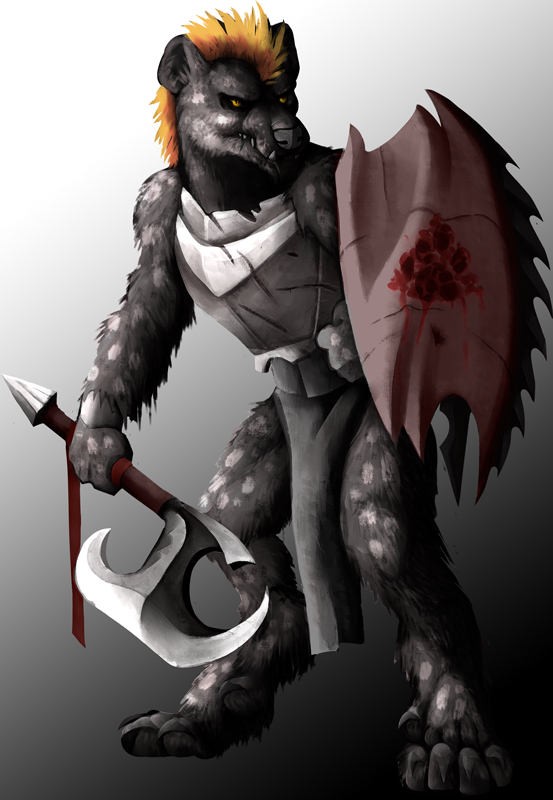
In the dawn of time, before the Sovereigns and the Silver Flame, Eberron was the domain of the fiendish overlords. This was an age of chaos, as the overlords constantly clashed with one another. The Rage of War commanded armies of fiends and savages, while the Wild Heart raised hordes of ravenous beasts. In the struggles between the two, the Wild Heart bred dire hyenas that could consume the Zakya warriors of Rak Tulkhesh. But fiends cannot be permanently slain by tooth or claw; their energy remains. Twisted from within by the immortal essence of the demons they’d devoured, the hyenas were warped into something entirely new, something that was neither beast or demon: and so the first gnolls were born.
Formed from both War and the Wild, the first gnolls were recruited and bred by both Rak Tulkhesh and the Wild Heart. As foot soldiers of the overlords they fought against orcs and the other early humanoids, as well as battling gnoll clans serving other overlords. Even after the overlords were defeated and bound by the Silver Flame, gnolls continued to be pawns of the overlords. The fiendish spark burned within them, and when they weren’t directly serving the Lords of Dust, most gnolls engaged in savage acts of brutality. The Dhakaani goblins ruthlessly exterminated gnolls in imperial territories, driving them back into the wilds.
In the present day gnolls are primarily found on the west coast of Khorvaire. Here’s a few notable concentrations of gnolls.
Gnolls are found across the Demon Wastes. Some have integrated into the Carrion Tribes, while other clans refuse to have anything to do with other creatures. These gnolls have embraced the Rage of War and engage in endless, ecstatic violence; when there are no outsiders to fight, they find reasons to battle the other clans. There have been times in the past when a great leader has united them and lead a horde through the Labyrinth, and this could happen again; but for the most part they are one of the ongoing dangers of the Demon Wastes, ever hungry to spill blood in the name of Rak Tulkhesh.
The gnolls of the Towering Wood are creatures of the Wild Heart. These feral hunters prowl through the Eldeen Reaches, preying on any creatures who cross their paths. These gnolls rarely organize beyond clans. The fact that they don’t form armies limits the overall threat that they pose to the people of the Towering Woods; they’ve never amassed in sufficient numbers to threaten the Greenheart, for example. But because they’re scattered and mobile, the Wardens of the Wood and the shifter tribes of the Towering Woods have never been able to end the threat. Clans melt away into the depths, appearing to strike isolated villages and travelers. Some say that there is a piece of the Towering Wood that can only be found by gnolls and lycanthropes who serve the Wild Heart—a dark haven where these feral forces build their strength and wait to strike.
There at least two gnoll clans that live deep in the King’s Forest of Breland. While smaller than the clans of the Towering Wood, these gnolls are likewise driven by the Wild Heart; they are cruel hunters who take pleasure in terrifying their quarry. Typically they remain in the wildest, darkest depths of the King’s Forest, avoiding the Knight Rangers and restricting their attacks to those fools who stray far from the safe paths. But there have been times when their numbers have grown, and when gnoll raiders have emerged from the Forest to prey on surrounding villagers.
While savage gnolls are often tied to the Rage of War or the Wild Heart, few know those names. Clans are guided by warlocks and fiendish visions, and each clan has its own name for the power that fuels their thirst for blood. The gnolls of Rak Tulkhesh show more martial discipline, while the gnolls of the Wild Heart are feral and cunning. Both are uniformly cruel, taking pleasure not simply in spilling blood but in instilling terror in their prey. The last great raid across the Labyrinth was centuries ago, but the people of Aundair still share grisly tales of the horrors unleashed by the pillaging gnolls, and Brelish children know gnolls devour those fools who stray from the path. This uniform cruelty is unusual in Eberron, where goblins are often more honorable than humans and orcs may be champions of the light. But gnolls aren’t natural creatures; they were shaped by overlords, and the essence of demons flows through their veins. They were bred to spill blood and sow terror, and for countless generations they gleefully embraced that path. But there are gnolls who reject the foul influence of their creators… such as the Znir Pact of Droaam.
THE ZNIR PACT
The region now known as Droaam has long been home to gnoll clans. The Rage of War seeks endless battle, and when there is no greater conflict it delights in setting its minions against one another. For countless generations, gnolls fought troll, ogre, and other gnolls seeking blood for their hungry idols. Centuries ago two gnolls from rival clans faced one another on a battlefield soaked in the blood of their kin and questioned the path that had led them there. The two urged others to deny the voice that called for endless war, to refuse to chase death in the service of a fiend. Two became four, then eight, until entire clans heeded the call. Clan leaders dragged their idols to the place now known as Znir—a word that simply means stone—and there they shattered the images of the fiends they once served. Together the gathered hunters, shamans, and warriors swore an oath: They might be many clans, but from this day forward they would be one pack. They would allow no one—not chieftain, god, or demon—to hold dominion over them.
This was easier said than done. Fighting the fiendish influence within was challenging enough, but the western wilds were a chaotic tapestry of battling forces. The leaders of the newly forged Pact had no desire to rule over other creatures, but even just holding their territory would invite attack. And so they developed the path that has carried them forward to this day: the road of the mercenary. The gnolls would claim no territory beyond the lands around Znir. They would fight for any who would pay a fair price. But if anyone sought to enslave a gnoll, or to strike against Znir itself, they would face the wrath of all of the united clans. This was a lesson that had to be taught many times, but after a century or so, the point was made. To those who paid them, the gnolls were as reliable as stone. Those who betrayed them or who picked a fight would fall before the might of the full Pact.
Some scholars of the Five Nations find it strange that the Znir Pact never took the path of conquest. There was no parallel to the united force of the Pact within the region, and they could have defeated the various chieftains and warlords they served. But the fact is that the gnolls have never had a desire to rule other creatures. They love the hunt and the thrill of battle. The path of the Pact allows them to do what comes naturally—to stalk and kill, to fight endless battles. But they do so together. They choose the paths they follow and the battles they fight. One could look at the Pact and say that they serve many masters. But the Znir gnoll would respond that they serve only themselves: that they choose who they fight for, that they set the terms of their service.
Znir Clans
The Znir gnolls include a dozen different clans, each of which holds onto distinct traditions. Once the clans were devoted to different faces of the overlords, but when they shattered the statue, each clan chose one of the moons. All gnolls hunt and fight, but the Barrakas are known to be the finest trackers of the Pact; the Aryth the deadliest archers; and the Olarune are the strongest warriors and most forceful in the vanguard. Typically, mercenary units are comprised of gnolls of a single clan, assigned based on the nature of the task that lies ahead, and contracts are usually negotiated for a period based on cycles of the clan’s moon. The clans maintain distinct territories within the Znir region. Despite this, all gnolls are welcome around the hearth of any clan; the Znir take pains to crush any tension that arrises between the clans. Shamans and leaders from each clan maintain a council at the Znir, around the broken idols. Here they mediate disputes, assign contracts to clans, and allocate funds and equipment. The Eyre clan have honed their skills as smiths and tanners, and they craft much of the equipment used by the Znir gnolls… though there is still a strong tradition of scavenging among the Znir, and warriors will often claim trophies from fallen foes.
Gnoll vs Gnoll
Droaam is a small place, and the Znir will serve any who will pay a fair price. This inevitably leads to conflict between Znir gnolls. In such situations, Znir will fight one another with all their skill. But they will strike to wound… and a gnoll wounded by another gnoll will immediately withdraw from battle, no matter how superficial the wound. While some clients take umbrage at this—You can still fight! Get back out there!—this is an absolute rule of all Znir contracts, and those who defy this will be punished by the united clans.
In general, the Znir take their contracts seriously. If the client breaks the terms of the agreement, the contract immediately ends. As long as terms are met, Znir will face any danger and will never betray a client. They have earned this reputation over the course of centuries, and this gives them a place much like the Sentinel Marshals of House Deneith in Khorvaire; everyone knows that the word of the Znir is as unbreakable as stone.
The Daughters and Tharashk
In their rise to power, the Daughters of Sora Kell have contracted for fully half of the forces of the Znir Pact (divided among all clans). This is an extended contract, under which the gnolls serve both as soldiers, hunters, and peacekeepers. Most large communities have a Znir garrison that’s serving the Daughters. These troops are present to protect the region from brigands or invaders, and to help maintain order. But they serve the Daughters, not the local warlord; it’s understood that if the warlord turns against the Daughters, the local Znir will act in their interests. The remainder of the Pact serves other masters. Many warlords maintain their own Znir forces, either as bodyguards, enforcers, or hunters. House Tharashk has also begun brokering the services of Znir gnolls within the Five Nations. The Pact is still cautious about this arrangement, however. Within Droaam, Znir customs are known and respected, and the Znir can unite against anyone who defies them. The Znir recognize that they don’t hold such power over the rulers of the Five Nations… and thus they are concerned about serving so far from their stones. In addition to those who serve through House Tharashk, a number of Znir have been sent east to study the Five Nations, gathering knowledge of its people and customs so the Znir council can determine how to engage with the wider world. This scouting role is a reasonable path for a gnoll player character; it’s their job to travel the world beyond and learn its ways, and to make friends and allies.
The Demon Within
The Znir defied the overlords when they shattered their statues, but there is still a spark of a fiend in the blood of each gnoll. Znir refuse to allow the demon within to hold dominion over them. Young gnolls learn how to resist this influence—to channel the strength of the fiend without giving it power over them. For most gnolls this is simply a matter of discipline. Znir gnolls are known for remaining calm in the face of provocation; having learned to fight their own demons, they aren’t easily manipulated by mortals. However, some gnolls learn to draw on their unnatural heritage and to channel this power in useful ways. Znir gnolls have their own equivalents of rangers and barbarians; the ranger’s primal magic draws on the Wild Heart, while the barbarian channels the fury of the Rage of War. Znir shamans are similar to warlocks, typically following the path of the Fiend. However, in all of these examples, the Znir don’t serve the dark power. Rather, they can be seen as stealing their strength from it; learning to draw on it without giving anything in return.
In their determination not to let fiendish forces hold dominion over their people, the Znir gnolls have also developed their own techniques for fighting supernatural threats. Champions trained to face fiends and undead are known as hwyri, and wield powers similar to those of paladins in other lands. However, hwyri don’t worship any divine power. Their abilities come from training and understanding of the demon within; they aren’t crusaders, they’re mercenary demon hunters. Most hwyri come from the Vult clan, and in a land that shuns the Silver Flame, these gnolls can be the best hope for people facing fiendish threats. There has been some tension between the Vult and the lycanthropes of the Dark Pack; the Vult shamans suspect that the Pack is vulnerable to the influence of the Wild Heart.
ZNIR GNOLL TRAITS
Exploring Eberron will include my rules for Znir gnoll player characters. For the moment, here’s a few general tips on playing a Znir gnoll.
Bone Eaters. Gnolls possess powerful jaws, as reflected by their bite attack. Gnolls can chew through and digest bone, and dislike letting food go to waste. When savage gnolls raid a village, they will consume even the bones of their victims. Znir gnolls won’t eat their fallen foes if they’re in the company of creatures who will be uncomfortable with such behavior. But they will often eat a small piece of any creature they slay—even if it’s just a finger—to form a bond with the victim. The Znir believe that those you kill wait for you in the realm of death, and honoring them ensures that they won’t be hungry when you travel to that land.
Pack Instincts. Gnolls have very strong pack instincts. They instinctively work together in combat, and they think nothing of placing themselves in harm’s way to protect their kin. Znir gnolls will not deceive members of their pack; if there are problems, they will call them out directly. If a gnoll character adopts a group of adventurers as their temporary pack, these things apply to the other players—but they will be surprised and angry if their non-gnoll packmates don’t show them the same respect.
Casual Aggression. Gnolls often seem very aggressive to other creatures. However, gnolls themselves don’t consider casual intimidation to be a hostile act; it’s just a way to establish a place in the hierarchy of the pack, largely ignored once that hierarchy is established. One of the most common ways this manifests is that gnolls make demands rather than requests. As a gnoll, use active statements rather than passive queries.
Cunning Hunters. Gnolls are strong and aggressive by nature. But both the Znir gnolls and there savage kin are cunning hunters rather than simple brutes. Gnolls work together as a pack, always searching for weaknesses in enemies and supporting injured allies. Znir goals won’t break their word, but they don’t hold to any idea of honorable conduct on the battlefield; they are ruthless and efficient, and see nothing wrong with ambushing or tricking a superior foe. Some gnolls have a supernatural knack for minicry, and will use this gift to draw enemies into danger.
The Fiend Within. As a gnoll, there is a spark of demonic influence within you. The Znir learn to control this at an early age. But how does it manifest in you? Do you suppress it completely, or do you channel it in some way—possibly reflected by your class abilities? Are you a hwyri who seeks to fight supernatural threats, or are you not concerned with such things?
That’s all I have time for today, but you’ll find more about gnolls and the Znir Pact in Exploring Eberron! Thanks to my Patreonsupporters, who keep this site going and who chose this topic!
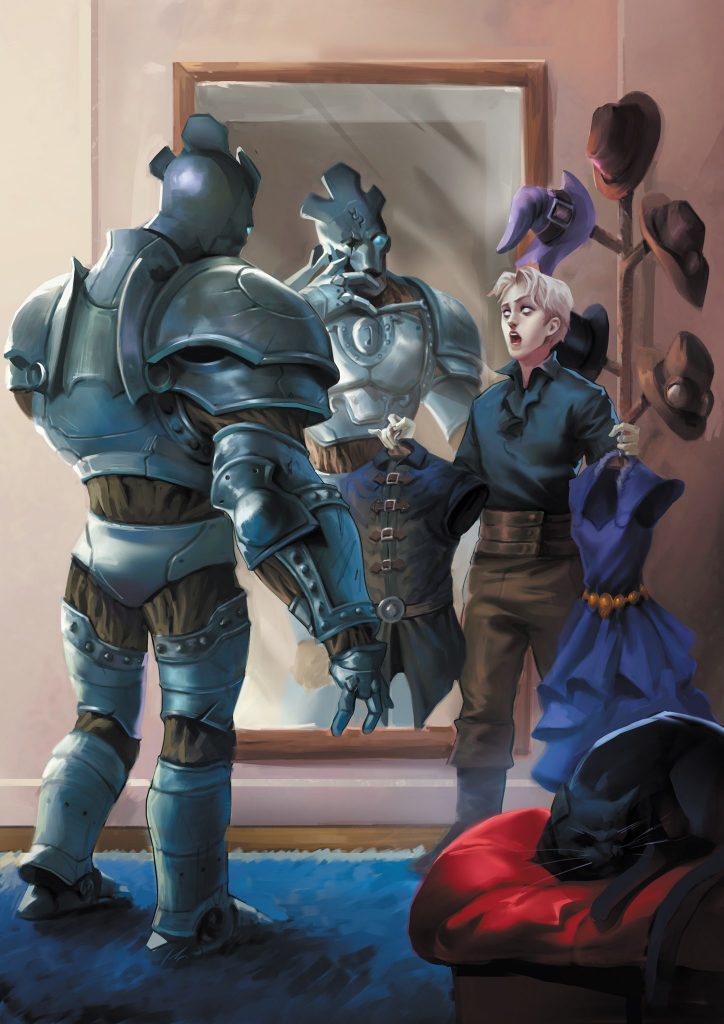
People ask me a lot of questions about Eberron. While I’ve typically answered the most frequently asked questions at sometime in the past, every now and then there’s an INFREQUENTLY asked question that still seems like it’s worth answering. Over the last few weeks two of those have come my way. How could a warforged become a cleric of the Blood of Vol? And can a warforged become a vampire?
Could a Warforged Become a Cleric of the Blood of Vol?
The Blood of Vol is based on the principle that the blood of the living holds a spark of divine power, and that all mortals have the potential to harness and evolve that Divinity Within. A Seeker cleric believes they are drawing on their own divine spark when they cast spells.
Warforged don’t have blood. Therefore, it seems logical to assume that they don’t have the spark of the Divinity Within. So why would they follow the Blood of Vol, and how could a warforged Seeker paladin or cleric justify their divine magic?
To begin with, let’s start with the WHY. Ultimately, the Blood of Vol faith is grounded in the question what just god would allow death and suffering, with the conclusion none; the fact that we suffer shows that if there are gods, they are cruel. All we have is each other, and we must stand together and defy death. The Seekers place a strong emphasis on community and protecting the weak. Any death is tragic. They use undead because once the spark is gone, there’s no reason NOT to use the corpse if it can help protect the living. More powerful undead—vampires, mummies—know that they will never achieve divinity, as they lost their divine spark when they died; but they can still fight to defend and to guide the living, to be champions of life… and perhaps someday topple the Sovereigns themselves and free the entire world from the curse of mortality. This is where the warforged Seeker comes in. They have no blood, and presumably no divine spark. But they are immune to disease and to the ravages of time. A warforged is in many ways much like a mummy. They can’t achieve true divinity, but they can protect and guide others. So the warforged Seeker priest isn’t driven by a desire for personal power; rather, they are driven by compassion and the desire to protect their community from suffering and death.
But what about the HOW? If Seeker clerics draw their power from their own blood, how do they get magic? Well, first of all, remember that the “drawing power from within” is an article of faith. They don’t KNOW the power comes from within with any more absolute certainty than a paladin of Dol Arrah knows that their power comes from Dol Arrah. So one option is to simply say “It works, don’t question it.” But the other example is to look to the mummy. Malevanor, the high priest of the Blood of Vol in Atur, is a mummy. He has no blood. So how does he cast spells? There’s two simple answers. The first is the idea that he draws on the divinity of the people around him. This ties to the strong community focus of the Blood of Vol; he can’t attain personal divinity, but he can draw on that potential within you and use that power to protect or heal you. With that said, what happens if you’re not around? Well, Seeker communities donate blood to sustain their champions. Vampires drink this blood, and while it is within them this connects them to the sparks of the living. Seeker mummies and liches BATHE in the blood of the faithful, and this charges their power for a short time.
So for your warforged cleric, the simplest answer is that they draw their power from the rest of the party! If you want to be creepy about it and the rest of the characters are willing, they could actually get blood donations from the party. But you could also just say that the proximity spark does the trick. On the other hand, you could also just say that they don’t KNOW how it works, but it does work… and that they BELIEVE it’s because they (and presumably all other warforged) have divinity within as well, despite having no blood. This would certainly be an interesting long term arc to explore!
Having said all that, back around 2005 I worked with David Esbri—who was at the time doing illustrations for the RPGA—on an early concept for an Eberron comic. One of the villains in that was a Warforged tied to the Emerald Claw who had embedded components allowing it to drain blood from its victims… essentially, an artificial vampire who believed that he could use this blood to become divine. So you could always explore a more exotic path!
Can Warforged Become Vampires?
There’s many answers to this question. The simple answer is that under the rules of 3.5 they couldn’t; “vampire” was a template that couldn’t be applied to constructs, and 3.5 warforged were constructs. The 5E rules have changed, however, and by the rules as written a warforged can become a vampire. However, the rules are guidelines, not absolute and inflexible! In my opinion, this is a case where the DM has to decide what they want from the STORY. Does it make SENSE for a warforged to be able to become a vampire, when it has no blood and doesn’t eat in the first place?
In my campaign, I would say that no, a warforged cannot become a vampire. A vampire can drain the LIFE FORCE from a warforged, but it has no blood for a vampire to drink. Vampire spawn rise when “buried in the soil”—I don’t see this having much meaning for a warforged. I DO think that warforged can become undead—that they can become vessels for the power of Mabar, channels through which it can consume the essence of the living—but I would be inclined to create a unique warforged expression of vampirism, rather than just forcing the standard bloodthirsty form onto them. I’d see it as draining energy like a wight as opposed to drinking blood, and I’d consider which of the traditional vampire powers made sense and what it might have instead.
That’s all I have time for today! Have you used warforged seekers or undead in your campaign?
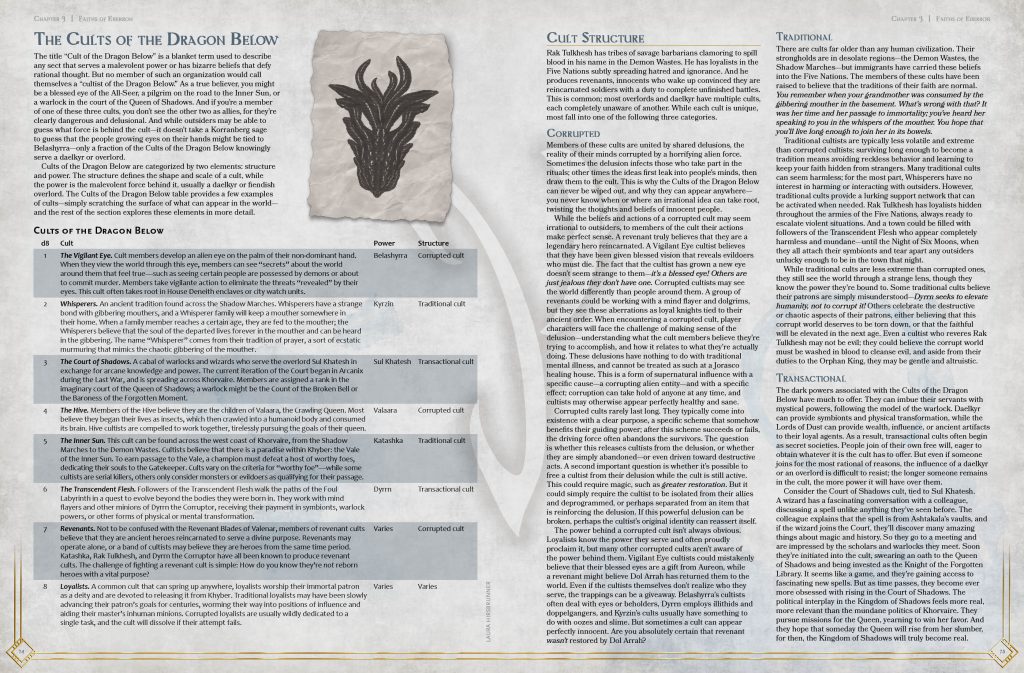
The Cults of the Dragon Below have been a part of Eberron from the very beginning, but there’s never been much detail about them. The basic idea has always been that “Cult of the Dragon Below” is a general term applied to a vast array of disparate sects driven by delusions or by ties to a dark power (typically a daelkyr or an overlord). But there’s only been a few cases where we have concrete examples of specific Cults of the Dragon Below. The Whisperers and the Inner Sun have both been mentioned in Dragon articles, while the cult in Khyber’s Harvest are traditional loyalists tied to Belashyrra. In Exploring Eberron, I wanted to go deeper—to give very concrete examples of cults and the powers behind them. How do the cults of Dyrrn differ from the followers of Valaara or Sul Khatesh? Beyond the basic introduction shown above, this section presents ten of the dark powers that create Cults of the Dragon Below and explores their goals, methods, and beliefs.
One statement that may come as a surprise to people is the idea that “Only a fraction of the Cults of the Dragon Below knowingly serve a daelkyr or overlord.” There’s basically three levels of this understanding.
Many corrupted cults are influenced by a dark power but don’t recognize this and don’t worship that power. In the example given above, the Vigilant Eye is a cult that is connected to Belashyrra, and SOME Vigilant Eye cults recognize this and offer prayers and bloody sacrifices to the Lord of Eyes. But you could easily have a Vigilant Eye cult in the Sharn Watch whose members believe that their new eyes are a blessing from Aureon, and that its visions reveal hidden evils in peoples’ hearts. This is a threat, because these false visions may guide the cultists to murder innocents—but the cultists don’t worship Belashyrra and truly believe that they are serving a righteous cause.
Traditional cults worship an entity… but they may not acknowledge the true nature of that being. In the Shadow Marches, most people know Kyrzin as a dangerous threat; in local folktales it’s typically known as the Prince of Slime or the Bile Lord. The Whisperers worship Kyrzin by the name the Regent of Whispers, and say that the Regent grants the gift of immortality to the faithful through the medium of the Gibbering Beasts. Neither of these two groups—common Marchers, Whisperers—may know that the creature they are worshipping or cursing is a daelkyr. The daelkyr incursion took place thousands of years ago, long before humanity even arrived on Khorvaire. So the Whisperers knowingly worship a being that others fear, but a) they believe that Kyrzin is benevolent force and b) they don’t know that it’s a daelkyr. Because that’s not relevant to their beliefs; what matters is that the Regent creates gibbering mouthers and shows them the path to eternal life.
Loyalists and most transactional cults knowingly traffic with dark powers and may well know the name and nature of the being they are dealing with. This is your path for the Carrion barbarians who howl prayers to Rak Tulkhesh as they charge their enemies, or the warlock bargaining with Sul Khatesh for forbidden arcane secrets.
These are the fractions—those with no real knowledge of the force they serve, those who interpret that force in a different way than others, and those that knowingly embrace a daelkyr or overlord. Ultimately, it’s up to the DM to decide the balance between those three, and which is the most common.
As you can see, editing and layout is continuing (thanks to the tireless efforts of Wayne Chang and Laura Hirsbrunner). However, I am also still writing: the various complications I’ve been dealing with are ongoing (… and the book is getting longer…) and I don’t have a firm release date yet. I’ll post a date as soon as I have one I’m sure of.
In the meantime, thanks again to my Patreon supporters who keep this blog going—a gnoll article is on the way soon!
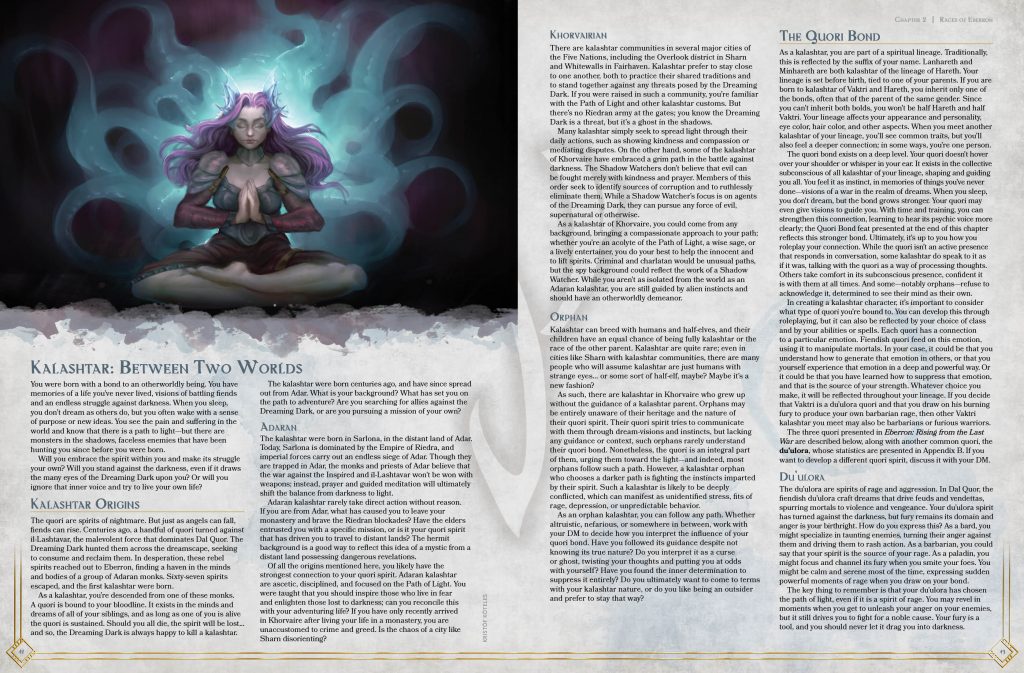
The above image shows a two-page spread from Exploring Eberron, including art from Kristóf Köteles. I’m thrilled with how the book is coming together, but it’s a long journey and it’s not over yet.
Exploring Eberron is a huge undertaking. By the time it’s done, I expect the book to include over 180,000 words… which is longer than my first two Eberron novels combined! I know what I’m capable of when I’m writing at top speed, and that’s what my original estimates have been based on. But unfortunately I haven’t been able to maintain that speed. Over the last six months there have been family issues that have had to take priority, and once things pushed into this year it collided with the work I need to do for The Adventure Zone: Bureau of Balance. The production of board and card games is a lengthy process, and I have dates I have to meet to hit our GenCon release for Bureau. Exploring Eberron is my labor of love—but that also means it’s the one thing that has a timeline that can be pushed, and so it has been.
My hope had been to release Exploring Eberron by the end of this month. The art has been in hand for months now, and the first half of the book have already gone through editing and layout. But I am still writing the final chapter; the recent Lamannia article is a preview of that. Once I’m done, that material will have to go through editing and layout, and then the completed book will need to go through a final review process with the DM’s Guild for hardcover printing.
So when will Exploring Eberron come out? The short answer is that I don’t have an absolute answer. I’d hoped for this month, but that seems unlikely. I’m reasonably confident that it will be released in March, but I’m not prepared to say whether it will be at the beginning or the end of the month. What I can say is that we’re close, and that I’m excited about how it’s coming together.
So thank you for your patience and your enthusiasm. We’ll continue to release previews in the days ahead, and I’ll let you know when there’s more news!
Eberron has a unique planar cosmology, but Rising From The Last War only scratches the surface of the planes; in this article and the upcoming Exploring Eberron, I’m digging deeper. Thanks to my Patreon supporters, who keep this site going and who chose this topic for my final January article!
LAMANNIA: THE TWILIGHT FOREST
Lamannia embodies primordial nature, untapped and
untamable. It represents the raw power and majesty of the natural world.
Lamannia is often called the Twilight Forest, and depicted as a realm of
colossal trees and massive beasts. However, the forest is just one of the
facets of Lamannia. Every natural environment is represented in Lamannia,
contained in a layer that exemplifies and exaggerates its features. Windswept
desert, raging ocean, endless plains; all can be found in Lamannia.
At first glance, Lamannia appears to overlap with a
number of other planes. How does the Twilight Forest differ from the domain of
the Forest Queen in Thelanis? How does the chill tundra differ from the icy
layers of Risia? Shouldn’t the volcanoes of the Broken Lands be in Fernia?
Well, there are dryads in the trees of the Endless Weald of Thelanis; sprites
hide behind leaves and satyrs dance in the clearings. And in Fernia a blazing
volcano could be home to Azer smiths forging wonders in its depths, or a balor
who delights in unleashing streams of lava to destroy unwary adventurers. In
Fernia, the volcano is a metaphor for industry or destruction. In Lamannia,
it’s a metaphor for volcano. It’s an
iconic, perfect example; it doesn’t need fey
or fiends to make its point, because the volcano itself is the point. The
elementals of Lamannia aren’t the anthropomorphic genies found in Fernia and
Syrania; they are the pure, living essence of the elements, unburdened by any
humanoid desire. Its primary inhabitants are beasts—both beasts that you might
encounter in the wilds of Eberron, and massive creatures that can be seen as
iconic representations of their type: the idealized incarnation of BEAR or
WOLF.
Some scholars assert that Lamannia served as a
blueprint for the material plane, that it was in Lamannia that the Progenitors
perfected the ideas of storm and stone. They believe that the natural world is
infused with the essence of Lamannia—and that druids and others who wield
primal magic actually manipulate that Lamannian essence. Certainly, Lamannia is
charged with primal power; druids who travel to the Twilight Forest can be
overwhelmed by the sheer force of nature that infuses this place.
Lamannia lies close to the world, and it’s one of the
easiest planes to reach. Its treasures are wood and stone—natural object imbued
with elemental power, herbs and plants whose effects are far stronger than
their mortal counterparts. But when you come to Lamannia, you are prey; there
are many predators in this realm, and anyone who seeks to despoil the
embodiment of nature will be hunted.
Universal Traits
Lamannia is a reflection of the natural world,
intensified and exaggerated. The air is pure and clean, the water fresh and
clear. Colors are impossibly vivid. It is suffused with life—a realm in which
any stone could be an earth elemental, where any tree could be awakened.
Vegetation is nearly always in bloom and beasts are
almost always in the peak of health. With the exception of layers such as The
Rot, Lamannia reflects the ideal state of the natural world. Here are a few of
the consistent traits of the plane.
Extended primal magic. When you cast a spell that draws on primal magic magic that has a duration of 1 minute or longer, the duration is doubled, to a maximum duration of 24 hours. Typically druids and rangers channel primal magic, but it’s up to the DM to decide in the case of each spellcaster. A paladin that follows the Oath of the Ancients might channel primal magic to cast their spells, while an Aundairian ranger could use arcane techniques.
Indomitable beasts.While in Lamannia, beasts and elementals have a +2 bonus to Constitution and advantage on saving throws against being charmed, frightened, or immobilized. When an elemental or beast first arrives in Lamannia from another plane, any magical effect that is charming it or binding it in any way is broken; this can be disastrous for an elemental airship that’s thrown into the plane.
The land provides. When you make a Wisdom (Survival) check to forage for food or shelter in Lamannia, you have advantage on the roll. The vegetation is bountiful and the land sustaining. It may be difficult to forage in the Broken Land, but you’ll at least have advantage to help you with the roll.
Primordial matter. It is difficult to destroy or contaminate the matter of Lamannia. An ongoing purify food and drink effect cleanses any sorts of poisons or contaminants from beyond the plane. In addition, natural materials such as wood and stone are tougher than their mundane counterparts. When trying to destroy such objects, increase the Armor Class suggested in Chapter 8 of the Dungeon Master’s Guide by 3 and double the hit points of the object.
Most layers of Lamannia follow a traditional
day-night cycle. However, layers aren’t synchronized and likewise don’t match
any time zone in Eberron. There is only one moon in the sky of Lamannia; a
Wisdom (Nature) check with a DC of 10 will identify it as Olarune, though it
appears larger than in the sky of Eberron and is always full.
Denizens of Lamannia
A common story of Lamannia tells of an explorer who
passed through a manifest zone and found herself on a vast mountain peak.
Pushing up the mountain, she was exploring a mysterious thicket when she was
set upon by rats the size of wolves. She fought the rats, but was on the verge
of being overwhelmed… until a giant beak flashed down and snapped up a rat in a
single bite. The wide ‘thicket’ wasn’t natural briar; it was the nest of a
gargantuan roc.
BEASTS
Lamannia is filled with all manner of beasts. Any
natural creature can be found in Lamannia; indeed, some sages assert that the
presence of a creature in Lamannia is what defines it as “natural.” These creatures
fall into the following categories.
·
Mundane
animals are identical to their counterparts in Eberron. Any natural
creature can be found in a layer with an appropriate environment. If such
beasts are the first things player characters encounter in a visit to Lamannia,
they might not realize they’ve traveled to another plane.
·
Dire
animals are creatures of remarkable size. Any beast described as ‘giant’ or
‘dire’ can serve in this role. Such creatures are more common than mundane
animals; in the Twilight Forest, most owls are giant owls, and they prey on
giant weasels and rats. While the existing animals are a place to start, any
sort of beast can have a dire counterpart in Lamannia.
·
Megafauna
are gargantuan beasts. The roc is an example of Lamannian megafauna; those
found in Eberron have been drawn through manifest zones or slipped between
planes during coterminous periods. A megafauna serpent could use the statistics
of a purple worm. These two creatures provide a rough scale of power for
megafauna, but a DM can create a wider range of megafauna; adventurers could be
hounded by a pack of gargantuan wolves. While these creatures are similar in
form to beasts, they are typically classified as monstrosities. Between their
vast size and their connection to the plane, they are immune to most effects
that only target beasts, and you can’t charm a roc with a simple animal friendship spell.
· Totems are beasts that are beyond the tactical scale… creatures that can be measured in miles. The gnome explorer Tasker tells a tale of finding an island in the Endless Ocean that turned out to be an enormous turtle; another of his stories deals with a pack of lycanthropes living in the fur of a massive roaming wolf. Such totems aren’t natural creatures and don’t need to eat or excrete. Their origins and purpose are unsolved mysteries, but most sages believe that they are immortal spirits projected by the plane itself. Some claim that the totems are connected to all creatures cast in their image. Others believe that the totems are sources of primal power, that barbarians, shifters, and druids can receive power and guidance from them. All that is known for sure is that they’re immune to common spells, and to date there are no accounts of anyone successfully harming or communicating with a totem.
For the most part Lamannian beasts are no smarter than their
counterparts on Eberron. However, there are animals that possess intelligence
similar to that granted by the awaken spell.
However, even these beasts generally follow their natural instincts and live wild
lives. While in Sharn giant owls may own shops and run for city council, the
giant owls of Lamannia are content to hunt the beasts of the Twilight Forest.
So it’s possible to find creatures in Lamannia that speak Common or a
Primordial dialect, but most have little interest in long conversations. Also,
don’t forget that dinosaurs are natural beasts! While a megafauna owl is
impressive, the megafauna version of a swordtooth titan (tyrannosaur) is a
sight to see!
ELEMENTALS
After beasts, the most common inhabitants of the plane
are elementals. Genies, mephits, and
anthropomorphic elementals are found on other planes; the inhabitants of
Lamannia are pure and raw in form. These include the standard earth, fire, air,
and water elementals, but they can come in a wide array of sizes and forms.
Adventurers exploring the broken lands could encounter tiny globs of lava
crawling across the land… while the leviathans of the Endless Ocean and the
elder tempests of the First Storm are forces of apocalyptic power. The
elementals of Lamannia are the spirits commonly summoned and bound by the Zil,
used to propel lightning rails and airships. While intelligent, these elementals
are utterly alien. They have little concept of time, and perceive the world
around them though the balance of elements. The sole desire of most elementals
is to express their element: to burn,
to flow, to fly. Many have an antagonistic attitude towards spirits of other
elements, which drives the deadly conflict in the Broken Land. This is another
obstacle in dealing with elementals, as they tend to perceive humanoids as
globs of water. While it’s possible for a character that speaks Primordial to
talk with a Lamannian elemental, it’s usually difficult to establish any sort of
common basis for negotiation. Still, there are legends of wandering druids who
“befriended earth and air;” anything is possible!
HUMANOIDS
The merfolk came to Eberron from Lamannia, and their
ancestors remain in the Endless Ocean. These primordial merfolk are closer to
their elemental roots than their counterparts in the seas of Eberron; while
they are just as intelligent as their cousins, they are driven by primal
instincts. They wield druidic magic, but they don’t craft tools or structures.
This serves as a model for other humanoid natives of Lamannia. Any race with a
strong primal connection could be tied to Lamannia, but natives of Lamannia are
driven by instinct and avoid the trappings of civilization. There could be
tabaxi dwelling in the branches of the Twilight Forest, but if so they will
feel feral and wild.
During the Silver Crusade, a significant number of
lycanthropes made their way or were exiled to Lamannia. While in Lamannia, a
lycanthrope cannot spread the curse to anyone other than their offspring. The
unnatural impulses of the curse—the drive to prey on innocents, the bloodlust
that can cause a victim of lycanthropy to lose control of their actions—are
suspended while they remain on the plane. Primal instincts are amplified;
Lamannian werewolves remain predators and take joy in the hunt. But they aren’t
driven to evil and remain in full
control. Packs and communities of lycanthropes are scattered across the layers.
Most are descended from lycanthropes who fled Eberron to escape both the templars
and the dark power whose corrupting influence led to the crusade; these
shapeshifters embrace their primal nature and rarely assume humanoid forms. But
there are also packs descended from afflicted templars who chose exile over
death, who strive to preserve the beliefs and traditions of their ancestors.
There are bitter feuds between these afflicted templars and the “first wolves”
and other lycanthropes of Lamannia, but the templars can be valuable allies for
planar travelers.
There are also a handful of druids and rangers who
have crossed into Lamannia and chosen to remain in this primal paradise. Many
run with lycanthrope packs, embracing their feral instincts and spending their
days in wild shape. Others act as planar shepherds, seeking to minimize the
impact of dangerous manifest zones and to help unwary travelers.
HIGHER POWERS
There are no celestials or fiends in Lamannia. It is a
realm of elementals and beasts, and the elementals are alien and untamed. Yet
explorers often report a feeling that they are being watched. And there are times when random events seem to be
guided by an unseen hand. When outsiders have sought to bring industry to bear
in Lamannia, they have been found by megafauna or elder elementals, or struck
by especially vicious turns of weather. It’s possible that this is the work of
the totems—that totems possess omniscience and great influence over their
layers. Or there could be a greater power that watches over the entire plane.
There is a single moon in the sky above every layer, the moon Olarune; some
scholars assert that this is the consciousness that governs the plane. This is
reflected in Eldeen shifter traditions that predate the practices of the
Wardens of the Wood; shifter druids suggest that it was Olarune who created the
shifters, and that the first lycanthropes were her champions. It is up to the
DM to decide if there’s any truth to these tales.
Layers of Lamannia
Like many of the planes, Lamannia is made up of layers—a
connected web of demiplanes, each highlighting a particular aspect of primal
nature. The scope of any single layer is up to the DM as suits the needs of the
story. One layer in Lamannia might contain a single colossal mountain peak; on
the other hand, the Twilight Forest could be as large as Khorvaire itself (or
even Eberron!). The edge of a layer could be an impassable physical barrier, or
it could wrap around onto itself; sail far enough in the Endless Ocean and
you’ll find yourself back where you began.
The layers of Lamannia are connected by physical portals, but
these portals often only allow travel in one direction. Any deep pool of water
may connect a layer to the Endless Ocean; but while you can get to the Ocean by
diving into a pond in the Twilight Forest, but there’s no gate back to the
Forest on the other side. The Endless Ocean contains small islands; people who
explore these islands will find they have moved to a new layer.
The Twilight Forest
The sky is hidden by the dense canopy of this vast
rainforest, leaving the forest floor in an endless twilight. The trees are over
a hundred feet in height—impressive, certainly, but not as tall as the
greatpines of the Towering Wood in the Eldeen Reches. But as people explore the
Twilight Forest, they will come upon strange ridges and walls of wood. Some
come together, forming twisted wooden canyons. Following these, explorers will
find that they are the roots of truly colossal trees, vast titans wider and
taller than the towers of Sharn. The Twilight Forest as mortals experience it
lies in the shadow of the grander canopy that rises far above it, and these
mighty trees are home to megafauna and mightier beings.
The Twilight Forest is wild and untamed. However,
explorers can find wide tracks through the lower forest. Survival experts may
recognize that these aren’t tracks formed by humanoid hands; rather, they are
the paths of totems, who have crushed the lesser forest beneath their colossal
feet. The Forest is filled with beasts; mundane and dire creatures in the lower
forests, megafauna in the grand canopy above it, and the occasional passage of
totems. There are multiple communities of lycanthropes scattered throughout the
lower forest. A clan of wererats have carved out a warren in the roots of a
colossal tree, while a pack of wild wereboars feuds with werewolves descended
from exiled templars. An ancient elf druid named Haral, who spends most of her
time in the form of an owl, does her best to maintain order; she is assisted in
this by a megafauna owl she calls Ruark. However, the Twilight Forest is larger
than the Eldeen Reaches; these are just a few examples of the inhabitants of
the forest.
Another noteworthy area is the Graveyard. Of all of
the layers, the Twilight Forest is closest to Eberron. There are many manifest
zones between the Twilight Forest and the material plane, and when the planes
are coterminous it’s possible for people—or objects—to pass through. The region
known as the Graveyard contains a number of manifest zones that are tied to the
oceans of Eberron, and to the air above them—and over the course of thousands
of years, they have caught a number of ships in their net. The focal point of
these manifest zones are dozens of feet above the ground. First of all, this
means that it’s not easy for stranded travelers to find their way back; second,
this means that ships fall when they
pass through, causing damage and often killing many of the travelers. So the
Graveyard contains the wrecks of ships from many eras—an ancient Aereni
galleon, a Lhazaar vessel, a recently lost Lyrandar airship. This provides an
opportunity to introduce outside influences to the Twilight Forest, or to have
forgotten treasures hidden in Lamannia. A Dhakaani vessel holds a priceless and
powerful artifact long sought by all of the Heirs of Dhakaan… but the vessel was
infected by spawn of the Daelkyr, and these have carved out a foul warren
beneath the ship.
Elementals don’t have an especially strong presence
in the Twilight Forest, but they are still present throughout it. A gust of
wind, a pool of water, a rolling stone—in Lamannia, any of these things could
be alive.
The Broken Land
The Broken Land is a volcanically active region filled
with high mountains and lava plains. There are constant eruptions, and the
layer is home to many fire and earth elementals, who engage in an ongoing
environmental conflict. Fire elementals flow out with the lava as volcanoes
erupt; earth elementals work to contain the eruptions and to rebuild the
shattered peaks, only to have them erupt again. Few beasts manage to thrive in
this layer, but there are some tough dinosaurs who’ve clawed out a niche. While
this region has fewer connections to Eberron than the Twilight Forest, it’s
also possible to find shipwrecks or remnants of other travelers here; it’s
certainly a harsh and deadly landscape for adventurers who are stranded here or
those who must recover a lost relic from this place.
The Endless Ocean
This layer reflects the majesty of the ocean depths. It
is home to a vast array of fish and aquatic beasts, along with merfolk tribes
and a wide range of water elementals… from simple sentient currents and weirds
all the way to massive leviathans. Megafauna battles are common, and this is
the source of the tale of the island that turned out to be a totem turtle. True
islands are few and far between, and most are actually portals to other layers
of Lamannia. There are many manifest zones spread across the Endless Ocean,
almost all of which connect to the ocean depths of Eberron.
The First Storm
A layer of plains and low hills, this region is
permanently lashed by hurricane winds and endless storms. Beasts huddle in
caves and the limited shelter, while all manner of elementals clash in the
storm-lashed plains. A massive elder tempest drives the heart of the storm;
during the Sundering of Sarlona, an apocalyptic cult in Ohr Kaluun sought to
bring this elemental to Eberron, believing it would destroy the world.
The Rot
Decay is part of nature, and this is reflected in the
Rot. This relatively small layer is swamplike, filled with fallen, rotting
trees. There are corpses of megafauna beasts scattered around the layer, and
giant insects and other massive scavengers prey on their remains. There’s a
community of wererats thriving in the Rot, and there could be a small outpost
of the Children of Winter who found there way here. While this is a symbol of
death and decay, it is entirely natural; the undead have no place here. It’s
possible a necromancer could arrive here, hoping to animate the massive
corpses; however, this would violate the theme of the plane, and if there is
any higher power at work in Lamannia it would direct forces to counter this. While
most layers of Lamannia are free from disease, disease is itself part of
nature; a manifest zone tied to the Rot could spread plagues into the surrounding
region.
Titan’s Folly
Lamannia is filled with precious natural resources; it’s
hardly surprising that an advanced civilization would try to harvest them.
During the Age of Giants, the Cul’sir Dominion set up a research station and
mining camp in a layer of Lamannia. After a decade struggling against megafauna
attacks and elemental-enhanced weather, the outpost was finally overwhelmed and
abandoned. It is a testament to the arcane engineering of the giants that
anything remains of this structure… although it may be that it remains because
the ruin itself has become a symbol of nature-reclaiming-civilization, becoming
the theme of the layer. Vines and moss cover shattered walls, and the bones of
giants are scattered throughout the remnants of this garrison. Valuable and
powerful treasures may well be hidden in the Folly, but explorers will have to
contend with aggressive elementals, dangerous beasts, and traps left by the
long-dead giants themselves.
Other Layers
These are just a handful of the many layers of Lamannia.
In developing a layer, think of a distinctive natural feature—a canyon; a
desert; a lone mountain—and build the layer around it. What creatures would be
found there? Have any outsiders taken up residence? Is there an unusual role
for elementals? How does it connect to other layers, or to Eberron?
Manifestations of Lamanna
There are many ways for Lamannia to influence an
adventure even if the player characters never leave the material plane.
MANIFEST ZONES
Lamannia is a prolific source of manifest zones. Quite
often manifest zones are found at the heart of a region that resembles the
connected layer: zones tied to the Endless Ocean are found underwater, while
manifest zones tied to the Twilight Forest can be found in the Towering Woods, the
King’s Forest, and other vast woodlands. However, it’s also possible to find
Lamannian zones in areas with no obvious connection to the layer—such as the
aquatic zones tied to the Twilight Forest that produce the Graveyard. Here’s a
few of the common effects of Lamannian manifest zones.
Elemental Power. Manifest zones tied to Lamannia may have strong elemental resonance. When spells that summon elementals are cast in such a region, they’re treated as if they were cast at a level one higher than the spell slot that was expended. There are a number of these zones in Zilargo, and House Cannith and the Twelve are eager to find unclaimed zones. However, there are risks associated with them. Elementals may spontaneously manifest in such places; sometimes they linger for a long time (a pool tied to Lamannia could be inhabited by water weirds), but often they only linger for a few hours and then dissipate. Passing through such a zone can also impart a surge of power to an existing elemental; this can potentially allow a bound elemental to break free from its bonds.
Gateways. A manifest zone can serve as a direct portal between Lamannia and Eberron. Typical such portals only open under certain circumstances—often when the planes are coterminous, but the requirements could be even more restricted (for example, when the planes are coterminous and Olarune is full). Such gateways can allow adventurers to travel to Lamannia, but they can also be the source of hostile elementals or deadly megafauna. Rising From The Last War suggests the idea that what appears to be a ring of standing stones could be a group of slumbering earth elementals stranded in such a gateway.
Growth. A common effect of a Lamannian manifest zone is to enhance the growth of plants or beasts in the region around it. This is less about fertility (which is commonly associated with Irian) and more about the size and health of the beast. Animals are often drawn to such zones. House Vadalis is always searching for manifest zones with this trait, and many Vadalis enclaves are built in these zones.
Purity. Vegetation and water in such a zone are healthy and pure, as if constantly affected by purify food and drink. Such zones can be a valuable resource for small communities. Such regions may also manifest the ‘primordial matter’ described earlier; stone and wood may be unusually tough. The prison of Dreadhold is built in such a manifest zone; not only is the stone of the region denser than usual, it cannot be penetrated by scrying or teleportation.
Resistance. While Lamannian manifest zones can be useful tools for communities or dragonmarked houses, some zones actively resist and repel civilization. As noted in Rising From The Last War, weather, vegetation, and a rapid rate of decay can combine to quickly destroy structures built in the zone and overgrow the ruins.
These effects aren’t mutually exclusive; a manifest
zone could have both the growth and resistance traits, and also become a
gateway under specific circumstances. Zones can also have very specific effects;
notably, the elemental power trait is often tied to a specific element. The
weird-haunted pool enhances water elementals, but doesn’t help if you’re trying
to summon fire elementals.
COTERMINOUS AND REMOTE
Lamannia has a swift planar cycle. It is reliably
coterminous for a week around around the summer solstice, and remote for a week
during the winter solstice; it can also become coterminous at other times,
often related to the lunar cycle of Olarune.
While Lamannia is coterminous, the effects of Lamannian
manifest zones are enhanced. In regions of unspoiled nature—such as the Eldeen
Reaches, the wilds of Q’barra—fertility of both plants and animals is enhanced,
and beasts conceived in these periods are often exceptionally strong and
healthy. Primal spells that affect beasts or elementals are extended; if a
spell has a duration of 1 minute or longer, the duration is doubled, to a
maximum duration of 24 hours.
While Lamannia is remote, fertility rates drop and
beasts born in these periods are often weak or sickly. Beast are often uneasy,
and the duration of any primal spell that affect beasts or elementals is cut in
half, to a minimum duration of one round.
LAMANNIAN VISITORS
The inhabitants of Lamannia rarely choose to travel to
Eberron. Those few civilized creatures—lycanthropes, merfolk—are content in
their primal realm and generally only cross over by accident. However,
accidental visitors can be a source of trouble or adventure. A powerful
elemental or a megafauna beast can pose a deadly threat to a region. Megafauna
creatures can become local legends; imagine a Vadalis expedition seeking a
legendary megafauna ape (which, if captured, might break free while on
exhibition and climb the towers of Sharn!). There’s no records of a totem beast
ever passing through to Eberron, and it’s possible that they cannot manifest
beyond Lamannia.
LAMANNIAN TREASURES
Lamannia vegetation is prized by alchemists. Herbs and
roots from Lamannia can produce exceptionally strong potions, and many types of
Lamannian vegetation have innate magical effects; there are bushes in the
Twilight Forest that naturally produce goodberries.
Lamannian lumber likewise can have unusual traits, mirroring the densewood and
bronzewood found in Aerenal. Lamannian wood and stone can serve as powerful
focuses for primal magic, for creating figurines
of wondrous power, or for tools designed to summon or bind elementals.
Lamannian Stories
Lamannia is a source of elementals and dire beasts. It
is wild and untamed, strengthening primal magic and providing a haven to
lycanthropes. It resists any intrusion by civilization. Here’s a few ideas for
working it into your story.
·
A Savage
Land. When a party of
adventurers unknowingly pass through a gateway, they must find a way to survive
in this wild realm. This could be as simple as finding another manifest zone to
take them home… or it could require them to survive in Lamannia for months
while waiting for the planes to become coterminous. Another option is for the
group to be stranded when their airship passes through a manifest zone and the
elemental breaks free; in this case, the adventurers must decide whether to
protect the other survivors, and deal with conflicts that arise among them.
·
Megafauna
Island. Due to close ties to Lamannia, there’s an island that is home to an
unusual array of megafauna beasts. Adventurers could stumble onto this on their
own, or they could be hired by an heir of House Vadalis who wants to
investigate the rumors without drawing the attention of rivals in the house.
·
The Great
Beast. A Lamannian zone could realize a megafauna predator into the region,
spreading terror among the locals. Must this creature be destroyed? Can it be
returned through the zone, or is it even hostile?
·
Lycanthropes.
Lamannia suppresses the negative effects of the curse of lycanthropy. Adventurers
could stumble upon a village of lycanthropes and jump to the wrong conclusion,
not knowing that the influence of the local manifest zone allows them to
control the curse. Alternatively, a group of benevolent lycanthropes could
return to Eberron only to fall prey to the predatory impulses of the curse: can
the adventurers capture these lycanthropes alive and help them return to the
Twilight Forest?
·
Relic
Hunt. The trail of a powerful artifact leads to Lamannia. It might have
been on a ship lost in the Graveyard, or it could be that an artificer needs
Lamannian resources to complete an eldritch machine. Can the adventurers win
this deadly race?
·
At War
With Nature. An Ashbound druid manages to establish a new Lamannian
manifest zone in a major city, such as Fairhaven or Sharn. The resistance
effect is causing the city to crumble, releasing elementals and wild
vegetation. Can the adventurers find a way to remove the manifest zone?
Alternately, House Cannith could be determined to create a bridge that allows
them to harvest Lamannian resources… will they succeed, or will their efforts
backfire dramatically?
· Unusual Flavor. The impact of a manifest zone can be felt just as part of the backdrop of a scenario. The village of Clearwater is in a hostile region, but it survives because of the small lake that provides fresh water and a seemingly inexhaustible supply of fish. In a small Eldeen village, the locals live in harmony with a breed of giant rabbits unknown elsewhere in Khorvaire. A tribe of shifters lives in the branches of the three massive trees that grow in a Lamannian manifest zone.
If you have questions or stories about what you’ve done with Lamannia, post them below!
The latest Unearthed Arcana article presents new subclasses for the barbarian, monk, paladin, and warlock. I’ve already written articles about the barbarian, monk, and warlock that examine the role of each class and subclass in the setting, and I wanted to look at the new subclasses and share how I’d incorporate them into Eberron.
Barbarian: The Path of the Beast
The Path of the Beast allows a barbarian to physically transform: manifesting natural weapons, adapting to hostile environments, and channeling psychic power through their attacks. A simple way to use this is as a form of Weretouched Master, a tradition that enhances a shifter’s primal gifts. Shifter barbarians are found in the Eldeen Reaches, and a champion with the powers of the Path of the Beast would definitely fit in among the Ashbound or possibly the Wardens of the Wood.
With that said, one of the key features of the Path of the Beast is that you can change the benefit each time you use a feature. You can change the benefit of Bestial Soul each rest, and manifest a different natural weapon every time you use Form of the Beast… including “great mandibles” or a “spiky tail.” Add to this the idea that the higher level features have a certain psychic flavor and I think this is an interesting martial tradition for changelings—let’s call it a Changeling Monstrosity, as an alternative to the Changeling Menagerie druid suggested in this article. This is based on the idea of a changeling warrior learning to make more dramatic transformations, which fits with the fact that they can change the natural weapon each time they use it; you’ll see a few other explorations of this idea in Exploring Eberron. But where would this tradition be found? It feels too savage for the stable changelings of Sharn; instead, I see it as being a tradition developed by the changelings of Droaam, emulating the monstrous creatures they deal with on a daily basis. Imaging a changeling arguing with a minotaur and suddenly manifesting mandibles and a scorpion tail. The higher level features reflect the idea that the changelings of Lost have learned to harness latent psychic abilities. A player character following this path could have left Droaam in the service of Daask, could be serving the interests of Lost, or could simply be following their own path.
The Path of the Beast also lends itself to the idea of the Experiment… someone whose class features were bestowed upon them by an outside force. I see three obvious options for this.
Mordain the Fleshweaver. A person growing mandibles and a spiked tail when they get angry? That certainly sounds like something Mordain would enjoy. A major advantage to Mordain is that he might create something like this as a one-off, with no deep investment in what actually happens to the character—so it’s a way to follow this path without having a lot of strings attached. One question I’d have is whether you were created from scratch, or if you had a life before you were changed… in which case, how and when did it happen? Can you return to your old life, or are you afraid to reveal what you’ve become? You could instead be a creation of a daelkyr, which is the same basic idea on a larger (and more terrifying) scale.
House Vadalis. We’ve hinted at Vadalis experiments magebreeding supersoldiers; you could be the result. Unlike Mordain, if Vadalis is involved this would likely have been a carefully organized program and there would be others… unless you were the only one that survived! Given this, you could have escaped from the program, in which case you might be on the run or even forced to fight other members of your unit (consider the show Dark Angel). But you could also be an agent of the house; the program was a success, after all, and you’re proud of your heritage.
The Mourning. You were in Cyre on the Day of Mourning and it changed you… but you’re still learning just how deep those changes go. If I went down this path, I’d play up the unpredictable nature and the idea that you’re afraid of what you’re becoming. Even if I, the PLAYER, was fully in control of my abilities I might suggest that the CHARACTER isn’t… that they don’t always choose when they rage, and that they don’t know what Form of the Beast will take.
In all of these cases, you might say “But if you start at 1st level, you won’t HAVE any of your Path of the Beast powers when the campaign begins.” This doesn’t concern me. The whole idea is that the character is evolving. I’d start out by emphasizing how my existing class features reflect this backstory—that when I rage, my damage resistance and increased damage reflect a physical transformation—and have it just ramp up dramatically when I finally manifest the Path of the Beast.
Monk: The Way of Mercy
Monks who follow the Way of Mercy are “wandering physicians to the poor and hurt” who “learn to manipulate the life force of others to bring aid to those in need.” An immediate, simple option is for this to be an order tied to House Jorasco. There are already a number of orders that learn to use marks in unconventional ways; some of the abilities of the Way of Mercy are reminiscent of the Nosomantic Chiurgeons of Dragonmarked. Now, one could make the argument that Jorasco heirs are supposed to charge for their services and don’t simply help those in need. In previous articles I’ve called out the fact that I believe this to be overstated; that a Mercy order could be essentially a PR path for the house, or also that they might charge those they heal to perform community service as payment for their healing. But if you DO want to be strict about Jorasco-doesn’t-heal-without-pay, an alternative is to say that this is a tradition that PREDATES the house—an order of halfling monks that operate in the Talenta Plains, who have refused to accept the modern traditions and values of the house. This would add to the idea of them wearing masks—they are formally concealing their identities and connection to the house—and ties to the Talenta mask tradition. Personally, I also like the idea of a plague doctor mask based on a glidewing’s head. So you could say that this IS a part of the house, or you could say that it’s essentially a renegade tradition: the house doesn’t actively seek to suppress it, but it’s understood that its members will be masked and largely keep to the Plains.
Jorasco is the easiest option for this path, and Jorasco halfling isn’t a bad choice for a monk. But there’s certainly other options. A few off the top of my head…
A prototype warforged designed as a field medic.
An acolyte of Arawai’s Gift, a vassal sect that sees life as the gift of the Sovereign of Life and Love. Monks of this order are charged to preserve life and to mediate disputes… but if someone abuses Arawai’s Gift, it can be rescinded.
A kalashatar follower of the Path of Light; this tradition could combine the martial discipline of the Path of Shadows with psychometabolic healing techniques. In this case, I’d definitely flavor the features as being psionic in origin.
Looking to Jorasco’s Mercy or Arawai’s Gift, I’d probably flavor the character less as an aggressive martial artist and more focused on deep knowledge of pressure points and Qi. Even when using a standard unarmed strike—and even though it still deals bludgeoning damage—I might still describe it as a gentle touch that nonetheless deals significant damage.
Paladin: The Oath of the Watchers
The Oath of the Watchers is a little more straightforward than the previous two subclasses. A few ideas…
The Shadow Watchers are a kalashtar order that seek to fight the agents of the Dreaming Dark. As quori are classified as aberrations in Rising From The Last War, Abjure The Extraplanar is a useful tool. Spells such as chromatic orb could be presented as psychic manifestations, though other abilities could be derived from faith in il-Yannah.
The Edgewalkers are an elite Riedran military force trained to combat extraplanar threats. You could be a renegade Edgewalker who fled Sarlona after discovering that your masters ARE extraplanar threats, or you could be a goodwill envoy sent by the Inspired to help deal with a rising threat in Khorvaire (the Inspired don’t like the Lords of Dust or daelkyr any more than anyone else does).
The Oath of the Watchers is a perfectly logical path for templars of the Silver Flame; the Church has always had its orders of exorcists.
While the Gatekeepers are also well known for battling extraplanar threats, I personally prefer druid/ranger/barbarians as Gatekeepers; but any Watcher Paladin would likely find a good ally in a Gatekeeper.
Warlock: The Noble Genie
The role of genies in Eberron is a larger topic I don’t have time to cover right now. With that said, there’s relatively little about the subclass that requires a connection to a genie. The most distinctive features are the idea that you have an object that you use to tether creatures to temporarily add them to your patron’s menagerie, and that you can ultimately call on your patron for favors. A few alternatives…
An Ancient Dragon is using you as a remote researcher. When you use Genie’s Entertainment, you’re actually transporting the victim to your patron’s laboratory in Argonnessen.
An Archfey‘s story revolves around their vast menagerie, and Genie’s Entertainment draws the victim to their domain in Thelanis. There’s nothing that says an Archfey HAS to serve as an Archfey patron, if the powers of a different patron make sense with their story!
You could actually be a field researcher for a University… perhaps the Library of Korranberg, Arcanix, or Morgrave University. Rather than having an all-powerful patron, your Vessel and the benefits could all be tools created by artificers at your University; if it’s Morgrave, it could very new and experimental, with new class features literally reflecting new innovations your department has developed.
How do you plan to use these subclasses? The topic of the next article will be chosen by my Patreon supporters, who keep the website going—thanks for your support!
If all goes well, I’ll be doing more Eberron support on this site in 2020. The frequency and form of this content will depend on my Patreon support. In addition to feature articles, I’ll always be tackling frequently asked questions about Eberron. But I also want to take the time to answer a few INfrequently asked questions.
Can Warforged Cry?
In MY Eberron, no: warforged don’t cry. There’s two major reasons for this. The first is that warforged are generally depicted as having crystaline eyes. They thus have no need to lubricate their eyes and there’s no logical reason for them to have any sort of tear duct. So there’s no biological reason for it. But beyond that: I don’t WANT non-human species of behave just like humans. I always think it’s more interesting to explore how a nonhuman species differs from humanity as opposed to saying “They’re just like us, but with pointy ears or green skin.” So I want to know what warforged do INSTEAD of crying.
Warforged have the capacity to feel emotion. A warforged can feel joy or sorrow. But they can’t smile, and in my opinion, they can’t cry. So how do these emotions come out? Is there an involuntarily physiological response like a tear? Is there a more voluntary response, like when you embrace the sorrow and start sobbing? In MY Eberron, a warforged’s involuntary response to sorrow is a slight trembling that runs through the root-like musculature of the warforged. If the warforged has metal armor plating, this will rattle the plates against one another, creating a soft, dissonant chiming sound. If the warforged has non-metal armor, if will be more of a rustling like rain. When a warforged is in the grip of sorrow, a common response is to bring its arms together—as if hugging itself—and to rhythmically tap is fingers against its forearms, essentially creating an amplified version of that “crying” sound. A warforged may also do this rhythmic tapping against one forearm as a general expression of sorrow or frustration—the equivalent of taking a deep sigh.
Now, that’s what *I* do in MY Eberron. The second side of the question is what I think the official answer might be, and my suspicion is that it’s “If there’s no rule that states a warforged can’t cry, than it can cry.” If I HAD to explain how this would work, I’d say “The organic components of a warforged are infused with alchemical fluids. Warforged tears are an involuntarily expulsion of these fluids.” But again, I personally would prefer for them to express their grief in a way that’s unique to warforged, rather than to mirror humanity.
What are your thoughts on warforged crying? Have you ever addressed it in your campaign? Post your answers below! Also, go to TheAdventureZoneGame.com to check out my latest game, currently in preorder until mid-January 2020!
This is a time to think of all the things we’ve thankful for, and I for one am thankful that I haven’t been replaced by a changeling. So it seems like a good time to address a few of the questions I’ve received about changelings, the shapeshifters of Rising From The Last War.
First, let’s take a quick look at the foundation of the changeling:
As an action, you can change your appearance and your voice. You determine the specifics of the changes, including your coloration, hair length, and sex. You can also adjust your height and weight, but not so much that your size changes. You can make yourself appear as a member of another race, though none of your game statistics change. You can’t duplicate the appearance of a creature you’ve never seen, and you must adopt a form that has the same basic arrangement of limbs that you have. Your clothing and equipment aren’t changed by this trait. You stay in the new form until you use an action to revert to your true form or until you die.
A question that comes up quite often is given the threat posed by changelings impersonating people, what steps do Eberron’s factions and governments take to deal with them?
The everyday magic that drives the civilization of Khorvaire only goes up to around 3rd level. So you don’t have guards stationed with true seeing at every important location. Which is good, because from a metagame perspective, changelings should be able to fool people. That’s the point of playing a changeling. We don’t muzzle dragonborn to keep them from using their breath weapons or make wood elves wear cement boots to negate their extra movement. If you play a changeling, you should be able to fool people.
With that said, that doesn’t mean it should be EASY. The people of Khorvaire are very aware of the existence of changelings, and after centuries of coexistence have a very good idea of their capabilities. So let’s consider those for a moment.
As a changeling it is assumed that you can perfectly replicate the appearance of a creature you’ve seen before (just like someone using disguise self). No roll is required to duplicate basic physical appearance.
However, this doesn’t provide you with any knowledge of that person and their quirks. It’s taken for granted that you sound like them—the voice comes with the shape—but you don’t know their mannerisms or their vocabulary.
Likewise, the most crucial limitation on changelings is that clothing and equipment don’t change. You can look like a guard, but you don’t get the uniform for free.
So: People of Khorvaire know there are people out there that can duplicate their appearance… but that they can’t steal their memories or copy their belongings. One immediate impact of this is that people make a conscious effort to develop unique mannerisms and accessories. People establish in-jokes and call-and-response phrases. They will often have at least one unique, personal accessory—a piece of clothing, jewelery, even a pet—that they carry all the time as an identifying factor. In part, this is simply about developing a personal style; but in Eberron, it also has the absolute concrete underlay that “If you see me without this accessory, you should be suspicious.’
So in my case, I have a hat that I wear all the time. Everyone knows me by that hat. If I every show up without the hat, my friends will notice. They won’t automatically assume that I’m an imposter, but they WILL probably try out one of our shared jokes or stories and see if I respond to it. This same basic principle applies to institutions. Guards will have distinctive uniforms. They will have SOME sort of ID object—whether it’s identification papers, a brooch of rank—that will stand out if it’s absent. And they WILL have a system of passwords or phrases that they use to test people suspected of being imposters. Because after all, changelings aren’t the only threat; anyone can get a hat of disguise. In a high security location, this system could have more layers to further confuse people. The ID item could change regularly. Imagine an ID brooch that’s a common magic item, enchanted so you can change its color by touching it and saying a command word. The appropriate color could vary based on the current time and day of the week. So an imposter with disguise self could duplicate the appearance of the uniform; but if they don’t know the system, they won’t know what color their brooch should be.
While this isn’t foolproof, these sorts of systems can make it very difficult for a changeling to fool people. However, this is where DECEPTION comes into play. You don’t have to make a skill check to duplicate someone’s appearance. You have to make a skill check when you do something that makes them suspicious… and if you are successful, it means you’ve managed to allay their suspicions. If you duplicate my appearance and don’t have my hat, a successful Deception check means you’ve recognized that people are suspicious and done SOMETHING to convince them that nothing’s wrong. Perhaps you make an excuse about what happened to the hat. Perhaps you never even know the hat is the issue, but you’re just so skilled at putting people at ease that they forget about the hat. It’s the same principle with a password or an ID badge. The fact that you don’t know the password doesn’t mean that it’s impossible for you to get past a guard; an excellent Deception check means you’re able to convince them there’s a good reason you don’t have the password, or to otherwise get them to ignore it. On the other hand, there can also be inanimate security systems that can’t be fooled. An alarm could be tied to that common magic ID badge; if you enter the chamber without one, it will trigger the alarm. Which means you CAN still pull off this job; but you are going to have to somehow get one of those badges to do it.
In general, if you’re playing a changeling bard with expertise in Deception, you are SUPPOSED to be a master deceiver. You SHOULD be able to fool people. On the other hand, you’re not going to be able to simply walk into the Kundarak vault and steal all the treasure because you’re wearing someone’s face. They will have passphrases, and they will use magic that’s available (up to 3rd level); so you will have alarm, and in the case of a Kundarak vault you might even be questioned under a zone of truth. People KNOW changelings are around. They are PREPARED. But it’s always possible to overcome these with enough work and preparation.
One key point to bear in mind is that an easy way to not get caught is to not impersonate someonein the first place. The whole idea of a persona is that changelings will CREATE unique identities for their purposes. If a family of changelings created the identity of “Keith Baker,” they’re the ones who came up with the hat in the first place; they KNOW all the recognizable quirks of the character. The traveling changelings often don’t duplicate the appearance of outsiders; they simply use the persona best suited to the situation.
Another question that’s come up is can a changeling impersonate a warforged?This ties to a second question, can a changeling appear to be wearing a mask, but it’s actually just their face?
The answer to both of these hinges on the phrase your clothing and equipment aren’t changed by this trait. A mask is a piece of equipment, so no, you can’t make a fake mask. Likewise, you can duplicate the appearance of a warforged, but you can’t replicate armor—and most warforged are always wearing armor. So you could be a “naked’ warforged, which means you’ve just got the livewood musculature exposed, but that’s not normal for warforged and you’ll draw a lot of attention.
If a Changeling transformed into someone/thing with webbed hands and feet, or claws, would they have any benefit, even if it’s not a lot?
No. A changeling gains no mechanical benefit from their disguise. As suggested in the comments, I could imagine granting a Stealth bonus to a naked changeling who wants to shift the color of their skin to hide in a snowbank, but the key points there are “naked” and “snowbank” (IE, not a complex background). A changeling can make it LOOK like they have sharper teeth or claws, but this doesn’t actually give them natural weapons; it’s a deception. Essentially, it is a form of disguise self, NOT alter self.
Having said that, Exploring Eberron will have a few options that allow changelings to improve their natural shapeshifting abilities in order to get mechanical benefits from it.
Could a particularly skilled Changeling pull off a Cuttlefish impression?
No; the ability states “you must adopt a form that has the same basic arrangement of limbs that you have.” With that said, I have in the past suggested the idea of a Changeling Menagerie—a changeling who is mechanically a Circle of the Moon druid, but who explains their class features as being derived from their mastery of shapeshifting as opposed to druidic traditions.
I’d love to know more about Changeling Culture. I do have a question, and it might be addressed in your book already, but here it is: In your Eberron, how would Changelings view love and romance? Would they stick with their persona the entire time they’re with their significant other, or show their true nature once they decide to commit to each other?
Exploring Eberron does go into more detail about changeling cultures, and the key point is that this isn’t a simple answer because there’s more than one changeling culture and the common answer (as there’s always exceptions in love!) would definitely vary by culture.
Stable changelings live openly as changelings and wouldn’t need to hide their true nature in the first place. I’d expect them to use personas as part of courting, but not to deceive the lover—rather to show them all the different facets of the changeling’s personality, to explore all the possibilities of their relationship. This could be confusing for a non-changeling lover, but between changelings it would be an important part of learning about one another. A final aspect of this could be developing an entirely new persona that is used ONLY with the lover: this is who I am with YOU.
Passers—lone changelings blending into non-changeling communities—might chose to share their true nature with a lover because they want to be completely honest with them. But there are passers who deny their own changeling nature and consider their chosen persona to BE their true identity; so they might believe they are BEING honest in using the persona. But part of the point is that passers aren’t really a culture; each one deals with unique circumstances.
Where the static changeling might create personas to show their facets to a lover, for the traveling changelings personas are important tools and stories. Many personas are shared, and any change you make to the core story of the persona would have to be followed by anyone else using the persona. If Tel-as-Bronson takes Jesse as a lover as Bronson and their cousin Dal also uses Bronson, then it’s Dal’s job to love Jesse when they are Bronson. So essentially, the question is are you taking this lover yourself—in which case, once you are certain about the relationship, you would DEFINITELY want them to know your true face—or is the persona taking this lover—in which case you’d never want to let them see your true face. This doesn’t mean the persona-lover would be any less intense or real; but it’s not part of YOUR story, it’s THEIR romance.
And these are just three of the more prevalent changeling cultures. So there’s a lot of possibilities.
I would think changelings must have some kind of internal law system for dealing with malcontents.
Remember that just like elves or for that matter drow, “changelings” don’t have anything as a whole. They aren’t a monolithic force; they have different cultures, and each culture will have their own traditions. With that said, yes, there would definitely be punishments for those whose actions threaten the community. Also bear in mind that theft of identity is a crime under the Code of Galifar; obviously casual actions can be hard to prove, but it’s an issue a changeling had best be aware of if they are going to be going before the law of the Five Nations.
One of the simplest but most severe punishments would be an indelible mark—a magical tattoo that cannot be removed by shapeshifting. The technique of the indelible mark is a secret held close by the elders of the Children of Jes, used only in severe situations. An equally severe punishment for serious offenses is removal of all or part of a limb; as noted above, changelings can’t create limbs with their power. With both of these punishments, the message is simple: if you abuse your gift, it can be taken from you. A lesser punishment would be the destruction of the criminal’s personal personas (through other changelings adopting the person and taking actions that can’t be undone).
Do changelings sometimes use their shapechanging artistically or outlandishly? Wild hair colors, patterned skin, strange eyes?
This is a question of culture. In stable changeling communities where they live openly as changelings, they absolutely use shapeshifting artistically and as a form of expression. The Queen of Stone has a changeling dancer changing patterns on their skin as part of the performance. Page 18 of Rising From The Last War notes that changeling names often incorporate a minor degree of cosmetic shapeshifting—Jin-with-vivid-blue-eyes. Traveling changelings and passers hiding their changeling nature obviously won’t use shapeshifting in this way, but still use it subtly to convey messages to family members.
Can all changelings get pregnant? Are they biologically asexual and just choose their current sex with shapeshifting?
Yes. What’s been stated in the past is that changelings set their sex with shapeshifting. Prior canon has said that a pregnant changeling actually loses the ability to shapeshift during the pregnancy. This seems extreme to me, but I could see the idea that they need to maintain a female form in order to maintain the pregnancy (and that shifting form very early in the pregnancy would simply end it, so changelings have a very easy form of birth control). The idea that changing sex is an instinctual thing, like flipping a light switch, and that a normal changeling couldn’t, for example, assume a male form but keep the uterus. With that said, if you had a changeling called out as having greater control over their abilities (for example, the Changeling Menagerie druid I’ve mentioned elsewhere) I might allow that.
Can changelings mate with non-changelings, and are their children full-blooded changelings?
What we’ve said before is that changelings can mate with most humanoids; if the child is born to a changeling mother they’ll be a changeling, while if the mother is another species there’s a 50/50% chance for either species. A changeling child is born with the apparent species of their mother, and the shapeshifting ability doesn’t set in for around a year. This is the origin of the name “changeling” — because when someone’s previously human child suddenly becomes a pale thing, it was once thought that the original child had been taken to Thelanis.
Having said that: while changelings CAN mate with other humanoids, I’d say that it is RARE for them to impregnate creatures of other species. It can happen, but the fertility rate isn’t that high. It’s quite possible that humans and other human-compatible species are the most viable. With that said…
Are changelings biologically compatible with other changelings or are they parasitic with humanoids?
Changelings are biologically compatible with changelings. Most changeling cultures are relatively insular, precisely because many traditions of the culture are tied to shapeshifting and a fluid outlook on identity, and it’s difficult to integrate a single-skin into the community. There certainly are changelings who choose to pursue relationships with members of other species —see the changeling romance answer above—but it’s not the common practice.
Can they disguise injuries, like if a guard cut your face and you escaped but they try to track you by the cut?
It would depend on the extent of the injury. There is no mechanical benefit to changeling shapeshifting, so they can’t actually heal themselves. However, I’d personally say that they can conceal minor injuries. If it’s a specific story point—an especially grievous wound inflicted for the express purpose of marking the changeling—I’d probably have the changeling make a Wisdom (Medicine) check to simply seal the wound. If they failed that, I’d still likely let them minimize and conceal it, but if someone was explicitly looking for an injured changeling it would be grounds for requiring a Charisma (Deception) check to conceal it.
What if you cut off a changeling’s arm?
Changeling shapeshifting provides no mechanical benefit, and as a changeling “you must adopt a form that has the same basic arrangement of limbs that you have.” The ability to regrow a lost limb would certainly be a mechanical benefit. So as noted above, this is a particular brutal form of justice in a changeling community.
Can changelings fake convincing dragonmarks? Can changelings be tattooed?
Yes and yes. A changeling can duplicate the appearance of a creature they’ve seen; there’s no exception stating “unless that creature has a dragonmark.” With that said, dragonmarks glow when used; if the character is attempting to make it appear functional, I’d definitely require a Charisma (Deception) check, and for them to have seen the mark used before. And note that this sort of fake dragonmark won’t let you use a dragonmark focus item.
As for being tattooed, changelings can definitely be tattooed, and they can just as easily erase the tattoo with a moment’s thought. As mentioned above, the Children of Jes have a curse known as the indelible mark which can only be removed using a spell that would remove a curse, but a mundane tattoo can be easily faked or removed.
What’s up with doppelgangers? We know changelings believe they’re a kind of insane changeling, but how true is that if doppelgangers seem to come from Khyber?
Under 5E lore, doppelgangers are changelings twisted by the daelkyr Dyrrn the Corruptor. A general belief is that this change is actually primarily psychological. Doppelgangers have a fundamentally alien outlook. They are predators who so paranoia and chaos when not working for a specific Cult of the Dragon Below, but there’s often no apparent motive for their actions. This is largely about the horror of a creature who knows your thoughts, who can kill you with its bare hands and steal your face, but that you don’t know WHY or what it wants.
One possibility is that doppelgangers are biologically distinct from changelings. Another possibility is that they are physically identical, and that the doppelganger’s superior abilities are simply unlocked by its alien psychology. With this said, it’s possible that changelings can also unlock these same abilities—but that in so doing they will lose their original personality and become doppelgangers.
Would a scholar be able to tell the difference between a changeling and a doppelganger? Would a changeling be able to recognize a doppelganger if they saw it using its abilities?
In their natural forms, doppelgangers and changelings are quite different. Just take a look at the picture in the Monster Manual! Doppelgangers are hairless and less human in their proportions. If you embrace the idea of the changeling becoming a doppelganger, once it underwent the psychological transition its “true form” would change to match the hairless doppelganger form.
With that said, a changeling could DISGUISE itself as a doppelganger (if it had see one in its true form), and vice versa!
As for recognizing it, the BASIC shapeshifting action is identical. You don’t see someone shift faces and say “That’s not a changeling, it’s a doppelganger!” You recognize it by its ability to read thoughts and by its deadly unarmed attack.
Does the 2nd level Moonbeam work against changelings? If so, wouldn’t this have large implications in the viability of hiding as a changeling? Likewise, are changelings immune to the polymorph spell, which fails when used on shapeshifters?
WotC has confirmed that changelings are considered to have the Shapechanger subtype. So they are indeed immune to polymorph and can be affected by moonbeam.
With that said: Moonbeam isn’t a particularly effective changeling test. It’s a 2nd level spell, so it is in the world, but that’s still not something people use all the time. It’s also a druid spell, and druidic magic isn’t common in the Five Nations. Most important, it inflicts 2d10 radiant damage, which is MORE than enough to kill a normal person. So using moonbeam to check if someone’s a changeling is like shooting them in the face to see if they’re a vampire.
To what degree are 4th (Private Sanctum), 5th (Geas), and 6th (Forbiddence) level spells available to high end buyers (eg Royalty). I know the 3.5 Dreadhold write up had antimagic, which is 8th level, but I don’t have a sense to grade from “Standard enclave” to “The most impenetrable prison of all time”. I know greater marks go up to 5th, but are 5th level spells that aren’t on a Spells of the Mark list available for the ultrawealthy?
This isn’t strictly a changeling question, but it ties to the general topic of detection. First of all: one of the general principles of Eberron is that only magic of up to 3rd level is commonly available — employed by magewrights, etc. This article discusses a range of options that fall under that umbrella, based on alarm, glyph of warding, and arcane lock.
Spells of 4th level and above can be available, but they are rare and expensive—not services you should take for granted. The Spells of the Mark tables are good guidelines but are NOT complete. These are spells heirs may be able to CAST, but the direct powers of a mark are not as important as the ability to use focus items – and for example, I have a focus item in Exploring Eberron that allows a dwarf with the mark of warding to cast guards & wards. Effects such as forbiddance and true seeing are POSSIBLE, but they should be RARE, not something anyone would take for granted. It’s the sort of thing where a commoner might have HEARD of a Kundarak houseward but never seen one.
Meanwhile, Dreadhold is the most secure prison in Khorvaire. It is LEGENDARY. Yes, it employs forbiddance and antimagic—but that doesn’t mean you should find these effects in a typical city jail.
Doesn’t the Shapechanger ability of the changeling invalidate the 9th level Infiltration Expertise and 13th level Imposter ability of the Assassin rogue? Isn’t that too powerful? I assume that a changeling should get advantage on Deception checks because of its disguise, but that’s what Imposter does.
I don’t see the conflict between these abilities. ANYONE can get the ability to change their appearance as a changeling does. Disguise self is a 1st level spell and the hat of disguise is an uncommon magic item, and both of these are BETTER than the changeling’s Shapechanger power because they allow the user to change the appearance of their equipment and clothing. It’s been called out in the past that hats of disguise are standard issue for elite members of the Royal Eyes of Aundair; if this uncommon item entirely negated the 9/13 abilities of the assassin, it would be pretty sad for the assassin.
The 9th level Infiltration Expertise ability allows you to “establish the history, profession, and affiliations for an identity… For example, you might acquire appropriate clothing, letters of introduction, and official-looking certification…” The changeling Shapechanger ability doesn’t give you ANY of these things, specifically NOT letting you change your clothing. Infiltration Expertise is the perfect tool for a changeling who wants to create a new persona. The Shapechanger ability changes their face, but Infiltration Expertise creates an IDENTITY that will hold up if the disguise is questioned.
Meanwhile, the basic idea of the Shapechanger ability—like the hat of disguise or disguise self—is that the disguise is PHYSICALLY perfect, but that the changeling will have to make a Deception check if there’s reason for someone to be suspicious. Imposter gives a changeling—or an assassin using a hat of disguise—advantage on any Deception check, which is extremely useful.
A key point here: You suggest “The implication to me would be that a Changeling would have an advantage on deception for casual disguises.” I disagree. The disguise itself is physically perfect and requires no roll (again, like disguise self and hat of disguise). If there is a reason that the disguise would be questioned—they run into a close friend of the person they’re impersonating, they don’t know a password or have an important identifying object—they have to make a Deception check. They don’t inherently get advantage because of the disguise; they are MAKING the check because the disguise is being questioned. To get advantage they’d have to have something else that shifted the odds in their favor — they’d done extensive research, someone provides a distraction, or they’re an expert assassin with the Imposter ability.
So in short, being a changeling is like having a hat of disguise that doesn’t affect your clothing. It lets you change your personal appearance, nothing more. If the disguise is questioned you have to make a Deception check. If you have the Imposter feature you get advantage on this check; and if you have Infiltration Expertise, you ALSO have the proper clothing, identification, and background connections for the role… which reduces the chance that your appearance will BE questioned in the first place.
I’ll be writing more about changeling culture in my upcoming book Exploring Eberron. In my next post I’ll talk about my plans for PAX Unplugged and The Adventure Zone: Bureau of Balance!
And thanks as always to my Patreon supporters! I hope to do more with the site in the future, and support will help determine what’s possible.
If you have questions or thoughts about changelings, post them below!
The Ironroot Mountains are rich in precious metals and ore, and the dwarves of the Mror Hold wield considerable economic power for such a small nation. The Mror dwarves have long been miners and warriors, proud of their clans and their traditions. And the clans have long told stories of the great deeds of their ancestors—of dwarves who ruled a vast domain below the roots of the mountains, who battled the ancient goblins long before humanity came to Khorvaire, of artificers who crafted wonders deep below the earth. According to these stories, the first clan lords were exiled from the Realm Below for their wild and reckless ways—but that someday, when the Mror walked a righteous path, the gates of the Realm Below would be opened to them once more.
In the early days of the Last War, the legends were revealed to be true. Delving ever deeper, Mror miners broke through into an ancient hall. There is a vast subterranean realm below the Ironroot Mountains, and the ancient dwarves who carved these halls did produce amazing artifacts and legendary weapons. But those dwarves died long ago. The daelkyr Dyrrn the Corruptor has laid claim to the Realm Below, and the minions of the Foul Labyrinth are spread throughout its halls. Dolgrims, dolgaunts, mind flayers, and other vile aberrations dwell in the depths. Degenerate derro dwell among these creatures, perhaps the last remnant of the dwarves of old.
Ever since this discovery, the Mror Clans have been waging a war to reclaim their ancestral holdings. The aberrations have yet to mount a counter-offensive or truly organized defense, and the dwarves have established a beachhead in the depths. Along the way, they have recovered both relics of the ancient dwarfs and weapons and tools of the daelkyr themselves—living weapons and items known as symbionts. Some of the clans—notably Clan Mroranon, the strongest of the holds—take the stance that all things tied to the daelkyr are abominable, and that any use of such things will lead to corruption. But others—notably Clan Soldorak—assert that symbionts are just tools, and that the weapons of the enemy can be used against them. Over the course of decades, Soldorak and its allies have brought symbionts into their daily lives, finding new uses for these living tools. Soldorak warlocks have found ways to draw on the power of the daelkyr themselves. Such warlocks swear that they’ll only use these powers for the good of the Holds, but Mroranon purists mutter that there can be no traffic without corruption.
The Present Day
Today, the dwarves continue their slow war in the darkness. Occasionally a force of aberrations seeks to rise up from the depths, but overall there is a stalemate; the Mror have claimed upper halls, but it will take a great effort to press deeper. From a practical standpoint, this means that there is a vast dungeon below the Holds. Many clans would be happy to have adventurers drive deeper into the daelkyr-held halls beneath their holds, especially if those adventurers include among them a dwarf of their line. This is an especially logical focus for a dwarf with the noble background; among many of the clan lines, the elders have asserted that if their heirs want territory, they must carve it out of the Realm Below.
So on the one hand, the Mror Holds are shaped by the knowledge of the Realms Below—the awareness that there is untold wealth and power to be gained in the depths, combined with the knowledge that a deadly enemy with vast and as yet untested power lies beneath their feet. Dyrrn the Corruptor has yet launch an organized attack against the surface, but many feel that it’s only a matter of time. Some say that it’s a question of poking the hornets nest, that all traffic with the Realm Below should be severed before Dyrrn rises. Others believe that Dyrrn is biding its time while spreading its corruption through its symbionts and cults—that Dyrrn is already attacking the Mror Holds, just not through brute force. While some say that these are the excuses of cowards: that the aberrations are not as strong as others think, and that the holds should launch a concetnrated campaign to fully reclaim the Realm Below. It’s up the a DM to decide the truth and the path a campaign will take. Are Dyrrn’s minions already corrupting the dwarves from within? Do you want to have a resurgence of this ancient threat, with the dwarves fighting a desperate battle to contain hordes rising from below? Or do you want to keep the Realm Below as a mysterious dungeon for bold adventurers to explore?
Rising From The Last War presents the foundation of this idea, and provides a few example symbionts. Exploring Eberron goes farther, with a deeper look into the cultural impact of these events, along with additional symbionts and character options.
Why Did This Happen?
Since Eberron began, the Mror dwarves have been called out as being fundamentally less interesting than the dino-riding Talenta halflings, the deadly gnomes of Zilargo, and the ancestor-worshipping warrior elves of Valenar. In the past, their primary direction has been about their economic power; but that’s a subtle distinction. In developing Rising From The Last War, we wanted to add something that made the Mror dwarves distinct without completely rewriting their history. But the Realm Below has always been part of their history. This article was the first mention of the ancient kingdom below the Holds—a realm of wonders destroyed by the daelkyr long ago. Likewise, symbionts were introduced in the original 3.5 Eberron Campaign Setting and expanded upon in Magic of Eberron. But neither of these elements received much attention. Rising presented an opportunity to expand on both of these. We give the daelkyr a more significant role and create a line in the sand for adventurers who want to face them: here is a place where you know one can be found. We also take symbionts—something I’ve always liked—and say that there is a place in the world where they are being used as tools, the same way magic is used as a tool. For adventurers who prefer a more traditional dwarven story, there’s the Mroranon and their allies—proud warriors staunchly opposing the aberrations and holding to the traditions of their ancestors. For players who want something new, try the Soldorak with their warlocks and their symbionts. A critical point here is that the Soldorak aren’t evil or inherently corrupt; they see symbionts as one more tool, as a science to be mastered. Some of the other clans say that it can’t be mastered without sowing corruption—but that’s a decision the DM will have to decide. So ultimately, this was an opportunity to add a unique path for dwarf adventurers, while also expanding on the role of symbionts and the daelkyr.
But wait, you say? I keep mentioning dwarf warlocks, and dwarves aren’t especially good at being warlocks? Well, perhaps there’s an option in Exploring Eberron that will help those would-be Soldorak cultists…
What About The Shadow Marches?
The Shadow Marches also have a division between those who follow the Daelkyr adn those who oppose them. Is this just the same story repeated?
On a grand cosmic scale, it can be seen that way. But the two are very different. The story of the Marches has been playing out for thousands of years. The Gatekeepers are a truly ancient tradition. The Cults of the Dragon Below are an established part of Marcher culture. The Gatekeepers maintain the seals that keep the daelkyr bound, while the Kyrzin’s Whisperers maintain the gibbering mouthers that live in their basements and consume their elders. It is an established tradition on both sides. By contrast, the situation in the Mror Holds is active and unfolding. There IS the risk that Kyrzin could drive an all out offensive (even if the daelkyr itself can’t leave Khyber). The Soldorak are actively trying to harness and use the symbionts in a more industrial manner than the ancient cults of the Marches. And frankly, the Mroranon may oppose the daelkyr, but they don’t understand what they are fighting as the Gatekeepers do. There’s also the simply point that there’s different daelkyr involved. The Marches are primarily associated with Kyrzin and Belashyrra, while it’s Dyrrn the Corruptor who’s active below the Holds. Part of this is that it’s a great reason for a Gatekeeper adventurer to be sent to the Mror Holds, to find out just what’s happening in the east and report back to the elders in the Marches.
Q&A
How does House Kundarak fit into this picture?
The original 3.5 lore suggests that it was the Kundarak dwarves that opened the passages to the Realm Below. This isn’t entirely eliminated, but it’s downplayed. The idea remains that the Kundarak dwarves weren’t exiled; they left the Realm Below as guardians assigned to watch over the exiles and prevent their return. There’s a few things to consider here.
The timeline isn’t as interesting. Set aside the idea that Dragonmark of Warding just happened to manifest on a line of dwarves maintaining wards (thousands of years after their being assigned to that position), it sets the discovery of the Realm Below as something that happened centuries ago, removing the urgency and drama of the situation. We want the interaction with the Realm Below to be recent enough that’s adventurers can be an active part of the discover, and its impact on the Holds is still unfolding.
The previous approach meant that Kundarak maintained a direct cultural line to the Realm Below. We preferred the idea that this line was broken, that no dwarf really knows what they’ll find in the Realm Below. This ties to the fact that the ancient dwarves could make artifacts, and that there are secrets below any artificer would love to master. But it also means that the dwarves could discover that their ancestors weren’t what they believe them to have been.
Which all leads to the idea that the Kundarak did seal and protect the paths to the Realm Below long ago… but that then thousands of years passed and they, too, largely forgot what had come before. They didn’t fail in their duty; the paths were sealed. They just were so successful that they eventually forgot what that duty was and moved on (again, over the course of thousands of years and the rise of new civilizations) and eventually someone else DID break the seals.
But the answer is simple. If you prefer the old lore, you can use that Dragonshard exactly as it reads. The Kundarak DID open the seals to the Realm Below a thousand years ago. But this only revealed the upper levels, which were empty and long abandoned. What happened recently wasn’t the discovery of the Realm Below; it was that someone found a way to go even deeper into it, and that’s when they found the levels still occupied. So it was a known curiosity, but only recently became an opportunity and a threat.
Will you ever give a canon answer for the other 10 clans where they fall on the symbiont acceptability spectrum?
I doubt it. Exploring Eberron addresses some of the other clans, but a number are left intentionally neutral so DMs and players can decide what to do with them.
The only small niggle I have was that one in-universe tabloid on a Mror noble going to Korth kitted out with a slew of symbionts. Personally find it difficult to swallow that they’d travel internationally as such. But then, can you really believe everything you read? Especially with the Karrns likely bitter still over Mror ceding from Karrnath.
The clipping in question is on page 121 of Rising From The Last War. With all of those clippings, It’s very important to look at the source. The Korranberg Chronicle is the most reliable source. The Five Voices — in this case, the Voice of Karrnath — present inflammatory and nationalistic views. So it’s hardly surprising that the Voice of Karrnath would focus on the unsavory aspects of a visiting Mror dignitary and try to generate fear.
With that said, I DON’T have a problem with the idea of Lord Malus showing up in his living armor. You have to consider WHY he’s doing this, and WHERE. If he’s an ambassador coming to Fairhaven on bended knee, this would be a terrible choice. But to paraphrase 300, this is Karrnath. This is the nation that has entire fortresses staffed with the undead. It is a nation that understands displays of power and wielding tools that terrify others. In wearing his armor, Lord Malus is intentionally seeking to intimidate and to project power: I have mastered these terrifying things.
And there’s one other element to consider. Most symbionts have a feature called symbiotic nature. Attuning to a symbiont is a commitment, and they can’t be casually removed. Malus could surely have had his armor removed before leaving the Mror Holds; but he couldn’t simply take it off before coming to the meeting.
That’s all for now! Let me know your thoughts on this new twist on the dwarves of Eberron. And thanks as always to my Patreon supporters, who keep this site alive. I hope to do more on the site in the months ahead, and Patreon support will help determine what that looks like. And thanks as well to Júlio Azevedo, who produced the image above for Exploring Eberron!