As chosen by my Patreon supporters, my next major article is going to be on the nobility of Khorvaire. This article is a shorter subject. Last week I wrote about the Tairnadal elves. This article deals with the other culture of Aerenal: the Aereni elves, the servants of the Undying Court. I’ve written about Aerenal in this article and this article, and there’s a section on Aerenal in Exploring Eberron; I’m including the two pages we’ve already previewed below. Let’s consider a few infrequently asked questions!
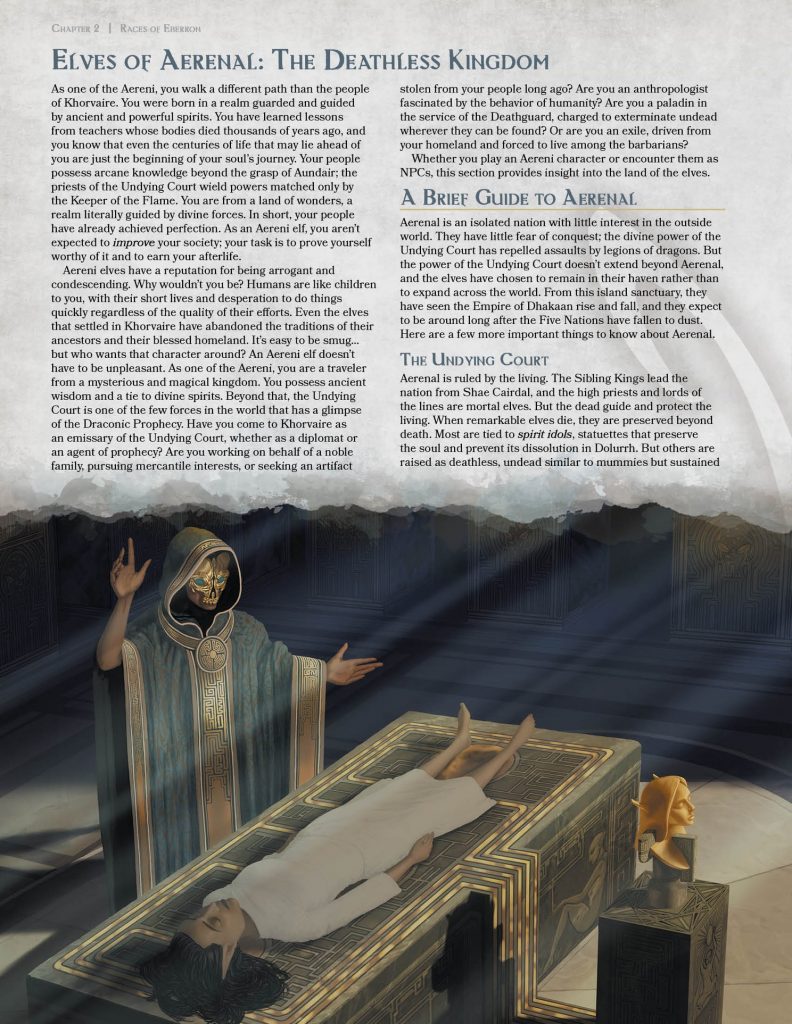
Are Phiarlan and Thuranni elves still considered Aereni? Are they eligible to become spirit idols or deathless? What about the elves with the Mark of Shadow who serve with the Cairdal Blades in Aerenal?
The answer to this is largely spelled out in this article. “Aereni” is a culture; being Aereni means that you honor your ancestors, give your devotion to the Undying Court, and serve the Sibling Kings. The shadow-marked families—Tialaen, Shol, Ellorrenthi, Paelion, Thuranni—were never actually Aereni; they remained independent from the Undying Court, the line of Vol, and the Tairnadal, and traveled between communities of all of these cultures. When the Undying Court eradicated the line of Vol and exiled its allies, the shadow-marked families chose to leave with them. Some feared that they too would be persecuted for their marks; others believed that the supporters of the Undying Court had committed an unforgivable sin in spilling so much elven blood. As this article says, “to mark their departure from elven society, (the shadow-marked families) formally joined their lines into a new alliance: House Phiarlan.“
As for those shadow-marked elves who are occasionally seen in the Cairdal Blades? This is also explained in the article: “A handful remained, believing that it was their duty to the kingdom; these elves found themselves largely absorbed into other lines, and this mingling of blood causes the Mark of Shadows to occasionally appear in Aerenal.” The elves who develop the Mark of Shadow in Aerenal aren’t Phiarlan or Thuranni; they are now Jhaelian or Mendyrian. And the mark only appears rarely because unlike the houses, the Aereni aren’t trying to arrange matches to produce the mark; the marked bloodlines are heavily diluted.
So no: the elves of House Thuranni and Phiarlan aren’t Aereni. They intentionally severed their ties to their homeland and have no loyalty to the Undying Court or the Sibling Kings. And since elevation to the Undying Court—whether as a spirit idol or as one of the deathless—is an honor the Aereni bestow on their most celebrated citizens, it is not offered to those elves who have abandoned their homeland and its traditions.
With that said, a Phiarlan elf could return to Aerenal, abandoning the house and embracing the Aereni traditions; they’d just have to find a noble line willing to adopt them, just like the shadow-marked elves who stayed behind when the phiarlans originally left. And as Aereni, such elves would be eligible to join the Court, though again, they’d have to impress the priests and people with their worth. But joining the court isn’t about whether you have a dragonmark; it’s whether you are a devotee of the Undying Court who has proven yourself worthy to join it, and whose talents and achievements justify this gift.
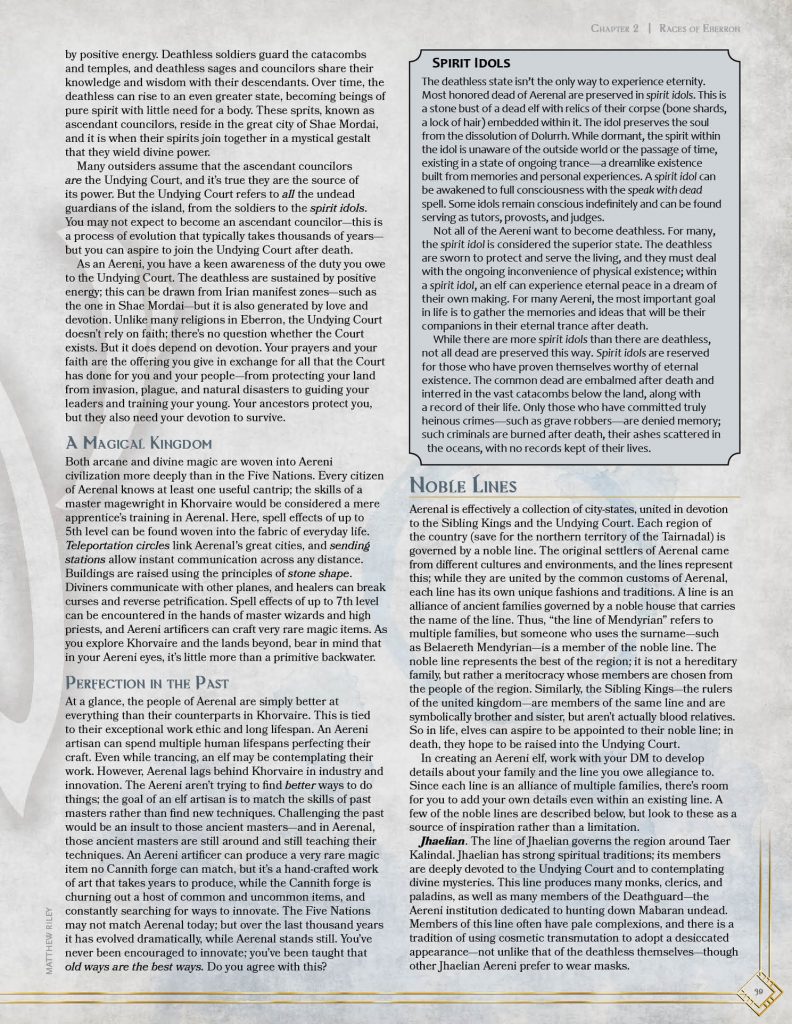
Could someone use a spirit idol as a template to clone a revered ancestor? Perhaps by transferring the soul into a construct body, or even a living elf willing to give their body to the ancestor?
All of this seems possible, but the real question is would the ancestor be happy about it? As noted in the ExE preview, for many Aereni becoming a spirit idol is something they look forward to. When they aren’t interacting with the living, the spirit within the idol exists within a paradise of its own making, dwelling within its memories and ideas. The Aereni see life as something you do to prepare for your afterlife. You don’t want to die too quickly, because then you don’t have enough memories to build a satisfying eternity. But most see life as the chrysalis, with the spirit idol as a blessed ascension, eternity unbound by the physical form.
So COULD the soul within a spirit idol be transferred into some other vessel? Sure, I don’t see why not. But this isn’t a problem the Priests of Transition are trying to solve; they see the spirit idol as being a blessed member of the Undying Court, not as a victim who needs to be saved.
Do Aereni ever join the Tairnadal, for instance one who feels rejected and out of place with their family?
Sure! We’ve mentioned it before. And likewise, zaelantar youths sometimes leave the steppes and become Aereni; this is one path for a Tairnadal youth who doesn’t get chosen by a patron ancestor. This isn’t common in either direction; a would-be Aereni has to be accepted by a noble line, while a would-be Tairnadal has to be chosen by a patron ancestor to truly become Tairnadal. But it certainly happens.
The Tairnadal faith seems fundamentally more demanding than the Undying Court. Both revolve around preserving and communing with honored ancestors, but the Tairnadal faith requires imitation and constant war, while it doesn’t seem like the Undying Court places any demands on its followers (maybe to eliminate Mabaran undead)?
The Tairnadal faith is more demanding than the Undying Court, yes. This is because the end result of the devotion is completely different. Through their faith, the Aereni seek to preserve the Undying Court. But with the exception of the ascendant counselors and divine spellcasters, the Aereni have a very concrete, limited relationship with their ancestors. If you took the Right of Counsel feat in the 3.5 ECS, you had to physically go to Shae Mordai to speak with your ancestor. By contrast, each Tairnadal vessel believes that they are a living vessel for the spirit of their patron. They believe that the patron offers them direct, personal guidance—that their remarkable skills are the result of the patron guiding their hands. So the Tairnadal endures this more demanding service because they believe that they receive a more dramatic benefit in exchange.
Having said that, a critical point is that we just haven’t talked much about what Aereni devotion actually looks like. Only the elite Deathguard are charged to fight Mabaran undead. An Aereni civilian shows their devotion through prayers, which combine expressions of gratitude for the ongoing protection the Court provides with tales that commemorate their deeds and discoveries. But the second way an Aereni honors the ancestors is by following in their footsteps. This isn’t as dramatic or absolute as the Tairnadal revenant. But Aereni do seek to hone a skill that one of their ancestors perfected—to study their teachings and master their techniques. The point is that these skills often have nothing to do with WAR and often aren’t as OBVIOUS as the revenant’s martial devotion. But the Aereni painter is honoring a great painter of the past. The bowyer followers the example of a legendary artisan (and may have served the deathless artisan as an apprentice). As a side note, this is why the WGtE suggested an Aereni variant that sacrificed weapon proficiencies for expertise with a single skill or tool—because that focused expertise is a form of Aereni devotion. Exploring Eberron includes a different approach to this concept.
So Tairnadal devotion is more demanding and intense than Aereni devotion. But the Aereni do offer prayers to their ancestors throughout the day, and they think about their ancestors constantly, reflecting on their lessons and honoring them through the exercise of their skills.
How do clerics of the Undying Court actually MANIFEST? Are they rare? For the cleric, what does it feel like to cast a spell and how do they believe they are doing it?
So under the hood, the Undying Court actually has a great deal in common with the Silver Flame. The Silver Flame was created when a force of immortals bound their spirits together into a force of pure celestial energy. The Undying Court is likewise a gestalt of souls—it is essentially a smaller Silver Flame, whose coherent elements are able to also maintain independent existence (as deathless) while still adding their power to the whole.
When a cleric of the Undying Court casts a spell, they are drawing on that GESTALT, not dealing with a single, specific member of the Court. They don’t send in a request for magic that has to be approved; what it MEANS to be a cleric of the Undying Court is that you have been recognized as a worthy vessel of its power and you have been granted the ability to draw on that well of energy. This is especially important beyond Aerenal, as the Court can’t directly affect the world the way it does in Aerenal; it NEEDS champions to serve as its hands. But essentially, as a cleric of the Undying Court, when you cast a spell, you are reaching out with your mind and channeling the power of your collective ancestors. You can FEEL them all around you, hear dozens of whispering voices, feel their strength and support. But it’s not that ONE SPECIFIC ANCESTOR is with you; it’s the gestalt as a whole.
HAVING SAID THAT, in my campaign I WILL give a cleric or paladin of the Undying Court a close relationship to a particular ancestor. They can’t initiate contact with that ancestor, but it may give them divine visions (something I discuss in this article) and missions. If they use commune or similar spells, it will be that ancestor who gives them answers. It’s a little like the idea of Tira Miron being the Voice of the Flame; the UC spellcaster will have a specific ancestor who acts as their intermediary to the Court. So that’s a unique aspect to worshipping the Court.
As for rarity, in my opinion Aerenal has more divine spellcasters than any nation in Khorvaire, even Thrane. For the Aereni, divine magic IS a science. They CREATED a divine power source, and it’s part of their government! A divine caster of the Undying Court still needs faith; it’s that faith that allows them to channel the power. But they are also, essentially, granted a license to draw on the power of the Court.
Of course, that’s if they ARE legitimate representatives of the Court. You could certainly play a character who is in essence a divine hacker—stealing energy from the Court to cast their spells WITHOUT actually being an authorized agent of the Court. This could be an interesting path for a Divine Soul sorcerer. Another option would be an Undying Warlock, who would have a relationship with a specific ancestor rather than drawing on the power of the Court… which could be because the ancestor is running a rogue operation hidden from the rest of the Court!
Just how many bodily desires do Deathless retain anyways?
In my opinion, none. Deathless are described as desiccated corpses. Consider the description of the ascendant counselor: the corpse of an elf so shriveled and aged it seems no more substantial than smoke. What survives in the deathless is the SOUL, loosely bound to the body. What makes an ascendant counselor “ascendant” is that they have moved almost entirely beyond their bodies; from the 3.5 ECS “They rarely inhabit their physical forms, preferring to explore the universe in astral form.” The body of a deathless is a corpse. it has no biological processes; if you pushed food down its throat it would just rot in its stomach cavity.
However, the counter to this is that the deathless experience reality in a way mortals can’t imagine. They are sustained by positive energy, by the love of their descendants; that is their food and drink. Do they love? Certainly. On a certain level, they ARE love; just as they are sustained by the energy of their descendants, they are defined by the love they feel for them in return. This is why deathless are “usually neutral good.” What we’ve said about Mabaran undead is that they are drawn towards evil because the hunger of Mabar hollows them out emotionally, driving them to become predators; conversely, the Deathless are sustained by love, and this softens a cruel heart.
Meanwhile, spirit idols are sustained by positive energy but live in a world they craft from their memories. They eat, they drink, they love. But they eat anything they can imagine, whether it’s having the memory of their favorite meal or whether they can combine different tastes they remember to create something new. Their companions are likewise the memories of people they knew, so they can return to an old lover, duel with a rival, or share a drink with a close friend. All of which ties to whether either form of deathless would WANT to return to life. The key with the spirit idol is that the elves believe that you need to live long enough to HAVE enough memories and ideas to populate eternity. So they will raise people who die young, even if they are deemed worthy of joining the court, because they haven’t completely the life segment of their spiritual journey. But they see physical existence as, essentially, a chore—something you do in preparation for what comes next, not the highest form of existence.
That’s all for now, but there’s more Aerenal ahead in Exploring Eberron! Thanks as always to my Patreon supporters, who keep this site going!