IFAQ: Houses and Politics

I’m still busy working on Exploring Eberron, but I like to take time to answer questions from my Patreon supporters when I can. Today’s question comes from Reighndragon:

How far do the dragonmarked houses involve themselves in national politics? How do they view the restrictions imposed on them by the Korth Edicts? In specific: Is it possible for a dragonmarked gnome of House Sivis to take a seat in the advisory council of the king of Q’Barra? Would House Lyrandar be inclined to send an airship for the Aundairian army to perform a paratrooper invasion of Thaliost?

First of all, I suggest reviewing this article for a deeper look at the houses overall, including a discussion of the Korth Edicts. Let’s look at the basic points.

  • The houses are first and foremost BUSINESSES. They are interesting in making a profit.
  • They do business with and have holdings in most of the nations of Khorvaire.
  • In many cases—especially Sivis and Kundarak—their business depends on their customers believing that they are neutral, reliable forces. If it was revealed that House Sivis was sharing all its data with the Royal Eyes of Aundair, it would be a disaster for the house.

So this is a simple equation: What does a house gain from getting involved in politics, and what does it have to lose? In the long run, will this help its profits, or hurt them? Let’s look at the two examples.

Can a Sivis gnome take a seat on the advisory council of the King of Q’barra?

Certainly. This doesn’t even violate the Korth Edicts, which prevent a member of a dragonmarked house from owning land, holding a noble title, or maintaining an army. If a King wants ADVICE, where’s the harm in that? Corporations in our world hire lobbyists and get included on advisory boards all the time. The only reason it would be a problem is if word got out that this advisor was sharing Sivis customer secrets; if that were to happen, I would expect the advisor to be very publicly excoriated from the house, and possibly be faced with more severe punishments for scarring the reputation of the house.

A quick point of comparison is Valenar. House Lyrandar essentially runs the administration of the nation on behalf of the Tairnadal. But they don’t actually hold noble titles or own the land; it’s a simple arrangement where they do work the Tairnadal don’t want to do, while allowing them to create opportunities for Khoravar immigrants. But here’s the big thing: they don’t give the Tairnadal free shipping. Their administrative work is a separate business transaction; but if the Tairnadal want to use Lyrandar airships, they pay just like anyone else. Which brings us to the next question…

Would House Lyrandar be inclined to send an airship for the Aundairian army to perform a paratrooper invasion of Thaliost?

House Lyrandar is a BUSINESS. They can and did provide transport services to ALL nations during the war. The opening of my novel City of Towers involves a Cyran force defending against an airship attack. But that isn’t a political move on the part of Lyrandar, because they serve anyone who can pay for the service. So sure, they’d allow Aundair to charter an airship for their paratroops, and then they’d let Thrane charter a ship for its counter attack. They aren’t choosing a side; they’re selling their services to anyone with the gold.

Now, COULD they decide to take sides and offer their services to Aundair for free? Sure, they could, but WHY? How does this help their bottom line, when it invites distrust and possible retaliation from the rest of the Five Nations? Their neutrality is their shield and maximizes their profits; once they choose sides, they are narrowing their markets. Why is this a sound business decision? What is Aundair offering that’s worth risking their business? We’ve called out that Aurala is friends with the Matriarch of the house, and Aurala could offer them a second grant like Stormhome (which ALSO violates the Edicts…). But essentially, why wouldn’t they just ask Aundair to PAY for the ship? Aurala can definitely afford it, and that’s what Lyrandar does.

So: at the end of the day, houses are going to make their choices driven by profit. At the moment, they work with anyone willing to pay for their services. They definitely can and will do favors for allies—see House Jorasco’s ties to the Boromar Clan in Sharn—but that is always measured on the balance of will this help our hurt our profits? Now let’s hit one more part of the question…

How do they view the restrictions imposed on them by the Korth Edicts?

Again, check out this article for a deeper look at this question. One of the key story elements of Eberron is the idea that it may no longer be possible to enforce the Korth Edicts. If Breland makes a Deneith heir a duke, who’s actually going to do something about it? Queen Aurala’s consort is a Vadalis heir, and though he holds no title it’s pretty sketchy. The Korth Edicts worked when Galifar was united; now, it’s possible no single nation can enforce them, and we’ve called out examples of houses that ARE pushing against them. One concrete example is House Tharashk; in brokering the services of Droaamite services, they are likely breaking the “no armies” clause. But who’s going to try to stop them… especially when everyone wants to hire their monster mercenaries? So again, it’s all about will this help or hurt their profits?

The other big thing people often forget about the Korth Edicts is that they weren’t simply a burden on the houses; they were an opportunity. Essentially, they were a deal with Galifar: If the houses agreed not to challenge him politically (no titles of nobility) or militarily (no land, no armies) he wouldn’t challenge them economically. The houses hold monopolies on a scale that’s illegal in the US today, and under the Edicts they regulate their own industries. So they don’t particularly want to throw out the Edicts, because for House Sivis, the lack of antitrust laws is far more important to their bottom line than being able to have a noble title. This ties to one last question that came up in another discussion. Paraphrased…

My character was hired by House Cannith to do a job that involved me being locked in a room with no way to leave. While I was doing this job, a bunch of cultists teleported in and because I couldn’t leave, my friends and I were nearly killed. Can I sue Cannith for negligence? And if I do, would they be more likely to settle or to do something dramatic like assassinate me?

The good news is that they probably wouldn’t assassinate you. The bad news it that it’s because you don’t have a case. There’s no worker protection laws in Eberron. The Korth Edicts specifically protect the nobility—the houses can’t raise armies against them or create rival kingdoms—but they aren’t about protecting the commoners. On the contrary, the Edicts specifically lay the foundation for the house monopolies. This is far more like The Jungle than the world we live in today. Having said that, this isn’t to say that they houses are intentionally careless with the lives of their employees, especially heirs of their own house; part of being family businesses is that they don’t want their own children to die. If a Lyrandar heir is injured on the job, they likely will be taken care of. But this is driven by their own self-interest, not the law; and if a random “adventurer” is hurt while working for them… isn’t that why they call them adventurers?

Now: I said they wouldn’t assassinate you… which is BECAUSE you have no case. If you did, or at least were posing some other sort of threat to them? Then it’s at least on the table. We’re back to that original question: how will this affect their bottom line? Are you a hero whose actions matter and whose death would be noticed? Do they NEED to assassinate you, or can they just threaten you? Slander you? Buy your company and have you fired? We’ve said before that the houses will do terrible things to maintain their power. The question is always back to the balance sheet; how much are you going to cost them, and what’s the best way to minimize that number? It’s also definitely the case that some houses are worse than others, and that ultimately it will come to who’s in charge of the region. I think the majority of Lyrandar heirs would be horrified at the idea of their house sanctioning assassination. But Calynden d’Lyrandar, the Kraken of Stormreach? That dude has Thuranni on speed dial.

To be clear: this is a terrible terrible situation… and that’s the point. Overall, the houses are amoral corporate entities driven by profit and possessing potentially unchecked power. Because one of the other core principles of Eberron is that it’s a world that needs heroes. Some heroes fight demons; others battle corrupt corporations. Which story do you want to explore? Note that if it’s a story you DON’T want to explore, you can push a more positive view of the houses. But the current situation is intentionally imperfect.

Why did the Twelve permit Cannith to agree to the shutting down of the creation forges in the Treaty of Thronehold? Beyond producing warforged it seems like that is a huge hit to their ability to produce goods on a massive scale.

Excellent question, and also discussed in the other linked article. Here’s the factors.

  • The Treaty of Thronehold represented a rare moment of unity. The reason the Korth Edicts are difficult to enforce is because no one nation can enforce them alone. This was a demand made by ALL THE NATIONS.
  • House Cannith’s leadership and its major operations were lost in the Mourning, and the house is STILL reeling from that blow. Starrin d’Cannith, the patriarch lost in the Mourning, might well have found a way to counter the demand. But as of the Treaty of Thronehold, Cannith doesn’t even HAVE a patriarch.
  • The warforged are seen as weapons. Most nations were uncomfortable with Cannith having the capability of producing its own private army of constructs, given that the war was now over. The recognition of warforged as sentient, free beings was a further nail in this coffin: It could be seen as violating both the Korth Edicts (no house armies) AND the Code of Galifar (no slaves).
  • Last but not least: Cannith had always dominated the Twelve. Many of the other houses were HAPPY to see Cannith taken down a peg. So they weren’t fighting as fiercely as they might have against other restrictions.

Bear in mind, the creation forges are NOT the primary tool that Cannith uses for mass production of mundane goods; they have other eldritch machines and focus items that assist general mass production. Rising From The Last War specifically identifies the forges as producing warforged (page 280) while the Eberron Campaign Guide says “These enormous contraptions… are designed to churn out mechanized soldiers.” They were also used to produce titans and homunculi, but again, they WEREN’T the be-all end-all of Cannith’s production facilities, and there are “Forgeholds” that don’t have creation forges.

So this article paints the Dragonmark Houses in a bleaker and more corporate light than most… but they’re definitely not monolithic. So I’m curious as to which of the Houses you think is more willing to incidentally hurt people on their way to profit (aka less empathy), versus those with more empathy involved in their methods.

This is a good question. I am presenting the houses in a harsh light here, because the point is that they could do terrible things if they chose. The theme we wanted to explore with them from the start is that in the wake of the Last War, are the houses more powerful than nations? But the fact that there are few checks on their power isn’t supposed to make them monsters. The idea is that over centuries, most people have come to trust and rely on the houses, because they’ve been reliable. You believe that Sivis will keep your secrets safe, that Kundarak protects your goods, that you’ll get the best sword at a smith with the Cannith seal and you won’t get food poisoning at the Ghallanda inn. I call out that they regulate their own industries as a sign of the power they possess; but the twist is that they actually DO regulate their own industries. There’s tremendous potential for abuse, but that doesn’t mean it’s common. In general, MOST PEOPLE view the houses as reliable businesses, not as terrifying corporate tyrants. It’s just that, again, they DO have unchecked power and COULD abuse it… and what happens if and when they do?

So the question is: What houses are willing to hurt people in the name of profit? Which generally lack empathy? As the question notes, houses aren’t monolithic. So I’ll call out that I think Cannith is near the top of the “low empathy” list. During the war they manufactured weapons for all sides, and they essentially created a slave race that they threw onto the front lines of that war. On the other hand, I’ll note that Aaren d’Cannith—the creator of the modern warforged—left the house in protest of the treatment of the warforged. Of the current Cannith contenders I’d say that Jorlanna is probably the best of them; both Zoraln and Merrix are pretty ruthless.

So Cannith is up there. Thuranni surely is as well; it’s a house who’s specialty IS assassination. Calynden may make the order, but it will be a Thuranni heir who actually fires the crossbow. Phiarlan is somewhat better, and again, there are a significant number of Phiarlan heirs who truly believe in the ARTISTIC mission of the house and don’t work with the Serpentine Table.

I’d put Vadalis on the low-empathy side, as well. They are essentially about manipulating animals for the benefit of humanity, and I don’t think PETA would approve of their methods. Sivis is tricky because they definitely place the APPEARANCE of neutrality as paramount… but they’re also Zil gnomes, so they live in a society that embraces the idea of assassination as an acceptable tool in pursuit of the greater good. I tend to think of Sivis as one of the nicer houses, but in part that’s because they DON’T have a lot of competition; if something came up, we’d likely see a darker side pretty quickly.

So which are the nicest houses? I think Kundarak is pretty much what it says on the can: they are honest folk who want to keep your stuff safe for you. Ghallanda is literally in the business of hospitality, and their name means “The Helpful Hound That Appears Where Needed The Most”; i think they are the most inclined to offer empathy and even charity when called for; at the end of the day, I think Ghallanda likes people. I think Medani is a reasonably empathetic house and tries to do what it feels is right, which is also why they’re one of the less influential houses. I tend to think that Orien is another house that basically just tries to provide a useful service; they haven’t tried to destroy Lyrandar’s airship business…. yet.

The others all fall in the middle. I think Lyrandar is generally a friendly house. But if someone started developing airships anyone can fly? People like Calynden would go to great extremes to eliminate that threat. Individual Tharashk inquisitives can be great, but the house as a whole is very ambitious. Jorasco is very complicated, and discussed at more length in the article linked earlier; there are many Jorasco HEIRS who are driven by empathy and want to help however they can, but there’s also ruthless people determined to ensure that the house thrives as a business.

I’m going to stop there, because this has already gone on WAAAY too long for an IFAQ. BUt the ultimate answer is this: The houses are as ruthless and frightening as you want them to be. The framework is there to run a campaign in which the houses are ruthless dystopian megacorporations, and it’s questionable who could stop them if they go in that direction. But you CAN also just focus on them as reliable service providers, and just ignore the lack of outside oversight or labor laws.

Thanks again to my Patreon supporters! Per the latest Patreon poll, the next major article will explore Dolurrh, the Realm of the Dead!
IFAQ: Historical Figures in Thelanis?

My previous article on Faerie Tales in Thelanis raised a number of good questions that I wanted to respond to. But these IFAQ articles are supposed to be short and focused, so rather than expanding yesterdays article, I figures I’d address this as a new infrequently asked question.

If a historical figure has become a figure of folklore, how would they manifest in Thelanis? If the faerie tale has changed over time, does the figure in Thelanis change as well?

This is a valid question, because in yesterday’s article I talk about a story told in Breland called “The Sleeping Prince,” in which Sora Katra curses a newborn prince so he falls into an eternal slumber. That’s clearly a faerie tale. The villain is Sora Katra. Faerie tales are the foundation of Thelanis. Therefore, Sora Katra must have a counterpart in Thelanis, right?

Wrong! Because there’s a catch. In the MROR HOLDS, there’s a tale older than Breland that tells of how Lady Narathun cursed Doldarun’s son to slumber, until he was rescued by humble Toldorath. In ancient Sarlona, the Corvagurans told a tale of how the prince was cursed by the Demon-Seer of Ohr Kaluun—a nation that no longer exists. There’s even a Dhakaani story about how Hezhaal—a Dirge Singer who felt betrayed by the empire and withdrew to study dark magics—cursed the son of the Marhu with eternal slumber, only to have him saved by a humble golin’dar.

Sora Katra, Lady Narathun, the Demon-Seer, Hezhaal… none of these exist in Thelanis. Instead, there’s a layer of Thelanis where an archfey known as the Lady in Shadow dwells in the wilds and plots revenge on those who have wronged her. Elsewhere in the layer, there is indeed a prince she has cursed to slumber waiting to be rescued. But there’s also a tower where the Lady in Shadow has imprisoned her own son; and she keeps a walled garden of wonders, and will punish anyone who steals from it. And The Lady in Shadow has been in Thelanis for as long as anyone knows—longer than ANY of the civilizations that tell these tales.

A follow up question is how the stories of Thelanis differ from myths. The key point is that myths are specific stories, dealing with the deeds of specific deities. Consider the myth of the Deluge, something found in many different cultures. The tale of Utnapishtim, of Deucalion, of Noah; each of these is a myth. What you’d find in Thelanis is a layer in which a humble person escapes a great flood that kills the other denizens of the layer (… over and over and over). But it’s not Noah, Utnapishtim, or Deucalion. It’s the core story that serves as the foundation for all of them.

Now, here’s the bit that will really bake your noodle: some of these things actually happened. The Dhakaani don’t tell fictional stories; Hezhaal was a real person. Sora Katra is a real person, and most likely she DID curse a prince as described; the whole point of the Daughters being legends is that they did the things people talk about. And yet, the Lady in Shadow is older than any of them. So that’s the central mystery of Thelanis: how is it that these stories in Thelanis keep being retold or keep being played out in different civilizations? Does the story continue to exist in Thelanis because it continues to exist in some form in the world, or does it continue to exist in the world because of Thelanis? You can bet that there’s a class at Morgrave University that dwells on this very topic!

In 5th edition, hags are fey. So… what’s Sora Katra’s connection to Thelanis?

It’s true: in fifth (and I believe fourth) edition, hags are fey. But in third edition, when the Daughters of Sora Kell were created, they were monstrous humanoids. I don’t intend to change the fundamental story of the world every time a new edition redefines a monster—just as the new default lore associated with, say, medusas doesn’t change the backstory of Cazhaak Draal.

With that said, in many ways it makes more SENSE for the Daughters of Sora Kell to be fey than to be monstrous humanoids. They ARE specifically the antagonists in dozens of faerie tales told in the Five Nations. They follow a sort of faerie tale logic, especially Sora Teraza. So I actually LIKE that they are fey; the issue is that they aren’t FEY OF THELANIS. Just as rakshasa and the demons of the Demon Wastes are native fiends tied to Khyber rather than the planes, the Daughters of Sora Kell are native fey. This has a number of important impacts. The archfey of Thelanis are immortal; if they are destroyed they will be reborn, much like the overlords of Eberron. It’s possible they might CHANGE slightly—that there’s a sense that it’s a new iteration—but the core story will exist. And that’s the second point: the archfey of Thelanis are essentially trapped by their stories. For all their power, they CAN’T change their stories. Like the angels and fiends of Shavarath, they rarely meddle with Eberron because for the most part their stories are self contained (the exception being archfey whose stories specifically INVOLVE meddling with Eberron, likethe Prince of Frost I described yesterday).

The Daughters break all those rules. First of all, they are mortal. They had parents and they were born… and some day they WILL die. Beyond that, while they inspire stories, they are very actively meddling with events in Eberron. They are defined by basic stories and do tend to hold to those iconic roles, but they aren’t TRAPPED in the same way the immortals are. So, they share some characteristics with the fey of Thelanis, but they are native fey and differ in many important ways.

Thanks again to my Patreon supporters for keeping this blog going, especially in these difficult times. One day left in the April poll!

IFAQ: Faerie Tales in Eberron

My Patreon supporters are still voting on the subject of the next major article, but it the meantime I wanted to take a moment to answer this question from The Ultimate Human:

In an upcoming adventure, my players are going to head into Thelanis. I want them to have to advance through stories to advance to deeper layers of the plane. Do you have any suggestions for commonly told (in universe) stories or myths that would be unique to Eberron, or ideas for adapting fairytales to the setting?

When I’m making up faerie tales or folktales for a story, I try not to make it very deep or complicated. If the idea of a story is that it’s a story that all the characters know – a common folktale they’d have heard as kids – it needs to be a story the players can pick up quickly. If it’s too long or contains too many details, they won’t be able to remember it all.

With this in mind, I’ll certainly use stories from our world as inspiration. In Exploring Eberron I mention the tale of “The Sleeping Prince.” A newborn prince is cursed by Sora Katra; when he comes of age he falls into a deep slumber, until he’s are saved by the Woodcutter’s Daughter. This isn’t Briar Rose, but it’s close enough that I don’t need to explain it in any more detail to most players. Now, if the ADVENTURE needs more detail—the characters need to re-enact the conclusion—then I’ll add something that fits the adventure I want to run. Well, she had to steal the Silver Rooster from the giant’s tower, and when the Prince heard it crow at dawn the curse was broken. Say, there IS a giant tower just to the north… The key point here is that you can make a story first, and then figure out the adventure; or you can make the adventure (I want a story with a giant!) and the explain how it connects to the story.

In general, there’s a few steps I’d use to create an in-world story. The first is to identify the purpose of the story. WHY do people tell this story to their friends or children? Here’s a few basic reasons.

  • Warning. Don’t stray from the path. Don’t tell lies. Don’t take gifts from strangers. The story teaches you NOT to do something, by showing the disastrous consequences of that behavior.
  • Encouragement. Be brave! Be honest! Believe in yourself! This story shows the values and behavior society wants from you, and the rewards it can have.
  • Fan Fiction. The story may encourage or warn, but it’s primarily an opportunity to showcase a protagonist who is based on a historic figure or who exemplifies the values of our culture, family, or nation. This is King Arthur; we all know the stories aren’t entirely true, but it’s fun to imagine that they could be. You could make someone up for this story, or grab a figure from history (King Galifar! Lhazaar! Mroranon!).

The next step is to consider if there’s an existing trope that applies, because again, in this case you WANT it to be as easy as possible for the players to fill in the blanks. Person cursed to enchanted sleep? Child trapped in a tower? Hero is rewarded for act of kindness with unreasonably powerful magic item? Got it.

Following this principle, consider a few of the challenges faced in the novel The Gates of Night when a group of adventurers are passing through Thelanis. They need to hunt a legendary beast; this is essentially the Calydonian Boar/Questing Beast myth. A serpent offers to let them cross a river on its back, but only if they answer a question truthfully: this is an encouragement story, be brave and be honest and you’ll make it across. They go to an inn, where the innkeeper demands a character’s voice as payment for the night, promising to return “a voice” in the morning; hijinks ensue when it’s the wrong voice. Don’t make shady deals with strangers!

These sorts of stories are great for a single adventure. If you’re dealing with a longer arc for fey, you may want a deeper story. In creating the Prince of Frost for Court of Stars, I said that he was once the Prince of Summer, but his heart froze when his beloved chose a mortal hero over him. She and the hero cast their spirits forward in time to escape his wrath; now he bides his time in his tower of frozen tears, taking out his anger on mortal heroes and waiting for the spirit of his beloved to be reborn. This adds a touch of tragedy—he’s not just EEEEEEvil, he’s betrayed and bitter—but gives him both an ongoing role (he hates virtuous mortal heroes) and a concrete goal that could be explored (if one or more of the PCs carries the spirit of his beloved or her lover). Yet it’s still a story that I could tell in two sentences.

The final question is if you can add a concretely Eberron touch to the story. For example, in “The Sleeping Prince” it’s Sora Katra who curses the Prince. I could imagine a story about how an ancient druid stuck an axe in Oalian and said that only the destined protector of the land could remove it; when the farmer Arla did, she became the first Warden of the Wood, gathering the bravest rangers from across the land around the Oaken Table in the Greenheart, along with a mystical advisor (The Great Druid). Boom, now I can easily spin off a whole bunch of stories about the Wardens of the Wood by lifting from Arthur.

Another option to consider when creating folktales for your campaign is to involve your players. The whole idea is that these are stories the CHARACTERS will know and care about. So rather than you just telling them, ASK for details. “Hey,Bo Mroranon, everyone knows the story of Mroranon and the Troll King—how young Mroranon tricked the Troll King and stole his crown. Do you remember how exactly he tricked the King?” There are times when this isn’t the right answer, but if you don’t NEED to control every aspect of the story, this is a great way to give the players a sense of personal investment; these are THEIR stories. Note that in doing this, I’ll establish the absolute details; I could have said “Mroranon stole the Troll King’s crown, but lost his hand in the process” — meaning the player can’t now say “The King just gave him the crown and nothing bad happened!

So: I recognize that I haven’t actually answered the original question in the sense of “What are some stories in the world” — but that’s because *I* don’t have a library of existing stories, I make them up as needed. Consider the lesson of the story; if there’s a familiar trope you can hang it on, but at the same time if there’s a twist to ground it in Eberron; and how it’s going to affect the adventure.

Do you have any collections you like?

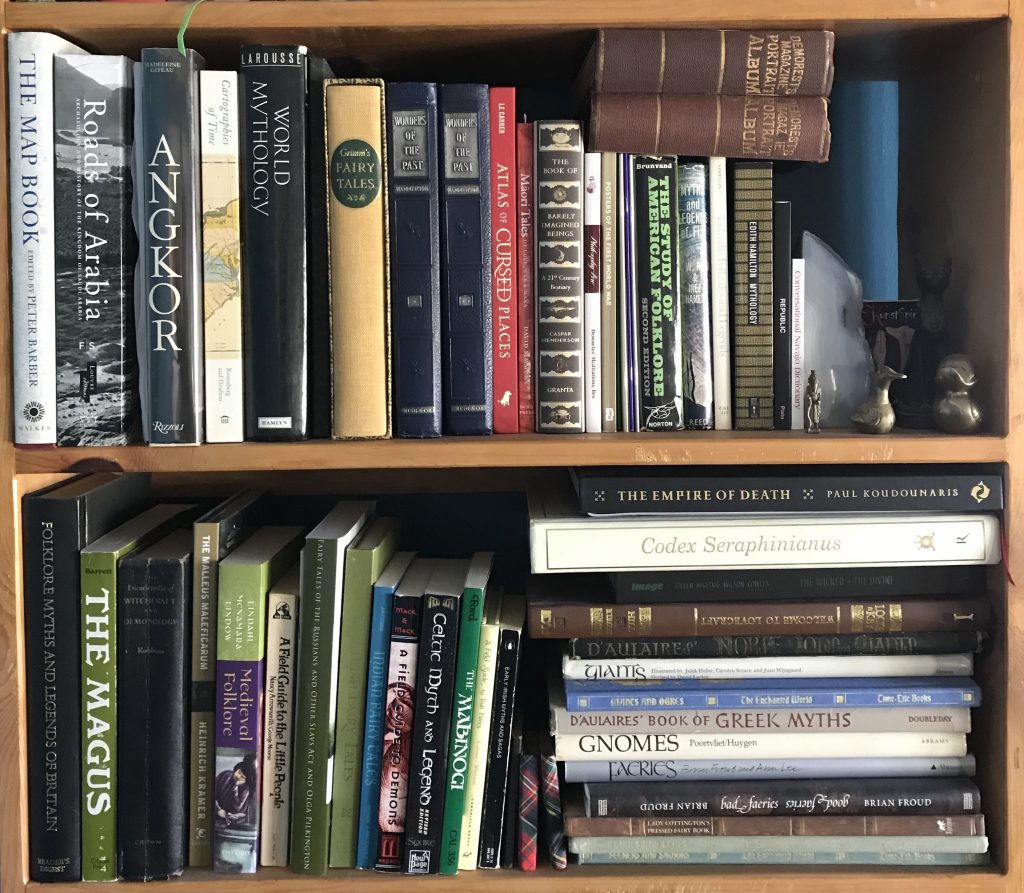
I think the simplest answer is to just share a picture of a few of my bookshelves. A Field Guide To Little People is certainly a favorite, as are the D’Aulaires myths. But I also enjoy books that take the style of faerie tale and folklore but tell unique stories, such as The Dictionary of the Khazars by Milorad Pavić; Night’s Master by Tanith Lee; and Deathless by Catherynne Valente.

Have you created any faerie tales or folktales in your Eberron? Share your experiences below! And thanks as always to my Patreon supporters for keeping this blog going!

IFAQ: Lhazaar Princes

While we’re all trapped in our bunkers, I’ve asked my Patreon supporters to present some interesting short questions on topics that are infrequently raised. Today’s question comes from Joseph.

When did Ryger become High Prince of the Lhazaar Principalities? The ECS says he represented the Lhazaar Principalities as High Prince at Thronehold, and that this was necessary for the Principalities to be recognized as a nation. Rising says he awarded himself the title AFTER Thronehold. While other sources—this Dragonshard and ECS in talking about Thuranni—suggest that there’s always been a high prince. What’s the story?

Needless to say, I can only give my opinion. But given that I wrote all of the Lhazaar material referenced above, that should count for something.

In this case, the most accurate source is the Dragonshard. The Rising section was simplified for the sake of brevity; the goal of Rising was to focus on the present rather than delving too deeply into how we got there. With this in mind, the crucial first step is to understand what it means to BE “High Prince.” In most of the principalities, the title of prince isn’t hereditary. You have to EARN it; you become a prince by being a leader the people of your principality will follow, whether you achieve it through charisma or wealth. With that in mind, the question posed here says that “there’s always been a high prince”… which is inaccurate on one crucial detail. Consider this quote from the Dragonshard…

The Lhazaar princes have always been willful and independent, and the history of the region is filled with feuds between princes. Powerful alliances have risen and fallen, but the islands have never been fully united under one prince. There has always been at least one lord who has claimed the title of high prince. This claim usually reflects the power of the lord’s fleet, and as a result the high prince usually has the respect of the other princes — but this doesn’t make their word law. They can make requests of the other princes, but unless they intend to use force, they cannot make demands.

So: Lhazaar herself was the first high prince, the first captain whose influence stretched across the entire region. Since then, there’s always been at least one lord who’s claimed the title. The key points here are that there’s been times when there’s been two or even three people who have CLAIMED to be the high prince; and that giving yourself the title doesn’t mean anything on its own. You don’t wield power because you’re the high prince; you can call yourself the high prince BECAUSE you wield enough power to back it up it.

What does this mean for Ryger? Let’s turn back to the ECS.

The largest fleet currently operating in the Principalities is the Seadragons, led by High Prince Ryger ir’Wynarn… The prince has ruled the Seadragon Principality for fifteen years, and throughout that time he has claimed to have the blood of the Galifar kings running through his veins. Whether this claim is true or not, Ryger has demonstrated remarkable charisma, a gift for leadership, and a head for strategy that makes him one of the deadliest captains plying the waters off the eastern shores… Pirate, privateer, merchant—Ryger has worn all of these hats and more since wresting the prince’s crown from the head of Horget Black, the previous high prince of the Lhazaar Sea.

As high prince, Ryger is seen as a leader among equals, and most of the sea barons and pirate lords bow to his wisdom and counsel (though not yet to his rule). Those who refuse to pay heed to Ryger do so quietly, so as not to attract the attention of his warships and loyal warriors. It was Ryger who gathered a council of captains and went to Thronehold to represent the Principalities in the talks that ended the war. Now, working mainly as a merchant fleet for House Orien, the Seadragons hope to gain an even greater advantage in peace than in war. High Prince Ryger wants to unite the Principalities under one banner… the banner of Prince Ryger ir’Wynarn.

Let’s break this down.

  • “High prince” is a title that implies that the bearer is the most powerful captain in the Principalities and wields influence throughout the region.
  • Ryger has been a prince for 15 years, but he didn’t start as high prince.
  • Horget Black was the previous high prince. He was in power at least 25 years ago, when he welcomed Thuranni to the region. At some undefined point in the last 15 years, he was defeated by Ryger, who “wrested the prince’s crown from his head.” While this could be a literal crown, the main point is that Black was acknowledged as the most powerful and influential captain in the Principalities and Ryger defeated him, thus implying that HE was now the most powerful captain.
  • Ryger gathered the delegation of princes that represented the region at Thronehold, and used the title of High Prince while there. No one else in the region challenged this, and this means that the other NATIONS assume that Ryger is the recognized leader of the Principalities.
  • … Which he kind of is, because no one else has challenged him and he has the strongest fleet. However, he WANTS the Principalities to join together as a true unified nation with a clear hierarchy, and that has NOT happened. He’s the high princes, and other princes will RESPECT that, but he can’t actually COMMAND any of them–he can only make requests and threats.

Rising meanwhile condenses this all down into a very simple form: Ryger has the best fleet, he represented the nation at Thronehold, he’s declared himself high prince, but he’s been unable to unite everyone. The timeline’s a little fuzzy, but the main point is that he called himself high prince before, but by using the title at Thronehold he gained international recognition as high prince and that really sealed the deal.

An important point here is that the Principalities are not a unified culture. The gnomes of Lorghalen, the Bloodsail elves of Farlnen, Mika’s Cloudreavers, the changelings of the Gray Tide—these are all proudly independent and unique. They have joined together against common enemies, and they have common traditions that unite them against the rest of the world, including the traditions of prince and high prince. But high prince isn’t a title that’s granted, it’s a title that’s claimed by someone who has the power to back it up. Ryger is high prince because he says he is and because no one’s challenged his claim. But he HASN’T managed to get Lorghalen and Farlnen and the Gray Tide to all come together and agree on a more concrete system of governance or greater union.

So: What happened to Horget Black?

Little has been said about Horget Black. Most crucially, it’s never said WHAT Principality he ruled. The ECS states that he gave Thuranni the right to set up shop in REGALPORT. There’s two ways to look at this.

The first is that Horget was himself Prince of the Seadragons. In this case, Ryger was a brilliant and capable Seadragon captain who served Captain Black for a period of time before seizing both his principality and the title of high prince. This isn’t in any way unprecedented; again, in most principalities, prince isn’t a hereditary title. The question is how it ties into the statement that Ryger has been Prince of the Seadragons for 15 years; whether that was also when he defeated Horget, or if it’s referencing that he was one of the most respected captains during that time—people were already calling him a prince even though he served Horget. It’s possible that as he called himself High Prince, Horget let his best captains be called princes.

The second option is that Horget was asserting his authority as high prince by inviting Thuranni to go settle on SOMEONE ELSE’S ISLAND. That’s the kind of thing you could get away with if you’re truly the high prince, and it would be a clear reason for Ryger to hold a grudge.

Where’s Horget now? It’s really up to you. We know he’s not a power player in the Principalities today. However, we also know that you are only prince as long as you can hold power; if he was legitimately broken—by an injury, by a crippling loss of reputation, or by age—it’s not unreasonable that he would accept his defeat and remain in a lesser standing. PERSONALLY, I’d do one of two things: I’d either have him sailing a ghost ship and occasionally popping up to take vengeance on Seadragon vessels… OR I’d have him as an old man missing a limb, serving Ryger in Regalport as a trusted advisor.

Have you put some thought towards how people travel between principalities? Given what you’ve said above, is it plausible to assume Rygar might enforce a set of rules around people who’ve fairly paid to travel between princes, or is it more like a mutual agreement that princes don’t sabotage each other’s ships when they’re carrying civilians/foreigners or trade goods?

Most ships in the region fly two flags: the flag of the ship itself (IE Breland, Aerenal, Lyrandar) and a secondary flag indicating the Principality with which they are doing business. So an Aereni ship carrying lumber to Regalport will fly a secondary Seadragon flag.

So: it’s more like a mutual agreement. If you plunder a ship bearing a Seadragon flag, you are striking at Ryger, and he may demand reparation or take retaliatory action. Conversely, if a merchant ship flies a Seadragon flag WITHOUT having legitimate business with Ryger, he may take offense at THAT.

I’ll answer more infrequently asked questions in the days ahead, and be posting a poll to Patreon to determine the subject of the next major article! Smooth sailing to you all!

IFAQ: Dhakaani Artificers?

While I get certain questions about Eberron all the time, I’ve asked my Patreon supporters to give me some simple infrequently asked questions. Today’s question comes from DMZ:

I have a goblin PC who is an Heir of Dhakaan but I don’t feel confident about his backstory. Are there any Dhakaani clans that are known for their Artificers, that want to preserve knowledge and the past or maybe one that wants to unite goblinoids once again?E

The Empire of Dhakaan was an advanced goblin nation that dominated Khorvaire long before humanity arrived on the continent. It was ultimately destroyed by the daelkyr, but before it fell completely a number of clans retreated into deep vaults. Recently these “Heirs of Dhakaan” have returned to the surface. They are more advanced and disciplined than the Ghaal’dar goblinoids most people are familiar with. You can find more information on the Dar—Dhakaani goblinoids—in this article.

So: are there any Dhakaani clans known for their artificers, their desire to preserve knowledge, and maybe that wants to unite goblinoids once again? In fact, there’s one that fits all three of these categories: the Kech Volaar, the “Keepers of the Word.” The Volaar value knowledge above all else—both the records of history but also, knowledge of the arcane. The Volaar have the finest duur’kala bards of all the clans. But they also have daashor—the forge adepts who serve the Dhakaani as artificers—and they are actively working to perfect the arcane science that produces wizards. All of the Dhakaani clans want to reunite the DAR, but many believe that the modern goblinoids have been corrupted by the daelkyr and cannot be saved. Of all the clans, the Kech Volaar are the most optimistic that it may be possible to reclaim these lost souls and to rebuild the Empire with ALL goblinoids.

There are a number of elements that make the Kech Volaar an excellent choice for PCs who want to be Dhakaani adventurers. The Kech Volaar are eager to learn more about the modern world, and especially to study the arcane science or traditions of other cultures. As such, a Volaar adventurer could simply be out in the world gathering information, with a special interest in investigating anything tied to arcane science. The Volaar are also determined to recover powerful Dhakaani artifacts lost during the fall of the Empire (and quite possibly now in the hands of chaat’oor!), which is another concrete quest for a player character to pursue.

So as a Volaar artificer you could be gathering information, searching for Dhakaani artifacts, or simply trying to improve your own skills by studying the artifice of other cultures.

Exploring Eberron has an extended section about the Kech Dhakaan that describes nine clans and goes deeper into the daashor tradition, so there’s a deeper examination of all of this coming soon!

iFAQ: University Adventures

I’m still working on Exploring Eberron, but with many of us trapped at home I want to write a few shorter articles dealing with INfrequently asked questions from my Patreon supporters. This week we’ve been tackling the concept of magical education in Eberron. Let’s wrap up that topic with this question.

If you were to run an anime-inspired school-based game, where would you set it?

We’re used to the idea of D&D being about epic adventures and dungeon crawls, but there’s lots of fantasy stories that focus on schooling and coming of age. Set aside anime for a moment; The Name of the Wind and the Harry Potter series are both stories that focus on adventures at a school or university. So whether you’ll looking for anime flavor or the more traditional fantasy of The Name of the Wind, I think this is a fun idea to explore.

With that in mind, I DID explore it… in the Wayfinder’s Guide to Eberron. In the WGtE I included three “Starting Points.” This was an early variation of the Group Patrons of Rising, with the point of tying a campaign to a location and a theme rather than a patron. These included Clifftop, a hub for globetrotting adventurers; Callestan, a gritty street-level campaign; and Morgrave University.

So to answer the question: I would personally choose Morgrave University or Arcanix. Which I’d choose would be based on the type of story I want to tell. Arcanix is closer to Hogwarts. It is ISOLATED—heck, the towers are floating, and if you haven’t learned to fly yet it takes time to get down! There’s a supporting village nearby, but there’s not a lot of activity there. By contrast, Morgrave is right in the middle of Sharn, so there’s all sorts of opportunity for trouble just off campus (much as University students in The Name of the Wind can go into Imre). Likewise, Morgrave University is infamous for indulging in dungeon delves and dangerous expeditions as “field trips.” Furthermore, Arcanix is specifically a college of magic, which limits your character concepts; because Morgrave is a more general purpose institution, it’s easier to justify any class.

These are supposed to be short articles, so I’m not going to retread all the ground covered in the Wayfinder’s Guide. But I’ll touch on a few things I’d personally focus on in running a school-based campaign.

Story rewards. I’d drop the standard experience point system and base character advancement either on time or on clearly established milestones. It’s also possible that you could tie specific class abilities to in-game situations. If you want to learn a specific spell, you’re going to have to sneak a particular spellbook out of the Library. You may be a 3rd level fighter, but to get the abilities of your Martial Archetype you’re going to have to find a mentor. This is a way to blend story and mechanics together. In a game at school you’re not likely to be amassing TREASURE—so one option is for the rewards you gain to BE access to locations or the favor of teachers—but those can be linked to concrete rewards, whether it’s access to your full class abilities or something beyond that, such as Supernatural Gifts or Marks of Prestige from the Dungeon Master’s Guide.

How will you handle power? D&D is based on an underlying system of character advancement that provides players with new abilities to explore and the ability to take on greater challenges over time. At the same time, it’s can be bizarre to have your characters become 6th or 7th level characters AT SCHOOL when that’s a level of skill that dwarfs veteran soldiers… especially if the DM wants to present rival students or professors as having even greater power. There’s a few ways to address this.

  • Limit advancement. You can always choose to say that characters DON’T advance in this campaign – or do so very, very slowly. You improve by gaining allies, influence, and information, not by doubling your hit points or gaining new spells. This is perfectly reasonable if everyone agrees, but at that point—if you’re eliminating a significant piece of the rules system—I’d question whether you should be using an entirely different rules system that isn’t based around character advancement to begin with.
  • It’s all relative. Sure, characters gain a level every two sessions. And the evil professor is a 9th level spellcaster. And there’s a lich in the basement. But it’s reasonable to say that this is how things appear because you’re in a microcosm and you’re comparing skills to people in that bubble with you. I would have no problem playing through a school campaign in which characters got up to 10th level and at the end of it saying “Okay, you all graduate. How about when we start the new campaign with you adventuring in the wider world, you all start off at 3rd level?” The point being that 10th level on the SCHOOL SCALE might only be 3rd level outside. Obviously this takes some suspension of disbelief—I used to be able to teleport! I raised someone from the dead! But hey, that was school, kids. Crazy things happen.
  • Ignore it. Sure, it doesn’t make sense for you to be dueling another student and that both of you are 9th level wizards. But so what? If people are having fun, does it matter?

How do you explain character classes? We’ve mentioned before that the abilities of player characters are inherently remarkable… that just at first level you’re pretty amazing. How’s that fit with a school game, where you’re just supposed to be students? Here again I’d follow the it’s all relative approach. Yes, mechanically you’re a 1st level wizard. But in this setting, that reflects the idea that you have an APTITUDE for wizardry and you need to work to develop it. A few quick thoughts…

  • Wizard? Artificer? You’re science nerds. You’re all about figuring out how arcane science works.
  • Fighter? Barbarian? You’re the jocks. Perhaps you actually want to be soldiers when you graduate, or perhaps you’re here on a Hrazhak scholarship. Barbarian, you really need to deal with your anger issues.
  • Cleric? You’re deeply religious and know that your faith in Aureon/The Divinity Within is going to help you pass that math test. Faith and divine magic ARE real things in Eberron; there’s surely a chaplain at school who will want to help you develop your faith and your abilities. You might get divine visions pushing you to do things! Paladin, you’re in the same boat, but you’re ALSO a jock on a Hrazhak scholarship.
  • Rogue? You might be a bit of a rebel—the student from Lower Dura or the bad side of the tracks, who has friends in the Boromar Clan and can get Dreamlily for the party. Are you here reluctantly? Are you hoping to turn a profit on this whole thing? Are you more interested in gambling than studying? Bard, you could follow the same path, but you’re a bit of a know-it-all and hey, you should start a band.
  • Sorcerer? Like the Cleric, sorcery is a thing that happens in the world. You may not have any knowledge of Arcana and may not want to learn, but there’s likely a teacher or professor who specializes in helping sorcerers develop their abilities. One question is whether you’re here by choice, or whether you’re here because you HAVE to be to learn to control your powers.
  • Warlock? You could take this a few ways. You COULD say that you’re working with a particular division of the Conjuration department that cultivates warlock relationships. But if it were ME, I’d play you as Ally Sheedy in The Breakfast Club. You’re the weird kid, the outsider who’s always writing poetry in your journal in the corner, who prefers talking to your imaginary friends to going to parties… except your imaginary friends are REAL and they’re teaching you how to do things. Like the cleric, your patron could give you visions or tasks that push you to work with the other characters despite your preference for isolation.
  • Druid? Ranger? You’re both odd choices for a big city school, but hey, you just moved to town from the Eldeen Reaches and your family insisted you get an education. Shifter Ranger? You’re DEFINITELY on the Hrazhak team, and you’re annoyed because these city kids are playing it ALL WRONG.

Backgrounds obviously overlap with these ideas. Noble background? You’re from a wealthy family. Urchin? You’re the orphan here because one of the professors sponsored you. Sage? You’re the annoying know-it-all. Entertainer? You DO have a band. Soldier? You’re from a military family, and if you screw up here you’re heading back to Rekkenmark. Criminal? OK, YOU’RE the one who can get some dreamlily for the party.

This has turned into a longer article than I’d intended, so I’m going to stop here. But hopefully this gives you ideas! Thanks as always to my Patreon supporters!

iFAQ: Aereni Learning

Until I’m done with Exploring Eberron, I don’t have time for deep dives. My next major article will take a deeper look at the Mror Dwarves. But meanwhile, with all of us trapped inside, I want to do a few daily posts dealing with some interesting questions from my Patreon supporters. Here’s the first!

The elves of Aerenal are supposed to spend decades perfecting the techniques of their ancestors. When an Aereni character starts out 100 years old, it’s not because they spent decades in diapers or because they’re dumber than human wizards, it’s because they’ve spent decades going deep in their studies. But how does this hold up for Aereni adventurers? They advance at the same pace as other player characters. How does an elf go from taking decades to perfect a cantrip to suddenly casting far more complex spells in a much shorter period of time?

First of all, let’s shoot the elephant in the room: character advancement doesn’t make sense. How is it that your HUMAN wizard can spend a decade studying at Arcanix, but exponentially increase their skills after a month of adventuring? How does the halfling rogue get expertise with Persuasion by stabbing a bunch of goblins? It’s a mistake to look at any of this too deeply, because it’s not logical. This also ties to the idea that the way in which player characters advance is part of what makes them remarkable and NOT typical for all inhabitants of the world. There are veterans of the Last War who still use the “Guard” statblock, because for most people that represents an OK level of skill. Player characters are supposed to be heroes, and their ability to quickly skyrocket to a greater level of power is a narrative device, not something that holds up to any sort of close analysis.

WITH THAT SAID: That doesn’t mean we can’t make it make as much sense as possible, and this is a good question. How come the Aereni wizard spent decades studying magic back home but can advance just as quickly as the human wizard? The key point is that the Aereni apprentice didn’t spend decades studying a specific spell; it didn’t take them that long to learn to cast one particular cantrip. Instead, they were mastering techniques of spellcasting. They were studying history, theory, and concretely, they were mastering somatic and verbal components. Arcane magic is a form of science, and somatic and verbal components are the underlying mechanics that make it possible. An Aereni apprentice learns precise accent and inflection of verbal components, and precise performance of somatic components, exactly mimicking the techniques of the masters of their line. They spend endless hours drilling until these techniques come naturally. When an Aereni wizard casts a spell, it looks and sounds exactly the same as the master who created the spell ten thousand years ago. Because they’ve perfected these basic principles, when they learn—or even create—new spells, the basic techniques will carry them forward. They CAN advance quickly precisely because they spent all that time learning to crawl… ensuring that they are building on a perfect foundation.

This same principle applies across all classes. The Aereni fighter is learning the basic techniques of all weapons, perfecting the most basic guards, learning to hold and move with the weapon just as their ancestors did. They are learning the most fundamental martial principles—and then they can quickly build on top of those without losing those core techniques.

Aereni PREFER to take their time with things. An Aereni fighter might spend four hours each night practicing a specific move while the other characters are taking a long rest, and continue to practice that move in their mind while trancing. But the decades they spent learning before created a foundation that lets them advance quickly when needed. They were honing the basic building blocks that they assemble as they advance with the other characters.

Now, ultimately, does all that work actually make the Aereni player character a better wizard? No. Mechanically, there’s no difference between the Arcanix-trained wizard and the Aereni wizard. But THEMATICALLY the idea is that the Aereni wizardry is beautiful and perfect, like watching a dance; by contrast the Arcanix wizard is taking a lot of shortcuts and throwing in a lot of personal touches. It works great for THAT WIZARD and may be more innovative, but the Aereni find it painful to watch. The second aspect of this is the idea that player character classes reflect a level of talent most people can’t attain, and that the Aereni have MORE people with that level of skill. It takes them longer to get there, but Aerenal has more actual wizards than Khorvaire, whereas in the Five Nations most people just spend the few years required to become magewrights.

Taking as given that player character advancement is not logical, mostly a game mechanic construct, can this focus on learning the exact techniques and history of the past account for the slow pace of technological development in Aereni cultures?

Exactly so. This is something that’s discussed in this article and in this episode of Manifest Zone. A critical quote:

This is why, despite Aereni society having been around for over twenty thousand years, humans are beginning to do things with magic that the elves have never done. Elven society is driven by tradition rather than innovation – by absolutely perfecting the techniques of the past instead of developing entirely new ways of doing things. Innovation does happen – and an Aereni player character might be the great elf innovator of this age – but it isn’t enshrined as a cultural value as it often is among humanity…

Part of the idea is that what the elves see as sloppy Arcanix techniques might actually be BETTER than the ancient Aereni traditions; certainly they’re easier to learn. But the elves take comfort in adherence to what they know.

Thanks again to my Patreon supporters, and I’ll tackle another question tomorrow!

IFAQ: Dragonshards and Tharashk

When did dragonshards become important as magical fuel? House Tharashk was discovered in 498 YK. The lightning rail went into operation in 811 YK, but Tharashk only stepped up mining in the Shadow Marches & Q’barra in the past decade? What delayed them so long?

There’s two significant questions here: When did dragonshards become important and why did it take Tharashk so long to start major mining operations in Q’barra?

The spells, items, and services available in 998 YK represent the pinnacle of arcane science. Like any form of science, these things didn’t emerge into the world fully formed. The lightning rail of 811 YK was the result of decades of research and development—and it was quite different than the lightning rail of 998 YK. It originally used volatile Fernian ash as its fuel, and both the binding and the conductor stones had flaws.

Eberron dragonshards are found across Eberron. Xen’drik, the Shadow Marches, and Q’barra are especially rich sources of dragonshards, but there are dragonshard deposits across Khorvaire. Eberron dragonshards are an important element in the creation of magic items and in maintaining ongoing magical effects—such as the lightning rail and elemental airships. Eberron shards can be refined into a powdered form that can be used in place of any spell component with a cost.

So: it’s possible to perform most forms of arcane science without dragonshards; it just takes a range of different substance, which are usually more exotic and specific to the effect being produced. However, this uses refined Eberron dragonshard powder (also known as residuum). Raw dragonshards can be used, but unless they are processed and refined it’s inefficient; you’re significantly better off using the other alternative. Because of this, the process of refining dragonshards to create residuum was a crucial breakthrough that had cascading effects across the magical economy. While creating magic items still requires a range of additional rare elements, the universal nature of refined dragonshards allowed Cannith and others to dramatically increase both the range and scale of production. Using processed dragonshards as an energy source made the lightning rail safer and allowed Orien to operate more carriages. But again, this process of refining was a breakthrough that occured less than two centuries ago, and it’s a process that continued to be explored.

So: Eberron Dragonshards have always been a valuable source of magical energy, but it wasn’t until the last two centuries that they became as valuable and universal as they are today. Eberron dragonshards CAN be found across Khorvaire, and initially, that supply was sufficient to meet demands. But within the last century that demand has steadily grown—which has in turn driven people to find richer pools to draw on.

This brings us to House Tharashk. Why are their operations in Q’barra only a decade old? House Tharashk began as a house of hunters, not prospectors. For centuries its primary focus was on inquisitive work and bounty hunting. Prospecting is a relatively new path that arose both with the increased demand for dragonshards mentioned above and crucially with the creation of the prospector’s rod. As with many houses, the base powers of the dragonmark aren’t as important as the focus items that channel that power. As the speaking stone is to House Sivis, the prospector’s rod is to Tharashk: it is this tool that expands the powers of the mark beyond the simple scope of casting locate object and allows prospecting on an industrial scale.

In my Eberron, it’s a mistake to say that prospecting in the SHADOW MARCHES only began ten years ago. Dragonmarked calls out that House Sivis originally came to the Shadow Marches in search of dragonshards, and that the mineral wealth of the Shadow Marches has always been a secondary source of wealth for the house. That effort may have increased over the past decade as the house as a whole has realized that there’s more wealth and influence to be gained from dragonshards than bounty hunting, but it’s been something that has been scaling up over the course of the past century.

Q’barra, on the other hand, IS a new development. The world’s a big place, and Tharashk hasn’t been able to search all of it. Prior to the Last War, Q’barra was a shunned backwater thought filled with hostile scales. The Dragon articles call out that it was only ten years ago that settlers discovered rich deposits of dragonshards in Q’barra. Tharashk responded quickly to this discovery and has ramped up its efforts ever since. But why didn’t they go there earlier? Because they already had a rich source of dragonshards in the Shadow Marches and were still expanding their operations, and because no one knew there were dragonshards in Q’barra. It’s entirely possible that there are other rich deposits in Khorvaire that have yet to be discovered!

Ultimately, the key takeaway here is that the arcane industry in Eberron is just like industry and science in our world. It evolves and expands. The current state of things in 998 YK reflects the latest developments; drop back to 498 YK or 811 YK and the world will be a much different place.

Thanks as always to my Patreon supporters for keeping this blog going! I’ll be posting a poll to the inner circle soon to determine the subject of the next article.

iFAQ: Warforged, Blood, and the Blood of Vol

People ask me a lot of questions about Eberron. While I’ve typically answered the most frequently asked questions at sometime in the past, every now and then there’s an INFREQUENTLY asked question that still seems like it’s worth answering. Over the last few weeks two of those have come my way. How could a warforged become a cleric of the Blood of Vol? And can a warforged become a vampire?

Could a Warforged Become a Cleric of the Blood of Vol?

The Blood of Vol is based on the principle that the blood of the living holds a spark of divine power, and that all mortals have the potential to harness and evolve that Divinity Within. A Seeker cleric believes they are drawing on their own divine spark when they cast spells.

Warforged don’t have blood. Therefore, it seems logical to assume that they don’t have the spark of the Divinity Within. So why would they follow the Blood of Vol, and how could a warforged Seeker paladin or cleric justify their divine magic?

To begin with, let’s start with the WHY. Ultimately, the Blood of Vol faith is grounded in the question what just god would allow death and suffering, with the conclusion none; the fact that we suffer shows that if there are gods, they are cruel. All we have is each other, and we must stand together and defy death. The Seekers place a strong emphasis on community and protecting the weak. Any death is tragic. They use undead because once the spark is gone, there’s no reason NOT to use the corpse if it can help protect the living. More powerful undead—vampires, mummies—know that they will never achieve divinity, as they lost their divine spark when they died; but they can still fight to defend and to guide the living, to be champions of life… and perhaps someday topple the Sovereigns themselves and free the entire world from the curse of mortality. This is where the warforged Seeker comes in. They have no blood, and presumably no divine spark. But they are immune to disease and to the ravages of time. A warforged is in many ways much like a mummy. They can’t achieve true divinity, but they can protect and guide others. So the warforged Seeker priest isn’t driven by a desire for personal power; rather, they are driven by compassion and the desire to protect their community from suffering and death.

But what about the HOW? If Seeker clerics draw their power from their own blood, how do they get magic? Well, first of all, remember that the “drawing power from within” is an article of faith. They don’t KNOW the power comes from within with any more absolute certainty than a paladin of Dol Arrah knows that their power comes from Dol Arrah. So one option is to simply say “It works, don’t question it.” But the other example is to look to the mummy. Malevanor, the high priest of the Blood of Vol in Atur, is a mummy. He has no blood. So how does he cast spells? There’s two simple answers. The first is the idea that he draws on the divinity of the people around him. This ties to the strong community focus of the Blood of Vol; he can’t attain personal divinity, but he can draw on that potential within you and use that power to protect or heal you. With that said, what happens if you’re not around? Well, Seeker communities donate blood to sustain their champions. Vampires drink this blood, and while it is within them this connects them to the sparks of the living. Seeker mummies and liches BATHE in the blood of the faithful, and this charges their power for a short time.

So for your warforged cleric, the simplest answer is that they draw their power from the rest of the party! If you want to be creepy about it and the rest of the characters are willing, they could actually get blood donations from the party. But you could also just say that the proximity spark does the trick. On the other hand, you could also just say that they don’t KNOW how it works, but it does work… and that they BELIEVE it’s because they (and presumably all other warforged) have divinity within as well, despite having no blood. This would certainly be an interesting long term arc to explore!

Having said all that, back around 2005 I worked with David Esbri—who was at the time doing illustrations for the RPGA—on an early concept for an Eberron comic. One of the villains in that was a Warforged tied to the Emerald Claw who had embedded components allowing it to drain blood from its victims… essentially, an artificial vampire who believed that he could use this blood to become divine. So you could always explore a more exotic path!

Can Warforged Become Vampires?

There’s many answers to this question. The simple answer is that under the rules of 3.5 they couldn’t; “vampire” was a template that couldn’t be applied to constructs, and 3.5 warforged were constructs. The 5E rules have changed, however, and by the rules as written a warforged can become a vampire. However, the rules are guidelines, not absolute and inflexible! In my opinion, this is a case where the DM has to decide what they want from the STORY. Does it make SENSE for a warforged to be able to become a vampire, when it has no blood and doesn’t eat in the first place?

In my campaign, I would say that no, a warforged cannot become a vampire. A vampire can drain the LIFE FORCE from a warforged, but it has no blood for a vampire to drink. Vampire spawn rise when “buried in the soil”—I don’t see this having much meaning for a warforged. I DO think that warforged can become undead—that they can become vessels for the power of Mabar, channels through which it can consume the essence of the living—but I would be inclined to create a unique warforged expression of vampirism, rather than just forcing the standard bloodthirsty form onto them. I’d see it as draining energy like a wight as opposed to drinking blood, and I’d consider which of the traditional vampire powers made sense and what it might have instead.

That’s all I have time for today! Have you used warforged seekers or undead in your campaign?

IfAQ: Can Warforged Cry?

Art by Júlio Azevedo for Exploring Eberron!

If all goes well, I’ll be doing more Eberron support on this site in 2020. The frequency and form of this content will depend on my Patreon support. In addition to feature articles, I’ll always be tackling frequently asked questions about Eberron. But I also want to take the time to answer a few INfrequently asked questions.

Can Warforged Cry?

In MY Eberron, no: warforged don’t cry. There’s two major reasons for this. The first is that warforged are generally depicted as having crystaline eyes. They thus have no need to lubricate their eyes and there’s no logical reason for them to have any sort of tear duct. So there’s no biological reason for it. But beyond that: I don’t WANT non-human species of behave just like humans. I always think it’s more interesting to explore how a nonhuman species differs from humanity as opposed to saying “They’re just like us, but with pointy ears or green skin.” So I want to know what warforged do INSTEAD of crying.

Warforged have the capacity to feel emotion. A warforged can feel joy or sorrow. But they can’t smile, and in my opinion, they can’t cry. So how do these emotions come out? Is there an involuntarily physiological response like a tear? Is there a more voluntary response, like when you embrace the sorrow and start sobbing? In MY Eberron, a warforged’s involuntary response to sorrow is a slight trembling that runs through the root-like musculature of the warforged. If the warforged has metal armor plating, this will rattle the plates against one another, creating a soft, dissonant chiming sound. If the warforged has non-metal armor, if will be more of a rustling like rain. When a warforged is in the grip of sorrow, a common response is to bring its arms together—as if hugging itself—and to rhythmically tap is fingers against its forearms, essentially creating an amplified version of that “crying” sound. A warforged may also do this rhythmic tapping against one forearm as a general expression of sorrow or frustration—the equivalent of taking a deep sigh.

Now, that’s what *I* do in MY Eberron. The second side of the question is what I think the official answer might be, and my suspicion is that it’s “If there’s no rule that states a warforged can’t cry, than it can cry.” If I HAD to explain how this would work, I’d say “The organic components of a warforged are infused with alchemical fluids. Warforged tears are an involuntarily expulsion of these fluids.” But again, I personally would prefer for them to express their grief in a way that’s unique to warforged, rather than to mirror humanity.

What are your thoughts on warforged crying? Have you ever addressed it in your campaign? Post your answers below! Also, go to TheAdventureZoneGame.com to check out my latest game, currently in preorder until mid-January 2020!