Patreon Preview: Mysteries of the Talenta Plains
11
Every month, I answer interesting questions posed by my Patreon supporters. Such as…
While they’ve never been described in canon material, siege staffs have always been part of my vision of Eberron; they’re described in my first Eberron novel, City of Towers. The principle is simple: The people of Khorvaire create arcane solutions to problems we solve with technology. By the rules of D&D, wands, rods and staffs are effective tools for channeling offensive arcane magic. Therefore, just as a cannon is a really big gun, it made sense to me that Khorvaire’s answer to artillery would be a really big wand… a siege staff. Here’s what I presented in Exploring Eberron.
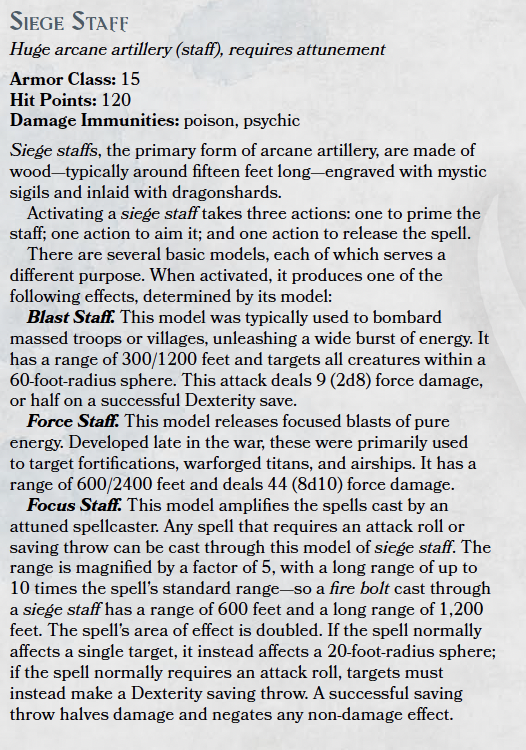
So the point is that siege staff (and yes, I say “staffs” instead of “staves”) is a generic term for “powerful arcane artillery”. Cannith makes them, but so does the Arcane Congress and so does the Eternal Dominion, and so did the giants of Xen’drik. A siege staff is a tool for concentrating arcane energy, and any civilization that understands the basic principles of arcane science could make a form of siege staff. They won’t all be the SAME, just as guns produced by different nations in our world are different. There will be cosmetic differences and there could be mechanical differences. But any advanced arcane civilization may employ a form of siege staff. Missing from this excerpt above is the detail that when a staff that has an effect that allows a saving throw is used at long range, targets have advantage on the saving throw. The ideas I discuss here also apply to long rods, another form of arcane artillery described in Exploring Eberron.
Could you elaborate on that? What would be some differences between siege staffs of the Thunder Sea, those used by Lhazaar pirates, and those made by House Cannith?
Sure. Once of the things that defines House Cannith is MASS PRODUCTION. As a rule, House Cannith is the industry standard, and its creations are reliable and predictable. As such, the default description in Exploring Eberron applies to Cannith siege staffs. When dealing which siege staffs from other cultures, there’s a few things to consider: Appearance, Function (Force, Blast, Focus), Damage Type, and Efficiency.
Generally, appearance is broadly consistent; a siege staff is a very long rod. This is based on the principle that the wand/rod/staff is an efficient tool for channeling arcane power. But other material used in the construction of the rod and other cosmetic details will vary from culture to culture. Function refers to the three basic functions I described in Exploring Eberron. A culture may not produce all three types of staffs (Blast, Force, and Focus) — or it may produce a superior form of one type and an inferior form of another. This is echoed by Damage Type. Force is the default, common form of energy employed by Cannith staffs. But different cultures may rely on other forms of energy. Efficiency I touched on above. Cannith is the industry standard; other cultures may vary from the norm, for better or for worse. It’s also the case that many cultures produce Focus staffs that can only be used with a specific school of magic or even a specific spell. With all that in mind, let’s theorize about siege staffs of other cultures.
HOUSE CANNITH. Cannith staffs are mass produced and have a very uniform appearance. They are typically made from densewood and have a steel core and steel bands engraved with draconic sigils (which are often used in the arcane science of the Five Nations). Cannith produces all three types of staff described above, performing as described above. Force is the most common damage type.
LHAZAAR PRINCIPALITIES. Lhazaar staffs are hand-carved and each one is unique in some way. Lhazaar artillerists combine different types of wood with metals that resonate properly with them. Some Lhazaar artillerists prefer having knots or whorls in the wood; others cut such imperfections out of a staff. Bands of metal are common, but some hammer nails of different metals into the length of the wood, or drape anchor chains over them. Focus staffs are fairly rare on Lhazaar ships. A few notable traditions: The Wind Whisperers produce blast staffs that deal thunder damage and force staffs that inflict lightning damage. The Bloodsails bind spirits to their staffs, firing bolts of howling spectral matter; their blast staffs inflict psychic damage, terrifying victims to death. This has the advantage of killing crew while leaving an enemy vessel untouched. Bloodsails also are known to use focus staffs that can project necromancy spells. Lorghalen ships generally fling Lorghalen cannonballs at the enemy instead of using siege staffs.
Efficiency varies from ship to ship, because Lhazaar staffs are all custom made. A particular vessel may be renowned for its exceptionally powerful force staffs, and rivals may be yearning to claim them. I’m posting a table of Siege Staff Quirks on my Patreon; these would be common for Lhazaar staffs.
ETERNAL DOMINION. The Sahuagin civilization of the Eternal Dominion is ancient and well ordered. It doesn’t use the same forms of mass production as House Cannith, but its weapons are fairly uniform in design and appearance. There are two basic designs used by the Dominion. Spikes are whorled shafts of coral or bone. While rare, kraken bone makes especially powerful staffs, dealing an extra d8 of damage and having a +10% bonus to range. Spikes deal Force damage. On the other hand, Dominion magebreeders also produce slugs—LIVING siege staffs. Blast slug staffs inflict poison damage, and are useful for clearing a crew without damaging a ship; they have a shorter range (200/1000 feet) but deal 3d8 poison damage in an 80 foot sphere. Force slug staffs inflict acid damage.
RIEDRA. Riedran ships typically use Sentira or crysteel weapons; these sometimes take the form of massive orbs rather than staffs. Blast weapons generally inflict psychic damage, while Force weapons are telekinetic in nature and inflict force damage.
AUNDAIR. Thanks to the Arcane Congress, Aundair has experimented with a wide range of designs. These are produced in small batches; as a result, there is more standardization of design than Lhazaar, but far more diversity than Cannith. Almost any damage type can be encountered on the battlefield, and focus staffs are flexible. Audairian staffs are more elegant than either Cannith or Karrnathi designs; beauty is an important factor. It’s also possible to encounter Aundairian staffs blessed by a particular archfey, though these are NOT mass produced. These can be more efficient than standard staffs, or you could roll on the Staff Quirks table I’m posting on my Patreon. Fey-touched weapon may have unique limitations—they can only be used by a particular bloodline, the artillerist must share a secret or tell a story to reload the weapon, etc. The greater the restriction, the more powerful the weapon will be.
KARRNATH. While Karrnath largely employs Cannith weapons, it also produces its once designs. General artillery uses darkwood with bands of spiked iron, and are wider and stubbier than Cannith designs. Karrnath has been known to field fire Blast staffs and Evocation focus staffs. Seeker units—such as the Order of the Emerald Claw—produce weapons similar to those of the Bloodsails; blast staffs often inflict psychic terror.
THRANE. Thrane employs standard Cannith staffs in battle. However, over the course of the war the theocracy began working with the Silver Pyromancers to create divine artillery. This is made of oak inlaid with silver and typically inflicts radiant damage. Thrane focus staffs can only be used by divine spellcasters. Reloading and firing Thrane weapons often requires singing hymns to the Flame.
BRELAND AND CYRE. Breland and Cyre largely relied on Cannith standard designs rather than producing their own. Both nations contained large Cannith production facilities, and Brelish foundries produced raw materials for Cannith. This is also reflected in the fact that Cannith produced unique weapons for these nations, such as the floating fortresses of Breland.
These are just a few possibilities! Hopefully this gives you some ideas for your campaigns. As I mentioned above, I’m sharing a table of possible staff quirks on my Patreon! Thanks as always to my patrons, whose support is what allows me to keep creating material for Eberron.
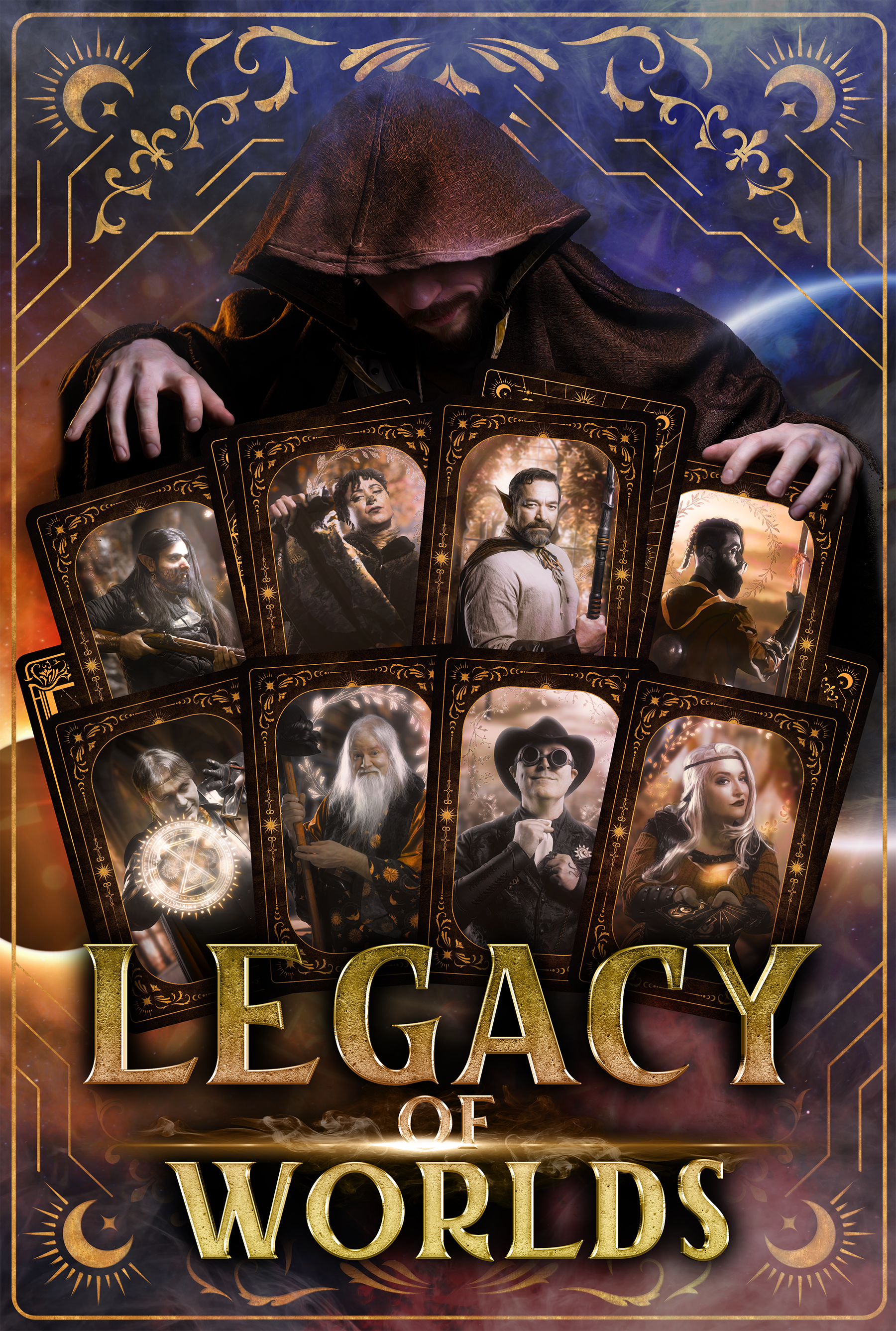
Imagine an adventure that explores all of the official realms of Dungeons & Dragons—adventurers from a number of classic settings coming together to face a force that threatens all of their worlds, embarking on a quest that will take them to many different settings. Hearing this you might say “Oh, right, that’s the new WotC adventure Eve of Destruction, right?” And, well, yes it is. But it’s also the basis of Legacy of Worlds, a liveplay campaign that launches on the Six Sides of Gaming at 8:30 Eastern Time on March 12th . What is Legacy of Worlds? Well, tome keeper Devin Wilson explains it succinctly here. The cast includes Luke Gygax, Elisa Teague, Thomas Gofton, KP Upadhyayula, Bee Zelda, Ed Greenwood, and Noordin Ali Kadir, playing champions from Eberron, Oerth, Faerun, Ravenloft, Mystara, and more!
I’ve never been drawn to liveplay, but I love this group—the players, the characters, and the adventure. I especially love the relationship between Merrix and Elminster… and DM Devin does a fantastic job of creating stories that entangle all of the planes and that have significance for all of our characters. Here’s a fun moment from the first episode.
Now, to shoot the tribex in the room, I’m sure many of you are saying But wait! Eberron has its own cosmology! It shouldn’t be possible for Elminster and Merrix to have a team-up. And you’re right. Eberron has its own unique cosmology and a different approach to deities than many of the other settings; it’s intentionally isolated. But it’s also always been the case that it’s a place where you can tell the story you want to tell. The original 3.5 Eberron Campaign Setting had the Plane of Shadow as part of Eberron’s cosmology, with the idea that it was a back door that let you sneak to other settings. I once played a warforged cleric of the Becoming God in a Forgotten Realms campaign based on this idea. It didn’t change anything about how I wrote or ran Eberron; it was a weird one-time fluke, because that was the story I wanted to tell. Eberron: Rising From The Last War expanded on this, in this section labeled “Eberron and the Multiverse”:
It is theoretically possible to travel between Eberron and other worlds in the multiverse by means of the Deep Ethereal or various spells designed for planar travel, but the cosmology of Eberron is specifically designed to prevent such travel, to keep the world hidden away from the meddling of gods, celestials, and fiends from beyond… In your campaign, you might decide that the barrier formed by the Ring of Siberys is intact, and contact between Eberron and the worlds and planes beyond its cosmology is impossible. This is the default assumption of this book. On the other hand, you might want to incorporate elements from other realms. Perhaps you want to use a published adventure that involves Tiamat or the forces of the Abyss meddling in the affairs of the world. In such a case, it could be that the protection offered by the Ring of Siberys has begun to fail. You might link the weakening of Siberys to the Mourning — perhaps whatever magical catastrophe caused the Mourning also disrupted the Ring of Siberys, or perhaps a disruption of the Ring of Siberys actually caused the Mourning!
If contact between Eberron and the wider multiverse is recent and limited, consider the implications for everyone involved. In the Great Wheel, Asmodeus is an ancient threat, with well-established cults, lines of tieflings, and a long history of meddling that sages might uncover in dusty old tomes hidden in remote libraries. But if Asmodeus has only just discovered Eberron and begun to influence it for the first time, there is no lore about him to be discovered on Eberron. He has no power base and needs to recruit new followers. Unusual alliances might form against him, as celestials and fiends join forces to expel this hostile outsider.
No Contact is the default assumption. Legacy of Worlds is a What If? scenario—What if Merrix was a hero? What if he was pulled into another setting? What if he had adventures with Elminster and friends? None of that is canon or kanon; Legacy Merrix isn’t going to appear in my Quickstone campaign. I doubled down on this by deciding that Legacy Merrix is from Eberron in 1018 YK, in part of justify the fact that he’s a 20th level character in this campaign. So the Eberron he’s from is different in many ways, some of which might come out during the campaign. But nothing I do as Merrix changes canon or kanon; it’s just a fun story to explore as a purely hypothetical scenario!
Anyhow, I love playing in Legacy of Worlds and I hope you’ll check it out! I’ll be hanging out in chat with some of the cast for the premiere, so come join me there! And here’s one more awesome picture from KP Upadhyayula—if you enjoy his work, check out his studio here!
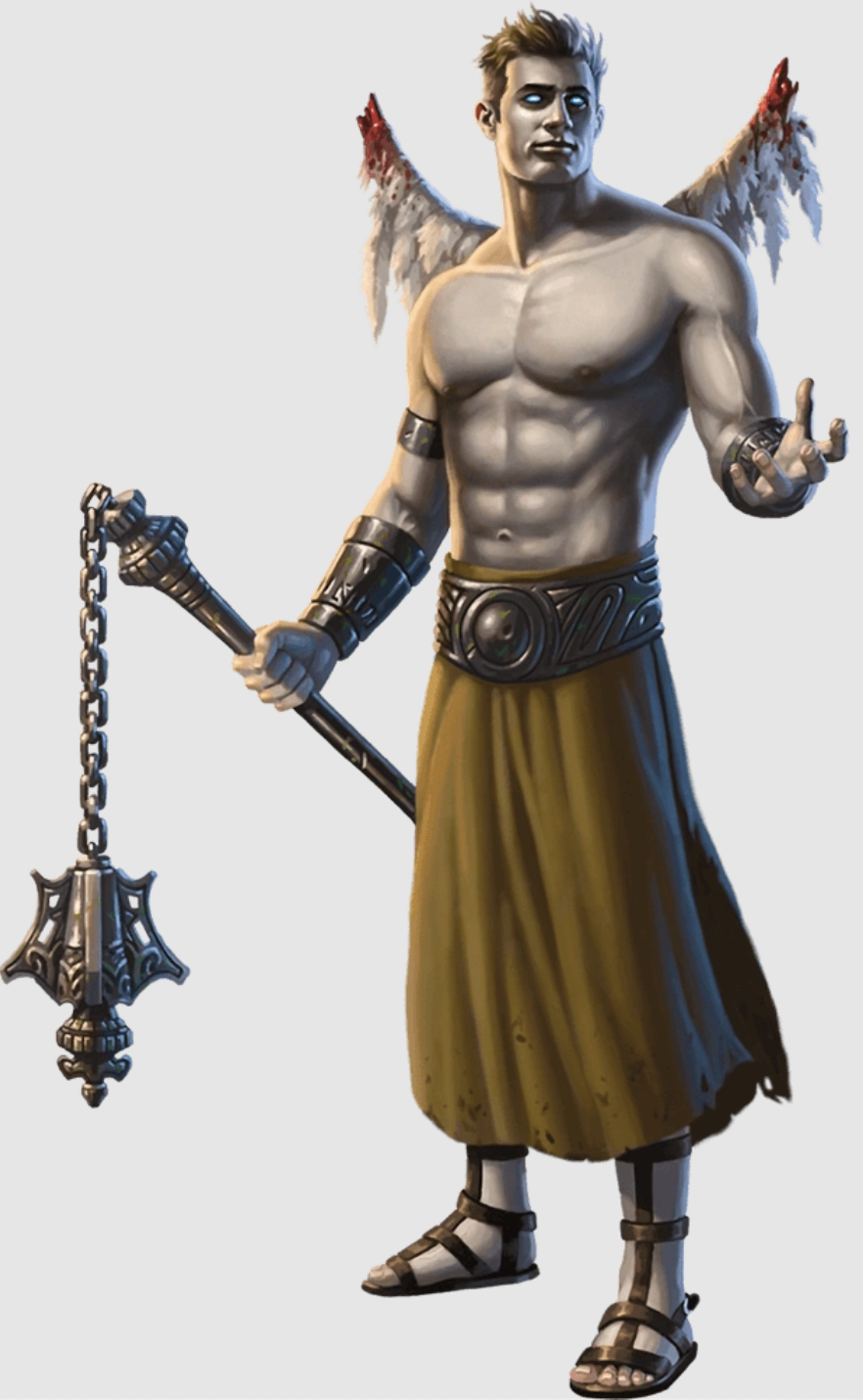
“You said this was a fallen angel,” Thorn said. “How’s that different from a devil?”
Drego shook his head. “The two are completely different. Devils are tied to malevolent concepts – hate, fear, greed. What we’re dealing with is a radiant idol, an angel punished for pride by being imprisoned on Eberron. It still possesses its original appearance, more or less, and its powers are still tied to its original dominion.”
“So who are we dropping in on tonight?”
“Do not speak this name casually,” Drego said, and there was no trace of his usual levity. He traced lines in the air as he continued. “You must understand the sheer power of the being we face. He has likely influenced the lives of thousands of your countrymen, Thorn, and just speaking his name could draw unwanted attention to us.” He made a last flourish in the air, and Thorn could just make out a translucent pattern of rippling arcane energy that dulled all sounds beyond and kept Drego’s voice close. “Tonight we shall destroy Vorlintar, the Voice of the Innocent and the Keeper of Hopes, Fifth among the Fallen of Syrania.”
The shimmering glyph burst into flame, burning without substance, and then it was gone.
“Call him by his titles,” Drego said, “But do not speak his name.”
“Keeper of Hopes?” Brom said, and his chuckle echoed off the walls. “He doesn’t sound so terrible.”
“And he wasn’t, when he was a force for light. Now he holds to his dominions, but he has become a force for evil. He is indeed the Keeper of Hopes – the hopes that he has stolen from all those who fall under his sway. He devours innocence, leaving pain and despair. As we draw closer to his throne, you will feel his talons tearing at your mind. You must be strong and hold him at bay, for a clean death is far better than a life without hope.”
– From The Son of Khyber
The Sharn: City of Towers sourcebook introduced a new threat to the Eberron campaign setting: the radiant idol. Sharn is closely tied to Syrania, and we thought it would be interesting to introduce a new sort of fallen angel cast out of the sky. The Sharn book has this to say…
A radiant idol is an angel that has been banished from Syrania and condemned to spend eternity on the Material Plane. Not all radiant idols are evil, and none are as thoroughly corrupt as the fiends of the lower planes. Their greatest sin, as a rule, is the desire to be worshiped by the humanoids they consider lesser beings, and most gather cults of devoted humanoid followers on the Material Plane—thus giving rise to their common name.
I expanded on this in Exploring Eberron, noting…
Many sages believe that touching Eberron’s ground makes angels vulnerable to the influence of Khyber and the overlords, while others theorize that mortal worship—the positive energy that sustains the Undying Court—is like a drug to the dominions. Whatever the cause, dominions who interact with mortals run the risk of becoming corrupted. Such immortals crave mortal adoration and often seek to dominate mortals by exercising the power of their sphere. Not all dominions fall prey to this corruption, but once one does, there seems to be no way to undo it. Even if the angel is destroyed and reforms, the corruption remains. It’s unlikely that such an angel would be met in Syrania itself; typically, these corrupted angels are forever stripped of the power of flight and condemned to walk the Material Plane as radiant idols.
For me personally, a radiant idol brings a few interesting elements to a story. They have no connection to the major factions; they aren’t aligned with the Lords of Dust, the Daelkyr, or the Dreaming Dark. They don’t care about the Draconic Prophecy and they aren’t trying to take over the world; they just want to be adored. In a world where gods don’t walk the earth, it can be fun to have a cult where you can actually beat up their deity. Radiant idols are going to be a problem whenever you encounter them, but an idol is a problem you can solve—something that’s typically intensely regional. They make good monsters. And beyond that, they work well with the overall noir vibe of Sharn and Eberron overall… fallen angels; addicted to mortal worship; glorious and beautiful but bound to dirt and grime.
There are a many ways to base an adventure around a radiant idol…. here’s a few options.
Cult Mystery. The idol is actively recruiting and adventurers run across its spreading cult. Perhaps a friend or ally has a sudden change in behavior. The key question with a radiant cult is whether the cultists are being compelled supernaturally—forced to take a blood oath and terrified that the idol will torture or kill them if they reveal its presence, or simply compelled by charm—or whether they have simply been compelled by its innate charisma (and possibly dreams!) and truly believe in the idol. Perhaps they believe the idol will turn the world into a paradise. Perhaps they believe it will protect them from their enemies in exchange for their faith. In one adventure I ran, the idol convinced its followers that it could give the souls of people killed in a particular way eternal peace as opposed to the dissolution of Dolurrh, in a paradise far more pleasant than the grim lives they were living… compelling these cultists to murder their own loved ones believing the idol would preserve their spirits in a form of paradise (this is a variation of Kotharel the Harvester, an idol canonically imprisoned in Dreadhold). One of the things that distinguishes such a radiant cult from daelkyr cults is that their beliefs are usually very concrete: they interact directly with the source of their faith, whether it’s compelled by a blood oath or freely chosen. Daelkyr cults are typically driven by irrational belief; cultists of Dyrrn’s Transcendant Flesh will never meet Dyrrn and don’t even KNOW their group is tied to him; they are simply gripped by the belief that their flesh could be better. Members of Sul Khatesh’s Court of Shadows may revere the Queen of Shadows, but they will never MEET her. Radiant cultists interact directly with their idol. Which means that in a cult mystery story, the adventurers aren’t just investigating the cult; they can track it directly to its source and face the radiant idol. A few cult mystery points to consider…
Visible Cult. Rather than being a mystery that needs to be slowly unraveled, a radiant cult could be an active force within its community that adventurers will encounter openly. It could be recognized as a fringe religion, with outsiders failing to realize the idol is real—the people in Tumbledown have some weird beliefs… don’t go there on a festival day, is all I’m saying. Or it could be that the idol backs a force that adventurers may not initially identify as a cult. A violent new street gang starts fighting Daask and Boromar thugs in Callestan, guided by a War idol. A district has a volunteer police force that’s picking up the slack from the corrupt Sharn Watch. If they’re doing a good job, does it matter that they worship an Order idol? Adventurers come to a small agricultural village and find it thriving due to the influence of a Nature idol. But does this “Father of the Harvest” demand some sort of price from its followers? This is a solid option for a Children of the Corn scenario. But the interesting point here is is the idol actually a threat, or is it helping its followers? If the Father of the Harvest demands that people kill their parents and use their remains to fertilize the soil, that’s a problem. But what if it doesn’t do that? What if it just wants them to sing its praises and dance in the fields? What if that Order idol is making peoples’ lives better with its volunteer force? Is the idol of Joy actually harming anyone with its dionysian revels? Personally, I like radiant cultists to have a dark twist—as I’ll discuss further below, I like to call out that idols are fundamentally corrupted even if their core concept is pure. But even with that twist, there can still be the question of whether the adventurers are right to interfere. Imagine a Life idol who uses its ability to raise dead to resurrect slain members of its cult… but because of the balance of life, they must pay for the resurrection not with diamonds, but with another life. Perhaps they actually take volunteers—an old man sacrificing himself to give life to a child who died young. Perhaps they impose a death penalty on criminals within their community—do adventurers have the right to interfere with this? Or perhaps they murder travelers to buy life for their own. But again, the idol isn’t forcing them to do this… so what do the adventurers do when they find out?
Hidden Monster. In the story that opens this paragraph, Vorlintar is simply a monster. He is anchored in a desolate place most people never go. He pulls innocents into his orbit and drains them of hope. It’s not a story of slow investigation, and he’s not in a place the adventurers would ever normally go; instead, they learn of his presence and must go to him, entering his lair and discovering the horror he’s been perpetrating in this forgotten corner of the city. This is a simple way to introduce a powerful foe, and the idol could easily have something the adventurers need—a book or blade brought down from Syrania, an angel’s tear… or it could just be that the idol is anchored in a place the adventurers need to be, drawn to a point of power that the adventurers have a different use for.
Power Player. I tend to have my idols anchored in a particular location; a spider lurking at the heart of its cult web. But you COULD have an idol… say, an idol of Trickery… who is less interested in direct worship and more in being part of the game. It needs to be part of a web of deception and intrigue to feel alive, and it’s playing all sides and perhaps stirring up new conflicts within the criminal underworld of Sharn or the rivalries of Aurum Concordians. It could be that it has its own small cult within this tapestry—a few agents in every faction bound by its blood oath—or it could be content to just manipulate on its own. A question here is whether the idol itself is walking around Sharn, using magic to appear human (and having to be careful not to crash skycoaches with its flightless aura)… or if it is acting through a dominated host most of the time, only appearing personally when it needs to exercise its full force. Keep in mind that when it DOES act directly it can use alter self to appear as the person it usually dominates. So you could have a fun twist where the adventurers see the idol using powerful magic and are baffled later when they confront the “idol” and find them to be mortal.
Mechanically, radiant idols have no limitations on their movement. Just because they are often dropped in Sharn doesn’t mean that they have to STAY there. Sharn: City of Towers suggests that there can be up to six radiant idols in Sharn at a time, but it doesn’t explain why six is a magic number. In my campaign, it’s a territorial thing; idols can feel one another and if there’s more than six in one place if feels crowded, even if it’s a huge city and they aren’t stumbling over one another. So my murder-your-loved-ones idol was in Korth. The Father of the Harvest could be in a little farming village. Idols often start in Sharn but they don’t have to stay there. HOWEVER, I personally like my idols to have an anchor point—a place of power and security. They’re immortal embodiments of ideas, and their motivations aren’t like those of mortals; with the exception of “power players” as I described above, I see idols as wanting to sit on their anchors and bask in the adoration of their cultists. In Sharn, an anchor could be where they first appeared in the material plane. Or it could be a place that particularly resonates with their domain. So Vorlintar, an idol that consumes hope, is anchored in a ruined temple in the desolate distract of Fallen. It’s a double dose of despair, a place where faith failed to protect the people of the distract from a terrible calamity. An idol of war might be anchored beneath the Cornerstone of Sharn, drinking in the aggression of the duels and matches in the arena above… or in a district wracked by gang warfare. Where Vorlintar dwells in the lower city, I could imagine an idol of the tempest who is anchored in a high spire in Upper Sharn that draws lightning. Likewise, there could be a reason the Father of the Harvest has chosen a particular farming village as his anchor… what is it?
Mechanically, you could play up the place of power idea by giving an idol lair actions in its anchor point… or perhaps limiting it, saying it can only cast its highest level spells in its anchor. The 3.5 idol has greater teleport, and I like to allow an idol to teleport 1/day… but I only allow it to teleport to the location of either its anchor. So an idol that ventures out into the world can slip back to its anchor… but if you face it in its anchor point, there’s nowhere to run.
The first thing she saw were the angel’s wings – outspread and glorious, with long feathers as dark as a moonless night. Now the source of the chimes became clear, for there were chains attached to every feather. Strange weights were bound to the ends of the chains, weights of many shapes and sizes, engraved with symbols Thorn didn’t recognize. Their purpose was clear; for all his glory, Vorlintar could not rise from the ground.
Radiant idols embody ideas. As presented in Sharn: City of Towers, each idol has a domain. But WAR or LIFE or NATURE are broad concepts. Exploring Eberron suggests that most idols began as dominions of Syrania, and a dominion has a focus within a domain—a dominion is the Angel of Swords, not the Angel of War. This article discusses immortal personalities and might be spark some ideas. “Swords” may be too broad a concept, but with an Idol of War I could imagine…
These are three ideas I made up ON THE SPOT, and I’m sure I could do better. But it gives that point of a narrow aspect of a broad domain. Beyond that, while it is not in any way required, *I* like to have a radiant idol reflect a slightly corrupted, greedy aspect of its core idea. As in the opening story, Vorlintar has gone from observing hopes to stealing them. The Lord of Sacrifice is pushing cultists to make unnecessary (if heroic) sacrifices. The Giver of Life needs someone to die before it can raise dead. I like the fact that all radiant cults aren’t automatically vile—again, the idea of the Giver of Life using its abilities to cure wounds and raise dead to protect its cultists, creating an idyllic healthy community—but that even there, you’ve got the ethical twist of that health comes at a cost.
So the first question with an Idol is what is its defining concept and personality. For me, its appearance flows from that. When in its true form, the key elements of a radiant idol are that it inspires awe—that high Charisma and Aura of False Divinity—and that it can’t fly, and that there is something suggesting it has been cast down. The simplest way to represent this is with maimed wings—severed, broken, withered, burnt—but there are other options, like Vorlintar’s weighted chains. The key point is that an idol is an idea; when someone sees it they should understand what that idea is. Of course, this is the point to idols having disguise or alter self; they can HIDE their fallen nature.
A last point here is that while it’s easiest for idols to use an existing clerical domain, that shouldn’t be an absolute limitation. There’s no Domain of Hope for Vorlintar. Likewise, I think JOY is a great domain for a radiant idol, inspiring bacchanalian frenzies. It could be that these could be linked to existing domains—Joy could be based on Peace or Life—but a DM can always just make up a spell list that fits a concept that doesn’t match a domain.
In Eberron, immortals can’t be permanently destroyed, and this is as true for radiant idols as it is for any other immortal. Notably, when an idol is destroyed and reforms, it is still a radiant idol; if their corruption could be undone by death, they’d be killed instead of cast out of Syrania. So radiant idols can’t be permanently destroyed. But we never say HOW QUICKLY THEY COME BACK. Part of what I like about idols is that they are a problem that can be solved. With that in mind, I’d consider the following options.
This can vary by idol! Canonically, the radiant idol Kotharel the Harvester is sealed in Dreadhold because while it was defeated, it simply could not be destroyed. I could imagine an idol of Life who drains the life of an oath-bound cultist every time it’s dropped below 1 hit point; you can’t defeat it until you free its cultists from their bonds!
Radiant idols may claim to be gods, either Sovereigns or unique gods; alternately they could claim to be servants or representatives of Sovereigns. But they AREN’T gods. You can’t actually gain the powers of a cleric from a radiant idol. However, there’s a few possible loopholes. If a radiant idol impersonates a sovereign—the Lady of Lightning claiming to be Dol Arrah—then her cultists could be clerics or paladins of Dol Arrah, because they have faith in Dol Arrah; the power is still coming from a divine power source, it’s just not the idol itself. The point here is that the idol can’t take those powers away from them because it’s not given them the powers. Another option is to allow the radiant idol to cast its domain spells through cultists who have sworn a blood oath—so a Life idol could cure wounds through the hands of a cultist. The power is entirely controlled and drawn from the idol, but the cultist APPEARS to cast spells. I would also consider allowing an idol to produce a warlock following this same principle; the warlock’s powers come from the idol investing a fraction of its immortal essence in its servant.
Beyond this, I have no issue with allowing idols to break the rules to fit their story. As I suggested earlier, I’m fine suggesting that the Giver of Strength can give the benefits of heroism to anyone who’s sworn its Blood Oath. Each idol could give unique gifts to its cultists. But purely on a power level, radiant idols can’t create paladins or clerics; the best they could do is take advantage of someone’s faith, claiming credit for divine power that’s flowing from an actual divine power source.
A radiant idol could also be a source of magic items. Perhaps the idol’s blood acts as a magical potion (or a drug!), and it gives this to its cultists. In my adventure where the idol wanted people to murder those they cared about, it gave its cultists amulets they had to give to their victims, to ensure their spirits were channeled to the idol. I could see an idol of fire that could turn weapons into flame tongues by engraving its name on them… but when the idol is defeated, those things would likely lose power.
In both 3.5 and fifth edition, a radiant idol has a challenge rating of 11. They are powerful, yes, but not THAT powerful. In general, this is something I like about them. They’re powerful enough to be exciting, but weaker than daelkyr, the prakhutu of the Lords of Dust, or even powerful Inspired. However, that’s a base level, and radiant idols can be as powerful as you want them to be. In 3.5 canon Kotharel the Harvester is a 30 HD radiant idol who literally cannot be destroyed, hence his being stored at Dreadhold. The description of Vorlintar at the start of this article likewise suggests a level of power beyond the default radiant idol; radiant idols don’t generally have the ability to scry on people who speak their names, and Vorlintar also has what amounts to a feeblemind attack where he tears hope out from his victims and leaves them in a vegetative state. Just as Dyrrn and Belashyrra are more powerful than the generic daelkyr presented in the 3.5 ECS, you can create radiant idols that are more powerful than the base model. You can use a Planetar or Solar as a foundation for creating a more powerful radiant idol, shifting spell lists if necessary and adding the unique traits of the idol (including those I describe below)—Aura of False Divinity, Blood Oath, Flightless, Domain, Guide Thrall.
Last but not least… The radiant idol was introduced in Sharn: City of Towers. There’s a stat block for radiant idols in Eberron: Rising From The Last War, but it doesn’t incorporate a lot of what I consider to be the defining elements of the 3.5 radiant idol—ideas I’ve mentioned often in this article. Let’s take a look at those.
INNATE MAGIC. Per Sharn: City of Towers, radiant idols had the following spell-like abilities: At will—alter self, charm person, dream, heroism, nightmare, rage; 3/day—confusion, greater dispel magic, mind fog, slow; 1/day—dominate person, eyebite, hold monster, song of discord, greater teleport (self only). Let’s consider the function of these spells. Alter Self gives the angel the possibility of moving among mortals, and it can reduce itself from large to medium; alternately, it can simply shift its appearance to better fit the image it is creating for its cult, concealing its disfigurement and adding details that fit its God of ____ storyline. Dream and nightmare (which in 5E were combined into a single spell) allow it to influence and lure followers from a distance, as well as giving missions to its loyal cultists; it’s a small-scale Dreaming Dark, and potentially a fun surprise for the player who immediately assumes that when they stumble on someone being manipulated by dreams that quori are responsible. Confusion, mind fog, hold monster, song of discord, and mind fog all play to the idea of the idol’s supernatural charisma and its ability to overwhelm mortal minds, while dominate person is a great way for the idol to directly control a cult lieutenant. Keep in mind that in 3.5 rules, dominate person had a duration of 1 day per caster level; it’s interended to be a long term effect, again, the sort of thing they’d use to telepathically control a minion. Radiant idols also have the inherent power of glibness, which provides a +30 bonus to Deception checks made to convince someone of their honesty and makes them immune to any magic that would force them to tell the truth or reveal the truth of their words.
DOMAIN. S:CoT gives radiant idols a special gift:
Each radiant idol chooses one cleric domain to represent the portfolio it claims in its masquerade of divinity. The radiant idol gains the granted power of that domain, and can use each spell up to 6th level in that domain as a spell-like ability. It can use 1st-level spells at will, 2nd- and 3rd-level spells three times per day each, and 4th- through 6th-level spells once per day each.
For me, this is a crucial aspect of a radiant idol. It’s not just a generic idol; it is an idol of FIRE or an idol of LIFE. In Exploring Eberron I call out that Syranian angels have domains; this reflects that idea. It’s something that adds flavor but also means its idol has a distinct set of spell like abilities.
CULTISTS. The 3.5 idol has a number of powers that specifically tie to its role as cult anchor. FIts Aura of False Divinity afflicts enemies with despair, but grants allies within 30 ft the effects of Good Hope: Each affected creature gains a +2 morale bonus on saving throws, attack rolls, ability checks, skill checks, and weapon damage rolls. This plays up the idea that the idol FEELS DIVINE—that it feels awesome and terrible, able to crush or inspire hope just with its presence. A more dramatic feature is the Blood Oath. After an extended ritual, a radiant idol can form a connection with a cultist that allows them to locate and scry on the cultist, cause them pain, or even kill them outright. This oath can even be forced on unwilling participants, if they are restrained throughout the ritual and fail enough saving throws. This can create an interesting situation where a victim doesn’t believe in the idol, but knows that if the idol could be watching them at any time and that if they defy it, they could suffer pain or death. Which in turn means that adventurers opposing a cult need to recognize that the cultists they are fighting may be innocent victims just trying to save their own lives or the lives of people they care about.
FLIGHTLESS. Radiant idols cannot fly through any means. In addition, per S:CoT, Spells that grant flight to other characters fail within 30 feet of a radiant idol, as if it were at the center of an antimagic field, but only magic related to flight is affected. Magic items that grant the power of flight likewise fail. Even creatures with a natural ability to fly feel uncomfortable near a radiant idol.
HOW’S RISING STACK UP? The radiant idol in Rising From The Last War is a watered down version of the original idea. Its Aura of False Divinity can charm anyone within 30 feet. This is effective against enemies and implies supernatural charisma, but it lacks the original aspect of inspiring allies, which helps with the cult aspect of the story. There’s no mechanical aspect to being flightless; the idol doesn’t have a flying speed, but there’s nothing saying it can’t fly and nothing that stops other creatures from flying around it. Meanwhile, there’s some overlap in the spell list; the Rising Idol can use charm person at will and dominate person once per day, and mass suggestion is in the same sort of mood as dominate and charm, and replaces the nonexistent mind fog and song of discord. But then it has some very specific spells—raise dead, cure wounds at will, commune, insect plague. There’s no clear theme to these; raise dead is handy and insect plague is good for wrathful god, sure, but how do they relate to one another? Meanwhile, they notably lack dream, which is a great tool for a manipulative cult leader.
SO WHAT WOULD I DO? Without entirely redesigning the stat block, I’d change a few of its existing traits and add a few others, as outlined below.
Roll twice on the name column and combine the names together: Ranrael, Kastar-Ular. The wings column describes why it can’t fly but also suggests general appearance. Domain and Cult Focus gives a broad domain and a possible cult direction.
| d8 | Name | Wings | Domain/Cult Focus |
| 1 | Kastar | Severed | Order. The cult seeks to bring order to the idol’s sphere of influence, stopping violence and crime, but also enforcing a dress code and restricting free speech. |
| 2 | Rael | Petrified | Forge. The cult is building a monument or weapons—or a monument that is also a weapon—that honor the idol. |
| 3 | Ular | Chained | Death. The idol promises a peaceful eternity to victims killed in a ritual manner; their souls are contained within the idol, preventing resurrection until the idol is destroyed. |
| 4 | Astul | Frozen | Life. The idol uses its magic to provide perfect health to its cultists—but for every cultist it heals, an innocent person suffers the malady removed. |
| 5 | Ran | Burnt | Peace. Cultists of the idol exist in a state of perfect, serene peace; however, they are incapable of taking any remotely aggressive action, even in the most desperate situations. |
| 6 | Avar | Glass | Trickery. The idol yearns to see intrigues unfold in the community, and dispatches its cultists to infiltrate factions and guilds to sow discord. |
| 7 | Tus | Broken | Knowledge. The cultists of the idol cannot lie and others find they cannot lie to the cultists. What chaos will this bring to a community that has a lot of skeletons in its closets? |
| 8 | Vala | Spectral | Nature. The idol can provide a community with bountiful crops and healthy stock… but there is a price for this supernatural prosperity. |
When I have time I answer questions from my Patreon supporters, as this support is what allows me to continue to create Eberron content. Here’s a few questions patrons posed on this article.
In Sharn the presence of Radiant Idol cults seems fairly prominent. With Idols being Large and likely not having subtle falls from grace, how does the city handle this eventuality? Are members of the Blackened Book prepared to handle a “live idol fall” or is their cast to the material more subtle? Does the Sharn Watch have methods of detecting the gravity well the Idols generate, etc?
In my Eberron, they aren’t that obvious. Being “cast down” to the material plane doesn’t mean they literally fall from the sky. In my game they appear in a place that’s suited to their nature—IE, the Giver of Strength might have appeared under Cornerstone, while Vorlintar appeared in Fallen. So you don’t have weather-oracles saying “There’s a 50% chance of falling idols today.” Likewise, I tend to have their cults manifest in places that aren’t all that obvious; the point of Vorlintar in The Son of Khyber is that no one cares about Fallen and so the cult goes unobserved… or in the case of the Giver of Strength, it could be that it takes a player character to notice the strange pattern of deaths. This ties to my general point that the world needs heroes—I want ADVENTURERS to deal with idols, not to have them just make a sending call to the Blackened Book’s Idol Squad. Canonically we know that Kotharel the Harvester was defeated by the Knights of Dol Arrah—which in my opinion was a legendary order of champions who might just as well have been player characters. Essentially, if a idol is too obvious in its manifestation and is causing havoc crashing lifts and skycoaches, the city could send the Redcloaks and Blackened Book to deal with it—but first, that’s why most idols WON’T be that clumsy and obvious and second, that’s going to be a tough fight for the forces of the law. This is a job for Harryn Stormblade, or at least the Harryn Stormblade of today, and that’s all of you. Regarding size, this is where magic comes into play. Rising stats only give them disguise self, but 3.5 let them alter self—which, in 3.5 allowed you to shrink a size category. So ORIGINALLY they were supposed to be able to move among humans unnoticed. I’d personally allow still them to do that; and if I didn’t, that’s the point of Guide Thrall, allowing them to telepathically control a cultist who can serve as their hands and eyes among the common people.
I certainly think that the Blackened Book KNOWS about radiant idols and has records of idols that have threatened the city in the past. But I don’t think that they are aware that there’s six idols in Sharn at any given time. And if you go to the Blackened Book and say There’s a radiant idol in Fallen! in my game, they’ll say Thank goodness it’s somewhere where we can ignore it! Last time one of those things turned up, it wiped out an entire watch station and it was only stopped when Boranel himself came and punched it into Dolurrh. Likewise, the Silver Flame has records of radiant idols, but in Sharn Ythana Morr will probably ask how much you’re willing to pay to have it dealt with (What? It’s in Fallen? Why would anyone even care?) while Mazin Taza would WANT to help you deal with this threat, and might even try to take it on himself… but he doesn’t have the power to deal with a radiant idol, and trying will just get him killed. This is on you, adventurers!
How do other cultures deal with radiant idols, either cases like the Mror or the Zil that may view them differently or outlying cultures like the Dhakaani?
Radiant idols aren’t COMMON and I think it’s entirely plausible that there’s never been a radiant idol in the Mror Holds. If there has been, odds are good that it was JUST ONE — something that spawned a particular story about the bold deeds of Mroranon crushing the wingless angel, but not that has created a cultural attitude.
With the Zil, I could go in one of three very different directions. The first would be to say that the Trust would swiftly identify an idol and eliminate it as quickly as possible whenever it appeared. Why do I say this is possible in Zilargo when it’s beyond the Blackened Book in Sharn? Because it’s THE TRUST, and that’s kind of the point of the Trust; they are terrifyingly efficient and effective, and they are scarier than an idol. The second option is to say that an idol of Knowledge or Trickery might actually find a comfortable home in Zilargo — that a particular Zil family could have a symbiotic relationship with a hidden idol, providing it the adoration it craves in exchange for its knowledge or gifts. Again, I see most idols as having a maximum effective range; they aren’t TRYING to conquer the world, and a radiant cult could happily thrive in a particular village for centuries without ever being known to the outside world. So there could easily be a Zil family who has worked out a decent arrangement with “Grandfather”… as long as you don’t reveal the secrets, he won’t kill you through your blood oath, and everyone’s happy! The final option is to combine the two: the Trust is aware of radiant idols and THE TRUST has absorbed idols of either Knowledge or Order and made them part of their whole system. Are adventurers about to interrogate a Trust agent with amazingly important secrets? Too bad, Oversight just activated his blood oath and killed him.
The Dhakaani have absolutely dealt with radiant idols, because Sharn is a nexus of idols and Sharn began as a Dhakaani city. Part of my point is that defeated idols may take centuries to reform… and have reformed and been destroyed multiple times throughout the history of the city. So there could be Dhakaani tales of Vorlintar or the Giver of Strength, and their appearances in the present day are just their latest of many incarnations.
How do radiant idols clash with other supernatural forces? For instance, how do bonded cultists interact with daelkyr influence, and how do radiant idol dreams conflict with quori dreams?
Radiant idols are unique individuals. They have no particular means to be aware of daelkyr influence or quori schemes, or to be given special treatment by these greater powers. The idol’s ability to influence dreams is the dream spell, no more or less. So if both the quori and an idol are trying to influence the same person, both can; it’s going to be frustrating for both of them realizing that they are playing tug of war. I think it’s quite valid for a party of adventurers to be tipped off about a radiant idol by a Dreaming Dark agent who wants them to get rid of this immortal interloper who’s stumbled into their sandbox. Likewise, there’s no rules or limits regarding what the daelkyr can do. You could have a cult that’s both influenced by a daelkyr AND bound by an idol’s blood oath. You could say the daelkyr influence breaks the blood oath. Or you could have Dyrrn twist an idol and create something horrible and new, blending the traits of the daelkyr and the idol.
That’s all for now! Feel free to discuss the topic in the comments, but I won’t be answering further questions. Thanks again to my Patrons for making these articles possible!
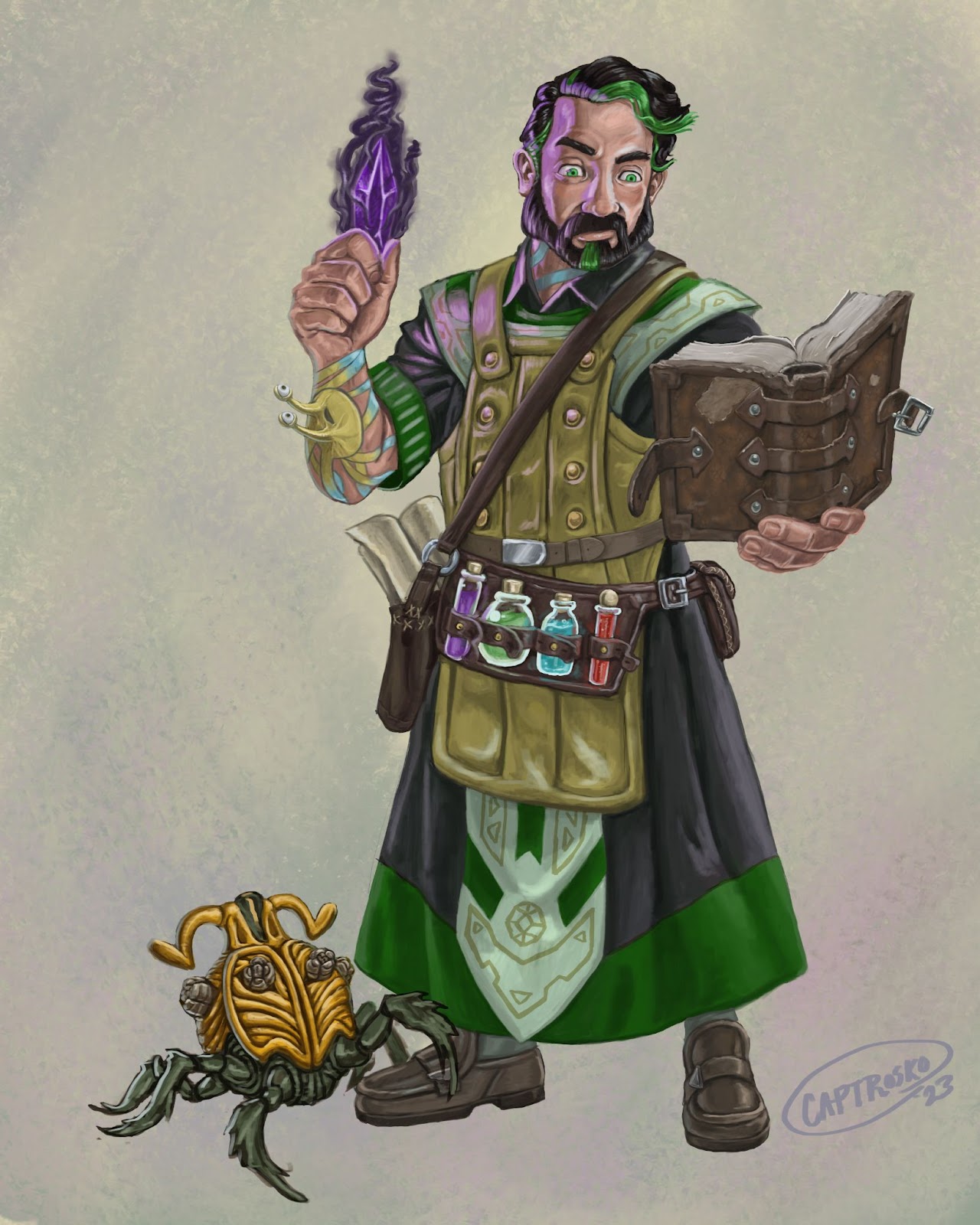
It was pure luck that Rusty found the loose board in his room in the Crooked Cat. The space below was just small enough to hold a folded sack… but that sack was a bag of holding which was somehow shielded from divination. Now the contents of the bag were spread out across the bed. Three different sets of identification papers. Ten Kundarak letters of credit, each worth one thousand galifars. Three vials bearing the Jorasco seal—high grade healing potions. A spellshard. A wand, a rapier, and a ring… all radiating magic. “So what do you think?” Rusty asked his friends. “Are we the luckiest bastards in Sharn? Or should we put this all back, get a new room, and pretend this never happened?”
My previous post examined buried treasures and how the pursuit of a lost, legendary treasure could be the driving force for an entire campaign. But not all treasures are ancient relics found in a monster’s lair. In Khorvaire, there are many options for finding hidden treasures that are anything but legendary. Consider caches—something stored away or hidden for future use. Here’s just a few example caches that come to mind…
As uncommon magic items, bags of holding are part of everyday life; portable holes and handy haversacks are rarer but still well known to the general public. Such things make it possible to conceal a significant amount of equipment in a relatively small space. A cache could contain mundane supplies or money—something that would help a group of adventurers but that has little immediate impact or identifying marks. On the other hand, it could contain valuable magic items… perhaps a conveniently interesting item for each of the adventurers, something that will get them started on their adventures. But such items might be distinctive, whether they are clearly tied to a particular organization or to the original owner. Are the players concerned about running into someone who recognizes this loot? On a different spectrum, a cache could contain trinkets that have little concrete value but that tell a story or set the players on a path… A journal that exposes a secret plot or a possible threat, or evidence about a crime that’s long gone unpunished. On the other side, a cache could have magic that is exceptionally powerful, but more than the adventurers want to deal with. A bag of blast disks; a spellshard containing secrets of proprietary Cannith artifice; the Orb of Dol Azur (which for this purpose we’ll say has the same stats as the Wand of Orcus). If you’re a group of 3rd level characters, what are you going to do with the Orb of Dol Azur? Especially knowing that in all likelihood it was stashed by an incredibly powerful and dangerous person who will probably come looking for it? On an even more exotic path, imagine that you find a cache that contains the answer to the cause of the Mourning—along with an item (an arcane core for a weapon, an artifact tied to an overlord) that could allow someone to enact a second Mourning. If this falls into the hands of any nation it will irrevocably alter the balance of power in Khorvaire. What will the adventurers do with it?
Part of the point of a cache is that it’s not a deep dungeon or a tomb full of traps. A good narrative example is the troll’s den in The Hobbit. After the trolls are defeated, Gandalf concludes that they must have a safe hole, and they search until they find it… and when they do, it’s full of treasure, including two named magic swords and some swanky gear for Bilbo. We get a slight repeat of this in Fellowship of the Ring, where the hobbits just kind of stumble across a barrow and end up with some nice equipment. A cache can be a fun way to give adventurers some decent equipment while also setting up interesting story hooks. Do they have to worry about the owner of the cache coming after them? Does anything they’ve claimed rightfully belong to someone else, and if so, do they want to find that rightful owner… who could then become a patron of the party? Does something in the cache draw them into a greater plot—is there evidence of a murder that should be avenged, or an Emerald Claw threat about to happen, a Chamber scheme? With all these stories in mind, one of the key questions is how the players encounter the cache. A few possibilities…
Random Chance. All the clever concealment in the world can’t counter pure luck. Perhaps the adventurers are caught in a skirmish between Daask and the Boromar Clan, and an eldritch bolt that misses its target shatters the hollow statue of Boldrei containing a stashed haversack. Perhaps when the character with Sage background conducts research they need a book in the Morgrave stacks that no one else would ever have reason to look at—and they find that this obscure account of Galifar the Dark’s economic policies is a hollowed out book containing a spellshard, a glove of storing, and a few other key belongings of a rogue Dark Lantern. Perhaps the rogue goes to visit an old mentor and finds them dead—their apartment is trashed, but because the adventurer knows the mentor, they spot the clue that reveals their hidden cache. The PC feels certain the mentor would want them to use these hidden tools, but will they try to avenge their mentor? And why WAS the mentor killed? The point here is that finding the cache isn’t the challenge; it’s a surprise, something that falls into the path of the PCs, and the question is what they will do with it.
Spoils of War. As with the trolls in The Hobbit, a cache could be a reward for victory. After defeating the Emerald Claw’s latest scheme, the adventurers find a key to a Kundarak vault or a note with the address of their safehouse. The cache contained goods or equipment they wouldn’t just carry around town, and may have additional clues about future threats, local agents, or other hooks for future stories. But the challenge is fighting the cache owner; once that’s accomplished, the cache itself is relatively easy.
The Tiny Dungeon. On the other hand, there are countless ways a cache could be secured. This article discusses a few examples of how everyday magic can take interesting forms. Glyphs of Warding are extremely flexible, and even an alarm can be a concern if you’re afraid of who will be alerted. So one option is that the players find a cache but have to deal with considerable security to gain access to it. Another is that they learn of a cache but reaching it is going to be a journey. A group of Cyran adventurers might be contacted by an old comrade in arms who has located a cache of Cyran treasures just inside the Mournland. When they arrive, the contact is missing; perhaps kidnapped or killed by agents of an Aurum concordian who wants the cache. Can the adventurers get there first, and if so, can they bypass its security? Will they keep the goods or turn it over to New Cyre and Oargev? The main difference between this and the buried treasure stories of the last article is the scale. This isn’t an epic expedition that will cover multiple sessions, and the treasure in the cache is significant, but it’s not a dragon’s hoard. This is an adventure low level characters can complete; the loot creates more opportunities and hooks for them, but it’s not a king’s ransom.
That’s all for now! Thanks as always to my Patreon supporters, whose support makes these articles possible. Speaking of which, I will be doing a live Q&A on the Last War on Sunday January 14th at 9 AM Pacific time, on the Threshold Discord channel associated with my Patreon. If you’re a patron and you can’t make it live, don’t worry – it will be recorded and shared with all patrons. Thanks for your support! And also, thanks to Matthew Johnson for the image of the artificer Ink Narathun that opens this article!
The year is coming to a close, but there’s still time to answer an interesting question posed by one of my Patreon supporters…
Buried or otherwise, legendary lost treasures are a great trope for setting a campaign in motion. From One Piece to The Hobbit to Raiders of the Lost Ark, it’s an easy drive for story. This doesn’t have to be driven by greed; just comparing those three examples, the quest for treasure could be driven by the status that will accompany the recovery of the treasure, by a rightful claim to the wealth, or by the desire to keep a dangerous artifact out of the hands of people who will abuse it. Regardless of whether the adventurers are driven by pure self-interest or whether they’re serving a greater good, a grand quest for a legendary treasure can be a solid drive for adventure.
So… what are some legendary treasures of Eberron? Let’s consider a few, canonical and otherwise.
TREBAZ SINARA. The island of Trebaz Sinara was Lhazaar’s seat in life and her home in death, and its vaults held the treasures and tribute she gathered in her decades as the pirate queen. Her heirs followed in this tradition, adding vast wealth and extravagant tombs… and each one did something to add to the security of the island. Lystara the Red bargained with one of the Lords of Dust and established a deadly demonglass reef—a maze that can gut a ship from below. Hungry Lhazaan imported the most terrifying monsters from across the world to guard the shores. Duros the Wise worked with the greatest mages of the age to add arcane wards and traps to the halls and tombs of Trebaz Sinara. And Astalaar—the last pirate queen to rule from Trebaz—well, no one knows exactly what she did. Astalaar swore that no one would ever steal her treasures after her death, and no one has… because since the moment of her death, no one has set foot on Trebaz Sinara. Most ships that enter the demonglass maze around Trebaz Sinara never return. But a few captains claim to have safely navigated the maze and its monsters, only to find themselves on the opposite side of the island. In 997 Koulton Brightwind sought to land on Trebaz Sinara using a stolen airship; his vessel barely survived the unnatural storms that rose up, and despite pressing through them Koulton was unable to find the island. Trebaz Sinara is a large island, and people can safely sail around it, but something prevents anyone from landing on it. Has the island been shifted to another plane? Is it simply concealed from any ship that lacks the proper enchantments? The truth remains a mystery. But Trebaz Sinara holds the treasures of a dynasty of legendary pirates, including the crown jewels of Lhazaar herself.
The first challenge to Trebas Sinara is finding the island itself—discovering what Astalaar did to conceal it and how to overcome its defenses. Once this is accomplished, however, it will still take a very capable ship and crew to thread the needle of the stormlashed demonglass maze (an airship is an option, but as Prince Brightwind can attest, the supernatural storms make this a dangerous choice!). And making landfall on Trebaz Sinara is just the start of the story, as the isle is home to countless monsters, and every tomb has its own host of traps. A party of treasure hunters could simply snatch all that they could carry and flee back to sea. But Trebaz Sinara was the seat of Lhazaar herself, and if someone claimed Lhazaar’s crown and her ancient keep they would be in a powerful position to challenge Rygar for the title of High Prince of the Lhazaar Principalities; the wealth of Sinara could be enough to jumpstart a new nation.
RED KNIGHT. During the Last War, House Cannith established a number of hidden forgeholds where they worked on military projects of the utmost importance. Some of these are relatively well known within the house, such as the Whitehearth facility that plays a role in Shadows of the Last War. But there’s another forgehold whose existence was hidden not only from the Twelve, but even from the Lords Seneschal of House Cannith. Red Knight was personally established by Starrin d’Cannith. It’s existence was only revealed after a team of adventurers recovered one of Starrin’s journals from the ruins of Metrol; potentially, this could have been the work of the player characters, either before the campaign begins (it’s a prelude that the PCs were brought together to work on this Metrol job, and their success is what leads to the ongoing campaign) or potentially as their first adventure. Regardless of how they come by it, Starrin’s journal reveals the existence of Red Knight, a forgehold isolated even from House Cannith, where the Gorgon was working on his most cutting edge, dangerous experiments. Unfortunately, the journal is damnably vague about what those experiments were. It’s possible that Red Knight holds the secret to the Mourning, or that it houses some other weapon of incalculable power. But it could be that its research was focused in an entirely different direction, but one that could be equally world-shaking. Perhaps Red Knight holds the prototype for a teleportation network (that doesn’t need House Orien), or a reliable resurrection creche (with no need for House Jorasco). Maybe Starrin found a way to create portals to other iterations of Eberron lost in the Maze of Realities. Perhaps he was harnessing the full power of an overlord… in which case, it could be that the accidental release of that overlord triggered the Mourning!
It could be that the adventurers learn of Red Knight on their own and choose to conceal this information from everyone else, not wanting anyone to know about it until they’ve found it and learned exactly what it contains. On the other hand, every power player in Eberron would jump at the chance to seize this hidden facility. All three Cannith factions would be desperate to acquire it, as would the Aurum, the Dark Lanterns, the Royal Eyes of Aundair, the Blood of Vol, the Lord of Blades… so the question for the DM is who they want to be involved in the race. The initial challenge will be trying to locate the forgehold without revealing anything about it to the rest of the world. The secrets could be hidden in the Mournland (especially Eston or Making), but it’s possible that Merrix, Jorlanna and Zorlan have critical keys or pieces of information whose relevance they aren’t aware of. Once it’s located, bypassing the security of the forgehold will be an epic endeavor in its own right, as it will be defended by remarkable magic and cutting-edge constructs. The exact nature of the defenses could relate to the work being done there. If involves teleportation, it could exist in the astral or ethereal plane. If it deals with resurrection, it could have a staff of arcanists who are automatically reborn any time they die—similar to a lich’s phylactery only without death. If it’s tied to an overlord, Red Knight could be located in the heart demiplane of that overlord… and possibly been overrun by its minions. And if the adventurers succeed, the question rises again: do they take what they can carry and run? Do they destroy it so no one can harness its power? Or do they seek to operate it? If one of the player characters is a Cannith heir, do they work with one of the three aspiring barons, or do they make their own claim to reuniting the shaken house?
THE GRAVEDIGGER’S HOARD. As noted in this article, Hazcoranar the Gravedigger is a rogue black dragon infamous for looting treasures of fallen or falling human civilizations. He’s gathered artifacts from the Empire of Dhakaan, the Cul’sir Dominion, and the pre-Sundering kingdoms of Sarlona… not to mention pillaging battlefields during the Last War. There’s many accounts of priceless treasures stolen by the Gravedigger. But where does he keep his hoard? As a rogue, Hazcoranar isn’t welcome in Argonnessen. Which means his hoard is hidden somewhere where it could be found. The Gravedigger spends much of his time actively pillaging, and a clever group of adventurers could sneak in while the dragon is away. But would they take what they could and flee, spending the rest of their lives wondering when the Gravedigger would track them down? Or might they believe that they could fight the dragon and survive, claiming his lair as their spoils?
Hazcoranar’s hoard is an opportunity for a classic dragon’s lair tale. Somehow the adventurers stumble onto a secret leading them to his hoard… a map? A lone survivor of a previous expedition? A journal whose pages have been torn out and scattered? The lair could simply be isolated and well-hidden; or it could be in a demiplane or an extradimensional space, where the challenge isn’t simply finding it but finding out how to forge an arcane connection to it. Perhaps the adventurers find the back door and are able to sneak in and steal something while the dragon is away, but can they come up with a way to actually defeat the Gravedigger? Beyond that, what will they do with their spoils? Relics from ancient Xen’drik may not have any active claimants, but the treasures Hazcoronar stole from the Dhakaani or during the Last War could well have people eager to recover them; will the adventurers restore these relics to their rightful owners or claim their rights of salvage?
THE MOURNING VAULT. On a far smaller scale, countless noble families lost their estates and their treasures when the Mourning struck. If a Cyran adventurer has the Noble background, they could have just such an estate in the Mournlands. Perhaps they discover the existence of a vault they never knew about—an ancestral hoard hidden beneath their estate, holding treasures that are rightfully theirs. This is smaller and more manageable that some of the earlier ideas. The adventurer knows exactly where their estate is. The challenge is that it’s in the Mournland. They will have to cross the untold dangers of the Mournland to reach it, and there’s no telling how the estate itself has been transformed. There’s also the question of whether the vault holds secrets about the character’s family they themselves never knew… in which case, the recovering of the first treasure could just be a stepping stone toward the next phase of the campaign. There’s also the question of whether the noble will just claim the treasure as their rightful due, or whether they will use it to try to help New Cyre or other refugees. Nonetheless, this is a concept that is smaller and more manageable than some of the preceeding ideas—it’s a treasure that the adventurers COULD recover and take away without it being the end of their lives as professional adventurers, or threatening the balance of power of a region.
These are four solid ideas. But this is still just scratching the surface. A few more to consider…
The list goes on! The Lair of the Keeper, the master vault of House Kundarak, the hoard of Hassalac Chaar or the lich Gath… I’m going to stop here, but I hope this gives you some ideas.
Any of these treasures could start a campaign rolling. A few things to consider…
There’s only a few hours left in 2023, and this is all I have time for. I hope it gives you somethign to work with! And again, my deepest thanks to my Patrons who have supported my in 2023. It’s been a hard year, and this support is the only thing that allows me to spend time continuing to explore Eberron. In addition to asking questions, patrons have access to live and recorded Q&A sessions and the opportunity to play in my ongoing Eberron campaign. If that sounds interesting, check it out. And regardless, happy New Year!!!
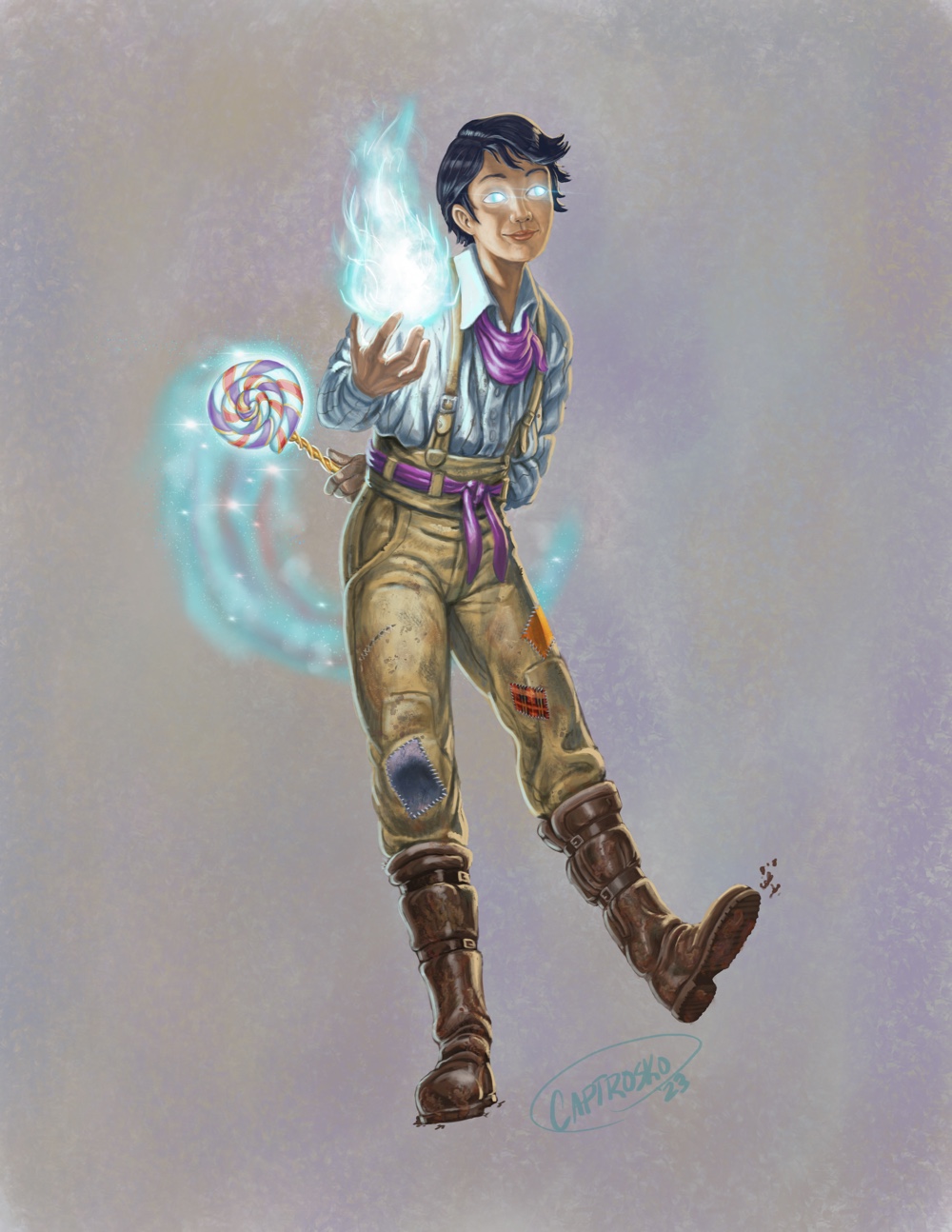
As time permits, I like to answer interesting questions posed by my Patreon supporters. Here’s one from this month…
So first of all, this question is sort of like saying In a campaign in which the daelkyr are the primary villains, would the orcs be the right quest-givers? To which the answer is that Gatekeepers would be the most likely quest givers. Ghaash’kala orcs, Jhorash’tar orcs, a Tharashk inquisitive working the mean streets of Sharn—they’re not going to know anything about the daelkyr. This is key here because the automatic answer is that followers of the Path of Light are an excellent option for drawing adventurers into the schemes of the Dreaming Dark. But not all kalashtar follow the Path of Light, and even among those that do there are different approaches among the faithful. A few quick points to keep in mind…
So keeping that in mind, let’s revisit the question… In a campaign about fighting the Dreaming Dark, would kalashtar be the right quest givers? They COULD be, but what that would look like would depend on the individual. A key point here is that as a DM running a long term campaign I’m usually not going to start by stating on day one The Dreaming Dark are infiltrating House Cannith and planning to create an army of warforged vessels they’ll use to conquer Khorvaire! What I want is for the players to learn about the Dreaming Dark and their greater scheme organically… to interfere with a minor scheme and then slowly get pulled deeper and deeper into it. My novel series The Dreaming Dark deals with, surprise, a scheme by the Dreaming Dark. But they don’t even get MENTIONED in Book One; there’s simply an incident in which the protagonists cross paths with a kalashtar. In Book Two the character returns to help them with a problem and avoiding spoilers, the story evolves from there. So this is a case where a kalashtar drives the story… but she doesn’t just show up in Book One and say “You must come with me now to fight the Dreaming Dark!”
Taking all that in mind, let’s consider three different kalashtar, any of which could be PCs or NPC quest givers.
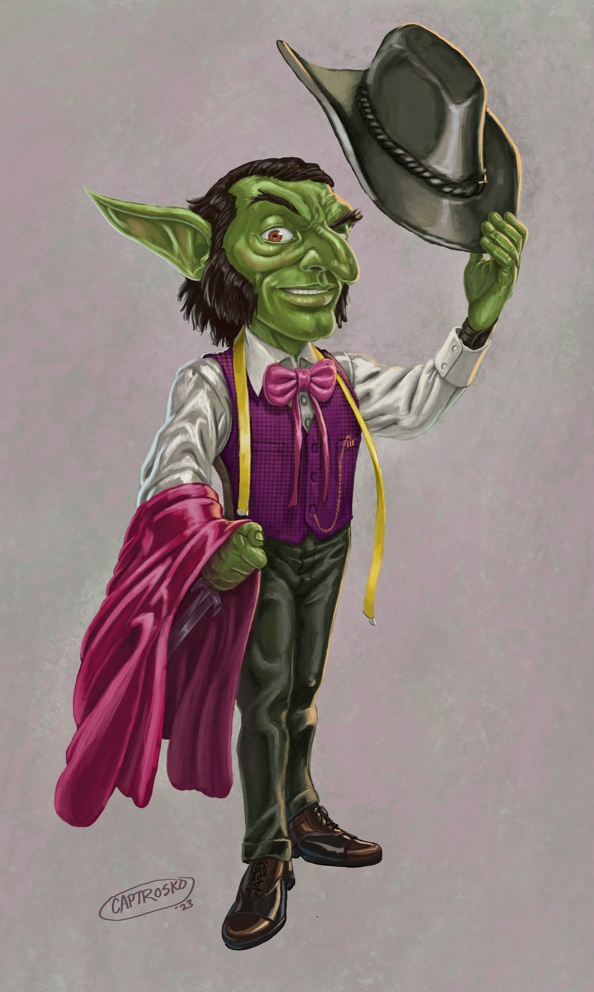
TARI (pictured above) is an orphan who grew up in the Shadow Marches. They’ve never met another kalashtar and didn’t know the word until someone else used it to describe them; they still don’t really know what that means. They know nothing about the Dreaming Dark or the Path of Light, and have instead found their way to the Silver Flame. Mechanically they are a divine soul sorcerer, with their powers flavored as a blend of silver fire (guiding bolt, sacred flame) and psychic influence (charm person, hold person, detect thoughts). The idea is that all of this is largely intuitive, driven by their compassionate spirit and their unrecognized link to their quori. Tari is better suited to being a PC than an NPC; part of the point of the character is that they are connected to powerful forces they don’t yet fully understand, and that they can receive guidance and visions from both the Flame and their quori. So as a PC, Tari COULD lead the other adventurers into a scenario with the Dreaming Dark, but the idea is that they wouldn’t know what they were getting into… they’d just know that something is wrong and needs to be investigated, and THEY would learn about the Dreaming Dark along with the other adventurers as they dig deeper into the adventure.
VIRASHANA is a kalashtar soulknife rogue from Breland. She was raised in the Path of Light and knows its traditions, and if she’s in Sharn she knows people in Overlook; but overall she operates alone. She’s what the Path calls a Shadow Watcher—someone who seeks to fight evil directly and forcefully. When she was young, the kalashtar coummunity she was part of was targeted by the Dreaming Dark and her father was killed by an Inspired mindstealer. Now she craves vengeance and has devoted her life to identifying and eliminating mind seeds and other agents of the Dreaming Dark in Khorvaire.
Virashana could absolutely draw adventurers into a story, but she would likely be acting alone: she’s been conducting a personal investigation and she’s identified a threat, and she needs back-up. This story is stronger if one of the player characters has a pre-existing connection to Vira, and even if they’ve never met IN THE CAMPAIGN, this is where I might draw on a character’s background and work with the player to develop a story. Perhaps a Folk Hero, Inquisitive, or former Sentinel Martial once teamed up with Virashana to catch a murderer driven by nightmares. Maybe a former Spy got an unexpected assist from Virashana after his handler mysteriously turned on him (due to a mind seed). If the player is up for it, I might ask them to tell me about the time Virashana saved their life… establishing that she’s a mysterious woman with psychic knives who helped you out with some creepy dream business.
The main point is that Virashana can get a story rolling with her investigation, and she can share general knowledge about the Dreaming Dark, but she’s never been to Adar, she’s never actually met a Riedran Inspired, and she’s not connected to a larger network of kalashtar. She’s great for getting adventurers involved in a small, targeted scenario that will later be revealed as part of something larger. She’ll show up and say Good to see you again, Daine. What’s it been—five years since that ugly business in the Cogs? Well, it’s happening again… something to do with House Deneith. You and your friends free tonight? Dress for the sewers. She’s following a lead, she doesn’t have a lot of information, and she’s going to get her hands dirty whether you join in or not.
ALARKHAD is a kalashtar monk from Adar, sent by the elders to serve as a Lightbringer—combating the Dreaming Dark and other malevolent forces by inspiring the people around him to be better and generally bringing more light into the world. While I’ve described him as a “monk”, mechanically he’s a bard; his Inspiration and bardic magic (mainly enchantment and divination spells) are presented as psionic powers. He can definitely serve as a patron for a group of adventurers. Like the character in my novel, he might just show up when the adventurers need guidance or healing, helping to remove a psychic “curse” one of the characters has been afflicted with in an encounter with quori vessel. Unlike Virashana, he is more likely to guide and advise. Coming from Adar, he has access to a deeper knowledge base and resources, but he dislikes direct, ruthless action and beyond that, he’ll need time both to come to trust the adventurers and to prepare them for the greater conflict that lies ahead.
So after helping them in a previous adventure, Alarkhad might approach the characters and say There is a malevolent force growing in Callestan. Speak to those who are suffering there, and look closely at the agents of House Tarkanan; I cannot say with certainty that they are the source of this corruption, but they may be. He isn’t coming along. He doesn’t actually have a personal stake beyond people are suffering. He’s just letting you know something is rotten in the district of Callestan and you need to check it out. It might not even BE related to the Dreaming Dark — but if you resolve the situation compassionately, he’ll conclude you have the skills and temperament to deal with the more serious scheme he’s aware of.
If I’m running a campaign in which the Dreaming Dark are the major villains, I’ll start by coming up with their BIG GOAL. As I’ve said in other places, the first thing I’ll do is pick a catspaw. The Dreaming Dark established Riedra by turning all the existing powers against one another and then presenting the Inspired as unifying saviors. They convinced the people of Riedra to forge their own chains. In my campaign, if they want to conquer Khorvaire they’ll take the same approach. They’ll push the Five Nations to tear themselves apart (canonically, there’s lots of hints that they could have set the Last War in motion) and then present a savior to fill the role of the Inspired in Khorvaire… or, potentially, a different approach that still ends with a stable pacified population, such as an army of quori-possessed warforged. So, who’s the figurehead in this scheme? It could be the ruler of one of the Five Nations; a dragonmarked house; the Twelve; a new religion; an existing religion (new zeal for the Sovereign Host!); a political movement. Whatever this is, it’s going to be something I want to develop over time. I don’t want to send 1st level characters up against THE DREAMING DARK; I want them investigating something smaller. Identify a mind seed. Investigate the actions of a strange warforged that turns out to have an impossible design. Deal with a psychic plague spreading through a bad part of Sharn. Deal with a serial killer driven by dreams. These could be trial runs of something they intend to deploy later, or dominos whose impact won’t be seen until later (the serial killer causes fear in the area which makes people more willing to accept martial law when it’s proposed). This also means that when the player characters solve the problem, they aren’t actually drawing the wrath or attention of the Dreaming Dark. The psychic plague was a trial run; the warforged was a prototype; the serial killer already served his purpose. The adventurers have triumphed and done something good for their community, but the Dreaming Dark’s plan continues to unfold.
I’m creating a smol table for randomly generating Dreaming Dark schemes as a treat for my Patreon supporters (Inner Circle and above). If that sounds like fun, check out my Patreon!
This month, patrons also asked a questions about the Quori themselves…
This is a VERY deep cut. The Lluora quori are an idea I suggest in this article, when someone asked if there could be a quori of sloth. Here’s what I said…
“Sloth” isn’t quite the right word for a quori. The general idea is that quori specialize in developing and manipulating particular emotions or moods. So the key is that this quori—which I’ll call the Lluora—doesn’t embody sloth itself; rather, it specializes in SAPPING MOTIVATION. Consider all the tools of procrastination—creating distracting tasks or options; causing the mortal to endlessly question their decisions, paralyzing them with self-doubt; causing them to question their end goal; encouraging Whataboutism and “Why bother doing anything when nothing will ever really change?” I don’t think they’d be common. One possibility is that they’d be a sort of jailor, trapping mortals in their own mental prisons and preventing them from ever building up the motivation to escape. Another is that they’d advise kalaraq, suggesting ways to undermine mortal motivation.
So sure, there could be a Lluora line. Which branch would they serve? One immediate option is THE GUIDING PATH. The Lluora essentially specialize in preventing progress and quelling resistance by dissolving the motivation to rebel. Another option is THE THOUSAND EYES, serving in the role of jailor described above. But also, it’s important to keep in mind that not every quori specializes in administering RIEDRA. This ties to theoretical quori who deal with greed or envy. There are quori who have no role in Riedra, because their role is to serve the Dreaming Dark as it plants roots in OTHER CULTURES. The lluora CAN help the Guiding Path sap motivation. But it’s going to have a far greater impact *working in the Five Nations* helping to undermine passion and drive. Riedra is a fairly stable machine at this point; it’s Khorvaire where there’s more need to actively inflame greed, doubt, envy, and more.
But there’s another point here. If you make a new type of quori and then aren’t sure how it fits into the Dreaming Dark’s activities on Eberron, remember that QUORI DON’T BELONG ON EBERRON. That’s not why they exist. They SHOULDN’T all have a role to play on Eberron, because THAT’S NOT WHERE THEY ARE SUPPOSED TO BE. If you can think of a useful way the Dreaming Dark could use them in its schemes, that’s great. But they are supposed to have a role to play in DAL QUOR; whether there’s something for them to do on Eberron is entirely secondary.
No, personally I wouldn’t do this. The idea of a missing quori TYPE seems forced. If I was to push a Baker’s Dozen on the quori—and I probably WOULDN’T—I’d say that there are thirteen KALARAQ, but that Taratai is missing. But on reflection I think this is an unnecessary limitation. As for quori themselves, I think thirteen is too FEW. Consider how many different times of demons or devils exist! The ones we know may be the most common types, but I don’t feel a need to completely lock down how many strains there are; I like being able to add a new rare quori type if I think of something cool.
That’s all for now! I need to stockpile firewood for Long Shadows. Oh, with that in mind: I’ll be doing a live Q&A on Saturday, December 23rd at 9 AM Pacific Time for my Threshold patrons; the session will be recorded and made available to Inner Circle patrons after the fact. So, one more reason to check out my Patreon! Patreon support is what makes it possible for me to spend time on Eberron, so thanks to all of you who make this possible!
Every month, I answer questions posed by my Patreon supporters. I christened these articles as “IFAQs” with the idea that they are INfrequently asked questions—a chance to ask things you won’t find answered in any sourcebook. And this one is definitely that…
I imagine most of you are saying “Sphinx-what now?” This question is tied to the previous article I wrote on Sphinxes in Eberron. In Fifth Edition, sphinxes have power over time and I suggested a few explanations for that. Here’s the one that’s relevant.
Most recently, (Morgrave scholar) Cord Ennis returned with a refinement of his thesis. Ennis suggests that sphinxes are mortal, civilized creatures, but that the reason there’s no evidence of any sphinx civilization is because they aren’t from this time. There are a number of accounts in which people facing sphinxes in their lairs are shifted through time—the apocryphal tale that Breggor Firstking was a beggar who was given a chance to relive his life and used his knowledge to become a king, or the story of the man who sleeps in a sphinx’s lair without permission and awakes a hundred years later. According to Ennis’s theory, the idea that sphinxes can move through time helps to explain both their seemingly oracular abilities and their interest in seeming cryptic actions; that their enigmatic behavior shapes future events in ways we don’t see, but they do. The lack of any signs of sphinx civilization is because it doesn’t exist in the scope of history as we know it. And further, the fact that sphinxes only manipulate time in their lairs suggests the use of some form of eldritch machine as opposed to the innate powers one would expect in a living manifestation of the Prophecy—that they accomplish time travel using a tool, rather than personal power alone. Ennis asserted that this could explain Flamewind’s observed behavior—at times the cryptic oracle, and at other times almost more of a curious tourist.
While intriguing, Ennis admitted that there was one piece of the puzzle that still escaped him. When do these time-traveling sphinxes come from? His first thought was the distant future—that they could even be some sort of mystically evolved descendants of the modern races. Yet if that were the case, is there no risk of their meddling changing their own future? Given this, he ultimately favors the idea that the sphinxes are from the very distant past—that they could potentially be the citizens of the FIRST civilization of Eberron, a society that predates the Age of Demons and whose existence was wiped from history by the dominion of the overlords. With this as a foundation, Ennis suggests that the actions of the sphinxes might not be the absolute demands of destiny one would expect from embodiments of the Prophecy, but rather a grand game. As their time is long past, the sphinxes don’t actually care what about the ultimate outcome; whether the overlords rise again or the daelkyr are unleashed doesn’t actually hurt them. Ennis further suggests that this could reflect the different techniques seen among sphinxes. The “divine” sphinxes—those wielding clerical abilities—could see their actions as being a divine mission, potentially even one mandated by the Progenitors (because what other gods were there at the dawn of time?) while the “arcane” sphinxes could be the scientists of their time. Thus, Flamewind could be in Sharn because she knows it is a nexus of elements she wants to deal with—events or people she wants to observe or influence—but that between those key events she is simply enjoying studying this time and place, so alien to her native time.
In that article someone asks “How do they reconcile the fall of their civilization? Do they know their time will run out?” Here’s my answer to that.
Certainly. It’s something we see in various versions of Atlantis. Imagine that they know that their civilization will end in one year. The overlords are going to rise and that is absolutely, 100% inevitable: Krypton WILL explode. They don’t have the resources to project their entire civilization beyond the Age of Demons; they can only support, say, one hundred time travelers. And it may even be that they can only support them for a certain amount of time, that they will eventually be pulled back to the doomed dawn. So those one hundred time travelers are essentially stretching that final year out for as long as possible by dwelling in other times — seeing as much as they can of a future their people will never know, cataloguing the wonders of eternity and doing what they can to be a part of legend—to create stories that WILL be remembered—before they are gone.
On the other hand, if you want a more activist story, consider this: what if the reason the sphinxes are tweaking history and shaping stories is because they are creating a point in the distant future that they CAN move their civilization to? Essentially, it’s an even longer game than the Lords of Dust. Each shift—each hero tested—is shifting the number of a combination lock. At some point they will create the future they are looking for, five thousand years from now, when Sphinx Atlantis can leap forward in time and be saved. So they could, essentially, be from both the past AND the future.
And just to have all the information about time-traveling sphinxes in one place, here’s what else I said.
Time Travelers. One of the core elements of sphinxes as time travelers is the idea that they are a mortal civilization. They are advanced beyond any civilization that exists today, but they are individuals using magical tools to accomplish these things—they are arcane scientists and divine spellcasters, capable of observing the tapestry of time and playing a great game with it. If this is the case, Flamewind in Sharn may indeed have very specific events she wants to observe and people she wishes to drive down specific paths, but at the end of the day she is a mortal wizard. She may play the role of being enigmatic and all-knowing, but there’s a touch of the Wizard of Oz; she DOES have knowledge of the future and of the potential destiny of the characters, but she’s not in fact infallible, she is playing her own game, and she also enjoys being a little bit of a tourist between those critical events. Should you follow this path, there’s a few points I’d consider.
- The spellcasting abilities of a sphinx reflect whether they are a divine or arcane spellcaster—essentially, a wizard or a cleric. Under this approach, gynosphinxes and androsphinxes are simply male and female sphinxes, and it should be possible to encounter an androsphinx wizard or a gynosphinx priestess. A key question is what divine power sphinxes serve; personally, I like the idea that they might have a different sort of relationship with the Progenitors than people of the present day.
- In shifting themselves or others to another plane, I would specifically use XORIAT. We’ve established that Xoriat is the key to time travel, and I’d assert that the time travel techniques being used by the sphinxes are based in this. The sphinxes aren’t creatures OF Xoriat and have no love for the daelkyr; they are scientists who are USING Xoriat. But they can also toss you into it for kicks.
- The lair abilities of a sphinx are tied to a form of eldritch machine. Most likely this is specifically linked to the sphinx and cannot be used or even understood by any other creature… But it’s POSSIBLE that someone who’s figured out the mystery of the sphinx and has access to their lair could find a way to hack their time machine. A second specific question is where Flamewind has her lair. If the lair is a machine, it’s not likely to be something she could build in Morgrave University. In the novel City of Towers, this is why she deals with the protagonists in the abandoned temple in Malleon’s Gate; she hangs out at Morgrave, but her LAIR is in Malleon’s.
- The final point is that time-traveling sphinxes are manipulating events, but they don’t have the same sort of agenda as heralds of Prophecy or Archfey emissaries. They aren’t invested in the outcome in the same way as, say, the Lords of Dust or the Chamber. Ultimately, this isn’t their time and the outcome won’t actually AFFECT them; it’s more intriguing than vital. However, divine sphinxes are more likely to be driven by a divine mission, while arcane sphinxes are more likely to be scientists and researchers.
So, let’s look back to the original question… If you had to place Sphinx-lantis anywhere in Your Eberron, where do you think it would be and why? The answer is simple: It was in a place that no longer exists. This comes back to the idea that it simply isn’t possible for the sphinxes to somehow save it. The overlords ripped their way out of Khyber and they can shape reality with their power. It’s not just a matter so splitting previous continents, though I think that definitely happed. Consider the overlord Ran Iishiv, the Unmaker. It seeks to tear down reality itself, and in the Age of Demons it was free to express that desire; in my opinion, large chunks of whatever existed before were completely destroyed by Ran Iishiv, and that’s just ONE of the overlords. This comes back to the observation in the original article that there are no traces of a sphinx civilization… in my opinion, it’s just one of the pieces of the world that Ran Iishiv unmade while earning that title. There may be TRACES of Sphinxlantis that have somehow survived, but I think they would be more likely to be artifacts than structures.
A second key point is that in my opinion, Sphinxlantis was just one of the civilizations that existed in the past. So what other creatures were around? For starters, dragons and titans. Dragons are said to have emerged from the blood of Siberys falling upon Eberron; they were there at the start. You could use this to play with some of the “First World” ideas, if you want. However, in my opinion “modern” dragon civilization has absolutely nothing in common with the Sphinxlantis-era dragons—whatever civilization existed at the dawn of time were completely annihilated by the Age of Demons. Rak Tulkhesh and Tol Kharash set existing civilizations against one another in brutal wars, while Eldrantulku and Bel Shalor tore them apart from within. The Wild Heart and the Heart of Winter devastated civilizations with the horrifying potential of nature, while Ran Iishiv simply annihilated them. And dragons themselves would be subsumed by the Daughter of Khyber. Again, these are just a few of the overlords and they dominated the world for millions of years… it’s no surprise that little remains. With that said… who else could have existed? Frankly, anyone. Dragons and titans are sure things. But given the role of the Ghaash’kala, it’s quite possible that orcs existed at the dawn of time and survived through the Age of Demons. I’ve joked about the people of the Five Nations attributing Dhakaani ruins to some lost human civilization… but if it suits the story you want to tell, you could say that there was a human civilization in Sphinxlantis, something far more advanced than the present day. A truly odd idea is that the sphinxes were products of a primordial human civilization. Rather than saying that in the past you had sphinx families sitting around a table together at Sphinxsgiving, it could be that the sphinxes were created by the people of Sphinxlantis AS time travelers—that the reason their eldritch machines can’t be used by others is because the sphinxes themselves essentially ARE eldritch machines. You can explore this idea whether or not you use humans as their creators.
Another thing I’d consider: If the myths are accurate, Sphinxlantis predates both the Sovereign Host and the Silver Flame. Earlier I suggest that the divine spellcasting sphinxes may engage more directly with the Progenitors. This ties to something I suggested in my Siberspace campaign—that LILENDS are children of Siberys. There’s some broad similarities between lilends and sphinxes, both blending humanoid and animal features. It could be that the shape of the sphinx is a reflection of a connection to Siberys (though they ARE mortal, not celestial)… or it could be that the people of Sphinxlantis created the sphinxes in partial emulation of lilends and other celestials. In any case, because Sphinxlantis predates the Silver Flame, they would have had more interaction with individual native celestials—couatls, lilends, and more.
A key question in deciding why this matters depends on the motivation of the Sphinxes, and I presented some options in this article. Do the sphinxes have a mission? Are they paving the way for a new Sphinxlantis to be born in the distant future? Are they playing a cosmic chonological game with one another? Is there actually a secret war being waged between the divine spellcasting sphinxes and the arcane spellcasting sphinxes? Or are they ultimately just tourists, stretching out the final days of their civilization by living out their lives in other times and watching the world that takes their place?
Aside from the sphinxes themselves, one reason this matters is because it is an excellent source of artifacts. Part of the whole point of time traveling sphinxes is that they are more advanced than any modern civilization, including Argonnessen. The certainly had a closer relationship with the native celestials, and may have had a closer relationship with the Progenitors themselves. And any object that has survived from the dawn of time would HAVE to be powerful and virtually indestructible. So this is an excellent origin point for artifacts that are incredibly powerful but have no connection to any known civilization—artifacts that could do ANYTHING.
Typing this, another thought occurs to me. I’ve said that the sphinxes could have had a different relationship with the Progenitors. That could include Khyber. If I wanted to explore a story that deals with the Progenitors as actual, concrete entities I might consider the idea that Sphinx civilization is older than the world itself—that rather than being created BY the Progenitors, the sphinxes could have come to this reality WITH the Progenitors. In this concept, they aren’t celestials because they’re older than the celestials. Though again, this is as a civilization—any individual sphinx is mortal, so it’s not like Flamewind is older that Eberron, but her people were. This could be one reason that they aren’t fighting the destruction of Sphinxlantis… because some among them honor Khyber and believe that Khyber deserved an opportunity to express their vision on reality, at least for a time.
Again, it’s important to me to say that we don’t know if the Progenitors were real or if the creation myth is just a metaphor. But part of the point is that if it is a metaphor, it may be a metaphor in which the reality we know was created not by cosmic dragons but by three immensely powerful mortal individuals—potentially, members of the same civilization as the Sphinxes. I say this in the same way I suggest multiple possible causes for the Mourning: because the answer depends on the story you want to tell. If sphinxes are survivors of the first civilization, THEY may know the true nature of the Progenitors… and may have been their servants, creations, or peers.
That’s all for now! Thanks for reading and thanks to my patrons for making these articles possible. Also, every month I run an Eberron game and any of my patrons at the $6 Threshold level can apply to play in it… and I’m just setting the time for the December game now. So if that sounds interesting, check out my Patreon!
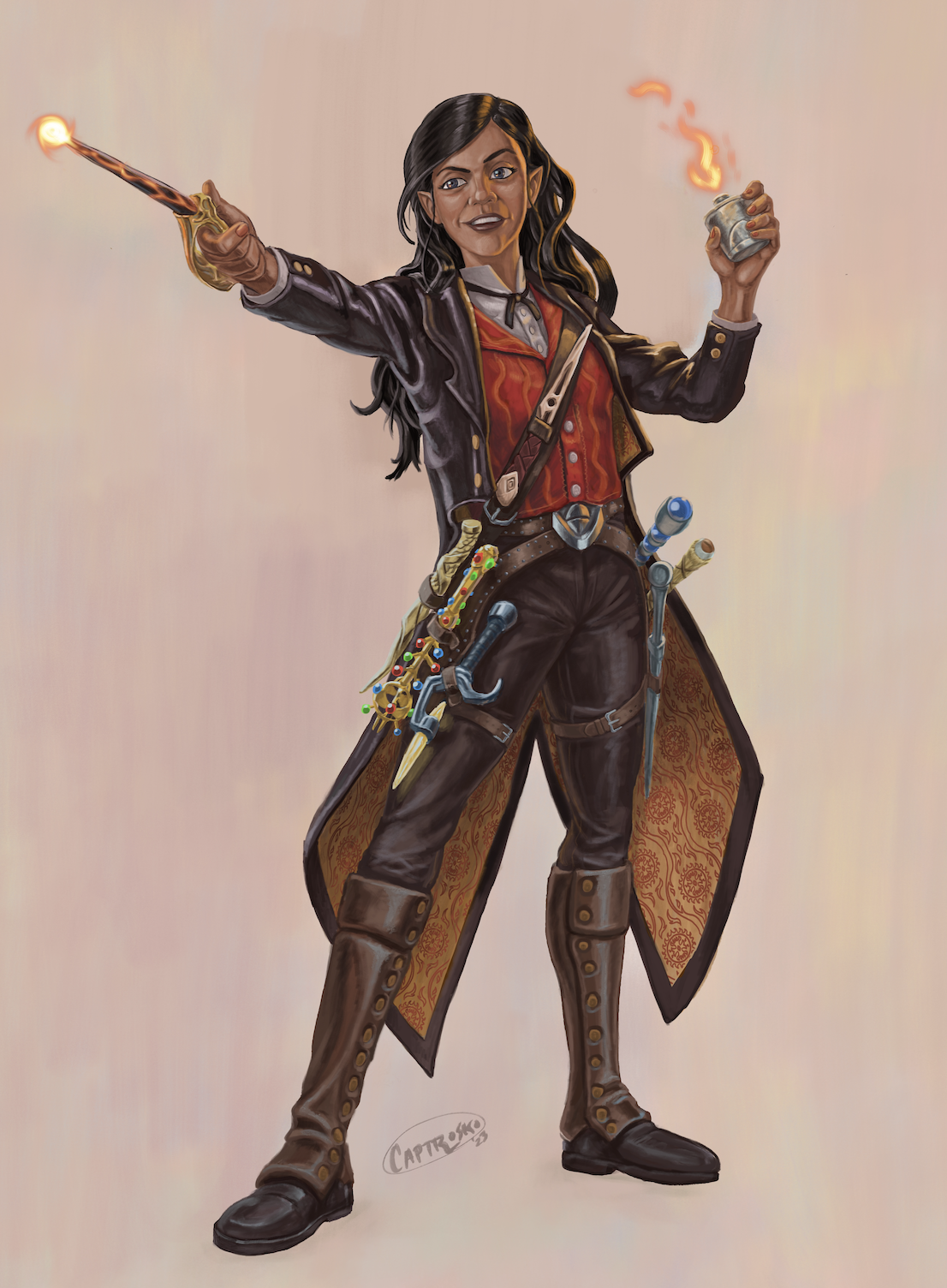
Each month I answer questions posed by my Patreon supporters. Here’s a few interesting ones from November!
Atur, the City of Night, is an independent duchy within Karrnath. This article provides a broad look at the city, while this article takes a closer look at the Grand Duke of Atur. As presented in these articles, Atur is a stronghold of the Blood of Vol in part because the city is built at the heart of a powerful Mabaran manifest zone. This allows for widespread use of necromancy in the same way that the manifest zones of Sharn makes it possible to build sky scraping towers. In fact, the ongoing rituals of the Blood of Vol play a crucial role in channeling and containing the dangerous energies of Mabar. Here’s a key quote from the first Atur article…
The Seekers have no attachment to corpses and most are happy to donate their remains to serve the greater good. As a result, skeletons are found performing menial tasks and manual labor across the city. Because they serve many different functions, they’re generally painted to indicate their service; blood-red for those associated with the Monastery or other temples, dark green for sanitation, black and gold for those tied to the city watch, blue for this tied to commerce; artists add often secondary designs that give each skeleton a little personality. However, these are standard skeletons, possessing limited intelligence; they are managed by Bone Wranglers, specialized magewrights who effectively program the undead.
So, skeletal labor is common place. But what are some other manifestations of necromancy in Atur? Here’s a few.
Bone Beasts. Obedient and tireless, skeletons make excellent laborers. While Atur is infamous for its practice of animating the bones of its citizens, the city makes use of the bones of many creatures. Skeletal horses, oxen, and tribex are found drawing wagons and coaches throughout the city. Skeletal hounds and wolves are employed as tireless watchdogs. Skeletal cats and rats control the living rate population. Skeletal pigeons are used as couriers. If you’re wondering how could a skeletal pigeon fly without flesh or feathers, consider that the bones of a skeletal are held together by mystical force, essentially translucent ectoplasm. It’s this same force that takes the place of the feathers and flesh of a skeletal bird. While the remains of any birds can be used to create couriers, pigeons are the most common choice.
Garghouls. The bonesmiths of Atur aren’t limited to direct animation of remains, and they create many forms of undead that use only parts of a corpse. Garghouls typically use a skull, which is embedded into a door or a statue and empowered to perform specific actions. For example, a door may have a skull embedded into it; the skull is aware of the people on the doorstep, and if you speak the proper password it will unlock the door. Properly enchanted garghouls can speak or sing, though they are not properly sentient and can only repeat phrases implanted by bone wranglers. Garghouls are often used as another form of security, triggering an alarm, glyph of warding, or simply taking notes on intruders or people they observe.
Ghastlights. As called out above, skeletons are held together by an ectoplasmic force. This is typically invisible, but under the right circumstances it can manifest as a green glow. The streetlights of Atur take advantage of this phenomenon. Shards of bone are implanted in lanterns shed an eerie light. The essence burns out over time, so you have bone-tenders wandering the streets with bags of broken bones freshening the lamps. Just as the towers of Sharn rely on the Syranian manifest zone, ghastlights only function in Mabaran zones with the proper traits.
Remnants. Some bonesmiths and wranglers specialize in working with partial remains. Garghouls are one example of this, but there’s a wide range of options. In Atur, you could encounter a gearwheel being turned by a tirelessly pumping pair of skeletal legs, or a chair with a pair of skeletal arms that massage you while you relax. Helping hands are skeletal hands that can be programmed to serve a variety of functions; consider Thing from The Addams Family. Most helping hands aren’t fully sentient and can only perform specific actions. However, there is a ritual that can bind a greater degree of a person’s essence to their hand… creating a creature that uses the stat block of the crawling claw, but without being inherently evil. Bones from a specific creature have a sympathetic resonance, which is why animate dead typically can’t use bones from multiple creatures mixed together. Bonesmiths can work with this connection; mansions in Atur have bone boards, where moving a knucklebone in the dining room (or any other room) rattles a matching fingerbone in the servant’s station.
Funerary Fashion. Remnants can be incorporated into clothing; fingerbones are often used as clasps. One of the more colorful accessories is the rasp, a skeletal serpent programmed to serve as a belt, boa, or other form of adornment. In addition to serving as a practical belt or fashion accessories. Rasps typically use the poisonous snake stat block combined with skeleton traits; they don’t produce poison, but can at least serve as a brief distraction if flung at an enemy and commanded to attack.
Bone Grafts. Eberron: Rising From The Last War introduces prosthetic limbs—common magic items that can take the place of a lost limb. Throughout the Five Nations these are usually made from wood or metal. In Atur, they are typically made from bone—which could be the polished bone from the original severed limb, or the limb of a different creature. It’s up to the DM to decide if these prosthetic limbs function beyond Atur and can thus be encountered anywhere in the world, or if they only function in a Mabaran manifest zone. Beyond their appearance, they function like typical prosthetic limbs. While they are made using necromantic rituals, they draw on the lifeforce of the bearer and thus aren’t affected by turn undead or similar effects. And before anyone asks, you can definitely get a skeletal version of an arcane propulsion arm!
These are just a few examples, but I hope they’ll inspire more ideas!
Exploring Eberron has a section on the Blood of Vol that addresses this. Here’s the relevant section…
If the power of the Blood of Vol flows from within, who answers when a cleric conjures a celestial or invokes planar ally? One simple answer is for the DM to use a being who has the statistics of a celestial or fiend, but that is formed from blood and magic; it’s a manifestation of your own divine essence and fades away when its work is done. This might seem a strange match for planar ally, a spell that normally requires payment to an external force, but even an ally of your own essence might demand a service in return. This could be seen as a request from your subconscious—a demand that you do something you know you should do, but that you’ve been trying to ignore. On the other hand, it could be a mysterious task with no discernible purpose; this ties to the fact that your Divinity Within is something beyond mere mortal understanding, and you don’t fully understand what it needs or wants.
Another possibility is that you’re drawing on the Seeker community rather than reaching to the planes for assistance. One principle of the faith is that champions become undead so that they can help other Seekers. When you cast planar ally, rather than calling a celestial or fiend, you might summon an undead champion of your faith; this could be anything from a vampire to a mummy lord or a death knight. In this case, the payment they demand for their service would likely be a tithe to the Seeker temple they are bound to. On a smaller scale, your DM could similarly decide that when you cast conjure celestial, it summons a sarcastic flameskull instead of an angel.
This is another relevant section…
As a divine spellcaster who follows the Blood of Vol, you believe that your power comes from your own soul. As a paladin, you are calling on the power of your own blood when you heal your allies or smite your enemies. The visible manifestations of magic of the Blood of Vol typically involve crimson energy, as if luminous tendrils of blood are flowing from you. But it’s not simply your power. Consider the Seeker priest who casts commune; how can they gain information they don’t already know? The answer is that the divinity within is something far greater than you. It is a god, possessing celestial power you can’t understand or imagine—but it is still in its chrysalis, waiting to be born. When you cast your spell, you awaken a sliver of its power; once the spell is done, it returns to its rest.
Atur is q special case. Chapter 18 of Chronicles of Eberron covers Karrnathi Undead and addresses their wider role in more detail. Here’s a relevant quote…
The followers of the Blood of Vol—who prefer the term Seekers—are the ones who practice necromancy and embrace the undead. The Blood of Vol has had a presence in Karrnath for over a thousand years, but it has never been the faith of the majority. During the Last War, Kaius I embraced the Blood of Vol and it gained greater influence; during this time, the undead were incorporated into the Karrnathi army. In more recent years, Kaius III and the Regent Moranna turned against the Blood of Vol. The chivalric orders of the Seekers were disbanded, and Kaius has used the Seekers as a scapegoat—blaming the famines and plagues that crippled Karrnath on the Seekers.
So with Joe Flyspeck village, the question is whether the village is a community of Seekers or Vassals. If it’s a Seeker village, they will be using undead labor as they have been for centuries. If it’s a Vassal community, they wouldn’t know how to create undead even if they wished to — and most wouldn’t. The people of Karrnath are USED to undead. The Seekers have been using them for over a thousand years, and they were part of the armies of Karrnath for decades. So Karrns won’t flinch when they meet a skeleton soldier or an oathbound (mummy) monk, and many Karrns are simply ambivalent about undead. But there are some who feel that the use of undead and embrace of the Seeker faith was a betrayal of the traditional culture of Karrnath — as noted above, who use the use of undead as an excuse for Karrnath’s losses in the Last War. “If we’d relied on pure Karrnathi steel and skill, King Kaius would be ruling a new Galifar now.” Because of these attitudes, you DON’T see a lot of undead labor in the major cities. Those who associate with undead are generally assumed to be Seekers. But Karrns are USED to undead, and not surprised to find Karrnathi undead used in special cases.
Sharn: City of Towers is the best source for information on the Code of Galifar, and talking about what constitutes a crime and how justice is enforced. The Code of Kaius uses the Galifar code as its foundation, but is a form of martial law. Under the Code of Galifar you are innocent until proven guilty, and if a crime is serious enough to go to court you may have a trial by jury. Neither is true under the Code of Kaius. Justice flows summarily from the warlord and their representatives, and there is no recourse or appeal. So what is considered a CRIME is generally the same, but punishments are harsher and often carried out on the spot. Meanwhile, crimes such as treason are interpreted more broadly in Karrnath; there’s no right to free speech, for example. That’s the basic concept; hopefully you can extrapolate from there.
So if you’re talking about WARRIORS, the answer you are looking for may lie in SHAVARATH. Consider this section from Exploring Eberron.
All mortal creatures have a spiritual connection to Shavarath, and there’s a sliver of their spirit in the plane. The strength of this sliver is determined by the mortal’s courage, willpower, and martial drive… Sometimes, on the death of a great mortal warrior, echoes of their personality and martial spirit can coalesce into a sword wraith (though its abilities may vary based on the champion it echoes). Unlike standard conscripts, sword wraiths are capable of meaningful action even without the direction of an immortal and can command conscripts of their own. A sword wraith has the appearance of its mortal source and some of the memories, but it’s only an echo of the mortal, much like the traces of memory that allow you to speak with dead. Sword wraiths reconcile their memories with the war within the layer. If there’s a sword wraith of Karrn the Conqueror commanding troops in Nullius Terram, he believes that he’s fighting for Karrnath and can’t be convinced otherwise; after all, he’s only a memory, and there are limits to his ability to reason.
So adventurers might meet a sword wraith of Lhazaar commanding a ship in the Bloody Sea. Dhakaani champions, the Mror clan founders, heroes of the Last War—any of these could be found as sword wraiths, serving the legion that best matches their values. There are sword wraiths of many patron ancestors of the Tairnadal elves; however, these aren’t the patrons themselves, simply echoes left behind. While sword wraiths generally form after a mortal’s death, the slivers of especially remarkable heroes can manifest sword wraiths even while alive. King Boranel of Breland surely has a sword wraith serving in the Legion of Justice, and it’s possible an adventurer could meet their own sword wraith while exploring Shavarath.
Meanwhile, Thelanis isn’t affected by HISTORY or real events. Consider this from Exploring Eberron:
Breland tells tales of the Sleeping Prince, cursed to slumber by a cruel hag until he’s saved by the courage of the Woodcutter’s Daughter. In the Mror Holds, there’s a tale older than Breland itself, in which Lady Narathun curses Doldarun’s son with eternal sleep, until he’s saved by humble Toldorath. And the Dhakaani dar have an ancient story about how Hezhaal—a dirge singer who betrayed the empire and studied sinister magic—cast the marhu’s son into a cursed slumber, until he was saved by a simple golin’dar.
The stories of Thelanis don’t exist BECAUSE of events in the material plane; instead, events on the material plane are sometimes drawn to reflect Thelanian stories. So there may well BE a Dread Conqueror in Thelanis. But if so, there’s ALWAYS been a Dread Conqueror in Thelanis, and scholars will say “Ah, you can see how in Karrnathi folk tales Karrn the Conqueror assumed the role of the Dread Conqueror; but you can find a similar version of these stories in Nulakhesh, based around the deeds of the Iron Emperor.“
Part of what you’re running into is the fact that mortals are more complex than immortals. Mortals have shades and dimensions. Immortals embody specific iconic concepts. So with a figure like Genghis Khan, there’s three distinct ideas you could explore which would all be different immortals.
… the further point here is that the story won’t change, because what you’re dealing with isn’t REAL, it’s SYMBOLIC. Mabar is about despair and decay. Irian is about hope and growth. The Victorious Emperor in Irian will ALWAYS be enjoying the rise of his empire, while the Emperor in Darkness will always be sullenly watching it collapse. Meanwhile, yes, the fact that the the triumph of the Victorious Emperor means that other people have been subjugated isn’t the focus of the story in Irian; an immortal in Irian embodies hope and triumph. If you want to see brutal conquest, you need to go to Shavarath. And again, this is what makes the material plane special and what makes mortals special—they can be many things at once. Their stories can evolve and change. They can create hope and despair through the same action. Most immortals are inherently more two-dimensional, because they are symbols, not people. And keep in mind that the mortal Genghis Khan would cast a shadow in Mabar, a sword wraith in Shavarath, an ember in Irian—because he touches them all. As a side note, the idea of the empire-in-decline is one story you could tell about Genghis in Mabar. Another would be the Collapsing Empire—the story of the empire being CONQUERED by Genghis, facing an implacable enemy and knowing the end is near. Again, if the story was about the ACTUAL BATTLE it would be in Shavarath; but if the story is about the DESPAIR and terror of the people forever awaiting the arrival of the Horde, endlessly preparing but knowing no preparations will be sufficient… that’s Mabar.
That’s all for now! Thanks again to my patrons for posing these and many other questions, and for making these articles possible. If you have questions of your own—or if you’d like to play in my ongoing Eberron campaign—check out my Patreon!
 Unlock with Patreon