Six Questions: Will Hindmarch

I know a lot of interesting people. Some I’ve worked with, some I’ve met while traveling the world, some just owe me money. My name may be on the website, but it seems kind of boring if I’m the only person whose voice is heard here. So I’m bringing some of my friends to the site, as time permits. I’m not a podcasty kind of guy, so I’m just keeping things simple: one guest, six questions.
My guest this week is designer WILL HINDMARCH. He does an excellent job of covering his career at his website. In short, he is a writer, gamer designer, and extremely clever person. Over the years we have collaborated on a number of things. We worked together on the Feng Shui sourcebook Friends of the Dragon, which may (absolutely no guarantees) be one of the first places where flashbacks are suggested as an RPG story mechanic. Years later Will invited me to take part in his anthology The Bones: Us and Our Dice. Later still I had a chance to play in his cyberpunk adventure Always/Never/Now, which was one of the most entertaining roleplaying experiences I can recall. This doesn’t begin to touch on the scope of his work… like I said, check his bio. And now, let’s get to the questions!

Who are you? Please answer in exactly five words. 

Writer, designer, gamer, mooncalf? Word.

What have you done over the last decade?

Not enough. Since 2002, either on staff or as a freelancer, I’ve put a fingerprint on something like 100+ publications, mostly in the game sector, and it still feels like I’m lagging behind prized contemporaries and luminaries.

In the past decade, I’ve gotten married, moved from city to city a few times, and learned a lot about writing, design, development, and production from some of the gaming hobby’s most-skilled people. I’ve achieved a few long-term goals from my past but I have a lot more still waiting to be realized. I’ve sailed on the surface and I’ve scraped the bottom of the sea, but at least I’m still here, chasing new goals. Advance, setback, pirouette, onward.

The big thing that I’ve done in the past ten years and get to know some of my favorite game designers, writers, and other creative folk in a way that goes beyond fan mail or a handshake. I count myself incredibly lucky for the company I’m allowed to keep. I’m surrounded by intimidating talents and wonderful hearts and cunning minds and while I haven’t yet made the mark (or all the games and books) that I so desperately wanted to make by this point, I am better primed to do those things now than I was before. I remain hopeful, most days.

Always, Never, or Now?

I wish the answer was “always.” I fear the answer is “never.” I know it isn’t “now.”

What’s your favorite game you didn’t create?

Tricky, this one. I have created a number of games close to zero. Most of my work has been on other people’s games, expansions, and supplements. Vexing.

Truth is, I am near-sighted when it comes to favorites—my favorite game is often the one that I am obsessed with in the moment, so not only does my favoritism juke and weave, it often doubles back and leads me through the woods to familiar groves after years away. Which is to say, I don’t know. I’ve singled out Castle Falkenstein as an answer to this question a few times, but there have been times when my favorite game was Wraith: The Oblivion, the Saga system (whether it’s powering fantastical or super-heroic roleplaying), and I’m plainly a sucker for the confluence of mechanics that make up Lady Blackbird. I’ve been playing a whole lot of 7 Wonders for the last year or so, too; I admire that game rather a lot.

But my favorite game? It’s probably Thief: The Dark Project. That’s the most engaged and captivated I have ever been in actual play, and I was engaged and captivated something close to my maximum amount by that game. It builds a terrific world, tells a great tale, features wonderful characterization and mechanics, and is probably the most frightening game I have ever played.

If you were trapped on a desert island, what three dice would you take?

Probably 2d6 and 1d10. I can play a whole lot of my favorite RPGs with the sweet curve of 2d6 and the nice simple determination of a single ten-sider. Plus, if I can tally in the sand or make tick-marks on the tree(s), I can track successes and play all manner of great games calling for more dice. The sand will become a record of adventure, grooved all over with the scrap measurements of play, maybe even gridded out with a simple board for tracking coconut goblins and sea-smoothed stones standing in for bold adventurers.

When the sailors finally row up to rescue us, I’ll hold up my finger and be like, “Let’s just finish this round to see if we can save the lost treasure.”

What’s one of your favorite ways to set the mood when you’re running an RPG?

Music. I use a lot of tricks and techniques, from small talk to cadence to lighting, but music is one of my favorites because it’s like getting a whole secondary channel of mood and information into the play space. I can say one thing and let the music support or confound those words and create a situation or atmosphere that much more nuanced than I could do with just words alone. I’ve written a fair bit about this and hope to write more. A lot of what I do with music at the game table is intuitive but I’m eager to externalize it as actionable advice one day.

Have A Gloomy Holiday!

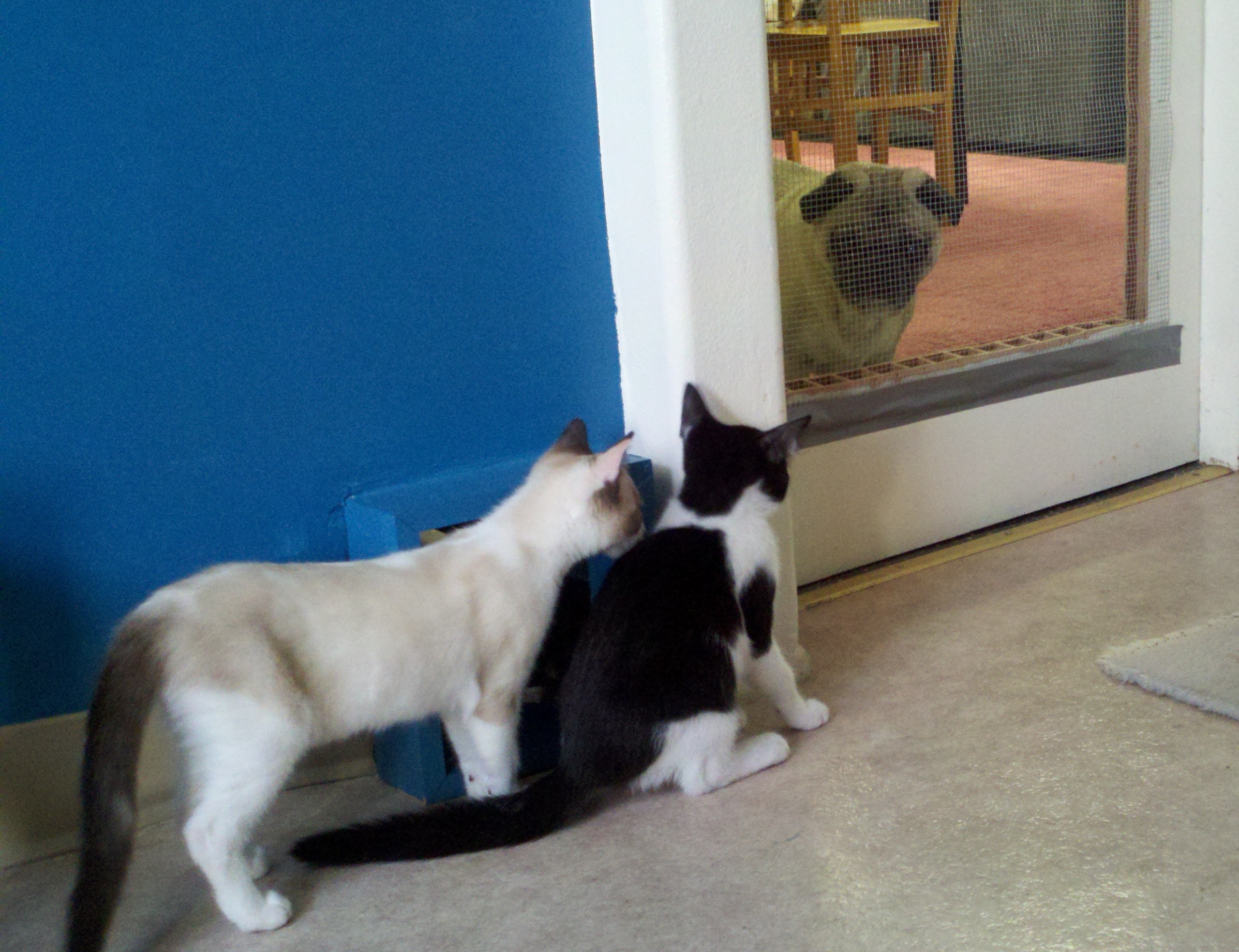
Overall, I’m pretty happy with 2012. We survived the Mayan Y2K+12 Bug with a fine bunker warming featuring Molly Lewis & the Doubleclicks. Looking back over the year, Jenn and returned to Portland after a brief stay in Austin, Texas. We sailed the seas on the second JoCoCrazyCruise. We acquired a pair of adorable kittens who have since quadrupled in size…

Our lives are one big adorable YouTube video.

In gaming news, I released Cthulhu Fluxx and the first expansion for Cthulhu Gloom, Unpleasant Dreams. Gloom was featured on the Geek & Sundry show Tabletop. I’ve expanded this site with Six Questions, which has helped me to get to know some of my friends a little better and answered such burning questions as “What three dice would Will Hindmarch take to a desert island?”

In gloomier news, the current issue of Dragon marks the final installment of the Eye on Eberron series. It is my hope that Eberron will continue to be supported in D&D Next, but I don’t have any news on that front. With that in mind, I am developing a new fantasy setting that I’ll be using as a foundation for games and fiction. Expect to see a more detailed discussion of this new world over the next few months!

I count myself lucky for all of the good things in my life. I’m grateful to be surrounded by good friends and family, and especially for my wonderful wife Jenn. And I consider myself blessed to have been able to share my creations with so many people. Working on Gloom and Eberron has been a wonderful experience. I always enjoy discussing my games and novels with people, and if there are things you’d like to know, use that contact button on the right!

Happy holidays to all of you, and I look forward to sharing stories in 2013!


Dragonmarks 12/21: Is Boranel Evil?

This will likely be the last Dragonmark of 2012. Come the new year, I will be focusing most of my creative energy on my new world, which I’ll talk more about next week. In months ahead, I will be discussing elements of the new world and asking for your opinions on different things. However, Eberron remains close to my heart and I will continue to do Dragonmark posts; they’re just more likely to be monthly than weekly. And while I have no new information on the subject, I hope that Eberron will be supported in D&D Next – if you want to see Eberron support in DDN, keep asking WotC and hope for the best!

As always, the answers to the questions below are my personal opinions and may conflict with canon sources.  

If Krozen’s evil, shouldn’t Boranel be evil too? He uses his dark lanterns to commit assassination, theft etc: evil acts.

Does he? Again, for my opinions on alignment in Eberron, take a look at this post. I’d pay particular attention to the discussion of Kaius and Aurala, and the note that Aurala’s generals and ministers may engage on actions on behalf of Aundair she wouldn’t personally condone.

Let’s compare Zilargo and Breland for a moment. Both have exceptional intelligence services. Both employ assassins. But just how do they employ those assassins? In Zilargo, the Trust routinely deploys assassins against its own citizens. Not only that, it regularly engages in pre-emptive assassination, killing people who haven’t yet committed any crime (but will if they aren’t stopped). They are content to, in short, rule through terror and the threat of execution.

In Breland, Lord Ruken ir’Clarn is the leader of a movement determined to end the Brelish monarchy when Boranel dies. He seeks to rob Boranel’s children of their birthright and change Brelish tradition. And yet, he’s still alive. Do you think Boranel doesn’t know what he’s up to? Do you think that Ruken is somehow so amazing that the Dark Lanterns couldn’t kill him? No on both counts. His shield is that he’s a Brelish noble and member of parliament whose actions are, by and large, purely democratic in nature. Boranel doesn’t want ir’Clarn to succeed, but if it the will of the people that he does, Boranel will accept it. I’ll also point to the fact that despite the Citadel being a key edge Breland had over the other nations during the Last War, Dark Lanterns were never deployed to assassinate other kings or queens. They were certainly employed in the war – look to Thorn’s Far Passage assignment – but there were places the king wouldn’t go.

Looking to the Thorn of Breland novels, Thorn’s first assignment is to recover a prisoner from a nation that is NOT a signatory of the Treaty of Thronehold and thus not bound by the Code of Galifar. Thorn is told that she is authorized to kill that prisoner’s jailer if need be, but that isn’t the mission; she’s there to rescue a prisoner, not specifically to assassinate a foreign leader. In the second novel, she is sent to identify a terrorist threat to Breland, and if it exists, to eliminate its leader. This is a straight-up assassination, true, but again it is targeting a criminal who potentially poses a threat to every citizen of Sharn… and she’s instructed to confirm that he is a threat before carrying out the sentence (and she’s pretty cranky about acting as what she sees as a paid assassin for House Cannith). In the third novel, her initial assignment is to protect Prince Oargev from assassins, and she’s authorized to use lethal force in the process – but she’s there in a defensive capacity. Breland is willing to employ assassination as a tool against terrorists and monsters. But it doesn’t use it casually and it chooses targets carefully. More important is the fact that Boranel is King of Breland, not master of the Citadel. He allows the Dark Lanterns to exist. At times, he even requests specific actions from them. But he is NOT their direct commander and is in all likelihood not even aware of many of the assassinations that they carry out. Who is? People like Talleon Haliar Tonan, commander of the Sharn Dark Lanterns (Sharn: City of Towers page 139). Talleon is specifically noted as being “devoted to the preservation of Breland and to the King, but he is utterly ruthless, and authorizes torture, theft, and assassination if the mission requires it.” I highlight the but because it speaks to the fact that this isn’t the general tone of Breland or the general will of the king; Talleon is willing to take extreme action in defense of the kingdom that Boranel likely wouldn’t approve of. And what’s Talleon’s alignment? Lawful evil. He works within a hierarchy and system – but he is willing to engage in evil acts to preserve that system.

Earlier there was a long discussion about the Valenar invasion, and that the Humans were only too happy to throw off the yoke of Cyran rule, based on hatreds dating back to old Sarlona. But what of Lhesh Haruuc’s creation of Darguun — from lands that had also been part of Cyre? Were the Humans there from the same region of Sarlona as those in Valenar?

No, I don’t believe that the human inhabitants of Darguun were or are of Khunan descent. The Khunans were never a numerous people. They fled directly across ocean during the Sundering, settling on the east coast of Khorvaire. They were thus refugees, not a planned settlement; they didn’t come with supplies or plans for expansion; and the region that is now Valenar was quite sufficient for their needs. You see similar “refugee colonist” cultures in the Shadow Marches and the Demon Wastes; in both cases you have a similar situation where these people were happy to settle where they landed and never had need or resources to push deeper into the continent.

Meanwhile, the people of Cyre are largely descended from the blended folk of Rhiavaar, Nulakesh, and Pyrine—people who came in an organized wave of colonization and expansion. Nonetheless, the human population density of Khorvaire is relatively low, and the Five Nations always claimed territory that they didn’t really need. Breland claimed Droaam and the Shadow Marches as part of its domain; however, unlike Cyre, it never actually conquered those territories. Cyre DID conquer Khunan Valenar and set its nobles up as overlords.

Being far inland, Darguun never had refugee colonists. Cyre claimed the territory and had settlers there, but it never had a particularly dense human population. The main reason it was so easily stolen is that Cyre’s grip on it was always tenuous… and there was no way it could stretch itself to reclaim that largely unnecessary region when it was already hard pressed on all sides by the other nations.

As I recall from a flashback scene in the Heirs of Dhakaan trilogy, some Cyrans fought back…and died. Are the rest now slaves, or did Haruuc treat them with dignity in exchange for their acceptance of the new realilty?

Haruuc had no interest in being an occupying force. He didn’t want to conquer humans; he wanted them out of the land that rightfully belonged to his people. As such, Cyrans suffered one of three fates:

  • Exile. Those who were smart and fled towards the heart of Cyre were largely allowed to leave.
  • Death. Again, Haruuc didn’t want the hassle of managing a large captive population, and unlike the Valenar he had no intention of becoming a liege lord to human vassals; again, he was building a new homeland for his people, taking back the land originally stolen by humanity. There was no room for human dignity in this equation. If people resisted, most were killed.
  • Slavery. Some prisoners were kept as slaves. Again, the goblin view is that these are the people who stole Khorvaire from their ancestors; they deserve no better.

Having said that, there’s no reason that INDIVIDUAL humans couldn’t earn the respect of the goblins around them and find some sort of acceptance within a Darguul community. But that would very much be a case by case basis; it wasn’t Haruuc’s intention in the war of foundation.

I will also point out that the Valenar had a longer engrained relationship with the Khunans. The Valenar had defended the region for decades. The Khunans were used to their presence; there were adults with no living memory of a time when they didn’t have Valenar defenders. The Valenar simply killed the Cyran overlords and said “We’re in charge now” and the Khunans largely said “OK, doesn’t make much difference to us.” In Darguun, you didn’t have this sort of pre-existing relationship. Goblins were employed as mercenaries, but the percentage of mercenary goblins was quite low compared to the current population of Darguun; Haruuc brought together a host of goblins who had never had anything to do with humans, promising them a better land and better life.

Apart from Aundair, who is more likely to ignite the next war?

If I had to pick one force, I’d go with the Lords of Dust supporting Rak Tulkhesh. The question is who they would trick into starting it for them. This is discussed in more detail in a recent Eye on Eberron article (http://www.wizards.com/dnd/Article.aspx?x=dnd/dragon/2012October).

What 3 historical events in Eberron timeline would make the best backdrops/focus for one-off adventures?

It’s very difficult for me to limit myself to three. So I’ll just say that these are three events I believe would make good one-offs – but by no means the only ones. If I had the time, I could come up with twenty, easy. And no, I don’t have time.

The Lycanthropic Purge: Part One. Some people have the idea that the Purge was a one-sided affair, with poor miserable lycanthropes being relentlessly pursued by evil templars. This wasn’t the case at all. When it began, it was a war. I like to call it “28 Days Later with werewolves instead of zombies.” I’d also consider Aliens to be an excellent inspiration for tone. A single lycanthrope was generally far more than a match for the typical templar (most likely a 1st level warrior) and all it takes is a single bite to pass the infection. I’ve often wanted to make a one-off about a group of lost/scattered templars and local shifters forced into an uneasy alliance as they try to escape suddenly hostile territory, or to deal with a fiend-possessed lycanthrope leader… dealing both with an extremely deadly foe and their own distrust of one another.

The Lycanthropic Purge: Part Two. Eventually the power of the curse was broken; the number of lycanthropes were cut down to more containable numbers; and it became closer to a witch-hunt. But that witch-hunt could make for a very interesting one shot. The PCs are a mix of Silver Flame inquisitors and local villagers. There are wererats in the village, and they are murderous, malevolent and very clever… and they will do their best to trick you into harming innocents. Can you find the true villains without harming or killing innocent people?

Against The Giants. The PCs take on the roles of elven resistance fighters from a variety of cultures in the last days of the war against the giants. You’ve got a drow assassin who’s turned on his former masters but is still distrusted by the others; a haughty Qabalrin necromancer and a Cul’sir wizard liberated from the giants… along with early Tairnadal. Take this group and turn it into Inglorious Basterds. I want my titan scalps!

Do you ever tire of creating content for the ‘kitchen sink’ of campaign settings?

This is related to another question…

Did you ever feel like the stipulation of “if it’s in 3.5, it’s in Eberron” hurt your creativity in any way?   Two examples of which that I can think of just to edify my point are this: I’m personally not a huge fan of psionics, but you not only have a custom race with them, but in fact an entire continent.  Arguably putting it on par of importance with Dragons (one part of the name of the game).   Second example is the creative take you took on the drow in Xen’drik.  I felt like they were something that had to be put in due to fan love for their race, and that you had to add, but that you really twisted on it’s head._

First, let’s tackle the phrase “kitchen sink.” This impression usually comes from that second phrase – the fact that one of the ten things you should know about Eberron is “if it’s in D&D, it has a place in Eberron.” The key to me is that when I hear “kitchen sink”, I think of it as a negative term that implies that things are jammed together with no rhyme or reason. We’re going to have a culture that is effectively identical to revolutionary France next to an Aztec nation next to Menzoberranzan. This isn’t the case in Eberron. Just look at the answers I’ve given in the last few posts. They are answers about the unique history and cultures of Eberron – the political and religious conflict between Thrane and Cyre; the fate of Cyran refugees; the difference between Boranel and Krozen. My recent Eye on Eberron articles deal with the Rage of War, the sacred assassins of the Silver Flame, and the Children of Winter. None of these are in any way defined by it being a “kitchen sink”; they are tied to the religions and mystical forces unique to the world.

It’s also vital to recognize that the statement isn’t “If it’s in D&D, it’s in Eberron.” It’s “If it’s in D&D, it has a place in Eberron.” If you love abeil (bee people), there are many places you COULD put them. They could have a lost hive-city deep in Xen’drik. They could be a product of the Mourning, in which a Cyran city was transformed into an Abeil hive. They could be a new creation of Mordain the Fleshweaver. But if I don’t like abeil, I don’t have to use them at all. They aren’t IN Eberron; it’s simply easy for you to add them in if YOU want to. There’s a place for them in Eberron. This is the key to the statement that Eberron is a “kitchen sink.” It’s as much of a kitchen sink as you want it to be. I don’t use goliaths, genasi, illumians, chaos gnomes, etc. But if I wanted to, I could find a place for them.

With that said, there are things I was forced to put in. We needed a clear role for the core races of D&D, including the drow… and with the advent of 4E, including dragonborn and eladrin. 4E added Baator to the cosmology. Now, if I had been told “The drow must be just like Forgotten Realms… in fact, we want you to put Menzoberranzan somewhere” I would be very frustrated. Instead, my challenge was “you’ve got to have drow… but what makes the drow of Eberron unique? What makes the eladrin of Eberron different from those of other settings?” I think the EoE article on Baator is the best example of this. I will admit that I HATED having Baator added to the cosmology when it wasn’t there before. The Eye on Eberron article gave me a chance to define Baator in a way that made sense for Eberron… to create a new story for it, one that used the same familiar cast of characters but gave them a new backstory, motivation and role in the world than how they’d been used before. Baator is a divine prison, and Asmodeus has only just broken his bonds and risen to power; the archdevils have an element of warring crimelords, struggling to build new empires from ashes.  It’s a completely different way of using the devils than you’d get in 4E core, and that’s what I like. If YOU like Menzoberranzan, you can add it to Eberron; no one’s stopping you. But I’m going to offer the Sulatar, Qaltiar, and Umbragen.

So is it creatively stifling? It IS limiting to be forced to work in some of these things, sure. There are some I wouldn’t add in if I was doing it entirely on my own, absolutely. But if anything, it’s an interesting creative challenge to say “How do I make gnomes that AREN’T the gnomes you find elsewhere?”

Looking to psionics, that was my choice from the start, not something forced upon the world. When I read my original AD&D Player’s Handbook, it came with an appendix on psionics. They’ve always been around in D&D, but they’ve generally been a weird stepchild that doesn’t really fit the tone of everything else… or forced on everyone, as in Dark Sun. With Eberron, I wanted a compromise. I wanted to give psionics a logical place in the world, and to consider the impact they would have on a culture much as Khorvaire explores the impact of magic. But I also wanted to make sure that someone who HATED psionics could essentially ignore them. Hence, Riedra. If you LIKE psionics, play up the role of the kalashtar and Dreaming Dark, and maybe even set your campaign in Riedra. If you hate psionics, drop the Dreaming Dark and the Kalashtar, and never go to Riedra. You don’t NEED to put kalashtar in your campaign; but if you like them, they have a place complete with history, conflict, and culture.

If you ever tire of it, what kind of theme/campaign setting would you prefer to work on?

Funny you should ask, as I AM working on a new campaign setting. Thanks to Jeff LaSala, I’m due to write about my “Next Big Thing”, and that is going to be my new campaign setting. The holidays have pushed me off schedule, so it won’t come out until next week, but expect more news then… to be followed by an ongoing discussion of the world as it moves towards completion.

Six Questions: The Doubleclicks!

I know a lot of interesting people. Some I’ve worked with, some I’ve met while traveling the world, some just owe me money. My name may be on the website, but it seems kind of boring if I’m the only person whose voice is heard here. So I’m bringing some of my friends to the site, as time permits. I’m not a podcasty kind of guy, so I’m just keeping things simple: one guest, six questions.

The Doubleclicks: Aubrey (L) and Angela (R)

My guests today are THE DOUBLECLICKS, Portland’s hottest comedy/nerd/folk sister band. In their own words, they “write songs about Dungeons & Dragons, beatboxing, and lots and lots of heartbreak.” You may know them from W00tstock or the Ladies of Ragnarok, or you may not know them at all, in which case you should stream some music right now.

On to the questions!

How did you get started? What drove you to dive into the cutthroat, Smaug-eat-Smaug world of Nerd-Folk music?

Angela: Growing up and through school, my favorite music has always been stuff with lyrics that have something to say – usually something funny – like They Might Be Giants or Jonathan Coulton. I started playing guitar during college, because, despite having a very musical family, it wasn’t until I left home that I realized that playing guitar actually “makes you cool.” Aubrey moved out to Portland toward the end of my college career, and encouraged me to write songs and perform them with her at a local open mic night – and, when it came to songwriting, I immediately jumped to emulate my influences – with songs that are more about lyrics and storytelling than anything else. That was almost 4 years ago now. We officially started the band in 2011, and we’ve had just an amazing time.

Aubrey: Angela started writing songs and playing the guitar for her friends, and I dragged her out to open mics around Portland because I knew other people would be delighted by her performances. Then we started playing little shows for our friends and found a band name, started writing more songs… and have been meeting amazing people ever since!

If you were taken to a zoo on a distant planet and forced to perform three of your songs for the rest of your lives, which three would you choose?

Angela: Oh, how I hope this doesn’t happen. For the first, I’d choose Oh, Mr. Darcy, because it’s a true story that has shaped who I am. For the second, I’d choose Imposter (the song about Mars Curiosity), because it’s also got true sentiments, plus it’s about space, so that might help us gain some sympathy with our alien zoo-keepers. For the third, it seems like I should choose a happy one, but I think I’d choose “A Song about EVE Online,” because it’s hard to play, and if we had to perform the same songs for the rest of our lives, we might as well be improving.

Aubrey: Setting the mood, Imposter, and Clever Girl.

Is “This Fantasy World” based on a true story? How did you get started with gaming, and what are some of your favorites?

Angela: “This Fantasy World” is about meeting someone in a Dungeons and Dragons game and falling in love. It is, in fact, based on a true story – it’s about the D&D game in college, in which I met my boyfriend. I got started with gaming in high school – my friends and I would play D&D with dice and graph paper in the foyer of our school, while I waited for my mom, who taught at my school, to be finished, so I could go home. My experience, through high school and college, was pretty limited to D&D, occasional tries at Werewolf or Mage, and some board games like Twilight Imperium (I didn’t know any better, ok?). It wasn’t really until we started the band that our worlds were expanded to see awesome indie RPGs like Lady Blackbird and Dungeon World, and fantastic board games – my current favorites being Ticket to Ride and Lords of Waterdeep (I’m a sucker for victory points).

You’ve just released a holiday album, Christmas Ain’t About Me. What makes it different from the average holiday collection?

Angela: Christmas Ain’t About Me is our take on Christmas. There are a couple of songs that are specific to this year’s holiday – about the old man with the white beard who makes the season great (Gandalf), and what happens on December 21 (The End Of The World.) We also took some of the classic Christmas Song Types – the love song, the travel song, and the song from a kid’s perspective – and twisted them to our own experiences. The making of this album was a great experience in getting-something-done-and-out-there-quickly – and we’re very proud of how it turned out.

Aubrey: There are several holiday themes- children, elves, presents, travel, being with friends… but we based it off our personal experiences which makes it a bit nerdier than average.

In honor of your song “Worst Superpower Ever”, I have to ask: Would you rather have Superman’s super-ventriloquism or Batman’s bat-thermal-underwear?

Angela: That is a tough choice – both of those seem *amazing.* I’d probably go with bat-thermal-underwear though, because super-ventriloquism seems like it go horribly wrong more often than not.

Aubrey: I want the thermal underwear! Being warm when it’s freezing outside makes me unstoppable!

What’s next?

This Friday, we are prepping for the apocalypse with a live-streamed bunker concert on Molly Lewis’ YouTube Channel at 7:30 pm PST. If we survive, in 2013, we will hit the road for a West Coast tour through Seattle, Portland and most of California – playing in a lot of game and comic stores. We’re planning to make a new album in the first half of 2013, and then tour all over the place, because touring is awesome.

Six Questions: Erin Evans

I know a lot of interesting people. Some I’ve worked with, some I’ve met while traveling the world, some just owe me money. My name may be on the website, but it seems kind of boring if I’m the only person whose voice is heard here. So I’m bringing some of my friends to the site, as time permits. I’m not a podcasty kind of guy, so I’m just keeping things simple: one guest, six questions.

Looking to my own novels, my favorites are the Thorn of Breland series. This is partially due to the excellent work of my editor, ERIN EVANS. You may know Erin from her own Forgotten Realm fiction, including The God Catcher and Brimstone Angels. Her most recent release is Lesser Evils, the second Brimstone Angels book.

What have you done over the last decade?

Met this guy. Graduated college. Bought an RV. Named it the Chairman. Drove east. Wrote. Drove West. Wrote. Worried. Became an ezine columnist. Lived in National Parks. Lived in Vegas. Wrote a little better. Landed, finally, in Seattle. Sold the Chairman. Got an internship with a small press (Per Aspera Press). Got a crash course on publishing. Wrote a little better. Bought a townhouse. Got a “real job” as an editor for Wizards of the Coast. Got married to that guy. Become Eberron line editor. Edited you three times. Wrote The God Catcher. Wrote a lot better. Got laid off. Had crisis.Wrote Brimstone Angels. Became freelancer. Worked on TERA. Told people they should at the very least play through to the quests with Fraya, because I wrote all her dialogue and I’m really proud of it. Had a baby. Wrote Lesser Evils. Was chosen for the Sundering series, the relaunch of the Forgotten Realms for D&DNext. Got this email. Bought a house. Forgot this email. Found it again. Answered.

The protagonist of Brimstone Angels is a tiefling – a horned humanoid with fiendish characteristics. Why drove you to write about tieflings? What’s appealing or alien about them? 

I have this thing about “ugly” characters. My therapist would probably have things to say about it (that I would probably turn around and use in a story!), but it boils down to the fact that I feel like if your character is going to be “weird” you should go all in–I don’t want to read about how hard your elf has it for having odd ears. I don’t buy it. I love 4E style tieflings, because you can’t pull your narrative punch and opt for a human with teeny sexy horns and a faintly unsettling air. They have to deal with their heritage and how it makes people react–whether that’s internalizing those preconceptions or raging against them or throwing themselves headlong into fulfilling them. There are a lot of very relatable character options created by those big horns and tail.

And it makes a lot of story options too. One thing I love about fantasy is that you can talk about real world issues in a way that feels “safe.” A lot of people who might feel uncomfortable confronting their own biases head-on can think about them more easily when you’re talking about people who aren’t real–and then you can make that leap to real-world. I know that helped me a lot. So things like having Brin, one of the main characters of Brimstone Angels and a human, react in a very expected, kind of bigoted way when he first meets the tiefling twins, and then reconsider his opinions when he hears other people taking those assumptions to places the girls didn’t earn, and reconsider further when he gets to know them–I love that.

What character from fantasy fiction would you like to punch in the face? 

Isn’t everyone’s answer Joffrey Baratheon? I know he’s a kid, but come on.

My second answer is a shameless plug: One of the villains in my next book Lesser Evils is a Netherese wizard called Adolican Rhand. Normally, I like writing villains that you sort of sympathize with–complex people who are making choices you can understand, until you get to thepart where they want to wipe out all the elves or blow up the moon or just burn down an orphanage. I think those villains are more interesting and, on a certain level, scarier–if you’re agreeing with them or feeling sorry for them, it’s a reminder that you too could have made a similar path.

But for Lesser Evils, I ended up with one villain who is meant to embody what’s scary about Shade–they feel entitled to an empire, and what lies between them and that goal isn’t something they really consider. And as a result Rhand became the creepy embodiment of a very visceral fear. I hate writing about him, because all I want Farideh to do is run like the wind. I have said before that if someone came up to me at a con cosplaying as Adolican Rhand, I would punch them in the face and run away, and apologize later from a distance. He just ooks me out that much.

What’s your favorite scene from one of your stories?

I still really love the scene in The God Catcher where Nestrix is buying a cloak and starts having flashbacks to what she remembers during the Spellplague. That was one of those scenes that came out whole cloth, and said everything I wanted it to in a very immersive way. But I have a lot of runners up: the prologue from Brimstone Angels, the fight with the gravehounds from “The Resurrection Agent,” and there’s a flashback scene with Brin in Lesser Evils that I really love. I think what they all have in common is that these are scenes that I feel managed to be the kind of thing that sucks you in as a reader and put you in the POV character’s mindset exactly how I want.

If you were sent to a desert island and only allowed to take three books, which would be the last one you’d burn to stay warm?

I’ve said it over and over, but To Say Nothing of the Dog by Connie Willis is just my favorite book bar none. To me, it hits a wonderful balance between concept and plot and character. And it’s hilarious. So I would hold onto that for as long as I could. Also, my copy is a mass market paperback, so it wouldn’t last long in a fire.

What are you looking forward to?

Finishing the first draft of my next book The Adversary. I’m really excited to be included in the lineup for The Sundering (along with R.A. Salvatore, Paul S. Kemp, Richard Lee Byers, Troy Denning, and Ed Greenwood), but I also like getting through the first draft. Partly because I’m at the stage now where I’m noticing things that need to be changed and debating changing them now or later, but also, once it’s done, you can see the whole shape of the piece and find the rest of the places it can be made even better.

Dragonmarks 12/5: Siberys, Flame and Hybrids!

Soon I’ll start talking about the new setting I’m working on, but for now here’s another round of Eberron answers to chew on. As always, these are just my personal opinions & aren’t canon in any way.

What can you tell us about the status of Eberron in the next edition?

At this point in time, I have no new information. It’s my hope that it will be supported, but I haven’t heard anything positive or negative in this regard.

When will you write more novels? Are you writing one now? Write one now.

As regards Eberron novels, that’s up to Wizards of the Coast, not me. Eberron belongs to WotC, and they are the only ones empowered to authorize Eberron stories. There’s lots of stories I’d like to tell, and this is one reason I’m working on a new setting – so that I’ll have free rein to develop fiction in that world.

In the unlikely event that a Warforged gained a dragonmark, would it replace the ghulra, or be its own thing?

A warforged getting a dragonmark is going to be a one of a kind story, so it’s up to you, really. Is the dragonmark somehow manufactured? Is the Prophecy declaring this warforged to be a tool of destiny? This will likely manifest in different ways. However, I personally wouldn’t replace the ghulra. The ghulra is, essentially, the true name of the warforged: the symbol of its soul. It is unique. A dragonmark is not unique; it can be shared by many people. It touches the soul, but it is not the entirety of it.

Can you provide an in game explanation about how the only interracial breeding possibilities are between human with orcs and elves?

First off, changelings and kalashtar can both interbreed with other races, including humans, Khoravar, and elves. However, these crossings don’t produce hybrids; a human-kalashtar crossing produces a human or a kalashtar, not a half-kalashtar. So to reframe the question, why are half-elves and half-orcs the only hybrid races?

First off, I see no reason to assume that other hybrids aren’t possible; it’s simply that if they are possible, the offspring are a) not sufficiently different from one of the parent races so as to require new mechanics, and/or b) are sterile or otherwise not true breeding. Essentially, if you were in my campaign and said “I want to play a half-dwarf… mechanically he’s a dwarf, he’s just a little skinny and people make fun of his mother” I’d allow it. But I wouldn’t give you any special abilities for it – you don’t get to take human-only feats. So there exists the possibility that half-elves and half-orcs aren’t the only hybrids. But they are still the only true-breeding hybrid races that possess their own unique racial traits, so let’s keep moving forward.

We’ll start with the Khoravar… that’s the name the half-elves of Eberron have given their race, for those who don’t know it. First off, as noted in the Dragonshard on the subject the elves themselves were surprised and disturbed when they had viable hybrid offspring. Why is this possible? It could be that it has little to do with humanity and everything to do with the elves. Remember that the elves are the product of genetic engineering; when the giants enslaved the people of Shae Tirias Tolai, they altered them and stripped them of their ability to slip through the Feywild, transforming eladrin into the modern elves. They were bred to be slaves; as such, it’s not unreasonable to think that they intentionally made them genetically adaptable to help maintain their stock. We’ve never discussed the possibility of, say, elf-goblin hybrids… but if you want to make things interesting, you could say that elves can breed with anything. It would explain the fifty shades of elf you find in many settings.

As for half-orcs, personally, I think orcs work in the same way. I don’t personally consider half-orcs to be specifically half-human, half-orc. In my opinion, a half-orc might be part hobgoblin, elf, shifter, or dwarf. Basically, the orc genes are dominant enough to produce a uniform set of traits when bred with other creatures; though with that said, I’d think that you would see some differences between the hobgoblin and shifter half-orcs. But mechanically they are identical. Why is this possible? It could simply be a bizarre evolutionary trait that has allowed the orc to thrive in difficult environments. Or it could have been a gift from Vvaarak – a blessing of fertility upon the first race of druids.

What if Siberys was not killed by Khyber, despite false myths that say the contrary? Or could he resurrect?

Well, assuming you take the Progenitor myth at face value, it’s hard for Siberys to be alive because the pieces of his body are scattered across the sky. The dragons were born from his blood, and the radiance of the Ring is in my opinion the primary source of the energy mortals manipulate with magic. If he’s not killed, you have no Ring, no dragons, and no magic.

Could he be resurrected? Anything’s possible. But I don’t know what you’d do with him if he was. We’re talking about a dragon wrapped around the world… a dragon who, in his first life, created entire planes for fun. Which means if he was alive again, there’s no particular reason for him to hang around in this one; he’d probably go and see how things were working out in Syrania and Irian, then swim off into the Astral to think about what to do next. The gravitational impact of this celestial motion would likely wreak all sorts of havoc, and there’s then the question of if there would still be arcane magic in the world if he left.

A key point here is that Siberys has no particular reason to care about humans. We’re children of Eberron, and late to the game at that. Even the dragons were born of his blood, not personally shaped by his hand; if anything, he’d be more interested in the outer planes, because those he worked on deliberately.

And worst comes to the worst, he’d want a second round with Khyber and might try to get Eberron to let her go. And Eberron is the world we are standing on. If Eberron were to rise, it would literally destroy the world as we know it.

So personally, I’d let sleeping dragons lie.

What kind of creatures dwell, by your reckoning and imagination as the creator of Eberron, within the distant Ring of Siberys.

Siberys is, in my mind, the source of arcane magic. Dragons are the children of Siberys and Eberron; as such they are mortal creatures whose blood is suffused with mystic power. Per Dragons of Eberron, the couatl were formed from “the pure blood of Khyber before it touched the earth.” So couatl are one example of creatures you might find in the Ring. The key to me is that natives of the Ring would likely be highly magical creatures, as much spirit as flesh; flight would also be a common thing. But beyond “look to the couatl as an example,” it’s not a subject I’ve given much thought.

Does Eberron exist in a specifically imagined Solar System; if so what are the other celestial bodies or major planets therein.

Nope. We defined the moons, and there are a lot of them; you could choose to spread them out as planets if you prefer. But we’ve never described other planets in the system. I believe there are other worlds – the daelkyr are described as having produced mind flayers when they destroyed the homeworld of the Gith – but we’ve never stated if these are physical worlds that can be reached through space travel or alternate material planes. It’s something I’m thinking about as I’m developing my new setting, but it wasn’t something that was considered for Eberron.

Why did Thrane reject Cyran refugees?

I’ll throw out a few factors.

  • Like all of the Five Nations, Thrane’s resources were stretched thin by the war. Krozen’s top priority was to make sure he could tend to the needs of his own people.
  • No one won the war. Cyre never conceded its position or acknowledged Thrane as a righteous victor. Many of those refugees are thus unrepentant enemy combatants. Even the civilians have the potential to form a hostile fifth column within the native population. Why should we put the safety and wellbeing of our own people at risk to help those who were, months ago, trying to kill them?
  • The Mourning is utterly terrifying. An entire nation has been destroyed. No one knows why or how. Is it divine punishment of the Cyrans, and if so, will it follow them wherever they go? We need to regroup, consolidate our forces, and find out what it is and how to protect ourselves from it; this is not a time to take unnecessary risks.

There’s three reasons. Jaela would likely argue for compassion for those in need. Krozen would counter that the closed border protects the people of Thrane. And in the end, Jaela is the spiritual leader; it was Krozen and the cardinals who chose to refuse refugees.

On the other hand, while I understand the motives for Thrane’s rejection of the refugees, it seems odd since Breland welcomed them, and this puts the Flamers to shame given their beliefs in helping others.

The key here is to look at the event in context. The people of Thrane follow the faith of the Silver Flame. But they are also the people of Thrane, and have secular concerns that drive their daily lives. This isn’t a case of peaceful innocents hurt by a natural disaster. At the time of the Mourning, Thrane and Cyre had been at war for almost a century… and the last few decades of the war were fairly bitter between them. Consider the following, drawn from The Forge of War:

  • In 978 YK, Cyre and Thrane were briefly allies. However, Cyre refused to aid Thrane against Brelish aggression. This led to a collapse of the alliance. One of the first conflicts following this was Cyre’s siege of Arythawn Keep. This was a brutal massacre. The Cyrans took no prisoners, and their warforged troops pursued those who fled, hunting them down tirelessly and slaughtering them. That’s an image that is very close to the minds of Thranes on the Cyran border: their own innocents being mercilessly pursued by Cyran troops.
  • In 993 YK, Jaela Daran came to power and immediately sought peace with Cyre. Queen Dannel refused her entreaties, and Thrane soon learned that this was because Cyre had an ambitious plan to bring down Thrane with a direct assault on Flamekeep itself.  Per Forge of War, while this plan was never executed, “Keeper Daran had no counter to High Cardinal Krozen’s claim that Cyre was a clear and present danger.” So again, when Cyre was seemingly punished by divine force for its folly, most Thranes felt little desire to aid the people who just years earlier had plotted to ravage Flamekeep.

In many ways, the question isn’t why Thrane didn’t help Cyre, but rather why Breland did. Breland and Thrane were allied against Cyre on the Day of Mourning. However, Breland had fewer bitter conflicts in its past – no incidents matching either of those I called out above. And to be more cynical, the fact of the matter is that the Cyran claim to the throne was always the best one. By taking in Oargev – keeping his former enemy close – Boranel put himself in a very strong position to control whatever future the nation may have. Breland’s actions may have been pure politics as much as humanitarian kindness.

I do believe that individual followers of the Flame quite likely provided aid to Cyran civilians in need, both before and after the Mourning; and remember, there are followers of the Flame in Breland as well as Thrane. But these incidents were the acts of compassionate individuals as opposed to the policy of a nation. Thrane’s refusal to aid Cyre was a secular act, not driven by faith; it was the act of a nation scarred by war, one that had offered the hand of peace in the past and been answered with betrayal and aggression.

Speaking of Cyre: was there ever anyone doubting what they were doing, when they were planning on attacking Flamekeep? That is, literally, the most important city for the Church of the Silver Flame… I can definitely imagine the shock people of Thrane felt, for those who found out about this (did it become public knowledge? because if so, yeah, Krozen is right in that you can’t expect Thranes to help the people from Cyre all that much)… Kind of insane, really, to consider destroying Flamekeep.

Who said anything about destroying it? We’re going to liberate it from the corrupt cardinals and false Keeper. And don’t forget, there are followers of the Flame who believe the theocracy is a mistake and source of corruption. Under Cyran rule, the church would be restored to its proper role.

Well, I mean, being seen to march against Flamekeep with the purpose of killing the Keeper, that would still cause some unrest, surely? Sure, the Church might have been too involved in secular matters, but going in there to try and kill Jaela Daran still wouldn’t go very well with most followers of the Church, even those outside of Thrane – Cyre isn’t exactly noted as a gathering point of the Silver Flame, so they can’t even do what Aundair might be able to pull off, and say they’re working towards protecting the true purpose of the Church, at least not while also being particularly convincing. Also, the Keeper was chosen by the Flame itself – then again, the queen could be trying to sell it as Jaela being false, so that could work, for those who would believe her.

Let me preface this by saying that the attacking Flamekeep scenario comes from The Forge of War, which I didn’t work on. As such, while I’m going to explain what I consider to be the logic behind it, it wasn’t my idea to begin with. But let me try.

The plan was not publicly known, nor did it involve fighting through Thrane. According to Forge of War , the idea was to defeat Thrane with a single massive naval assault on Flamekeep, with the idea that if Flamekeep could be seized Thrane would be forced to capitulate. With this in mind…

  • This plan was driven by the fact that there was a new, inexperienced Keeper… and surely enhanced by the fact that she was a child, something unprecedented in history.
  • I don’t think the plan was ever to “kill the Keeper.” Rather, it would be a matter of taking her as a hostage. Dannel would have a couple of angles she could work. First of all, she would be dissolving the flawed theocracy and restoring the church to its proper role as spiritual guardian. Second, she would be essentially serving as a regent. This child Keeper is too young to handle such responsibility; Dannel will protect her and guide her as she grows into her role. With the subtext being “she is our prisoner and we could kill her if we wanted.” Many followers of the Flame had doubts about the theocracy, and false Keepers aside, the idea of a child Keeper would seem strange to many. So Dannel presents herself as a protector restoring things to their proper place… not a destroyer or assassin. Rather, she kills Krozen, pinning all the blame on him for corruption and leading the church astray.
  • The plan wasn’t publically known. I would imagine that the force being chosen for the assault would be carefully vetted, either being loyal vassals of the Sovereign Host who would be happy to weaken the Flame, or followers of the Flame who strongly opposed the theocracy.
  • When Krozen exposed the plan, you can be sure that he painted it in the worst possible light. He likely accused them of wanting to kill Jaela, and if it was me, I’d say that Dannel planned to declare Oargev as a new puppet Keeper (doubly infuriating because the Keeper is chosen by the Flame, not by mortals). So yes, this infuriated both Thranes and other loyal followers of the Flame in other countries. The plan was thus never carried out; once warned the Thranes surely bolstered their defenses, and beyond that the public sentiment in all nations would make it an unwise move.

But yes, you can see why this would make Thranes unsympathetic to the Cyran refugees… if you go with the idea of Krozen presenting Oargev as Dannel’s would-be puppet Keeper, you can doubly see why there would be no hope of setting up a New Cyre in Thrane; I’d further play up a large segment of Thranes – and even Flame loyalists in Breland – bitterly hating Oargev in the present day.

Can the SF be a good deity and not just an impersonal force?

The Silver Flame isn’t an impersonal force. It’s a force of positive energy that holds mighty demons at bay. When Bel Shalor escaped his bonds and threatened Thrane, it reached out to Tira and gave her the power she needed to defend her people. Since then, it has continued to empower noble souls to defend the innocent. It calls paladins to service and grants its power to the most faithful of its servants. It’s not an impersonal force. It doesn’t grant its gifts to everyone. When Overlords ravage the land, it doesn’t ignore the people in need.

However, it’s not an anthropomorphic entity. It’s a gestalt of thousands of noble souls, many of which were never human. It doesn’t view the world as a human would, nor does it value humans more highly than other mortals; an orc and a human are equally worthy of its gifts, if they have noble aims. It exists to defend the mortals of Eberron from supernatural threats: demon lords who would collapse the world into chaos; undead forces that would drain the life from it; a plague of lycanthropy that could consume nations. It takes no stand on conflicts between mortals, whether that’s humans fighting humans or humans fighting orcs. It was kindled by couatls fighting demons before human civilization existed. It grants its agents the power to save humanity from demons; it is up to the humans to use that power wisely when no supernatural threat exists. In judging a mortal soul, it doesn’t view it the same way as we might. It responds to faith, selflessness, the desire to help others. Tira, Krozen, Jaela, and Dariznu all share faith and a fierce determination to help their fellow mortals, and it is this that binds them all to the Flame. It’s simply that they all have different ideas about the form this help should take. Dariznu believes that publicly burning dissidents alive is the only way to bring others to the righteous path; Jaela finds this to be horrifying, while Krozen considers it a necessary sacrifice to maintain order in Thaliost. All three believe that their actions and approaches help people… and that is what the Flame responds to. It’s also the case that the Flame can only act through its agents. When Bel Shalor threatened Thrane, the Flame couldn’t simply blast him; it could only empower Tira to do what needed to be done. The Flame isn’t an impersonal force. It was formed from a great sacrifice, and ever since then it has protected the world from evil. But it is only as strong as its mortal agents. It gives noble souls the power to do good; it’s up to them to live up to the promise of their own souls.

If you want the Silver Flame to be more active, I wouldn’t do this through the Flame itself; rather, I’d turn to the Voice of the Flame. Tira’s spirit is the bridge between Church and Flame. Per canon, her role is subtle and passive… it is the quiet voice that urges you to do good, set against the subtle influence of Bel Shalor pushing you towards darkness. If I want to give someone a divine vision from the Flame, I’d have it come from Tira. But personally, I don’t want the Flame itself to be actively intervening in the daily lives of most people, because it strips a depth from the stories. I want the PCs to be the ones who have to decide what to do about Dariznu – is he actually serving a greater good, as he believes? Do they have the right to bring him down, and have they thought about what happens after? If the Flame itself personally sanctions this action, it becomes clear-cut and to my mind, less interesting. As is, the Flame empowers your paladin because you have the conviction to do good, and the potential to do good. But it’s up to you to live up to that potential, and to make the right choices.

Six Questions: Jeff LaSala

I know a lot of interesting people. Some I’ve worked with, some I’ve met while traveling the world, some just owe me money. My name may be on the website, but it seems kind of boring if I’m the only person whose voice is heard here. So I’m bringing some of my friends to the site, as time permits. I’m not a podcasty kind of guy, so I’m just keeping things simple: one guest, six questions.

My guest this week is JEFF LASALA. Eberron fans may know Jeff from his many DDI articles or his novel The Darkwood Mask. Others may know him from short fiction or his work with Goodman Games. Over the years I’ve gotten to know Jeff while discussing his Eberron projects, and back in 2011 he invited me to be a part of a intriguing project he was putting together… a cyberpunk anthology called Foreshadows: Ghosts of Zero. Foreshadows brought together writers, authors, and musicians; each writer chose a track of music that had been created for the anthology and wrote a story inspired by it. Other contributors include Ed Greenwood, Ari Marmell, and former Questioneer Don Bassingthwaite. But why don’t I let Jeff speak for himself?  

Foreshadows: The Ghosts of Zero is a cyberpunk anthology which brings music, art, and fiction together to create a sense of a world. What inspired you to create Foreshadows?

The sheer desire to combine music and the written word—something my brother (a musician) and I (a writer) have talked about for ages. It had always seemed to us that it was something people should do. Why weren’t they doing it? Hey, we should do it! Like adding the Z-axis plane to X and Y, a third dimension of awesomeness manifests when you combine the right sort of media. How different would movies be if they had no music? Or vocals at all? For Foreshadows, we went and combined music, fiction, and illustration. Win-win-win.

Where did “The Ghosts of Zero” come from?

The answer is more or less in the prologue of the book, which is in itself odd. Anthologies don’t generally have a prologue, since they’re a bunch of stand-alone stories. But ours sets the stage for the shared setting: a cyberpunkish, dystopian near future. In the lexicon of the Foreshadows future, zero often means death, defeat, or neutralization. And as for ghosts, well, you’d have to read the prologue to find out!

It’s also a subtitle to uniquely identify this anthology. Should there come a sequel, we can keep the Foreshadows main title.

What brands The Darkwood Mask as an Eberron tale? How would it be different if you placed it in the Forgotten Realms? 

Karrnath, absolutely. It’s a unique culture that feels vaguely familiar—militant, cold, grim, proud—but has some dark elements no one in real life can actually relate to. In Karrnath, if you’re a patriot and you “support the troops” and love your country, it means you’ll let your sons and daughters march off to war, where they might die and become property of the government. They just might be reanimated to bolster the crown’s skeleton and zombie armies; if they’re truly exceptional soldiers, the Ministry of the Dead might make their remains into one of Karrnath’s elite undead. It’s a nation that survived famine and near annihilation during the Last War and now enjoys a fearsome reputation because its king made some tough choices and some dire sacrifices. The Darkwood Mask is an Eberron tale because Karrnath is an Eberron fixture and that’s where both the protagonist and the book’s plot spring from.

In the Forgotten Realms? Tough one. It wouldn’t be the same. There’s cold war, espionage, and a delicate diplomatic climate in The Darkwood Mask that makes the story work. It would feel quite different, but I could see transplanting the character of Tallis (a MacGuyveresque ex-soldier) into a puppet state controlled by the Zhentarim. Soneste (the psionic-using inquisitive) would probably hail from Waterdeep; she’d be a wannabe noble socialite who possesses too much courage and skill to be be satisfied with that life. Maybe she’d become a Harper. And as for the villain of the story? He or she would probably aim to supplant Manshoon in the Zhentarim but not for the obvious reasons.

What’s the most difficult challenge you’ve faced as a gamemaster, and how have you dealt with it?

Meeting all player expectations. I’m a story guy, so the games I run are set up for—I like to think—interesting roleplaying dynamics, moral choices, and character opportunities. But I know not all players get into that so much. Some really just want dungeoncrawling and combat and will only tolerant a certain amount of talkie-talk from the story-based players. And this is just a simplification; there’s a whole spectrum of roleplayers and they’ve been the subject of numerous articles. I simply do my best to make my games diverse. You’ll get to slay monsters in my dungeons, but you’ll also end up in some situations where you’ll have to think hard about your alignment. Oh, and your character’s backstory will come up and be part of the long term campaign.

What’s your dump stat?

Strength, certainly. If you’re even half-decent in everything else, you’re in good shape for the snakes and arrows of life. When I make characters, Charisma usually takes the hit, but not because I play socially inept fighter types. Ironically, while I love deeply complex characters, they’re not usually big on talking—which, it should be noted, is not the same as not acting. I myself am not a natural orator, though, so it works out.

What’s next?

Some solo projects, I think. I’m exhausted with collaboration, even though I love it and will never stop doing it. Also, an eventual fantasy series with sci-fi and horror elements. That’s totally coming out of me in the—I hope—near future. And oh yeah, more DDI articles, as long as they keep letting me write them.

For more about Foreshadows, along with samples of the music, check out this post at SF Signal!

Six Questions: Matt Forbeck

I know a lot of interesting people. Some I’ve worked with, some I’ve met while traveling the world, some just owe me money. My name may be on the website, but it seems kind of boring if I’m the only person whose voice is heard here. So I’m bringing some of my friends to the site, as time permits. I’m not a podcasty kind of guy, so I’m just keeping things simple: one guest, six questions.

Today my guest is MATT FORBECK. I turned to Matt for advice when I was just getting started out as a freelancer, and his words of wisdom helped me get to where I am today. You might know Matt from his work with TSR, Pinnacle, AEG, Wizards of the Coast, Green Ronin, Games Workshop, White Wolf, Human Head, Reaper Miniatures, or an appalling number of other companies. Prior to 2012, Matt had written over a dozen novels, including The Lost Mark trilogy of Eberron novels. In 2012 he decided to up the ante and get Kickstarter support to write twelve novels in the course of the year. But let me speak for himself…

Hi Matt! So… what’s your story?

Which one? I got lots of ’em.

Oh, you mean this crazy project I’m working on in which I’m writing a dozen novels this year? I call it 12 for ’12 (a dozen books in 2012, see?), and it’s a way for me to get a whole lot of self-published books out fast. I’m a fast writer, and I’ve been wanting to do this for a while, but I didn’t know how I could take the time out of my schedule of writing books for regular publishers to do it. Then Kickstarter came along.

Kickstarter’s a crowdfunding platform on which you can post an idea for a project and ask people to back it with pledges of cash. If you hit your minimum goal for the project, you’re off and running. I decided to break 12 for ’12 up into four trilogies to make it a bit more manageable, and I ran a Kickstarter drive for each of them. They all went way past their goals, and I’m writing the books now as fast as I can.

How do you top it in 2013? Or do you just keep going with 24 for 24?

I think I’m going to top it with something entirely different. In addition to writing novels, I also design tabletop games, create toys, work on video games, and write comics. After a year of mostly focusing on novels, I may just go back to mixing it all up again.

Or I’ll do 13 for ’13 and work my way up to 24 to ’24. That gives me a dozen years, right?

What was the inspiration for the different trilogies? Did you sit down and brainstorm them all at once, or does each one have its own history?

Each has their own history. Like most writers, I have more ideas than I can possibly tackle. I always find it funny when people ask me where I get my ideas? I wonder how come they don’t have them, or what did they do to make them stop?

Let me run through the trilogies in order.

Matt Forbeck’s Brave New World. I created a tabletop roleplaying game back in 1999 called Brave New World, which has been out of print for a while, although you can now get PDFs and even the core rulebook in print through DriveThruRPG.com. I hadn’t worked much in that world — a dystopian USA In which superheroes have been outlawed unless the works for the government — for years, with the exception of a script for a feature film that’s currently searching for funding. I wanted to get back to it and tell the stories it demanded.

Shotguns & Sorcery. This was originally a setting for the d20 RPG that I’d licensed to Mongoose Publishing back in 2001. My wife got pregnant with quadruplets in 2002, and that threw the plans for that out the window. I decided I want to return to it in novels and explore this fantasy noir setting in which the Dragon Emperor has set up a walled city that he protects from the hordes of zombies that scratch at its walls, all in exchange for his subjects’ fealty. It’s been a load of fun.

Dangerous Games. I made my living as a freelance game designer for many years, and I still go to Gen Con — the largest tabletop gaming convention in America — every August. As writers often do, I’d often wondered what would happen if things went horribly, terribly wrong there. That’s what Dangerous Games is: a trilogy of thrillers set at Gen Con, my favorite event of the year.

Monster Academy. I created the first YA series of novels for Dungeons & Dragons back in 2004 or so. As that wound down Wizards asked me to pitch them some ideas for new series. I came up with this one about a reform school for young monsters based in the center of a kingdom in which good has triumphed over evil. I decided to keep it for myself and pitch it around to other publishers, but I never got around to actually writing any of the books. Now I finally get to do that.

You’ve written in many, many shared universes. Which one was the greatest challenge for you?

The Guild Wars universe, I think. I had a wonderful time working on Guild Wars: Ghosts of Ascalon, but when I was writing it, the game wasn’t even close to finished. Things seemed to change on a daily basis. I’ve often said it wasn’t like trying to hit a moving target so much as an exploding target.

Fortunately, my pal Jeff Grubb was one of the main lore creators at ArenaNet, which develops the Guild Wars games. They brought him in as a co-author to help with the details I didn’t have a prayer of getting right, and it’s a much better book for all his efforts.

You’ve managed multiple successful Kickstarter campaigns. What challenges have you faced? Do you have any advice for people who want to dive into the Kickstarter pond?

The real trick is guessing how much you can line up in the way of pledges before you start. This helps define everything about the drive, from the kinds of rewards you can offer to your stretch goals to the length of the drive. It’s almost impossible to get exactly right, but some basic research and comparisons with other projects in the same category that are similar to yours can shed a lot of light.

As for advice, I have metric tons of it, and I get asked to share it all the time. I’m happy to do so, but I could hold forth about it for several chapters of a book. In fact, the final stretch goal for my last 12 for ’12 drive was to get me to write such a book about writing those books and running the Kickstarter, so look for that in 2013, after I’m done with the novels.

Finally, given the season… what are you thankful for?

I have a lot to be thankful for, not least of which is the fact I get to entertain people for a living, but in the end I always come back to my wife and kids. Ann and I struggled for years to have kids at all, and when they came, they were a bit more challenging than we could have expected — especially since four of them arrived at the same time as quadruplets.

Even in the hardest moments, though, I focused on the fact of how lucky we were to have them at all. While raising them has been the greatest challenge in my life, it’s also been by far the most rewarding and has given me a sense of purpose that nothing else ever has. I’m more thankful for that than I could ever express in words, so I spend a good part of my day trying to show them that instead.

Now look. I’ve gone and got something in my eye.

I’m Backing… Boss Monster

It’s tough being the boss. The kobolds are on strike, the bottomless pit isn’t deep enough, and that bum King Croak just got a new princess in his dungeon… and you know those gallant knights can’t resist the ol’ princess in peril gag. Your stomach’s growling – how are you going to lure some tasty adventurers to your lair?
As a kid, I used to pump quarters into Ghosts’n GoblinsI slaughtered my way ever further into the dungeon, splattering minions in the quest to reach the next big boss. Boss Monster is a non-collectible card game that recaptures those eight-bit adventures… from the other side of the screen. As a boss monster, you need to build a dungeon that is dangerous enough to slay the most epic hero. But it won’t matter how deadly your dungeon is if you can’t lure heroes to your door… so you need to balance your firepower with the right combination of loot.

Boss Monster is a dungeon-building game. Every turn, a few heroes show up in town. You win the game by killing ten points worth of heroes; you lose if too many get through your defenses and wound you. Every hero can take a certain amount of damage and desires a certain type of loot; they will go to the dungeon of the player with the greatest amount of the loot they are looking for. So in the example above, the Thief wants gold (as shown in the upper right corner of the hero card); Gorgona’s dungeon has three bags of gold. She’s got a pair of holy relics for luring clerics. However, if fighters or wizards show up, she’s currently got nothing to offer. Meanwhile, her dungeon can inflict 5 points of damage… which means she doesn’t actually WANT that epic thief in the picture coming to visit, because she can’t kill it.

The basic action of the game is simple; each round, you have the opportunity to add a room to your dungeon. Heroes are drawn to the dungeon based on treasure, and then you see if those heroes can survive a dungeon and wound the boss or if they die in the process. The fun of the game comes in dungeon design. First there is the basic challenge of competing with your opponents to have a dungeon that can lure the heroes that are out there. But beyond that, there’s a lot of strategic options to room placement. Some rooms provide bonuses to adjacent rooms of a specific type; the Dizzygas Hallway bumps up the room that comes after it, if that room is a trap. Other rooms provide special benefits if a hero dies in that room. Setting up a effective dungeon the same fundamental thrill you get from putting together a killer combo in a deck-building game, but that combo is on the table and continues to evolve over time. In addition, spell cards and certain rooms (such as the Jackpot Stash in the image above) are one-shot resources that provide an instant effect, allowing additional strategic choices and twists in the action.

Boss Monster can be played by two to four players; it’s strongest with three or four, but works as a two player game. Once people know how to play, it’s reasonably fast; an average game takes about 20 minutes. The 8-bit art is entertaining and fits the theme. The wide range of options makes it very replayable, and it’s the sort of game where even when I lose, I just want to play again.

Boss Monster currently has a week left in its Kickstarter campaign. Backers at the $25 level get a host of extra cards and bonus goodies; at higher levels you can playtest future expansions and even get a copy of the playtest deck (which is what I’ve been using) right away. All I’ll say is that it’s quick, fun, and I’ve been playing it whenever I’ve been able to drum up opponents; I actually played a few rounds on Election Night, as we waited to see who would end up as our next boss monster. So check out the Kickstarter, and tell ’em Hellcow sent you!


Cthulhu Gloom: Unpleasant Dreams

The Silver Key” and “The Dream-Quest of Unknown Kadath” are two of my favorite stories by H.P. Lovecraft. I love the bizarre fantasy of the Dreamlands, where an army of cats clashes with hungry zoogs and divine secrets are hidden on the distant face of Mount Ngranek. However, “The Dream-Quest” is a very different sort of story from “The Dunwich Horror” or “The Shadow Over Innsmouth.” When I designed Cthulhu Gloom I decided to focus on stories set in the waking world, in part for the benefit of people with less familiarity with the Mythos. It’s hard enough getting a handle on doom-shrouded Innsmouth, mi-go, and shoggoths without having to figure out what Celephais is supposed to be. But I always knew that I wanted to created an expansion devoted to the Dreamlands… and the result is Unpleasant Dreams, which hits shelves this week!

WHAT’S NEW?

Unpleasant Dreams is a 55-card expansion. It includes a new family of Dreamland natives, which includes a few familiar faces – such as your ghoul Friday, Richard Pickman – a few new characters, like Zoobee the Zoog (pictured above). It adds three new stories, which I’ll discuss in more detail later this week. New transformation modifiers give you the opportunity to Saddle a Shantak, to be Grabbed by (Night)Gaunts, and more… can you control your shantak, or will it carry you off to another family? While many of the cards relate to the Dreamlands, “Dreams in the Witch-House” also has a strong showing, and Herbert West finally has a chance to Cut Down on Classwork and Collect Corpses.

While Unpleasant Dreams doesn’t add any entirely new mechanics, there are a few twists on old cards. Typically, an Untimely Death provides you with additional negative points if you have the story icon that fits the death. In Unpleasant Dreams, many deaths provide special ongoing benefits if you can make the stories line up. Dying in bed is normally a bad thing… but if you have the Dream icon you may go on to become a king in the Dreamlands, and as a result your draw limit is increased by one. Unpleasant Dreams also brings in one of my favorite expansion rules: Guests.

GUEST STARS

The Gloom expansion Unwelcome Guests introduced a new type of card: the Guest. When Guests are used, one or two are placed in the center of the table at the start of the game. While they are alive, they move between families whenever certain conditions are met. As long as a guest is in front of you, it is considered a member of your family and you gain any benefits it may provide. Unpleasant Dreams includes two Guests: Brown Jenkin and Ephraim Waite.

Brown Jenkin appears in the story “Dreams in the Witch-House.” The one-time familiar of the eponymous witch, he is a murderous little creature that can be encountered both in dreams and reality. In Unpleasant Dreams he follows the new Dream icon; whenever someone has a dream, Brown Jenkin shows up to haunt them. He carries an additional power: while he is part of your family, you may play an Untimely Death on a character with the Magic icon as the second play of your turn. It’s dangerous to dabble in the dark arts when Brown Jenkin is around!

Ephraim Waite appears in “The Thing on the Doorstep.” A sorcerer with a talent for transferring his mind into other peoples’ bodies, he is difficult to kill. In Unpleasant Dreams he follows Deaths; meanwhile, he himself cannot be killed unless he has a Magic icon showing. Just when you think you’ve gotten away with a clean kill, you find Ephraim is still hanging around… and finishing him off will take some work!

While I’m discussing guests, I’d like to clarify one thing. The special powers of a Guest – including following deaths or dreams – are persistent effects. If a Transformation is placed on a Guest, it will override its previous persistent effects. So if Ephraim Waite Triumphs In Tenure, he’ll stop following deaths and can be killed even if he lacks Magic.

Later in the week I’ll discuss the new stories in Unpleasant Dreams. If you have additional questions about Unpleasant Dreams or Gloom in general, ask away!