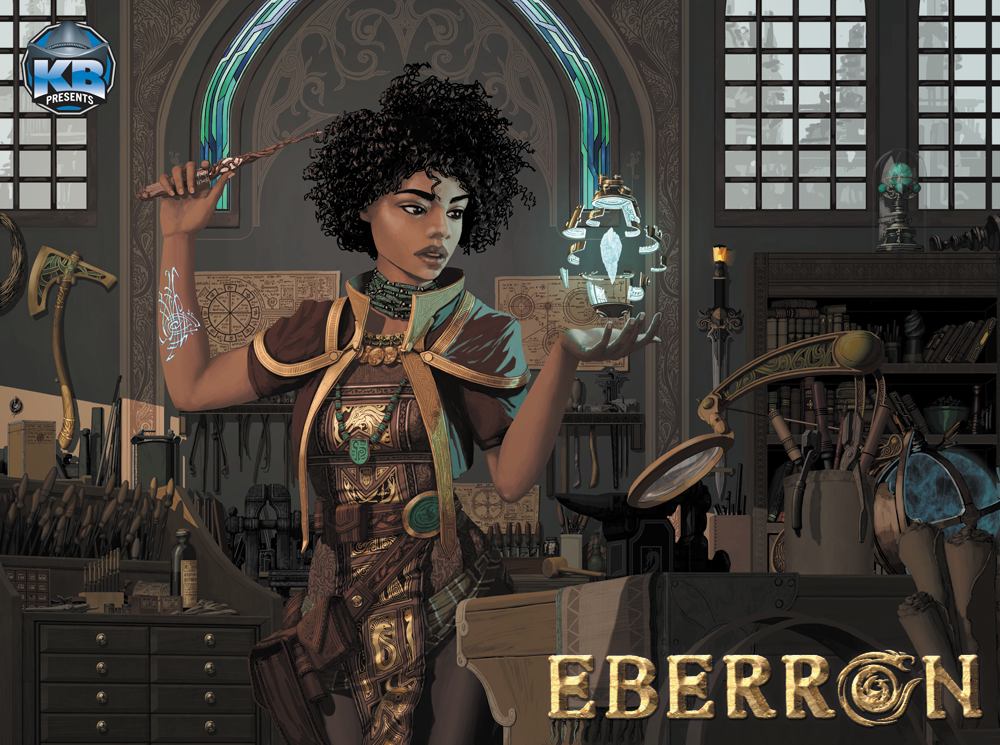
Art by Rich Ellis and Grace Allison from Phoenix Dawn Command
Looking at the power of the Council of Ashtakala, people might wonder why the Lords of Dust haven’t conquered the world. A rakshasa’s first answer to this would be, “Haven’t we?”
“Eternal Evil,” Dragon 337
This month is challenging for many reasons, so rather than writing a long article I planned to write a number of smaller articles addressing questions posed by my Patreon supporters—questions like…
How do the Lords of Dust actually manipulate the people of Khorvaire, considering that their mental manipulation magics are not quite on par with, say, the Dreaming Dark? What’s the edge that allows them to compete with even mundane intelligence agencies such as the Dark Lanterns or House Phiarlan?
The problem is that sometimes questions that SEEM like simple topics turn out to have a lot of layers, and this turned out longer than planned. But let’s start with the shortest summary. How do the Lord of Dust manipulate the people of Khorvaire?
The Lords of Dust have been manipulating the people of Khorvaire since before there were people on Khorvaire. They don’t need to subvert people as the Dreaming Dark does, because they have a vast network of pawns that have been serving them for many generations.
Because of this, they already have people in influential positions in most major institutions and organizations in Khorvaire. They generally don’t directly control any of those organizations, but they are able to control the flow of information, burying reports, guiding the leaders in particular directions, and so on. And they do have Thuranni assassins, Dark Lanterns, and Trust agents (among others) who are directly loyal to them if they need them.
They have amassed vast wealth over the course of a hundred thousand years. Their top agents are mind-reading fiends. When they do need to put pressure on someone new, they can use both gold and secrets to do so.
They know possible paths of the future. They can start political movements that they don’t directly control because they know that in a century that movement will accomplish the thing they want it to. They have the Butterfly Effect on their side; they DO know that this one butterfly flapping its wings will cause a hurricane across the world in a decade. Now, that knowledge isn’t ABSOLUTE. They don’t know the impact of EVERY butterfly. But they know a few of them, and use those to their benefit.
A fun way for the Lords of Dust to manipulate people in the present is Faustian bargains: Give me your soul and I will grant you great wealth! Beat me at fiddling and I’ll give you this golden fiddle, but if you fail I take your life! The point is that FIENDS CAN LIE. Sul Khatesh can actually form warlock pacts, but a normal rakshasa CAN’T actually claim your soul. The point of this is the butterfly effect. What the fiend WANTS is for you to have this golden fiddle or to have wealth (which the Lords of Dust can easily grant through their connections and amassed resources) because somehow those things advance the prophetic path they are trying to lock in. But they want you to think that you WON the fiddle, or that they have claim to your soul… when both of these were just set dressing so people wouldn’t try to understand their REAL motives.
That’s the short answer. But as I said, there’s a lot more to this. So if you’d like to know more, read on.
An important step in planning an Eberron campaign is to decide which major villains you want to use, because you don’t have to use them all (and I personally wouldn’t). There’s nothing wrong with saying that it’s going to be a century before the Lords of Dust have an opportunity to release an overlord, that the stars aren’t right for any of the daelkyr, or that the Dreaming Dark is content in Riedra for the moment. So first of all, keep in mind that there’s no rule stating that the Lords of Dust HAVE to be actively competing with the Dreaming Dark, because it could be that the Lords of Dust aren’t trying to accomplish anything significant at the moment.
In choosing which villains you want to use, you want to consider the difference in their goals and methods, something I briefly discuss in this article. The Dreaming Dark is an alien force that seeks to conquer through subversion and infiltration, and this is why its tools are mind seed and possession. The story of the Dreaming Dark is a story of people you trust being turned against you, a story of secret invasion. The Lords of Dust tell a very different story. They have immense power in the present day. They have resources they’ve been amassing for a hundred thousand years. They have access to artifacts and eldritch machines. They have agents in place in every major house and organization. But they don’t care about the present day. Look back to the quote that opened the article. The Lords of Dust aren’t trying to conquer the world, because from their perspective they already have. They don’t want the trouble of openly ruling pathetic mortals, but through their vast network of pawns, they already have all the power they need in the present. Their goal isn’t to infiltrate existing organizations, because if they need to infiltrate an organization, they’ve already done it. Their goal is to shape events that will in turn shape the path of the future. Let’s take a quick look at the resources they have available.
The Lords of Dust are immortals who have been present since time began. They have been planning their schemes for a hundred thousand years. This has given then time to amass vast resources and to shape civilizations on both a large and small scale; the “Eternal Evil” article notes that when Lhazaar planned her expedition to Khorvaire, a rakshasa was advising her.
Through their studies of the Draconic Prophecy, they not only know the paths that will release their overlords, but they have a general roadmap of the paths the future can take. So that raksahsa guiding Lhazaar wasn’t acting blindly; they KNEW the consequences of pointing Lhazaar at Khorvaire and were intentionally shaping the future. The Lords of Dust are the organization who could build a vault in the wilderness because they know that THREE THOUSAND YEARS LATER it will be important. Again, think of them as time travelers; they just have to live their way forward to their desired future instead of jumping back and forth.
The central core of the Lords of Dust are rakshasa. Their leaders—Hektula, the Wyrmbreaker, etc—are exceptionally powerful rakshasa. But even the default rakshasa is a shapeshifting, mind-reading fiend with a range of enchantment and illusion abilities and potentially, the ability to return after death. But in many ways, the most powerful rakshasa ability is their spell immunity. A rakshasa cannot be “affected or detected” by spells of 6th level or below unless it allows it. That includes things like detect evil and good, see invisibility, and even true seeing. It allows them to walk through magic circles and forbiddance as if they weren’t there. They can ignore the vast majority of tools that would normally be used to detect the presence of fiends or to defend against them. It’s up to the DM to decide what it means that you “can’t be affected or detected” by, say, true seeing or zone of truth. In MY campaign I say that both spells appear to work normally even though they don’t; so a truthteller BELIEVES the rakshasa has been affected by zone of truth even though they haven’t, and true seeing shows the rakshasa’s disguise self as it it was its true appearance. So again, the point is that the rakshasa have a huge advantage because the magic we rely on for our highest security doesn’t work on them; the rakshasa CAN lie in a zone of truth and can look a top Medani agent in the eye without its true nature being exposed.
The majority of the agents of the Lords of Dust are mortal “pawns.” Some of these are what Exploring Eberron calls loyalist cultists, who know the power they serve and and proud of this allegiance. But just as many are devoted to SOMETHING or SOMEONE but don’t realize that this is a fiend or a creation of fiends. Again, the Lords of Dust have been working at this since before human civilization existed, and they are shapeshifting, mind-reading fiends with a map of the future. They have created political movements, art movements, devoted groups of friends, what have you — all to gain pawns who will do a favor at the precise moment it’s needed, likely never knowing the full significance of that favor. One of the most important functions of a pawn is to be in a useful position that allows a rakshasa to temporarily take their place at critical moments. It’s a waste to have a rakshasa working as a clerk in the royal archives of Breland for thirty years. But the Lords of Dust may have a PAWN working as a clerk, and on the three days where there’s something vitally important that the Lords of Dust need in the archives, a rakshasa can take the pawn’s place and accomplish those tasks. Again, it’s almost impossible to identify these pawns, because FOR THE REMAINING THIRTY YEARS that pawn is just a loyal clerk doing their job and they don’t even KNOW what the rakshasa did or why it did it when they let it take their place.
So the story of the Dreaming Dark is one of aliens infiltrating our world. The story of the Lords of Dust is one of discovering that aliens infiltrated our world thousands of years ago and have been secretly pulling the strings ever since. The goal in dealing with the Lords of Dust isn’t to UTTERLY DEFEAT THE LORDS OF DUST. They’re simply too deeply entrenched, not to mention immortal, and again, they are actually part of the status quo of society as we know it. You’ve lived alongside them all your life, and they NEED the world to generally be stable; if they need you assassinate Queen Aurala in order to free Sul Khatesh, they need there to be a Queen Aurala. So the goal is to disrupt their immediate plans so that they will go back to the drawing board and scheme for another two centuries while our lives go on as normal.
When dealing with the Lords of Dust, part of the question is what you’re actually dealing with. You can use them in small ways or as major villains. Here’s a quick overview.
Lone Wolves. The schemes of the Lords of Dust unfold over the course of centuries. What do they do to pass the time in the space in between? Adventurers could clash with a fiend who, while technically tied to the Lords of Dust, is pursuing an entirely personal agenda. A lone rakshasa could be playing a game with a mortal family—say, killing the second child of each family member when that child reaches their 22nd birthday—just for fun. They could start a cult of serial killers because it amuses them to do so. They could seek revenge on a dragon that annoyed them a thousand years ago. In creating lesser fiends, consider that they are likely to share some traits with the overlord they serve. Minions of Sul Khatesh may be interested in arcane experiments, minions of Rak Tulkhesh may enjoy murder and cruelty, and minions of Eldrantuklu love intrigues. So essentially, you can have a villainous fiend—even a member of the Lords of Dust—without the adventure being about THE LORDS OF DUST.
Doing What They Love. Mordakhesh and Rak Tulkhesh love to spread war and hatred. Hektula and Sul Khatesh love to have people using magic in ways that sow fear. These schemes don’t necessarily AMOUNT to anything; they are literally just a way to pass the time for a few centuries while they wait for their next release-the-overlord possibility to come around. In general, you can think of this as “feeding the overlord.” It’s not like Rak Tulkhesh can starve to death, but if Mordakhesh can feed him war he is HAPPY and that in turn pleases Mordakhesh. So he LIKES to sow hatred even when there’s no world-shattering threat involved, as long as he doesn’t cause so much chaos that it interferes with future plans. So you can fight an evil wizard who’s empowered by Sul Khatesh and do something good by defeating them, but the FATE OF THE WORLD was never at stake and Hektula herself doesn’t care too much. You did a good thing that protected the local community from that wizard, but it’s not like Hektula will vow vengeance because she has literally done THOUSANDS OF TIMES. Sometimes the seeds grow into beautiful bloody flowers, sometimes troublesome adventurers stop them. No big deal… she’ll plant more.
Butterfly Collectors. It’s possible that one or more of your characters has a critical role to play in events that will trigger the release of Sul Khatesh… two hundred years from now. The whole idea of manipulating the Prophecy is that it takes generations to play out. As such, it’s possible that a Lord of Dust needs the adventurers to do something that doesn’t threaten them or the world in the present day, and that could even be useful to them. Consider The Hobbit: Gandalf could be a disguised rakshasa, who brings the dwarves to the Shire, convinces Bilbo to join their company, and helps them defeat Smaug because he knows that if Bilbo joins them he WILL find the One Ring, and he’s just laying the groundwork for the events of The Lord of The Rings, which will occur a century later. But in the short term, Bilbo and his friends defeat a dragon, find a magic ring, have great adventures and become friends. This is exactly the sort of thing a Lord of Dust could set in motion; it not only SEEMS innocent, it IS innocent… until a century later, when the fate of the world is determined by these events. Remember that the Lords of Dust are limited by needing the correct mortals to fulfill the Prophecy, because they need things to happen in the proper way. In this example, Hektula might know EXACTLY where the Ring is the whole time, but she needs BILBO to defeat Golumn in the battle of riddles and to claim it himself.
Loyalist Cults. Many pawns work for the Lords of Dust without knowing it. But all of the overlords have cults that DO know who they work for and revel in it. The Carrion Tribes of the Demon Wastes are examples of this, but there can be fiend cults throughout Khorvaire. If you need a quick minor villain, great, use an overlord cult. This is in the middle of this list because it can go in either direction. The cultists could be engaged in a scheme that will lead to the release of an overlord, or they could just be in that “doing what they love” role. Rak Tulkhesh loves to have cults shedding blood, and it could be that’s all that’s going on—and you stopping that cult is just a good thing for everyone. Or it could be that the actions of that cult are part of an early stage of releasing an overlord. The question there is whether a) by the time the adventurers defeat the cult, they have already done the critical action they needed to perform to push the prophecy to the next level or b) whether the cult being defeated WAS PART OF THE PLAN ALL ALONG. Because that’s the way the Lords of Dust work; they may have pushed their cult into your path because they NEEDED you to defeat them. Exploring Eberron discusses the cults of five different overlords.
Releasing an Overlord. This is the main event: the idea that the Lords of Dust are working toward the release of an overlord, and that a release—or at least a partial release—could occur in the course of a campaign. This requires the Lords of Dust to get a particular path of the Draconic Prophecy to pass; this is discussed in this article. The critical point is that these are things that have MANY steps and you’re just coming in at the end; they have likely been working on this for centuries, and these are the last steps. So usually this is something that adventurers will discover at a critical point and then have to fight on multiple steps. The challenge is that the rakshasa have a map of the future and the adventurers don’t. As noted above, it could be that by the time the adventurers defeat a cult they’ve already accomplished what they needed to do, or it could be that defeating the cult was part of the plan.
Rebinding an Overlord. Here’s the thing: preventing the release of an overlord isn’t nearly as much fun as rebinding an overlord that has been partially released. If you successfully keep the plan from succeeding, you never actually get to see how bad things could be. History is full of moments when the plans of the Lords of Dust were blocked and NOBODY KNOWS ABOUT THEM. But everybody knows about Tira Miron’s sacrifice to rebind Bel Shalor, because the Shadow in the Flame WAS partially released and terrorized Thrane for months before Tira figured out how he could be defeated… which meant identifying a different path of the Prophecy (she needed to be channeling a couatl; to be wielding Kloijner; to fight him at a particular place and time; to be working with specific allies). A campaign involving the partial release of an overlord gives all sorts of opportunities to battle fiends and unravel mysteries, and to ultimately fight an aspect of the overlord (which is what the stat blocks in Rising represent, though they are MUCH weaker than the overlords presented in third edition)… While a campaign in which the adventurers just block the release can feel anticlimactic.
You might well say “If the Lords of Dust are so powerful, why don’t they just kill the player characters the moment they become a threat?” Because sure, from a mechanical standpoint they easily could. They have hundreds of rakshasas—possibly thousands—epic magic and countless pawns in positions of power. The reason they don’t turn all the power against the adventurers is because they need the player characters—or at least, believe that they MIGHT need the player characters. You know how we always say that player characters are remarkable and that they’re the heroes of the age? That’s because they are PROPHETICALLY SIGNIFICANT. It may be that the Lords of Dust have specific plans that they need to use the PCs for (Hektula needs you to kill Queen Aurala to release an overlord) or it could be that they are just the first dominos in a long line (Hektula needs your wizard’s GREAT-GRANDAUGHTER to kill Aurala’s great-grandson… and your wizard doesn’t even have any children yet). They may not even KNOW what role they need you for, but they know you’re significant and they’re figuring it out. This is why pawns of the Lords of Dust tend not to be the people IN power, but rather the advisors, the scribes, the people in the background. The Lords of Dust can’t force the actions of prophetic lynchpins without derailing the prophecy. They couldn’t just replace Lhazaar with a rakshasa or use dominate person (which any raksahsa can cast) on her; they needed her to CHOOSE to go to Khorvaire. It’s the same here. They can manipulate the adventurers by manipulating the events around them, but they can’t just mind control them or replace them.
One way to think about it is rats in a scientist’s maze. Your PC is a rat and the Wyrmbreaker wants you to go down a particular path. He can try to lure you to go the way he wants—drop a piece of cheese down the right path—but he can’t just PUSH you down the path or the experiment becomes invalid. Should you at the final moment FAIL to go down the proper path, he’s not going to kill the rat; what’s the point? Instead he’s going to put you back in the cage and start figuring out the next experiment. Because that’s the thing: there will ALWAYS be a way to release the overlords. The moment Tira rebound Bel Shalor, a new path for his release began to take shape. It could take centuries for the Lords of Dust to identify that new path, and a thousand years before they have a chance to make it happen, but they WILL figure it out. Dustoran has tried and failed HUNDREDS OF TIMES. When you foil his plot, he’s going to just move on to the next one. And let’s face it, even if he was certain he has no further use for you, he doesn’t NEED to kill you. You’re mortal. If you’re human, you’ll be dead in a few decades; he’ll still be here in ten thousand years.
That’s all for now! Thanks as always to my Patreon supporters for posing this question and for making these articles possible!
My last article discussed the impact the long lifespan of elves has on the elves of the Five Nations. This brought up a few other points I’d like to discuss.
Elves are Old for a Long Time
The elves of Aerenal devote decades or centuries to intense, focused study. In the previous article I said that the elves of the Five Nations don’t do this because the infrastructure doesn’t support it; a Brelish elf is going to the same school or university as a Brelish human, and there’s no decades-long classes in the Brelish core curriculum. This raised the question of whether that means the elves of the Five Nations are more versatile than the Aereni… and if so, if combining greater versatility with longer life meant that they dominated the study of arcane sciences in Khorvaire. The answer to this is NO. It’s not just the culture of the Aereni that’s the issue; it’s the fact that elves mentally mature at the same pace as humans and then are OLD FOR A VERY LONG TIME. Here’s a quote from a previous article…
This ties to the idea that a seven-hundred year old lifespan is both a blessing and a curse. Our fluid intelligence – which fuels our ability to adapt to entirely new things – peaks in young adulthood. You grandfather may be a brilliant doctor, a skilled mathematician, and still have trouble learning to use an iPhone that a three-year-old masters in three days. The child is running on fluid intelligence, which allows them to quickly adapt to new things. You grandfather is working off crystallized intelligence, the concrete skills he has perfected over time. For me, this is the fundamental difference between elves and humans… because in my Eberron, both elf and human peak in fluid intelligence at the same time. An elf’s mental facilities don’t deteriorate due to age as a human’s will, so the 110-year-old elf is still sharp and alert… but they’re is also just as firmly set in their ways as a hundred-year-old human, and it’s difficult for them to adapt to entirely new things.
This follows the principle that older people tend to be more conservative than younger people, and the point I made earlier that Brelish elves are more likely to support the monarchy because they don’t like change. Aereni society is built with this in mind, but the general idea is that elves are more likely to specialize than to be diverse in their skills because it’s harder for them to learn entirely new things—and, just as I don’t remember much of the Latin I learned in college, if an elf doesn’t USE a skill for 50 years, it will atrophy. Focusing on a few skills ensures that they MAINTAIN those skills. So if you go to Arcanix, the 500 year old elf professor is more likely to be the one who’s been teaching the same Siberyan Principles course for 300 years—and who is AMAZING at it—than the young hotshot teaching the course that challenges all established principles. There are always exceptions; Mordain the Fleshweaver is a remarkably innovative elf, though it’s questionable as to whether you can still call him an elf. And your player character elf can certainly defy this pattern. But generally, elves are old for a long time; a 200 year old elf has the same general outlook on life that a 200 year old human would if they could live that long, and they aren’t as flexible in their outlook as a 20 year old human.
Where Did You Get Your Training?
Throughout many editions of D&D, elves, dwarves, and other races have had features that feel more cultural than genetic. All elves have “Elf Weapon Training” with longswords and longbows. All dwarves know how to use axes and they’re either brewers and smiths; in third edition, all dwarves had a bonus to fight orcs. It doesn’t matter if they’d never SEEN an orc or ever picked up a hammer: ALL DWARVES HAVE THIS.
This stems from the same monocultural impulse that says “All orcs are evil,” and from the beginning we pushed against this in Eberron. In third edition we largely just ignored it. In fifth edition we’ve more actively challenged it. The Aereni elf subrace in Wayfinder’s Guide and Exploring Eberron removes the Elf Weapon Training trait, because elves in Eberron DON’T all know how to use swords and bows. In Wayfinder’s and Rising From The Last War we suggested that assigned racial languages could be changed, because dwarves aren’t born knowing Dwarvish; if you’re a dwarf born in the slums of Sharn, you might know Goblin instead of Dwarvish. Tasha’s Cauldron of Everything expanded on this with the optional Proficiency Swap system; they specifically call out the example of an elf who swaps longsword proficiency for an instrument proficiency. So Maza Thadian, the best cook in Sharn, doesn’t know how to use a longbow—because she traded that proficiency for Cook’s Utensils.
So the key point here is that Elf Weapon Training—or Dwarf Weapon Training, or similar features—don’t represent some sort of genetic talent. Which means that if you’re playing an elf and you choose to KEEP Elf Weapon Training, it’s up to you to decide how your character acquired that training. In Exploring Eberron I note that Mror dwarves can base their racial Weapon Training and Tool Proficiencies on their experiences in the War Below. This is an equally logical approach for dwarves and elves of the Five Nations. The Last War lasted for a century. Even if your background is entertainer, you can still say that you served in the last war for a decade back eighty years ago. It didn’t because the focus of your life, which is why you’re a bard instead of a fighter, but you still retain that basic training. On the other hand, if your background is ENTERTAINER, perhaps you worked archery into your act. Or, even if you don’t worship the Silver Flame NOW, perhaps you spent a decade as part of a devout Thrane militia fifty years ago and received your training then. Or you could say that your elf character never touched a bow until yesterday—but YOU have an ancestor who lives in your memories and who’s been training your while you trance. Essentially, the fact that you have skill with these weapons is part of your character’s story, and I want to know the STORY behind it. Three Brelish elves may all have Elf Weapon Training—but HOW they got those proficiencies may be completely different for each of them, and it’s certainly different from the training a Tairnadal ranger received.
Potential Lifespan is Just That
In the last article a question was raised as to whether elves would have a different outlook on the Blood of Vol, because the religion evolved as a reaction to the brutality of life and elves are less likely to see life as brutish and short. Well, the Blood of Vol evolved in the cold, harsh regions of Karrnath and the northern Lhazaar Principalities. It evolved among people who were fighting famine and plagues, and who were oppressed by tyrannical rulers. It is a reaction to the basic question what just gods would allow death and suffering… and SUFFERING is an important word to remember. Because just because an elf can POTENTIALLY live to be 700 years old doesn’t mean they WILL. Elves have no special resistance to cold or disease. They may not sleep, but they still need food and water. They can suffer from the cold, and they can suffer the agony of watching their starving children dying from diseases. The long lifespan can seem like a curse on two levels: first, when an elf child dies of a fever when they are ten years old, it seems more unjust because they COULD have had centuries of life. Second, the elf who does live for centuries while enduring starvation and disease and who has to watch their friends dying around them may well feel that another century of life is just more time to suffer.
Aerenal is in many ways a utopia. It is a peaceful, advanced nation where people DO expect to live out most of their natural life in comfort and health. And yes, the Blood of Vol won’t find much purchase there. But it won’t find much purchase ANYWHERE where people live long and comfortable lives. It takes root in those places where people are surrounded by suffering and loss, places where the cruelty of mortal life is made manifest. And just because elves can potentially live longer than humans doesn’t mean that they will—and it doesn’t protect them from starvation, poverty, plague, or any of the other tragedies that humanity endures.
My Patreon backers have posted a lot of good questions on other topics, so this is all for elves for the moment… I’ll try to get back to it in a century or so! Thanks to my Patreon supporters for making these articles possible.
In the fifth edition of Dungeons & Dragons, elves can live to be up to 750 years old. In the past I’ve written many articles about the elves of Valenar and Aerenal and how their long lifespans have affected their culture. But what about the elves of the Five Nations, who are part of a culture driven by short-lived humans? This month, my Patreon supporters posed a number of interesting questions on this topic.
An adult elf of the Five Nations is not only older than the current monarch of their nation, they’re older than the NATION, given that Galifar only dissolved a century ago. How does their long lifespan affect their national loyalty?
First of all, we’ve always said that most demihumans of the Five Nations tend to put their national identity before their species. A third-generation Brelish halfling might support the Glidewing in the Race of Eight Winds as a nod to their Talentan heritage, but they consider themselves Brelish, not Talentan. So that’s the first point to consider: elves born in the Five Nations generally embrace that culture. Which comes to the second point: until the Last War, the Five Nations were united as Galifar. But there were still Five Nations, each of which was culturally distinct and maintained traditions that predated Galifar; Galifar united them under a single ruler and code of laws, but it didn’t erase that cultural identity. The point of this is that not only does your 300-year-old Brelish elf think of themselves as Brelish, they’ve thought of themselves as Brelish far longer than a 30-year-old human; they’ve had far longer to invest in the traditions of Breland and to have a very strong sense of what it means to be Brelish. Which ties to the second point. Because their long lifespan means they’ll outlive the humans around them—whether we’re talking about their monarch or their neighbor—the elves of the Five Nations tend to invest in institutions and customs more than in individual humans. An elf invests in the concept of Breland more deeply than in any one ruler. Likewise, they invest in families more than individuals, seeing the living members of the family as the latest incarnation of that beloved family. For an off the cuff example, consider the relationship between humans and dogs. My household is a pug household. We had a pug we loved, and when he passed away we got a new pug—who is very much his own person, but also very much a pug. And when he passes away, I expect we’ll get another pug. We love our pugs, and in the moment, we love our current pug most of all. But we also know that barring tragedy we will outlive him. So we love him in the moment, we give him the best life that we can, and when he passes we’ll honor him by bringing a new pug into our lives. What we’re NOT going to do is suddenly decide to get a St. Bernard; we’ve become pug people, and we don’t WANT a different dog.
This basic principle applies both to national identity and to an elf’s personal relationships with shorter lived races. Breland in this instances is “Pugs” while King Boranel is “The Current Pug.” The elf who has chosen to live in Breland for three centuries loves Breland more than any other nation. Most likely, they also love Boranel; they may fondly remember Wroaan or other rulers, but Boranel is alive and with them now; they will always honor Wroaan’s memory, but they support the current king. Unless, of course, they don’t like Boranel, in which case they may grumble and think “There’s always a bad one in the litter, but in another ten yeas we’ll get a new one that will be better.” That elf doesn’t want to go live in Thrane any more than I want to get a St. Bernard; they’ve become comfortable with Breland and it’s become part of their identity. With this in mind, I would also say that Brelish elves in particular likely strongly oppose the Swords of Liberty and the anti-monarchy movement, because the four hundred year old elf is far more invested in the institution of the Brelish monarchy than the human who’s only lived with it for twenty years. They’ve invested in the idea of Breland for centuries, and part of that idea of Breland is that it’s a monarchy.
As I said, I’d extend this to an elf’s personal relationships with humans. In playing an elf character, I’d consider whether I know the ancestors of one or more of the other player characters. I might ask one of the other players (it’s a collaborative story and I want to work with them, not impose my story on them ) if they’re OK with the idea that my character has had a long relationship with their family. Throughout the campaign, I might discuss my experiences and adventures with their ancestors. It might even be that the reason I’m part of the adventuring party is to look after that character—because their grandfather would never forgive me if anything happened to them. If you’re familiar with Deep Space Nine, there’s a touch of this in the way Dax refers to their previous hosts. As an elf, play up the fact that you may have known Queen Wroaan or met Kaius I. When you’re at a store in Sharn, mention how it use to be a restaurant a century ago and had the best fried spider legs in the city—they just don’t make them like that any more.
It’s suggested that some elf immigrants to Khorvaire came with a plan to marry into human families and essentially outlive their way to power, inheriting family fortunes from their short-lived spouses. Canon lore suggests that this was abandoned out of an initial revulsion for the Khoravar, but how has it played out in the present day?
The canon answer is clear: elves haven’t taken over all the noble families of Galifar, and in fact, very few elf nobles are mentioned. The question, then, is WHY. The answer is that people of Galifar are well aware of the disparate lifespans of their neighbors and that the laws of the land take it into account. Any position with a lifetime appointment will have clauses that allow for the holder to be removed, so you can’t just appoint a warforged to a lifetime position and then have no way to remove them ever. Meanwhile, nobles will always has pre-nuptial agreements to address this; I think the standard one is simply that a spouse doesn’t inherit the title. It passes to the eldest child or, failing that, to a sibling.
Looking at an example of this in play, Kaius III of Karrnath is married to Etrigani, an Aereni elf. As long as Kaius is alive, Etrigani carries the title of queen. When Kaius dies, however, the crown of Karrnath would pass to their eldest child, not to Etrigani. If they have no children (and currently they don’t), it would pass sideways along the line to Kaius’s sister Haydith. A spouse could likely serve as a regent while waiting for a child to come of age, but they can’t claim the title as their own… thus preventing an elf from marrying into a family of human nobles and holding the title for the next five centuries.
There are a few elf nobles in the Five Nations, and it’s certainly the case that if you’re an Aundairian elf with the noble background, you may be waiting a LONG TIME before the title falls to you.
This raises another question. If my elf character is two hundred years old and knew the wizard’s grandfather, how come I’m only a first level character?
The long-lived races are always a problem in this regard, and I’ve talked about this before in this article. First of all, I’ll call out the fact that in REAL LIFE, skill doesn’t progress in a continuously upward line as we grow older. I learned Latin in college, I haven’t used that skill in two decades, and at this point I can recognize some words but I couldn’t write a sentence in Latin. In another 20 years I may have forgotten it entirely, and that’s nothing like an elf living for centuries. Generally speaking, we reach plateaus with skills and have to work to maintain them. I also fenced in college. Guess what? I’m older now and while I still know some tricks, I’m not a better fencer than I was. Admittedly I multiclassed and took levels of writer instead of fighter, but the point remains: age alone doesn’t equate to skill. A second point is simple: How good is your grandfather at making TikTok videos? Now, replace “TikTok videos” with “Modern Techniques of Arcane Spellcasting.” You could absolutely say that your 1st level elf wizard was a cutting edge wizard 300 years ago, but he’s been out of the game for a while—writing novels, perhaps—and now his spellcasting techniques are incredibly out of date and he can’t figure out these fancy somatic components the kids are doing these days. “That thing! With the fingers!”
While that’s a FUNNY option, I would personally be more likely to use my elf character being 1st level to add a hook to their backstory: WHY are they 250 years old and only first level? My immediate inclination is just what I said above but without the comical agism. My elf character trained as a wizard 200 years ago, and then spent the last 200 years as a novelist or a poet—some career that essentially has no concrete bearing on the skills I use while adventuring—and I need to get back in practice. I remember the basics, and it’s all going to come back to me quickly once we get going, but come on people, I haven’t even cast a cantrip since before you were born.
A more dramatic option would be to justify my temporary low level as a form of injury. Perhaps I served in the Last War—possibly even serving with the parents or grandparents of one of the other characters—and suffered “spellshock” from an arcane attack. Or perhaps I was caught in the Mourning and was found in a coma—I’ve recovered, but my whole body feels numb and I haven’t fully recovered my spellcasting ability. OR, perhaps I was on an epic adventure (again, could be with an ancestor of one of the PCs) and was cursed by an archfey. Breaking that curse could be an ongoing story hook, or it could be something that is broken BECAUSE I’m adventuring with the descendant—allowing me to regain my skills. All three of these options would allow me to say that I WAS a fairly high level character a century ago but I’ve temporarily lost those skills. While other characters may feel like they’ve dramatically improved by the time they reach 9th level, I feel like I’ve only just gotten my sea legs back.
The main point here is that you shouldn’t look at the old dwarf or elf and say “It makes no sense that I’m 120 and still have the same skills as a 20 year old human.” First of all, remember that in Eberron ANY player character is remarkable. Second, don’t just say “it makes no sense”—figure out a way that it COULD make sense. An injury, a curse, a century away from adventuring. The fact that you’re only 1st level NOW doesn’t prevent you from having BEEN higher level at some point in the past.
Do the longer lived races like the elves and dwarves view the Blood of Vol differently (insofar as their lives are not as short, cruel and hopeless as the oppressed humans who latched onto it a couple millennia ago)?
This raises an important point: the fact that you CAN live to be seven hundred years old doesn’t mean that you WILL. Elves are just as susceptible to disease and to cold as humans are. They may not sleep, but they certainly need to eat. So if you’re an elf farmer in Karrnath surprised by a sudden frost, you can still be worried that you’re hungry, that your children are freezing and one has a fever, and that if the frost kills your crops there’s no knowing how you’ll get the money you need to survive. Even if you do somehow live through it, the fact that you get to look forward to hundreds of years of watching your friends die may not feel like a blessing. Those people who founded the Blood of Vol, who felt that life was short, cruel, and helpless, weren’t dying of old age. So no, I don’t think it has a notable effect. And also, the Blood of Vol has never been widespread in the Five Nations. The Brelish elf may not see the appeal to the Blood of Vol, but most Brelish HUMANS don’t see the appeal either.
That’s all for now! I am VERY busy with writing deadlines and family matters and I likely won’t have times to answer questions on this topic. Thanks as always to my Patreon supporters for asking interesting questions and for making this website possible!
She had the body of a great black cat, with the neck and head of a beautiful elf-maiden – though if that head was on a humanoid body, she’d have to be nine feet tall to match the scale. Her skin was flawless cream, her eyes glittering gold. Her long hair was midnight black, dropping down and mingling with the vast raven’s wings folded on her back. The black of her fur and hair was striped with bands of brilliant orange, and these seemed to glow in the dim light; when she shifted these stripes rippled like flames.
“Why are you doing this?” Daine said. “If you know so much about our destinies, why the riddles? Why not just tell us what you know?”
The sphinx smiled. “What answer do you wish to hear, Daine with no family name? That I am bound by divine and arcane laws, and have told you all that I can? That I have told you what you need to know to fulfill your purpose in this world? Or that I have my own plans, and I am shaping your destiny as much as any of the others who watch?”
“Which is true?”
“Which will you believe?”
City of Towers
Sphinxes are enigmatic and inscrutable. For all their cryptic insights and challenges, in some ways the greatest riddle of the sphinx is the sphinx itself. Where do they come from? What is the source of their knowledge, and most of all, what is their motivation? In most tales a sphinx is found guarding some arcane site or artifact, only sharing its treasure or its knowledge to those who can pass its test. Why does it do this?
No sphinx will answer these questions. No power on Eberron can read the mind of a sphinx, and divinations shatter against their inscrutable nature. And so the sages of Eberron are left to ponder the riddle, studying the clues that are available. The first and most popular theory about sphinxes was presented by the loremaster Dorius Alyre ir’Korran. In his Codex of All Mysteries, ir’Korran asserted that sphinxes are living embodiments of the Draconic Prophecy. Their oracular abilities are tied to the fact that they are manifestations of the Prophecy and innately know the paths of the future. They are bound to their duties and found in portentous locations because they are literally instruments of destiny, positioned to guide and challenge the people who will in turn shape history. They slip through time and space because they exist beyond it. Ir’Korran suggested that although they appear to be individuals, sphinxes are in fact all part of a greater entity, fingers on a hand too vast for mortals to see.
For centuries most scholars have supported ir’Korran’s theory. Magister Mara ir’Lain observed that sphinxes often appear to be guarding tombs, temples, or treasures, but there are no reliable accounts of a sphinx being assigned such a task. An androsphinx that identified itself as Silverstorm challenged Harryn Stormblade in the ancient Dhakaani citadel below Cazhaak Draal, but the only Dhakaani account that mentions sphinxes is the story of Jhazaal Dhakaan outwitting a sphinx to obtain its secret knowledge. Ir’Lain believed that this supported the Codex: that as Silverstorm wasn’t posted by the Dhakaani, its stewardship of Cazhaak Draal must be tied to the Prophecy.
However, over the centuries, scholars have learned more about sphinxes. In his paper “The Sphinx in the Library”, Professor Cord Ennis of Morgrave University made the following observations (summarized for the terrestrial reader; Ennis doesn’t mention the Monster Manual):
Sphinxes are powerful and varied spellcasters. The androsphinx in the Monster Manual is a divine spellcaster, using Wisdom to cast cleric spells. the gynosphinx is an arcane spellcaster, using Intelligence to cast wizard spells. While it’s possible that this is tied to the species of sphinx, it’s equally plausible that these are learned skills—that an androsphinx could master arcane magic, or a gynosphinx could channel magic through faith.
While they often appear to be bound to some sort of duty, sphinxes seem to have personalities and even a desire to learn. The most well-documented sphinx of the modern age, Flamewind, resides at Morgrave University and often spends her time reading; she has been known to attend parties and theatrical events.
Sphinxes are monstrosities, not celestials, fiends, or fey. This suggests that they are creatures of flesh and blood, rather than immortal incarnations.
Ennis challenges the Codex on multiple points. If sphinxes are extensions of the Prophecy, are they monstrosities rather than some form of celestial or fiend? Why do we see what appear to be both wizards and clerics among them, rather than a single path reflecting the channeled power of the Prophecy? Why did Flamewind attend the premiere of Five Lives, and even shed a tear in the final act? There are certainly reports of Flamewind assuming the role of the imperious oracle—as she did when first encountered, and as in the account quoted at the start of the article—and yet, she also seems to be capable of more casual interactions.
Cord Ennis believed this proved that sphinxes could have a more mundane origin: that they are mortal creatures, that they can study and learn, that they have more personality than the typical celestial. But as critics were quick to point out, no one has ever discovered any evidence of a civilization of sphinxes. There’s only a single account (discovered in Cul’sir ruins) of multiple sphinxes being encountered at the same time. All of this supports the Codex. There’s no signs of a sphinx civilization because sphinxes are tools of the Prophecy.
A team of researchers in the Arcane Congress presented a new theory, seeking to bridge the two: that sphinxes are creatures of Thelanis. The premise is that sphinxes aren’t instruments of destiny, but rather that they exist to drive the plot. Thelanis is the plane of stories, and its archfey often seem to enjoy seeing echoes of their stories in the world. Under this theory, the reason sphinxes show up at such dramatic times and locations is because the story needs themto—that they are some form of servants to the archfey, helping to guide the world in ways that echo the story of their masters. This ties to the fact that Thelanian creatures often show more personality and quixotic behavior than many other creatures, and that lesser fey aren’t immortal. While a compelling theory, opponents countered with the point that sphinxes don’t share the typical traits of Thelanian entities—which is to say, they are monstrosities rather than fey.
Most recently, Cord Ennis returned with a refinement of his thesis. Ennis suggests that sphinxes are mortal, civilized creatures, but that the reason there’s no evidence of any sphinx civilization is because they aren’t from this time. There are a number of accounts in which people facing sphinxes in their lairs are shifted through time—the apocryphal tale that Breggor Firstking was a beggar who was given a chance to relive his life and used his knowledge to become a king, or the story of the man who sleeps in a sphinx’s lair without permission and awakes a hundred years later. According to Ennis’s theory, the idea that sphinxes can move through time helps to explain both their seemingly oracular abilities and their interest in seeming cryptic actions; that their enigmatic behavior shapes future events in ways we don’t see, but they do. The lack of any signs of sphinx civilization is because it doesn’t exist in the scope of history as we know it. And further, the fact that sphinxes only manipulate time in their lairs suggests the use of some form of eldritch machine as opposed to the innate powers one would expect in a living manifestation of the Prophecy—that they accomplish time travel using a tool, rather than personal power alone. Ennis asserted that this could explain Flamewind’s observed behavior—at times the cryptic oracle, and at other times almost more of a curious tourist.
While intriguing, Ennis admitted that there was one piece of the puzzle that still escaped him. When do these time-traveling sphinxes come from? His first thought was the distant future—that they could even be some sort of mystically evolved descendants of the modern races. Yet if that were the case, is there no risk of their meddling changing their own future? Given this, he ultimately favors the idea that the sphinxes are from the very distant past—that they could potentially be the citizens of the FIRST civilization of Eberron, a society that predates the Age of Demons and whose existence was wiped from history by the dominion of the overlords. With this as a foundation, Ennis suggests that the actions of the sphinxes might not be the absolute demands of destiny one would expect from embodiments of the Prophecy, but rather a grand game. As their time is long past, the sphinxes don’t actually care what about the ultimate outcome; whether the overlords rise again or the daelkyr are unleashed doesn’t actually hurt them. Ennis further suggests that this could reflect the different techniques seen among sphinxes. The “divine” sphinxes—those wielding clerical abilities—could see their actions as being a divine mission, potentially even one mandated by the Progenitors (because what other gods were there at the dawn of time?) while the “arcane” sphinxes could be the scientists of their time. Thus, Flamewind could be in Sharn because she knows it is a nexus of elements she wants to deal with—events or people she wants to observe or influence—but that between those key events she is simply enjoying studying this time and place, so alien to her native time.
While these are all intriguing possibilities, as long as sphinxes remain inscrutable they will remain a mystery. Servants of the Prophecy? Agents of the archfey? Travelers from the dawn of time? All three are possible, and the only way to learn the truth is through adventure. Within their lairs, sphinxes have the ability to manipulate time and travel the planes.
Why Does This Matter?
The mystery of the sphinx is an important part of the creature, and something I want to maintain rather than simply providing an absolute answer. Are sphinxes time travelers? Agents of Prophecy? Shapers of story? All three are possible—but each has a different impact on both the role a sphinx may play in a campaign and on the mechanics of the sphinxes themselves. Most critically, the rules of the sphinx’s lair action state that the sphinx can shift itself and others to “another plane of existence.” It doesn’t specify which plane of existence or that the sphinx has multiple options. This answer—along with the circumstances under which the sphinx would USE its lair actions—likely depends on its origins. Because again, always remember that just because a sphinx CAN do something doesn’t mean it WILL. A Prophecy sphinx my have the POWER to shift people through time, but it may never use it if it isn’t required. So, let’s briefly consider the theories presented above and the ways these would impact a story.
Time Travelers. One of the core elements of sphinxes as time travelers is the idea that they are a mortal civilization. They are advanced beyond any civilization that exists today, but they are individuals using magical tools to accomplish these things—they are arcane scientists and divine spellcasters, capable of observing the tapestry of time and playing a great game they are playing with it. If this is the case, Flamewind in Sharn may indeed have very specific events she wants to observe and people she wishes to drive down specific paths, but at the end of the day she is a mortal wizard. She may play the role of being enigmatic and all-knowing, but there’s a touch of the Wizard of Oz; she DOES have knowledge of the future and of the potential destiny of the characters, but she’s not in fact infallible, she is playing her own game, and she also enjoys being a little bit of a tourist between those critical events. Should you follow this path, there’s a few points I’d consider.
The spellcasting abilities of a sphinx reflect whether they are a divine or arcane spellcaster—essentially, a wizard or a cleric. Under this approach, gynosphinxes and androsphinxes are simply male and female sphinxes, and it should be possible to encounter an androsphinx wizard or a gynosphinx priestess. A key question is what divine power sphinxes serve; personally, I like the idea that they might have a different sort of relationship with the Progenitors than people of the present day.
In shifting themselves or others to another plane, I would specifically use XORIAT. We’ve established that Xoriat is the key to time travel, and I’d assert that the time travel techniques being used by the sphinxes are based in this. The sphinxes aren’t creatures OF Xoriat and have no love for the daelkyr; they are scientists who are USING Xoriat. But they can also toss you into it for kicks.
The lair abilities of a sphinx are tied to a form of eldritch machine. Most likely this is specifically linked to the sphinx and cannot be used or even understood by any other creature… But it’s POSSIBLE that someone who’s figured out the mystery of the sphinx and has access to their lair could find a way to hack their time machine. A second specific question is where Flamewind has her lair. If the lair is a machine, it’s not likely to be something she could build in Morgrave University. In the novel City of Towers, this is why she deals with the protagonists in the abandoned temple in Malleon’s Gate; she hangs out at Morgrave, but her LAIR is in Malleon’s.
The final point is that time-traveling sphinxes are manipulating events, but they don’t have the same sort of agenda as heralds of Prophecy or Archfey emissaries. They aren’t invested in the outcome in the same way as, say, the Lords of Dust or the Chamber. Ultimately, this isn’t their time and the outcome won’t actually AFFECT them; it’s more intriguing than vital. However, divine sphinxes are more likely to be driven by a divine mission, while arcane sphinxes are more likely to be scientists and researchers.
Agents of the Archfey. If Sphinxes are tied to Thelanis, they are a form of fey; it’s up to the DM to decide whether to add the fey subtype or simply to say that you don’t HAVE to be fey to be from Thelanis. Sphinxes would effectively be Greater Fey—not truly immortal, but with a loose relationship to time and reality. A few thoughts about Thelanian sphinxes…
The plane they can travel to is Thelanis. Their ability to manipulate time is something that they don’t use with great precision and essentially only use when it serves the story; they aren’t truly time travelers, but they can throw Rip Van Winkle ahead a century when it fits the story.
A sphinx will be tied to a specific archfey, and its goals and the role it plays—guarding a location, posing a riddle—are tied to the story of that archfey. A Thelanian sphinx will be bound by fey logic: if it eats anyone who fails to answer its riddle, that’s not a CHOICE, it’s what it HAS TO DO. It MUST follow its role in the story.
While they draw on wizard or cleric spell lists, sphinxes aren’t actually clerics or wizards; their spellcasting reflects innate fey powers rather than arcane science.
Incarnations of Prophecy. If they are incarnations of the Prophecy, sphinxes stand sideways to the conflicts of the Lords of Dust and the Chamber. They don’t seek to manipulate the Prophecy: they ARE the Prophecy. While they may not be celestials or fiends, neither are they mortal creatures: they appear when and where they are needed, and likely disappear back into the Prophecy once their purpose has been fulfilled. If you want to explain the curious behavior of Flamewind, one possibility is to say that while a Prophetic sphinx has a limited existence, during the time it does exist it is a conscious entity; that Flamewind has spent eons as a disembodied thread of the Prophecy and is enjoying this incarnate period while she waits for the purpose that has caused her to be made manifest comes to a point. Key points about Prophetic sphinxes…
A Prophetic sphinx has no tied to any specific plane; as such, the planes it can access are likely tied to its specific Prophetic role.
This likewise ties to its ability to time travel. Essentially, a Prophetic sphinx has no free will. It exists for an absolute purpose. It CAN manipulate time or transport people to the planes, but it won’t and can’t use this power unless it is necessary for the purpose it’s manifested to fulfill. If adventurers must travel to Shavarath, it will transport them to Shavarath. If they must go forward ten years, it will take them forward ten years. But it can’t just decide that it would be INTERESTING to take them forward ten years to see what happens, as a time-traveling sphinx might.
The spellcasting abilities of a Prophetic sphinx are an innate part of its purpose and not skills it has learned.
The sphinx only exists to fulfill a purpose, guiding or guarding a particular node of the Prophecy. It is quite possible that part of its purpose is to prevent the Lords of Dust, Dragons, or other forces from interfering with that Prophetic lynchpin. But it has no wider goals, and it will discorporate once its purpose is fulfilled.
Essentially, time traveling sphinxes are the most free-spirited and are essentially playing a game with their riddles and challenges, while Prophetic sphinxes are the least free-willed and most bound to an absolute agenda, with Thelanian sphinxes falling in between.
Don’t Time Travelers Break The Game?
The fifth edition sphinx has the ability to travel in time, and to take others with it. From a purely abstract perspective, this throws all sorts of wrenches into a campaign. If adventurers fight a sphinx, why doesn’t it just go back in time and kill their grandparents? If the daelkyr rise, why don’t the adventurers get a sphinx to take them back in time and undo everything?
First of all, that last point is an excellent argument for having that power: it IS an ultimate escape hatch. It means that you CAN put failure on the table. You CAN have have Rak Tulkhesh break its chains and drown the Five Nations in blood, and the only hope is for the adventurers to fight their way to Sharn and convince Flamewind to give them a second chance. From a narrative perspective, that option is a great thing to have. The trick is that it shouldn’t be something that trivializes every defeat… “Oh, Flamewind, I lost at cards last night. Can we redo that?” Which brings up a number of points: when they can travel in time, and when they will travel in time.
First of all: time travel is a LAIR ACTION for a sphinx. You may not meet a sphinx in its lair… and a particularly sphinx might not even HAVE a lair. In Sharn, Flamewind definitely can’t call Morgrave University “her lair.” Presumably, her lair was in the Xen’drik ruins where she was first found. I’ve suggested that she might have built a NEW lair in some abandoned part of Sharn, but it’s equally plausible to say that she just doesn’t have a lair in Sharn; if she wants to help you time travel, you’ll all have to make a trip to Xen’drik (and hope nothing else has taken over her lair!). So keep in mind that when you meet a sphinx guarding a tomb, there’s no rule saying that the tomb is actually its LAIR.
Second: Even if a sphinx COULD solve all your problems with time travel, why would it? The Thelanian sphinx is there to nudge the story in a particular direction, not to completely rewrite it; as said earlier, it’s likely doesn’t have full free access to time travel, and can only actually use the power when it fits the narrative (IE: it can toss Rip Van Winkle forward a hundred years, but it can’t take you back in time to murder King Jarot). The Prophecy sphinx is even more limited, bound by unbreakable bonds of fate to only do the things it’s supposed to do, and taking you back in time isn’t an option. The wild card is the time traveling sphinx, but here’s the catch: it doesn’t care about your problems. From the perspective of the time traveler, it sees the full scope of history, filled with uncountable deaths and tragedies. From your perspective, the release of Rak Tulkhesh is a horrible tragedy that could be stopped and hundreds of thousands of people could be saved. From the time traveler’s perspective, the rise of Rak Tulkhesh and those tragic deaths are just one page in the book of all history, one filled with countless tragedies and countless deaths; what the time traveler knows is that HISTORY GOES ON, and that in three thousand years these events will only be a memory. The time traveler’s job isn’t to defeat Bel Shalor for Tira Miron; it’s to challenge Tira Miron to realize that she has the power to do it herself. Or they might even just be here to watch! The release of Rak Tulkhesh in 998 YK is a fascinating moment in history and they’re just here to watch it unfold.
The short answer I’d give is that when dealing with a time traveling sphinx, decide EXACTLY WHY IT’S HERE. If it’s a divine sphinx it may have what it believes to be a divine mission. If it’s an arcane sphinx, it may be a tourist here to observe history or it might be playing a game, seeing if it can engineer a very specific outcome. Whatever the goal, nothing else matters to it. Everyone around it is simultaneously already dead and haven’t yet been born. You may want it to solve your problems, but your problems are no more important to it than the problems of every single other tragic person in history, and if it’s not helping them it won’t help you. It’s not here to beat Rak Tulkhesh for you—it’s here to give you the clue or the challenge, and then see if you do succeed… or take notes on exactly how things play out when you fail and then go home to the dawn of time, where that failure is just an entertaining anecdote.
Of course, there’s a third even zanier option to consider, following the model of The Magicians: How do you know that sphinxes HAVEN’T been resetting the timeline? Is it in fact possible that Flamewind is in Sharn to engineer a very specific outcome—and if it somehow fails, she will take the entire city back in time and replay the entire scenario until you dummies get it right? It could be that the adventurers somehow realize that Flamewind has prevented Rak Tulkhesh from being released thirty times already—but again, she can’t solve the problem, she can only pull everyone back a year and hope that this time you’ll figure it out. Or, on a smaller scale, you could have a Groundhog Adventure where each day ends with a second Mourning and the adventurers starting over again… Once again, Flamewind is reseting Sharn each time they fail, but she can’t actually solve the problem for them, because it’s their history. But again, it’s easy enough to say that this is the single reason she’s in Sharn… and once you to get it right, she’ll return to her own time for good.
Essentially, yes, unlimited time travel would cause all sorts of problems. So limit it. Limit what they can do (no lair, no travel; no violating the laws of the Prophecy; etc) and limit what they are willing to do. Your horrific apocalypse is just one page in a very big history book, and for the time tourist it’s a cool event to observe happen, not something they need to fix.
Looking the time travelers from the past, How do they handle and reconcile the fall of their civilization? They can go back to their home at the dawn of time, but eventually that time runs out on their civilization?
Certainly. It’s something we see in various versions of Atlantis. Imagine that they know that their civilization will end in one year. The overlords are going to rise and that is absolutely, 100% inevitable: Krypton WILL explode. They don’t have the resources to project their entire civilization beyond the Age of Demons; they can only support, say, one hundred time travelers. And it may even be that they can only support them for a certain amount of time, that they will eventually be pulled back to the doomed dawn. So those one hundred time travelers are essentially stretching that final year out for as long as possible by dwelling in other times — seeing as much as they can of a future their people will never know, cataloguing the wonders of eternity and doing what they can to be a part of legend—to create stories that WILL be remembered—before they are gone.
On the other hand, if you want a more activist story, consider this: what if the reason the sphinxes are tweaking history and shaping stories is because they are creating a point in the distant future that they CAN move their civilization to? Essentially, it’s an even longer game than the Lords of Dust. Each shift—each hero tested—is shifting the number of a combination lock. At some point they will create the future they are looking for, five thousand years from now, when Sphinx Atlantis can leap forward in time and be saved. So they could, essentially, be from both the past AND the future.
But What About Zenobaal?
Dragons of Eberron presents the idea of Zenobaal, a rogue dragon who refers to itself as “The Prophecy Incarnate”. One aspect of Zenobaal is that he has an alliance with a gynosphinx named Maris-Kossja, and that they have a brood of half-dragon gynosphinx offspring. How does that fit with this idea?
There’s a few factors: first and foremost, this article is based on the fifth edition interpretation of sphinxes, which positions them as being more rare and unique — as opposed to the default 3.5 approach, by which sphinxes are just part of the world. This article notably doesn’t address hieracosphinxes, for example. The second point is that I didn’t create Maris-Kossja or Zenobaal, and this article is based on how *I* use sphinxes — which is more reflected by Flamewind. With that said, I have no issues with Zenobaal, and I think it can work in this interpretation. The simplest approach is to use the time travel idea, because under that concept sphinxes ARE mortal and could have offspring; Maris-Kossja has come from the past or future, is fascinated with Zenobaal, and has chosen to produce offspring with him… creating that rare time when you could encounter multiple sphinxes. That’s pretty straightforward. The more exotic option is to go with the Prophetic Sphinx and say that this is evidence of Zenobaal’s deep ties to the Prophecy. Zenobaal is so bound to the Prophecy that it has literally manifested a mate for him—and that his half-dragon offspring are flesh-and-blood manifestations of the Prophecy.
In general, however, this article is based on the 5E interpretation of sphinxes and will not necessarily apply to all 3.5 uses of sphinxes. You’ll have to decide how to address other contradictions. If you go with time travel sphinxes, and interesting option is to say that criosphinxes and hieracosphinxes are MODERN sphinxes — that they are either the primitive ancestors of or devolved descendants of the time traveling sphinxes.
A warning: I am working on multiple deadlines at this point in time, and will not be answering as many questions on this topic as I often do. Feel free to post questions and thoughts below and to comment on other peoples’ questions; just keep in mind that I may not have time to answer them.
Thanks as always to my Patreon supporters, who chose this topic and the next one in the queue: Avassh, the Twister of Roots!
The airship is an iconic element of Eberron. I’ve recently wrapped up a series on Arcane Industry and I’ve discussed Flight in Eberron in a previous article, but I’ve received a lot of questions about airships that aren’t covered in current material and I want to share my thoughts on them. A few disclaimers: this is not a deep mechanical breakdown of all aspects of airships and airship travel, and notably doesn’t delve into airship combat in any way. Likewise, this is quite different that what’s suggested in the 3.5 Explorer’s Handbook, which I didn’t work on. This how I use airships in MY campaign; it’s up to you to decide if you want to use this approach in yours.
THE BASICS
First and foremost, it’s important to understand that airships are a recent development. Lyrandar’s first airships went into service in 990 YK, just eight years before the default starting date. All of this ties to the idea that the science of air travel is very recent and that there’s a lot of room for improvement. From a narrative perspective, we don’t WANT airships to be perfect. We want it to be easy for airships to crash, because adventurers having to escape from crashing airships is an excellent drama. We want them to have limited range so that there are still places you can’t get to easily—that you can’t just fly your airship to Ashtakala. We want them to be largely limited to House Lyrandar because that gives Lyrandar power and adds another source of dramatic tension. So always keep in mind that airships aren’t perfect and that this is intentional. This is the DAWN of air travel; again, Eberron is closer overall to mid-nineteenth century Earth than to twentieth century Earth.
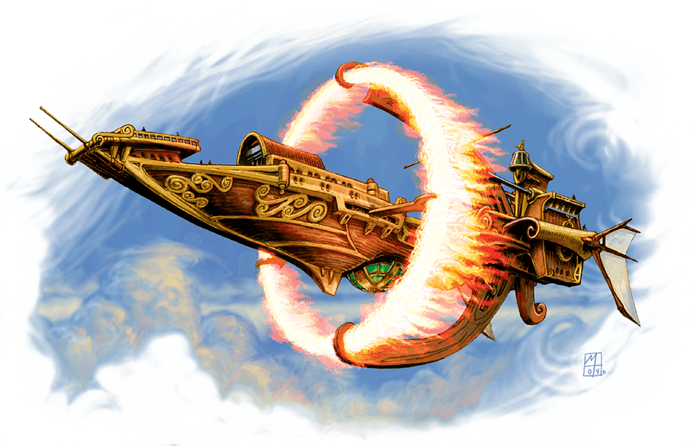
An airship is made using a soarwood hull. Soarwood is effectively weightless, though it’s not lighter than air. So a piece of soarwood will naturally float in the air, but it won’t rise. The crucial point here is that the soarwood hull is weightless… But an airship is more than its hull. Cargo, crew, and the elemental engine all do have weight, and these are sufficient to pull an airship to the ground. It is the elemental engine that provides lift and keeps an airship in the air; if the ring is shut down, an airship will crash.
So what IS the elemental engine? The heart of it is the elemental core, an engraved sphere of brass and mithral with a khyber dragonshard at the center. A raw elemental is bound to this dragonshard—”raw” in the sense of “general” elemental, not an anthropomorphic entity like an efreeti or azer. The elemental is absolutely anchored to the core and can’t be easily released; what the engine does is to pull it out from the core, stretching it out across the ship’s systems and the ring. This doesn’t release the elemental; it’s still anchored to the khyber shard, and if the engine is fully shut down, the elemental snaps back into the core.
Mark Tedin’s original airship from the 3.5 Eberron Campaign Setting.
AIRSHIP SYSTEMS
The elemental engine provides both lift and motive power. As long as the engine is active, an airship can hover or move forward. But there’s a lot more going on with an airship than just the ring. Here’s a few of the secondary systems that are vital to airship operations.
Elemental Veins. The elemental engine uses engraved strips of metal to channel the power of the elemental through the vessel and out to the ring. You can think of these as the veins of the ship, channeling power through its body. In addition to directly connecting the core to the elemental ring, these channel the secondary enchantments of the focusing nodes and the wind wards. There is a great deal of redundancy to the patterns of the veins, so severing a single line will have minimal impact on the ship; it could cause a particular section to lose heat or create a gap in the wards, but it would taken massive damage to cause the ring to break down. The metals used in the veins vary based on the type of elemental involved.
Focusing Nodes. These are metal polyhedrons, typically 8 inches in diameter, engraved with engraved with sigils and inlaid with Eberron dragonshards. They’re superficially similar to the conductor stones used in the lightning rail and serve a similar role; they are placed at critical vein junctures and help to draw out and stabilize the power of the core. Focusing nodes also maintain an enchantment that maintains a consistent temperature within the vessel, even at high altitudes that would typically be bitterly cold. As with the veins, the loss of a single node generally isn’t disastrous, but the crew needs to monitor and maintain them.
Wind Wards. An airship is an open-deck vessel that moves swiftly through the upper atmosphere. What keeps people from being blown off the deck? How can people breathe at high altitudes? How does an airship handle turbulence? The wind wards are the answer to these questions. An airship is enveloped in a ward that shunts both wind and small objects (such as birds) around the vessel, as well as maintaining air pressure within the wards. The wind wards are also play a role in maneuvering the ship; the ring provides forward thrust, but the envelope of winds helps the vessel turn. While the wards are controlled by the Wheel of Wind and Water, they draw power from the focusing nodes and have their own system of “ward wings” that must be maintained and adjusted by the crew. In the current design, the wind wards suffice only to ensure the safe operations of the vessel and don’t provide any special protection in combat; projectiles can penetrate the wards. However, it’s possible that a future design could strengthen the wind wards to serve as a form of defensive shield.
The Wheel of Wind and Water. This is the dragonmark focus item that controls the ship. It has two purposes: it allows the captain to interface with the elemental, helping to calm it and to direct speed and thrust; and it also allows the captain to maintain the wind wards, and use them to direct fine maneuvering.
THIS IS NOT INTENDED TO BE A COMPLETE LIST OF SYSTEMS. Airships are complicated, and a DM can certainly add greater complexity to fit the needs of the system. But this provides a general overview of major systems and things that can go wrong.
WHY LYRANDAR?
The classic airship uses a fire elemental in its ring… so why is the Mark of STORM useful for controlling it? What is it that gives Lyrandar the monopoly on air travel?
The Mark of Storms gives its bearer a general affinity for elemental forces that is enhanced by the wheel of wind and water. However, that’s a secondary aspect. It’s the wind wards that are specifically tied to the Mark of Storm, and every airship relies on these WIND wards, regardless of the form of elemental that provides thrust. As noted above, the wards both protect the ship and its crew and play an important role in maneuvering. An airship without the wind wards would have to operate at lower altitudes and slower speeds, and couldn’t maneuver as effectively as a Lyrandar vessel. The wheel of wind and water serves both purposes: controlling the elemental and drawing on the pilot’s mark to maintain the wind wards.
While a wheel of wind and water typically LOOKS like a classic ship’s wheel, the pilot doesn’t actually steer by turning it; instead, the pilot enters into a trancelike state where they commune with the elemental and wards. It’s not that they issue specific orders to the elemental, it’s that they experience the ship as an extension of their body.
So what happens when a ship loses its Lyrandar pilots? Most people simply can’t interface with a wheel of wind and water, but player characters aren’t most people. Someone with a strong personality and understanding of arcane science could essentially try to hack the system, using their sheer force of will to direct the elemental. Personally, I’d allow a player character who’s proficient with Arcana to bond to the wheel; while it doesn’t follow the normal rules of attunement, this connection does require the pilot to devote one of their attunement slots throughout the process. An unmarked pilot must make make regular control checks; this is performed when they first bond to the wheel, whenever they make a significant change to speed or course, and every hour they remain connected. A control check is a Charisma check with a base difficulty of 12, though the DM can adjust this based on current conditions (it’s more difficult to maintain control in a storm, for example); they could also choose to increase the difficulty each hour, if the goal is to model an emergency situation that can’t be sustained indefinitely. Every time the pilot fails a check, both the pilot and the elemental suffer a level of exhaustion (the effects of elemental exhaustion are described below). An unmarked pilot can’t maintain the wind wards; this forces the vessel to operate at lower altitudes, typically cuts its maximum speed in half, and makes storms and other weather effects considerably more dangerous. A pilot can choose to use Intimidation when making a control check—forcing their will upon the elemental—but if the check fails, the elemental suffers two levels of exhaustion.
A pilot with the Mark of Storm has a far easier time controlling an airship; all of the systems are designed to interface with the marked heir. They only need to make a control check once every four hours. Complex maneuvers or adverse conditions could require a Charisma (Air Vehicles) check, but failure doesn’t impose exhaustion on the pilot, though depending on the conditions calling for the check it could impose elemental exhaustion.
ELEMENTAL EXHAUSTION AND ONGOING COSTS
Elementals bound to airships aren’t entirely aware of their condition. While technically sentient — possessing Intelligence and even language— “raw” elementals are extremely alien beings that don’t perceive reality or the passage of time in the same ways that creatures of the material plane do. More than anything, a raw elemental wants to express its nature. A fire elemental wants to BURN. When an airship is operating at peak efficiency, that’s what the elemental experiences; the fire elemental in the ring doesn’t even realize it IS bound, it just knows that it’s BURNING. The challenge to the pilot is essentially to keep the elemental calm. The more excited it gets, the more energy flows into the systems… and while this might seem like a good thing, it actually runs a risk of overloading the focusing nodes and burning out the elemental engine—initially causing the loss of secondary systems, and eventually causing the elemental ring to collapse and the ship to crash.
The brings us to the ongoing costs of maintaining an airship. Eberron: Rising From The Last War notes that “many powerful tools—such as the lightning rail and elemental airships—require an ongoing expenditure of Eberron dragonshards to maintain their enchantments.” The key phrase there is to maintain their enchantments. Dragonshards don’t function as FUEL for an airship; again, the motive power is provided by the elemental, and that movement doesn’t directly require any expenditure of dragonshards. However, dragonshards must be expended to maintain the elemental engine—both periodic infusions of residuum to the main engine node and replacing focusing nodes that burn out (new shards can be implanted in a burnt-out node, so it’s not that the entire node is disposable). So dragonshards aren’t analagous to gasoline in a car; instead, it’s about adding oil to keep the engine running and replacing fuel. But, the more restless an elemental becomes, the more of a strain it places on these systems. This is measured by the concept of Elemental Exhaustion. With no levels of exhaustion, the ship runs at peak capacity. At six levels of exhaustion, the elemental must be confined to the core, which means the elemental engine (and ring) has to be shut down. The levels in between don’t have the standard effects of exhaustion, but they require an increasing expenditure of residuum to maintain the engine and focusing nodes will burn out; at high levels of exhaustion, it’s likely that sections of the ship will be without heat and it might become impossible to maintain the wind wards. This is a simple system, and if I was planning to make extensive use of it I’d add more concrete details to the consequences of each level—but this is the basic idea.
This brings up two important questions I’ve been asked, Can airships hover?andWhy are docking towers so important? Yes, airships can hover. The elemental doesn’t particularly care if it’s moving or standing still as long as it’s generating the ring. Which means hovering places the same strains on the elemental engine as moving—and that a hovering airship is still going to generate elemental exhaustion and consume shards. The most important function of a docking tower is to calm the elemental. Every eight hours spent at a docking tower removes a level of elemental exhaustion, and it’s also possible for an airship to hover indefinitely while connected to a docking tower.
This in turn explains the current limitations of air travel: It’s dangerous to go too far from a docking tower… And currently there AREN’T THAT MANY DOCKING TOWERS; they’re primarily in the big cities. This isn’t something that I particularly want to put strict ranges on, because it’s not entirely reliable (a skilled pilot can keep the ship in the air for a longer period of time) and because it might well vary based on the design of the ship itself; certain ships may be designed to endure longer journeys and higher rates of exhaustion, while a small “commuter” ship might fail with just two levels of exhaustion. Ultimately, the point is that this is a tool that allows the DM to place limits on what a vessel can do. If a group of adventurers hijack an airship and want to fly to Ashtakala the DM can say “This ship won’t make it that far“—perhaps adding “… But that bigger ship over there could!” Though as a second note, I’d think that just being in the Demon Wastes might be something that upsets the elemental and significantly raises the difficulty of control checks. This is something the pilot would definitely notice—the elemental doesn’t want to be here.
UNORTHODOX AIRSHIPS
The standard Lyrandar airship designs are the work of collaboration between Zilargo and the Twelve, specifically House Lyrandar and House Cannith. Zil shipwrights create the hulls (using soarwood from Aerenal) and Zil binders produce the elemental cores, while Cannith artisans install the elemental engine and the veins. It was Cannith and Lyrandar working together who produced the first working wind wards, it is this that currently provides Lyrandar with dominance over the industry. Cannith doesn’t know the secrets of Zil binding, because they aren’t actually involved in the development of the elemental core; and meanwhile, the Zil don’t have the expertise to create the elemental engine or to produce wind wards.
With that said, these airships have been operating for less than a decade and the science is still evolving. Lyrandar and Cannith are continuing to evolve their design, improving speed, maneuverability, and range; they’ve certainly been experimenting on aerial warships as well. On the other side of things, the Arcane Congress and the Zil themselves are exploring other approaches to air travel, building on the principles of the skystaff (broom of flying) or carpetof flying. Currently these are largely limited to small, low-altitude vehicles—like the skystaff—but the work is ongoing. As a DM, if you WANT to introduce an airship that breaks some of the rules described here—notably, an airship that doesn’t require a Lyrandar pilot or that has an indefinite range—go ahead! The main things to think about are HOW it manages to be more efficient than the Lyrnadar vessels and where it came from. Is it a single prototype that can’t be efficiently reproduced? Or are there more of them? In general, House Lyrandar doesn’t care about one-offs; the fact that one group of adventures has a superior airship doesn’t threaten their business. On the other hand, if the adventurers or their patron actually seek to create a fleet of airships that will challenge Lyrandar’s economic monopoly they could have to deal with saboteurs or other troubles. But again, a single group of adventurers with their own unique airship isn’t a problem for Lyrandar.
GENERAL Q&A
What do the of crew an airship do to assist their respective pilot? More specifically, what are the most interesting things you have the crews do in your games?
In my opinion, an airship is just as complicated to run as a sailing vessel. You have to make adjustments to maintain the wind wards. You have to monitor the focusing nodes and adjust less crystals that maintain the ring. The engineer monitors the elemental engine, which includes adding residuum but also just performing minor rituals that keep the systems running. In my games I largely have the crew stay out to the way and do their jobs, because they’re too busy to chat with adventurers. I’ve run a one-shot set on an airship a number of times over the past year, and the main NPC the adventurers encounter is the steward, because it’s his job to deal with them. When there’s a dramatic combat scene, I may call out a number of NPC crew members in the scene who are doing their jobs and note that if these innocents die bad things could happen; if a fireball takes out the guy maintaining the local wind wards, things could get very unstable!
How volatile is an elemental core?
In my opinion, the elemental core itself is quite stable. The elemental CAN’T easily be removed from the core; it’s stretched out of it, but if the engine breaks down, it snaps back into the core; when not engaged, it lies in a dormant state. So more often than not, an elemental core can actually be recovered from a crashed airship. On the other hand, there can be effects that target the core itself. In one adventure I ran, when an airship passed through an airborne Lamannian manifest zone it broke the containment and caused the elemental to burst free (noted as a risk of zones with the Elemental Power trait in Exploring Eberron). In my novella Principles of Fire, terrorists specifically break the containment of one of an airship’s elemental cores (it was a double-ringed ship and the other survived the crash). So GENERALLY the cores are stable, but nothing’s stopping a DM from creating a specific threat that can break one.
What’s the difference between different kinds of elemental rings? Why do some ships have more than one?
In my opinion, different types of elementals should provide different benefits and drawbacks. I don’t have time right now to get into a full breakdown of different airship designs and the specific effects of rings, but my most basic thought is that fire is faster (more FORCE) and air is more maneuverable. Multiple rings can be added for speed, but what we’ve suggested in the past is that they are used by especially large ships—that essentially, one ring is devoted to LIFT and the other to THRUST.
Is there anything you do use from the airship section in Explorer’s Handbook?
I think most of the material in Explorer’s Handbook can overlap with the ideas I present here. The maps are good, the basic concept of the “arcane matrix” is similar to what I do with the elemental veins, and all the rules about shiphandling, manueverability, and such are things I don’t address here that work fine. I use life rings and like the sidebar on “How To Survive A Crashing Airship.” We mainly differ in the idea of elemental consciousness, the process of controlling the elemental, and the ongoing costs of maintaining an airship—along with the idea of the wind wards.
Soarwood isn’t lighter than air? What about the soarwood skiffs from Five Nations?
This is a reference to the following quote…
Karrnathi soldiers stormed the city of Shadukar in 959 YK. The city’s defenders were not expecting a Karrn attack from Cyre, especially one accomplished using soarwood skiffs that could glide across the Brey River.
Five Nations, Page 149
These soarwood skiffs weren’t FLYING vehicles; they were simply so exceptionally light and buoyant that they allowed the invading force to glide across the surface of the river, both more quickly and quietly than traditional boats. But Karrnath does not have a fleet of flying skiffs.
How does this work with the Wind Whisperers, who have stolen airships? If they don’t have docking towers, how can they maintain them?
The Wind Whisperers are a force in the Lhazaar Principalities that include half-elves with the Mark of Shadows. I think they have managed to create a single functional equivalent of a docking tower in their home harbor. But beyond that, I’d assert that they’ve found a way to calm elementals that is different from what the house uses; the most logical answer is that they have a few allies from Lorghalen that worked with them on this. As someone noted on Discord, “one gnome with a flute vs precision Cannith engineering.”
Can a pilot develop a bond or connection with the elemental of their ship?
I think they can, yes. The piloting process I’ve described is essentially a trance where they do connect to the elemental. It’s a little like working with any kind of mount; you can ride a horse without feeling any empathy for it, but you’ll have a better experience if you’re able to establish a connection. I think the best pilots are those who do feel a tie to their elemental companion. Note that this would not satisfy the Power of Purity — as noted in the next question — who would point out that the elemental is still BOUND and has no choice; the fact that the pilot may empathize the elemental with it doesn’t mean they are treating it as an euqal.
What are the moral issues with binding elementals into Khyber dragonshards? How sentient are they?
(Reposted from a previous Dragonmark) There’s no easy answers in Eberron. The elemental binders of Zilargo claim that bound elementals are perfectly content; that elementals don’t experience the passage of time the way humans do. All they wish is to express their elemental nature, and that’s what they do through the binding. The Zil argue that elementals don’t even understand that they ARE bound, and that binding elementals is in fact MORE humane than using beasts of burden. An elemental doesn’t feel hunger, exhaustion, or pain; all a fire elemental wants to do is BURN, and it’s just as content to do that in a ring of fire as it is in Fernia.
On the other hand, an Ashbound druid will tell you that this is a fundamental disruption of the natural order. And any random person might say “When a bound elemental is released, it usually goes on a rampage. That means it was unhappy, right?”
Maybe… or maybe not. In my opinion, the “raw” elementals — the “fire elemental” as opposed to the more anthropomorphic salamander, efreeti, or azer — are extremely alien. They don’t experience existence in the same way as creatures of the material plane. They are immortals who exist almost entirely in the moment, making no plans for the future or worrying about the past. My views are pretty close to the description from the 5E Monster Manual: “A wild spirit of elemental force has no desire except to course through the element of its native plane… these elemental spirits have no society or culture, and little sense of being.”
When the fire elemental is released, it usually WILL go on a rampage. Because what it wants more than anything is to burn and to be surrounded by fire… so it will attempt to CREATE as much fire as possible. If it burns your house down, there’s no malice involved; it literally doesn’t understand the concept of a house, or for that matter the concept of YOU. In my short story “Principles of Fire” one of the characters interrogates a bound air elemental; he advises a colleague that the elemental doesn’t really understand its surroundings, and sees humans as, essentially, blobs of water.
So: there’s no absolute answer. Some people are certain that the elementals are entirely happy, and others are certain that it’s a barbaric and inhumane practice. What I can say is that MOST of the people in the Five Nations don’t think about it at all; to them, it’s no different from yoking an ox or using a bonfire to cook dinner. If you want to create a story based on a radical group that has proof that bound elementals are suffering, create that story. But the default is that there are extreme views on both sides, but that the majority of people just ride the airship without giving a thought to whether the ring has been unjustly imprisoned.
Follow-Up: A question was posed about how this relates to the Power of Purity, a group of Zil binders that seek to understand elementals and to work more closely with them. This still works with what I’ve described here. Elementals ARE sentient. It is possible to communicate with them. They simply are sentient in a very alien way. They have language, but that doesn’t mean they think like we do. In my vision, “raw” elementals generally don’t speak with one another; the elemental languages represent the ability to interface with the elemental and to draw its attention in a way that usually doesn’t happen. An airship pilot needs to interface with and guide an elemental, and a Purity binder does this as well. Most binders DISMISS the need to understand the elemental consciousness; Purity binders feel that truly understanding elementals is the secret to vastly better results. And if you want someone to suddenly reveal that elementals are being tortured and to upset the industry, the Power of Purity would be a good place to start.
That’s all for now! Thanks again to my Patreon supporters for making articles like this possible!
Recently my Patreon supporters posed a number of questions about Q’barra, and I wanted to share the answers where everyone could see them! These get fairly deep into the weeds of Q’barra lore, so here’s a few quick explanations for terms you might not know.
Masvirik is the fiendish overlord bound in Q’barra, more commonly known as “The Cold Sun.” The Poison Dusk are the servants of Masvirik, a blend of corrupted lizardfolk, kobolds, and dragonborn.
The Masvirik’uala are an alliance of lizardfolk sworn to protect the region from the Poison Dusk and Masvirik. To ensure that they never forgot their mission, the couatl bound the lizardfolk to a shared dream that would forever remind them of their purpose. This is discussed in more detail in this article.
The Trothlorsvek is the dragonborn culture in Q’barra, and are also discussed in the previously linked article. Their ancestors came to Q’barra with Rhashaak, the last dragon sent to protect the region from Masvirik.
Dusk shards are eberron dragonshards infused with fiendish power.
Before I dive into the questions, I wanted to call out that there’s just 24 hours left for people who want to submit an entry to play in my next Threshold session; you can find more information here.
Previously you made an off hand comparison that “Masvirik is to the lizardfolk as Katashka is to humans” – what did you mean by that?
Some servants of the Poison Dusk are undead and some aren’t, but those that are undead aren’t like Mabaran undead. Masvirik’s champions channel the overlord’s power, which can cause mutation. After death, that aspect of Masvirik can continue to animate the body, creating a form of undead. Keep in mind that when I say “aspect of Masvirik” that doesn’t mean he himself is consciously driving all these beings; like most overlords, Masvirik is essentially dreaming. Possession starts as just a general drive to serve the Poison Dusk. Physical mutation generally occurs as the spirit grows stronger and begins to edge out the mortal spirit; ultimately this can kill the vessel, leaving an undead being entirely driven by the evil within it.
What role do the Blackscale Lizardfolk play in Q’barra?
It wasn’t clearly defined in the 3.5 ECS. The approach of 4E was to say that Masvirik’s servants are vessels for its power and that this physically transforms them — and that the colonists mistakenly assumed these were distinct species, whereas in fact they are corrupted. So the classic “Poison Dusk lizardfolk” weren’t pygmy lizardfolk, but rather corrupted kobolds—with Dungeon 185 noting that the kobolds of the region are the most vulnerable to the influence of the Cold Sun, thus driving that idea that most of the time, people encountering “The Poison Dusk” encounter these small scales. It goes on to note that with Masvirik’s dusk shard champions “Many are physically transformed so that they possess serpentine or draconic traits and specifically resemble a black dragon” — so Blackscale lizardfolk aren’t a SPECIES, but rather corrupted champions of Masvirik. As such, they largely aren’t encountered outside of the Poison Dusk and don’t play a distinct role in Q’barra separate from the Poison Dusk.
The ECS states that the Cold Sun are primarily found in the “north and east”. Would you then say that the Dragonborn/Trothlorsvek are actually the primary scales in Hope/New Galifar? Or is that outdated canon?
It’s outdated canon. With that said, I wouldn’t say that there ARE “primary scales” in Hope and New Galifar. The Masvirik’uala form the bulk of the population, but what Dungeon 185 notes is that “the lizardfolk proved willing to cede certain regions to the outsiders”. They don’t have a concept of owning land and they essentially moved out of the regions the colonists moved into; they largely avoid contact with the settlers when possible. I think they can still be found in Hope and New Galifar, but again, they essentially move to stay out of the way of the colonists, so you don’t FEEL their presence strongly. By contrast, the Trothlorsvek are few in number and their cities are largely in the unclaimed region, but they are more open to interacting with the settlers when they do meet; High Elder Bhisma has forged an alliance with Newthrone and forbid clans from attacking human cities, and it was likely Bhisma who participated in the Thronehold discussions. But the Dragonborn have their ancient duties to attend to and aren’t TRYING to integrate with the settlers, which again is why the settlers know so little about them.
Is the shared dreamscape of the Masvirik’uala in Dal Quor, like the Uul Dhakaan, or is it separate from the plane?
Logically, it makes more sense for it to be isolated from the plane. It was created by the couatl, who have no personal connection to Dal Quor or reason to have influence over it. Furthermore, if it’s in Dal Quor it’s easier for it to be manipulated or corrupted by outside forces, so it’s SAFER for it to be isolated. So my inclination would be to say that the lizardfolk dream is IN THE SILVER FLAME. The main thing is that this would mean that the Masvirik’uala should be IMMUNE TO THE DREAM SPELL, because like kalashtar they don’t dream in Dal Quor. On the other hand, if you want adventurers to be able to explore it or want it to be corrupted by the Quori you could place it in Dal Quor… But again, it seems illogical to me that the couatl would have the ability to permanently transform Dal Quor. Yes, on the one hand the Couatl host had more raw power than Jhazaal Dhakaan, and she created the Uul Dhakaan… but on the other hand, as a mortal, Jhazaal had a tie to Dal Quor and a deep understanding of stories, while as native celestials the couatl have no connection to Dal Quor.
Would you say that the Draconic Eidolon has existed undisturbed since the rise of draconic power toward the end of the Age of Demons? Would it have weathered the Turning of Ages, undisturbed? I assume the Draconic Eidolon might have been attacked in the past by quori, but remained impenetrable?
I’d be inclined to say that it’s more recent than the Age of Demons. It’s supposed to be an arcane artifact—something the dragons CREATED—and to me, it’s an example of the fact that even at their more advanced level of magic, dragons are capable of innovation and evolution. With that said, one possibility would be to say that it was created by Ourelonastrix and that it holds the spirits of the dragons who inspired the myths of the Sovereigns; in that case, yes, it would be that old.
What kind of magic do the lizardfolk use? Dragons of Eberron mentions that Vvaraak taught many other groups of druids, including that ” lizardfolk boast Gatekeepers in Q’barra and Xen’drik” while Rising from the Last War says that lizardfolk culture “blends druidic traditions with the beliefs of the Silver Flame”
The general principle is that where there’s contradictions, the latest source takes precedence—notably, the intentional change of the Blood of Vol over the editions when compared to the ECS. Rising intentionally contradicts prior canon on a number of points. So I would use Rising’s statement here: the Lizardfolk have a tradition that blends primal magic and the power of the Silver Flame. I see no reason that Vvaraak would have had anything to do with it, and beyond that, the Masivirik’uuala AREN’T GOOD AT LEARNING NEW THINGS. The whole reason their culture has remained as stable as it has for tens of thousands of years is that they rely on the dream for their traditions. If Vvaraak taught them something entirely new, it would be forgotten in a few generations because it’s not embedded in the dream. So I’d ignore Dragons of Eberron on this point — though it could be advanced as a crackpot theory by a Morgrave scholar.
As noted, they wield a blend of divine and primal power… so, for example, an Ancients paladin or a Nature cleric are both solid choices for the lizardfolk, though rangers and druids are also options. They do not have a Keeper or Voice of the Flame; the shared dream of the Masvirik’uala serves the role of a Voice of the Flame for them.
Do the Shulassakar play any role in the region? The dragonshard on them says “The shulassakar devote their energy to guarding Krezent and other couatl ruins scattered across Eberron.”
No, the Shulassakar don’t play a major role in the region. The lizardfolk predate the Shulassakar and the lizardfolk dream is essentially a self-sustaining system; they don’t NEED shulassakar assistance (just as there’s no significant shulassakar presence among the Ghaash’kala). The Shulassakar guard Krezent because there’s no one else to do it. I expect that there may be some Shulassakar OBSERVERS in Q’barra, but they aren’t integrated into the Masvirik’uala.
When did Rhashaak arrive? How has he survived? Was he the first draconic guardian of Haka’torvhak?
This is a question that simply isn’t going to have a logical answer, which is why my general principle is NOT to try to pin down every scrap of history in these vast stretches. Per 5E dragonborn lifespan is equivalent to humans. Barring a supernatural force like the Uul Dhakaan or lizardfolk dreams, it’s hard to envision a dragonborn civilization enduring for *75,000* years with no significant change — and still being around to have an empire that clashed with the Dhakaani. One way to explain it would be to suggest that they have gone through multiple rises and falls, being nearly decimated by the Poison Dusk only to eventually rebuild, in which case past civilizations could be entirely different. A simpler alternative would be that Rhashaak was the LAST guardian, not the first; that with all previous guardians, Argonnessen eradicated them AND their dragonborn retinue when they became corrupted. With Rhashaak, they realized that while he was corrupted, he was both contained and containing Masvirik—that rather than replacing the cork in the bottle over and over, they could just LEAVE it. So in that case, Masvirik could have been put in place in the Age of Monsters, allowing his dragonborn to establish an empire around the same time as Dhakaan.
For story purposes, whether Rhashaak’s reign lasted one thousand years or three thousand years is largely irrelevant; it lasted for a long time, a long time ago. However, if you want to nail it down, there’s two possibilities. Either it’s artistic license — even the dragonborn likely don’t have perfect records, and who else would even know? The lizardfolk don’t record history in that way—or Rhashaak was ALWAYS SUSTAINED BY THE POWER OF HAKATORVHAK—that part of BEING the guardian of Haka’torvhak was spiritually bonding with the city, and it was always just a question of how long he could sustain it without being corrupted.
What’s the big difference between a dusk shard and a khyber shard with a demon in it? Is it just that dusk shards, being based in Eberron shards, were a more convenient storytelling mechanism for Q’barra?
The short form is that there weren’t enough Khyber shards IN Q’barra, so Eberron shards were used instead, which is why THEY DON’T WORK AS WELL. In general principle, think of a dusk shard as a sponge used to soak up Masvirik’s malefic power; it’s better than leaving the mess on the floor, but you’re going to get wet if you touch it.
That’s all for now! Thanks again to my Patreon supporters for making these articles possible.
This month, my Patreon patrons asked for guidance on running high-level adventures in Eberron. In my next article, I’ll discuss plot hooks and villains you might use for such adventures. But first, I want to build a foundation with this article. Because there’s two primary challenges to building high level adventures in Eberron. The first is the concept that there aren’t a lot of high level NPCs in Eberron cities—how do you challenge player characters when they’re more powerful than the rest of the world? The second is that the best way to set up high level adventures is to plan ahead—to think about where your campaign will go at the higher levels before the adventurers get there.
PLAYER CHARACTERS ARE REMARKABLE
From the beginning, a central idea of Eberron was that player characters are remarkable. They’re the heroes of the movie, the protagonists of the novel… and especially in pulp adventures, such heroes are larger than life. Even at low levels, player characters are more capable than most people in the world. Just consider the Five Nations: we say that magic of 3rd level is part of everyday life, magic of 4-5th level is rare and remarkable, and magic of 6th level or above is legendary. So what does that mean for the 11th level wizard, who can cast 6th level spells? If adventurers are so much more powerful than the people around them, what can challenge them?
A common problem is the idea that if the player characters are the most powerful people in the room, what keeps them under control? This is reflected in many MMORPGs, where city guards are extremely powerful because it’s the only way to limit antisocial behavior; players have to believe that if I break the rules, my character will die. This idea is that a player may say if my PC is more powerful than the king, why aren’t I the king? If my wizard is higher level than the archmage of Arcanix, why don’t I take their place?
The all-powerful guards are necessary if players just want to be murder hoboes or knights of the Dinner Table — if they view the campaign as nothing more than an opportunity to kill anything that can give them XP and loot. And if those are your players, the rest of this article may not help you. But the fact is that D&D is a roleplaying game, not a wargame. When we play an RPG, we are creating a story. We’re making our own movie. And how do we want that movie to end? With that in mind, consider James Bond, Indiana Jones, and Aragorn from Lord of the Rings. All three of these would be the player characters in their respective stories. All three are badasses who can beat the odds and defeat legions of lesser foes. And yet they don’t rule their worlds. Looking at them one by one…
James Bond is the best spy in MI6. But no Bond movie ends with him murdering the Queen and declaring himself King of England. In D&D terms, Bond is probably higher level than M. But he doesn’t want to be M. He’s a field agent, not an administrator. And critically, he’s driven by duty and his love of his country. He doesn’t WANT power or wealth; he is the hero of the story, and he wants to do his job and help his people. When he wins a victory, the next step isn’t TAKE OVER THE WORLD, it’s to wait for the next threat that only he can deal with.
Indiana Jones is an adventurer who can overcome impossible odds. But he’s also a college professor… and at the end of the adventure, the government is going to take the Ark of the Covenant away and give it to the “Top Men in the Field.” Watching the movie, we all KNOW these “Top Men” are idiots and that Indy is far more capable than them. But he gives them the Ark and goes back to his college. Because again, he’s loyal to his country and he likes his job; he’d rather BE an adventuring professor than running some government think-tank. Adventurers are typically adventurers because they’d rather be adventurers than to have desk jobs, regardless of how much power or prestige comes from those positions.
In Lord of the Rings, Legolas, Gimli, and Aragorn are the classic model of player characters—ridiculously powerful compared to the people around them. While the Rohirrim—veteran soldiers!—are dying in droves at Helm’s Deep, Gimli and Legolas are doing cool stunts and comparing the dozens of foes they’ve dispatched. But at the end of the battle, they don’t kill Theoden and take over the keep themselves; instead, they head off to the next adventure, seeking a challenge that only they can face. But wait! Aragorn DOES become king at the end! Quite true, but the key there is at the end… and more critically, that kingship was always a part of his story. He was always Isildur’s heir, the Last of the Dunedain, bearer of the Sword that was Broken. If Aragorn was a player character, he and the DM would have established this idea during session zero. It’s an evolving part of his story comes to a satisfying conclusion at the end of the story; he didn’t just seize a crown on a whim because he happened to be the most powerful character in the room at the time
My point is that if players care about the story, it doesn’t matter if the player characters are the most powerful people in the room or the kingdom. Perhaps they COULD slaughter the entire garrison of city guards… but why would they want to? The fact that there’s no one in the city that can challenge them isn’t an issue if their enemies aren’t the common people of the city. On the contrary, ideally the fact that the player characters are so much more powerful than the common people becomes almost a burden, because it means the common people need their protection—that with great power comes great responsibility. What we said when we were writing the original ECS was that if the Tarrasque attacks Sharn, it’s up to the player characters to do something about it, because no one else can. There’s no Elminster or Gandalf waiting in the wings. Jaela Daran would if she could, but she’ll lose her power when she leaves Flamekeep. The Great Druid is a tree. Mordain the Fleshweaver, Lady Illmarrow, the Lords of Dust… they might have the power, but they aren’t going to use it to help; more likely than not, it was one of them that brought the Tarrasque to Sharn. So your characters are the more powerful than anyone in Sharn? Then you’re the only people who can save it.
There’s two places where this doesn’t work. The first is if your players don’t want to be heroes. Perhaps they want to be true villains, or perhaps they just want to be sociopathic murder hobos. We’re the most powerful people in Sharn, who can stop us? It’s a simple fact that Eberron wasn’t designed to tell this story. Eberron was designed with the idea that adventurers would be the greatest heroes of the age, that if the Tarrasque attacks Sharn, only the PCs can stop it—not if the PCs attack Sharn, who will stop them?
There’s two answers to this. The first is that while Khorvaire doesn’t have many powerful HEROES, it has no shortage of powerful villains. Just because you decide to be a jerk doesn’t mean that the Dreaming Dark or Lady Illmarrow will be your buddies. Your villainous plans likely clash with their villainous plans. So you’re still going to have to deal with the bad guys. Second, the reason Eberron doesn’t have powerful NPC heroes is because we expect you to be those heroes. If you choose to be villains, the forces that oppose you will be the heroes of the age—the characters you COULD have been, but chose not to. The next Tira Miron, a new Harryn Stormblade, a Thorn of Breland. It will be up to the DM to create those heroes, because again, by default we want you to BE those heroes. But if you decide to be the greatest villains of the era — or just the bloodthirstiest murder hobos —the DM can fill that void with new champions.
The second place where power can be an issue is when you just don’t WANT your characters to be the most powerful people in the setting, good or evil. Perhaps you’re playing a campaign where your characters are ratcatchers in Sharn, and it makes no SENSE that you’d ever be able to fight the Tarrasque or battle Lady Illmarrow. The answer there is simple enough: don’t become that powerful. Yes, characters of 10th level and above are remarkable in Khorvaire; if that doesn’t make sense with your story, keep the characters below 10th level! Use milestone advancement instead of experience points. Focus on abstract rewards rather than the typical loot: the treasures you gain are social standing, business opportunities, and hey, the friends you make along the way. I was a player in just such a ratcatchers campaign, and we started at 3rd level and ended the campaign at 3rd level, because mechanical advancement wasn’t what the campaign was about. The rules are tools, and it’s always up to us to decide which to use and how to use them. if you don’t want to tell a story about the most powerful characters in Sharn, they never have to become the most powerful characters in Sharn.
Earlier I said that ideally part of what keeps powerful characters in check is that they like the story and want to be a part of it. James Bond doesn’t shoot the Queen because that’s not part of the story any of us want to see. What this means is that you need to have a story that the players want to be a part of, and their characters need to have clear roles in that story. So, let’s talk about that.
SCRIPTING THE SHOW: CAMPAIGN DESIGN
So you’re sitting down to run a new campaign for your friends. You could just dive into it blindly. They meet in a tavern, they learn about a ruin, they get some treasure, and you’ll figure out what happens next week when next week rolls around. And when you get to the higher levels, perhaps you realize that you’re running out of things that could randomly stumble across the adventurers’ path. If that’s you, no worries—I will have some suggestions for you in the next article. But it’s not how I approach a campaign. For me, developing a new campaign is very much like developing a TV show. Let me walk you through my steps.
The Writers’ Room: Session Zero
As the DM, I’m creating the bulk of the story, but it’s not MY story. My favorite thing about RPGs is collaboration—working with the players to create a story that we’ll all love. So using the TV analogy, the first thing I have to do is to pitch the idea to the players. I may want to run an espionage campaign. But if none of the players want to play an espionage campaign, that’s where you end up with James Bond shooting the Queen—because the player isn’t interested in this story and doesn’t care about how it ends. So the first thing I’m going to do is to find a group of players who want to play an espionage campaign. I’m going to get buy-in on other aspects of it. Would you rather be working for Breland or Aundair? I want this to be a high-stakes campaign where player characters can die… are you all OK with that? Your characters need to blend in, so I’m not going to allow exotics like tieflings, minotaurs, aarakocra—are you all ok with that?
This is basically the role of the group patrons presented in Rising From The Last War and Tasha’s Cauldron of Everything. A group patron essentially establishes the genre of the story—establishing from the start that we’re all spies or we’re all working for Sora Kell. Once I have player buy-in on the basic story, I’ll generally get the players to talk through character ideas. In addition to ensuring that there’s a balanced party and that character ideas fit the story, this is also an opportunity to see if the players have interesting ideas that I can use. These could be fairly simple—things like the secrets in Eberron Confidential, which give a unique hook but don’t drive the entire story. On the other hand, sometimes a player will have a BIG idea. I ran a campaign in which a player said I want to be a paladin of the Blood of Vol. My idea is that my parents were Seekers who were condemned by Kaius and killed, and i was raised and trained by Lady Illmarrow. My goal is to overthrow Kaius III. However, if and when I succeed, I’ll realize that I’ve been deceived for my entire life: that Lady Illmarrow was deceiving me. Then I’ll have to try to reform the Order of the Emerald Claw and defeat Lady Illmarrow, while also having to deal with the chaos I’ve caused in Karrnath by killing Kaius.
Now: that’s a very deep story. Given a backstory like that, one option as DM is to say That’s really not going to fit with the campaign I have planned. We aren’t going to be going anywhere near Karrnath. Is there something else you’d enjoy? Another option is to explore middle ground. This adventure isn’t going to Karrnath, but what if you were a Glory paladin, your parents were revolutionaries who were killed, and you were raised by the Swords of Liberty and are determined to bring down King Boranel? The player gets a similar idea—I’m being duped into killing a king, which will cause chaos I need to fix—but it works with the story I have in mind. Another possibility is to say That’s outside the scope of this campaign, but I’m fine with the idea that you were trained by Illmarrow and that you are trying to recruit allies who could help you overthrow Kaius—that’s just something that you’d presumably do after this campaign is done. With all of these, the point is that I want the player to be excited about the character and their story. I want to know that james Bond won’t kill the Queen not because she’s too powerful and he couldn’t, but because he actually WANTS to protect the Queen.
So: the first step is the pitch. The second step is to see what kind of characters players are interested in. And from there, I’ll start to develop my show.
The Story of the Series
In session zero I established the genre of our story. I may have set out a group patron. I likely told the players WHERE the story was taking place—Callestan in Sharn, Hope in Q’barra, Threshold. I may have set out an overall story in the pitch: You’re spies working for the King’s Citadel, you’re exorcists of the Silver Flame, you’re professional adventurers with the Clifftop Adventurer’s Guild. But they don’t know what troubles lie ahead, what mysteries they’ll have to unravel, what enemy they’ll ultimately face. So I’m going to start by sketching that out. How and where is this story going to begin… and in my mind, how’s it going to end?
A critical point here is that I expect that my plan won’t entirely survive contact with the enemy. I’m not going to try to force the campaign to follow an absolute path, because it’s a collaborative story; it could be the choices of the players will carry us in a completely unforeseen direction. I was in a campaign where we were fighting the Emerald Claw and we all got killed by vampires, and the players (myself included) lobbied the DM to have us all come back as vampires forced to serve the Emerald Claw, trying to find some way to escape this curse. That sort of creative freedom is one of the things that makes RPGs great. But even if I know it may not last, I’m still going to have a general idea of where the campaign is headed and with this in mind I’m going to pick an endgame villain. I’ll talk about this more below, but the point is that I’m going to pick a powerful villain who is driving the ultimate story—someone who can pose a threat to high level characters, and someone who they may not even KNOW about until they’ve come a long way. The players may initially think that they’re fighting the Aurum, but once they finally defeat the Aurum mastermind they’ll discover that he was just a pawn of Sul Khatesh… and I know that the final endgame will be defeating the unleashed Sul Khatesh and restoring her binding.
The Story of the Season
Once I’ve come up with the overall story—The adventurers are going to start as adventurers in Sharn but will stumble into a mystery that will ultimately lead them to saving Aundair from Sul Khatesh—I am going to break it down into seasons. This means coming up with clear milestones where the players feel a real sense of accomplishment and learn something significant that will drive the next season. So looking to the plot I’ve described, the players may not even hear the name Sul Khatesh in the first season. They’ll be dealing with mysteries in Sharn, clashing with the Boromar clan and a powerful Aurum Concordian. But there’s a recurring villain or NPC who’s a warlock of the Court of Shadows, and it’s going to be in the SECOND season that we realize that he’s been manipulating the Concordian or providing them with secrets or magic items on behalf of Sul Khatesh.
To begin with, I’m only going to focus on the first season; I’ll have general ideas for what will happen next (it’s in season two that they discover who the warlock works for) but I’m going to start by developing that first season. What’s the primary action: Solving mysteries? Defending a small town? Recovering relics from the Mournland? Who’s the first major villain the adventurers will have to deal with? What’s the first clear, concrete milestone where they’ll feel like they really accomplished something and made a lasting change? How will this set things up for the second season?
One aspect of this stage is to estimate how MANY seasons there may be. Do I think this campaign could go on for years, or do I only expect it to last for ten sessions? If it’s a limited run, I may not need that endgame villain; the big bad of the season may be sufficient.
The Story of the Episode
Each adventure is like an episode of a show. Some are going to advance the story, moving us toward the milestone that defines the season. Others may be “Monster of the Week” stories that are just fun and don’t advance the story, and that’s OK; sometimes you just need a chance to beat up a bandit and take their pie. I’m not going to try to plan every adventure in a season right away, in part because the actions and decisions of the players are likely to change the path. But I’ll usually come up with basic ideas for the first three adventures, figuring out out how these will introducing critical elements of the overall story and the season. Who are the key NPCs I want to appear? Will the adventurers obtain an item that’s going to become important later?
For example, two years ago I was running a short campaign (only planning one season). The setting was Callestan in Sharn, with a Gangs of New York vibe. The adventurers were going to have to deal with the conflict between Daask and the Boromar Clan, but the big bad would turn out to be the Order of the Emerald Claw. In the first session, one of the characters—a courier—was hired to deliver a package to a tavern. The package contained a timelocked bag of holding filled with skeletons, and the adventurers had to deal with them. The second adventure involved a zombie outbreak in a dreamlily den. The third adventure involved a device being triggered on a planar faultline, dropping a section of the district into Mabar. The key point is that as of the end of that third adventure the PCs still hadn’t heard the name “The Order of the Emerald Claw.” They knew that SOMEONE was using Callestan as a proving ground for necromantic weapons, but they’d been busy putting out the fires and dealing with tensions among the gangs. They were getting clues and they were making friends, but they hadn’t yet identified the necromancer who was the big bad of the season.
Another example is my novel Dreaming Dark novel series. From the beginning I knew that the endgame villain was the Dreaming Dark; heck, it’s the title of the series. But in the first novel, City of Towers, the adventurers never fight an agent of the Dreaming Dark or hear its name. Instead they deal with a Cult of the Dragon Below. But certain things happen that they’ll later find were caused by the Dreaming Dark, and they get help from a kalashtar NPC who becomes very important in the second book. So, the Dreaming Dark is the endgame villain, but the big bad of the first season is a Cult of the Dragon Below.
For a final example, consider the campaign I’m currently running for my Patreon supporters; Patrons can watch the first session here. First I pitched the idea of running this fantasy western on the edge of Droaam. Then we built out the characters. Now the first season has begun. With minor spoilers, in this first session I’ve introduced a threat that could play a greater role in the future—the fiend-touched minotaurs of Turakbar’s Fist—and the adventurers have made a bargain with an enigmatic supernatural entity. Right now the players don’t KNOW the full importance of either of those things. It could be that one of those is tied to the Big Bad of the https://transparentpharmacy.net/ season. It could be that one of them is tied to the endgame villain. Or either or both could be more incidental. It’s only over time that they’ll learn what’s important and what’s incidental, as the story continues to unfold.
Recurring Characters
Something we called out in the original Eberron Campaign Setting is that good campaigns often have recurring characters, both villains and allies. Player characters grow more powerful over time; nothing stops VILLAINS from becoming more powerful as well. Magneto won’t suddenly become irrelevant when the X-Men gain a level; instead, he’ll find an even greater source of power HE can use, becoming an even greater threat that only they can face. Lady Illmarrow, the Lord of Blades, Mordain the Fleshweaver… the statistics given for them are a starting point, but if you’re using them in a major role and the adventurers grow in power, have the enemy improve as well! While this is something you can do with the major villains, you can also build a great villain from humble beginnings. The original ECS included three sets of statistics for Halas Martain, who was essentially Belloq from Raiders of the Lost Ark—a rival adventurer who might try to steal the achievements of the PCs. We included three sets of statistics so he could continue to grow just as they did. We originally planned to do the same thing for the Lord of Blades—three sets of statistics, so that he could grow in power over the course of a campaign—but this ended up being cut. Recurring villains and allies are a great way to build investment in a story. Players may not care about a random bandit, but when they realize that bandit is working for #$%# Halas Martain—who spoiled their previous adventure, and who they thought was dead—then there’s investment.
One problem with this is that D&D is a system where casual death is often assumed… Where player characters often just kill their enemies. When Halas Martain tries to steal the Orb of Dol Azur from you, what, you’re going to take him prisoner and keep him with you for days while you find an appropriate authority? Who does that? but there’s lots of ways to deal with this. Don’t have your villains fight to the death. Perhaps Halas jumps off a bridge in Sharn when he only has 1 hit point left; and you know he’s got a feather token. Perhaps he vanishes. Did he blink? Turn invisible and run away? Who knows, but he’s clearly gone. Or perhaps he definitely died. So what? This is a world with raise dead. Maybe he was restored by the Queen of the Dead in Dolurrh and charged with a mission! Maybe this ISN’T Halas Martain at all — it’s a changeling who’s adopted the identity to mess with you. Consider comic books; there’s always a way to bring back Doctor Doom if you want to.
Big Bads, Endgame Villains, and Incidental Opponents
Eberron has a LOT of villains. Just between the different daelkyr and overlords there’s a host of awful fates awaiting the world. Add in the Dreaming Dark, the Aurum, the Cults of the Dragon Below, the Dragonmarked Houses, the Heirs of Dhakaan—there’s no shortage of possible enemies, and one might think that there’s no possible way Khorvaire could survive with such forces arrayed against it.
The key for me is that I’m never going to use all of those villains in a single campaign. The Rak Tulkhesh exists, sure; but it’s entirely possible that the threads of the Prophecy won’t align in a way that could release him for another thousand years, and that Tulkhesh and his cults just aren’t a factor in my campaign. Perhaps the Dreaming Dark is busy in Sarlona and just doesn’t have time to meddle with Khorvaire right now. It’s OK to leave some of the toys on the shelf. When I start a campaign, I’m going to start by picking an endgame villain—someone with the power to challenge even the most powerful characters, someone whose ambitions will create a compelling story. With that in mind, then I’ll pick a big bad for the first season. Perhaps the two will be related; if my endgame villain is Lady Illmarrow, I might choose Demise (an Emerald Claw necromancer) as my first big bad; she’s powerful, but she’s someone the adventurers CAN clash with at, say, 6th level. On the other hand, I might pick someone who has no connections to the endgame villain. Perhaps the big bad of the first season is going to be Daask; it’s simply that while we are fighting Daask we’ll stumble onto a few plans and agents of the Emerald Claw, things that won’t make sense until we get to season two… just like the Dreaming Dark in City of Towers.
Once I’ve got my endgame opponent and my big bad(s), I can decide if I want to use any of the others as incidental opponents. It may be that the Dreaming Dark won’t have any major role in the campaign, but that means I could use a Thoughtstealer as a monster of the week and not worry about how it connects to anything.
We designed our villains with these roles in mind. The Lords of Dust, the Dreaming Dark, and the Daelkyr are all good potential endgame villains. The Aurum, the Emerald Claw, and the Cults of the Dragon Below are all designed to be possible opponents for low level characters. Villains like the Lord of Blades and Lady Illmarrow falling in the middle, as powerful foes who aren’t entirely beyond reach but who could grow more powerful over the course of a campaign. I talk more about different villains and the way they can shape a campaign in this article (which predates Rising, so it might be outdated!).
So that’s a glimpse into MY process; hopefully you enjoyed it! In my next article I’ll give some more specific examples of story hooks, plot twists, and characters you might use in high level Eberron campaigns. Thanks as always to my Patreon supporters, who chose this topic and who make it possible for me to write these articles!
In the last article you mentioned the Guild of Moonlight and Whispers. Could you provide the names of some of the other wizard circles and arcane orders that make up the Arcane Congress?
Certainly! Arcane orders have played an important role in the development of arcane science. and can provide both connections and rivals for spellcasting characters. Eberron: Rising From The Last War discusses the costs and benefits of arcane orders on page 158, while Sharn: City of Towers discusses them on page 146. In short, membership in an arcane order provides you with high-quality lodging, advantage on arcane research and benefits when creating magic items when you have access to the facilities of your order. But beyond that, it provides a degree of status: If you’re a member of the Esoteric Order of Aureon, you’re a REAL wizard. While these are tangible benefits, a second point is that in means that you have peers. As we’ve always said, true wizards are rare and remarkable. If you’re in an arcane order, you know other wizards and artificers. They could provide you with useful leads or insights for your adventures. You could learn spells from the order’s library; if a DM wants to limit spell access, it could be that certain orders are the only place to acquire a specific unusual spell, because Maximillian Hysian of the Esoteric Order created Maximilian’s Earthen Grasp. It can also be a fun source of rivals—whether establishing that you have a friendly rivalry with a member of your own order, or a more bitter feud with a member of another order. It is the case that not all arcane scholars use the wizard or artificer class; there could be a sage in your circle who knows 5th level spells even though they can’t cast them, or someone capable of creating magic items even though they don’t have the full abilities of an artificer.
The canon books specifically discuss the three orders known in Sharn and Breland: the Esoteric Order of Aureon, the Guild of Starlight and Shadows, and the now-shunned Closed Circle. Arcane orders are found across the Five Nations, but they began in ancient Thaliost and Aundair has more than any other nation.
As with anything I write, this is a foundation for DMs to build upon. Ignore what you don’t like, and add your own ideas to your Eberron!
THE ARCANE ORDER OF AUREON (Aundair, Thrane)
The Arcane Order of Aureon is the largest and most powerful circle in Aundair, wielding influence both within the Arcane Congress and among the nobility of the nation. For this reason it is often disparaged by the other circles, who assert that it has become a hollow shell choosing members based on pedigree rather than arcane talent… essentially, that its members are more likely to be nobles rather than sages. Members of the Arcane Order must swear to use “Aureon’s Gift” to preserve civilization and in the service of the law. While its diverse membership practice all forms of magic, the schools of evocation, abjuration, and divination have especially strong support in the order.
Though not the first wizard’s circle, this was the first circle to use the term arcane order. The Arcane Order was founded in ancient Daskara by monks devoted to Aureon, but quickly spread into Thaliost. Bound by the belief that magic should be a force for law and order, the circle were staunch supporters of Galifar I. They provided magical support during his conquest and helped enforce order across the united kingdom in the aftermath. They formed the solid foundation of the Arcane Congress and ensured the Congress served crown and kingdom. It’s worth noting that the Princess Aundair was originally a member of the Guild of Moonlight and Whispers—and that Aundair herself was instrumental in convincing the other circles to unite in the Arcane Congress, setting aside the feuds many of the lesser circles had with the Arcane Order. Those feuds continue to this day, but are conducted within the confines of the Congress.
Over the course of centuries, internal rivalries caused the Arcane Order to split along national lines. This resulted in Breland’s Esoteric Order of Aureon and the Erudite Order of eastern Cyre. The Arcane Order remained a force in central Cyre and in Thrane, though its support dropped significantly in Thrane following the depredations of Sarmondelaryx, the Year of Blood and Fire, and the rise of the Silver Flame. Today the Arcane Order maintains a single hall in Thrane, in the city of Sigilstar.
THE GILDED LABYRINTH (Thrane)
While small, the Gilded Labyrinth is the one truly respected arcane order in Thrane. Its members are more commonly known as Silver Pyromancers, and specialize in incorporating the divine energy of the Silver Flame into arcane spells. This requires a deep devotion to the Flame in addition to arcane knowledge. Mechanically, members of the Gilded Labyrinth might be Divine Soul sorcerers or Celestial warlocks, but their traditions are grounded in arcane science and members must be proficient in Arcana. The Labyrinth is an arm of the Church of the Silver Flame, operating under the broader umbrella of the Order of the Pure; more information can be found on page 152 of the Five Nations sourcebook.
THE GUILD OF MOONLIGHT AND WHISPERS (Aundair)
Said to be the first true wizard’s circle in Khorvaire, the Guild of Moonlight and Whispers was founded in ancient Thaliost by Margana Lain. The guild was dedicated to finding ways to replicating the mystical powers of the fey through arcane science. Members specialize in illusion, enchantment, divination, and magic related directly to the fey, and the Guild is an exceptional source of knowledge regarding fey and archfey.
Moonlight isn’t a large circle, in part because of its extremely high standards. However, it is the most widely respected circle in Aundair, in part because Princess Aundair was herself a member of Moonlight and Whispers. While its members are devoted to their nation, they believe that the Arcane Order of Aureon’s obsession with laws and political power undermines the pure pursuit of arcane knowledge. When someone challenges Aureon in the Arcane Congress, it usually takes the support of Moonlight to have a chance to succeed. Breland’s Guild of Starlight and Shadows was founded by members of Moonlight, and the two are generally friendly; while Starlight has less of an interest in the fey, both circles have a common interest in illusion and enchantment. Members of one of these circles will usually be admitted to the halls of the other, though not accorded the privileges of full members.
Mechanically, most members of the circle are wizards, but the guild does accept Archfey warlocks as long as they are proficient in Arcana; the circle is devoted to understanding fey magic, not simply using it.
THE ORDER OF THE ETHEREAL BLADE (Aundair)
The Order of the Ethereal Blade was founded in the fifth century (YK) as a duelist’s society, where members of other circles could test their skills and spells in battle with fellow mages. What began as a mystical fight club became the core of the original Knights Arcane, and also pioneered Aundair’s Bladesinger tradition (the Tairnadal, Greensingers, and others have their own forms of this path). Today, the Ethereal Blade focuses on the study and development of war magic, but it remains a dueling society whose members are always ready to prove their mettle in battle. Many of Aundair’s finest warmages are members of the Order, along with officers of the Knights Arcane and Knight Phantoms.
While it began as a wizard’s circle, today the Order of the Ethereal Blade welcomes Eldritch Knights, Arcane Tricksters and others who blend martial and mystical techniques. With that said, it’s still an arcane order. There are other societies that cater purely to duelists and wandslingers, including Fairhaven’s League of ir’Lain and the Darkwood Wands of Passage.
THE UNSPOKEN WORD (Aundair)
The Unspoken Word is devoted to the pursuit of ultimate arcane power. Members believe that laws and moral concerns should never stand in the way of knowledge. Just as the Guild of Moonlight and Whispers seeks to unlock the mysteries of the fey, the Unspoken Word strives to master the powers of dragons, overlords, and daelkyr. Its members are determined to unravel the secrets of the Du’raskha Tul, the moon-shattering magics of the giants, and more. What has allowed this order to survive when similar groups—such as the Closed Circle of Breland—were destroyed is the absolute insistence that such magic should never be USED: that these words will forever remain unspoken. Unspoken mages insist that fear cannot be allowed to stand in the way of progress. But an Unspoken wizard pursuing the moon-breaking magic of the giants will insist that they have no desire to shatter moons; it’s simply that if such powers can be understood, could we use them in positive ways?
Members of the Unspoken Word are often viewed with a trace of fear, and most enjoy this infamy. They like to imply that they have dreadful secrets locked away in their vaults, fell powers they could unleash if they choose to. But again, they continue to exist because they never have caused disasters… and because their members are mages of considerable skill. While most are wizards, they accept Fiend and Great Old One Warlocks, provided they are proficient in Arcana and devoted to the pursuit of arcane science.
Mordain the Fleshweaver is said to have been part of the Unspoken Word before his fall from grace, though other accounts say that he began as a member but ultimately severed ties with the order in part because he believed such knowledge should be USED. However, the order may still have relics from his time as a member, and it’s possible Mordain still sends them little “gifts” — some of which could be very dangerous.
Lesser Orders
The circles mentioned above have considerable prestige and significant resources. They have broad areas of study; while Moonlight may specialize in Illusion and Enchantment, you can still discuss evocation in the hall. But especially in Aundair, there are a host of lesser orders. Most have a narrow focus and more limited resources. Members of the Lodge of the Eternal Flame are acknowledged as some of the most accomplished pyromancers in Khorvaire, but they only accept Evokers and refuse to practice any form of frost-related magic, and they only have a single hall. Here’s a few of these lesser orders.
Dolurrh’s Gate. Based in Fairhaven in Aundair, this is one of the only respected orders of Necromancers in the Five Nations. Members of the order focus on the positive uses of necromancy, such as the practical value of speak with dead; they’re also experts on undead, studying how to contain and control undead threats.
The Golden Seal. This order of Abjurers is based in Fairhaven in Aundair. Originally part of the Arcane Order of Aureon, they were split from the main order in 312 YK and charged with maintaining the mystic defenses of the Arcane Congress—and in replicating the abilities of the Mark of Warding. It was wizards of the Golden Seal who first perfected the common glyph of warding spells used in the Five Nations. While small, this is an elite order whose members gained considerable prestige during the Last War.
The Guild of Endless Doors. Based in the city of Passage in Aundair, this guild of Conjurers catalogs manifest zones that can serve as planar portals, along with the circumstances that can open them. They are determined to unlock the secrets of teleportation, and to make this a part of everyday life. They have often feuded with the Guild of Moonlight and Whispers, and some believe that House Orien has sabotaged their research. It’s worth noting that the Guild of Endless Doors did develop the forms of teleport, teleportation circle, and misty step currently taught at Arcanix; it’s simply that those first two spells are largely useless because of how few people in the Five Nations can actually cast them, and they are working on developing more accessible forms of this magic. However, they are a lesser order and lack the resources of Orien.
The Keepers of Aureon’s Veil. The Keepers are a semi-monastic order, who maintain the Starpeaks Observatory in the mountains close to the village of Askelios. While reclusive, they are respected for their exceptional work with divination; when a Keeper addresses the arcane congress, people listen. This is an excellent option for a Diviner with the hermit background.
The Lodge of the Eternal Flame. Located in the city of Thaliost, this order of Evokers specializes in pyromancy. The Lodge is located on a small manifest zone tied to Fernia, and the “Eternal Flame” is a manifestation of that.
The Children of Siberys. One of the newest circles is based in Arcanix, and is notable in that it doesn’t actually involve wizards. This article discusses “Dragonblood sorcerers”—sorcerers who use the trappings and techniques of arcane magic to focus their gifts. Traditionally these sorcerers have been rare curiosities. Recently Arcanix Provost Iria ir’Rayne posited that there may be considerably more latent Dragonblood sorcerers in the world than we realize, simply waiting for their powers to be recognized and released. Iria founded the Children of Siberys in 989 YK, with the intention of both guiding Dragonblood students and in studying the nature of Dragonblood sorcery. At the moment it’s a small order that lacks resources or influence, but ir’Rayne is fighting to expand the circle. A player character who chooses to be a Dragonblood sorcerer could easily be an important member of the Children, even at low level.
Again, these are just a few of the lesser orders… and these are orders that are active today, not taking into account the many circles that have fallen over time, on their own or through hostile action (like the Closed Circle of Sharn).
Secret Societies
Arcane orders are exclusive, but generally not secret; part of the point of joining an arcane order is the prestige associated with it. While the Unspoken Word walks a dangerous line, it celebrates this and takes pride in its work. However, there are other cabals of mages that aren’t so open. TheCourt of Shadows is a league of warlocks and wizards inspired by Sul Khatesh. The Mosiac Committee is an Aundairian society that works to obscure the Draconic Prophecy. The College of Whispers is devoted to the Shadow, and counts both bards and wizards among its members. These are just a few examples; there are many more hidden below the surface of society.
Q&A
What is the relationship between wizard circles and the dragonmarked houses? They come across like smaller, yet non-negligible businesses and start-ups standing under the shadow of much vaster megacorporations.
While Sharn: City of Towers highlights the ability to sell spellcasting services as one of the benefits of an order, this is rendered somewhat obsolete by the current implementation of magewrights and notably isn’t mentioned as a benefit of circle membership in Rising From The Last War. Essentially, while your wizard may know how to cast knock, imagine our world: if you need someone to open your door, are you going to go to the Mason’s hall and ask if someone there can help, or are you just going to go to the professional locksmith who has a store on the corner and is licensed by House Kundarak? And while the orders allow members to create magic items at a lower cost, they don’t have the facilities to produce such items on an industrial scale. It is the case that if you’re looking for a magical service no magewright can provide or a magic item Cannith doesn’t sell, the Esoteric Order of Aureon might be able to help you — but precisely because that would be dealing with services the houses can’t provide, they aren’t direct rivals.
With that said, the circles are responsible for many of the developments that have brought services that were once solely tied to the dragonmarked houses to the public domain. I believe the Guild of Endless Doors has already cracked the basic mystery of teleportation, which is why an Arcanix-trained wizard can learn the teleport spell; it’s simply that as a 5th level spell it’s beyond the ability of any common magewright and hasn’t been able to be incorporated into everyday magic, and they’re still trying to develop a more accessible form of it. Likewise, while the guilds are not run to make a profit, some receive grants from the Arcane Congress while others sell their work to the Arcane Congress; these funds have been invested over centuries and ensure the solvency of the circles.
Would the Aurum count among its number many members of arcane orders?
Yes, it’s quite likely that the Aurum includes a number of influential members of arcane orders. And it may well be that there are Aurum concordians helping to fund the work of the Guild of Endless Doors and other circles that have the potential of undermining dragonmarked monopolies.
When you say the Guild of Moonlight and Whispers has high standards, what form might that take? Do you need to be able to cast second level spells, or have at least a +7 to Arcana, or pass a series of tests (or all of the above)?
Largely this is a plot device. It’s quite reasonable to say that they’d actually require someone to be able to cast a spell of the Third Circle (3rd level) or to hit a repeated set of high Arcana checks in an extended challenge. But if you WANT a PC to be part of an order at 1st level, you could say that an influential member of the circle has sponsored them because “They can see their exceptional promise” or simply as a mysterious favor—no one knows why Syla ir’Lain broke protocols to allow her in, but some say the request was made by the Lady in Shadow herself! The main point is to say that membership is exclusive and that members must be remarkable in some way — it’s not just magewrights and wandslingers.
Can you explain the relationship between the Wizard Circles and the Arcane Congress?
The formal structure of the Arcane Congress would need to be the topic of another article. The circles are part of the foundation of the Arcane Congress and have representatives in the Congress, along with the noble families, but the Congress is a formal institution that directly serves the crown (and is funded by it). The Arcane Order of Aureon was instrumental in building the foundation of the Congress, but the Order and the Congress are two separate entities (though many members of the Order serve in the Congress).
In a sense, the circles serve as research arms of the Congress. If the Guild of Endless Doors unlocks new secrets about teleportation, it will pass those along to the Congress. In some cases circles receive research grants from the Congress, while others operate independently and sell the fruits of their labor to the Congress.
Are there similar organizations for sorcerers and warlocks?
Part of the challenge here is that WE see the world through a mechanical lens. WE see all wizards as wizards, all sorcerers as sorcerers. But the WORLD doesn’t necessarily have such ironclad distinctions. Consider this: Wizards don’t choose their Arcane Tradition until 2nd level. They all start with the same basic foundation. They are all using the same arcane science; even if they debate the merits of Externalism versus Siberyan Theory, two wizards can trade spells. Arcane Tradition is a point where they diverge, but it’s a specialization rather than a completely different path. I may be an Evoker while you’re a Diviner, but we’re still both WIZARDS… And I can still cast divinations, and you can still cast fireballs. We still have a common frame of reference. And that’s part of what wizards circles are for: for wizards to learn from one another, to collaborate on research, and so on.
By contrast, WE see all sorcerers as sorcerers, but in practice they don’t have a lot in common. This is part of why THEY choose their archetype at 1st level: because sorcerers with different origins are extremely different. Consider three sorcerers: a human with red scales and an affinity for flame, who might grow wings if they become powerful enough; a Lyrandar half-elf who channels power through their Mark of Storm; and a kalashtar orphan who intuitively wields divine energies as a Divine Soul sorcerer. What do these three have in common? What can they teach one another? What would cause THEM to think that they should form a club?
Having said that, there are some organizations for sorcerers. The biggest are called “dragonmarked houses.” The previous article on Arcane History touches on “Dragonblood” sorcerers, who DO use the trappings of arcane science to master their abilities, and I’ve given them a lesser order in the list above… But that’s because they’re TRYING to approach their powers from a scientific perspective and learn from them.
Warlocks are in a similar position. They choose their patrons at 1st level, and again, an Archfey warlock devoted to the Forest Queen doesn’t feel some sort of kinship to a Great Old One warlock working for Dyrrn the Corruptor just because they are both arbitrarily classified as “warlocks.” Warlocks with an interest in arcane science can join circles, as described above. Other warlocks generally only ally with warlocks serving the same patron, and often these covens are highly secretive (such as the Court of Shadows). So there are definitely alliances of warlocks, but they are usually driven by allegiance to a common patron, not by a shared scholarly interest in the abstract experience of being a warlock.
Also are there any other circles outside of Aundair, like Cyre and Karrnath?
The question raised was specifically about the circles aligned with the Arcane Congress, so I wasn’t covering other nations; Thrane just snuck in (since admittedly the Gilded Labyrinth isn’t part of the Congress). Breland has the Esoteric Order of Aureon, the Guild of Moonlight and Shadows, and had the Closed Circle. Karrnath doesn’t support wizard’s circles; it focused on martial orders and chivalric societies. With that said, some of those martial orders include warmages and the like; the Order of the Blackened Sky is an example of this. but they are martial orders with a magical aspect, not wizard’s circles.
Would The Unspoken Word be trying to discover the cause of the Mourning? Given that discovering the cause of the Mourning might return the world to war, might the Aurum, the Houses, or peace-loving monarchs be trying to stop them?
In my opinion, there are MANY forces trying to discover the cause of the Mourning. The Unspoken Word, the Arcane Order of Aureon, the Royal Eyes, the King’s Dark Lanterns, Rekkenmark, the Order of the Emerald Claw, the Lord of Blades, the Shadow Cabinet, every branch of House Cannith, and many more. Yes, while we don’t know the cause of the Mourning, there will be peace because we are afraid to return to war. However…
It is entirely possible that the Mourning was caused by a manufactured weapon or ritual.
If that’s the case, someone already KNOWS the cause of the Mourning. They could be perfecting the ritual or building an improved, focused version of the weapon.
If someone does master such a weapon and we know nothing about it, we will have no defense. Whether we intend to build such a weapon ourselves or simply to discover how to protect ourselves from it, we must understand it.
We cannot take the risk of someone else discovering and mastering this power while we remain in ignorance. Even if every nation agreed not to pursue it, that would leave groups like the Lord of Blades and the Emerald Claw pursuing it, and imagine the horrors we would face if one of them mastered such power?
For a more idealistic approach, a certain queen might think with the power of the Mourning at my disposal, no nation could stand against me. I would be able to restore a peaceful, unified Galifar without even fighting a war, because who would dare challenge such power?
Given that: are you so certain that the Unspoken Word wasn’t actually behind the Mourning? If anyone could have produced such a horrific weapon, wouldn’t it be them—most likely working in the direct service of the crown? You can be sure the Voice of Breland has accused them of it…
So first of all, I think the Unspoken Word is one of the top suspects among those who believe the Mourning was a weapon. Within Aundair, I think it’s entirely possible that it’s actually caused their stock to rise, either because people believe they might have caused the Mourning or because people believe they might be the key to mastering its power and coming up with a viable defense against it. The question of which they want is up to you. Do they think the best way to defend Breland is to harness this power as a weapon? Or are they actually true to their stated principles, and are determined that no one should ever USE such a weapon? The answer could determine if they’re a dangerous enemy or a valuable ally for the adventurers…
That’s all for now! Thanks as always to my Patreon supporters for posing the question and making these articles possible.
This is my third article on this topic, following Arcane Science and The Arcane Arts. Arcane magic is a part of everyday life in Khorvaire. But how did we get to this point? If you travel back a thousand years, what sort of magic did the Princess Aundair using in battle? Who were the Teslas and Edisons of Khorvaire… or, if you prefer, the Tashas and Mordenkainens?
One way to approach this would be to a big timeline of specific dates: “535 YK: First confirmed use of the phantasmal killer spell.” However, this is impractical. Among other things, there is no single path of development in Eberron. Over the course of tens of thousands of years, many different cultures have developed arcane traditions. Take fireball; the externalists of Khunan invented one form of fireball, but the Siberyan wizards of Thaliost independently created a different form of the spell, and Brelish sympathists created a different version of the spell… Meanwhile, the Sulat giants were flinging fireballs forty thousand years ago. So the goal of this article isn’t to tell you who invented fireball. Instead, it’s a broad overview of the history of Arcane Magic in Khorvaire over the course of the last two thousand years, noting a few specific developments, movements, and individuals. It is NOT comprehensive; it is a foundation for DMs to build upon. If you’re looking for older civilizations, a few are touched on in the Arcane Arts article. If you’re interested in the weapons of war, check out Exploring Eberron.
Beyond that, this article assumes you have read the two preceding articles—that you know the difference between Siberyan theory and externalist magic, and that you know that magic is more complicated than it may appear. If you haven’t read those articles yet, now would be a good time to do so.
As with the previous articles, where this article references rules, it assumes the use of the fifth edition of D&D. This specifically addresses the development of ARCANE MAGIC as opposed to psionics, divine magic, or primal traditions. And as always, this is what I do at MY table, and what follows may contradict canon material. Use what you like, ignore what you don’t!
THE NOT-WIZARDS: Sorcerers, Warlocks, and Dragonmarks
Sorcerers and warlocks typically manipulate the same forms of energy as wizards. However, neither sorcerers or warlocks need to understand the powers that they wield. Later sections will discuss their role in history, but on the whole warlocks and sorcerers didn’t band together or seek to apply scientific knowledge to the development of their gifts; however, they served as an inspiration to those scholars who believed it was possible to replicate their powers through scientific means. While sorcerers and warlocks were scattered individuals, dragonmarks were a greater force in history; due to their hereditary nature, they served as the foundation of powerful guilds, ultimately becoming the houses that continue to shape the world today. Here’s a quick look at these three paths.
SORCERERS
Sorcerers appear in every humanoid society, spread out across history. Generally, sorcerous power isn’t as reliably hereditary as dragonmarks are, so families of sorcerers haven’t become a powerful force in Khorvaire. There are exceptions—notably the Houses of the Sun and Moon that ruled ancient Corvagura in Sarlona—but even there it is likely the case that ongoing exposure to the wild zones of the region was the primary factor in the development of sorcerous power, not simply bloodline; those few Corvaguran nobles who came to Khorvaire failed to pass their powers on to their children. There might be similar regional pockets of sorcery in Khorvaire, or families with a greater chance to manifest dragonblood talents; however, this still isn’t reliable enough for sorcerers to wield the same sort of power as the dragonmarked houses. In general, sorcerers are considered to be remarkable and unique; during the Dark Ages they were valued for their power but didn’t seek to form any sort of fellowship of sorcerers or explore the science behind their gifts. While sorcerers generally don’t need to understand the science behind their powers, the most common forms of sorcerers do map to the common theories of arcane science. Those with “Planar Power” are effectively using Externalist magic, while “Dragonblood” sorcerers are channeling Siberyan power. The other most common manifestation of sorcerers are dragonmarks themselves… though there is also the possibility of sorcerers whose gifts are in some way engineered. Here’s a quick breakdown of these paths.
Planar Power. In the past, the most common form of sorcerer was touched by the power of one of the planes. This is believed to be tied to planar conjuctions, being born in a manifest zone, or perhaps because a parent attracts the attention of a planar entity. However, it is still extraordinarily rare; Sharn is in a manifest zone to Syrania, and of the tens of thousands of children born there every year, only a handful develop sorcerous gifts. While there’s no absolute limitations imposed on player characters who choose this path, generally the origin and spells of a planar sorcerer will reflect the influence of the plane they’re connected to. A sorcerer tied to Irian might be a Divine Soul with powers of light and healing, while one connected to Daanvi might be a Clockwork Soul with spells that enforce order. Keep in mind that the title of an origin is implied lore, not an absolute restriction. A sorcerer with the Draconic Bloodline could be tied to Shavarath or Fernia, with their “Draconic” features resembling the characteristics of a denizen of the plane. In general, however, planar sorcerers don’t manifest dramatic physical mutations. This is something that distinguishes them from tieflings and people with aberrant dragonmarks, both of whom are seen as dangerous. The powers of a sorcerer are generally seen as a blessing; even before the sorcerer learns to control them, they rarely trigger accidentally or pose the sort of threat associate with aberrants and tieflings.
Dragonblood. As arcane science advanced, sages discovered a new form of sorcerer: individuals with an innate power to channel the ambient magical power known as the Blood of Siberys. These sorcerers use the techniques and trappings of Siberyan wizardry to harness their power; they study Arcana and apply it to their magic. But a dragonblood sorcerer doesn’t prepare spells as a wizard does; instead they must discover the spells they are naturally attuned to—the spells they are innately prepared to cast. This is the “Harry Potter” model of sorcerer; they resemble wizards and study alongside wizards, but their gift is tied to an innate talent, not simply learned. The Arcanix scholar Iria ir’Rayne believes that there may be more people with latent dragonblood talent than has been realized; it’s simply that there’s no widespread method to test for this talent. Dragonblood rarely has any obvious physical manifestation and as such generally doesn’t involve the Draconic Bloodline origin, but most other origins could be tied to this form of sorcerer.
Dragonmarks. Characters with dragonmarks can present sorcerer or warlock abilities as expanded powers of their dragonmark. A halfling could be a Divine Soul sorcerer who presents their healing and strengthening spells as being channeled through their mark, whiile a Lyrandar heir could be a Storm Sorcerer. Such a character doesn’t have to present all of their spells as being tied to their dragonmark, but the point is that they have learned to channel power through their mark in ways that most of their kin cannot… and along the way, discovered a few other dragonblood talents or planar gifts.
Aberrant Dragonmarks. This follows the same principle as the dragonmarked sorcerer, with the added note that aberrant marks are typically destructive or dangerous. An aberrant sorcerer possesses greater power than someone who solely possesses the Aberrant Dragonmark feat, but they are still channeling their power through their mark, and as they gain Sorcerer levels their mark may grow, spreading across their body. A core idea of aberrant dragonmarks is that they are dangerous: that while a player character may be in full control of their mark, there may have been tragic incidents before they mastered its power—and that they still may have to deal with some sort of quirk or manifestation of the mark that continues to be a burden, as described in Rising From The Last War. Sorcerer-grade aberrant marks have been rarely seen since the War of the mark, but over the last century they’ve been appearing in ever-increasing numbers. Iria ir’Rayne has advanced the idea that some aberrant dragonmarks (notably not the “mixed marks” that occur from mixing dragonmarked bloodlines) could be the result of untapped dragonblood potential “spoiling”—that if a child received guidance and training before the manifestation of a mark, they could develop the talents of a dragonblood sorcerer instead. However, this is controversial theory has largely been dismissed by the Arcane Congress.
Magebred Sorcerers. Actual draconic ancestry isn’t commonly seen as an origin for sorcerers, but as Erandis Vol shows it’s not entirely impossible. Celestials and fiends don’t reproduce biologically, but it’s possible that a sliver of an immortal’s power could be imbued into a sorcerer; in this case their origin and spells would likely reflect the powers of that being. It’s also possible that either of these options—dragon or immortal—could be infused into a bloodline as a result of arcane experiments as opposed to any voluntary interaction on the part of the donor; a sorcerer with the Draconic Bloodline origin could be the result of a Vadalis experiment.
Sorcerers have always been uncommon. People know they exist, but because sorcery isn’t something that can be learned it’s increasingly less common that wizardry or artifice, not to mention magewrights. With the exception of aberrant dragonmarks, sorcerers generally aren’t feared. Sorcerers have always been allowed in arcane institutions, but because of their lack of flexibility have often been dismissed as flawed students. During the last century, Iria ir’Rayne has fought for greater recognition for sorcerers and to find ways to expand and embrace the potential of sorcery.
WARLOCKS
Like sorcerers, warlocks can be found in most civilizations throughout history. This article examines warlocks in more detail, discussing both possible patrons and interpretations of the class that don’t rely on patrons. But the classic warlock is someone who draws their power from their ongoing, active relationship with a powerful patron. They don’t have to have any sort of supernatural heritage and they don’t need to understand the powers that they wield; they simply need to earn the favor of a powerful being. This has led to a largely negative view of warlocks over the course of history, for a few reasons…
Wizards and arcane scholars often see warlocks as reckless fools, wielding powers they haven’t earned and don’t understand.
The Cults of the Dragon Below—both those devoted to daelkyr and those tied to overlords—are the most common source of warlock powers. Both tend to draw their warlocks down malevolent paths, eroding their morals and sanity and compelling them to do terrible things.
Even warlocks devoted to less malign powers are still serving supernatural entities. There is a common sense that this comes before faith in religion or loyalty to a nation—that warlocks are essentially spies serving unknown powers.
This is a simplistic view, and the actual reaction will depend on the nature of the patron, the views of the people the warlock is dealing with, and local customs. In Aundair, many noble families have longstanding pacts with archfey. In Breland, the wandslinger who won magic powers by gambling with an efreeti may be celebrated for their wit rather than reviled. The members of the Court of Shadows are arcane scholars lured into the Court by a hunger for knowledge. In the Mror Holds, there are warlocks who have stolen their powers from the daelkyr rather than earning them with allegiance… but Mror purists argue that any use of such powers has a corrupting effect. One could argue whether the relationship of a warlock and patron is really so different than that of a cleric and their deity, but the general opinion is that it is—that warlocks are driven by greed and the desire for personal power, that patrons likewise seek to meddle with the natural order, while the Sovereigns are the natural order.
Warlocks with different patrons have little in common with one another; they may have access to overlapping spell lists, but an Archfey warlock who’s working for Fortune’s Fool and a Great Old One warlock drawing power from Dyrrn wield very different powers; depending on their choice of spells, it’s possible that the GOO warlock could be considered to be wielding psionic power. Aside from the differences in the nature and source of their powers, patrons may have very different goals and limitations. A particular archfey could be limited to only having a single warlock at a time; they can’t imbue another mortal with power unless they dismiss their current agent. On the other hand, a cult of the Dragon Below might grant power to anyone who swears an oath… But it might also sink hooks into the psyche of the newly minted warlock, corrupting them and remolding them in the image of the patron.
The average commoner can’t tell the difference between a sorcerer and a warlock. It’s not that a warlock will inherently be distrusted the moment they step into a room; but if they announce their status—”Well, I was talking to Sul Khatesh last night in my dreams, and she taught me this new spell… Neat, huh?”—they may have to deal with fear and prejudice. Arcanix accepts Archfey warlocks and studies other paths, and other warlocks might be allowed as curiosities—but Arcanix forbids trafficking with overlords, daelkyr, or other entities defined as malefic forces. This isn’t a crime under the Code of Galifar, and even in the Arcane Congress there are ways a scholar to defend interactions with such entities—but it can be cause for inquiry, censure, or even expulsion. This is discussed further in the section on Arcane Research.
DRAGONMARKS
A dragonmark is a lens that allows the bearer to focus magical energy for a specific purpose. From the moment it manifests, it provides certain innate gifts—a few minor spell effects, an intuitive talent for a particular skill or tool. But the potential of the dragonmark is far greater than that. Heirs who learn how to channel magical energy can use their mark to produce greater effects, as reflected by the Spells of the Mark. And as noted before, a character could ascribe their class abilities to their use of their dragonmark. A Lyrandar Storm Sorcerer might have unlocked the greater powers of the Mark of Storm, while a Jorasco Life Cleric could attribute their healing abilities not to divine power, but rather to their dragonmark. A Thuranni rogue could even class features such as Uncanny Dodge or Evasion as manifestations of their dragonmark, as they conjure concealing shadows.
There was a time when cantrips were all but unknown to the people of Khorvaire: when those tinkers who carried the Mark of Making were the only humans capable of casting mending, when the Ghallanda gift of prestidigitation was a truly remarkable gift. Likewise, there was a time when the Spells of the Mark could only be cast by those with the Mark—when knock and arcane lock were the sole provenance of the Mark of Warding. But beyond all of this, the core strength of the dragonmark has always been focus items. The idea is simple: it is easier to produce a magical effect that channels the power of a dragonmark than one that doesn’t. It’s easier to make a serpentine mirror than a crystal ball… Not to mention eldritch machines like the creation forges or storm spires. Over the course of centuries, the Arcane Congress and other mages have worked to reverse engineer these powers, discovering how to mend, to detect poison, to feather fall. By default, all such spells are now in the public domain. But again, dragonmark focus items allow heirs to provide services no one else can offer. And beyond this, while player characters can learn any spell, a DM who wants to emphasize the power of the houses can assert that magewrights are more limited—that there are rituals that can only be learned by magewrights that carry a particular mark. Looking to page 318 of Rising From The Last War, it could be that healer magewrights must carry the Mark of Healing, and that locksmiths require the Mark of Warding—or, if you want to be less restrictive, it could be that any magewright can master these rituals, but that the guild trade schools tied to Kundarak and Jorasco have the best teachers.
The key points to bear in mind when moving forward are that there was a time when most Spells of the Mark were known only to the houses, and when many useful magic items existed only as dragonmark focus items. The fact that such spells can now be learned by wizards and that such items can be created in a form that anyone can use reflects centuries of effort on the part of the Arcane Congress. The houses aren’t happy about this gradual erosion of their monopolies. But while Lyrandar may be able to suppress the development of airships anyone can pilot, not even the Twelve can block the slow and steady advancement of arcane science. It’s still easier and cheaper to produce a serpentine mirror than it is to make a crystal ball… But the Royal Eyes of Aundair have a surveillance network employing crystal balls.
THE DARK AGES
When Lhazaar’s ships arrived in Khorvaire approximately three thousand years ago, they brought little in the way of arcane magic. The Khunan externalists were powerless in a land without wild zones, and the shadow lords of Ohr Kaluun didn’t join Lhazaar or the expeditions that followed her. While these explorers didn’t have wizards, they still had magic. The divine magic of the Pyrinean missionaries played an important role in ensuring the survival of the settlers, which in turn helped to cement the strong faith in the Sovereigns that remains to this day; however, the evolving role of divine magic is a topic for another article. The explorers, settlers, and reavers also counted sorcerers and warlocks among their champions. While celebrated or feared, those that followed these paths couldn’t simply teach their gifts to others, and were limited by their own heritage or the whims of patrons.
At this moment in history, none of modern nations existed; human civilization was an assortment of warlords, colonies, and small city-states. As humanity carved out its place on the continent, the first dragonmarks were appearing. The houses didn’t emerge fully formed. Each mark appeared on multiple families, and it took centuries for some houses to unlock the potential of their marks and to come together. This is discussed in this article, as well as in the 3.5 sourcebook Dragonmarked. The Scribing families were relatively quick to form the Sivis League, but the Sentinel families were actively opposed for centuries. Even before the houses were fully formed, the reliably hereditary nature of these powers meant that the dragonmarked had a degree of organization and unity—that they were able to explore their potential in ways unmatched by the warlocks and sorcerers of the age.
Another crucial element in this age was the arrival of the elves. The eradication of the line of Vol resulted in both the exile of Vol’s allies and the voluntary exodus of the Phiarlans and other elves who feared persecution. There’s a few important things to understand about this process. This wasn’t an orderly step by a nation seeking to establish colonies; it was a scattered wave of exiles and rebels. These were elves who fought against the Undying Court, or at least opposed its goals; they weren’t seeking to preserve its traditions or values. The Bloodsail Principality and House Phiarlan were the two places where these immigrants sought to retain some element of cultural identity; but the majority of exiles dispersed among the masses building nations. There are many reasons that these immigrants couldn’t raise humanity to the level of arcane sophistication seen in Aerenal. The everyday magic of Aerenal relies on an arcane infrastructure built up over tens of thousands of years. The exiles were removed from the powerful manifest zones of Aerenal, the ancient eldritch machines, the deathless mentors, and the underlying support—not to mention traditions that might call for a magewright to spend a century perfecting their skills. Even had they wished to, a single elf exile couldn’t reproduce the wonders of Aerenal in Khorvaire. Instead, most exiled wizards chose to use their talents to achieve personal power and influence. In the northeast, exiles laid the foundation of what would become the Blood of Vol. In the northwest, some helped powerful families forge ties with the local fey.
So overall, the exiled wizards of Aerenal filled the same role as sorcerers and warlocks: individuals feared or celebrated for their powers rather than the cornerstones of institutes of learning or the forces of innovation. However, merely by existing they served to inspire others—sages who recognized that these powers weren’t simply the gifts of immortal patrons or mystical mutation. Another important point is that Aereni magic hasn’t actually changed much over the last few years. So the spells of these wizards were much like those used today… and precisely because they were severed from Aereni culture (and had in many cases rebelled against it), they’re a possible source of unique spells or rituals that could be useful to a player character wizard. Consider the story of the Queen of the Burning Sky, still told in parts of Breliand even though she predates their nation. Raela Solaen was an Aereni wizard. She opposed the Undying Court and chose exile; making her way west she married Breggor Firstking of Wroat. Her arcane might was a key element of Breggor’s success; in the tales of Breggor’s siege of Shaarat (a former incarnation of Sharn), Solaen devastates the defenders with massive waves of fire. These stories may be exaggerated; Raela may have just been using fireballs and flaming spheres. On the other hand, it’s possible that the Queen of the Burning Sky developed unique war rituals—likely spells that inflicted less damage than a fireball, but with a far greater range and area of effect. As she had no interest in sharing her knowledge with others, her secrets died with her. But if Solaen’s spellshards were found today, her war rituals might be a boon to the nation that obtained them.
The key point is that in this time, few of the civilizations of Khorvaire had actually embraced the idea of SCIENCE. Warlocks and sorcerers gained their power through bargains or accidents of birth, as did the dragonmarked houses. The wizards of Aerenal were likewise considered to be enigmatic wonders; this wasn’t a path a normal person could follow. It would be centuries still before people recognized that magic was a tool that anyone could master, not some sort of divine gift.
FIVE NATIONS RISE
Two thousand years ago, Karrn the Conqueror sought to dominate Khorvaire. Five strong nations emerged from this conflict: Karrnath, Metrol, Daskara, Wroat, and Thaliost. While only shadows of the powerful nations of the present day, these young realms possessed greater resources and brought together larger numbers of sages than had been possible in the past.
During Karrn’s conquest, magic was still largely a thing of wonder rather than a tool of science. Kings and warlords employed mercenary sorcerers or exiled elves. But there were a number of crucial developments in this period.
Dragonmarks: The War of the Mark and the Twelve
It was in this time that the dragonmarked houses coalesced into something resembling their modern form. Cannith and Sivis were the first true dragonmarked houses, and both actively worked to identify other houses and to encourage them to adopt similar traditions and structure. These early houses wielded far less power than they have today, in part because they didn’t have the tools they have today; there were no airships, no lightning rail, no message stones. But Kundarak could craft arcane locks, Jorasco could cast lesser restoration, and Cannith excelled both at the creation of mundane goods and at the creation of magic items—though at this time, even something we’d now consider to be uncommon would be a great treasure. The houses were still learning what they could do: but even beyond their active magic, the intuition granted by a dragonmark meant that the house heirs excelled at certain fields. An Orien heir is faster than an unmarked courier and excels at the operation of land vehicles, while even before elemental vessels, any marked Lyrandar heir has a knack for navigation. Artisan’s Intuition provides a Cannith heir with a bonus to any ability check involving artisans’s tools. The heirs of the dragonmarked houses were simply better at certain things than unmarked folk, and even as they learned the full powers of their marks, they also worked to establish their dominance in those fields.
In addition to their innate powers, the houses were pioneers in the field of wizardry. Cannith and Sivis were foremost in this. Having observed the exiled elves of Aerenal, recognizing the power of words and the fact that their own marks were manipulating a form of energy in a measurable way, the members of these houses dug deeper into arcane mysteries. Sivis explored the science of sigilry and the paths of divination and illusion, while Cannith delved more deeply into conjuration, abjuration, and transmutation. Two of the greatest pioneers were Alder d’Cannith and LyssiaLyrrimand’Sivis. Were you to meet either of these two in combat today, their magic might not be so impressive; as discussed in previous articles, they required higher level spell slots to cast spells we know today. But it was Lyssia who developed the basic foundation of the elemental sigils—the verbal and somatic components used by most modern externalist wizards. Alder developed the earliest form of the modern magecraft spell, as well as pioneering techniques of spell preparation and aspects of artifice.
Even as the dragonmarked houses were carving out their places in the world, aberrant dragonmarks were becoming more common and more powerful. Aberrant heirs were by far the most common form of sorcerer or warlock in this age. Aberrant dragonmarks are a dangerous burden for those who bear them, but they can be mastered and wielded safely. There were places where aberrant sorcerers served in the military, or found other ways to use their destructive powers for the greater good. But any possibility for the peaceful integration of aberrant dragonmarks came to an end with the War of the Mark. This conflict occurred approximately 1,500 years ago and is covered in other sources, but it had two major effects. The first was the near eradication of aberrant dragonmarks and lasting prejudice against those who bear them. The second was to strengthen and unify the dragonmarked houses. It was in the final days of the War of the Mark that Hadran d’Cannith proposed that the houses work together to create an “institute for the application of magic“—a foundation that would study both the dragonmarks and ways to harness their power, but also other forms of arcane magic. It was Hadran’s charisma and dreams that paved the way for the Twelve, but it was Alder d’Cannith who made it a reality. It was Alder who designed the Tower of the Twelve, and who insisted on the name of the organization, and it was in this tower that Lyssia d’Sivis perfected the elemental sigils.
For the next five centuries, the Tower of the Twelve was the greatest institute of arcane learning in Khorvaire. While much of its resources were focused on the development of dragonmark focus items and other ways to harness dragonmarks, it also drove the development of wizardry and the earliest magewrights. A key point is that the Twelve didn’t seek to create forms of the Spells of the Mark that anyone could use. They weren’t interested in crafting an arcane lock that anyone could cast. But they were interested in the potential of arcane magic, and many of the spells and rituals they perfected could be learned by anyone with talent, marked or otherwise.
Hedge Wizards and Other Traditions
It’s a simple fact that magic works. Even in the Dark Ages, the priests of Aureon mastered a few basic principles of wizardry. Externalist wizards learned to tap the power of their local manifest zones, even if these spells were rough in form and only possible in specific rituals. Here’s a few figures known to history.
Heken Askarda was a Daskaran monk devoted to Aureon, who pioneered the development of utilitarian magic. Notably, she created spells—at the time, 1st level wizard spells—that produced the individual effects of prestidigitation (heating, chilling, cleaning, soiling, etc). Later generations would refine these spells to the level of cantrip and ultimately to the versatile spell that people use today. Early wizards were often focused on the combat applications of magic; Heken sought to show how Aureon’s gift could improve all aspects of life.
Duran perfected many of the basic techniques of arcane necromancy employed by the Blood of Vol. While Duran died long ago, some say that he was also the first human of the Five Nations to master the rituals required to become a lich.
Beren’s Hearth was a legendary inn located in a Fernian manifest zone. The innkeeper Beren had crafted externalist spells allowing him to channel the power of Fernia to heat food and the inn itself. According to the tales, when a group of bandits threatened Beren and his guests, the innkeeper called the fire out of the hearth, and it chased down his enemies and burned them. To this day, Brelish wizards often call flaming sphere “Beren’s blaze” and fire bolt “Beren’s blast.” According to the tales, Beren’s Hearth finally burnt down and the land was claimed for a Cannith foundry. There are many conflicting accounts of just where the Hearth was, and some who say that it was the Twelve—notably agents of Ghallanda and Cannith—who burned down the Hearth.
Beren and Heken are good examples of the wizards of this time. Both focused on narrow fields of magic. Heken’s spells were effects that can now be cast as cantrips, while Beren’s fire spells were strong but relied on a direct tie to Fernia; nonetheless, they were spells that they developed and improved in their lifetimes, and which were further improved upon by future generations of wizards. When a Brelish wizard casts Beren’s blast they aren’t actually casting the spell created by the Wroatian wizard, but they are using the pyromantic principles he pioneered.
The Mages of Thaliost
There’s a strong fey presence in the land now known in Aundair. The earlier settlers found ways to make peace with these spirits, and the great families that forged the nation of Thaliost attributed their success to their fey pacts. While this produced a number of legendary warlocks, such as Tyman Three-Cloaks and Vilina the Unseen, not all of the fey the families dealt with had the power to create warlocks—and those that did might only grant such gifts to one child in a generation. Thaliost also drew an unusual number of Aereni exiles during the Dark Ages. Some of these chose to settle in the Towering Wood, ultimately producing the first Greensingers. Others joined the ancient families, earning influence with their arcane knowledge. As noted earlier, it was no simple thing for the Aereni to share their traditions, and few wanted to; most of the exiles preferred to keep their secrets as a unique resource preserving their value. While the elf wizards and Archfey warlocks were rare, they were a part of life. Margana Lain was an early arcane pioneer, convinced that what the fey seemed to do by whim, mortals could master through will. Over the course of her life she made dramatic breakthroughs in the basic techniques of Illusion and Enchantment magic. While she was a wizard whose powers were based on arcane science, many stories that followed called her Margana the Fey, claiming that her studies allowed her to become an archfey. Arcanix-trained mages may refer to disguise self as Margana’s masque;invisibility as Margana’s veil; and minor illusion as Margana’s mirror (according to legend, Margana would weave images in a mirror, then pull them out into the world). In the present day, the ir’Lains are a proud Aundairian dynasty; Darro ir’Lain is Second Warlord of the Realm and Commander of the Knights Arcane.
Beyond her own accomplishments, Margana was instrumental in the creation of the Guild of Moonlight and Whispers, the first true wizard’s circle of the Five Nations. The Guild became an influential force in Thaliost, and soon other circles followed in its footsteps. These circles lacked the numbers or resources of the Twelve, and members were often distracted by petty feuds with other circles. But they also became an important element of Thaliost culture and fueled arcane research, ultimately forming a foundation for the Arcane Congress.
GALIFAR AND THE ARCANE CONGRESS
Approximately one thousand years ago, Galifar Wynarn of Karrnath succeeded where Karrn the Conqueror had failed, uniting the Five Nations under the banner of the kingdom that bore his name. A key element of his victory was the work of his daughter Aundair. Long intrigued by arcane science, Aundair studied with both the Twelve and the Guild of Moonlight and Whispers, and had come up with her own unique theories of magic—the basic elements of Siberyan theory. The people she worked with had great respect for her talents—and this in turn played an important role both in Galifar’s negotiations with the Twelve and in recruiting Thaliost mages to his cause. There was no question that Aundair would govern Thaliost in the united kingdom. As the princess took stock of her domain, she worked to quell the conflicts between the rival circles of magic. Aundair recognized that the Twelve was capable of accomplishing grander things than the little circles… but she likewise knew both that the Twelve would always approach magic with a desire for profit, and that their greatest interest would always be harnessing the power of the dragonmarks. Beyond this, she had witnessed firsthand the desire to the houses to prevent people from developing spells that replicated the Spells of the Mark; she concluded that her father’s kingdom needed an institution that would pursue arcane science for the good of the kingdom, not simply in pursuit of gold. In 15 YK, Galifar I established the Arcane Congress, which united the resources of the Aundairian circles… though the circles have always continued to exist as fraternal orders in Aundair, and additional circles were established across Galifar.
The question has come up before: If you went back in time, how would the magic used by Aundair differ from that a wizard wields in the present day? Using the terms discussed in this article, the wizardry of early Galifar had higher spell slots (1-2 level higher cost than modern spells), lengthy preparation, and limited options. Notably, it would be centuries before any form of necromancy was part of the curriculum. Likewise, in the early days there simply weren’t many spells known over 3rd level. Today, the library of Arcanix includes spells created by the prodigies of the past even though few modern mages can cast them, but in the first days of the congress it would be possible for an exceptional wizard to have a 5th level spell slot… and simply not know any 5th level spells.
Institutes of Learning
This article talks about the education of magewrights, but what of wizards? The Arcane Congress was supported by Galifar, but it wasn’t the only institute of learning… And especially in the wake of the war, other nations had to develop their own
The Arcane Congress / Arcanix (Aundair). The Arcane Congress is a massive institution with campuses across Aundair. The most renowned among these is Arcanix, which serves as a center both for cutting edge research and for teaching the most advanced students. The original mission of the Arcane Congress was to improve the quality of life for the people of Galifar, and some of its greatest achievements were the development of the prestidigitation and mending cantrips, and the development of the everbright lantern.When Galifar collapsed, the Congress was immediately militarized. The core of Arcanix is located in a cluster of floating towers, and it was moved to its current location during the Last War to secure territory claimed from Thrane; while Arcanix is a school, it’s also an arcane citadel. All schools of magic can be studied at the Arcane Congress, but Aundair is particularly noted for diviners, abjurers, and conjurers. Aundair’s intelligence service—the Royal Eyes—makes extensive use of divination, and a skilled diviner may be recruited by the agency.
Atur Academy (Karrnath). Based in the so-called “City of Night” in Karrnath, Atur Academy specializes in mystical studies shunned by other institutions. Atur is a stronghold of the Blood of Vol, and the Academy has no equal when it comes to the study of necromancy. While its coverage of other schools of magic is unremarkable, its researchers develop spells that others would consider to be horrifying, and its vaults are said to contain tomes and scrolls of many spells forbidden during the reign of Galifar.
The Library of Korranberg (Zilargo). The gnomes of Zilargo place great value on illusion, divination, and enchantment magic. Most of Zilargo’s many universities teach at least one of these subjects. The Library of Korranberg is especially noteworthy, and its divination facilities rival those of Arcanix.
Morgrave University (Breland). Breland relies on the trade schools of the Twelve for general magical education, and the King’s Citadel trains spies and war mages. But Morgrave University is Breland’s best option for general research and private training. Morgrave’s faculty is eclectic, and its facilities are no match for Arcanix. But Morgrave still produces an impressive number of wizards and artificers. This is driven by a tradition of encouraging students to personalize their techniques, shifting verbal and somatic components to find a uniquely effective approach. Aundairian and Aereni wizards find this to be revoltingly slipshod, but it has produced some impressive results.
Rekkenmark (Karrnath). While its focus has always been military strategy and martial excellence, since the collapse of Galifar Rekkenmark has aggressively expanded its mystical studies. While still limited in scope, Rekkenmark has top-notch facilities for evokers and war magic, and reasonable instructors for conjuration and abjuration.
The Tower of the Twelve (Karrnath). Each dragonmarked house maintains trade schools tied to its guilds across Khorvaire, and many houses have their own facilities that engage in the secret or private work of their house. The Tower of the Twelve isn’t a production facility; rather, it is both a symbol of house cooperation and a center that brings together the finest minds of all of the houses to conduct shared research and to train promising heirs. It has access to unrivaled resources, drawing on bother the finest minds and vast resources of the houses. However, its primary focus is always on the applications of the dragonmarks and on things that can produce profit, rather than on purely abstract knowledge.
Two other noteworthy schools were lost in the Mourning. The Vermishard Academy trained promising nobles in the arts of enchantment, while the Wynarn Institute of Art (WIA) focused on the artistic potential of illusion and conjuration magic. Like other nations, Cyre embraced the martial aspects of magic during the Last War, but its war magic programs weren’t as developed as those of Karrnath or Aundair.
The Pace of Innovation
If I had more time, this article would include a timeline of the development of key arcane tools, from the siege staff to the speaking stone and beyond. I’m afraid this will have to wait for a future article. But it is crucial to understand that arcane science in the Five Nations is advancing at an exponential rate. The first lightning rail went into service in 811 YK. The first true warforged was created in 965 YK. The first elemental airships took flight in 990 YK. The Last War dramatically ramped up the pace of innovation, and saw more widespread training in the use of offensive cantrips (resulting in the more widespread presence of wandslingers). Beyond this, House Tharashk’s ever-greater ability to gather dragonshards and evolving ability to refine them has helped to support the more industrial role of magic—something that will be discussed in the upcoming article of Arcane Industry.
Alternate Spell Names
This article suggests a number of alternate names for spells tied to historical figures; a Brelish evoker might refer to flaming sphere as Beren’s blaze, while an Aundairian illusionist could refer to invisibility as Margana’s veil. The goal here isn’t to replace names and demand that you use these new names. Rather, it’s an example of the fact that spell names—like fireball— are largely generic and that different nations and cultures may have their own names for them. A Cyran wizard might cast an externalist form of fireball they call Fernia’s fury, while a Karrn evoker might use a Siberyan form called red dragon’s wrath. Spells are tools, and it’s not like there’s only one version of a sword in the world. But the key point here is that I’m never going to come up with a complete list of unique Brelish spell names… and that it’s always ok to just call a fireball a fireball. Use my suggestions if you like, but as a player or DM you should always feel free to name your own spells. If you don’t want to just cast ray of frost, YOU can decide you call it ice drake’s tooth… though, or course, you may have to tell your DM “That’s ray of frost.”
The same principle applies in reverse to any spell in D&D that HAS a proper name attached, like Tasha’s hideous laughter. One option is to simply drop the proper name; the spell is hideous laughter. Another is to replace it with someone from Eberron; Tenser’s floating disk could be Heken’s floating disk. A third option is to create Eberron versions of these common characters…
Sora Tasha was a wizard of Thaliost who was adopted by the infamous Sora Kell. In some stories, Tasha was a beloved protege of her “grandmother,” who disappeared into the planes long ago searching for Sora Kell. In other versions of the story, Tasha was responsible for Sora Kell’s disappearance, stealing her mentor’s grimoire and trapping her in a planar prison. Some stories say Tasha is long dead, while others say her spells have preserved her and she has taken Sora Kell’s hidden sanctum as her own.
Mordenkainen d’Phiarlan is the original name of the wizard now known as Mordain the Fleshweaver. As Mordain, he is infamous for his mastery of transmutation magic; but he was a remarkably gifted wizard who came up with a number of innovative spells before he became obsessed with transmutation, and those that use this name are among his earlier works. The slight twist is that most of his spells draw on Xoriat in various ways. The phantom hound of Mordenkainen’s faithful hound is a many-eyed multiidimensional denizen of Xoriat. Mordenkainen’s blade is a shard of Xoriat itself. Mordenkainen’s magnificent mansion creates a pocket of space in Xoriat; fortunately, it’s impossible to breach the walls of the manor (probably…). Note that this has nothing in common with magnificent mansions created through other methods (such as Ghallanda’s manor key)… Again, one spell can have many variants. It’s also the case that there are few living spellcasters who could actually CAST Mordenkainen’s sword; it’s something that might be found in one of Mordain’s abandoned spellshards, deep in the library of Arcanix.
Bigby is said to be a giant wizard of the Cul’sir Dominion. He was one of the mentors (and slavemasters) of the legendary elf wizard Cardaen. When the warrior queen Vadallia rescued Cardaen from the citadel he was imprisoned in, she cut off the giant’s hand. Cardaen later perfected the series of spells, saying that he had bound Bigby’s hand to do his bidding. Cardaen’s spells are known both to Tairnadal and Aereni wizards, and could have been shared with wizards of the Five Nations.
In Conclusion…
I had hoped to incorporate a more lengthy list of innovators and a timeline of some of the major developments, such as the everbright lantern and the siege staff. However, the fact is that this article has already taken more time than I have available—and that if I were to add every detail I’d like to add, it might be weeks before I could complete it. The next article in this series will cover Arcane Industry, and if time allows I’d love to do a shorter article speicifically about innovators and innovations—but time is always the enemy. I will note that Arcane Industry will cover the questions about the regulation of magical research that’s come up in the past.
Thanks to my Patreon supporters for choosing this topic. It’s your support that makes these articles possible, and that determines the amount of time I can spend on them. I’ll be posting a poll for the next new topic soon!
Magic is a part of Eberron. The world is drenched in eldritch power—the force that flows from the Ring of Siberys, the energies of the planes, enigmatic divine power sources. Like wind, tide, iron or fire—magic is a resource waiting to be harnessed.
This is the second in a series of articles. The previous article covered the THEORIES of arcane magic. This article delves deeper into the practical evolution of magic—the concrete elements of a spell and how less advanced forms of magic differ from what we cast today. Subsequent articles will deal both with the specific evolution of arcane science in Khorvaire—including specific innovators and key discoveries—and arcane industry in the Five Nations. However, to understand how magic has evolved we need to understand the elements of magic in more detail.
Where this article references rules, it assumes the use of the fifth edition of D&D. Also, as with the previous article, this specifically addresses the development of ARCANE MAGIC as opposed to psionics, divine magic, or primal traditions. In fifth edition, the distinction between these is more story-driven than mechanical; nothing’s stopping you from describing your bard as using primal magic. But this is about the development of arcane science as described in my previous article—and with that in mind, primarily focused on artificers and wizards. As always, this is what I do at MY table, and what follows may contradict canon material. Use what you like, ignore what you don’t!
Magic: More Complicated Than You Know
To understand how arcane magic has evolved, we have to look under the hood and understand exactly how it works today. The rules of Dungeons & Dragons deal with the game mechanics of magic. For a wizard to cast a fireball, they must prepare the spell during a long rest. It takes an action to cast the spell, burning a 3rd level spell slot and requiring verbal, somatic, and material components. That fireball has a range of 150 feet and inflicts 8d6 fire damage. These are the FACTS of the fireball, and it doesn’t matter if the wizard is drawing on the essence of Fernia, using sympathetic magic, or focussing the Blood of Siberys to produce this effect: Fireball is one action; V S M components; 3rd level spell slot.
Those are the facts of the fireball. But what does any of that mean? What IS a spell slot? What are components? What does it mean to “prepare a spell”? What is the STORY behind these things, that explains what your wizards is actually doing? As described in the Arcane Science article, the basic principle of arcane magic is that the spellcaster is harnessing a particular power source—perhaps the emanations of the Ring of Siberys or the power of the planes—through scientific principles. They have mastered reliable, repeatable techniques that allow them to alter reality in specific ways. Let’s take a closer look at each element of spellcasting.
PREPARING SPELLS
Both wizards and artificers have access to a wide range of spells. Artificers have access to the full artificer spell list, while wizards can cast any spell in their spellbooks. But they have to prepare a specific subset of those spells during a long rest, and these are the only spells they can cast until they go through a second round of preparation.
It’s easy to overlook the importance of preparation. It’s something that happens between adventures. But the point is that while a wizard or artificer may know how to cast dozens of spells, that knowledge is useless to them without proper preparation. And this is a key part of recognizing the complexity of arcane magic. Yes, it only takes a wizard six seconds to cast fireball… But that’s because they have spent hours preparing to cast fireball. For the artificer, this is a little more obvious; they produce their spell effects using tools, and they are literally preparing those tools. When an Alchemist artificer prepares cure wounds, they are mixing up a base salve that can be triggered to generate an instant healing effect; the salve they’d use for alter self is entirely different, and if they haven’t mixed it up during the long rest, they can’t prepare it in the middle of an adventure. This same principle applies to the wizard. They aren’t preparing physical tools, but they are performing a host of minor rituals and formulas that are required to be able to cast that swift spell. When a wizard prepares fireball, they might first need to mediate on the twelve principles of fire, running through a series of equations in their mind. Next, they build on that to establish a source of power. This could be forging a connection to Fernia, or it might be igniting a spark within their own spirit—an ember forged from the Blood of Siberys that they carry within. Think of the actual casting of the spell as turning on the gas to a gas stove; it doesn’t do anything if you don’t have the spark prepared to ignite it. But even then, there’s ANOTHER series of rituals that need to be performed—to protect the caster from the powers that they are channelling. Consider how dangerous it is to work with other sources of power in our word—electricity, fire, nuclear power. Arcane power is no different. A wizard who casts fireball without proper precautions could spontaneously combusts, or simply boil the blood within their brain. Part of preparing fireball is preparing the wards that protect you from the dangers of casting the spell. To be clear, this is a very specific set of wards that only protect you from CASTING the spell, and that are shielding you an arcane level—reinforcing your aura, not your flesh. Consider also that these preparations are distinct for each spell. You may use the same arcane spark to ignite your fireball and burning hands, but the fact that you have to prepare those two separately shows that each one has its own unique set of required rituals. All of which is to say that this preparation is extremely specific; preparing fireball doesn’t automatically protect you from FIRE, it just protects you from the very specific dangers involved in casting fireball.
The main point here is that as a wizard, you do most of your actual WORK during your long rest. You likely don’t get as much sleep as your comrades, because you’re going over Fernian formulas in your mind and tracing draconic sigils in the air, gathering the forces you will unleash the following day. Your power doesn’t come without effort; you put in a lot of work to prepare your spells.
COMPONENTS
I talked about components at length in this article. The short form is that components may vary and will reflect the arcane tradition you’re following. A Siberyan wizard will speak a few of the hundred Draconic words for fire, while an Externalist chants in Primordial. Components serve two purposes. They trigger the effects the caster spent hours preparing, and they also help to focus and channel that power. The key point is that the components are the trigger that invokes the previous preparations; they don’t produce the effect on their own.
SPELL SLOTS
If you think of a spell as a gun, the components are the trigger. The preparations are the bullet, carefully loaded in place and ready for use. The spell slot is the powder—the surge of energy that imbues the bullet with deadly force. So it is with spells. Someone can perform all the proper steps, say the words of power, trace the proper sigils in the air, but it’s all meaningless unless they can channel the POWER that enforces their will upon reality.
Spell slots reflect the maximum amount of energy a particular spellcaster can draw on in an instant (their maximum spell slot level) as well as their overall endurance (total number of slots). A low level wizard could understand the principles behind fireball, but they can’t grasp the power required to cast it. Possessing a spell slot means knowing both how to channel this degree of power, but also how to channel it safely. Again, arcane energy is like electricity, like fire, like radiation; it is dangerous, and there are limits on how much of it any one person can handle. When a wizard has exhausted their spell slots, they have pushed their mind and spirit to dangerous levels; they just can’t marshal the mental focus required to weave the threads of magic, and even attempting it could kill them.
WHAT ABOUT RITUALS AND CANTRIPS?
Performing a spell as a ritual allows the spellcaster to draw on the energies slowly and evenly, without taking the same physical or mental demand on the spellcaster… which is why spells cast as rituals don’t use a spell slot. Meanwhile, cantrips channel trivial amounts of arcane energy, which is why they also don’t require spell slots.
NPC arcane magewrights and wandslingers can typically only perform rituals or cantrips, though some may know one or two spells they can cast once per day. The flip side to this is that magewrights can often cast spells as rituals even though those spells don’t have the ritual tag. First and foremost, this reflects a deep and absolute dedication to a small set of spells. It’s not JUST that they have spent years honing those few spells; an elf wizard could do that. It’s that they focus on those things to the exclusion of all else. The arcane locksmith can’t spend a few more years and become a lamplighter as well; learning to cast continual flame as a ritual would cause them to lose the focus on locks that allows them to cast arcane lock as a ritual. Which is why player characters can’t learn these magewright rituals: the very act of being an adventurer would distract from the intense focus required to be a magewright. And as noted in Rising From The Last War, magewright rituals have an additional component cost, typically paid with refined Eberron dragonshards; it’s a specialized form of spellcasting that’s quite different from the flexible casting of a wizard.
SCHOOLS AND SPELLS
A PC wizard can cast any wizard spell. They may have an affinity for a particular school of magic, but a Diviner wizard can cast any wizard spell, and spells of all schools are taught at Arcanix. However, this reflects the remarkable talent and flexibility of PC wizards and the fact that Arcanix is the pinnacle of centuries of arcane research. The different schools of magic are different branches of science, and few people can master them all. An NPC evoker might not be able to cast divination, illusion, or enchantment spells; they’ve learn to conjure, to abjure, and to evoke powerful forces, but they simply can’t grasp the softer schools. A particular branch of the Esoteric Order of Aureon may not have any members who can actually perform necromancy. This same principle applies to spell selection. In general, PCs are allowed to learn any spell from the wizard spell list. But a DM could choose to limit certain spells, saying that they haven’t actually been developed by the character’s culture. Here’s a few ways to approach this…
Have the character acquire a spellbook belonging to a legendary mage—Mordain the Fleshweaver, Minara Vol—whose contents never became part of the common canon. it could be that these spells are higher level than most NPC wizards can cast, or it could be that there’s something about them that keeps lesser mages from being able to master them.
Tie the spell to an elite organization. This is why a wizard may want to join the Esoteric Order of Aureon or the Guild of Starlight and Shadows—to get access to spells that aren’t part of the common canon. It could be that multiple organizations have different versions of the same spell—the Aundairian Knights Phantom, the Tairnadal, and Thrane’s Order of the Silver Blades—all teach sword burst, but all use different variations with different physical manifestations.
Tie the spells to an ancient culture—Qabalrin necromancy, Cul’sir evocation. Examples are provided later in this article. It could be that the character is able to directly scribe spells from an ancient spellshard or spellbook, or it could be that the old spellbook provides inspiration that allows them to create entirely new spells—perhaps adding a new spell each time there’s downtime. Or it could be that the ghost of a giant wizard is haunting the ruins of Xen’drik, seeking to pass on its knowledge before it releases its grip on the world.
The adventurer could be the chosen protege of a powerful being—a dragon of the Chamber, Lady Illmarrow, one of the Lords of Dust. Or the mentor could be a purely intangible presence: Sul Khatesh, an Archfey, an Ascendant Councilor, or a force claiming to be Aureon. Why has such a powerful being chosen to help the PC? Do they have knowledge of the character’s potential actions through the Prophecy? Or do they have some personal investment in the character?
Personally, I wouldn’t do too much of this with spells of third level and below. There are places stronger in different schools of magic—for example, Atur is the best place to learn about necromancy—but 1st-3rd level spells are supposed to be easily accessible, and I wouldn’t want to place restrictions on a PC wizard early in their career. It’s in getting to higher level spells that AREN’T supposed to be common in Khorvaire that I’d put more emphasis on the wonder involved in acquiring them. There are very few wizards in the Five Nations who can cast a 7th level spell, so they’re shouldn’t BE a vast library of such spells just sitting on the shelf in Arcanix; acquiring such power should feel dramatic, whether the character is scribing their own spells, uncovering ancient secrets, or working with an enigmatic mentor. Having said that, wizards and artificers shouldn’t suffer for the story; the point is not to limit their access to spells, but to highlight how remarkable such characters are.
WHAT DOES ALL OF THIS MEAN?
Magic as it exists in the rules of fifth edition reflects the current state of the art. It didn’t begin this way. More primitive forms of arcane magic could have a number of limitations, and such things could be encountered through time travel or simply when dealing with some sort of primitive culture. Here’s a few ways to represent more primitive magic; I’m numbering them so that you could roll a d12 if you want to randomly generate a flawed form of magic.
Higher Spell Slots. The techniques of modern magic are designed to allow the caster to safely channel a significant amount of arcane energy… which translates to spell slots. A spellcaster using more limited techniques can’t channel so much magic as easily; they have to channel more energy to produce the same effect as a more advanced mage, which is to say their spells have an increased spell slot cost. This is one of the basic aspects of the pre-Galifar magic of the Five Nations; it used to be that magic missile was a second level spell. And the idea of someone being able to cast teleport? Don’t be ridiculous, it would take an impossible amount of power! So using this approach, you can use the same SPELLS, but increase the required spell slot by 1 or more levels. In such a scenario, it’s quite likely that the culture has no cantrips—that cantrip effects might require the expenditure of a 1st level spell slot.
Lengthy Preparation. The ability for a wizard or artificer to completely change out their prepared spells during a long rest reflects the sophistication of current techniques. A less advanced wizard might be limited in how swiftly they can change spells; it might take a full long rest just to prepare/replace one new spell.
Lengthy Casting. The ability to cast a spell in six seconds is a feature of advanced spellcasting. A slightly less advanced tradition might mean that a spell that normally takes an action to cast instead requires a full turn, preventing the caster from moving or taking a bonus action. An even more limited spell might require multiple actions to complete… though an interesting variation of this would be a tradition that allows multiple spellcasters to work together; so if a primitive fireball takes three actions to cast, one spellcaster could use three actions, or three spellcasters could work together and each use one action to complete it. This could also apply to the spell slot expended, which would be a way to offset a higher cost. So perhaps the primitive fireball takes 3 actions and a 6th level spell slot to cast—but up to three casters can work together on both, each contributing an action and a 2nd level spell slot to cast it. A more limited tradition might only be able to cast spells as rituals.
Limited Options. Simpler traditions may very well be restricted to specific schools of magic. An old Seeker wizard of pre-Galifar Karrnath might only know Necromancy and Divination spells, and be unable to master spells of other schools.
Limited Location. The spellcaster can only cast spells in a specific area. This could be quite large; an ancient externalist wizard might be able to cast spells while within 20 miles of a powerful manifest zone. On the other hand, it could be very limited; a wizard who can only perform magic within their tower. It’s possible that a player character wizard could use Arcana to adapt such spells to a form that could be used in any location, but it’s equally possible that the spell is too dependent to be adapted.
Required Focus. A modern wizard has the option to use a focus instead of material components, and can quickly switch between different focuses. A more limited tradition might require the spellcaster to make use of a particular focus: a haunted skull that guides a necromancer, a staff carved from a tree watered with the wizard’s blood. Such things could be magic items that anyone would find useful, or they could only have power in the hands of the mage that made them.
Required Species. A wizard’s spell uses the caster as a lens for its power. The spells of a particular tradition might only work with a specific type of lens—which is to say, a spell crafted by a giant might not work when cast by a human wizard (it might even harm the caster, who lacks the endurance of a giant). This is a case where a modern wizard might be able to make an Arcana check as a downtime activity to adapt the spell so anyone can cast it.
Expensive Components. A limited tradition could require the expenditure of expensive components for spells that don’t require such things in the modern form. These could be very specific (the eye of a griffon) or more general (50 gp worth of Eberron dragonshards). Note that this is an aspect of modern magewright magic; it could be more severe in limited traditions.
A Higher Price. A basic principle of this idea is that magic is dangerous and that the preparations wizards make allow them to safely perform magic. A more primitive tradition might not have all those preparations in place, in which case a spellcaster might suffer a level of exhaustion when they cast a spell, suffer direct damage, or have some other lingering consequence.
Unpleasant Cosmetic Effects. Not all effects have to have a mechanical impact. It’s possible that a primitive style of magic has a cosmetic effect that makes the spell difficult to use. Perhaps it creates a foul stench, or causes minor vegetation around the caster to die, or leaches the color from the caster’s hair and clothes. Perhaps the caster needs to shout their verbal components as loudly as possible. Perhaps an old form of necromancy causes the caster to attract restless spirits; they and everyone around them hear the whispers and moans of these minor shades for hours after the wizard casts a spell.
Challenging Concentration. The ease of maintaining an ongoing spell is a facet of modern magic. Someone using less advanced techniques might have disadvantage on Concentration checks to maintain their spells.
Greater Power. One unexpected side effect is that some primitive traditions of magic could be MORE powerful than modern magic—but the point is that this benefit is offset by the negative side effects described above, and the pioneers of modern magic sacrificed a degree of power for safety and ease of use. So it could be that the Externalist fire wizard of ancient Khunan adds the benefits of the Distant Spell and Empowered Spell Metamagic features when she casts a fireball—but she can only cast it within a mile of a Fernian manifest zone, and she suffers ten points of fire damage herself. Or it could be that an enchanter gains the benefits of Subtle Spell, but can only perform magic in his tower. Again, the point is that the side effects outweigh the benefits—but it’s still a way make “primitive” magic an unexpected challenge. Adding the Metamagic features of the sorcerer is a simple way to reflect such benefits, but anything is possible.
The basic point to all of this is that magic as we know it is quite sophisticated. The reason the Aereni, the dragons, and the wizards of Arcanix all use the same basic techniques is because it’s about as good as it gets. The Aereni wizard is a higher level wizard than the typical Arcanix graduate, which means that Aereni wizard has more spell slots and can cast spells that are beyond the ability of the students of Arcanix. But the techniques—the casting time, the components, the ease of concentration and preparation—are generally equivalent. With that said, part of the point is that it’s the PLAYER CHARACTERS who can perform this sophisticated magic. The tradition of the magewright is more limited: spells have Lengthy Casting (ritual only), Expensive Components (dragonshards), and Lengthy Preparation (well, in fact, NO ability to swap spells). The common wandslinger requires a focus. Beyond that, the general idea is that cantrips themselves are a relatively recent development in the mystical history of Galifar—which is why wandslingers were first fielded during the Last War. This in turn reflects the idea that the Five Nations are still evolving… while Aerenal, for example, has surely had cantrips for thousands of years, if not tens of thousands.
WHAT ABOUT ADVANCED MAGIC?
The previous section suggests ways that primitive magic could be inferior to magic as presented in the rules. Does that mean that the magic of advanced societies—such as Aerenal, Argonnessen, or the Venomous Demesne—should break the rules in other ways? If a primitive fireball is a 6th level spell, should an advanced one be a 1st level spell? While there is a certain logic to this, it’s not the path we’ve taken in the design. Given that player characters can COME from Aerenal or the Demesne, changing the rules of magic for that culture creates all sorts of issues—either story problems if you need to explain why the player character doesn’t use those superior rules, or balance problems if you allow them to. So what marks an advanced society isn’t that the rules are different; it’s that spellcasters are higher level.
What we’ve established in Khorvaire is that magic of 1st-3rd level is incorporated into everyday life, magic of 4th-5th level is rare but possible, and spells of higher level than that are all but unknown. Meanwhile, the rarity of a magic item is fairly accurate; common items are common, rare items are possible but rare, and legendary items are in fact legendary. By contrast, in Aerenal magic of up to 5th level is part of everyday life, while up to 7th level is known, and Aereni crafters can produce rare and very rare items. In part this applies to wizards and artificers, but the same principle applies to Aereni magewrights and adepts; even if they don’t actually use spell slots, they have access to spells of higher level than mages of the Five Nations. Go to Argonnessen, and great wyrms can cast spells of 9th level—or higher! So the point is that advanced civilizations don’t use different rules, but rather that powerful effects or more widespread. A player character from Aerenal CAN master the magic of their homeland by simply gaining enough experience; it’s simply that there are more NPCs that wield similar power there.
With that said, it’s certainly the case that advanced magical civilizations may have access to tools or rituals that don’t adhere to the rules—eldritch machines, or rituals such as the Du’rashka Tul or the spells the giants used to destroy the 13th moon. Like magewrights, these are things that exist outside the standard rules for player characters. The moon-breaking ritual of the giants wasn’t something that was cast by a single giant and it wasn’t a standard spell; it was something channeled through an eldritch machine and that required multiple mages—and quite possible a planar conjunction—to work. The magic wielded by player characters is reliable and convenient; the point of the eldritch machine is that magic doesn’t always follow those rules.
In the vast swath of time since the Age of Demons, many civilizations have harnessed arcane power. Delving deeply into these civilizations is beyond the scope of article, but it’s useful to explore a few of them at a high level, to have some concept of what’s gone before and what wonders player characters might discover in their adventures. Most of these civilizations are (or were) more advanced that the Five Nations in at least some ways; this is why their relics are valuable, and not simply something you could buy from Cannith. But there’s a number of important things to keep in mind. First of all, many of these civilizations existed for thousands—in some cases tens of thousands—of years. It’s not that these civilizations were in some way innately superior to humanity, capable of grasping secrets the Five Nations could never unravel on their own; it’s that they had time to unravel those secrets. This ties to the second point. It’s a common mistake to think that many of the great arcane innovations of the last millennium—for example, elemental binding and the warforged—were simply stolen from past civilizations. In both cases, these developments were inspired by discoveries made in Xen’drik, but the simple fact is that most advanced magic items can’t easily be duplicated by less advanced civilizations. You can’t just take the wand of Orcus apart and figure out how it works. An artificer can look at a Sulatar firesled and tell that it’s using a bound elemental. But how is it bound? What’s maintaining the wards? How was it constructed? Is it using unfamiliar materials—materials harnessed from a manifest zone, harvested from a creature never seen in Khorvaire, or created through transmutation? Was it created using an eldritch machine, in which case we’d need access to that machine to fully understand it? Did it use dragonshards refined with an unknown technique, or altered in some way (like the dusk shards of Q’barra)?
The point here is that it’s generally possible to identify the function of an alien magic item and to find a way to attune to it or use it, but that doesn’t mean it’s possible to duplicate it. It could be a wizard’s life work just to duplicate the material used on a firesled… which would be a crucial insight into the overall arcane science of the Sulat League. As is, the point is that the Zil binders were inspired by their discoveries of Sulat artifacts, but they developed their own, unique tradition of elemental binding based on that inspiration. Notably, the Sulatar drow do not have airships, and the Zil don’t currently have small vessels like firesleds. The same thing is true of House Cannith and the warforged. The discovery of the quorforged inspired Merrix and Aaren’s work, but quorforged weren’t sentient and weren’t created using the Mark of Making. If a team discovered an ancient Sulat FACTORY and were able to hold it for an extended period of time, they might be able to unlock its secrets and employ those techniques. But generally ancient relics are a source of inspiration as opposed to being the key to transforming society. Which means that if your fighter gets a vorpal blade from the ruins below Stormreach, it’s not irresponsible of you to hold onto it instead of handing it over to Cannith; they’d be impressed by its enchantments, but they couldn’t just turn around and start mass-producing them tomorrow. Having said all that, there ARE sages in Arcanix, Morgrave, and Korranberg who are studying all of these ancient cultures and working to unlock their secrets; but it’s not a trivial challenge.
The following list doesn’t cover all of the advanced arcane societies of Eberron, because there are a tremendous number of them. This doesn’t deal with the dragonborn empire that once spread out from Q’barra, the Umbragen drow below Khyber, or the countless civilizations that have risen in Xen’drik and been consumed by the Du’rashka Tul. But it covers a number of arcane civilizations, some long fallen, others still thriving. Likewise, this is a brief overview; it’s up to the DM to expand and add details to if one of these civilizations plays a major role in a campaign.
The Lords of Dust
The overlords of the Age of Demons possessed immense mystical power. They didn’t need SCIENCE to reshape reality; they simply did it intuitively with their own raw power. The same is largely true of their lesser minions. While rakshasa and other fiends often possess supernatural powers, these generally aren’t arcane; they are simply harnessing their own personal power. They’re more like sorcerers than wizards; they don’t need to understand their powers to use them. So it’s a fact that the overlord Katashka created the first (draco)liches through his own transcendent power, but he couldn’t teach mortals how to make liches on their own; they had to discover that over time.
A key element to this is that relics and artifacts of the Age of Demons are immensely powerful but largely can’t be replicated today. This is the origin of the name the Lords of Dust; because the rakshasa themselves dwell in the ruins of their masters’ citadels, and couldn’t repair them even if they wished, because it was the near-divine powers of the overlords that raised them. So magic items tied to the Age of Demons can be extremely powerful—artifacts, legendary, very rare—but there’s little to be gained by studying them, because they weren’t created using scientific principles and can’t be replicated without the power of an unbound overlord. Relics of the Age of Demons are usually tied specifically to the sphere of the overlord they are associated with; Rak Tulkhesh created many horrifying weapons of war, but didn’t create healing potions or things that soothed pain. This is a reason that most spellcasting agents of the overlords are warlocks rather than wizards; they may be granted direct power in exchange for their devotion, but they don’t learn scientific principles.
There are, of course, exceptions, and the most notable of these is Sul Khatesh. Known as the Keeper of Secrets and the Queen of Shadows, Sul Khatesh embodies dangerous secrets and the threat of magic. Sul Khatesh can teach magical secrets to her servants, provided that such secrets are dangerous. It’s worth noting that Sul Khatesh is bound and effectively dreaming. Her Court of Shadows is spread across Khorvaire, but she doesn’t always use it in ways that would seem to maximize its value to her; her actions are essentially reflexive, driven by her own subconscious, a dream that she may forget within an immortal moment. So when Sul Khatesh offers to teach a spell to a wizard in Aundair, you can be sure that the knowledge is dangerous… but that doesn’t mean that the offer is somehow tied to the schemes of the Court of Shadows in Karrnath. Beyond Sul Khatesh herself, her minions possess far greater arcane knowledge than most of the Lords of Dust. The rakshasa Hektula—who calls herself “The First Scribe”, though her enemies called her “The Bloody Scribe” due to her penchant for using the blood of dragons to write her spells—is the keeper of the Library of Ashtakala, and may be the greatest expert on arcane knowledge in existence. It is Hektula and her servants who create new magic items for the Lords of Dust… though largely, Hektula is absorbed with her endless work cataloguing and maintaining the library. Hektula could be an interesting patron for a wizard or artificer; for all her knowledge, Hektula doesn’t possess the mortal ability to innovate, and it could be that she sees a mortal’s potential to develop something entirely new.
The Dragons of Argonnessen
The dragons have been working with magic for a hundred thousand years. They have forgotten secrets lesser civilizations have yet to learn, and they can perform rituals that can devastate continents. In considering draconic magic, there’s a few important things to keep in mind.
The civilization of Argonnessen is based upon the depiction of dragons in the 3.5 rules of D&D, which makes the assertion that every dragon has an inner well of magical power, a force that grows stronger over time. Under the 3.5 rules, a typical gold great wyrm had the spellcasting ability of a 19th level sorcerer—and that’s without adding any class levels. A key consequence of this is that the magic of Argonnessen isn’t directly transferable to other creatures—because rather than harnessing external powers, it begins by drawing on the inner power of the dragon itself.
Like the overlords, this means that the magic items created by dragons usually can’t be reverse engineered by lesser creatures, because you can’t replicate the techniques used to create them unless you actually possess the inner power of a dragon. With that said, unlike the overlords, the dragons do wield their powers in a scientific way, not simply by acting on instinct. They’ve studied and honed their powers, and I would personally say that wild dragons that have grown up without any contact with the civilization of Argonnessen likely wouldn’t possess the full spellcasting abilities described in the 3.5 SRD. They might possess a fraction of those powers, channeling their innate might in very specific ways through insight, but I wouldn’t give them the versatility of an Argonnessen-trained dragon. This is a way to reconcile 3.5 and 5E. The 5E dragons reflect wild dragons either not raised in Argonnessen, or who have consciously refused to develop their powers. The “Dragons as innate spellcasters” option rule can reflect rogues or basic agents of Argonnessen. The true loredrakes of Argonnessen should have powers more on par with those presented in the 3.5 SRD. With this in mind, it’s also worth noting that the oldest dragons presented in 5E are ancient, described as being more than 800 years old; 3.5 has wyrm (1,000+) and great wyrm (1,200+). Again, the easy answer is that the dragons encountered in 5E aren’t the most powerful dragons in existence, and that wyrms and their elders rarely leave Argonnessen. The base stats for 5E dragons aren’t inaccurate, they just don’t show the full spectrum of draconic power.
Many of the greatest powers of the dragons aren’t things that would be represented by a traditional spell. When the dragons laid the Du’rashka Tul upon Xen’drik—a curse that has lingered for tens of thousands of years, disrupting any civilization that grows too large—that wasn’t the work of a single dragon burning a spell slot. It was a ritual that involved MANY dragons working in concert, all lending their immense power to the effort. So the greatest powers wielded by the dragons aren’t spells that can be cast in six seconds; they are rituals and eldritch machines.
Now, the dragons CAN teach magic to lesser creatures, as shown by Vvaraak teaching the Gatekeepers and the dragons sharing knowledge with the giants of Xen’drik. But the point is that in doing this they aren’t teaching the same techniques THEY use, because a giant doesn’t have the innate power of a dragon. Rather, it’s that over the course of eons, the loredrakes of Argonnessen have studying arcane science (and primal magic, as shown by Vvaraak) in depth. Unlike the elves of Aerenal, the dragons aren’t stagnant; they ARE always interested in learning more about how the world works. However, after the disastrous experience with the giants, they have sworn never to share their knowledge with lesser creatures.
The upshot of this is that the dragons of Argonnessen are the most advanced civilization on Eberron and possess immense arcane knowledge. However, they don’t share this knowledge with lesser creatures and they rarely interact with the world beyond Argonnessen. Beyond this, even for dragons, a hundred thousand years is a long time. The dragons could have forgotten or forbidden various magical techniques; adventurers could find the lair of a rogue dragon, now long dead, who’d been working on something forbidden by the Conclave. Likewise, just because the dragons are so advanced and have been studying magic for so long doesn’t prevent a player character from stumbling on something that somehow, no dragon has ever learned. The question is whether the Chamber would take an interest in such a development, or if they would choose not to meddle with humanoid civilization.
The Giants of Xen’drik
Long ago, the dragons of Argonnessen taught the first secrets of magic to the young giants of Xen’drik. Today, this is known as kurash Ourelonastrix (“Aureon’s Folly”), and has resulted in the Conclave of Argonnessen forbidding dragons from sharing knowledge with lesser creatures. But a key point here is that the dragons couldn’t share their full secrets; as noted above, draconic magic draws on the inner power of the dragon. Instead, they taught the giants the basic principles of arcane magic—the fundamental building blocks of artifice and wizardry—and what followed was the result of tens of thousands of years of giant innovation. With that said, the early giants weren’t giants as we know them today. They were highly intelligent, powerful beings—closest to the modern cloud and storm giants, though even more intelligent and advanced. It’s known that their greatest leaders with something even greater—titans, or in 5E terms, empyreans. What’s unclear is whether these empyreans were always empyreans—if they were immortals infused with this power in the first age of the world—or if they were born mortal and somehow attained empyrean power. The latter theory is implied by a number of sources, but as of yet no one has recovered any information about how a giant could become an empyrean—and whether modern giants, or even other humanoids, could make use of these techniques.
The giants were never a single monolithic culture. Beyond that, over the course of tens of thousands of years, many cultures rose and fell within Xen’drik. Three cultures have been called out in canon sources, but keep in mind that this isn’t supposed to be a comprehensive list. These are examples of giant cultures, and perhaps the greatest of them. But it’s possible that there were others before them—and certain that there were others that rose after their fall, only to be destroyed by the Du’rashka Tul.
TheCul’sir Dominion was the largest and most widespread of the giant nations. It’s hard to know the truth about a civilization that fell forty thousand years ago. According to the tales of the elves, the Cul’sir were ruthless tyrants who crushed countless lesser nations (including the feyspire Shae Tirias Tolai) while the recovered accounts of the Cul’sir depict their nation as a utopia that sought to assimilate more primitive nations for their own good. Likewise, it’s still unclear whether the Cul’sir suffered an unprovoked attack from Dal Quor, or whether the titan emperor Cul’sir sought to claim dominion over the Realm of Dreams, setting disastrous retribution in motion. What is known for certain is that the Cul’sir were a disciplined society with a strict social hierarchy and slaves of many species, that they destroyed the moon Crya in their war with the quori and that they were prepared to unleash even greater devastation rather than to allow the elves and other rebel slaves to bring down their empire. Cul’sir wizards and artificers excelled at evocation, conjuration, and enchantment—creating devastating weapons and enforcing their will upon lesser creatures.
The Sulat League was powerful, but less ambitious than the Cul’sir Dominion. Its power was such that the Cul’sir acknowledged the Sulat giants as equals and traded with them, the League doesn’t appear to have sought greater dominion… Though it could be that there were unrecorded conflicts between the two powers that established this detante. The Sulat mages excelled at transmutation and abjuration, and especially elemental binding and magebreeding (here meaning the use of transmutation magic and mundane techniques to change a species in ways that could be passed on to offspring). The Sulat giants are said to have created the drow, and fire giants are also thought to be a devolved legacy of the Sulat League. Any number of monstrosities in Xen’drik could have been created by the magebreeders of the Sulat League.
The Group of Eleven was an alliance of eleven city states, each ruled by an empyrean mage. The Eleven are known to have encouraged competition both within each city-state and between them, though this was a more ritualized and intellectual competition, not bloody warfare; nonetheless, this internal rivalry kept them from seeking power over other nations. The mages of the Eleven studied many branches of arcane science. Over time, each city chose to focus on the study of a single plane; the two that they left out of this efforts were Dal Quor (one reason the Cul’sir took such an interest in it) and Mabar. The Eleven explored the potential of externalist magic, of bargaining with the powers of a plane (though they seem to have had less success at this than the Unspoken of the Qabalrin, described below), and even exploring the planes; there are remnants of an Eleven outpost in the layer of Lamannia known as Titan’s Folly, and the empyrean Il’Ara now dwells in Risia with her subjects and slaves. While the Group of Eleven lacked the expansionist ambition of the Cul’sir Dominion, there’s no question that they did subjugate other species and considered themselves to be superior to other nations; it’s simply that conquest was never their primary goal.
One notable point is that none of these cultures employed necromancy. it could be that they dabbled with it and chose to turn away from it, or it might be that they simply never mastered this field of arcane science. It’s known that the Cul’sir Dominion feared and despised the Qabalrin elves (described later in this article) and that the Qabalrin practice of necromancy was part of this.
In general, the relics of the giants are a powerful draw for explorers and sages. Unlike the tools of the fiends and dragons, the giants relied on scientific principles (albeit arcane science) and as such there’s more that can be learned from their tools and their spells than those of the elder civilizations. However, as noted earlier, this doesn’t mean that it’s a simple matter to simply duplicate a Cul’sir technique or tool; there’s still a vast amount that modern sages have yet to unravel, and there’s a common belief that they may have used some form of dragonshard—either artificially created, or something naturally occurring that has been lost in the intervening millennia—that has yet to be identified. Nonetheless, the ruins of the giants can provide inspiration for modern artificers and wizards… and their artifacts and relics are more plentiful than those of the Age of Demons.
Ancient Sarlona
If you support my Patreon, this article goes into detail about the ancient nations of Sarlona. For the most part, these nations used techniques that are considered primitive today, but they had their own strengths. Here’s a quick overview.
Corvagura was dominated by two lines of sorcerers. The House of the Sun had Thelanian ties and was tied to Wild Magic, fire, and enchantment; the House of the Moon produced Shadow sorcerers who worked with necromancy, though they didn’t animate the dead. Corvagurans relied on innate sorcerous talent rather than understanding the science behind their powers, but it’s possible there are relics in the ruins of Corvagura that can enhance the powers of modern sorcerers.
Ohr Kaluun was dominated by Shadow Lords, who harnessed the powers of Kythri, Mabar, and Xoriat. Thanks to the influence of Kythri, they made countless breakthroughs in arcane science but would rarely maintain or preserve these techniques; thus Kaluunite wizards wielded astonishing powers but rarely passed their knowledge on to future generations. As such, the war mazes of Ohr Kaluun are a possible place to new spells or relics that could potentially be duplicated… but its possible that there’s good reason those relics and secrets were buried.
Khunan developed a strong arcane tradition based in the principles of Externalist magic, drawing on the power of the planes—influence that’s especially strong in that region, because of the wild zones of Sarlona. The Khunan refugees who fled the Sundering discovered that their techniques didn’t work on Khorvaire, and lacked the resources to build a new path to power. However, the ancient wizards accomplished great things, and there may yet be those in Syrkarn who still use their ancient knowledge… Or who have found specific places in Khorvaire where the ancient spells still work.
The Qabalrin
The very existence of the Qabalrin is something hotly contested by modern scholars. Many suggest that the very idea of the Qabalrin—an isolated city-state of elves wielding such vast arcane power that they were feared by the Cul’sir Dominion—is a ludicrous myth, at odds with the proven existence of elf slaves and wild tribes. And if these mighty elves existed, why didn’t they leave a greater mark on the world? Others point to elements of this civilization that have persisted in Aerenal—the calendar known as the “Qabalrin Wheel”, certain techniques used by the line of Vol. The primary source on the Qabalrin is the Ouralon Fragments, a set of damaged Cul’sir spellshards. The Fragments include the following details…
The god Ouralon came to the giants and taught them the secrets of arcane lore.
While the giants stood in Ouralon’s light, his shadow fell across a city of elves. They embraced the Shadow and it taught them vile secrets.
These Qabalrin blotted out the sun above them so that their city would always lie in shadow. Rather than expanding out, they delved down into Khyber.
The Qabalrin practiced dangerous magics forbidden by Ouralon. They broke the laws of life and death and trafficked with fiends. Giant and elf alike feared their magic, but none had the strength to challenge them in battle.
Finally Ouralon himself decided to destroy them. He ripped the heart of Siberys from the Progenitor’s corpse and hurled it at the city of the Qabalrin, utterly destroying the evil elves.
Part of the point of the Qabalrin is that they are essentially unknown—so it’s up to the DM to decide the absolute truth of the legends. Were they an independent civilization that evolved over the course of tens of thousands of years, which would disprove the idea that the elves were created after the Cul’sir Dominion sacked Shae Tirias Tolai? Or might the heart of their great city have been another stranded feyspire, perhaps one that chose to anchor itself to the material plane?
The concrete facts are that the Qabalrin were an isolated nation of elves located in the region of Stormreach now known as the Ring of Storms. They are said to have bargained with the Shadow (which could have been an overlord like Sul Khatesh), and the Qabalrin faction known as the Unspoken had extensive dealings with both native fiends and the denizens of the planes. A second faction, the Shapers of Night, worked with the powers of Mabar to unlock the secrets of necromancy, creating the first vampires. These two factions were rivals; the Unspoken considered the first vampires to be an unforgivable corruption of the elven spirit. Long feuds finally ending in open conflict. The Unspoken sealed the vampire lords of the Shapers of Night in prison tombs… but as they celebrated their victory, the sky began to fall. An early rain of Siberys shards devastated the city, culminating with a massive shard that devastated the region and utterly destroyed the Qabalrin. Before the end, the Unspoken performed an epic ritual that drew the spirits of the Qabalrin from their bodies, binding them together in a well of power not unlike the Silver Flame (on a far smaller scale). This power is the Umbra, the force harnessed by the Umbragen drow.
The upshot of this is that the Qabalrin were almost entirely destroyed, and that the greatest minds among them were either imprisoned in the depths or drawn into the Umbra—so those few who did survive the devastation and fled their home weren’t masters of their society’s great powers. So while it is the case that the Line of Vol had Qabalrin roots, those “roots” were tied to a handful of refugees who had likely been children or servants; the techniques they passed down were the simplest and most basic techniques. With that being said, the first vampires of the Qabalrin are still buried in the Ring of Storms, and one possibility—suggested in some canon sources—is that one or more of these ancient vampires could have been released, and could be influencing or assisting Lady Illmarrow, House Thuranni, or some other force.
In terms of magic, the Shapers of Night were the greatest mortal necromancers ever known. Beyond the initial guidance they received from “the Shadow,” they harnessed the power of Mabar in ways that no-one has managed since, and forged alliances with the dark power known as the Bone King. They crafted eldritch machines, spires that drew the power of Mabar directly into Eberron, draining the life from vast swaths of the Ring of Storms and sacrificing thousands of their own people in their question to master undeath. It is these acts that turned their own against them, and that ultimately resulted in their defeat at the hands of the Unspoken. It’s worth noting that they are primarily celebrated for creating the first VAMPIRES; it’s entirely possible that liches were a later innovation that the line of Vol developed tens of thousands of years later (though it’s also worth noting that the overlord Katashka created the first dracoliches during the Age of Demons)… and possible that the first oathbound (mummies) were actually the product of, say, Ohr Kaluun, meaning that the modern Blood of Vol reflects a blend of many traditions. Likewise, the Qabalrin created the FIRST vampires, but that doesn’t mean that all vampires are tied to the Qabalrin; they were simply the first to do it, but different strains of vampire were created at later times across the world, each with their own particular traits. Nonetheless, the Shapers of Night could be the source of epic necromantic rituals and artifacts, along with magic items that drain life, channel the power of Mabar, or command undead.
The Unspoken were peerless conjurers and abjurers, known for their bargains with fiends and powerful spirits. Their numbers may have included warlocks as well as wizards, but largely they bargained with dark forces as equals as opposed to pledging their services. Their artifacts and relics could be tied to summoning or binding spirits, such as the iron flask, or tied to planar travel, such as dream of the blue veil. Adventurers could encounter spirits bound by the Unspoken, or mighty beings who dealt with them in the distant past. A Qabalrin journal might include secrets about one of the Lords of Dust that could be invaluable to those fighting them. beyond this, the Unspoken still linger in the force known as the Umbra—though this is a gestalt entity, and it’s questionable if the spirits within it still possess any sense of individual identity.
Other Civilizations
Aerenal, the dwarf nation of Sol Udar, the Eternal Dominion of the Sahuagin, and the Empire of Dhakaan are all described in more detail in Exploring Eberron. The next article will explore a number of “primitive” techniques that rose in Khorvaire and are still practiced in places. There are far more—the Umbragen drow, for example—but this is all I have time to cover in this article.
In Conclusion…
Now that we’ve explored the nature of magic and the advantages of the modern style, the next article will look at the specific evolution of arcane science in Khorvaire, including the role of the Dragonmarked Houses, the Arcane Congress, and traditions that were abandoned over the passage of time. Thanks as always to my Patreon supporters, who are the only reason I can afford to spend time writing these articles! In addition, starting in January I’ll be running the first session of my Threshold campaign for Patreon supporters, so if that’s something that’s interesting, check it out!
It’s the last hours of 2020 as I post this, and I do just want to thank all of you for making this a wonderful year for Eberron. It brings me joy to see people building their own adventures within the world, and the ongoing support for Exploring Eberron and for my Patreon—which allows me to spend time on this website—means the world to me. So thanks to you all, and I hope 2021 will bring even more adventures (and, I hope, happier times) for all of us.