IFAQ: Faerie Tales in Eberron

My Patreon supporters are still voting on the subject of the next major article, but it the meantime I wanted to take a moment to answer this question from The Ultimate Human:

In an upcoming adventure, my players are going to head into Thelanis. I want them to have to advance through stories to advance to deeper layers of the plane. Do you have any suggestions for commonly told (in universe) stories or myths that would be unique to Eberron, or ideas for adapting fairytales to the setting?

When I’m making up faerie tales or folktales for a story, I try not to make it very deep or complicated. If the idea of a story is that it’s a story that all the characters know – a common folktale they’d have heard as kids – it needs to be a story the players can pick up quickly. If it’s too long or contains too many details, they won’t be able to remember it all.

With this in mind, I’ll certainly use stories from our world as inspiration. In Exploring Eberron I mention the tale of “The Sleeping Prince.” A newborn prince is cursed by Sora Katra; when he comes of age he falls into a deep slumber, until he’s are saved by the Woodcutter’s Daughter. This isn’t Briar Rose, but it’s close enough that I don’t need to explain it in any more detail to most players. Now, if the ADVENTURE needs more detail—the characters need to re-enact the conclusion—then I’ll add something that fits the adventure I want to run. Well, she had to steal the Silver Rooster from the giant’s tower, and when the Prince heard it crow at dawn the curse was broken. Say, there IS a giant tower just to the north… The key point here is that you can make a story first, and then figure out the adventure; or you can make the adventure (I want a story with a giant!) and the explain how it connects to the story.

In general, there’s a few steps I’d use to create an in-world story. The first is to identify the purpose of the story. WHY do people tell this story to their friends or children? Here’s a few basic reasons.

  • Warning. Don’t stray from the path. Don’t tell lies. Don’t take gifts from strangers. The story teaches you NOT to do something, by showing the disastrous consequences of that behavior.
  • Encouragement. Be brave! Be honest! Believe in yourself! This story shows the values and behavior society wants from you, and the rewards it can have.
  • Fan Fiction. The story may encourage or warn, but it’s primarily an opportunity to showcase a protagonist who is based on a historic figure or who exemplifies the values of our culture, family, or nation. This is King Arthur; we all know the stories aren’t entirely true, but it’s fun to imagine that they could be. You could make someone up for this story, or grab a figure from history (King Galifar! Lhazaar! Mroranon!).

The next step is to consider if there’s an existing trope that applies, because again, in this case you WANT it to be as easy as possible for the players to fill in the blanks. Person cursed to enchanted sleep? Child trapped in a tower? Hero is rewarded for act of kindness with unreasonably powerful magic item? Got it.

Following this principle, consider a few of the challenges faced in the novel The Gates of Night when a group of adventurers are passing through Thelanis. They need to hunt a legendary beast; this is essentially the Calydonian Boar/Questing Beast myth. A serpent offers to let them cross a river on its back, but only if they answer a question truthfully: this is an encouragement story, be brave and be honest and you’ll make it across. They go to an inn, where the innkeeper demands a character’s voice as payment for the night, promising to return “a voice” in the morning; hijinks ensue when it’s the wrong voice. Don’t make shady deals with strangers!

These sorts of stories are great for a single adventure. If you’re dealing with a longer arc for fey, you may want a deeper story. In creating the Prince of Frost for Court of Stars, I said that he was once the Prince of Summer, but his heart froze when his beloved chose a mortal hero over him. She and the hero cast their spirits forward in time to escape his wrath; now he bides his time in his tower of frozen tears, taking out his anger on mortal heroes and waiting for the spirit of his beloved to be reborn. This adds a touch of tragedy—he’s not just EEEEEEvil, he’s betrayed and bitter—but gives him both an ongoing role (he hates virtuous mortal heroes) and a concrete goal that could be explored (if one or more of the PCs carries the spirit of his beloved or her lover). Yet it’s still a story that I could tell in two sentences.

The final question is if you can add a concretely Eberron touch to the story. For example, in “The Sleeping Prince” it’s Sora Katra who curses the Prince. I could imagine a story about how an ancient druid stuck an axe in Oalian and said that only the destined protector of the land could remove it; when the farmer Arla did, she became the first Warden of the Wood, gathering the bravest rangers from across the land around the Oaken Table in the Greenheart, along with a mystical advisor (The Great Druid). Boom, now I can easily spin off a whole bunch of stories about the Wardens of the Wood by lifting from Arthur.

Another option to consider when creating folktales for your campaign is to involve your players. The whole idea is that these are stories the CHARACTERS will know and care about. So rather than you just telling them, ASK for details. “Hey,Bo Mroranon, everyone knows the story of Mroranon and the Troll King—how young Mroranon tricked the Troll King and stole his crown. Do you remember how exactly he tricked the King?” There are times when this isn’t the right answer, but if you don’t NEED to control every aspect of the story, this is a great way to give the players a sense of personal investment; these are THEIR stories. Note that in doing this, I’ll establish the absolute details; I could have said “Mroranon stole the Troll King’s crown, but lost his hand in the process” — meaning the player can’t now say “The King just gave him the crown and nothing bad happened!

So: I recognize that I haven’t actually answered the original question in the sense of “What are some stories in the world” — but that’s because *I* don’t have a library of existing stories, I make them up as needed. Consider the lesson of the story; if there’s a familiar trope you can hang it on, but at the same time if there’s a twist to ground it in Eberron; and how it’s going to affect the adventure.

Do you have any collections you like?

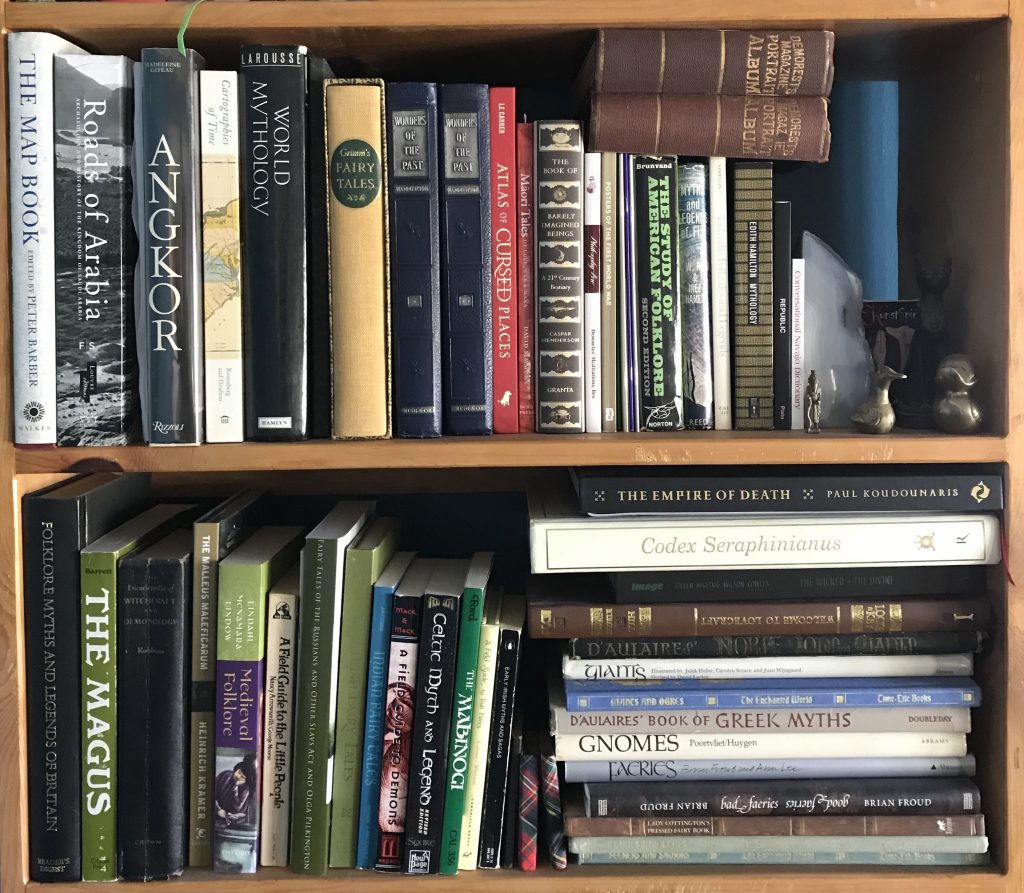
I think the simplest answer is to just share a picture of a few of my bookshelves. A Field Guide To Little People is certainly a favorite, as are the D’Aulaires myths. But I also enjoy books that take the style of faerie tale and folklore but tell unique stories, such as The Dictionary of the Khazars by Milorad Pavić; Night’s Master by Tanith Lee; and Deathless by Catherynne Valente.

Have you created any faerie tales or folktales in your Eberron? Share your experiences below! And thanks as always to my Patreon supporters for keeping this blog going!

IFAQ: Lhazaar Princes

While we’re all trapped in our bunkers, I’ve asked my Patreon supporters to present some interesting short questions on topics that are infrequently raised. Today’s question comes from Joseph.

When did Ryger become High Prince of the Lhazaar Principalities? The ECS says he represented the Lhazaar Principalities as High Prince at Thronehold, and that this was necessary for the Principalities to be recognized as a nation. Rising says he awarded himself the title AFTER Thronehold. While other sources—this Dragonshard and ECS in talking about Thuranni—suggest that there’s always been a high prince. What’s the story?

Needless to say, I can only give my opinion. But given that I wrote all of the Lhazaar material referenced above, that should count for something.

In this case, the most accurate source is the Dragonshard. The Rising section was simplified for the sake of brevity; the goal of Rising was to focus on the present rather than delving too deeply into how we got there. With this in mind, the crucial first step is to understand what it means to BE “High Prince.” In most of the principalities, the title of prince isn’t hereditary. You have to EARN it; you become a prince by being a leader the people of your principality will follow, whether you achieve it through charisma or wealth. With that in mind, the question posed here says that “there’s always been a high prince”… which is inaccurate on one crucial detail. Consider this quote from the Dragonshard…

The Lhazaar princes have always been willful and independent, and the history of the region is filled with feuds between princes. Powerful alliances have risen and fallen, but the islands have never been fully united under one prince. There has always been at least one lord who has claimed the title of high prince. This claim usually reflects the power of the lord’s fleet, and as a result the high prince usually has the respect of the other princes — but this doesn’t make their word law. They can make requests of the other princes, but unless they intend to use force, they cannot make demands.

So: Lhazaar herself was the first high prince, the first captain whose influence stretched across the entire region. Since then, there’s always been at least one lord who’s claimed the title. The key points here are that there’s been times when there’s been two or even three people who have CLAIMED to be the high prince; and that giving yourself the title doesn’t mean anything on its own. You don’t wield power because you’re the high prince; you can call yourself the high prince BECAUSE you wield enough power to back it up it.

What does this mean for Ryger? Let’s turn back to the ECS.

The largest fleet currently operating in the Principalities is the Seadragons, led by High Prince Ryger ir’Wynarn… The prince has ruled the Seadragon Principality for fifteen years, and throughout that time he has claimed to have the blood of the Galifar kings running through his veins. Whether this claim is true or not, Ryger has demonstrated remarkable charisma, a gift for leadership, and a head for strategy that makes him one of the deadliest captains plying the waters off the eastern shores… Pirate, privateer, merchant—Ryger has worn all of these hats and more since wresting the prince’s crown from the head of Horget Black, the previous high prince of the Lhazaar Sea.

As high prince, Ryger is seen as a leader among equals, and most of the sea barons and pirate lords bow to his wisdom and counsel (though not yet to his rule). Those who refuse to pay heed to Ryger do so quietly, so as not to attract the attention of his warships and loyal warriors. It was Ryger who gathered a council of captains and went to Thronehold to represent the Principalities in the talks that ended the war. Now, working mainly as a merchant fleet for House Orien, the Seadragons hope to gain an even greater advantage in peace than in war. High Prince Ryger wants to unite the Principalities under one banner… the banner of Prince Ryger ir’Wynarn.

Let’s break this down.

  • “High prince” is a title that implies that the bearer is the most powerful captain in the Principalities and wields influence throughout the region.
  • Ryger has been a prince for 15 years, but he didn’t start as high prince.
  • Horget Black was the previous high prince. He was in power at least 25 years ago, when he welcomed Thuranni to the region. At some undefined point in the last 15 years, he was defeated by Ryger, who “wrested the prince’s crown from his head.” While this could be a literal crown, the main point is that Black was acknowledged as the most powerful and influential captain in the Principalities and Ryger defeated him, thus implying that HE was now the most powerful captain.
  • Ryger gathered the delegation of princes that represented the region at Thronehold, and used the title of High Prince while there. No one else in the region challenged this, and this means that the other NATIONS assume that Ryger is the recognized leader of the Principalities.
  • … Which he kind of is, because no one else has challenged him and he has the strongest fleet. However, he WANTS the Principalities to join together as a true unified nation with a clear hierarchy, and that has NOT happened. He’s the high princes, and other princes will RESPECT that, but he can’t actually COMMAND any of them–he can only make requests and threats.

Rising meanwhile condenses this all down into a very simple form: Ryger has the best fleet, he represented the nation at Thronehold, he’s declared himself high prince, but he’s been unable to unite everyone. The timeline’s a little fuzzy, but the main point is that he called himself high prince before, but by using the title at Thronehold he gained international recognition as high prince and that really sealed the deal.

An important point here is that the Principalities are not a unified culture. The gnomes of Lorghalen, the Bloodsail elves of Farlnen, Mika’s Cloudreavers, the changelings of the Gray Tide—these are all proudly independent and unique. They have joined together against common enemies, and they have common traditions that unite them against the rest of the world, including the traditions of prince and high prince. But high prince isn’t a title that’s granted, it’s a title that’s claimed by someone who has the power to back it up. Ryger is high prince because he says he is and because no one’s challenged his claim. But he HASN’T managed to get Lorghalen and Farlnen and the Gray Tide to all come together and agree on a more concrete system of governance or greater union.

So: What happened to Horget Black?

Little has been said about Horget Black. Most crucially, it’s never said WHAT Principality he ruled. The ECS states that he gave Thuranni the right to set up shop in REGALPORT. There’s two ways to look at this.

The first is that Horget was himself Prince of the Seadragons. In this case, Ryger was a brilliant and capable Seadragon captain who served Captain Black for a period of time before seizing both his principality and the title of high prince. This isn’t in any way unprecedented; again, in most principalities, prince isn’t a hereditary title. The question is how it ties into the statement that Ryger has been Prince of the Seadragons for 15 years; whether that was also when he defeated Horget, or if it’s referencing that he was one of the most respected captains during that time—people were already calling him a prince even though he served Horget. It’s possible that as he called himself High Prince, Horget let his best captains be called princes.

The second option is that Horget was asserting his authority as high prince by inviting Thuranni to go settle on SOMEONE ELSE’S ISLAND. That’s the kind of thing you could get away with if you’re truly the high prince, and it would be a clear reason for Ryger to hold a grudge.

Where’s Horget now? It’s really up to you. We know he’s not a power player in the Principalities today. However, we also know that you are only prince as long as you can hold power; if he was legitimately broken—by an injury, by a crippling loss of reputation, or by age—it’s not unreasonable that he would accept his defeat and remain in a lesser standing. PERSONALLY, I’d do one of two things: I’d either have him sailing a ghost ship and occasionally popping up to take vengeance on Seadragon vessels… OR I’d have him as an old man missing a limb, serving Ryger in Regalport as a trusted advisor.

Have you put some thought towards how people travel between principalities? Given what you’ve said above, is it plausible to assume Rygar might enforce a set of rules around people who’ve fairly paid to travel between princes, or is it more like a mutual agreement that princes don’t sabotage each other’s ships when they’re carrying civilians/foreigners or trade goods?

Most ships in the region fly two flags: the flag of the ship itself (IE Breland, Aerenal, Lyrandar) and a secondary flag indicating the Principality with which they are doing business. So an Aereni ship carrying lumber to Regalport will fly a secondary Seadragon flag.

So: it’s more like a mutual agreement. If you plunder a ship bearing a Seadragon flag, you are striking at Ryger, and he may demand reparation or take retaliatory action. Conversely, if a merchant ship flies a Seadragon flag WITHOUT having legitimate business with Ryger, he may take offense at THAT.

I’ll answer more infrequently asked questions in the days ahead, and be posting a poll to Patreon to determine the subject of the next major article! Smooth sailing to you all!

IFAQ: Dhakaani Artificers?

While I get certain questions about Eberron all the time, I’ve asked my Patreon supporters to give me some simple infrequently asked questions. Today’s question comes from DMZ:

I have a goblin PC who is an Heir of Dhakaan but I don’t feel confident about his backstory. Are there any Dhakaani clans that are known for their Artificers, that want to preserve knowledge and the past or maybe one that wants to unite goblinoids once again?E

The Empire of Dhakaan was an advanced goblin nation that dominated Khorvaire long before humanity arrived on the continent. It was ultimately destroyed by the daelkyr, but before it fell completely a number of clans retreated into deep vaults. Recently these “Heirs of Dhakaan” have returned to the surface. They are more advanced and disciplined than the Ghaal’dar goblinoids most people are familiar with. You can find more information on the Dar—Dhakaani goblinoids—in this article.

So: are there any Dhakaani clans known for their artificers, their desire to preserve knowledge, and maybe that wants to unite goblinoids once again? In fact, there’s one that fits all three of these categories: the Kech Volaar, the “Keepers of the Word.” The Volaar value knowledge above all else—both the records of history but also, knowledge of the arcane. The Volaar have the finest duur’kala bards of all the clans. But they also have daashor—the forge adepts who serve the Dhakaani as artificers—and they are actively working to perfect the arcane science that produces wizards. All of the Dhakaani clans want to reunite the DAR, but many believe that the modern goblinoids have been corrupted by the daelkyr and cannot be saved. Of all the clans, the Kech Volaar are the most optimistic that it may be possible to reclaim these lost souls and to rebuild the Empire with ALL goblinoids.

There are a number of elements that make the Kech Volaar an excellent choice for PCs who want to be Dhakaani adventurers. The Kech Volaar are eager to learn more about the modern world, and especially to study the arcane science or traditions of other cultures. As such, a Volaar adventurer could simply be out in the world gathering information, with a special interest in investigating anything tied to arcane science. The Volaar are also determined to recover powerful Dhakaani artifacts lost during the fall of the Empire (and quite possibly now in the hands of chaat’oor!), which is another concrete quest for a player character to pursue.

So as a Volaar artificer you could be gathering information, searching for Dhakaani artifacts, or simply trying to improve your own skills by studying the artifice of other cultures.

Exploring Eberron has an extended section about the Kech Dhakaan that describes nine clans and goes deeper into the daashor tradition, so there’s a deeper examination of all of this coming soon!

iFAQ: University Adventures

I’m still working on Exploring Eberron, but with many of us trapped at home I want to write a few shorter articles dealing with INfrequently asked questions from my Patreon supporters. This week we’ve been tackling the concept of magical education in Eberron. Let’s wrap up that topic with this question.

If you were to run an anime-inspired school-based game, where would you set it?

We’re used to the idea of D&D being about epic adventures and dungeon crawls, but there’s lots of fantasy stories that focus on schooling and coming of age. Set aside anime for a moment; The Name of the Wind and the Harry Potter series are both stories that focus on adventures at a school or university. So whether you’ll looking for anime flavor or the more traditional fantasy of The Name of the Wind, I think this is a fun idea to explore.

With that in mind, I DID explore it… in the Wayfinder’s Guide to Eberron. In the WGtE I included three “Starting Points.” This was an early variation of the Group Patrons of Rising, with the point of tying a campaign to a location and a theme rather than a patron. These included Clifftop, a hub for globetrotting adventurers; Callestan, a gritty street-level campaign; and Morgrave University.

So to answer the question: I would personally choose Morgrave University or Arcanix. Which I’d choose would be based on the type of story I want to tell. Arcanix is closer to Hogwarts. It is ISOLATED—heck, the towers are floating, and if you haven’t learned to fly yet it takes time to get down! There’s a supporting village nearby, but there’s not a lot of activity there. By contrast, Morgrave is right in the middle of Sharn, so there’s all sorts of opportunity for trouble just off campus (much as University students in The Name of the Wind can go into Imre). Likewise, Morgrave University is infamous for indulging in dungeon delves and dangerous expeditions as “field trips.” Furthermore, Arcanix is specifically a college of magic, which limits your character concepts; because Morgrave is a more general purpose institution, it’s easier to justify any class.

These are supposed to be short articles, so I’m not going to retread all the ground covered in the Wayfinder’s Guide. But I’ll touch on a few things I’d personally focus on in running a school-based campaign.

Story rewards. I’d drop the standard experience point system and base character advancement either on time or on clearly established milestones. It’s also possible that you could tie specific class abilities to in-game situations. If you want to learn a specific spell, you’re going to have to sneak a particular spellbook out of the Library. You may be a 3rd level fighter, but to get the abilities of your Martial Archetype you’re going to have to find a mentor. This is a way to blend story and mechanics together. In a game at school you’re not likely to be amassing TREASURE—so one option is for the rewards you gain to BE access to locations or the favor of teachers—but those can be linked to concrete rewards, whether it’s access to your full class abilities or something beyond that, such as Supernatural Gifts or Marks of Prestige from the Dungeon Master’s Guide.

How will you handle power? D&D is based on an underlying system of character advancement that provides players with new abilities to explore and the ability to take on greater challenges over time. At the same time, it’s can be bizarre to have your characters become 6th or 7th level characters AT SCHOOL when that’s a level of skill that dwarfs veteran soldiers… especially if the DM wants to present rival students or professors as having even greater power. There’s a few ways to address this.

  • Limit advancement. You can always choose to say that characters DON’T advance in this campaign – or do so very, very slowly. You improve by gaining allies, influence, and information, not by doubling your hit points or gaining new spells. This is perfectly reasonable if everyone agrees, but at that point—if you’re eliminating a significant piece of the rules system—I’d question whether you should be using an entirely different rules system that isn’t based around character advancement to begin with.
  • It’s all relative. Sure, characters gain a level every two sessions. And the evil professor is a 9th level spellcaster. And there’s a lich in the basement. But it’s reasonable to say that this is how things appear because you’re in a microcosm and you’re comparing skills to people in that bubble with you. I would have no problem playing through a school campaign in which characters got up to 10th level and at the end of it saying “Okay, you all graduate. How about when we start the new campaign with you adventuring in the wider world, you all start off at 3rd level?” The point being that 10th level on the SCHOOL SCALE might only be 3rd level outside. Obviously this takes some suspension of disbelief—I used to be able to teleport! I raised someone from the dead! But hey, that was school, kids. Crazy things happen.
  • Ignore it. Sure, it doesn’t make sense for you to be dueling another student and that both of you are 9th level wizards. But so what? If people are having fun, does it matter?

How do you explain character classes? We’ve mentioned before that the abilities of player characters are inherently remarkable… that just at first level you’re pretty amazing. How’s that fit with a school game, where you’re just supposed to be students? Here again I’d follow the it’s all relative approach. Yes, mechanically you’re a 1st level wizard. But in this setting, that reflects the idea that you have an APTITUDE for wizardry and you need to work to develop it. A few quick thoughts…

  • Wizard? Artificer? You’re science nerds. You’re all about figuring out how arcane science works.
  • Fighter? Barbarian? You’re the jocks. Perhaps you actually want to be soldiers when you graduate, or perhaps you’re here on a Hrazhak scholarship. Barbarian, you really need to deal with your anger issues.
  • Cleric? You’re deeply religious and know that your faith in Aureon/The Divinity Within is going to help you pass that math test. Faith and divine magic ARE real things in Eberron; there’s surely a chaplain at school who will want to help you develop your faith and your abilities. You might get divine visions pushing you to do things! Paladin, you’re in the same boat, but you’re ALSO a jock on a Hrazhak scholarship.
  • Rogue? You might be a bit of a rebel—the student from Lower Dura or the bad side of the tracks, who has friends in the Boromar Clan and can get Dreamlily for the party. Are you here reluctantly? Are you hoping to turn a profit on this whole thing? Are you more interested in gambling than studying? Bard, you could follow the same path, but you’re a bit of a know-it-all and hey, you should start a band.
  • Sorcerer? Like the Cleric, sorcery is a thing that happens in the world. You may not have any knowledge of Arcana and may not want to learn, but there’s likely a teacher or professor who specializes in helping sorcerers develop their abilities. One question is whether you’re here by choice, or whether you’re here because you HAVE to be to learn to control your powers.
  • Warlock? You could take this a few ways. You COULD say that you’re working with a particular division of the Conjuration department that cultivates warlock relationships. But if it were ME, I’d play you as Ally Sheedy in The Breakfast Club. You’re the weird kid, the outsider who’s always writing poetry in your journal in the corner, who prefers talking to your imaginary friends to going to parties… except your imaginary friends are REAL and they’re teaching you how to do things. Like the cleric, your patron could give you visions or tasks that push you to work with the other characters despite your preference for isolation.
  • Druid? Ranger? You’re both odd choices for a big city school, but hey, you just moved to town from the Eldeen Reaches and your family insisted you get an education. Shifter Ranger? You’re DEFINITELY on the Hrazhak team, and you’re annoyed because these city kids are playing it ALL WRONG.

Backgrounds obviously overlap with these ideas. Noble background? You’re from a wealthy family. Urchin? You’re the orphan here because one of the professors sponsored you. Sage? You’re the annoying know-it-all. Entertainer? You DO have a band. Soldier? You’re from a military family, and if you screw up here you’re heading back to Rekkenmark. Criminal? OK, YOU’RE the one who can get some dreamlily for the party.

This has turned into a longer article than I’d intended, so I’m going to stop here. But hopefully this gives you ideas! Thanks as always to my Patreon supporters!

iFAQ: Aereni Learning

Until I’m done with Exploring Eberron, I don’t have time for deep dives. My next major article will take a deeper look at the Mror Dwarves. But meanwhile, with all of us trapped inside, I want to do a few daily posts dealing with some interesting questions from my Patreon supporters. Here’s the first!

The elves of Aerenal are supposed to spend decades perfecting the techniques of their ancestors. When an Aereni character starts out 100 years old, it’s not because they spent decades in diapers or because they’re dumber than human wizards, it’s because they’ve spent decades going deep in their studies. But how does this hold up for Aereni adventurers? They advance at the same pace as other player characters. How does an elf go from taking decades to perfect a cantrip to suddenly casting far more complex spells in a much shorter period of time?

First of all, let’s shoot the elephant in the room: character advancement doesn’t make sense. How is it that your HUMAN wizard can spend a decade studying at Arcanix, but exponentially increase their skills after a month of adventuring? How does the halfling rogue get expertise with Persuasion by stabbing a bunch of goblins? It’s a mistake to look at any of this too deeply, because it’s not logical. This also ties to the idea that the way in which player characters advance is part of what makes them remarkable and NOT typical for all inhabitants of the world. There are veterans of the Last War who still use the “Guard” statblock, because for most people that represents an OK level of skill. Player characters are supposed to be heroes, and their ability to quickly skyrocket to a greater level of power is a narrative device, not something that holds up to any sort of close analysis.

WITH THAT SAID: That doesn’t mean we can’t make it make as much sense as possible, and this is a good question. How come the Aereni wizard spent decades studying magic back home but can advance just as quickly as the human wizard? The key point is that the Aereni apprentice didn’t spend decades studying a specific spell; it didn’t take them that long to learn to cast one particular cantrip. Instead, they were mastering techniques of spellcasting. They were studying history, theory, and concretely, they were mastering somatic and verbal components. Arcane magic is a form of science, and somatic and verbal components are the underlying mechanics that make it possible. An Aereni apprentice learns precise accent and inflection of verbal components, and precise performance of somatic components, exactly mimicking the techniques of the masters of their line. They spend endless hours drilling until these techniques come naturally. When an Aereni wizard casts a spell, it looks and sounds exactly the same as the master who created the spell ten thousand years ago. Because they’ve perfected these basic principles, when they learn—or even create—new spells, the basic techniques will carry them forward. They CAN advance quickly precisely because they spent all that time learning to crawl… ensuring that they are building on a perfect foundation.

This same principle applies across all classes. The Aereni fighter is learning the basic techniques of all weapons, perfecting the most basic guards, learning to hold and move with the weapon just as their ancestors did. They are learning the most fundamental martial principles—and then they can quickly build on top of those without losing those core techniques.

Aereni PREFER to take their time with things. An Aereni fighter might spend four hours each night practicing a specific move while the other characters are taking a long rest, and continue to practice that move in their mind while trancing. But the decades they spent learning before created a foundation that lets them advance quickly when needed. They were honing the basic building blocks that they assemble as they advance with the other characters.

Now, ultimately, does all that work actually make the Aereni player character a better wizard? No. Mechanically, there’s no difference between the Arcanix-trained wizard and the Aereni wizard. But THEMATICALLY the idea is that the Aereni wizardry is beautiful and perfect, like watching a dance; by contrast the Arcanix wizard is taking a lot of shortcuts and throwing in a lot of personal touches. It works great for THAT WIZARD and may be more innovative, but the Aereni find it painful to watch. The second aspect of this is the idea that player character classes reflect a level of talent most people can’t attain, and that the Aereni have MORE people with that level of skill. It takes them longer to get there, but Aerenal has more actual wizards than Khorvaire, whereas in the Five Nations most people just spend the few years required to become magewrights.

Taking as given that player character advancement is not logical, mostly a game mechanic construct, can this focus on learning the exact techniques and history of the past account for the slow pace of technological development in Aereni cultures?

Exactly so. This is something that’s discussed in this article and in this episode of Manifest Zone. A critical quote:

This is why, despite Aereni society having been around for over twenty thousand years, humans are beginning to do things with magic that the elves have never done. Elven society is driven by tradition rather than innovation – by absolutely perfecting the techniques of the past instead of developing entirely new ways of doing things. Innovation does happen – and an Aereni player character might be the great elf innovator of this age – but it isn’t enshrined as a cultural value as it often is among humanity…

Part of the idea is that what the elves see as sloppy Arcanix techniques might actually be BETTER than the ancient Aereni traditions; certainly they’re easier to learn. But the elves take comfort in adherence to what they know.

Thanks again to my Patreon supporters, and I’ll tackle another question tomorrow!

IFAQ: Dragonshards and Tharashk

When did dragonshards become important as magical fuel? House Tharashk was discovered in 498 YK. The lightning rail went into operation in 811 YK, but Tharashk only stepped up mining in the Shadow Marches & Q’barra in the past decade? What delayed them so long?

There’s two significant questions here: When did dragonshards become important and why did it take Tharashk so long to start major mining operations in Q’barra?

The spells, items, and services available in 998 YK represent the pinnacle of arcane science. Like any form of science, these things didn’t emerge into the world fully formed. The lightning rail of 811 YK was the result of decades of research and development—and it was quite different than the lightning rail of 998 YK. It originally used volatile Fernian ash as its fuel, and both the binding and the conductor stones had flaws.

Eberron dragonshards are found across Eberron. Xen’drik, the Shadow Marches, and Q’barra are especially rich sources of dragonshards, but there are dragonshard deposits across Khorvaire. Eberron dragonshards are an important element in the creation of magic items and in maintaining ongoing magical effects—such as the lightning rail and elemental airships. Eberron shards can be refined into a powdered form that can be used in place of any spell component with a cost.

So: it’s possible to perform most forms of arcane science without dragonshards; it just takes a range of different substance, which are usually more exotic and specific to the effect being produced. However, this uses refined Eberron dragonshard powder (also known as residuum). Raw dragonshards can be used, but unless they are processed and refined it’s inefficient; you’re significantly better off using the other alternative. Because of this, the process of refining dragonshards to create residuum was a crucial breakthrough that had cascading effects across the magical economy. While creating magic items still requires a range of additional rare elements, the universal nature of refined dragonshards allowed Cannith and others to dramatically increase both the range and scale of production. Using processed dragonshards as an energy source made the lightning rail safer and allowed Orien to operate more carriages. But again, this process of refining was a breakthrough that occured less than two centuries ago, and it’s a process that continued to be explored.

So: Eberron Dragonshards have always been a valuable source of magical energy, but it wasn’t until the last two centuries that they became as valuable and universal as they are today. Eberron dragonshards CAN be found across Khorvaire, and initially, that supply was sufficient to meet demands. But within the last century that demand has steadily grown—which has in turn driven people to find richer pools to draw on.

This brings us to House Tharashk. Why are their operations in Q’barra only a decade old? House Tharashk began as a house of hunters, not prospectors. For centuries its primary focus was on inquisitive work and bounty hunting. Prospecting is a relatively new path that arose both with the increased demand for dragonshards mentioned above and crucially with the creation of the prospector’s rod. As with many houses, the base powers of the dragonmark aren’t as important as the focus items that channel that power. As the speaking stone is to House Sivis, the prospector’s rod is to Tharashk: it is this tool that expands the powers of the mark beyond the simple scope of casting locate object and allows prospecting on an industrial scale.

In my Eberron, it’s a mistake to say that prospecting in the SHADOW MARCHES only began ten years ago. Dragonmarked calls out that House Sivis originally came to the Shadow Marches in search of dragonshards, and that the mineral wealth of the Shadow Marches has always been a secondary source of wealth for the house. That effort may have increased over the past decade as the house as a whole has realized that there’s more wealth and influence to be gained from dragonshards than bounty hunting, but it’s been something that has been scaling up over the course of the past century.

Q’barra, on the other hand, IS a new development. The world’s a big place, and Tharashk hasn’t been able to search all of it. Prior to the Last War, Q’barra was a shunned backwater thought filled with hostile scales. The Dragon articles call out that it was only ten years ago that settlers discovered rich deposits of dragonshards in Q’barra. Tharashk responded quickly to this discovery and has ramped up its efforts ever since. But why didn’t they go there earlier? Because they already had a rich source of dragonshards in the Shadow Marches and were still expanding their operations, and because no one knew there were dragonshards in Q’barra. It’s entirely possible that there are other rich deposits in Khorvaire that have yet to be discovered!

Ultimately, the key takeaway here is that the arcane industry in Eberron is just like industry and science in our world. It evolves and expands. The current state of things in 998 YK reflects the latest developments; drop back to 498 YK or 811 YK and the world will be a much different place.

Thanks as always to my Patreon supporters for keeping this blog going! I’ll be posting a poll to the inner circle soon to determine the subject of the next article.

iFAQ: Warforged, Blood, and the Blood of Vol

People ask me a lot of questions about Eberron. While I’ve typically answered the most frequently asked questions at sometime in the past, every now and then there’s an INFREQUENTLY asked question that still seems like it’s worth answering. Over the last few weeks two of those have come my way. How could a warforged become a cleric of the Blood of Vol? And can a warforged become a vampire?

Could a Warforged Become a Cleric of the Blood of Vol?

The Blood of Vol is based on the principle that the blood of the living holds a spark of divine power, and that all mortals have the potential to harness and evolve that Divinity Within. A Seeker cleric believes they are drawing on their own divine spark when they cast spells.

Warforged don’t have blood. Therefore, it seems logical to assume that they don’t have the spark of the Divinity Within. So why would they follow the Blood of Vol, and how could a warforged Seeker paladin or cleric justify their divine magic?

To begin with, let’s start with the WHY. Ultimately, the Blood of Vol faith is grounded in the question what just god would allow death and suffering, with the conclusion none; the fact that we suffer shows that if there are gods, they are cruel. All we have is each other, and we must stand together and defy death. The Seekers place a strong emphasis on community and protecting the weak. Any death is tragic. They use undead because once the spark is gone, there’s no reason NOT to use the corpse if it can help protect the living. More powerful undead—vampires, mummies—know that they will never achieve divinity, as they lost their divine spark when they died; but they can still fight to defend and to guide the living, to be champions of life… and perhaps someday topple the Sovereigns themselves and free the entire world from the curse of mortality. This is where the warforged Seeker comes in. They have no blood, and presumably no divine spark. But they are immune to disease and to the ravages of time. A warforged is in many ways much like a mummy. They can’t achieve true divinity, but they can protect and guide others. So the warforged Seeker priest isn’t driven by a desire for personal power; rather, they are driven by compassion and the desire to protect their community from suffering and death.

But what about the HOW? If Seeker clerics draw their power from their own blood, how do they get magic? Well, first of all, remember that the “drawing power from within” is an article of faith. They don’t KNOW the power comes from within with any more absolute certainty than a paladin of Dol Arrah knows that their power comes from Dol Arrah. So one option is to simply say “It works, don’t question it.” But the other example is to look to the mummy. Malevanor, the high priest of the Blood of Vol in Atur, is a mummy. He has no blood. So how does he cast spells? There’s two simple answers. The first is the idea that he draws on the divinity of the people around him. This ties to the strong community focus of the Blood of Vol; he can’t attain personal divinity, but he can draw on that potential within you and use that power to protect or heal you. With that said, what happens if you’re not around? Well, Seeker communities donate blood to sustain their champions. Vampires drink this blood, and while it is within them this connects them to the sparks of the living. Seeker mummies and liches BATHE in the blood of the faithful, and this charges their power for a short time.

So for your warforged cleric, the simplest answer is that they draw their power from the rest of the party! If you want to be creepy about it and the rest of the characters are willing, they could actually get blood donations from the party. But you could also just say that the proximity spark does the trick. On the other hand, you could also just say that they don’t KNOW how it works, but it does work… and that they BELIEVE it’s because they (and presumably all other warforged) have divinity within as well, despite having no blood. This would certainly be an interesting long term arc to explore!

Having said all that, back around 2005 I worked with David Esbri—who was at the time doing illustrations for the RPGA—on an early concept for an Eberron comic. One of the villains in that was a Warforged tied to the Emerald Claw who had embedded components allowing it to drain blood from its victims… essentially, an artificial vampire who believed that he could use this blood to become divine. So you could always explore a more exotic path!

Can Warforged Become Vampires?

There’s many answers to this question. The simple answer is that under the rules of 3.5 they couldn’t; “vampire” was a template that couldn’t be applied to constructs, and 3.5 warforged were constructs. The 5E rules have changed, however, and by the rules as written a warforged can become a vampire. However, the rules are guidelines, not absolute and inflexible! In my opinion, this is a case where the DM has to decide what they want from the STORY. Does it make SENSE for a warforged to be able to become a vampire, when it has no blood and doesn’t eat in the first place?

In my campaign, I would say that no, a warforged cannot become a vampire. A vampire can drain the LIFE FORCE from a warforged, but it has no blood for a vampire to drink. Vampire spawn rise when “buried in the soil”—I don’t see this having much meaning for a warforged. I DO think that warforged can become undead—that they can become vessels for the power of Mabar, channels through which it can consume the essence of the living—but I would be inclined to create a unique warforged expression of vampirism, rather than just forcing the standard bloodthirsty form onto them. I’d see it as draining energy like a wight as opposed to drinking blood, and I’d consider which of the traditional vampire powers made sense and what it might have instead.

That’s all I have time for today! Have you used warforged seekers or undead in your campaign?

IfAQ: Can Warforged Cry?

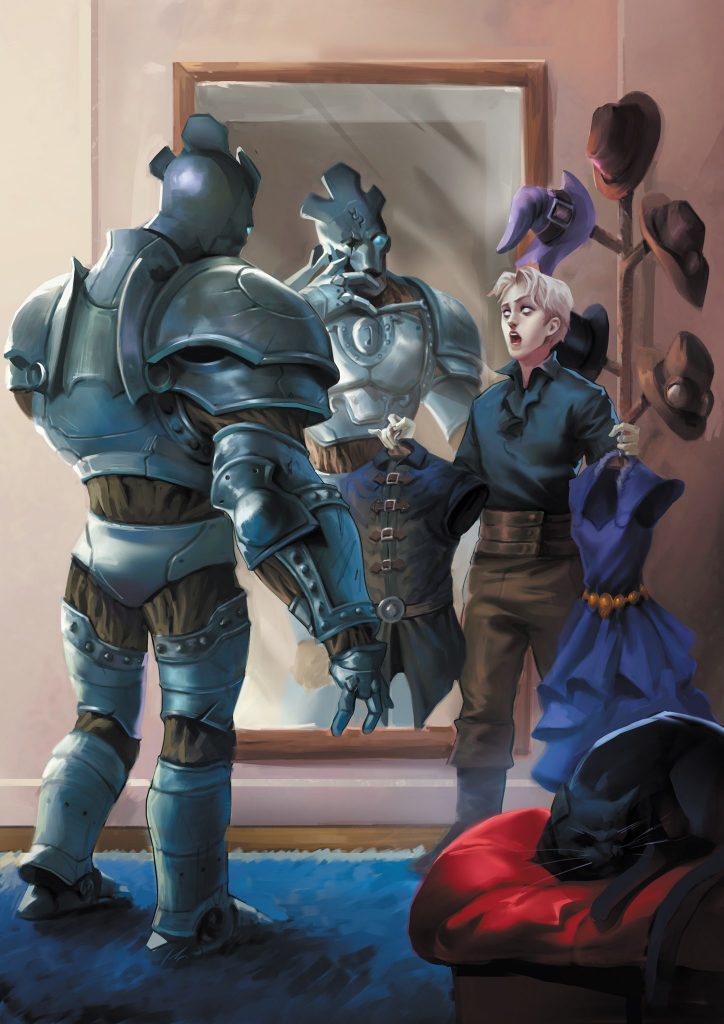
Art by Júlio Azevedo for Exploring Eberron!

If all goes well, I’ll be doing more Eberron support on this site in 2020. The frequency and form of this content will depend on my Patreon support. In addition to feature articles, I’ll always be tackling frequently asked questions about Eberron. But I also want to take the time to answer a few INfrequently asked questions.

Can Warforged Cry?

In MY Eberron, no: warforged don’t cry. There’s two major reasons for this. The first is that warforged are generally depicted as having crystaline eyes. They thus have no need to lubricate their eyes and there’s no logical reason for them to have any sort of tear duct. So there’s no biological reason for it. But beyond that: I don’t WANT non-human species of behave just like humans. I always think it’s more interesting to explore how a nonhuman species differs from humanity as opposed to saying “They’re just like us, but with pointy ears or green skin.” So I want to know what warforged do INSTEAD of crying.

Warforged have the capacity to feel emotion. A warforged can feel joy or sorrow. But they can’t smile, and in my opinion, they can’t cry. So how do these emotions come out? Is there an involuntarily physiological response like a tear? Is there a more voluntary response, like when you embrace the sorrow and start sobbing? In MY Eberron, a warforged’s involuntary response to sorrow is a slight trembling that runs through the root-like musculature of the warforged. If the warforged has metal armor plating, this will rattle the plates against one another, creating a soft, dissonant chiming sound. If the warforged has non-metal armor, if will be more of a rustling like rain. When a warforged is in the grip of sorrow, a common response is to bring its arms together—as if hugging itself—and to rhythmically tap is fingers against its forearms, essentially creating an amplified version of that “crying” sound. A warforged may also do this rhythmic tapping against one forearm as a general expression of sorrow or frustration—the equivalent of taking a deep sigh.

Now, that’s what *I* do in MY Eberron. The second side of the question is what I think the official answer might be, and my suspicion is that it’s “If there’s no rule that states a warforged can’t cry, than it can cry.” If I HAD to explain how this would work, I’d say “The organic components of a warforged are infused with alchemical fluids. Warforged tears are an involuntarily expulsion of these fluids.” But again, I personally would prefer for them to express their grief in a way that’s unique to warforged, rather than to mirror humanity.

What are your thoughts on warforged crying? Have you ever addressed it in your campaign? Post your answers below! Also, go to TheAdventureZoneGame.com to check out my latest game, currently in preorder until mid-January 2020!

FAQ: Changelings

This is a time to think of all the things we’ve thankful for, and I for one am thankful that I haven’t been replaced by a changeling. So it seems like a good time to address a few of the questions I’ve received about changelings, the shapeshifters of Rising From The Last War.

First, let’s take a quick look at the foundation of the changeling:

As an action, you can change your appearance and your voice. You determine the specifics of the changes, including your coloration, hair length, and sex. You can also adjust your height and weight, but not so much that your size changes. You can make yourself appear as a member of another race, though none of your game statistics change. You can’t duplicate the appearance of a creature you’ve never seen, and you must adopt a form that has the same basic arrangement of limbs that you have. Your clothing and equipment aren’t changed by this trait. You stay in the new form until you use an action to revert to your true form or until you die.

A question that comes up quite often is given the threat posed by changelings impersonating people, what steps do Eberron’s factions and governments take to deal with them?

The everyday magic that drives the civilization of Khorvaire only goes up to around 3rd level. So you don’t have guards stationed with true seeing at every important location. Which is good, because from a metagame perspective, changelings should be able to fool people. That’s the point of playing a changeling. We don’t muzzle dragonborn to keep them from using their breath weapons or make wood elves wear cement boots to negate their extra movement. If you play a changeling, you should be able to fool people.

With that said, that doesn’t mean it should be EASY. The people of Khorvaire are very aware of the existence of changelings, and after centuries of coexistence have a very good idea of their capabilities. So let’s consider those for a moment.

  • As a changeling it is assumed that you can perfectly replicate the appearance of a creature you’ve seen before (just like someone using disguise self). No roll is required to duplicate basic physical appearance.
  • However, this doesn’t provide you with any knowledge of that person and their quirks. It’s taken for granted that you sound like them—the voice comes with the shape—but you don’t know their mannerisms or their vocabulary.
  • Likewise, the most crucial limitation on changelings is that clothing and equipment don’t change. You can look like a guard, but you don’t get the uniform for free.

So: People of Khorvaire know there are people out there that can duplicate their appearance… but that they can’t steal their memories or copy their belongings. One immediate impact of this is that people make a conscious effort to develop unique mannerisms and accessories. People establish in-jokes and call-and-response phrases. They will often have at least one unique, personal accessory—a piece of clothing, jewelery, even a pet—that they carry all the time as an identifying factor. In part, this is simply about developing a personal style; but in Eberron, it also has the absolute concrete underlay that “If you see me without this accessory, you should be suspicious.’

So in my case, I have a hat that I wear all the time. Everyone knows me by that hat. If I every show up without the hat, my friends will notice. They won’t automatically assume that I’m an imposter, but they WILL probably try out one of our shared jokes or stories and see if I respond to it. This same basic principle applies to institutions. Guards will have distinctive uniforms. They will have SOME sort of ID object—whether it’s identification papers, a brooch of rank—that will stand out if it’s absent. And they WILL have a system of passwords or phrases that they use to test people suspected of being imposters. Because after all, changelings aren’t the only threat; anyone can get a hat of disguise. In a high security location, this system could have more layers to further confuse people. The ID item could change regularly. Imagine an ID brooch that’s a common magic item, enchanted so you can change its color by touching it and saying a command word. The appropriate color could vary based on the current time and day of the week. So an imposter with disguise self could duplicate the appearance of the uniform; but if they don’t know the system, they won’t know what color their brooch should be.

While this isn’t foolproof, these sorts of systems can make it very difficult for a changeling to fool people. However, this is where DECEPTION comes into play. You don’t have to make a skill check to duplicate someone’s appearance. You have to make a skill check when you do something that makes them suspicious… and if you are successful, it means you’ve managed to allay their suspicions. If you duplicate my appearance and don’t have my hat, a successful Deception check means you’ve recognized that people are suspicious and done SOMETHING to convince them that nothing’s wrong. Perhaps you make an excuse about what happened to the hat. Perhaps you never even know the hat is the issue, but you’re just so skilled at putting people at ease that they forget about the hat. It’s the same principle with a password or an ID badge. The fact that you don’t know the password doesn’t mean that it’s impossible for you to get past a guard; an excellent Deception check means you’re able to convince them there’s a good reason you don’t have the password, or to otherwise get them to ignore it. On the other hand, there can also be inanimate security systems that can’t be fooled. An alarm could be tied to that common magic ID badge; if you enter the chamber without one, it will trigger the alarm. Which means you CAN still pull off this job; but you are going to have to somehow get one of those badges to do it.

In general, if you’re playing a changeling bard with expertise in Deception, you are SUPPOSED to be a master deceiver. You SHOULD be able to fool people. On the other hand, you’re not going to be able to simply walk into the Kundarak vault and steal all the treasure because you’re wearing someone’s face. They will have passphrases, and they will use magic that’s available (up to 3rd level); so you will have alarm, and in the case of a Kundarak vault you might even be questioned under a zone of truth. People KNOW changelings are around. They are PREPARED. But it’s always possible to overcome these with enough work and preparation.

One key point to bear in mind is that an easy way to not get caught is to not impersonate someone in the first place. The whole idea of a persona is that changelings will CREATE unique identities for their purposes. If a family of changelings created the identity of “Keith Baker,” they’re the ones who came up with the hat in the first place; they KNOW all the recognizable quirks of the character. The traveling changelings often don’t duplicate the appearance of outsiders; they simply use the persona best suited to the situation.

Another question that’s come up is can a changeling impersonate a warforged? This ties to a second question, can a changeling appear to be wearing a mask, but it’s actually just their face?

The answer to both of these hinges on the phrase your clothing and equipment aren’t changed by this trait. A mask is a piece of equipment, so no, you can’t make a fake mask. Likewise, you can duplicate the appearance of a warforged, but you can’t replicate armor—and most warforged are always wearing armor. So you could be a “naked’ warforged, which means you’ve just got the livewood musculature exposed, but that’s not normal for warforged and you’ll draw a lot of attention.

If a Changeling transformed into someone/thing with webbed hands and feet, or claws, would they have any benefit, even if it’s not a lot?

No. A changeling gains no mechanical benefit from their disguise. As suggested in the comments, I could imagine granting a Stealth bonus to a naked changeling who wants to shift the color of their skin to hide in a snowbank, but the key points there are “naked” and “snowbank” (IE, not a complex background). A changeling can make it LOOK like they have sharper teeth or claws, but this doesn’t actually give them natural weapons; it’s a deception. Essentially, it is a form of disguise self, NOT alter self.

Having said that, Exploring Eberron will have a few options that allow changelings to improve their natural shapeshifting abilities in order to get mechanical benefits from it.

Could a particularly skilled Changeling pull off a Cuttlefish impression?

No; the ability states “you must adopt a form that has the same basic arrangement of limbs that you have.” With that said, I have in the past suggested the idea of a Changeling Menagerie—a changeling who is mechanically a Circle of the Moon druid, but who explains their class features as being derived from their mastery of shapeshifting as opposed to druidic traditions.

I’d love to know more about Changeling Culture. I do have a question, and it might be addressed in your book already, but here it is: In your Eberron, how would Changelings view love and romance? Would they stick with their persona the entire time they’re with their significant other, or show their true nature once they decide to commit to each other?

Exploring Eberron does go into more detail about changeling cultures, and the key point is that this isn’t a simple answer because there’s more than one changeling culture and the common answer (as there’s always exceptions in love!) would definitely vary by culture.

  • Stable changelings live openly as changelings and wouldn’t need to hide their true nature in the first place. I’d expect them to use personas as part of courting, but not to deceive the lover—rather to show them all the different facets of the changeling’s personality, to explore all the possibilities of their relationship. This could be confusing for a non-changeling lover, but between changelings it would be an important part of learning about one another. A final aspect of this could be developing an entirely new persona that is used ONLY with the lover: this is who I am with YOU.
  • Passers—lone changelings blending into non-changeling communities—might chose to share their true nature with a lover because they want to be completely honest with them. But there are passers who deny their own changeling nature and consider their chosen persona to BE their true identity; so they might believe they are BEING honest in using the persona. But part of the point is that passers aren’t really a culture; each one deals with unique circumstances.
  • Where the static changeling might create personas to show their facets to a lover, for the traveling changelings personas are important tools and stories. Many personas are shared, and any change you make to the core story of the persona would have to be followed by anyone else using the persona. If Tel-as-Bronson takes Jesse as a lover as Bronson and their cousin Dal also uses Bronson, then it’s Dal’s job to love Jesse when they are Bronson. So essentially, the question is are you taking this lover yourself—in which case, once you are certain about the relationship, you would DEFINITELY want them to know your true face—or is the persona taking this lover—in which case you’d never want to let them see your true face. This doesn’t mean the persona-lover would be any less intense or real; but it’s not part of YOUR story, it’s THEIR romance.

And these are just three of the more prevalent changeling cultures. So there’s a lot of possibilities.

I would think changelings must have some kind of internal law system for dealing with malcontents.

Remember that just like elves or for that matter drow, “changelings” don’t have anything as a whole. They aren’t a monolithic force; they have different cultures, and each culture will have their own traditions. With that said, yes, there would definitely be punishments for those whose actions threaten the community. Also bear in mind that theft of identity is a crime under the Code of Galifar; obviously casual actions can be hard to prove, but it’s an issue a changeling had best be aware of if they are going to be going before the law of the Five Nations.

One of the simplest but most severe punishments would be an indelible mark—a magical tattoo that cannot be removed by shapeshifting. The technique of the indelible mark is a secret held close by the elders of the Children of Jes, used only in severe situations. An equally severe punishment for serious offenses is removal of all or part of a limb; as noted above, changelings can’t create limbs with their power. With both of these punishments, the message is simple: if you abuse your gift, it can be taken from you. A lesser punishment would be the destruction of the criminal’s personal personas (through other changelings adopting the person and taking actions that can’t be undone).

Do changelings sometimes use their shapechanging artistically or outlandishly? Wild hair colors, patterned skin, strange eyes?

This is a question of culture. In stable changeling communities where they live openly as changelings, they absolutely use shapeshifting artistically and as a form of expression. The Queen of Stone has a changeling dancer changing patterns on their skin as part of the performance. Page 18 of Rising From The Last War notes that changeling names often incorporate a minor degree of cosmetic shapeshifting—Jin-with-vivid-blue-eyes. Traveling changelings and passers hiding their changeling nature obviously won’t use shapeshifting in this way, but still use it subtly to convey messages to family members.

Can all changelings get pregnant? Are they biologically asexual and just choose their current sex with shapeshifting?

Yes. What’s been stated in the past is that changelings set their sex with shapeshifting. Prior canon has said that a pregnant changeling actually loses the ability to shapeshift during the pregnancy. This seems extreme to me, but I could see the idea that they need to maintain a female form in order to maintain the pregnancy (and that shifting form very early in the pregnancy would simply end it, so changelings have a very easy form of birth control). The idea that changing sex is an instinctual thing, like flipping a light switch, and that a normal changeling couldn’t, for example, assume a male form but keep the uterus. With that said, if you had a changeling called out as having greater control over their abilities (for example, the Changeling Menagerie druid I’ve mentioned elsewhere) I might allow that.

Can changelings mate with non-changelings, and are their children full-blooded changelings?

What we’ve said before is that changelings can mate with most humanoids; if the child is born to a changeling mother they’ll be a changeling, while if the mother is another species there’s a 50/50% chance for either species. A changeling child is born with the apparent species of their mother, and the shapeshifting ability doesn’t set in for around a year. This is the origin of the name “changeling” — because when someone’s previously human child suddenly becomes a pale thing, it was once thought that the original child had been taken to Thelanis.

Having said that: while changelings CAN mate with other humanoids, I’d say that it is RARE for them to impregnate creatures of other species. It can happen, but the fertility rate isn’t that high. It’s quite possible that humans and other human-compatible species are the most viable. With that said…

Are changelings biologically compatible with other changelings or are they parasitic with humanoids?

Changelings are biologically compatible with changelings. Most changeling cultures are relatively insular, precisely because many traditions of the culture are tied to shapeshifting and a fluid outlook on identity, and it’s difficult to integrate a single-skin into the community. There certainly are changelings who choose to pursue relationships with members of other species —see the changeling romance answer above—but it’s not the common practice.

Can they disguise injuries, like if a guard cut your face and you escaped but they try to track you by the cut?

It would depend on the extent of the injury. There is no mechanical benefit to changeling shapeshifting, so they can’t actually heal themselves. However, I’d personally say that they can conceal minor injuries. If it’s a specific story point—an especially grievous wound inflicted for the express purpose of marking the changeling—I’d probably have the changeling make a Wisdom (Medicine) check to simply seal the wound. If they failed that, I’d still likely let them minimize and conceal it, but if someone was explicitly looking for an injured changeling it would be grounds for requiring a Charisma (Deception) check to conceal it.

What if you cut off a changeling’s arm?

Changeling shapeshifting provides no mechanical benefit, and as a changeling “you must adopt a form that has the same basic arrangement of limbs that you have.” The ability to regrow a lost limb would certainly be a mechanical benefit. So as noted above, this is a particular brutal form of justice in a changeling community.

Can changelings fake convincing dragonmarks? Can changelings be tattooed?

Yes and yes. A changeling can duplicate the appearance of a creature they’ve seen; there’s no exception stating “unless that creature has a dragonmark.” With that said, dragonmarks glow when used; if the character is attempting to make it appear functional, I’d definitely require a Charisma (Deception) check, and for them to have seen the mark used before. And note that this sort of fake dragonmark won’t let you use a dragonmark focus item.

As for being tattooed, changelings can definitely be tattooed, and they can just as easily erase the tattoo with a moment’s thought. As mentioned above, the Children of Jes have a curse known as the indelible mark which can only be removed using a spell that would remove a curse, but a mundane tattoo can be easily faked or removed.

What’s up with doppelgangers? We know changelings believe they’re a kind of insane changeling, but how true is that if doppelgangers seem to come from Khyber?

Under 5E lore, doppelgangers are changelings twisted by the daelkyr Dyrrn the Corruptor. A general belief is that this change is actually primarily psychological. Doppelgangers have a fundamentally alien outlook. They are predators who so paranoia and chaos when not working for a specific Cult of the Dragon Below, but there’s often no apparent motive for their actions. This is largely about the horror of a creature who knows your thoughts, who can kill you with its bare hands and steal your face, but that you don’t know WHY or what it wants.

One possibility is that doppelgangers are biologically distinct from changelings. Another possibility is that they are physically identical, and that the doppelganger’s superior abilities are simply unlocked by its alien psychology. With this said, it’s possible that changelings can also unlock these same abilities—but that in so doing they will lose their original personality and become doppelgangers.

Would a scholar be able to tell the difference between a changeling and a doppelganger? Would a changeling be able to recognize a doppelganger if they saw it using its abilities?

In their natural forms, doppelgangers and changelings are quite different. Just take a look at the picture in the Monster Manual! Doppelgangers are hairless and less human in their proportions. If you embrace the idea of the changeling becoming a doppelganger, once it underwent the psychological transition its “true form” would change to match the hairless doppelganger form.

With that said, a changeling could DISGUISE itself as a doppelganger (if it had see one in its true form), and vice versa!

As for recognizing it, the BASIC shapeshifting action is identical. You don’t see someone shift faces and say “That’s not a changeling, it’s a doppelganger!” You recognize it by its ability to read thoughts and by its deadly unarmed attack.

Does the 2nd level Moonbeam work against changelings? If so, wouldn’t this have large implications in the viability of hiding as a changeling? Likewise, are changelings immune to the polymorph spell, which fails when used on shapeshifters?

WotC has confirmed that changelings are considered to have the Shapechanger subtype. So they are indeed immune to polymorph and can be affected by moonbeam.

With that said: Moonbeam isn’t a particularly effective changeling test. It’s a 2nd level spell, so it is in the world, but that’s still not something people use all the time. It’s also a druid spell, and druidic magic isn’t common in the Five Nations. Most important, it inflicts 2d10 radiant damage, which is MORE than enough to kill a normal person. So using moonbeam to check if someone’s a changeling is like shooting them in the face to see if they’re a vampire.

To what degree are 4th (Private Sanctum), 5th (Geas), and 6th (Forbiddence) level spells available to high end buyers (eg Royalty). I know the 3.5 Dreadhold write up had antimagic, which is 8th level, but I don’t have a sense to grade from “Standard enclave” to “The most impenetrable prison of all time”. I know greater marks go up to 5th, but are 5th level spells that aren’t on a Spells of the Mark list available for the ultrawealthy?

This isn’t strictly a changeling question, but it ties to the general topic of detection. First of all: one of the general principles of Eberron is that only magic of up to 3rd level is commonly available — employed by magewrights, etc. This article discusses a range of options that fall under that umbrella, based on alarm, glyph of warding, and arcane lock.

Spells of 4th level and above can be available, but they are rare and expensive—not services you should take for granted. The Spells of the Mark tables are good guidelines but are NOT complete. These are spells heirs may be able to CAST, but the direct powers of a mark are not as important as the ability to use focus items – and for example, I have a focus item in Exploring Eberron that allows a dwarf with the mark of warding to cast guards & wards. Effects such as forbiddance and true seeing are POSSIBLE, but they should be RARE, not something anyone would take for granted. It’s the sort of thing where a commoner might have HEARD of a Kundarak houseward but never seen one.

Meanwhile, Dreadhold is the most secure prison in Khorvaire. It is LEGENDARY. Yes, it employs forbiddance and antimagic—but that doesn’t mean you should find these effects in a typical city jail.

Doesn’t the Shapechanger ability of the changeling invalidate the 9th level Infiltration Expertise and 13th level Imposter ability of the Assassin rogue? Isn’t that too powerful? I assume that a changeling should get advantage on Deception checks because of its disguise, but that’s what Imposter does.

I don’t see the conflict between these abilities. ANYONE can get the ability to change their appearance as a changeling does. Disguise self is a 1st level spell and the hat of disguise is an uncommon magic item, and both of these are BETTER than the changeling’s Shapechanger power because they allow the user to change the appearance of their equipment and clothing. It’s been called out in the past that hats of disguise are standard issue for elite members of the Royal Eyes of Aundair; if this uncommon item entirely negated the 9/13 abilities of the assassin, it would be pretty sad for the assassin.

The 9th level Infiltration Expertise ability allows you to “establish the history, profession, and affiliations for an identity… For example, you might acquire appropriate clothing, letters of introduction, and official-looking certification…” The changeling Shapechanger ability doesn’t give you ANY of these things, specifically NOT letting you change your clothing. Infiltration Expertise is the perfect tool for a changeling who wants to create a new persona. The Shapechanger ability changes their face, but Infiltration Expertise creates an IDENTITY that will hold up if the disguise is questioned.

Meanwhile, the basic idea of the Shapechanger ability—like the hat of disguise or disguise self—is that the disguise is PHYSICALLY perfect, but that the changeling will have to make a Deception check if there’s reason for someone to be suspicious. Imposter gives a changeling—or an assassin using a hat of disguise—advantage on any Deception check, which is extremely useful.

A key point here: You suggest “The implication to me would be that a Changeling would have an advantage on deception for casual disguises.” I disagree. The disguise itself is physically perfect and requires no roll (again, like disguise self and hat of disguise). If there is a reason that the disguise would be questioned—they run into a close friend of the person they’re impersonating, they don’t know a password or have an important identifying object—they have to make a Deception check. They don’t inherently get advantage because of the disguise; they are MAKING the check because the disguise is being questioned. To get advantage they’d have to have something else that shifted the odds in their favor — they’d done extensive research, someone provides a distraction, or they’re an expert assassin with the Imposter ability.

So in short, being a changeling is like having a hat of disguise that doesn’t affect your clothing. It lets you change your personal appearance, nothing more. If the disguise is questioned you have to make a Deception check. If you have the Imposter feature you get advantage on this check; and if you have Infiltration Expertise, you ALSO have the proper clothing, identification, and background connections for the role… which reduces the chance that your appearance will BE questioned in the first place.

I’ll be writing more about changeling culture in my upcoming book Exploring Eberron. In my next post I’ll talk about my plans for PAX Unplugged and The Adventure Zone: Bureau of Balance!

And thanks as always to my Patreon supporters! I hope to do more with the site in the future, and support will help determine what’s possible.

If you have questions or thoughts about changelings, post them below!
Lightning Round: Dragons, Tarkanan, and More!

Hi Everyone!

The last two months have been a whirlwind of travel and deadlines, and that’s kept me largely off the internet. In addition to traveling to GenCon, DragonCon, and XOXO, I’ve been working on Exploring Eberron—The Book Formerly Known As Project Raptor—and also on the game Twogether Studios is developing with the Adventure Zone. I’m also preparing to DM at Level Eater in Portland and G.A.M.E in Springfield!

In my next post I’ll talk more about all of these things, and about Eberron: Rising From The Last War, the Eberron hardcover that is  coming out in November. Today, I want to quickly answer a few questions from my Patreon supporters!

If Aberrant Marks can’t be passed on like normal Dragonmarks, what is life typically like for the children of House Tarkanan?

For those unfamiliar with aberrant dragonmarks or House Tarkanan, this article might be a useful crash course on some of the issues associated with them.

As for this question: remember that “House Tarkanan” is nothing like a Dragonmarked House. It’s a name this organization took in mockery of the Dragonmarked Houses, sort of like a gang calling themselves “The Kings of Callestan.” Just because they call themselves “Kings” doesn’t mean they actually have any sort of sovereign power! The Dragonmarked Houses are multinational guilds formed many centuries ago through the alliances of powerful families. They are dynasties as well as businesses with a presence in multiple nations and on multiple continents. By contrast, House Tarkanan was started less than a decade ago by the survivors of a disavowed Brelish commando unit. It has expanded its operations since then, but it is still a small organization and still fundamentally a criminal organization, NOT a dynasty. You aren’t born into House Tarkanan and you don’t need to marry into it; you’re simply recruited into it. Members often use the last name Tarkanan, but that’s an affectation. The leader of the gang often calls herself Thora Tarkanan, but her actual name is Thora Tavin.

So the main point is that there are no “children of House Tarkanan.” The organization thrives by recruiting new members, not by breeding them. If you’re a Tarkanan enforcer, you could marry a Morgrave librarian and have five kids; marked or unmarked, your spouse and children aren’t considered members of House Tarkanan unless they are recruited into it.

With that said, the issue behind the question is the idea that aberrant dragonmarks aren’t hereditary. And on that point, I’m going to change MY stance slightly. We’ve always said that the most reliable way to produce an aberrant dragonmark is to cross the bloodlines of two different houses—that this is more likely to produce an aberrant mark than a person with an aberrant mark having a child. And I stand by that, in general, with one exception: I think it’s fair to say that if both parents have aberrant dragonmarks, the odds of producing an aberrant child are the same as if you mixed two house bloodlines… that two aberrants ALSO produce a “mixed mark.” Since the War of the Mark, aberrant marks have been so rare that this has rarely been an issue. But now aberrant marks are starting to appear in greater numbers, and forces like House Tarkanan are concentrating them. So this is a factor that COULD lead to House Tarkanan producing more aberrant heirs.

But the critical question is… does it want to? 

Even if you have a more reliable way to produce an aberrant mark, one of the defining factors of aberrant marks is that they are unpredictable: even if two aberrant parents produce a child with an aberrant mark, most likely that mark will have NOTHING IN COMMON with the marks of the parents. The semi-canon example we have of this is in the novel The Son of Khyber. Tarkanan lieutenant Filleon is the son of Ghallanda-Jorasco parents and has a mark that gives him a lethal touch. His daughter Zae has a mark that lets her communicate with and control vermin… nothing to do with his mark, or Jorasco, or Ghallanda. The second key element is that fact that most aberrant marks have serious physical or mental side effects. In Son of Khyber, Filleon has a withered arm that’s a result of his mark, and accidentally killed his mother when his mark manifested. While Zae can communicate with rats, it appears that she can’t actually speak; Filleon himself says that her mark is a mental burden and that he feels pity for her. Essentially, if you’re a Cannith heir with the Mark of Making, there’s no reason not to pass that on to a child. If you’re an aberrant, you have no idea if your child will develop a mark they come to see as a curse, and you also know they’ll be ostracized and persecuted.

With player characters we tend to downplay the negative side effects of aberrant marks and leave it primarily up to the player to roleplay them. But the intent is that aberrant marks are difficult and dangerous. If we look to the X-Men as a comparison, consider Cyclops—the idea that if he loses his glasses, people may die. Or Rogue, unable to touch someone without draining their life force and memories. House Tarkanan wants to protect people with aberrant marks, and to train them to use their powers. But it’s a valid question if they’d actually want to dramatically increase the number of people with aberrant marks, given how often those marks can be a burden to the people who carry them.

Do aberrant marks follow the rules of if they are removed they will manifest again elsewhere on the body? Would they manifest with the same drawback? I know the novel dwarf has essentially regeneration backlash.

Aberrant marks are dragonmarks. As such, yes, if removed they will manifest elsewhere on the body. Essentially, the power doesn’t actually come FROM the physical mark; rather, the mark is a manifestation of the power. Cut the mark off, the power remains, and eventually the mark reappears. Whether the drawback remains the same depends on the drawback. In the case of the ratspeaker Zae, the idea is that her POWER is what drives her a little crazy; she hears whispering rats in her head all the time. As long as she has that power, it will be a burden. On the other hand, if Filleon cut off his withered arm, maybe that would be that… or maybe the power of the mark would cause ANOTHER one of his limbs to wither. There’s no absolute rules, and I don’t see that as something Filleon would be inclined to put to the test.

The dwarf Brom is an unusual character who would be difficult to create as a PC—an example of a greater or Khyber-level mark. He has essentially, a dramatic form of regeneration blended with reincarnation; when he’s injured, the cells regenerate, but typically as cells of a random humanoid. And certainly, if his mark was removed, it would return.

My general understanding is that the Aurum represents an ascendant merchant class that chafes at both Nations’ and the Houses’ powers – Something which puts them at least somewhat into alignment with Tarkanan. How do you think they would align and how would they conflict?

In many ways the Aurum and House Tarkanan are opposites. The Aurum is a collection of wealthy, privileged people who want even more wealth and power. By contrast, House Tarkanan was founded by betrayed soldiers, and represents an alliance of people scorned and feared by all, people who have endured poverty and hardship. Tarkanan is a very SMALL organization – per WGtE, a “small, elite force” and only just starting to establish itself beyond Sharn – while the Aurum is spread across Khorvaire. Members of House Tarkanan are united both by their marks and the persecution they’ve endured; they feel a sense of kinship and they generally do seek to help others with aberrant marks. Meanwhile, the Aurum is largely an alliance of convenience; they aren’t driven to help other wealthy people in need.

I could see two basic points. One would be straightforward. Tarkanan is a group of mercenary criminals. The Aurum are people with money who need mercenaries to do their dirty work. It is thus entirely reasonable for an Aurum mastermind to hire House Tarkanan to assist in an operation targeting a house,  and Tarkanan would be happy to take the job. The other possibility would be for a member of the Shadow Cabinet, such as Antus Soldorak, to recognize Tarkanan as a useful tool in their goal of destabilizing houses; with this in mind, they would offer Tarkanan gold and resources, while suggesting targets. Tarkanan is a small organization and would likely be happy to have that wealthy patron. I wouldn’t make the alliance any more direct than that. Thora would likely know very little about the patron, likely not even their name; part of the point would be that the Aurum could USE Tarkanan—known to have a grudge with the houses—as a catspaw to undertake missions they don’t want traced back to them.

If a dragonmarked heir became a warlord of Droaam somehow, would anyone call them out for violating the Korth Edicts?

Galifar I established the Korth Edicts, which forbid dragonmarked heirs from holding land, noble title, or maintaining military forces. In the wake of the Last War, it’s very unclear who could actually enforce the Korth Edicts. MOST people abide by them, because they carry the weight of centuries of tradition. But there’s a number of active examples where houses are violating the Edicts and nothing is being done. Essentially, sure, someone COULD call them out… and then what? Unless that person has powerful friends who take such an interest that they are willing to try to lean on the heir’s Baron to address the situation, odds are good it would be one more case where the Edicts are been violated and nothing is being done.

With that said, it’s also a weird issue because Droaam isn’t recognized as a sovereign nation. As such, being a warlord of Droaam likely wouldn’t be recognized as a “noble title” under the terms of the Edicts.

In an episode of Manifest Zone you (I think!) mentioned that the giants of Xen’drik were more like titans rather than the several sub-races that exist now. Could you expand on that at all? If the giants were like titans did the dragons curse the race when they destroyed their empire, deliberately fragmenting the race so they could not rise to dominance again?

That’s correct. This is covered in the 3.5 sourcebooks Secrets of Xen’drik and City of Stormreach. This is from City of Stormreach. 

In dealing with the giants of Xen’drik, it’s important to bear in mind that the giants have not always been such a divergent species. Many scholars claim that all modern giants—stone and hill, fire and frost—share a common biological ancestor, beyond the mythical titans. Some adventurers speak of encounters with primordial giants or eldritch giants, and this could be the answer to these stories. In any case, evidence exists that a few of the giant subspecies—such as the fire giants of the Sul’at League—existed prior to the great cataclysm. But others, most notably the hill giants, are said to be the result of curses unleashed in that war… powers unleashed by the dragons to prevent any giant nation from rising to its prior heights.

Titans were founders and leaders of many of the giant nations, while the “common” giants were more in the mode of storm giants or eldritch giants. The dragons unleashed epic curses—the Traveler’s Curse, the Durashka Tul, and more—and the modern giants are a reflection of these curses.

Are the half-giants a result of magebreeding or some sort of result of the curses like the hill giants? Are they actually “half” anything or are they simply the smallest giants?

The canon answer is given in the Player’s Guide to Eberron:

In the distant past, giant explorers from Xen’drik visited southern Sarlona. Their descendants are the half-giants described in the Expanded Psionics Handbook. It is unclear whether half-giants actually have human ancestry or are simply degenerate descendants of the titans of Xen’drik (as most giant kinds are believed to be).

This is echoed in Secrets of Sarlona…

Perhaps the most baffling of all the races on the continent, the nomadic half-giants of Sarlona are descendants of ancient giant explorers from Xen’drik. Some say the half-giants are degenerate offspring of the Xen’drik titans, while others contend they have a mixed human ancestry.

Are ogres and trolls actually related to the giants in the ways they are in other settings, or are they simply parallel creatures with similar traits (size, strength, ferocity) but different origins?

In my opinion, ogres and trolls are entirely unrelated to giants, which is one reason we suggests that the ogres and trolls of Khorvaire should speak Goblin instead of Giant. Trolls are likely part of the same biological path as orcs; ogres developed on Sarlona.

I am using Sarmondelaryx as a Patron for one of my players, in my campaign she has been sealed by Harryn Stormblade a couple of centuries prior to the start of our campaign. What kind of goals would you think she would be aspiring to for when she manages to get released? 

Sarmondelaryx is a character referenced in the Thorn of Breland novel series. She is a rogue red dragon possessing a set of powerful dragonshard artifacts; these help her avoid detection (and thus the Eyes of Chronepsis) and to bind souls, which has the effect of extending her life. She is infamous for having killed the first Prince Thrane and devastating the nation in the early days of Galifar.

So: Sarmondelaryx is a powerful, virtually immortal dragon with enemies in both Argonnessen and Ashtakala. She has consumed demons and slain dragons, and personally I would double down on her desire to make both sides suffer—to be a wild card in the ancient war between the Conclave and the Lords of Dust. I’d see her trying to stir up conflicts between the Lords of Dust and the Chamber, setting situations where they end up fighting each other while Sarmondelaryx (or her agent) escapes with whatever prize they were seeking. What does she want? She always wants to increase her own power… but as much as anything, I think she enjoys the game of outsmarting both of the superpowers, making her enemies suffer and proving her superiority.

The church of the silver Flame seems to have a lot of variance in its presentation by author. Structurally, it consistently has the big three orders of ministers/Templars/friars. Are other orders subsidiaries of those? Same organizational level but smaller and less prominent?

Certainly. The templars, ministers, and friars are the core roles of the church. The templar defends; the minister guides a particular community; and the friar remains in motion, bringing the light of the Flame to dark places. But within those three broad categories there are many orders and sects, many with narrower missions. For example, the Argentum is technically tied to the Templars, but it is tasked with seeking out dangerous magical relics. Some of these lesser orders are also specific to particular nations; the Argentum is a Thrane order.

That’s all for now—stay tuned for more on Exploring Eberron!