What’s the story with Action Pups?

We’re in the final two days of my latest Kickstarter and I’m still looking for some good dogs. But what IS this game? What it all about? What do I love about it?

In 2017 I made a game called Action Cats! as a labor of love. I never intended to release it; I just wanted to make a game with pictures of my friends’ cats. The structure is simple: the judge presents a picture of the cat and gives that cat a name. Everyone else combines two cards in their hand to create a sentence, and then tells that story. This is a critical point. You don’t just hand the cards in; you present the story, expanding and adding as much detail as you want. It was a simple side project, but once I started playing it with people, I discovered that it was a lot of fun. Collaborative storytelling is one of my favorite activities, and it’s the best part of Gloom. But… we’re living in very gloomy times, and as much as I love Gloom, it’s fun to have an excuse to tell HAPPY stories for a change.

We released Action Cats early in 2018. The next day, I woke up to find my pug staring at me as if to say “Dude, where’s MY game?” Scientific studies have determined that he’s 104.2% as cute as our cats (full disclosure, these are pug-funded studies), and we know a lot of other people with adorable dogs. So Action Pups! seems like the next logical step.

Gameplay

At a quick glance, Action Pups! looks like a lot of games you’ve likely already played. There’s a judge. People combine cards to make an answer. The judge makes a choice. It is a common design, and that’s a good thing about it; it’s a game I can play with any member of my family, and I can teach you how to play in 15 seconds. But the actual experience of playing it is quite different from, say, Apples 2 Apples. Let’s consider a round.

The judge sets a dog in the middle of the table and introduces them… in this case, the judge declares that this dog is Loudmouth Larry.

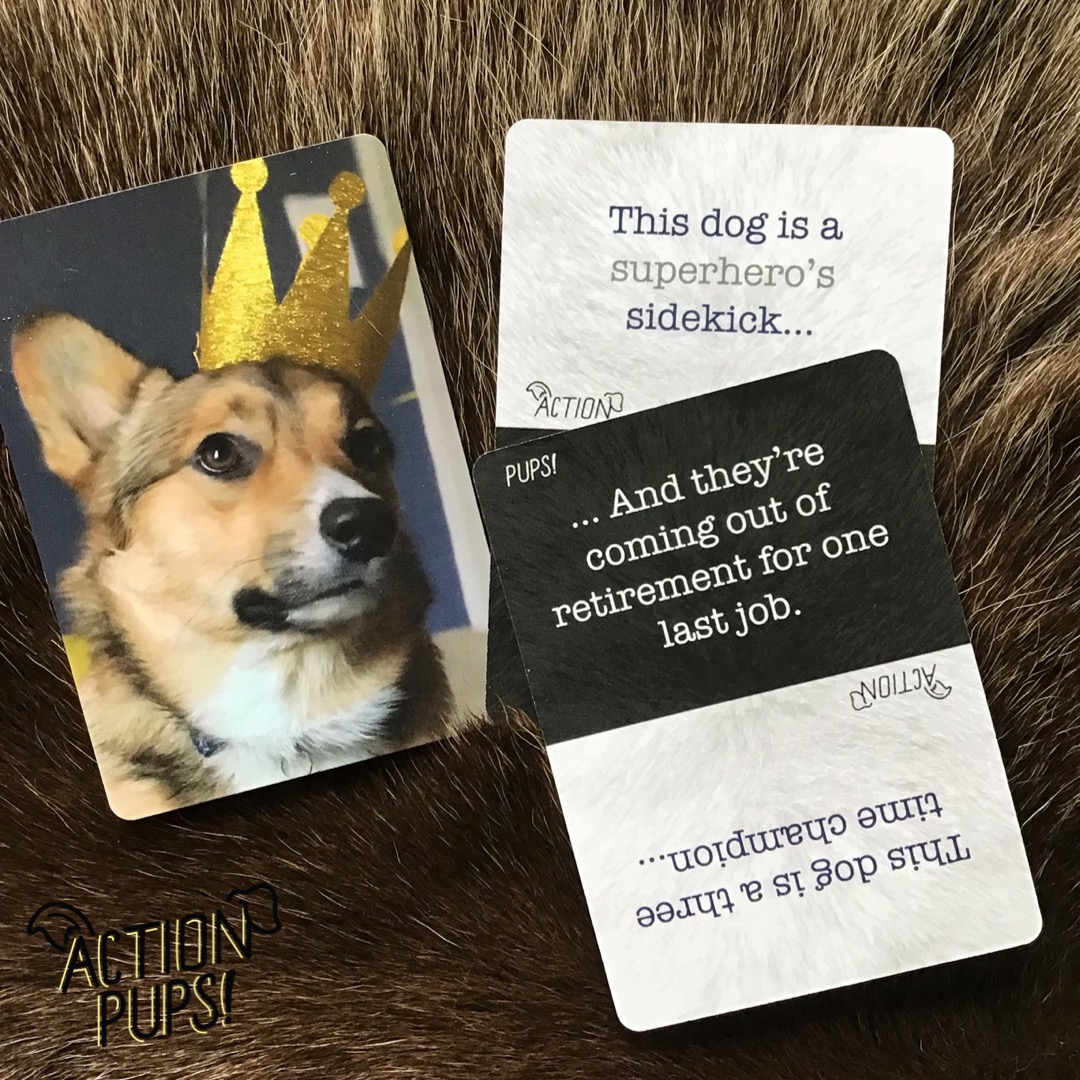
Each player has a hand of cards. One side of the card has a picture of a dog; the other has two story prompts—the beginning and the end of a sentence. Each player combines two cards to create a story; when everyone is done, they take turns pitching their stories.

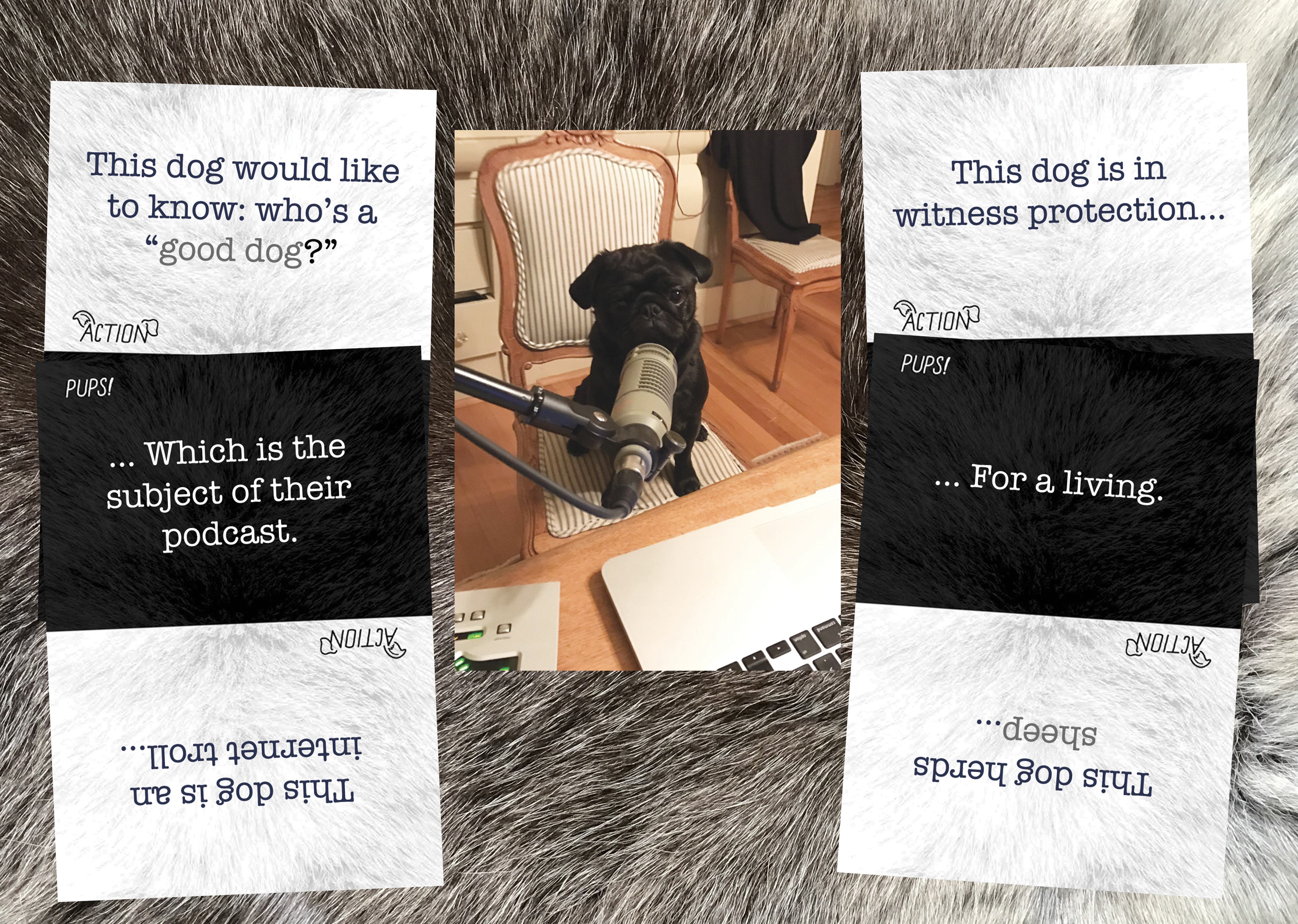
Keith: At the end of the day, I think there’s one question we all ask ourselves. Who… think about it… Who’s a good dog? Is it you? Is it YOU? Every week, Loudmouth Larry examines another of the great dogs of popular culture. This week: Snoopy. Cultural icon, sure: but is he a good dog? Tune in to find out!

Jenn: I admit, “Who’s A Good Boy” is a compelling podcast. But Loudmouth Larry’s personal story is far more interesting. You may not have thought about this, but when people go into witness protection, they can’t take their dogs with them; it’s a dead giveaway for someone searching for them. Loudmouth Larry is a professional surrogate dog, providing people on the lam with temporary canine companionship until they can return to their own lives. His podcasting is the one thing that provides continuity in this nomadic life. 

Now, if you’re not feeling inspired, you can just read the text straight off the card. But like Gloom, what I love about the game is using the card text as a starting point for a more interesting story. If the dog is a superhero’s sidekick, who’s that hero? Does the dog have a super power and a secret identity, and if so, what are they? If they have a podcast, what’s its name? Who sponsors it?

One of the things I enjoy about this is that it adds variety. There’s over 28,000 possible card combinations. But someone can play the same combination of cards three games in a row and come up with a different take on it each time. This is further enhanced by the use of gray text. In the example about, the card says ‘This dog would like to know: who’s a “good dog?”‘ The fact that good dog is in gray means that you can change it when you present the story. So Loudmouth Larry wants to know who’s a SOMETHING. He might want to know “who’s a cat in disguise?” or “who’s addicted to podcasts?”

Ultimately, the goal of Action Pups! is to encourage people to tell stories… to give you a reason to think about what your pup’s podcast might be, or how this dog is going to save the world. It’s family friendly, and some of the best games I’ve played have been with three generations at the table. It’s not a game about winning; but it’s a fun tool to get people telling stories. And, of course, it’s a chance to…

Get Your Dog In The Game

Action Pups! will include 170 dogs. But we don’t just want any dogs in the game; we want YOUR dogs. Anyone who backs the game can submit pictures of their dogs, and our favorites will be in the game. In submitting pictures, there’s a few things we’re looking for.

  • Portrait Orientation. The picture needs to fit on the back of a card.
  • Pups, Not People. We want images of individual dogs with no people in the shot. It’s about the dog’s story.
  • Props. Poise, or Potential. We’re looking for dogs that inspire stories. They’re all good dogs, but we want pictures that make you say “What’s that Pug doing in front of a microphone?” or “Why is that Corgi wearing a crown?” Whether it’s an interesting location, funny costume or prop, an interesting pose or expression, we’re looking for pictures that will inspire stories.

That’s all there is to it. But there’s not much time left! If you think your dog is an action pup, back the Kickstarter campaign before it comes to a close!

Dragonmarks: Cyre

The Jewel in Galifar’s Crown. Wondrous Cyre. Cyre was the heart of the united kingdom of Galifar. But what was the nation actually like? Many sourcebooks have explored the cultures and cities of Thrane, Breland, Aundair, and Karrnath. Since Cyre has fallen, the focus is often on the current plight of the refugees and not on the nation they lost. But as a Cyran PC, what are the memories you treasure? What was your childhood like? If you hope to rebuild your nation, what is it that you aspire to recreate?

In this article I’ll explore some of the history and culture of Cyre before the Mourning. Bear in mind that this is not canon material, and may even contradict canon sources.

“WHAT OUR DREAMS IMAGINE, OUR HANDS CREATE”

Galifar Wynarn was a military genius, but it was his eldest daughter Cyre who imagined the warring nations working together as a single family: Karrnathi might, Daskari faith, and the wisdom of Thaliost working together for the greater good. In crafting the map of the united kingdom, Galifar declared that Cyre would be the heart of the realm. His daughter would govern the province, and have all that she needed to pursue her vision. The crest of the Cyre is a crown and bell on a green field, above a hammer and bellows. The seat of the crown, the bell that rings in change, and the tools to build the future; the motto of the nation is “What our dreams imagine, our hands create.”

The provinces of Galifar largely retained the cultures and traditions of the nations they had once been. In many ways, their differences were reinforced and celebrated. Each nation was given one of the pillars of the united kingdom: the Arcane Congress in Aundair, the King’s Citadel in Breland, Rekkenmark in Karrnath, the Grand Temple of Thrane. Cyre was the exception. Rather than building upon the existing culture of Metrol, Cyre drew experts and artisans from across Galifar. Cyre wasn’t the center of any one discipline. Rather, it was the nexus where all of these things came together: the best of what Galifar could be. When the Arcane Congress perfected the everbright lantern, Metrol was the first city whose streets were lit with them. Soldiers trained in Rekkenmark, but the finest warriors served in the Vermishard Guard. While Metrol was the showpiece—a city of wonders—this principle was applied across central Cyre. Education, art, even agriculture; Cyre displayed the best of what Galifar could accomplish. 

This continued and evolved over the course of centuries. Karrns are tough, Thranes wise, Aundairians clever. The people of Cyre can trace their roots to all of these nations and believe they share all of these strengths; but beyond that, Cyrans strive to be creative, innovative, and artistic.

Cyre’s artistic (and some might say whimsical) temperament was balanced and sustained by the presence of House Cannith, which was based in the great city of Making. Many of Cannith’s greatest forgeholds were spread across Cyre; this provided a practical, industrial foundation that supported the wonders of Cyre. And those wonders took many forms. Where the Arcane Congress of Aundair focused on the practical applications of magic, the Wynarn Institute of Cyre explored the artistic potential of the arcane. Metrol was a city of light and marvels. Visitors could speak to illusions of past heroes and kings, and watch re-enactments of historic moments. It’s said that no one ever went hungry in Metrol, and no one ever felt the bite of winter. Cyrans say that this reflects the generosity and selflessness of the Cyran spirit; critics point out that these social projects were only possible because of the taxes paid by the people of other provinces. Certainly, Cyre held the wealth of Galifar and had a standard of living higher than any other province. Was this decadent? Or was in a work in progress, a model that could have someday been applied to all nations? There’s no way to know. Cyrans mourn what was lost; the people of other nations criticize the Cyran lifestyle as parasitic and unsustainable. What our dreams imagine, our hands build; bitter outsiders point out that it may have been Cyran hands that built, but they used the resources gathered by the hard work of others. 

This bitterness was further fueled by the Galifar’s traditions of succession. Following the example of Galifar I, the monarch’s children served as the governors of the five provinces. The eldest governed Cyre, and upon the death of the monarch they would take up the crown and their children would take over the governing positions. The prior governors would serve as regents until children were of age and as advisors moving forward, and when a monarch lacked five children the previous governors would maintain the posts. But the principle was simple: Cyre was the heart of Galifar, and all else would shift around it. Over the history of Galifar, there were multiple rebellions and attempted secessions; the Last War was simply the largest and last of them.

OUTER CYRE

Galifar’s goal with Cyre was to create something new, a culture combining the best aspects of the other nations. In the newly forged Thrane, Aundair, and Breland, the people kept their old traditions and the ruling families were often incorporated into the new governing structure. But in the old kingdom of Metrol—which covered an area roughly the size and shape of the modern Mournland—the old systems and rulers were pushed aside to make room for Cyre’s dream. Some of the noble families of Metrol embraced this new path. Others were resettled by Galifar, granted authority over regions that had previously existed as independent frontiers.

Southern Cyre covered what is now Darguun. Largely unsettled when Galifar was founded, it persisted as a backwater in the shadow of the kingdom. Its people ultimately prospered and took pride in their identity as Cyrans, aping the customs of the central kingdom. However, they had little of the wealth invested in the north or the wonders that came with it. There were ongoing clashes with goblins, a few severe—but the Ghaal’dar largely remained in the mountains and dark places until the Last War.

By contrast, Eastern Cyre —what’s now Valenar—was effectively a separate nation with dramatically different culture and values… and it was arguably Galifar’s greatest failing. The region had first been settled by immigrants from the Khunan region of western Sarlona. Galifar I wanted the lands of old Metrol, so he gave the nobles of Metrol authority over this region, setting them as the feudal overlords of the Khunan settlers. The Blade Desert served as a physical and cultural divide, and having granted the nobles their lands, Galifar largely ignored them. The noble families thus held to the traditions of Metrol rather than embracing the new culture of Cyre. Many were dissatisfied with the arrangement, and took this out on their Khunan subjects. Overall, the nobles of Eastern Cyre were petty and proud, and all too often cruel to their tenants. Some wonder why it was so simple for the elves to seize control of Valenar; first and foremost it’s because the Khunan people had no love for their Cyran rulers (generally called “thrones”) and many feel they are actually better off under the new regime.

CYRE AND THE LAST WAR

Under the reign of King Jarot, Cyre continued to shine. Aspiring artists and young nobles made their way to the heart of the kingdom, while the most promising artificers settled in the city of Making. King Jarot lavished attention on Cyre: expanding the Vermishard Palace; working with House Orien to expand the scope of the lightning rail within Cyre; spending hundreds of thousands of galifars on the Wynarn Institute of Art and the Cathedral of the Sovereign Host.

Following the death of Jarot, Galifar spiraled towards war. Initially, Cyran morale was high. Queen Mishann had centuries of tradition behind her. And everyone knew that Cyre had the best of everything: the finest wizards, the best soldiers, the foremost artificers. And on one level, this was true. But a single unit of exceptional soldiers means little when set against the martial cultures of Karrnath or Thrane. Cyre’s finest wizards were artists and theoretical scholars; Aundair had long worked on magic as a tool of war. And the expert artificers were largely tied to House Cannith, which remained neutral in the war. If you consider the nations as characters, Thrane is a paladin; Karrnath is a fighter; Aundair is a wizard; and Breland is a rogue. In this party, Cyre is the bard: elegant, clever, and doing a little bit of everything… but best when working with others, not well prepared to go toe to toe alone against a powerful foe.

Cyre adapted; it had to. Initially it relied heavily on mercenaries; it was the seat of Galifar’s treasury, and had the gold to spare. But as time passed and the scope of the conflict became clear, Cyrans devoted themselves to war. Cyre lacked the martial spirit of Karrnath or Thrane, but its people were sustained by the absolute belief that they were in the right. Beyond that, in the eyes of the people, Cyre was Galifar. It embodied the ideals of the kingdom, the best of what it could be—and that was something worth fighting for. Nonetheless, the struggle was a tremendous blow to the Cyran psyche. For centuries Cyrans had seen themselves as the stars of the show, beloved by all; now all hands were raised against them, and some at least could see their former beliefs as arrogance and narcissism. Cyre had indeed had the best of everything, but that’s because it was freely given. Now the Arcane Congress devoted its knowledge purely on the good of Aundair, Rekkenmark trained only Karrns, and the King’s Citadel served Breland. Cyre had echoes of all these things. Its wizards were still a match for any nation other than Aundair; the Vermishard Guard formed the core of Cyre’s new military academy. But it was clear that the Cyran dream had been sustained by many hands, and now the nation had to learn to stand on its own. 

TRADITIONS AND CUSTOMS

Cyran culture blends the traditions of other nations. A Cyran can play Conqueror with a Karrn, sing an add-a-verse song with an Aundairian, and debate religion with a Thrane. This reflects the founding principles of Cyre—to gather the best aspects of Galifar and to build upon them. Some call this the Cyran appreciation, and considering it an admirable thing. Others call it appropriation, depicting the Cyrans as carrion crawlers who steal from others and have the arrogance to say they can do better. But the Cyran appreciation is rooted in love, not arrogance. It’s based in the idea that there is no single perfect path, and maintains both that diversity is a source of strength and that there’s always room for improvement. Cyran culture is thus a strange chimera—a blend of familiar elements from across Khorvaire, combined with a steady, ongoing evolution. A Cyran musician might play Karrnathi funeral dirges in the style of a Thrane devotional. It’s a puzzle where the pieces are known, but they’re constantly being arranged in new ways. 

The Last War built walls between Cyre and the other nations, and every nation evolved in this isolation. Cyrans know the old add-a-verse songs beloved by Aundairians, but few know the Epic of Valiant and Vigilant, a tale of martial bravery close to the heart of every modern Aundairian. They don’t know the maxims of Beggar Dane that now serve as a cornerstone of Breland. But Cyrans still see their culture as being founded on the best principles of Galifar, and can still find some common ground with people of any nation. In playing a Cyran, you can find familiar things anywhere you go. But what is it that you treasure in your memories of Cyre? Do you cling to the past, or do you embrace the Cyran principle of always striving to find a new and better way?

Fashion

Cyran fashion blends practicality with endless diversity. Cyran clothing begins with a simple foundation: this base layer may be colorful, but it is first and foremost practical and durable. Breeches and skirts, shirts or gowns; a Cyran starts with whatever the individual finds most comfortable. Again, this base level is well made, but it is more functional than decorative. It’s what comes next that adds flair. Cloaks and gloves are both integral parts of Cyran fashion. Gloves can be short and sturdy for work or war, or long and decorative for more formal occasions. Cloaks likewise vary between the practical and purely decorative: a heavy cloak for traveling, a short cloak for a casual social event, and a long, light cloak with a glamerweave lining for an evening at the Grand Stage. In addition to gloves, boots, and cloaks, jewelry is an important part of Cyran fashion. Cyran jewelry is often made from copper, leather, wood, or glass; it’s not a display of wealth, but rather a way to express individuality. Feathers and bells are also common accessories; there is a Cyran dance that involves belled bracelets and anklets. Finally, masks are often worn at formal or festive occasions. Cyran masks aren’t intended to conceal identity or intent; rather they are a way of enhancing identity and expressing a mood.

Traditionally, Cyran fashion is filled with color (often accentuated with glamerweave). In the wake of the Last War, many Cyrans have adopted Mourningwear—clothing cut in the Cyran style, but entirely in black. Others celebrate their nation by preserving its styles. Because of the emphasis on durability, a Cyran character may still have the clothes they were wearing on the Day of Mourning. What was that outfit, and do you still wear it? Do you favor a mask, and if so, what is its design?

Cuisine

Cyran cuisine reflects all the principles taken above: working with the best of all traditions and then continuing to explore. In many ways this is similar to the Sharn fusion found in the City of Towers, and a number of Cyran refugees are rising stars in Sharn’s culinary scene. Cyrans blend the thrakel spices of Thrane with traditional Karrn stews, and add the heat of southern Breland to the delicate pastries of Aundair. While many refugees cling to family recipes as a way to remember the fallen nation, others continue the tradition of Cyran appreciation—adopting new favorites from the place they’ve found shelter, and looking for ways to improve them.

Magic

Traditionally, Cyrans viewed arcane magic as a form of art as well as a practical tool. On the one hand this lent itself to a wider study of illusion and enchantment than found in other nations. But beyond this, it’s also about the presentation of magic. Magewright, bard or wizard, a Cyran often puts more show into the performance of magic than even an Aundairian. For a wizard who’s studied at the Wynarn Institute, somatic components are almost a dance, and verbal components have the cadence of song or poetry. This ties to the Cyran love of capes and flowing clothing. As a Cyran spellcaster, you are truly a student of arcane arts; consider how your casting reflects this.

Religion

While the Silver Flame had some devoted followers and temples in Cyre, the Sovereign Host was the dominant faith. At the same time, religion is driven by faith and tradition, and Cyrans have always been encouraged to question and search for new paths. The war drove some Cyrans to embrace their faith more tightly, but for others it was another source of doubt. Likewise, the Mourning threw many devout Cyrans into a crisis of faith. With that said, there are many devout Cyrans. Followers of the Silver Flame don’t question the cause of the Mourning: they simply seek to protect the innocent from harm. Vassals of the Sovereign Host trust that there is a purpose to their suffering. And in the wake of the Mourning, some Cyrans have turned to the Blood of Vol or Cults of the Dragon Below, cursing the gods they once worshipped or following a darker vision. There are also a number of new strains of the old faiths: Cyran twists on the Flame and the Host that seek to adapt traditions to make sense of the war and the world.

The preceding paragraph primarily applies to Central Cyre. The nobles of Eastern Cyre were devout vassals, convinced that their leadership was a divine right. The people of Southern Cyre are less arrogant, but still tend to have a quiet faith in the Sovereigns.

In playing a Cyran divine caster, consider the impact the Mourning had on your faith. Are you conflicted and struggling to hold to your beliefs? Or was the Mourning a source of inspiration—you know you have a divine purpose, that your people need you? If you’re tied to an existing faith, do you follow the standard traditions or have you found an unusual path?

THE THREE CYRES

When most people say “Cyre” they’re thinking of Central Cyre. When they speak of Cyran refugees, they are talking about the people who fled the Mourning. But there were Cyran refugees long before the end of the war. The Tairnadal elves established the kingdom of Valenar in 956 YK, while Lhesh Haruuc claimed southern Cyre as Darguun in 969 YK. While Valenar was an unpleasant surprise, it had relatively little impact on the nation. Eastern Cyre had always been isolated, and the Khunan majority embraced elf rule; the refugees were thus a handful of nobles who were painfully out of touch with the traditions of the central kingdom. The loss of Darguun was a more significant blow. Southern Cyre was a backwater, but this was still close to home—and it resulted in a flood of refugees that the wartorn nation was ill-prepared to handle. In creating a Cyran character, consider which Cyre you’re from. 

  • Central Cyre. Odds are good that you yourself think of your home as the “true” Cyre. Before the Mourning, did you give much thought to the refugees of Valenar and Darguun? Even now, do you think of them when you think of your homeland? Are you devoted to the idea of rebuilding your nation and clinging to your memories and traditions? Or following the Cyran appreciation, are you instead looking forward and trying to find a new and better path, even if that means abandoning the dreams of Cyre?
  • Eastern Cyre. You’re tied to a noble family that can trace its roots back to Old Metrol, before Galifar even existed. You don’t accept any of the nonsense about Cyre being “the best of Galifar” or challenging tradition; if people had stuck to the old ways, perhaps all of this could have been avoided. Your people were devoted to the Sovereign Host and truly believed that Aureon had chosen you to rule. At the same time, your lands have been lost for over forty years, and the people of Central Cyre have never avenged you or shown your family the respect you deserve. You’re not as affected by the Mourning as some, because it wasn’t YOUR Cyre that was destroyed; now the others just get to see how you feel. As an Eastern Cyran, you have noble ancestry but you’re unlikely to have the noble background, as nobody cares about your claims. Do you despise the Valenar and hope to reclaim your long-lost homeland? Or do you want to rally Cyran survivors around the TRUE royal bloodlines, challenging Oargev and re-establishing the long-forgotten kingdom of Metrol?
  • Southern Cyre. Your people have been struggling for decades, eking out a life in camps and shelters. You were encouraged to take up military service; it was easier to send you to the front than to find a new home for you. Many of your friends and family chose to idolize the Queen and central Cyre, believing that she had a vision, that she would rebuild Galifar and restore an age of wonders. Did you feel that way? Were you an idealist and an optimist? Or were you bitter and angry at the nation that failed to protect you? Are you loyal to Cyre, or are you solely concerned with Darguun and taking vengeance on the goblins?

THE WONDERS OF CYRE

Cyre is lost to the Mournland, and all people have are their memories. But what are those memories? Cyre was a land of wonders… what are some of those wonders? Here’s a few of them…

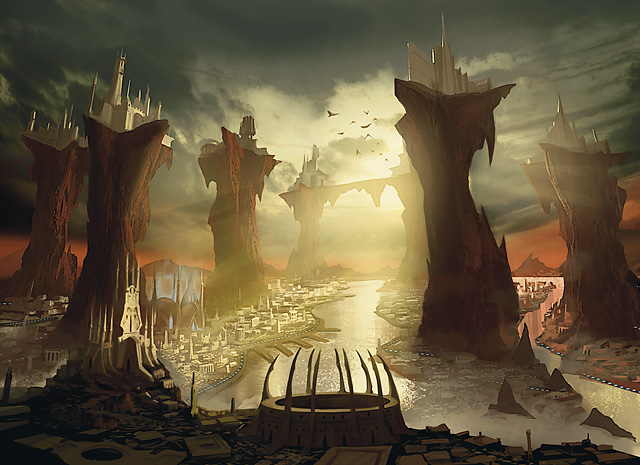
  • The Vermishards. Seven spires rise up from Metrol, a natural (or supernatural) wonder. These plateaus held the ancestral homes of the noble lines of Old Metrol, and the Royal Vermishard was the seat of the Cyran crown. However, over the course of centuries other powerful forces—such as House Cannith and House Phiarlan—made their way to the Vermishards. Cannith and Phiarlan worked together with Cyran magewrights to embed illusory lighting into the Vermishards, and these glittering spires were a remarkable part of the Metrol skyline.
  • The Wynarn Institute of Art. The Wynarn institute was both one of the foremost academies of magic in Khorvaire and one of its most amazing museums. In addition to purely artistic exhibits, the Hall of Kings allowed rulers to converse with illusory replicas of the past rulers of Galifar. Treasures of the pre-Galifar kingdoms were displayed here, along with modern works of art.
  • The Vault. The Royal Treasury of Galifar was commonly known as the Vault. While there were reserves hidden around the kingdom, the Vault included both the mint, the primary reserves of both currencies and precious metals, and cultural artifacts deemed too valuable to be displayed. Salvagers have dreamed of finding the “Golden Palace,” but there are stories saying that the Vault is actually missing. The Mourning had strange effects on Metrol, and the Vault may have simply been physically displaced, or it could have fallen into another plane.
  • The Cathedral of the Sovereign Host. Following the spread of the Church of the Silver Flame in Thrane, the Cathedral of the Sovereign Host became the primary seat of vassal devotion on Galifar. Many of the rulers of Galifar would make an addition to the Cathedral as a way of showing their piety. By the reign of King Jarot, it was a wonder. Nine colossal statues encircle the temple. Illusory displays within depicted scenes from the faith, and there was a vast collection of relics and artifacts. The fate of the cathedral and its treasures remains unknown.

All of these are within Metrol itself, and they just scratch the surface of what was possible. Aundair has floating towers; Cyre expanded on this with floating gardens, flower petals falling on the wind to the cities below. Even small towns had crystal theaters when people could scry on the great performances in the Demesne of Shape. There was always music in the air and lights in the sky. With this in mind, feel free to create wonders. Cyre was the seat of House Cannith and House Phiarlan, and second only to Aundair in arcane sophistication. What your dreams imagine, their hands could create. And even if they DIDN’T create the things you dream of, people might believe that they did; the legends of Cyre only continue to grow now that the kingdom is lost.

FINAL THOUGHTS

As a Cyran, you come from a culture that strove to find the best in all things, a tradition that encouraged creativity and innovation. But your people have also lived through a century of betrayal and war, fighting enemies on all sides. How has this affected you? Are you an idealist who still believes in the promise of Galifar—someone who believes that the Five Nations can and should unite, someone who tries to bring people together? Or do you curse the traitors who betrayed Mishann and doomed Galifar? Are you scarred by the memory of the Mournign and determined to reclaim your homeland or rebuild it somewhere else, or are you always looking forward to what happens next? Do you have any living relatives, and if so where are they now and what is their condition? Will you send money to your family in High Walls or New Cyre, or are you alone in the world? Beyond that, where was your home and what did you leave behind? Is there anything you wish you could recover from the Mournland, whether it’s something with practical value or simply sentimental? What do you still have to remind you of Cyre? 

GENERAL Q&A

Do Cyran nobles still have authority even though their lands have been lost?

This depends on the family and on the people you’re dealing with. The nobility of Cyre was originally drawn from across the Five Nations, and many Cyran noble families still have strong ties to other nations. Some families had significant holdings in other nations and still have wealth and influence, even if it’s limited. On the other hand, many Cyran nobles have lost everything but their titles. Some Thronehold nobles treat these displaced aristocrats with courtesy, but many dismiss them: at the Treaty of Thronehold, Queen Aurala famously said “Cyre no longer exists, and refugees have no place at these proceedings.”

In regard to YOUR character, there’s a simple way to determine the standing of your family: Your choice of background. If you take the noble background, your Position of Privilege means that you are treated with the respect of any noble; this implies that your family still has holdings or at least the respect of other aristocrats. But you could also be a fallen noble forced down a dark path (criminal background), a dandy who uses charm to find your way into courts even though you no longer have influence (charlatan), or a hero who still fights to protect the common people of Cyre even though you have no rank (folk hero). You could also take the noble background with the variant Retainers feature, reflecting that while you no longer have a position of privilege, you still have a few loyal followers who have been with your family for as long as you can remember.

The Forge of War says that Thrane turned away or even attacked Cyran refugees fleeing from the Mourning. You’ve said that this is inaccurate and possibly Karrnathi propaganda. Would this be a pervasive rumor? Would Cyrans think of Thranes as butchers who turned their backs? Is Karrnath exempted from this? What about Breland and Aundair?  

The faith of the Silver Flame is founded on the basic principle of defending the innocent from supernatural evil. I’ve already called out that if followers of the Flame were serving on opposite sides in a battle and a group of demons suddenly appeared, I’d expect the templars to set aside their political differences until the supernatural threat was dealt with. The same principle applies here. I could easily imagine an initial violent response if the surge of refugees was perceived as an attack. However, once it became clear that thi sis literally innocents fleeing a supernatural threat, I would expect Thrane to be the MOST active nation in providing support and shelter.

So my initial reaction is that Forge of War is simply WRONG. The situation as described makes no sense and I don’t see it as a rumor that would stick, because anyone familiar with the church should know it makes no sense. Why would they do something like that?

WITH THAT SAID: Maybe you WANT it to be true. If this is the case, the question is what could MAKE it happen as described. The simplest answer is that the facts aren’t straight. The Mourning transforms things caught within it. So perhaps Thrane templars DID “slaughter a host of Cyrans fleeing from the Mourning”—because those Cyrans had been caught in the Mourning and transformed into a ravening pack of bloodthirsty killers. They weren’t FLEEING the mists, they were charging out of them to kill anything they could get their hands on, and the templars had no choice but to put them down. So it is an absolute fact that Thrane forces killed a host of Cyran refugees, and Karrnath or other nations have publicized the story. But the truth isn’t as they present it—and beyond that, I’d still expect people who hear the story to say “But that doesn’t make any sense!”

So as a quick overview of how nations have responded to Cyrans, here’s MY personal opinion.

  • Breland has been presented as the most willing to shelter Cyrans without strings, as shown by the establishment of New Cyre. There are certainly tensions between the common people of Breland and the refugees, and life in camps like High Walls is hardly ideal, but it’s better than anything offered by Aundair or Karrnath.
  • I think Thrane would have responded with compassion and provided significant support. However, I can imagine Thrane focusing on integrating refugees into Thrane society as opposed to trying to preserve Cyran culture or supporting Cyran nobles; consider that they already set aside the Wynarn monarchy in favor of the Church. So they’d provide support and opportunities—for a new life as Thranes.
  • Aundair has been presented as unsympathetic (see that quote from Queen Aurala at the Treaty of Thronehold), and that makes sense. Aundair is the smallest of the Five Nations and has its own problems with the Eldeen Reaches, and Aurala still believes she would be the best ruler for a restored Galifar; none of this suggests sympathy for Cyre.
  • Likewise, I think Karrnath would be VERY unsympathetic. Cyre and Karrns were bitter rivals; per Forge of War, the Mourning followed directly on the heels of a Cyran sneak attack on the city of Atur. Karrnath had long struggled with famines and thus lacks the ability to suddenly support an influx of outsiders, and Karrns are known for being ruthless and pragmatic. Beyond this, as I called out in my last article, the Karrnathi undead are perfectly willing to slaughter civilians. If anyone slaughtered masses of Cyran refugees on the border, I’d expect it to be Karrnath.

Several maps show parts of the Talenta plains (or the borderlands) as part of Cyre during the Last War. Were these wartime holdings? Provinces of Cyre? How was Cyre’s relationship with the Halflings?

This is covered on page 202 of the 3.5 ECS:

Karrnath and Cyre both claimed parts of the Talenta Plains during the Last War. Prior to the fall of the kingdom of Galifar, the halfling tribes were permitted to wander their ancestral lands as long as they paid tribute to the Galifar king. With the coming of war, the halfling tribes began to cooperate in unprecedented ways to protect the Plains that all the tribes revered. Warriors of different tribes banded together, repelling invaders from Karrnath and Cyre by using their knowledge of the ways of the Plains to confuse and confound the invaders. Later, when the Plains became the place for various combatant nations to clash, the halfling tribes tried to stay out of the way.

Cannith had a lot of holdings in Cyre, and almost invariably there would have been mingling with the locals. Do you see the Houses as having a mostly distinct culture or also being something like citizens of the nation they grew up in? Cannith worked a lot with Cyre during the war, was that more an accident of proximity and money or did a lot of the leadership sympathize with the Cyrans? For example, is there a Cannith style or are there Cyran Cannith, Brelish Cannith, etc. styles of architecture/production?

The houses definitely hold themselves as extranational entities. They take their neutrality very seriously, and the only house we’ve suggested as having a national bias is Medani: so Cyre’s heavy association with Cannith was certainly based on gold. Cannith heirs consider themselves to be Cannith first, nation second. However, there’s certainly a national component to the personality of a dragonmarked heir. Beyond interaction with the locals, you’ve got the fact that houses are comprised of different families and these families are based in different nations—so the Vown are Brelish Cannith, while Juran are (or were) Cyran Cannith. It’s also the case that different enclaves have different focuses, which also affects corporate culture. Cannith South is focused on general industry, while Cannith East is more driven by weapons research and recently, experimenting with necromancy.

With that said, the HOUSES hold themselves as neutral; the members of the houses often had their own sympathies. In The Dreaming Dark novels, Daine is a Deneith heir who cut ties with the Blademark in order to fight for Cyre. Dragonmarked discusses such characters, who are generally referred to as “orphans.”

Could you elaborate a bit on what would happen to the royals and their families of the other nations once they were done reigning/advising. Would they be demoted to “regular” noble status? Would they hold land, and how would they inherit?

The position of governor came with land, but those holdings were tied to the position and would be passed to the new governor. The tradition was for a governor to marry into one of the noble families of the nation they governed, which served both to strengthen their connection to the land and to give them estates after their tenure passed. So the warlord families of Karrnath include many former governors. But this does mean that when the nations rallied behind their “kings” and “queens” to start the Last War, it was a substantial change. Frankly, this reflects how easy it was for Thrane to shift to a theocracy; they weren’t deeply attached to Wrogar’s line. Likewise, we’ve said that Kaius III is still in a delicate position with the Warlords of Karrnath; they trace their lineage back to the founders of the nation, while Kaius I was a son of Jarot. But the short answer to the question is that the governors would marry into the local nobility, which helped both to keep bloodlines fresh and to strengthen ties between Galifar and the local nobility.

What would YOU like to know about Cyre? Post your questions below. And thanks as always to my Patreon supporters for requesting the topic and making it possible!

Dragonmarks: Lycanthropes

I’m hard at work on many projects, but I’ve had a few questions tied to lycanthropes… and with Halloween around the corner, it seems like an appropriate topic to address! Thanks as always to my Patreon supporters for supporting the blog.

I’ve been listening to the stories of the Werewolf Trials of the Middle Ages. Was the Eberron purge based on these, or is this just a coincidence?

For those of you unfamiliar with the setting, the Lycanthropic Purge is an event that occurred around two centuries before the default Eberron campaign. The Church of the Silver Flame sent an army of templars into western Aundair and what is now the Eldeen Reaches to combat a rising tide of lycanthropy. Following a brutal conflict, the church supported an ongoing campaign to root out and cure or exterminate all lycanthropes that could be found. This conflict is also the root of the Pure Flame, a zealous sect of the Church of the Silver Flame that engages in ruthless and often violent behavior.

People often think of the Purge as a sort of inquisition, similar to the Salem Witch Trials or the Werewolf Trials mentioned above. It certainly ENDED that way, with the newly minted zealots of the Pure Flame trying to hunt down every last lycanthrope… and in the process, targeting many shifters and other innocents. So you can certainly use werewolf trials as inspiration for this period. But that wasn’t how the Purge BEGAN; it’s how it ENDED, a cruel inquisition carried out by people who had suffered through a decade of terror and loss and who were hungry for bloody vengeance. So how did it start?

Under the rules of third edition D&D—the edition that existed when Eberron was created—lycanthropy was a virulent curse. Under the rules of the time, any lycanthrope could spread lycanthropy. If one wererat creates two victims, and each of them infect two others, within five cycles of infection you have 243 wererats… and that assumes each one only has two victims! Essentially, in lycanthropy as presented you have the clear potential for a zombie apocalypse: a massive wave that could result in untold death and ultimately destroy civilization as we know it. The Purge ENDED in a cruel inquisition. But it BEGAN as a noble, selfless struggle to save the world from collapsing into primal savagery. Thousands of templars gave their lives in the Towering Woods, fighting to protect the people of Aundair from supernatural horror.

Under the rules of 3.5 and 4th Edition, afflicted lycanthropes can’t spread the curse. This eliminated the threat of exponential expansion that made the Purge so necessary. Personally, I make this a part of history. At the time of the Purge, lycanthropy was more virulent. By the end of the Purge, the power of the curse had been broken. The question is: Was this tied to some specific victory, to ann Overlord being rebound or an artifact that was destroyed? Or was it simply tied to the number of lycanthropes—when the population grows, so does the power of the curse? And this is important, because in FIFTH edition, all lycanthropes can spread the curse again! Personally, I’m embracing this as the continued evolution: whatever cause the power to wane, it’s rising again. A werewolf apocalypse is a very real threat. Could another purge be called for?

What Makes Lycanthropy A Curse?

Lots of people like lycanthropes. They see lycanthropes as champions of nature, and as the persecuted victims of the purge. So why am I insistent about it being a curse?

First, there’s a simple logic to the decision. Lycanthropes possess amazing abilities. They can transfer these gifts to others, quite easily. So if there’s no downside to being a lycanthrope, why aren’t we all lycanthropes? Why isn’t this gift embraced and shared? If one member of a party contracts lycanthropy, why shouldn’t every member of the party get in on it?

With this in mind, D&D has generally inherited its view of lycanthropy from the Universal monster, not from the World of Darkness and its champions of Gaea. Even a man who’s pure of heart and says his prayers by night can become a wolf when the moon is full. It’s the vision of werewolves that chain themselves up as the moon grows close for fear of killing innocents. The third edition rules were very clear about this. Initially, when a victim falls prey to the curse, THEY BECOME AN NPC for the duration of the event and act according to their lycanthropic alignment. You lose all control and don’t know what you’ll do.

The rules specify that if this goes on long enough, the alignment change becomes permanent and it’s possible for the player to take over. But this isn’t a casual thing. In Eberron, an evil person can have a valid role in society. But 3E called out that an evil lycanthrope isn’t just “evil;” they’re murderers who enjoy preying on their former family and friends. Likewise, a good lycanthrope isn’t just a nice person; they are compelled to abandon civilization to live in the wilds. Fifth Edition echoes this. Consider the following quotes from the fifth edition Monster Manual:

  • Evil lycanthropes hide among normal folk, emerging in animal form at night to spread terror and bloodshed, especially under a full moon. Good lycanthropes are reclusive and uncomfortable around other civilized creatures, often living alone in wilderness areas far from villages and towns.

  • Most lycanthropes that embrace their bestial natures succumb to bloodlust, becoming evil, opportunistic creatures that prey on the weak.

The point here is simple: no player character should WANT to become a lycanthrope. It’s a terrifying burden; even good-aligned lycanthropy will destroy your original personality and turn you into someone else.

Eberron generally takes a broad approach to alignment. But lycanthropy is a special case: it is a supernatural force that IMPOSES an alignment, and this overrides the victim’s ability to choose their own path. What we do say is that there are different strains of lycanthropy, and that alignment is tied to strain. So it is possible to have a good-aligned werewolf… but if they infect someone that person will become a good-aligned werewolf. Here again, I can’t emphasize enough that being a good-aligned lycanthrope isn’t just about being a virtuous person. If it was, the Silver Flame would support it. But just look back at that quote from the Monster Manual: Good lycanthropes are “reclusive and uncomfortable” around civilization. Good or evil, the curse fundamentally changes who you are and enforces a powerful set of instincts and drives.

I feel that natural lycanthropes have a greater ability to adapt and evolve personalities around the behavior dictated by the curse. But it’s important to recognize that there is a fundamental difference between a natural lycanthrope and, say, a gnoll or a shifter. The lycanthrope isn’t just bestial in appearance; they are a vessel for a powerful supernatural force that shapes and drives their behavior. A natural werewolf can fight those urges, but the urges will always be there.

The Origin of Lycanthropy

The origins of lycanthropy are shrouded in mystery. As with the Mourning, I don’t think this is something that needs to be established in canon. I’d rather present a few different ideas, and let each DM decide which one they prefer. So consider the following.

The Gift of Olarune. Common belief is that shifters are thin-blooded lycanthropes. But there are shifters who say that their kind came first. Shifters are touched by Eberron and Olarune, tied to the natural world. Olarune empowered her champions with a stronger bond to nature, blessing them with enhanced vitality, animal form, and other gifts. According to this legend, this gift was corrupted by a dark power—one of the other forces presented below. This explains why lycanthrope traits don’t reflect the natural animal. The wolf isn’t a cruel murderer; but the werewolf embodies our fears of the savage predator that lurks in the darkness. The rat doesn’t scheme to spread disease and undermine cities… but the wererat does.

This means that there was a proto-lycanthropy that was entirely benevolent… and it allows players to have a quest to restore this, cleansing the curse as opposed to wiping it out. In my opinion, this “pure” lycanthropy wasn’t infectious—it would only produce natural lycanthropes, assuming it was hereditary at all. Alternately, it might not even resemble lycanthropy; these blessed champions could be a form of druid.

I have no objection to the idea of there being a small population of these blessed lycanthropes in the world—but again, I’d probably make them non-infectious. The blessing is something you earn, not something you get from a bite. This removes the issue of “Why don’t we all become blessed lycanthropes?”

Overlords: The Wild Heart. The novel The Queen of Stone suggests that lycanthropy is tied to one of the fiendish Overlords of the First Age, a mighty spirit known as the Wild Heart. If this is true, lycanthropy has been around since the dawn of time… and the waning and waxing of the power of the curse likely reflects the strength of the Overlord’s bonds. If you want positive lycanthropes in the world, the Wild Heart could have corrupted Olarune’s Gift… or you could reverse it and say that Olarune’s Gift is a variant that released some of those cursed by the Wild Heart.

Daelkyr: Dyrrn the Corruptor. The Daelkyr are known for transforming victims and creating monsters. Not all of their creations are aberrations; the daelkyr Orlassk is credited with creating medusas and basilisks. Dyrrn the Corruptor is especially know for, well, corruption; this certainly fits with a curse that transforms people both physically and mentally and turns victims into predators that prey on their own friends and family. This could have been something created from scratch… or they could have corrupted the existing primal gift.

So personally, I see even good lycanthropes as victims, and as people who don’t want to spread their curse because it WILL destroy the original personality of the victim. I have run a campaign in which a druid was working to restore the curse to its original blessed form.

But looking to all of this: this is how I run lycanthropes. It’s in line with the depiction in the Monster Manual, which emphasizes lycanthropy as a curse that drives unnatural behavior (whether good or evil). I personally like the idea of the lycanthrope as an alien entity, a being whose behavior is shaped by an unknown supernatural power. Essentially, D&D has a LOT of half-animal humanoids. Tabaxi, gnolls, giff… I like to make lycanthropes feel very different than all of these. Whether in human, hybrid, or animal form, a werewolf is a magical weapon, shaped and empowered to prey on the innocent (or to defend them, if it’s a good strain). Natural lycanthropes can take control of this; Zaeurl of the the Dark Pact is a brilliant warlord. Zaeurl isn’t wild or uncontrolled, she isn’t a slave to her instincts. But she is still a vessel for a power that makes her a supernatural predator, and those murderous instincts are always there. The same is true of the good lycanthrope: they aren’t cruel or murderous, but there is a deep primal core to their personality calling them to retreat to the wilds, to defend their territory.

But again: I embrace this because I LIKE it… because I LIKE lycanthropes, regardless of alignment, to feel dangerous and alien. I want my players to be terrified of contracting lycanthropy, not looking forward to it. If you want to do something different in your campaign, follow the path that’s going to make the best story for you and your players.

The Timeline of the Purge

Here’s a quick overview of the Lycanthropic Purge, pulled from one of my earlier posts.

  • Lycanthropes have been present throughout the history of Galifar. However, they rarely acted in any sort of coordinated fashion; afflicted lycanthropes couldn’t spread the curse; and natural lycanthropes would generally avoid spreading the curse. They were dangerous monsters and something that templars or paladins of Dol Arrah would deal with, but not perceived as any sort of massive threat… more of a bogeyman and reason to stay out of wild areas.
  • Around the Ninth Century, there was a shift in Lycanthropic behavior. Packs of werewolves began coordinating attacks. Eldeen wolves began raiding Aundair, and wererats established warrens beneath the cities of western Aundair. More victims were left alive and afflicted. While terror spread among the common folk of western Aundair, the nobles largely dismissed the claims.
  • Sages in the Church of the Silver Flame confirmed that afflicted lycanthropes could now spread the curse. They realized that the raids and urban actions might not be as random as they appeared – that this could be the groundwork and preparations for a serious large-scale assault. Combined with the risk of exponential expansion, this was a potential threat to human civilization.
  • Templars were dispatched to Aundair, and fears were confirmed; there were more lycanthropes than anyone guessed, and they were better organized than had been seen in the past. What followed was a brutal guerrilla war; the templars had numbers and discipline, but they were fighting an unpredictable and extremely powerful foe that could hide in plain sight and turn an ally into an enemy with a single bite. Thousands of Aundairians and templars died in these struggles. Cunning lycanthropes intentionally sowed suspicions and fomented conflict between templars and shifters, resulting in thousands of additional innocent deaths.
  • The precise details of the war aren’t chronicled in canon and likely aren’t known to the general public. I expect it happened in waves, with periods where the templars thought the threat had finally been contained… only to have a new resurgence in a few years. Again, canon doesn’t state what drove the power of the lycanthropes. Whatever it was – demon, daelkyr, shaman – the templars finally broke it. Afflicted lycanthropes could no longer spread the curse, and all lycanthropes were freed from whatever overarching influence had been driving their aggression.
  • While the threat was largely neutralized at this point, people didn’t know that. There’d been ups and downs before. Beyond this, the Aundairian people had suffered through decades of terror and they wanted revenge. This is the point at which the Purge shifted from being a truly heroic struggle and became something more like a witch hunt, with mobs seeking to root out any possible lingering lycanthropes. Tensions with shifters continued to escalate as bloodthirsty mobs sought outlets for their fear and anger. A critical point here is that at this point, most of the aggressors were no longer Thrane templars. The primary instigators were Aundairians who had adopted the ways of the Silver Flame over the course of the Purge. For these new believers, the Silver Flame wasn’t just about defense; it was a weapon and a tool for revenge. This is the origin of the sect known as the Pure Flame, and its extremist ways can be seen in priests like Archbishop Dariznu of Thaliost, noted for burning enemies alive.

The take-away here is that the Purge began as a truly heroic struggle against a deadly foe, and the actions of the templars may have saved Galifar from collapsing into a feral savagery. But it ended in vicious persecution that left deep scars between the shifters, the church, and the people of Aundair. And now, it may be happening again.

Q&A

How prevalent were lycanthropes during the Dhakaani Empire?

That depends on the origin you chose for them. If you follow the idea of an Overlord, than the curse would exist during the Empire. However, I think it would be extremely rare. Consider a) the Dhakaani are highly civilized and city based, and b) the Dhakaani were a highly regimented and ruthless culture. Essentially, I would see the Dhakaani as being VERY quick to completely cauterize any nest of lycanthropes, just as they would quickly wipe out any form of biological disease. Now, lycanthropes could have still flourished in the wilds— the Towering Woods, the Shadow Marches—but they wouldn’t be seen in the Empire.

On the other hand, if lycanthropes were created by Dyrrn the Corruptor, they would have been a weapon unleashed in the Xoriat Incursion. There could well be historical evidence of a stretch of the western empire that was almost completely wiped out in a lycanthropic exponential expansion. Given this, if you wanted to present a Kech of the Heirs of Dhakaan that have somehow adapted and controlled their lycanthropy, it could be an interesting story—though the other Kech might see these things as abominations.

I know that werewolves transform when any moon is full, but do the twelve moons effect them differently in any noticeable way?

We’ve never discussed this in canon. There’s certainly precedent for it with the Moonspeaker druid. We’ve suggested the idea that Olarune has the greatest influence over lycanthropes, but I think it would be very interesting to say that different moons drive different impulses or moods. Another option would be to tie each strain to a particular moon.

I’m very curious about how lycanthrope genetics work. I know it’s a supernatural thing and probably don’t follow any scientific logic at all, but bloodlines and heritage are still strong symbolic themes to play with. 

It’s a good question. If a natural evil werewolf has a child with an afflicted good werebear, what’s the child? You’re correct to keep in mind that this is fundamentally magic and that science isn’t the factor here. I’m inclined to follow the precedent of the kalashtar, and to say that while the child may inherent genetic traits from both parents, they only inherent the supernatural lineage of one of them. In the example above, they don’t produce some sort of neutral wolfbear; the child is either a good werebear or an evil werewolf. In the kalashtar, this is predictable and tied to gender; the child inherits the curse from the parent of the same gender. But you could just as easily make it random, or assert that one of the strains (I’d tend to say the evil one) is dominant.

I will say that I don’t consider natural or afflicted to be a factor in this. Once you have the curse you have the curse. It’s more deeply rooted in the natural—it can’t be removed, and it’s shaped them psychologically since birth—but in terms of passing it to a child, I think there’s no difference.

Is it correct to assume that the children of a natural or afflicted lycanthrope with a humanoid is a shifter (albeit one with far more obvious bestial traits than average)?

No, that’s not what I’d say at all. In my opinion, the connection between lycanthropes and shifters is more nebulous than that—and as I suggest above, it could be that shifters actually predate lycanthropes. We’ve called out that with shifters it’s not necessarily clear what animal they are tied to, and that shifter traits aren’t hereditary. If shifters are related to lycanthropes, I think it’s the process of many generations.

So personally, I would say that the child of a humanoid and lycanthrope is a going to be a natural lycanthrope. The curse isn’t natural and isn’t limited by genetics; it’s a curse. WITH THAT SAID… I can see some strong story potential to making it not an absolutely sure thing, which would allow you to have a character who appears to be normal only to develop lycanthropy spontaneously late in life (Shadow over Innsmouth style).

With that said, if you want to use shifter mechanics to represent a hybrid child of a human and lycanthrope, there’s nothing wrong with that. I’d just personally say that the character isn’t a traditional shifter—that the MECHANICS are the same, but that there will be obvious physical differences (this character would be more obviously linked to the particular animal, would be driven to a specific subrace, etc).

One sourcebook (was it Secrets of Sarlona?) mentioned that shifters and lycanthropes originated from Sarlona, more specifically from the Tashana Tundra. If so, shouldn’t the daelkyr hypothesis be ruled out?

The sourcebook in question is Secrets of Sarlona. There’s a few factors to consider here.

  • Secrets of Sarlona suggests that shifters began on Sarlona, but gives no explanation of how they came to Khorvaire.
  • It specifically presents this Tashan origin as a surprise to both the humans and shifters of Khorvaire.
  • Neither shifter culture seems to have the motives or resources to organize a vast migration by sea, and the Eldeen shifter culture isn’t strongly intertwined with humanity.

Putting these three factors together suggests that shifters arrival in Khorvaire predates humanity, and was unusual in its origin. So I’ll present one hypothesis: Perhaps a large group of shifters entered one of the Wild Zones of Sarlona and were thrown into Thelanis. There, an Archfey—who called herself Olarune, after the moon—guided them through the Faerie Court, leading them out through another manifest zone into Khorvaire. This provides the basis for folktales of shifters as the chosen people of Olarune and gives them a migration that’s entirely unconnected to humanity. This could have occurred long before humanity crossed the ocean. And if we posit the Towering Wood as their landing point, it’s a wild region that was never tamed by Dhakaan; so it’s entirely possible they could have been present during the Daelkyr conflict.

WITH THAT SAID: A daelkyr wouldn’t have to cross thousands of miles to threaten Sarlona. We’ve discussed the Umbragen of Xen’drik fighting daelkyr. Remember that Khyber contains a myriad of demiplanes, which don’t follow natural law. So you could easily descend into Khyber in the Eldeen Reaches and emerge in Xen’drik, if you found the right passage.

Also: Secrets of Sarlona DOESN’T provide any explanation for the origin of lycanthropy. It seems to have had no significant impact on the history of Sarlona and is barely mentioned. It presents the possibility that it’s the result of an exposure to wild zones, but this is clearly called out as simply one possibility, not concrete fact… and I find it to be a weak story compared to the other options.

This is very well-timed, not just for Halloween, but because the shifter and the Silver Flame warlock in my group are sort of eyeing each other warily…

It’s worth exploring this a bit. The shifter tribes of the Towering Woods have far more experience with lycanthropes than humans do. They know that the good strains don’t pose a threat, and many clans would work in harmony with good-aligned lycanthropes. However, they despise EVIL lycanthropes. Again, per core rules, an evil lycanthrope is compelled to prey on the weak and innocent, even taking joy in targeting former friends and family members. The shifters understood this threat better than anyone, and had no desire to shield evil lycans. But they also understood that there were good strains as well.

So in principle, shifters and templars could have worked together against the common foe. But cunning lycans (especially wererats) worked to destroy this possibility before it could be realized. These agents intentionally sowed the idea that shifters were weretouched and supported all lycanthropes, actively working to set the templars and shifters against one another. The damage done by this lingers to this day. Many shifters hate the church, and followers of the Pure Flame hold to the idea that all shifters are weretouched or lycan sympathizers.

With that said, this isn’t universal. Many people on both sides understand that this was a trick, misinformation to turn allies against one another. There were shifters and templars who fought side by side during the Purge, and shifters who have become champions of the church in the decades that have followed.

All of which is to say: It’s up to your players to decide where they stand on this. Either one could be blinded by superstition and prejudice. Or they could understand that this hatred was engineered by a mutual foe, and be trying to work past it.

During development, was the purge specifically created to offset the “They’re heroes!” mentality that might come from such a “Holy Glorious Shenanigan” mindset otherwise?

Yes and no. The Purge was inspired by historical events, certainly: crusades, the Inquisition, wiping out smallpox. But in these situations, it’s vital to remember that Eberron isn’t our world. When we think of witch trials, we inherently assume that this involves the paranoid persecution of innocents, because (we believe) witches aren’t real. By contrast, the Purge was driven by an absolute concrete apocalypse level threat. Whatever you think about lycanthropes generally—even if you believe that lycanthropy is a blessing creating champions of the natural world—the lycanthropy presented in the rules of third edition was a curse, a supernatural force that could turn the noblest soul into a cruel murderer with the power to create more murderers. The curse that set the Purge in motion was a real, concrete supernatural threat that would have collapsed human civilization into primal murderous savagery. This is why it’s logical to think that this curse was created by the daelkyr or an Overlord: because it’s a weapon perfectly designed to tear apart a civilization from within and without.

So at its core, the Purge WAS a Holy Glorious Shenanigan. People ask why the Church didn’t put more effort into curing the victims, why it was so ruthless. To me, this fails to grasp the brutality of the situation. In my mind, we are talking about a horrific, terrifying struggle. Lycanthropes are powerful and deadly, and one-to-one the Templars were badly outmatched. Take the movie Aliens and set it in a redwood forest: that’s how I see the early days of the Purge. Add to this the idea that any village you find could be riddled with wererats scheming to poison you or turn you against innocents… or the entire village could BE innocent, and YOU DON’T KNOW. There could have been periods of peace, but when a surge occurred it would be sheer apocalyptic horror. In this phase, the templars weren’t cruel inquisitors. They weren’t in the position of power. They were heroes laying down their lives to protect the innocent people of Aundair.

After years of conflict, the tide finally turned. The power of the curse was broken. Suddenly the numbers of lycanthropes began to dwindle as they were defeated. But as noted in my timeline, this had happened before; no one knew that this time the threat was truly over. Now that the outright war had been won, the focus shifted to rooting out the survivors… those lycanthropes still hidden among the population. THIS is where we shift to the cruel inquisition and the paranoid witch hunt, taking the story we’ve seen play out many times in our history. But it’s important to remember that you’re dealing with a population that had suffered through a generation of blood-soaked terror, people who’d had lost countless loved ones to murderous lycanthropes. And remember that WE have the benefit of a rulebook that tells us with absolute authority how lycanthropy works, how it can be cured, that a good lycanthrope only creates other good lycanthropes. They had none of these things: what they had were countless conspiracy theories and superstitions born of terror and rage. And this was the foundation of the Pure Flame: a sect who saw the Silver Flame as a weapon, a tool not simply to protect the innocent but to punish the enemy, a force that had saved them from annihilation and could now make the forces that caused such terror pay for it.

So if anything, the Purge is a reflection of the moral complexity of the setting. It’s an event that can’t be painted as entirely good or purely evil. It was a conflict fought for the noblest of reasons that may have saved human civilization; and it was a ruthless persecution that resulted in the deaths of thousands of innocents and set an ember of hatred and suspicion between shifters and the church that still burns today. It is a stain upon the Church of the Silver Flame because of the innocents who died; but it’s also a symbol of selfless courage, of templars placing themselves in harms way to protect hundreds of thousands of innocent lives.

That’s all for now… happy Halloween!

Lightning Round Q&A: Manifest Zones and Magic

Hello, world!

I’ve been off the grid for a month: dealing both with a host of mundane challenges and working on Morgrave’s Miscellany, which will be released in November. This has kept me from posting much here. I will be back online next month, but for now I wanted to do a quick lightning round with some questions from my Patreon supporters.

MANIFEST ZONES

Manifest zones are often portrayed as this Venn diagram overlap between Eberron and another dimension/world, with the overlap recurring cyclically like the orbits of planetary bodies. Assuming that’s an accurate depiction of what you intended them to be… are manifest zones subject to continental drift, ocean levels, etc.?

This isn’t an entirely accurate description; it’s combining two separate ideas.

Manifest Zones are permanent locations: places where the influence of another plane can be felt in Eberron. This isn’t cyclical; it is ongoing and reliable. Sharn is built on a manifest zone that enhances spells tied to levitation and flight, and this supports the great towers and enables skycoaches; if that connection were to fade or be severed, the towers could collapse. Likewise, Dreadhold is built on a manifest zone, and this is tied into its security. Manifest zones are reliable. They are (super)natural resources, like rivers and veins of precious metal; thus many of the great cities and institutions are built to take advantage of them. Generally speaking we haven’t suggested that manifest zones are subject to effects such as tides or rising ocean levels. I think that the location of the manifest zone is static; if the land beneath it drifts or rises or lowers, the zone will remain constant. We’ve presented manifest zones that are small points high in the air or underwater, so they aren’t tied to soil.

Coterminous and remote planes are the result of the constant shifting of planar influence on the world. This is something that occurs cyclically, like the orbit of planetary bodies. When a plane is coterminous, it strongly influences Eberron, causing broad effects not unlike what a manifest zones can produce—but universally across the world. When its remote, the influence of that plane is far weaker.

You could say that while a plane is coterminous, the effects of a manifest zone are increased. So for example: you might say that tieflings may be born when a child is conceived in a manifest zone during a coterminous period. But that;s a double whammy, and critically the effects of a manifest zone continue even while the plane is remote.

The 4e ECG says that some manifest zones are permanent, and others may appear where no one was before. 

It’s entirely reasonable to say that a manifest zone can appear unexpectedly or that an existing manifest zone could suddenly fade. My point is simply that this isn’t how manifest zones USUALLY work. The ebb and flow of planar power—remote to coterminous—is a part of the setting, but it is a separate thing from the functioning of manifest zones, and that’s what I wanted to clarify. But there’s nothing wrong with having a new manifest zone appear.

Are there zones that respond to stimulus at a lower level of magic than eldritch machine?

We often say that manifest zones are a requirement for creating eldritch machines or for performing powerful magical rituals. But it’s not that the zone responds to the machine; it’s that the machine harnesses the existing power of the zone. Most manifest zones have perceivable effects at all times, just not as dramatic as the powers of an eldritch machine.

When I have more time, I’d certainly like to give more examples of manifest zones and the sorts of effects they can produce.

Is there any specific listed canon method to shut off a manifest zone?

In canon? No. Manifest zones also aren’t uniform in size, shape, or power, so I doubt that there’s a single method that would apply to all manifest zones; I’d also expect the method using to have to relate to the plane involved.

With that said, the idea that it can be done has certainly been presented. My novel The Son of Khyber involves an attempt to destroy Sharn using a Cannith weapon that would disrupt the manifest zone. Again, this isn’t canon (Eberron novels are suggestion, not concrete fact); and it is a weapon that critically had to be used in a very specific location and required a massive amount of arcane power. So when it has come up, it’s presented as a difficult challenge. But yes, it’s certainly POSSIBLE.

Could a tinkering arcanist build a music box that opens a foot-sized manifest zone? 

Sure. Anything is possible if it’s a story you want to involve. But something that CREATES a manifest zone certainly isn’t a trivial effect. It’s not something that people casually do. Again, manifest zones are things that must be found and harnessed; they aren’t created (if they could be easily created, we’d have more cities like Sharn). But if you WANT to say that this particular NPC has made some sort of bizarre breakthrough and created an artifact that produces a tiny manifest zone, why not?

Do the deathless need the manifest zone of Irian to stay “alive,” or just need it for their creation?

Deathless require an ongoing supply of positive energy to sustain their existence. There’s two primary sources of this: manifest zones to Irian, and the devotion of loyal followers. So Shae Mordai is located on a powerful Irian manifest zone, and that means that even if all the living elves were wiped out, the Court could survive. But a deathless who spends an extended amount of time outside manifest zone needs to have a pool of positive energy to draw on, which means devoted followers. The deathless counsellor in Stormreach is sustained by the devotion of the local Aereni community, and if they all left, she’d have to leave too.

This was the fundamental divide between the Line of Vol and the Undying Court. Positively charged undead can’t take the power they need to survive; it has to be freely given. Negatively charged undead consume the lifeforce they need; even if every living elf died, the vampire or lich will continue. So Vol asserts that Mabaran undeath is the only way to ensure the survival of the finest souls; the Undying Court asserts that all Mabaran undead consume the ambient lifeforce of the world, and that creating them is unethical and ultimately a threat to all life.

MAGIC IN THE WORLD

How do you imagine ID systems in Khorvaire? Who checks them, how are they authenticated?

We’ve generally suggested that Eberron is at a rough level equivalent to late 19th century earth, NOT 20th century. When you get into magical wards you can have more advanced forms of identification. But when it comes to ID papers, it’s NOT supposed to be on par with our modern day systems of databases, biometrics, or anything like that.

House Sivis fills the role of the notary in Eberron. Originally, arcane mark was one of the powers of the Mark of Scribing. The idea is simple: each Sivis heir can produce a unique arcane mark—a sort of mystical signature. A Sivis heir goes through training and testing to become a notary, and their mark is on record in the house. Like a modern notary, a Sivis notary would make a record of all documents they notarize and this would be held by the house. So: ID papers would be notarized by a Sivis scribe, who would review all materials before placing their mark. An arcane mark is difficult (though not impossible) to forge. A border guard is primarily just going to look at your ID papers and say “This appears to be you, and you’ve got a valid Sivis mark.” IF there was some reason to question things, the papers could be confiscated and referred to a Sivis enclave, who could use a speaking stone to check with the primary house records to confirm that ht papers were legitimately notarized. But that’s a very big step. Generally it’s a question of if you have a valid Sivis arcane mark.

Fifth Edition doesn’t have arcane mark, so instead we added in the scribe’s pen as a dragonmark focus item that allows a Sivis heir to inscribe mystical symbols. This would still work the same way: a Sivis heir would have to go through a process to become a notary, their personal mark is recorded, and records are made of every document they notarize.

So getting all the way to the point: 95% of the time, verification will essentially be on a level of what could be done in the 19th century: a cursory check for obvious signs of forgery, confirming that the material in the document is accurate (IE, it says you’re a dwarf but you’re clearly an elf), and that it has a Sivis mark. Forgery is thus entirely possible; the challenge is forging the arcane mark, because that’s a glowing magical symbol and you’d have to have some sort of magical tool to pull it off.

How do mundane craftsmen and martial characters stay relevant in an increasingly magical world like the Five Nations? I feel like the Houses and magewrights crowd out trade and spellcasting ability seems borderline required going forward for spies and fighters alike.

Magewrights don’t crowd out trade; magewrights are the future of trade. It’s essentially saying “Does a washing machine drive people who are washing by hand out of business?” Sure, so that launderer probably wants to invest in a washing machine. I still have a large article half-written that talks about the general concept of what it means to be a magewright. Essentially, as a blacksmith your life is simply easier if you can cast mending and magecraft (which I see as a skill-specific version of guidance). Now, those two cantrips on their own aren’t that much of a job; it’s the combination of those cantrips and mundane skill that make a good blacksmith. So I’m saying that in Eberron, most successful craftsmen will KNOW a cantrip or two.

With that said, you can also say “Why didn’t the microwave drive chefs who use longer cooking techniques out of business?” Prestidigitation allows you to heat food instantly, but you could certainly say that food snobs think that food produced through mundane means is BETTER.

The critical point here is that Eberron in 998 YK is based on the idea that civilization is evolving. The wandslinger is something new, a reflection of improved techniques developed during the Last War and now spreading out to the civilian population. Magic isn’t supposed to be a static force that’s remained unchanging for centuries; we are at a moment in time where people can ask “Can you really be a good spy without knowing magic?”

As I said, I’ll certainly write more about this in the future.

GENERAL

You’ve said that nothing in Eberron is born evil. Does that include aberrations created by the daelkyr, like the dolgrim, dolgaunts, and dolgrue?

My short form is that entirely natural creatures aren’t bound to an alignment; their alignment will be shaped by their culture and experiences. UNnatural creatures can be either forced into a particular alignment (like celestials, fiends, and lycanthropes) or strongly driven in a particular direction (like a vampire, who is driven towards evil by their connection to Mabar)…though you can have good vampires and even fallen celestials.

First of all, I don’t think you can make a single canon ruling on all aberrations. Beyond that, we have given examples of beholders and illithids who are at least neutral in Eberron. I think I see it as the equivalent of the vampire. A dolgrim or illithid is pushed in a particular direction. It’s gone alien brain chemistry. Its mind literally doesn’t work the way the human or dwarf brain does. However, I think that MANY aberrations have the ability to ultimately follow a unique path—that they aren’t absolutely locked into a particular form of behavior.

So let’s imagine a baby dolgrim raised by peaceful goblin farmers. I don’t think it would be just like any other normal goblin child, because IT’S NOT NORMAL. It’s brain was physically shaped in a particular direction by an alien geneticist. It’s tied to Xoriat and likely has vivid visions and possibly hallucinations pushing it in a particular way. And it has two unique (and yet merged) consciousnesses. So it wouldn’t just present as any old goblin that happens to have two mouths. But I don’t think it would necessarily be EVIL; it could find a unique path.

I know that werewolves transform when any moon is full, but do the twelve moons effect them differently in any noticeable way?

Not that we’ve said in canon so far, but I think it’s an excellent idea to explore and develop. In the past we’ve suggested that Olarune is the PRIMARY moon that influences lycanthropes. But if I was exploring the idea in more depth, I’d love to present ways in which different moons influence lycanthropes, suggesting that each moon pushes a particular time of emotion or behavior.

If their ships were made airtight, what’s to prevent House Lyrandar from flying into space? What would they find when they got there?

That depends. How are you viewing space? Are we using spelljammer concepts or modern science? Could a fire elemental exist in a vacuum, or would it be extinguished? Are we going to consider the stresses of re-entry that a rocket actually deals with and the sort of speed and forced required to break escape velocity, or are we going to saying that in THIS universe, magic propulsion overrides gravity? Or that there’s a universal gravity, and that when your Lyrandar airship sails into space people can still walk around as if there was gravity?

Essentially: I like the idea of an Eberron space race, though I’d likely start by exploring the moons. But if I was to propose such a campaign I’d need to stop and answer a lot of questions about the physics of the universe that we haven’t yet answered… and I’d want to think carefully about it before I do. For example, let’s just look at the moons. I can imagine the moons being fantastic wonderous locations, like Barsoom in Edgar Rice Burroughs novels. But I could ALSO imagine the revelation that the moons aren’t celestial bodies at all; they’re actually massive planar portals, allowing an airship to physically sail into another plane. I’d want to think about which story feels more interesting and which I’d like to explore. But as of now, there is no canon answer.

Would you ever allow a player to play as an escaped Chosen vessel?

Sure. I think there’s stats for them in Secrets of Sarlona. But the main issue is that the Chosen have no voluntary say in being possessed. Chosen vessels are genetically designed to be possessed by a particular quori. So my question is how your PC vessel deals with this. Are they a ticking time bomb who could be possessed at any time? Have they been given some sort of Adaran artifact that keeps them safe as long as they don’t lose the item? Or has the particular quori tied to their line been bound?

Were a particular quori to be made incapable of possessing its Inspired hosts, whether by destruction or imprisonment, would it be possible that the Chosen and Inspired of that particular line be “reassigned”? Would Dal Quor remove the Inspired as well if they removed the quori? Would an “unused” Chosen be given to a new quori or share the fate of the “used” Inspired?

The principle that’s been established is that the bond between quori and vessel is in some way biological. So Dal Quor can’t simply reassign a Chosen line; they’d have to breed a new one. With that said, Chosen CAN be possessed by any quori; it’s simply that they have to ALLOW themselves to be possessed, while they have no choice when dealing with the quori bound to their line. So there could easily be Chosen who are serving as voluntary vessels for other quori; it’s just that it can’t be forced.

That’s all for now! If you have questions related to these topics, post them below!

Dragon Con 2018

I’m doing my best to stay busy. In addition to releasing the Wayfinder’s Guide to Eberron, I’ve recently posted articles about The Aurum and The City of Silver and Bone, and contributed to the Sharn adventure Curtain Call. But wait, there’s more! This weekend I’m going to be at Dragon Con 2018 in Atlanta, talking about a diverse range of topics. If you see me around, feel free to say hello! I always love meeting people and I love to talk about the things I create, so please don’t be shy.

I’m participating in a total of six panels this year. Here’s the list.

FRIDAY, AUGUST 31

Board Game Design (11:30 AM, Westin Augusta 1-2)

How does one design a board game? Our experts talk about designing a board game from start to finish. Find out how a designer goes from creating the game on paper to getting it on the shelf! (Keith Baker, Bill Fawcett, Thomas Michael Gofton)

SATURDAY, SEPTEMBER 1

Advanced Game Mastery (2:30 PM, Westin Augusta 1-2)

Here we talk next-level tips & tricks for gamemasters. We talk about enhancing roleplay, speeding up combat, and enhancing the experience overall. A great panel for both beginners and veterans! (Keith Baker, Brianne Marie, Jason Massey)

SUNDAY, SEPTEMBER 2

Kill, Stab, Squash! Character Death in the Campaign! (1 PM, Westin Augusta 1-2)

We talk about character death in the campaign. How do different people handle it? How often should it be present in a campaign? Is there such a thing as a game that’s too lethal—or not lethal enough? (Keith Baker, Jason Buhlman, Kenneth Hite)

Ultimate Game Mastery (4 PM, Westin Augusta 1-2)

Here we talk about the great games we have played and how to bring that epic-ness to your own table. (Keith Baker)

The Investigative Game (5:30 PM, Westin Augusta 1-2)

How do you set up a mystery? How do you create clues for players to follow? What about investigative characters? Can investigative games exist in a magical universe like D&D? Find out! (Keith Baker, Kenneth Hite)

Eberron Returns! (7:00 PM, Westin Augusta 1-2)

Join the originator of the famed Eberron setting to talk about its return to the world of Dungeons & Dragons. (Keith Baker)

If you’re going to Dragon Con, I hope to see you at some of these! If you have any questions, post them below.

Dragonmarks: The City of Silver and Bone

The fourth edition of Dungeons & Dragons introduced the concept of the Feyspires: cities that drift between the Faerie Court of Thelanis and the material world. Legends say that the giants of Xen’drik pillaged one of these mystical cities, stealing its treasures and taking its people as slaves. According to these tales, the elves of Eberron are descended from these fallen fey. And it’s said that the ruins of the citadel remain somewhere in the wilds of Xen’drik. But these events occurred many tens of thousands of years ago, and the elves themselves know nothing about their distant ancestors. All that we know is the name of the fallen feyspire: Shae Tirias Tolai, the City of Silver and Bone.

So: the ruins of an ancient mystical city are lost in Xen’drik. But what will explorers find if they discover this shattered feyspire? What WAS the City of Silver and Bone? As with anything in Eberron, the answer is ultimately up to you. But here’s one possibility… an option that sheds new light on a few of the mysteries of the elves.

Study the lore of ancient cultures, and you’ll find a recurring story of a city that stands on the edge of life and death. A shade is drawn to Dolurrh, but along the way it passes through a wondrous city of silver and bone, a city with tapestries of fine glamerweave and bone fountains filled with blood. The librarians of this final city record the tales of the ghosts, a last record before their memories are lost in Dolurrh. The artists work with creative shades, offering a last chance to complete unfinished works. And then there are the necromancers who make darker bargains, offering a chance to return to the world of the living… but at a terrible cost.

This was Shae Tirias Tolai: the city at the crossroads, the repository of final thoughts and the last chance for the fallen to find a way back to the world. And its existence answers a number of questions that have lingered for some time.

  • The Qabalrin. It’s said that the Qabalrin were an elven nation of mighty necromancers who were feared by the giants, and who pioneered many techniques of necromancy. Stories say that there are ancient Qablarin vampires hidden in deep crypts, mighty undead that have been slumbering for tens of thousands of years. But the question has always remained: where did these elves come from? How did they learn these grand secrets of necromancy, this magic that rivaled the giants? If the tales are true, the first Qabalrin were fugitive citizens of Shae Tirias Tolai, survivors who used their necromantic knowledge to found a new realm in the mortal world.
  • Elven Necromancy. Likewise, the distant tie to Tirias Tolai explains the elven penchant for necromancy, both positive and negative. The Aereni and the line of Vol know nothing about their ancient ancestors, but memories still linger in their blood… and this may explain how the elves came to form two of the most remarkable necromantic traditions in Eberron.

But… it’s said that the giants feared the Qabalrin. How could that be, if they defeated Shae Tirias Tolai? Well, the story is that the titans of old took Shae Tirias Tolai by surprise, using treachery and careful preparation to catch the people of this city unaware. Beyond that, the inhabitants of the City of Silver and Bone weren’t warlike by nature. They dealt peacefully with the shades; they never expected an attack and weren’t prepared for battle. The Qabalrin, on the other hand, turned all their knowledge and power into weapons. They also rooted themselves in the mortal world. The original inhabitants of the City of Silver and Bone WEREN’T arch-liches or vampires; they simply knew the secrets of creating such things. In destroying the Silver City, the giants forced the survivors down a dark path.

So what lies in the ruins of the City of Silver and Bone? The first thing to bear in mind is that it is at its heart an imaginary city. It is literally ripped out of a faerie tale, and its structures and elements don’t have to conform to any sort of natural logic. It was always a gothic citadel that blended beauty and luxury with morbid reminders of death. Its people have been taken and it has been bound to the material world, but in a strange sense the city itself is still alive. Its story has simply evolved to encompass its downfall. Envision every story of a haunted castle or mansion and project it here. It is a city that was built using bones as its base—bones of dragons, giants, and all manner of lesser creature. Bone blends with marble and silver, with pools of fresh blood (which by all logic should have coagulated tens of thousands of years ago). Imagine a place of gothic beauty, and now add the aftermath of a terrible battle. Glamerweave tapestries display the tales of forgotten heroes, but the cloth is torn and tattered. The sounds of battle can still be heard as echoes. The spirit of every giant that fell in that ancient battle remain bound here, along with the angry shades of doomed eladrin and other innocent shades who were trapped in transition. Explorers may be overwhelmed by visions of that terrible final conflict, or assaulted by spirits who seek vengeance or a final release. An important point is that these spirits don’t have consecutive memory: for the most part, they are still trapped in the moment of their demise, still fighting their final battles and yearning for revenge on a nation that’s now dust.

Within this concept, it’s up to the DM to decide what wonders remain. Perhaps the library remains intact, holding the secrets of thousands of ancient champions (including dragons, giants, orcs, eladrin, and many others). Maybe there’s a vault of demiliches of dozens of different species, dragon-skulls who still remember the battles against the Overlords. The mightiest artifacts would have been taken by the giants, but there could be many lesser treasures that were beneath their notice… or deep vaults (such as that ossuary of demiliches) where even the giants feared to tread. Ultimately, it’s still important to bear in mind that it’s NOT simply the ruins of a mortal city; explorers are stepping into the story of a haunted ruin, clinging to its tragic loss. Another question to consider is whether the archfey of the city still remains, and if so in what form.

Strangely, this could be another way to explore the Raven Queen in Eberron. Perhaps the ruins of Shae Tirias Tolai still linger between Eberron, Thelanis, and Dolurrh. The Raven Queen is the archfey of the city that stands between life and death. The Shadar-Kai are all that remain of her beautiful children, and the memories she captures are what preserve her existence. If you take this route, the ruins would be revealed to be a gateway to Dolurrh. The question is whether the Raven Queen has accepted her fate and embraced her new story… or whether the player characters could undo the damage that has been done and somehow restore the City of Silver and Bone, allowing it to serve once again as a friendly waystation on the journey into oblivion.

Story Hooks

People exploring Xen’drik could simply stumble onto the ruins of Shae Tirias Tolai. The Curse of the Traveler makes the geography of Xen’drik unreliable; explorerers could discover the ruins once and never find their way back to the shattered city. But they could also be drawn to the haunted city. Consider the following ideas.

  • The party discovers a trinket from Shae Tirias Tolai. It could be carried by an enemy, found in a villain’s hoard, or simply discovered in a flea market or the trash heaps of Sharn. The trinket yearns to be returned to the City of Silver and Bone, and whoever holds it will have visions of the ancient city and its final battle. The trinket serves as a compass, and the party that carries it can ignore the Traveler’s Curse. Will they follow where it leads? A table of possible trinkets is included at the end of this article.
  • The Order of the Emerald Claw is searching for Shae Tirias Tolai. There are secrets in the City of Silver and Bone that are critical to the plans of the Queen of the Dead. Perhaps she can raise an army of lingering giant ghosts and bind them to her will. Possibly a crumbling dragon demilich knows the secret of restoring her lost mark. Whatever power she seeks, the PCs must find a way to reach Tirias Tolai before the Queen of the Dead… or if they arrive too late, to turn the lingering ghosts of the city against the Emerald Claw.
  • When a previously unknown undead force (Acererak? A Qablarin arch-vampire? A sinister being directly channeling the power of Mabar and Dolurrh?) threatens the world, the key to understanding this villain may lie in Shae Tirias Tolai. It could be held in a crumbling scroll in the library, found on a tattered tapestry, or contained in the cracked skull of an ancient demilich.
  • Someone who has been raised from the dead finds that they hear whispers, and are haunted by nightmares when they sleep or trance. Even though they have returned from death, a piece of their spirit has been trapped in Shae Tirias Tolai… and unless it can be released, their soul will eventually be torn from their body and pulled down into the haunted city. Play this a horror movie: the player character returned from the dead, but they came back incomplete and that hole in their soul is growing; if they can’t find the city they see in their visions, they will either die again or become some sort of undead monster.
  • Consider a variation of the Eye of Vecna. The giants couldn’t destroy the archfey of Shae Tirias Tolai, but they took pieces of the archfey and scattered them across the world. Each of these pieces grants great power, but the pieces yearn to be reunited and to return to the fallen feyspire. The spirit may not be evil in the traditional sense, but all mortals are as dust to it, and all that it cares about is its restoration and the restoration of its citadel. One possibility is that the sentience of the archfey doesn’t communicate directly with those who bear the pieces… but that they all know that ultimate power awaits in the haunted city.

These are just a few ideas. The point is that the City of Silver and Bone can serve many roles. It could be a haunted dungeon that adventurers stumble into once while exploring Xen’drik. It could the the ultimate capstone in the plans of the Emerald Claw. Or it could be a mystery that develops over time, a slow burn tied to the visions of a resurrected hero or the whispers of a powerful artifact.

Here’s a few ideas for trinkets tied to Shae Tirias Tolai. Even if the adventurers never go to the City of Silver and Bone, one of these trinkets could add interesting color to a story.

If you have questions or ideas tied to the City of Silver and Bone, share them below! Thanks as always to my Patreon supporters, who keep this website going. I’ll be at DragonCon, and I’ll post my schedule tomorrow!

Dragonmarks: The Aurum

Khorvaire is shaped by two powerful forces. The power of the aristocracy rests on land and tradition. The dragonmarked houses have used their gifts to carve out economic monopolies. How can a common person challenge these forces? If you don’t possess noble blood or a dragonmark, are you ultimately doomed to serve one of these forces?

The Aurum is a fraternal order that began in the Mror Holds; over the last century it’s spread across the Five Nations. Members of the Aurum are drawn from different religions, nations, races, and social classes. However, the order is highly selective in those that it allows to join. Notably, despite a general image as being a society of the wealthy and powerful, the Aurum rarely admits members of major noble families or dragonmarked heirs. Founder Anton Soldorak maintains that members of the Aurum must earn their place in the world, not simply stumble into it.

The Aurum is split into four levels, called concords. New members are admitted to the Copper Concord. While many believe that membership in the Aurum requires wealth, what the recruiters actually look for is influence and potential. To gain membership in the Copper Concord—the lowest level of the Aurum—you need to possess influence that will make you useful to other members. You could be a soldier, a member of the city watch, a prosperous merchant, a renowned actor, a respected sage in Morgrave, a member of a powerful criminal organization, a successful barrister… it’s a matter of impressing a patron with your talent, your influence, and most of all, your potential. Do you have skills or connections that will benefit the society? Or could you, with a little help? To move up in the ranks, you have to prove your talents and increase your influence. Members of the Gold Concord aren’t just actors, soldiers, or criminals; they’re crimelords, superstars, and generals. Members of the upper concords ARE invariably wealthy… but they’ve gained that wealth through their influence.

So what does the Aurum do? It’s a social club, with a hall in every major city in the Five Nations. It’s a philanthropic organization that supports local communities and arts. It’s a place where people with different political and religious beliefs can set those differences aside and talk; according to Soldorak, many of the most important negotiations of the Last War took place around a golden table. But ultimately, at the end of the day, it’s an organization that exists to increase the wealth and power of its members. Members of the Aurum are encouraged to assist one another and to exchange favors. Individually, Aurum concordians may not have the power of royalty or dragonmarked barons, but acting together they can accomplish great things.

So: the Aurum isn’t a SECRET society. It’s private, certainly; outsiders aren’t allowed into the halls. But even if the existence of the Aurum isn’t a secret, there are a host of conspiracy theories and stories about its hidden rituals and secret agendas. The most dramatic rumors speak of a cabal hidden within this cabal… a Shadow Cabinet of the most powerful individuals in Khorvaire. According to these stories, these concordians aren’t content to merely increase their own power; they are actively using the resources of the Aurum to undermine the Dragonmarked Houses and the old nobility of Galifar. On the surface this could seem to be a noble act. But the members of the Shadow Cabinet aren’t idealists working for the common good; they are simply determined to remove all obstacles to their personal power.

At its base, the Aurum is a society of wealthy and influential people. While the Aurum works together for the common good of its members, it’s not a tight-knit conspiracy like the Lords of Dust or the Dreaming Dark; it’s mainly a way to further justify the power of a few very powerful individuals. As such, there’s a few primary ways to use the Aurum.

  • As an enemy. Need a powerful foe for the players… who’s not TOO powerful? An Aurum concordian has power and influence, but can be driven by entirely selfish or eccentric goals. They aren’t trying to conquer the world; they’re trying to drive down property values in High Walls so they can buy a block of tenements on the cheap. If an Aurum concordian wants the Orb of Dol Azur it probably ISN’T because they’ll use it to kill everyone in Sharn; it’s just that they need it to complete their collection. Kaspar Gutman, the “Fat Man” of The Maltese Falcon, would definitely be in the Aurum if he lived in Eberron.
  • As an ally. All the things that make a concordian a useful enemy also make them good patrons for player characters. They have wealth, influence, and they’re generally not attached to any massive agenda; they’re driven either to increase their own wealth and influence, or simply to pursue their own interests. A concordian could be an eccentric collector seeking a rare artifact, an inventor who needs a priceless component only produced by House Cannith and reserved for the use of its heirs, or a ruthless criminal who’s going to draw the PCs into a web of intrigue. But again, they aren’t tied to any nation, any faith, or any vast and ancient force; they’re just people with money and things they want.
  • As an organization. An ambitious player character could be an aspiring member of the Aurum. Someone with the Criminal background could take the Aurum as their “criminal connection”—it’s not exactly a criminal organization, but it has criminal members and a great deal of shady influence. The Noble background couldreflect a character with a hereditary path into the Aurum… though again, Aurum membership must be earned. While members of the society will treat you with respect if you’re the child of a Platinum Concordian, and while that connection will get you past a lot of obstacles, you’ll have to prove yourself before you can wear the rings of a concordian.
  • The Shadow Cabinet. Part of the appeal of the Aurum is that it’s a society of individuals without a deep agenda. But what if there IS a group of shadowy masterminds pulling the strings from deep within, using the resources of its influential members to shatter the status quo? This storyline can be more compelling if players have already become entangled with the society in another way… if what appeared to be a club of eccentric and self-centered people are now revealed to be evil masterminds.

What’s my connection to the Aurum?

In the novel The City of Towers, the protagonist Daine has previously worked as a bodyguard for Alina Lorridan Lyrris, an Aurum concordian with great wealth and questionable morality. Daine doesn’t like or trust Alina, but when he and his companions are down on their luck, Alina is willing to offer them work. With the approval of the DM, any character could have a connection to an Aurum concordian. The first three tables establish a past connection to a member of the Aurum, while the DM can use the fourth table to determine the concordian’s current agenda.

Thanks as always to my Patreon backers, who keep this website going! And if you’re not up to date on Eberron in fifth edition, check out the Wayfinder’s Guide to Eberron and Curtain Call!

Q&A

What kind of economic sectors are not monopolized enough by Dragonmarked Houses (and the feudal nobility) to justify an Aurum concordian’s wealth?

First off, even within the fields monopolized by the houses, not everyone works directly for the house. Most people within a field are licensed by the house. They may receive training from the house; they pay a percentage to the house; they agree to meet house standards or follow certain practices (thus, standardized pricing for a longsword); and in exchange they can use the house seal. The Aurum includes many people whose businesses are licensed by a house. The most beloved singer in Sharn, from the list above, is surely licensed and booked by Phiarlan or Thuranni; but they aren’t necessarily an heir of the house, which means they will always be an outsider.

Beyond that, the house monopolies themselves aren’t absolute. Cannith dominates manufacturing, but they don’t control fashion or construction. Property management and real estate are options in places where the feudal monarchy has sold off land (which is certainly the case in parts of Breland and other nations). The houses have no role in the military, in religion, in crime, or in civic administration (examples of all those being given above). Anton Soldorak derives his wealth from mines, as do many concordians from the Mror Holds. Though by the principles of the Aurum, to rise to the upper concords you’d have to do more than inherit a mine; it’s Soldorak’s business accumen that turned those mines into an empire and founded the largest mint in Khorvaire.

So is the Shadow Cabinet a real thing, or not?

I think it is, but ultimately that’s up to each DM. The important thing is that even if it is real, most members of the Aurum itself don’t know about it. They may be tools of its schemes, and they might even support it if they did know about it, but it’s a secret society within a semi-secret society.

What’s Keith Up To?

I’ve been traveling ever since the release of the Wayfinders Guide to Eberron and I’m only just getting caught up on things. Here’s of a few of the things I’m doing…
Beyond that, of course, I’m dealing with all the challenges of everyday life (the pipes burst in my kitchen sink!) and playing in and running a few Eberron games (I’m hoping my envoy didn’t cause the Mourning by killing someone on the dance floor in Metrol, but I won’t know for certain until the next adventure).
All this has slowed down my production speed on the website. I’m working on an article about common magic, as requested by the Inner Circle patrons. But that’s a big thing and it’s going to take a while to really get it right. In the meantime, I want to publish more SHORT posts on the site. Rather than doing two long posts each month, I’d like to be posting a few short posts each week.
So, what is it you’d like to see? I’m looking at topics that can be covered in no more than four paragraphs and don’t require a lot of cross referencing. So I could answer a single interesting question, or a might post a table like Why Do You Need 200 GP or Falling in Sharn.
If you’ve got some short-answer questions or hook requests, post them below! And if you’ll be at DragonCon, Rose City Comic Con, or Level Eater, make sure to say hello!

GenCon 2018

I’m getting ready for GenCon, and I hope I’ll see some of you there. Here’s what I’m up to.

ILLIMAT AND TWOGETHER STUDIOS

I’ll be at Booth 2667 for much of the convention. This is where my company, Twogether Studios, will be demonstrating our game Illimat. This is a neo-classic card game we created in conjunction with the band The Decemberists; it’s familiar and mysterious at the same time. And if you’re an Eberron player, you can check out this article about using Illimat in Eberron! We’ll be doing demos all weekend, but we also have a special promotion. Each day, the first 25 people to purchase an Illimat product receive a copy of the limited edition Rusalka Luminary, pictured above! This is ONLY at Booth 2667. We’ll also be demoing my game Action Cats at Booth 1552, and you can buy either game at either location, but you can only get the Rusalka at Booth 2667.

EBERRON EVENTS

There’s two Eberron events on the GenCon Schedule.

Exploring Eberron with Keith Baker (Friday, 11 AM – Noon; Lucas Oil Mtg Rm 4)

The D&D setting of Eberron is a world of magic, pulp adventure, and noir intrigue. It’s been fifteen years since the Fantasy Setting Search that produced Eberron: join setting creator Keith Baker for a discussion of how Eberron came to be and how the world has evolved over the years! 

Inkwell Society Live! (Friday, 9 PM – 11 PM; Westin Grand Blrm I & II)

Within the seedy underbelly of Eberron metropolis, Sharn, the Inkwell Society follows the path of broken, beleaguered level zeroes who would kill for a little class, but when their rise collides with the Dream Lily cartels, they find the streets they roam are anything but home. Don’t miss DM Ruty Rutenberg unfold the next installment of the Inkwell Society LIVE at Gen Con 2018!

Both of these events have limited space, so if you’re interested, get your tickets now!

SIGNING

I’ll be doing a single signing session: Thursday from 3 PM4 PM at Booth 2667. 

WRITER’S SYMPOSIUM

I’m participating in the GenCon Writer’s Symposium this year. It’s a great program, and I’m doing four different session.

  • Convincing Aliens (Thursday, 11 AM – Noon; Marriott – Atlanta Room)
  • Finding Inspiration (Thursday, 4 PM – 5 PM; Marriott – Ballroom 1)
  • Dealing With Imposter Syndrome (Friday, 10 AM – 11 AM; Marriott – Atlanta Room)
  • When Fantasy Jumps The Shark (Friday, 3 PM – 4 PM; Marritott – Austin Room)

Most of these are already sold out, but there’s always the chance that there will be empty seats!

Whether we play a hand of Illimat or talk about Eberron, I hope to see you at GenCon!

Wayfinder’s Guide to Eberron FAQ

The Wayfinder’s Guide to Eberron was released on Monday, and a number of questions have already come up. Are warforged transformers? Where’s the artificer? Can you get a print version? Let’s look at a few of those issues.

GENERAL QUESTIONS

Is the Wayfinder’s Guide official content?

The WGtE is a 176 page book. It explores the general themes of the setting, with a tighter focus on Khorvaire and Sharn. This includes character ideas, story hooks, and optional rules that help capture the flavor of the setting. This is my take on Eberron, but is being considered official content.

The WGtE also includes rules for races and dragonmarks, which I developed with Ruty Rutenberg over the last year. These are the rules *I* use, but we want them to receive a wider round of feedback before they are finalized for the Adventurer’s League. So this material isn’t currently legal for the AL. The WGtE is a living document. If these mechanics change, it will be updated both in D&D Beyond and on the DM’s Guild, so you won’t have to buy a revised version of this content. This is why the WGtE currently isn’t available in print: we want to make sure that it IS final before you commit to a print version. But in getting it now you have a chance to play Eberron as *I’M* playing it.

Where’s the artificer? 

It’s coming. The artificer is already in development at WotC, so it was kept separate. A revised version of the artificer will be out soon in Unearthed Arcana, and Mike Mearls has said that this artificer will be added to the WGtE (which will be a free update for anyone who owns the book.

What is in WGtE for non-5e DMs who already have everything else ever written about Eberron?

The primary goal of the Wayfinder’s Guide is to give someone who knows nothing about the setting enough of a feel for the world to create a character or a story in it. It doesn’t focus on history or geography; it’s not an encyclopedia, it’s a guide to the flavor. It needs to serve the purpose of introducing someone who knows absolutely nothing to the world—but I also wanted it to be filled with inspiration for people who already know everything about it.

With this in mind, there’s generally less focus on exhaustive detail and more emphasis on what does this mean for YOU? It’s aimed both at players and DMs; it doesn’t reveal big secrets (such as, say, which rulers are vampires) but the ideas for what makes an Aundairian feel Aundairian are just as relevant when you’re making NPCs or setting a story in Fairhaven as they are for PCs. There’s ideas and optional rules that deal with capturing the FLAVOR of a pulp or noir story that aren’t in any of the existing Eberron sourcebooks.

As an example of this focus, here’s the entry on the Blood of Vol. In looking at the religions, I’m leaving out the deep details (what’s the church hierarchy like? What’s the history of it?) and focusing on if you follow this faith, what does that actually MEAN? How do you express your beliefs? 

Likewise, the section on Sharn doesn’t provide the district-by-district breakdown of Sharn: City of Towers… because you can get that by buying Sharn: City of Towers, which is available on the DM’s Guild and still entirely accurate aside from the mechanics. So instead it provides ideas for what could bring characters to Sharn or keep them there. One of my favorite elements of the book is the Starting Points: three districts (Callestan, University, and Clifftop) that could be used as a starting point and ongoing hub for a campaign, with each one exploring a different style of story you can tell in Sharn.

Beyond this, the WGtE also explores a few new ideas that arise from the mechanics of 5E: specifically the introduction of wandslingers. If you read this blog you may have already encountered wandslingers, but this refines the idea and provides a variety of arcane focuses to work with.

If you own every Eberron book, you don’t NEED to buy the WGtE. But my goal was to make it interesting and inspiring for even the most experienced Eberron DM.

Has the timeline been advanced for 5e? What year is it considered to be now? Has any lore changed substantially?

I didn’t advance the timeline in the WGtE. 998 YK is a critical moment in time, and moving the timeline forward would require me to make a lot of decisions that could contradict things people have done in their own campaigns. It’s possible that the timeline could be advanced in the future, but I didn’t feel that it was necessary.

The WGtE has already been updated twice, but I don’t know what’s changed.

The current changes have been quite minor, but I’ll keep a running log of changes at the end of this post.

A spellshard is “1 gp per page”. I don’t see in the 5e rulebook how many pages per spell each spell is. I seem to remember 3e being 1 page per level of spell with 0-level spells taking up one page. Should we default to that rule?

Sure, that seems reasonable.

RACES

The Kalashtar ability score improvement reads “Your Wisdom and Charisma scores both increase by 1. In addition, one ability score of your choice increases by 1.” A number of dragonmarks also use this wording, which is different from Half-elves in the PHB which says “two other ability scores of your choice increase by 1.” So could a kalashtar increase the Wisdom score by an additional point, or is the RAI for them to pick another ability besides CHA or WIS?

That is correct. A kalashtar could have +2 Wisdom, +1 Charisma; +1 Wisdom, +2 Charisma; or +1 Wisdom, +1 Charisma, +1 Intelligence (or any other ability). The use of “one ability score” as opposed to “one other ability score” was a deliberate decision to give those races and marks additional flexibility.

I have a question about the Shifters and the Kalashtar. Are they available to other races? Are there, for example, Elven Shifters and Orcish Kalashtars?

Shifters aren’t a human hybrid; they are a unique race. The lived on Eberron before humanity ever arrived. If they are based on any race, it would probably be orcs; they both have a primal nature and strong presence on the west coast of Khorvaire. However, if that’s the case, neither race is aware of it. Shifters are shifters.

Meanwhile, the kalashtar were created by a concrete event: the merging of a group of quori spirits with a group of Adaran monks. Adar is an isolated human-dominant nation. You could suggest that a character is a NEW kalashtar created from a later bond—a different quori exile. But if you want to create a dwarf kalashtar or orc kalashtar you run into the question of why they lose biological abilities of the core race. Why don’t they have darkvision? Why isn’t the dwarf kalashtar resistant to poison? And if you add those abilities, what do you take away to maintain balance? So the idea is possible, but it’s not a simple shift.

DRAGONMARKS

Can a dragonmark be obtained by a Variant Human? And does it still only replace the Ability Score Increase?

NO. “Dragonmarked Human” is a type of variant human, and you can’t take it in addition to the variant human presented in the PHB.

Is there a particular reason that the Mark of Hospitality gets Friends and not the ability to use Purify Food and Drink as a ritual?

The first draft included both, but halflings have very little design space in their subrace; compare to the Ghostwise (one-way, 30′ telepathic communication). I chose to drop purify food and drink because it rarely comes into play for PCs, and can (ironically) spoil some interesting scenarios… it’s hard to have a cool poison plot if PCs routinely purify their meals. Conversely, friends is something you want to be careful about using, but CAN be useful in any social situation. Tied to that, I like it as really broadening the concept of “hospitality.” What we’ve established about Ghallanda is that they aren’t just about food; they’re about making connections, knowing the community, etc. What’s the stereotype of the perfect bartender? They’re easy to talk to. That’s the purpose of the friends cantrip. Everyone KNOWS Ghallanda heirs have a magical ability to set people at ease. As long as they use it in a friendly manner—getting you to talk about your problems—it’s NOT going to cause anger. If you abuse it—using it to trick someone—they’ll be angry. But if you’re just talking to a friend and you turn on the charm, that’s what they EXPECT from you; you’re Ghallanda.

So essentially, I felt they couldn’t have both and that friends did more to expand the role of the house… while purify food and water could be an ability attached to a focus item. Just like…

Concerning the Mark of Scribing, where exactly did the concept of the Arcane Mark go? 

It went to the scribe’s pen, a common dragonmark focus item. This comes back to the core idea that focus items are a critical part of many house services. This is a critical point for many of the changes to the mark. Jorasco can cast lesser restoration. You can have a Shadow focus that grants disguise self, and it should be about half the cost of a standard hat of disguise. Essentially, don’t get too bogged down in the concrete powers of the actual mark; the IDEA of the Mark is the key, and its full powers can manifest as class abilities or through focus items.

WARFORGED

The races of Eberron received a development pass from WotC design and have been released as Unearthed Arcana content. Because of this, I’m not the final authority on how they work. I’ll share my OPINIONS, but Sage Advice is the final authority here.

Are warforged humanoids? constructs? both?

Under 5E rules, warforged are  humanoids.

So is the intent that ALL spells work normally on warforged PCs (other than, maybe, unique plot-device anti-warforged spells) including Antilife Shell & Horrid Wilting?

That is correct. Warforged are immune to disease and sleep, and resistant to poison, but otherwise they are treated like other creatures.

From a story/setting perspective, how does magical healing work for warforged?

While warforged are made from wood and metal, the idea is that the magic that suffuses them magic them functionally living creatures. Some of their mass IS organic; we’ve always send that the fibers you can see under their plating are an organic rootlike material. Beyond that, the idea is that their lifeforce is essentially tied to their material form and as they regain energy the body heals. This is tied to the fact that just like other characters, a warforged heals all damage at the end of a long rest. In my mind, this literally involves the body being mystically restored to “factory standard.” You can add cosmetic flavor to this—you can have your warforged hammering out dents in his armor—but the key point is that warforged heal like other creatures.

Warforged Integrated Protection

I would be interested in your thought process in creating the warforged integrated armor.

The warforged went through many different variations and iterations. The original 3.5 warforged set their AC at character creation with a feat and couldn’t change it going forward. The UA warforged wore armor like any other character and just received a +1 bonus to AC. With 5E, we wanted to keep the idea that armor is a part of warforged, while also allowing some degree of flexibility for a character whose capabilities change over time. We tried a version with AC tied to subrace and a version where you set AC at first level, like the 3.5 version. The final version was developed in conjunction with the WotC design team, and led us to the current version where warforged can shift their armor type at the end of a long rest. While this may seem odd, it’s always been part of the idea that warforged are LIVING creatures and can physically evolve; the reforged and warforged juggernaut were 3.5 prestige classes that embraced this concept. This just extends that idea… which is also a better match for the 5E healing model. Essentially, when a warforged completes a long rest it’s able to restore any damage its sustained. If it can do that, it’s not too much of a stretch to imagine it shifting its plating.

In terms of the capabilities of integrated protection, the original Unearthed Arcana warforged had a flat +1 to AC. The WGtE warforged generally start off with an AC equivalent to the best armor a character with the appropriate proficiencies can buy. Composite plating gives a first-level warforged AC 15, the same as half-plate; heavy plating is the same as plate armor. The warforged is ahead because starting characters can’t afford those armors, but the gap closes as other character get access to better armor. At level 5, heavy plating gives you AC 19, the same as +1 plate armor. Conversely, the original UA warforged could get +1 plate armor and have its +1 inherent AC on top of that. As is, warforged are ahead of the curve, but up until the highest levels other characters CAN match their AC with the right equipment. It’s also the case that the warforged takes an opportunity cost in that they gain no benefit from armor—so they don’t get the secondary benefits another character can receive from magical armor.

Does the Warforged Heavy Plating Integrated Protection work with the Fighter’s Defense Fighting Style? Unclear on if (armor) means you’re “wearing armor” or not.

The intent is while you are using darkwood core you are not considered to be wearing armor for purposes of game effects such as Unarmored Defense, while you are considered to be wearing armor when you’re using one of the plating modes. However, as written Integrated Protection doesn’t allow you to benefit from the Defense Fighting Style. This won’t be changed until people have a chance to provide feedback on the race mechanics as they stand.

Composite Plating and Heavy Plating both say “Armored” but do they count as medium and heavy armor respectively? Specifically does a warforged Barbarian in Heavy Plating mode lack access to the benefits of rage?

As written, the current version simply specifies that plating counts as armor, not that it counts specifically as heavy or medium armor. So in this version, a warforged barbarian can rage while in the heavy plating mode… though they will have to acquire the heavy armor proficiency before they can use heavy plating.

Can a warforged using the (unarmored) mode wear a magical suit of armor and get the benefits of it? 

No. Darkwood core leaves you as “unarmored” for purposes of any feature that interacts with being armored or unarmored. But that has no effect on the core Integrated Protection statement “You gain no benefit from wearing armor.” As a warforged, you don’t use armor; instead, you have warforged components.

Is it possible to enchant a warforged’s integrated plating? Would the Integrated Protection of a warforged be considered a “nonmagical object that is a suit of armor” for Forge Clerics?

No on both counts. In 5E, the idea is that a warforged is essentially a suit of magic armor. You can’t add additional enchantments to it. Instead, the strength of its enchantments inherently increases over time—which is reflected by warforged getting to add their proficiency bonus to their AC. So a warforged Forge cleric couldn’t enchant their body, but they could still enchant a weapon.

When a warforged is using the darkwood core (unarmored) mode and have light armor proficiency, can they choose whether they are considered to be armored or unarmored?

No. You are always considered to be unarmored when using darkwood core, and always considered to be armored when using plating.

If I’m playing a warforged barbarian, do I get to add my Constitution to my Integrated Protection? What about a warforged monk? 

No and no. Integrated Protection and Unarmored Defense are two separate features that set your AC, and the Sage Advice ruling on this is that you pick one—you don’t combine them. If you have your Integrated Protection mode set to darkwood core, you are considered to be unarmored and can thus use Unarmored Defense—but you’re always either using one or the other to determine your AC.

Is composite plating necessarily metal? Are warforged druids stuck with darkwood core?

I put this one to Jeremy Crawford, and he said that warforged druids CAN use composite plating. “It’s their body.”

Warforged Integrated Tool

An envoy warforged has an integrated tool that’s part of its body, and gains expertise with that tool. In the PHB, tool proficiencies provided by backgrounds include vehicles. So can I have a warforged with a built-in wagon? 

All things require the approval of the DM. If your DM WANTS to let you have a warforged with a built in boat, that’s great. But the design intent is that this applies to the specifically identified tools listed on page 154 of the Player’s Handbook. This does not include mounts and vehicles, which are detailed on the following page (“vehicles” are on 154, but not detailed). So again, if you and your DM agree, go for it. But it is not the design intent.

Tinker’s tools weigh ten pounds! Can an envoy have a built in tinker’s tools? Or a full dragonchess set? 

Certainly. The intention is that your warforged has a functioning version of this tool. This doesn’t mean that it in any way resembles the tools a human would use to perform the same task. A warforged with an integrated herbalism kit could literally have a garden built into its back, and pull out the herbs it needs when it needs them. Most important, consider that warforged are inherently magical creatures. They CAN physically alter their bodies (as shown by healing and integrated protection) and as shown by the spell prestidigitation it’s possible to create small, temporary objects through magic. So an integrated tool could be fully functional at all times—a warforged with smith’s tools has a hand that can function as a hammer. But it’s just as valid to say that the warforged does either perform a minor transformation to produce these tools or that it literally produces a temporary tool. Your integrated thieves tools could be lockpick fingers, but you could also study a lock and manufacture a key to fit it. Essentially, the FUNCTIONAL EFFECT is that the warforged always has a working version of this tool—but it’s up to you to decide exactly what that looks like.

Do you think an Envoy Warforged equipped with a disguise kit would also be able to disguise their voice? 

Sure—in the same way that a human with a disguise kit or an elf with a disguise kit could disguise their voice. They don’t have a special automatic success at doing it, but I’d consider it to be part of the ability check. If you want to have perfect Terminator style mimicry, you can get the Actor feat.

That’s all for the moment: post further questions below!

CHANGE LOG

  • 7/23/17. Page numbering corrected on appendix pages.
  • 7/24/17. Introduction text adjusted, kalashtar added to table of contents.