Dragonmarks: Cyre

The Jewel in Galifar’s Crown. Wondrous Cyre. Cyre was the heart of the united kingdom of Galifar. But what was the nation actually like? Many sourcebooks have explored the cultures and cities of Thrane, Breland, Aundair, and Karrnath. Since Cyre has fallen, the focus is often on the current plight of the refugees and not on the nation they lost. But as a Cyran PC, what are the memories you treasure? What was your childhood like? If you hope to rebuild your nation, what is it that you aspire to recreate?

In this article I’ll explore some of the history and culture of Cyre before the Mourning. Bear in mind that this is not canon material, and may even contradict canon sources.

“WHAT OUR DREAMS IMAGINE, OUR HANDS CREATE”

Galifar Wynarn was a military genius, but it was his eldest daughter Cyre who imagined the warring nations working together as a single family: Karrnathi might, Daskari faith, and the wisdom of Thaliost working together for the greater good. In crafting the map of the united kingdom, Galifar declared that Cyre would be the heart of the realm. His daughter would govern the province, and have all that she needed to pursue her vision. The crest of the Cyre is a crown and bell on a green field, above a hammer and bellows. The seat of the crown, the bell that rings in change, and the tools to build the future; the motto of the nation is “What our dreams imagine, our hands create.”

The provinces of Galifar largely retained the cultures and traditions of the nations they had once been. In many ways, their differences were reinforced and celebrated. Each nation was given one of the pillars of the united kingdom: the Arcane Congress in Aundair, the King’s Citadel in Breland, Rekkenmark in Karrnath, the Grand Temple of Thrane. Cyre was the exception. Rather than building upon the existing culture of Metrol, Cyre drew experts and artisans from across Galifar. Cyre wasn’t the center of any one discipline. Rather, it was the nexus where all of these things came together: the best of what Galifar could be. When the Arcane Congress perfected the everbright lantern, Metrol was the first city whose streets were lit with them. Soldiers trained in Rekkenmark, but the finest warriors served in the Vermishard Guard. While Metrol was the showpiece—a city of wonders—this principle was applied across central Cyre. Education, art, even agriculture; Cyre displayed the best of what Galifar could accomplish. 

This continued and evolved over the course of centuries. Karrns are tough, Thranes wise, Aundairians clever. The people of Cyre can trace their roots to all of these nations and believe they share all of these strengths; but beyond that, Cyrans strive to be creative, innovative, and artistic.

Cyre’s artistic (and some might say whimsical) temperament was balanced and sustained by the presence of House Cannith, which was based in the great city of Making. Many of Cannith’s greatest forgeholds were spread across Cyre; this provided a practical, industrial foundation that supported the wonders of Cyre. And those wonders took many forms. Where the Arcane Congress of Aundair focused on the practical applications of magic, the Wynarn Institute of Cyre explored the artistic potential of the arcane. Metrol was a city of light and marvels. Visitors could speak to illusions of past heroes and kings, and watch re-enactments of historic moments. It’s said that no one ever went hungry in Metrol, and no one ever felt the bite of winter. Cyrans say that this reflects the generosity and selflessness of the Cyran spirit; critics point out that these social projects were only possible because of the taxes paid by the people of other provinces. Certainly, Cyre held the wealth of Galifar and had a standard of living higher than any other province. Was this decadent? Or was in a work in progress, a model that could have someday been applied to all nations? There’s no way to know. Cyrans mourn what was lost; the people of other nations criticize the Cyran lifestyle as parasitic and unsustainable. What our dreams imagine, our hands build; bitter outsiders point out that it may have been Cyran hands that built, but they used the resources gathered by the hard work of others. 

This bitterness was further fueled by the Galifar’s traditions of succession. Following the example of Galifar I, the monarch’s children served as the governors of the five provinces. The eldest governed Cyre, and upon the death of the monarch they would take up the crown and their children would take over the governing positions. The prior governors would serve as regents until children were of age and as advisors moving forward, and when a monarch lacked five children the previous governors would maintain the posts. But the principle was simple: Cyre was the heart of Galifar, and all else would shift around it. Over the history of Galifar, there were multiple rebellions and attempted secessions; the Last War was simply the largest and last of them.

OUTER CYRE

Galifar’s goal with Cyre was to create something new, a culture combining the best aspects of the other nations. In the newly forged Thrane, Aundair, and Breland, the people kept their old traditions and the ruling families were often incorporated into the new governing structure. But in the old kingdom of Metrol—which covered an area roughly the size and shape of the modern Mournland—the old systems and rulers were pushed aside to make room for Cyre’s dream. Some of the noble families of Metrol embraced this new path. Others were resettled by Galifar, granted authority over regions that had previously existed as independent frontiers.

Southern Cyre covered what is now Darguun. Largely unsettled when Galifar was founded, it persisted as a backwater in the shadow of the kingdom. Its people ultimately prospered and took pride in their identity as Cyrans, aping the customs of the central kingdom. However, they had little of the wealth invested in the north or the wonders that came with it. There were ongoing clashes with goblins, a few severe—but the Ghaal’dar largely remained in the mountains and dark places until the Last War.

By contrast, Eastern Cyre —what’s now Valenar—was effectively a separate nation with dramatically different culture and values… and it was arguably Galifar’s greatest failing. The region had first been settled by immigrants from the Khunan region of western Sarlona. Galifar I wanted the lands of old Metrol, so he gave the nobles of Metrol authority over this region, setting them as the feudal overlords of the Khunan settlers. The Blade Desert served as a physical and cultural divide, and having granted the nobles their lands, Galifar largely ignored them. The noble families thus held to the traditions of Metrol rather than embracing the new culture of Cyre. Many were dissatisfied with the arrangement, and took this out on their Khunan subjects. Overall, the nobles of Eastern Cyre were petty and proud, and all too often cruel to their tenants. Some wonder why it was so simple for the elves to seize control of Valenar; first and foremost it’s because the Khunan people had no love for their Cyran rulers (generally called “thrones”) and many feel they are actually better off under the new regime.

CYRE AND THE LAST WAR

Under the reign of King Jarot, Cyre continued to shine. Aspiring artists and young nobles made their way to the heart of the kingdom, while the most promising artificers settled in the city of Making. King Jarot lavished attention on Cyre: expanding the Vermishard Palace; working with House Orien to expand the scope of the lightning rail within Cyre; spending hundreds of thousands of galifars on the Wynarn Institute of Art and the Cathedral of the Sovereign Host.

Following the death of Jarot, Galifar spiraled towards war. Initially, Cyran morale was high. Queen Mishann had centuries of tradition behind her. And everyone knew that Cyre had the best of everything: the finest wizards, the best soldiers, the foremost artificers. And on one level, this was true. But a single unit of exceptional soldiers means little when set against the martial cultures of Karrnath or Thrane. Cyre’s finest wizards were artists and theoretical scholars; Aundair had long worked on magic as a tool of war. And the expert artificers were largely tied to House Cannith, which remained neutral in the war. If you consider the nations as characters, Thrane is a paladin; Karrnath is a fighter; Aundair is a wizard; and Breland is a rogue. In this party, Cyre is the bard: elegant, clever, and doing a little bit of everything… but best when working with others, not well prepared to go toe to toe alone against a powerful foe.

Cyre adapted; it had to. Initially it relied heavily on mercenaries; it was the seat of Galifar’s treasury, and had the gold to spare. But as time passed and the scope of the conflict became clear, Cyrans devoted themselves to war. Cyre lacked the martial spirit of Karrnath or Thrane, but its people were sustained by the absolute belief that they were in the right. Beyond that, in the eyes of the people, Cyre was Galifar. It embodied the ideals of the kingdom, the best of what it could be—and that was something worth fighting for. Nonetheless, the struggle was a tremendous blow to the Cyran psyche. For centuries Cyrans had seen themselves as the stars of the show, beloved by all; now all hands were raised against them, and some at least could see their former beliefs as arrogance and narcissism. Cyre had indeed had the best of everything, but that’s because it was freely given. Now the Arcane Congress devoted its knowledge purely on the good of Aundair, Rekkenmark trained only Karrns, and the King’s Citadel served Breland. Cyre had echoes of all these things. Its wizards were still a match for any nation other than Aundair; the Vermishard Guard formed the core of Cyre’s new military academy. But it was clear that the Cyran dream had been sustained by many hands, and now the nation had to learn to stand on its own. 

TRADITIONS AND CUSTOMS

Cyran culture blends the traditions of other nations. A Cyran can play Conqueror with a Karrn, sing an add-a-verse song with an Aundairian, and debate religion with a Thrane. This reflects the founding principles of Cyre—to gather the best aspects of Galifar and to build upon them. Some call this the Cyran appreciation, and considering it an admirable thing. Others call it appropriation, depicting the Cyrans as carrion crawlers who steal from others and have the arrogance to say they can do better. But the Cyran appreciation is rooted in love, not arrogance. It’s based in the idea that there is no single perfect path, and maintains both that diversity is a source of strength and that there’s always room for improvement. Cyran culture is thus a strange chimera—a blend of familiar elements from across Khorvaire, combined with a steady, ongoing evolution. A Cyran musician might play Karrnathi funeral dirges in the style of a Thrane devotional. It’s a puzzle where the pieces are known, but they’re constantly being arranged in new ways. 

The Last War built walls between Cyre and the other nations, and every nation evolved in this isolation. Cyrans know the old add-a-verse songs beloved by Aundairians, but few know the Epic of Valiant and Vigilant, a tale of martial bravery close to the heart of every modern Aundairian. They don’t know the maxims of Beggar Dane that now serve as a cornerstone of Breland. But Cyrans still see their culture as being founded on the best principles of Galifar, and can still find some common ground with people of any nation. In playing a Cyran, you can find familiar things anywhere you go. But what is it that you treasure in your memories of Cyre? Do you cling to the past, or do you embrace the Cyran principle of always striving to find a new and better way?

Fashion

Cyran fashion blends practicality with endless diversity. Cyran clothing begins with a simple foundation: this base layer may be colorful, but it is first and foremost practical and durable. Breeches and skirts, shirts or gowns; a Cyran starts with whatever the individual finds most comfortable. Again, this base level is well made, but it is more functional than decorative. It’s what comes next that adds flair. Cloaks and gloves are both integral parts of Cyran fashion. Gloves can be short and sturdy for work or war, or long and decorative for more formal occasions. Cloaks likewise vary between the practical and purely decorative: a heavy cloak for traveling, a short cloak for a casual social event, and a long, light cloak with a glamerweave lining for an evening at the Grand Stage. In addition to gloves, boots, and cloaks, jewelry is an important part of Cyran fashion. Cyran jewelry is often made from copper, leather, wood, or glass; it’s not a display of wealth, but rather a way to express individuality. Feathers and bells are also common accessories; there is a Cyran dance that involves belled bracelets and anklets. Finally, masks are often worn at formal or festive occasions. Cyran masks aren’t intended to conceal identity or intent; rather they are a way of enhancing identity and expressing a mood.

Traditionally, Cyran fashion is filled with color (often accentuated with glamerweave). In the wake of the Last War, many Cyrans have adopted Mourningwear—clothing cut in the Cyran style, but entirely in black. Others celebrate their nation by preserving its styles. Because of the emphasis on durability, a Cyran character may still have the clothes they were wearing on the Day of Mourning. What was that outfit, and do you still wear it? Do you favor a mask, and if so, what is its design?

Cuisine

Cyran cuisine reflects all the principles taken above: working with the best of all traditions and then continuing to explore. In many ways this is similar to the Sharn fusion found in the City of Towers, and a number of Cyran refugees are rising stars in Sharn’s culinary scene. Cyrans blend the thrakel spices of Thrane with traditional Karrn stews, and add the heat of southern Breland to the delicate pastries of Aundair. While many refugees cling to family recipes as a way to remember the fallen nation, others continue the tradition of Cyran appreciation—adopting new favorites from the place they’ve found shelter, and looking for ways to improve them.

Magic

Traditionally, Cyrans viewed arcane magic as a form of art as well as a practical tool. On the one hand this lent itself to a wider study of illusion and enchantment than found in other nations. But beyond this, it’s also about the presentation of magic. Magewright, bard or wizard, a Cyran often puts more show into the performance of magic than even an Aundairian. For a wizard who’s studied at the Wynarn Institute, somatic components are almost a dance, and verbal components have the cadence of song or poetry. This ties to the Cyran love of capes and flowing clothing. As a Cyran spellcaster, you are truly a student of arcane arts; consider how your casting reflects this.

Religion

While the Silver Flame had some devoted followers and temples in Cyre, the Sovereign Host was the dominant faith. At the same time, religion is driven by faith and tradition, and Cyrans have always been encouraged to question and search for new paths. The war drove some Cyrans to embrace their faith more tightly, but for others it was another source of doubt. Likewise, the Mourning threw many devout Cyrans into a crisis of faith. With that said, there are many devout Cyrans. Followers of the Silver Flame don’t question the cause of the Mourning: they simply seek to protect the innocent from harm. Vassals of the Sovereign Host trust that there is a purpose to their suffering. And in the wake of the Mourning, some Cyrans have turned to the Blood of Vol or Cults of the Dragon Below, cursing the gods they once worshipped or following a darker vision. There are also a number of new strains of the old faiths: Cyran twists on the Flame and the Host that seek to adapt traditions to make sense of the war and the world.

The preceding paragraph primarily applies to Central Cyre. The nobles of Eastern Cyre were devout vassals, convinced that their leadership was a divine right. The people of Southern Cyre are less arrogant, but still tend to have a quiet faith in the Sovereigns.

In playing a Cyran divine caster, consider the impact the Mourning had on your faith. Are you conflicted and struggling to hold to your beliefs? Or was the Mourning a source of inspiration—you know you have a divine purpose, that your people need you? If you’re tied to an existing faith, do you follow the standard traditions or have you found an unusual path?

THE THREE CYRES

When most people say “Cyre” they’re thinking of Central Cyre. When they speak of Cyran refugees, they are talking about the people who fled the Mourning. But there were Cyran refugees long before the end of the war. The Tairnadal elves established the kingdom of Valenar in 956 YK, while Lhesh Haruuc claimed southern Cyre as Darguun in 969 YK. While Valenar was an unpleasant surprise, it had relatively little impact on the nation. Eastern Cyre had always been isolated, and the Khunan majority embraced elf rule; the refugees were thus a handful of nobles who were painfully out of touch with the traditions of the central kingdom. The loss of Darguun was a more significant blow. Southern Cyre was a backwater, but this was still close to home—and it resulted in a flood of refugees that the wartorn nation was ill-prepared to handle. In creating a Cyran character, consider which Cyre you’re from. 

  • Central Cyre. Odds are good that you yourself think of your home as the “true” Cyre. Before the Mourning, did you give much thought to the refugees of Valenar and Darguun? Even now, do you think of them when you think of your homeland? Are you devoted to the idea of rebuilding your nation and clinging to your memories and traditions? Or following the Cyran appreciation, are you instead looking forward and trying to find a new and better path, even if that means abandoning the dreams of Cyre?
  • Eastern Cyre. You’re tied to a noble family that can trace its roots back to Old Metrol, before Galifar even existed. You don’t accept any of the nonsense about Cyre being “the best of Galifar” or challenging tradition; if people had stuck to the old ways, perhaps all of this could have been avoided. Your people were devoted to the Sovereign Host and truly believed that Aureon had chosen you to rule. At the same time, your lands have been lost for over forty years, and the people of Central Cyre have never avenged you or shown your family the respect you deserve. You’re not as affected by the Mourning as some, because it wasn’t YOUR Cyre that was destroyed; now the others just get to see how you feel. As an Eastern Cyran, you have noble ancestry but you’re unlikely to have the noble background, as nobody cares about your claims. Do you despise the Valenar and hope to reclaim your long-lost homeland? Or do you want to rally Cyran survivors around the TRUE royal bloodlines, challenging Oargev and re-establishing the long-forgotten kingdom of Metrol?
  • Southern Cyre. Your people have been struggling for decades, eking out a life in camps and shelters. You were encouraged to take up military service; it was easier to send you to the front than to find a new home for you. Many of your friends and family chose to idolize the Queen and central Cyre, believing that she had a vision, that she would rebuild Galifar and restore an age of wonders. Did you feel that way? Were you an idealist and an optimist? Or were you bitter and angry at the nation that failed to protect you? Are you loyal to Cyre, or are you solely concerned with Darguun and taking vengeance on the goblins?

THE WONDERS OF CYRE

Cyre is lost to the Mournland, and all people have are their memories. But what are those memories? Cyre was a land of wonders… what are some of those wonders? Here’s a few of them…

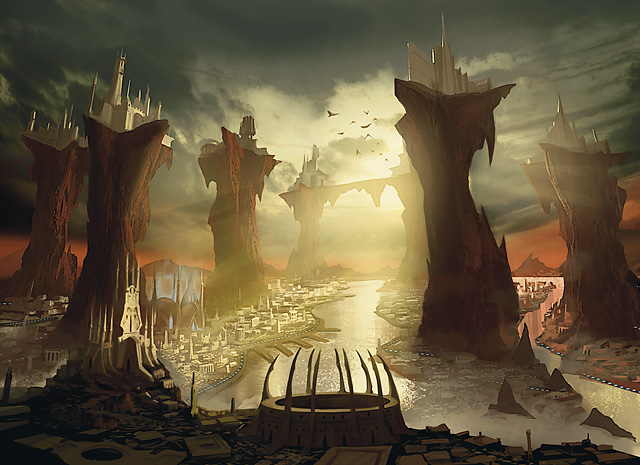
  • The Vermishards. Seven spires rise up from Metrol, a natural (or supernatural) wonder. These plateaus held the ancestral homes of the noble lines of Old Metrol, and the Royal Vermishard was the seat of the Cyran crown. However, over the course of centuries other powerful forces—such as House Cannith and House Phiarlan—made their way to the Vermishards. Cannith and Phiarlan worked together with Cyran magewrights to embed illusory lighting into the Vermishards, and these glittering spires were a remarkable part of the Metrol skyline.
  • The Wynarn Institute of Art. The Wynarn institute was both one of the foremost academies of magic in Khorvaire and one of its most amazing museums. In addition to purely artistic exhibits, the Hall of Kings allowed rulers to converse with illusory replicas of the past rulers of Galifar. Treasures of the pre-Galifar kingdoms were displayed here, along with modern works of art.
  • The Vault. The Royal Treasury of Galifar was commonly known as the Vault. While there were reserves hidden around the kingdom, the Vault included both the mint, the primary reserves of both currencies and precious metals, and cultural artifacts deemed too valuable to be displayed. Salvagers have dreamed of finding the “Golden Palace,” but there are stories saying that the Vault is actually missing. The Mourning had strange effects on Metrol, and the Vault may have simply been physically displaced, or it could have fallen into another plane.
  • The Cathedral of the Sovereign Host. Following the spread of the Church of the Silver Flame in Thrane, the Cathedral of the Sovereign Host became the primary seat of vassal devotion on Galifar. Many of the rulers of Galifar would make an addition to the Cathedral as a way of showing their piety. By the reign of King Jarot, it was a wonder. Nine colossal statues encircle the temple. Illusory displays within depicted scenes from the faith, and there was a vast collection of relics and artifacts. The fate of the cathedral and its treasures remains unknown.

All of these are within Metrol itself, and they just scratch the surface of what was possible. Aundair has floating towers; Cyre expanded on this with floating gardens, flower petals falling on the wind to the cities below. Even small towns had crystal theaters when people could scry on the great performances in the Demesne of Shape. There was always music in the air and lights in the sky. With this in mind, feel free to create wonders. Cyre was the seat of House Cannith and House Phiarlan, and second only to Aundair in arcane sophistication. What your dreams imagine, their hands could create. And even if they DIDN’T create the things you dream of, people might believe that they did; the legends of Cyre only continue to grow now that the kingdom is lost.

FINAL THOUGHTS

As a Cyran, you come from a culture that strove to find the best in all things, a tradition that encouraged creativity and innovation. But your people have also lived through a century of betrayal and war, fighting enemies on all sides. How has this affected you? Are you an idealist who still believes in the promise of Galifar—someone who believes that the Five Nations can and should unite, someone who tries to bring people together? Or do you curse the traitors who betrayed Mishann and doomed Galifar? Are you scarred by the memory of the Mournign and determined to reclaim your homeland or rebuild it somewhere else, or are you always looking forward to what happens next? Do you have any living relatives, and if so where are they now and what is their condition? Will you send money to your family in High Walls or New Cyre, or are you alone in the world? Beyond that, where was your home and what did you leave behind? Is there anything you wish you could recover from the Mournland, whether it’s something with practical value or simply sentimental? What do you still have to remind you of Cyre? 

GENERAL Q&A

Do Cyran nobles still have authority even though their lands have been lost?

This depends on the family and on the people you’re dealing with. The nobility of Cyre was originally drawn from across the Five Nations, and many Cyran noble families still have strong ties to other nations. Some families had significant holdings in other nations and still have wealth and influence, even if it’s limited. On the other hand, many Cyran nobles have lost everything but their titles. Some Thronehold nobles treat these displaced aristocrats with courtesy, but many dismiss them: at the Treaty of Thronehold, Queen Aurala famously said “Cyre no longer exists, and refugees have no place at these proceedings.”

In regard to YOUR character, there’s a simple way to determine the standing of your family: Your choice of background. If you take the noble background, your Position of Privilege means that you are treated with the respect of any noble; this implies that your family still has holdings or at least the respect of other aristocrats. But you could also be a fallen noble forced down a dark path (criminal background), a dandy who uses charm to find your way into courts even though you no longer have influence (charlatan), or a hero who still fights to protect the common people of Cyre even though you have no rank (folk hero). You could also take the noble background with the variant Retainers feature, reflecting that while you no longer have a position of privilege, you still have a few loyal followers who have been with your family for as long as you can remember.

The Forge of War says that Thrane turned away or even attacked Cyran refugees fleeing from the Mourning. You’ve said that this is inaccurate and possibly Karrnathi propaganda. Would this be a pervasive rumor? Would Cyrans think of Thranes as butchers who turned their backs? Is Karrnath exempted from this? What about Breland and Aundair?  

The faith of the Silver Flame is founded on the basic principle of defending the innocent from supernatural evil. I’ve already called out that if followers of the Flame were serving on opposite sides in a battle and a group of demons suddenly appeared, I’d expect the templars to set aside their political differences until the supernatural threat was dealt with. The same principle applies here. I could easily imagine an initial violent response if the surge of refugees was perceived as an attack. However, once it became clear that thi sis literally innocents fleeing a supernatural threat, I would expect Thrane to be the MOST active nation in providing support and shelter.

So my initial reaction is that Forge of War is simply WRONG. The situation as described makes no sense and I don’t see it as a rumor that would stick, because anyone familiar with the church should know it makes no sense. Why would they do something like that?

WITH THAT SAID: Maybe you WANT it to be true. If this is the case, the question is what could MAKE it happen as described. The simplest answer is that the facts aren’t straight. The Mourning transforms things caught within it. So perhaps Thrane templars DID “slaughter a host of Cyrans fleeing from the Mourning”—because those Cyrans had been caught in the Mourning and transformed into a ravening pack of bloodthirsty killers. They weren’t FLEEING the mists, they were charging out of them to kill anything they could get their hands on, and the templars had no choice but to put them down. So it is an absolute fact that Thrane forces killed a host of Cyran refugees, and Karrnath or other nations have publicized the story. But the truth isn’t as they present it—and beyond that, I’d still expect people who hear the story to say “But that doesn’t make any sense!”

So as a quick overview of how nations have responded to Cyrans, here’s MY personal opinion.

  • Breland has been presented as the most willing to shelter Cyrans without strings, as shown by the establishment of New Cyre. There are certainly tensions between the common people of Breland and the refugees, and life in camps like High Walls is hardly ideal, but it’s better than anything offered by Aundair or Karrnath.
  • I think Thrane would have responded with compassion and provided significant support. However, I can imagine Thrane focusing on integrating refugees into Thrane society as opposed to trying to preserve Cyran culture or supporting Cyran nobles; consider that they already set aside the Wynarn monarchy in favor of the Church. So they’d provide support and opportunities—for a new life as Thranes.
  • Aundair has been presented as unsympathetic (see that quote from Queen Aurala at the Treaty of Thronehold), and that makes sense. Aundair is the smallest of the Five Nations and has its own problems with the Eldeen Reaches, and Aurala still believes she would be the best ruler for a restored Galifar; none of this suggests sympathy for Cyre.
  • Likewise, I think Karrnath would be VERY unsympathetic. Cyre and Karrns were bitter rivals; per Forge of War, the Mourning followed directly on the heels of a Cyran sneak attack on the city of Atur. Karrnath had long struggled with famines and thus lacks the ability to suddenly support an influx of outsiders, and Karrns are known for being ruthless and pragmatic. Beyond this, as I called out in my last article, the Karrnathi undead are perfectly willing to slaughter civilians. If anyone slaughtered masses of Cyran refugees on the border, I’d expect it to be Karrnath.

Several maps show parts of the Talenta plains (or the borderlands) as part of Cyre during the Last War. Were these wartime holdings? Provinces of Cyre? How was Cyre’s relationship with the Halflings?

This is covered on page 202 of the 3.5 ECS:

Karrnath and Cyre both claimed parts of the Talenta Plains during the Last War. Prior to the fall of the kingdom of Galifar, the halfling tribes were permitted to wander their ancestral lands as long as they paid tribute to the Galifar king. With the coming of war, the halfling tribes began to cooperate in unprecedented ways to protect the Plains that all the tribes revered. Warriors of different tribes banded together, repelling invaders from Karrnath and Cyre by using their knowledge of the ways of the Plains to confuse and confound the invaders. Later, when the Plains became the place for various combatant nations to clash, the halfling tribes tried to stay out of the way.

Cannith had a lot of holdings in Cyre, and almost invariably there would have been mingling with the locals. Do you see the Houses as having a mostly distinct culture or also being something like citizens of the nation they grew up in? Cannith worked a lot with Cyre during the war, was that more an accident of proximity and money or did a lot of the leadership sympathize with the Cyrans? For example, is there a Cannith style or are there Cyran Cannith, Brelish Cannith, etc. styles of architecture/production?

The houses definitely hold themselves as extranational entities. They take their neutrality very seriously, and the only house we’ve suggested as having a national bias is Medani: so Cyre’s heavy association with Cannith was certainly based on gold. Cannith heirs consider themselves to be Cannith first, nation second. However, there’s certainly a national component to the personality of a dragonmarked heir. Beyond interaction with the locals, you’ve got the fact that houses are comprised of different families and these families are based in different nations—so the Vown are Brelish Cannith, while Juran are (or were) Cyran Cannith. It’s also the case that different enclaves have different focuses, which also affects corporate culture. Cannith South is focused on general industry, while Cannith East is more driven by weapons research and recently, experimenting with necromancy.

With that said, the HOUSES hold themselves as neutral; the members of the houses often had their own sympathies. In The Dreaming Dark novels, Daine is a Deneith heir who cut ties with the Blademark in order to fight for Cyre. Dragonmarked discusses such characters, who are generally referred to as “orphans.”

Could you elaborate a bit on what would happen to the royals and their families of the other nations once they were done reigning/advising. Would they be demoted to “regular” noble status? Would they hold land, and how would they inherit?

The position of governor came with land, but those holdings were tied to the position and would be passed to the new governor. The tradition was for a governor to marry into one of the noble families of the nation they governed, which served both to strengthen their connection to the land and to give them estates after their tenure passed. So the warlord families of Karrnath include many former governors. But this does mean that when the nations rallied behind their “kings” and “queens” to start the Last War, it was a substantial change. Frankly, this reflects how easy it was for Thrane to shift to a theocracy; they weren’t deeply attached to Wrogar’s line. Likewise, we’ve said that Kaius III is still in a delicate position with the Warlords of Karrnath; they trace their lineage back to the founders of the nation, while Kaius I was a son of Jarot. But the short answer to the question is that the governors would marry into the local nobility, which helped both to keep bloodlines fresh and to strengthen ties between Galifar and the local nobility.

What would YOU like to know about Cyre? Post your questions below. And thanks as always to my Patreon supporters for requesting the topic and making it possible!
Dragonmarks: Lycanthropes

I’m hard at work on many projects, but I’ve had a few questions tied to lycanthropes… and with Halloween around the corner, it seems like an appropriate topic to address! Thanks as always to my Patreon supporters for supporting the blog.

I’ve been listening to the stories of the Werewolf Trials of the Middle Ages. Was the Eberron purge based on these, or is this just a coincidence?

For those of you unfamiliar with the setting, the Lycanthropic Purge is an event that occurred around two centuries before the default Eberron campaign. The Church of the Silver Flame sent an army of templars into western Aundair and what is now the Eldeen Reaches to combat a rising tide of lycanthropy. Following a brutal conflict, the church supported an ongoing campaign to root out and cure or exterminate all lycanthropes that could be found. This conflict is also the root of the Pure Flame, a zealous sect of the Church of the Silver Flame that engages in ruthless and often violent behavior.

People often think of the Purge as a sort of inquisition, similar to the Salem Witch Trials or the Werewolf Trials mentioned above. It certainly ENDED that way, with the newly minted zealots of the Pure Flame trying to hunt down every last lycanthrope… and in the process, targeting many shifters and other innocents. So you can certainly use werewolf trials as inspiration for this period. But that wasn’t how the Purge BEGAN; it’s how it ENDED, a cruel inquisition carried out by people who had suffered through a decade of terror and loss and who were hungry for bloody vengeance. So how did it start?

Under the rules of third edition D&D—the edition that existed when Eberron was created—lycanthropy was a virulent curse. Under the rules of the time, any lycanthrope could spread lycanthropy. If one wererat creates two victims, and each of them infect two others, within five cycles of infection you have 243 wererats… and that assumes each one only has two victims! Essentially, in lycanthropy as presented you have the clear potential for a zombie apocalypse: a massive wave that could result in untold death and ultimately destroy civilization as we know it. The Purge ENDED in a cruel inquisition. But it BEGAN as a noble, selfless struggle to save the world from collapsing into primal savagery. Thousands of templars gave their lives in the Towering Woods, fighting to protect the people of Aundair from supernatural horror.

Under the rules of 3.5 and 4th Edition, afflicted lycanthropes can’t spread the curse. This eliminated the threat of exponential expansion that made the Purge so necessary. Personally, I make this a part of history. At the time of the Purge, lycanthropy was more virulent. By the end of the Purge, the power of the curse had been broken. The question is: Was this tied to some specific victory, to ann Overlord being rebound or an artifact that was destroyed? Or was it simply tied to the number of lycanthropes—when the population grows, so does the power of the curse? And this is important, because in FIFTH edition, all lycanthropes can spread the curse again! Personally, I’m embracing this as the continued evolution: whatever cause the power to wane, it’s rising again. A werewolf apocalypse is a very real threat. Could another purge be called for?

What Makes Lycanthropy A Curse?

Lots of people like lycanthropes. They see lycanthropes as champions of nature, and as the persecuted victims of the purge. So why am I insistent about it being a curse?

First, there’s a simple logic to the decision. Lycanthropes possess amazing abilities. They can transfer these gifts to others, quite easily. So if there’s no downside to being a lycanthrope, why aren’t we all lycanthropes? Why isn’t this gift embraced and shared? If one member of a party contracts lycanthropy, why shouldn’t every member of the party get in on it?

With this in mind, D&D has generally inherited its view of lycanthropy from the Universal monster, not from the World of Darkness and its champions of Gaea. Even a man who’s pure of heart and says his prayers by night can become a wolf when the moon is full. It’s the vision of werewolves that chain themselves up as the moon grows close for fear of killing innocents. The third edition rules were very clear about this. Initially, when a victim falls prey to the curse, THEY BECOME AN NPC for the duration of the event and act according to their lycanthropic alignment. You lose all control and don’t know what you’ll do.

The rules specify that if this goes on long enough, the alignment change becomes permanent and it’s possible for the player to take over. But this isn’t a casual thing. In Eberron, an evil person can have a valid role in society. But 3E called out that an evil lycanthrope isn’t just “evil;” they’re murderers who enjoy preying on their former family and friends. Likewise, a good lycanthrope isn’t just a nice person; they are compelled to abandon civilization to live in the wilds. Fifth Edition echoes this. Consider the following quotes from the fifth edition Monster Manual:

  • Evil lycanthropes hide among normal folk, emerging in animal form at night to spread terror and bloodshed, especially under a full moon. Good lycanthropes are reclusive and uncomfortable around other civilized creatures, often living alone in wilderness areas far from villages and towns.

  • Most lycanthropes that embrace their bestial natures succumb to bloodlust, becoming evil, opportunistic creatures that prey on the weak.

The point here is simple: no player character should WANT to become a lycanthrope. It’s a terrifying burden; even good-aligned lycanthropy will destroy your original personality and turn you into someone else.

Eberron generally takes a broad approach to alignment. But lycanthropy is a special case: it is a supernatural force that IMPOSES an alignment, and this overrides the victim’s ability to choose their own path. What we do say is that there are different strains of lycanthropy, and that alignment is tied to strain. So it is possible to have a good-aligned werewolf… but if they infect someone that person will become a good-aligned werewolf. Here again, I can’t emphasize enough that being a good-aligned lycanthrope isn’t just about being a virtuous person. If it was, the Silver Flame would support it. But just look back at that quote from the Monster Manual: Good lycanthropes are “reclusive and uncomfortable” around civilization. Good or evil, the curse fundamentally changes who you are and enforces a powerful set of instincts and drives.

I feel that natural lycanthropes have a greater ability to adapt and evolve personalities around the behavior dictated by the curse. But it’s important to recognize that there is a fundamental difference between a natural lycanthrope and, say, a gnoll or a shifter. The lycanthrope isn’t just bestial in appearance; they are a vessel for a powerful supernatural force that shapes and drives their behavior. A natural werewolf can fight those urges, but the urges will always be there.

The Origin of Lycanthropy

The origins of lycanthropy are shrouded in mystery. As with the Mourning, I don’t think this is something that needs to be established in canon. I’d rather present a few different ideas, and let each DM decide which one they prefer. So consider the following.

The Gift of Olarune. Common belief is that shifters are thin-blooded lycanthropes. But there are shifters who say that their kind came first. Shifters are touched by Eberron and Olarune, tied to the natural world. Olarune empowered her champions with a stronger bond to nature, blessing them with enhanced vitality, animal form, and other gifts. According to this legend, this gift was corrupted by a dark power—one of the other forces presented below. This explains why lycanthrope traits don’t reflect the natural animal. The wolf isn’t a cruel murderer; but the werewolf embodies our fears of the savage predator that lurks in the darkness. The rat doesn’t scheme to spread disease and undermine cities… but the wererat does.

This means that there was a proto-lycanthropy that was entirely benevolent… and it allows players to have a quest to restore this, cleansing the curse as opposed to wiping it out. In my opinion, this “pure” lycanthropy wasn’t infectious—it would only produce natural lycanthropes, assuming it was hereditary at all. Alternately, it might not even resemble lycanthropy; these blessed champions could be a form of druid.

I have no objection to the idea of there being a small population of these blessed lycanthropes in the world—but again, I’d probably make them non-infectious. The blessing is something you earn, not something you get from a bite. This removes the issue of “Why don’t we all become blessed lycanthropes?”

Overlords: The Wild Heart. The novel The Queen of Stone suggests that lycanthropy is tied to one of the fiendish Overlords of the First Age, a mighty spirit known as the Wild Heart. If this is true, lycanthropy has been around since the dawn of time… and the waning and waxing of the power of the curse likely reflects the strength of the Overlord’s bonds. If you want positive lycanthropes in the world, the Wild Heart could have corrupted Olarune’s Gift… or you could reverse it and say that Olarune’s Gift is a variant that released some of those cursed by the Wild Heart.

Daelkyr: Dyrrn the Corruptor. The Daelkyr are known for transforming victims and creating monsters. Not all of their creations are aberrations; the daelkyr Orlassk is credited with creating medusas and basilisks. Dyrrn the Corruptor is especially know for, well, corruption; this certainly fits with a curse that transforms people both physically and mentally and turns victims into predators that prey on their own friends and family. This could have been something created from scratch… or they could have corrupted the existing primal gift.

So personally, I see even good lycanthropes as victims, and as people who don’t want to spread their curse because it WILL destroy the original personality of the victim. I have run a campaign in which a druid was working to restore the curse to its original blessed form.

But looking to all of this: this is how I run lycanthropes. It’s in line with the depiction in the Monster Manual, which emphasizes lycanthropy as a curse that drives unnatural behavior (whether good or evil). I personally like the idea of the lycanthrope as an alien entity, a being whose behavior is shaped by an unknown supernatural power. Essentially, D&D has a LOT of half-animal humanoids. Tabaxi, gnolls, giff… I like to make lycanthropes feel very different than all of these. Whether in human, hybrid, or animal form, a werewolf is a magical weapon, shaped and empowered to prey on the innocent (or to defend them, if it’s a good strain). Natural lycanthropes can take control of this; Zaeurl of the the Dark Pact is a brilliant warlord. Zaeurl isn’t wild or uncontrolled, she isn’t a slave to her instincts. But she is still a vessel for a power that makes her a supernatural predator, and those murderous instincts are always there. The same is true of the good lycanthrope: they aren’t cruel or murderous, but there is a deep primal core to their personality calling them to retreat to the wilds, to defend their territory.

But again: I embrace this because I LIKE it… because I LIKE lycanthropes, regardless of alignment, to feel dangerous and alien. I want my players to be terrified of contracting lycanthropy, not looking forward to it. If you want to do something different in your campaign, follow the path that’s going to make the best story for you and your players.

The Timeline of the Purge

Here’s a quick overview of the Lycanthropic Purge, pulled from one of my earlier posts.

  • Lycanthropes have been present throughout the history of Galifar. However, they rarely acted in any sort of coordinated fashion; afflicted lycanthropes couldn’t spread the curse; and natural lycanthropes would generally avoid spreading the curse. They were dangerous monsters and something that templars or paladins of Dol Arrah would deal with, but not perceived as any sort of massive threat… more of a bogeyman and reason to stay out of wild areas.
  • Around the Ninth Century, there was a shift in Lycanthropic behavior. Packs of werewolves began coordinating attacks. Eldeen wolves began raiding Aundair, and wererats established warrens beneath the cities of western Aundair. More victims were left alive and afflicted. While terror spread among the common folk of western Aundair, the nobles largely dismissed the claims.
  • Sages in the Church of the Silver Flame confirmed that afflicted lycanthropes could now spread the curse. They realized that the raids and urban actions might not be as random as they appeared – that this could be the groundwork and preparations for a serious large-scale assault. Combined with the risk of exponential expansion, this was a potential threat to human civilization.
  • Templars were dispatched to Aundair, and fears were confirmed; there were more lycanthropes than anyone guessed, and they were better organized than had been seen in the past. What followed was a brutal guerrilla war; the templars had numbers and discipline, but they were fighting an unpredictable and extremely powerful foe that could hide in plain sight and turn an ally into an enemy with a single bite. Thousands of Aundairians and templars died in these struggles. Cunning lycanthropes intentionally sowed suspicions and fomented conflict between templars and shifters, resulting in thousands of additional innocent deaths.
  • The precise details of the war aren’t chronicled in canon and likely aren’t known to the general public. I expect it happened in waves, with periods where the templars thought the threat had finally been contained… only to have a new resurgence in a few years. Again, canon doesn’t state what drove the power of the lycanthropes. Whatever it was – demon, daelkyr, shaman – the templars finally broke it. Afflicted lycanthropes could no longer spread the curse, and all lycanthropes were freed from whatever overarching influence had been driving their aggression.
  • While the threat was largely neutralized at this point, people didn’t know that. There’d been ups and downs before. Beyond this, the Aundairian people had suffered through decades of terror and they wanted revenge. This is the point at which the Purge shifted from being a truly heroic struggle and became something more like a witch hunt, with mobs seeking to root out any possible lingering lycanthropes. Tensions with shifters continued to escalate as bloodthirsty mobs sought outlets for their fear and anger. A critical point here is that at this point, most of the aggressors were no longer Thrane templars. The primary instigators were Aundairians who had adopted the ways of the Silver Flame over the course of the Purge. For these new believers, the Silver Flame wasn’t just about defense; it was a weapon and a tool for revenge. This is the origin of the sect known as the Pure Flame, and its extremist ways can be seen in priests like Archbishop Dariznu of Thaliost, noted for burning enemies alive.

The take-away here is that the Purge began as a truly heroic struggle against a deadly foe, and the actions of the templars may have saved Galifar from collapsing into a feral savagery. But it ended in vicious persecution that left deep scars between the shifters, the church, and the people of Aundair. And now, it may be happening again.

Q&A

How prevalent were lycanthropes during the Dhakaani Empire?

That depends on the origin you chose for them. If you follow the idea of an Overlord, than the curse would exist during the Empire. However, I think it would be extremely rare. Consider a) the Dhakaani are highly civilized and city based, and b) the Dhakaani were a highly regimented and ruthless culture. Essentially, I would see the Dhakaani as being VERY quick to completely cauterize any nest of lycanthropes, just as they would quickly wipe out any form of biological disease. Now, lycanthropes could have still flourished in the wilds— the Towering Woods, the Shadow Marches—but they wouldn’t be seen in the Empire.

On the other hand, if lycanthropes were created by Dyrrn the Corruptor, they would have been a weapon unleashed in the Xoriat Incursion. There could well be historical evidence of a stretch of the western empire that was almost completely wiped out in a lycanthropic exponential expansion. Given this, if you wanted to present a Kech of the Heirs of Dhakaan that have somehow adapted and controlled their lycanthropy, it could be an interesting story—though the other Kech might see these things as abominations.

I know that werewolves transform when any moon is full, but do the twelve moons effect them differently in any noticeable way?

We’ve never discussed this in canon. There’s certainly precedent for it with the Moonspeaker druid. We’ve suggested the idea that Olarune has the greatest influence over lycanthropes, but I think it would be very interesting to say that different moons drive different impulses or moods. Another option would be to tie each strain to a particular moon.

I’m very curious about how lycanthrope genetics work. I know it’s a supernatural thing and probably don’t follow any scientific logic at all, but bloodlines and heritage are still strong symbolic themes to play with. 

It’s a good question. If a natural evil werewolf has a child with an afflicted good werebear, what’s the child? You’re correct to keep in mind that this is fundamentally magic and that science isn’t the factor here. I’m inclined to follow the precedent of the kalashtar, and to say that while the child may inherent genetic traits from both parents, they only inherent the supernatural lineage of one of them. In the example above, they don’t produce some sort of neutral wolfbear; the child is either a good werebear or an evil werewolf. In the kalashtar, this is predictable and tied to gender; the child inherits the curse from the parent of the same gender. But you could just as easily make it random, or assert that one of the strains (I’d tend to say the evil one) is dominant.

I will say that I don’t consider natural or afflicted to be a factor in this. Once you have the curse you have the curse. It’s more deeply rooted in the natural—it can’t be removed, and it’s shaped them psychologically since birth—but in terms of passing it to a child, I think there’s no difference.

Is it correct to assume that the children of a natural or afflicted lycanthrope with a humanoid is a shifter (albeit one with far more obvious bestial traits than average)?

No, that’s not what I’d say at all. In my opinion, the connection between lycanthropes and shifters is more nebulous than that—and as I suggest above, it could be that shifters actually predate lycanthropes. We’ve called out that with shifters it’s not necessarily clear what animal they are tied to, and that shifter traits aren’t hereditary. If shifters are related to lycanthropes, I think it’s the process of many generations.

So personally, I would say that the child of a humanoid and lycanthrope is a going to be a natural lycanthrope. The curse isn’t natural and isn’t limited by genetics; it’s a curse. WITH THAT SAID… I can see some strong story potential to making it not an absolutely sure thing, which would allow you to have a character who appears to be normal only to develop lycanthropy spontaneously late in life (Shadow over Innsmouth style).

With that said, if you want to use shifter mechanics to represent a hybrid child of a human and lycanthrope, there’s nothing wrong with that. I’d just personally say that the character isn’t a traditional shifter—that the MECHANICS are the same, but that there will be obvious physical differences (this character would be more obviously linked to the particular animal, would be driven to a specific subrace, etc).

One sourcebook (was it Secrets of Sarlona?) mentioned that shifters and lycanthropes originated from Sarlona, more specifically from the Tashana Tundra. If so, shouldn’t the daelkyr hypothesis be ruled out?

The sourcebook in question is Secrets of Sarlona. There’s a few factors to consider here.

  • Secrets of Sarlona suggests that shifters began on Sarlona, but gives no explanation of how they came to Khorvaire.
  • It specifically presents this Tashan origin as a surprise to both the humans and shifters of Khorvaire.
  • Neither shifter culture seems to have the motives or resources to organize a vast migration by sea, and the Eldeen shifter culture isn’t strongly intertwined with humanity.

Putting these three factors together suggests that shifters arrival in Khorvaire predates humanity, and was unusual in its origin. So I’ll present one hypothesis: Perhaps a large group of shifters entered one of the Wild Zones of Sarlona and were thrown into Thelanis. There, an Archfey—who called herself Olarune, after the moon—guided them through the Faerie Court, leading them out through another manifest zone into Khorvaire. This provides the basis for folktales of shifters as the chosen people of Olarune and gives them a migration that’s entirely unconnected to humanity. This could have occurred long before humanity crossed the ocean. And if we posit the Towering Wood as their landing point, it’s a wild region that was never tamed by Dhakaan; so it’s entirely possible they could have been present during the Daelkyr conflict.

WITH THAT SAID: A daelkyr wouldn’t have to cross thousands of miles to threaten Sarlona. We’ve discussed the Umbragen of Xen’drik fighting daelkyr. Remember that Khyber contains a myriad of demiplanes, which don’t follow natural law. So you could easily descend into Khyber in the Eldeen Reaches and emerge in Xen’drik, if you found the right passage.

Also: Secrets of Sarlona DOESN’T provide any explanation for the origin of lycanthropy. It seems to have had no significant impact on the history of Sarlona and is barely mentioned. It presents the possibility that it’s the result of an exposure to wild zones, but this is clearly called out as simply one possibility, not concrete fact… and I find it to be a weak story compared to the other options.

This is very well-timed, not just for Halloween, but because the shifter and the Silver Flame warlock in my group are sort of eyeing each other warily…

It’s worth exploring this a bit. The shifter tribes of the Towering Woods have far more experience with lycanthropes than humans do. They know that the good strains don’t pose a threat, and many clans would work in harmony with good-aligned lycanthropes. However, they despise EVIL lycanthropes. Again, per core rules, an evil lycanthrope is compelled to prey on the weak and innocent, even taking joy in targeting former friends and family members. The shifters understood this threat better than anyone, and had no desire to shield evil lycans. But they also understood that there were good strains as well.

So in principle, shifters and templars could have worked together against the common foe. But cunning lycans (especially wererats) worked to destroy this possibility before it could be realized. These agents intentionally sowed the idea that shifters were weretouched and supported all lycanthropes, actively working to set the templars and shifters against one another. The damage done by this lingers to this day. Many shifters hate the church, and followers of the Pure Flame hold to the idea that all shifters are weretouched or lycan sympathizers.

With that said, this isn’t universal. Many people on both sides understand that this was a trick, misinformation to turn allies against one another. There were shifters and templars who fought side by side during the Purge, and shifters who have become champions of the church in the decades that have followed.

All of which is to say: It’s up to your players to decide where they stand on this. Either one could be blinded by superstition and prejudice. Or they could understand that this hatred was engineered by a mutual foe, and be trying to work past it.

During development, was the purge specifically created to offset the “They’re heroes!” mentality that might come from such a “Holy Glorious Shenanigan” mindset otherwise?

Yes and no. The Purge was inspired by historical events, certainly: crusades, the Inquisition, wiping out smallpox. But in these situations, it’s vital to remember that Eberron isn’t our world. When we think of witch trials, we inherently assume that this involves the paranoid persecution of innocents, because (we believe) witches aren’t real. By contrast, the Purge was driven by an absolute concrete apocalypse level threat. Whatever you think about lycanthropes generally—even if you believe that lycanthropy is a blessing creating champions of the natural world—the lycanthropy presented in the rules of third edition was a curse, a supernatural force that could turn the noblest soul into a cruel murderer with the power to create more murderers. The curse that set the Purge in motion was a real, concrete supernatural threat that would have collapsed human civilization into primal murderous savagery. This is why it’s logical to think that this curse was created by the daelkyr or an Overlord: because it’s a weapon perfectly designed to tear apart a civilization from within and without.

So at its core, the Purge WAS a Holy Glorious Shenanigan. People ask why the Church didn’t put more effort into curing the victims, why it was so ruthless. To me, this fails to grasp the brutality of the situation. In my mind, we are talking about a horrific, terrifying struggle. Lycanthropes are powerful and deadly, and one-to-one the Templars were badly outmatched. Take the movie Aliens and set it in a redwood forest: that’s how I see the early days of the Purge. Add to this the idea that any village you find could be riddled with wererats scheming to poison you or turn you against innocents… or the entire village could BE innocent, and YOU DON’T KNOW. There could have been periods of peace, but when a surge occurred it would be sheer apocalyptic horror. In this phase, the templars weren’t cruel inquisitors. They weren’t in the position of power. They were heroes laying down their lives to protect the innocent people of Aundair.

After years of conflict, the tide finally turned. The power of the curse was broken. Suddenly the numbers of lycanthropes began to dwindle as they were defeated. But as noted in my timeline, this had happened before; no one knew that this time the threat was truly over. Now that the outright war had been won, the focus shifted to rooting out the survivors… those lycanthropes still hidden among the population. THIS is where we shift to the cruel inquisition and the paranoid witch hunt, taking the story we’ve seen play out many times in our history. But it’s important to remember that you’re dealing with a population that had suffered through a generation of blood-soaked terror, people who’d had lost countless loved ones to murderous lycanthropes. And remember that WE have the benefit of a rulebook that tells us with absolute authority how lycanthropy works, how it can be cured, that a good lycanthrope only creates other good lycanthropes. They had none of these things: what they had were countless conspiracy theories and superstitions born of terror and rage. And this was the foundation of the Pure Flame: a sect who saw the Silver Flame as a weapon, a tool not simply to protect the innocent but to punish the enemy, a force that had saved them from annihilation and could now make the forces that caused such terror pay for it.

So if anything, the Purge is a reflection of the moral complexity of the setting. It’s an event that can’t be painted as entirely good or purely evil. It was a conflict fought for the noblest of reasons that may have saved human civilization; and it was a ruthless persecution that resulted in the deaths of thousands of innocents and set an ember of hatred and suspicion between shifters and the church that still burns today. It is a stain upon the Church of the Silver Flame because of the innocents who died; but it’s also a symbol of selfless courage, of templars placing themselves in harms way to protect hundreds of thousands of innocent lives.

That’s all for now… happy Halloween!

Dragonmarks: The City of Silver and Bone

The fourth edition of Dungeons & Dragons introduced the concept of the Feyspires: cities that drift between the Faerie Court of Thelanis and the material world. Legends say that the giants of Xen’drik pillaged one of these mystical cities, stealing its treasures and taking its people as slaves. According to these tales, the elves of Eberron are descended from these fallen fey. And it’s said that the ruins of the citadel remain somewhere in the wilds of Xen’drik. But these events occurred many tens of thousands of years ago, and the elves themselves know nothing about their distant ancestors. All that we know is the name of the fallen feyspire: Shae Tirias Tolai, the City of Silver and Bone.

So: the ruins of an ancient mystical city are lost in Xen’drik. But what will explorers find if they discover this shattered feyspire? What WAS the City of Silver and Bone? As with anything in Eberron, the answer is ultimately up to you. But here’s one possibility… an option that sheds new light on a few of the mysteries of the elves.

Study the lore of ancient cultures, and you’ll find a recurring story of a city that stands on the edge of life and death. A shade is drawn to Dolurrh, but along the way it passes through a wondrous city of silver and bone, a city with tapestries of fine glamerweave and bone fountains filled with blood. The librarians of this final city record the tales of the ghosts, a last record before their memories are lost in Dolurrh. The artists work with creative shades, offering a last chance to complete unfinished works. And then there are the necromancers who make darker bargains, offering a chance to return to the world of the living… but at a terrible cost.

This was Shae Tirias Tolai: the city at the crossroads, the repository of final thoughts and the last chance for the fallen to find a way back to the world. And its existence answers a number of questions that have lingered for some time.

  • The Qabalrin. It’s said that the Qabalrin were an elven nation of mighty necromancers who were feared by the giants, and who pioneered many techniques of necromancy. Stories say that there are ancient Qablarin vampires hidden in deep crypts, mighty undead that have been slumbering for tens of thousands of years. But the question has always remained: where did these elves come from? How did they learn these grand secrets of necromancy, this magic that rivaled the giants? If the tales are true, the first Qabalrin were fugitive citizens of Shae Tirias Tolai, survivors who used their necromantic knowledge to found a new realm in the mortal world.
  • Elven Necromancy. Likewise, the distant tie to Tirias Tolai explains the elven penchant for necromancy, both positive and negative. The Aereni and the line of Vol know nothing about their ancient ancestors, but memories still linger in their blood… and this may explain how the elves came to form two of the most remarkable necromantic traditions in Eberron.

But… it’s said that the giants feared the Qabalrin. How could that be, if they defeated Shae Tirias Tolai? Well, the story is that the titans of old took Shae Tirias Tolai by surprise, using treachery and careful preparation to catch the people of this city unaware. Beyond that, the inhabitants of the City of Silver and Bone weren’t warlike by nature. They dealt peacefully with the shades; they never expected an attack and weren’t prepared for battle. The Qabalrin, on the other hand, turned all their knowledge and power into weapons. They also rooted themselves in the mortal world. The original inhabitants of the City of Silver and Bone WEREN’T arch-liches or vampires; they simply knew the secrets of creating such things. In destroying the Silver City, the giants forced the survivors down a dark path.

So what lies in the ruins of the City of Silver and Bone? The first thing to bear in mind is that it is at its heart an imaginary city. It is literally ripped out of a faerie tale, and its structures and elements don’t have to conform to any sort of natural logic. It was always a gothic citadel that blended beauty and luxury with morbid reminders of death. Its people have been taken and it has been bound to the material world, but in a strange sense the city itself is still alive. Its story has simply evolved to encompass its downfall. Envision every story of a haunted castle or mansion and project it here. It is a city that was built using bones as its base—bones of dragons, giants, and all manner of lesser creature. Bone blends with marble and silver, with pools of fresh blood (which by all logic should have coagulated tens of thousands of years ago). Imagine a place of gothic beauty, and now add the aftermath of a terrible battle. Glamerweave tapestries display the tales of forgotten heroes, but the cloth is torn and tattered. The sounds of battle can still be heard as echoes. The spirit of every giant that fell in that ancient battle remain bound here, along with the angry shades of doomed eladrin and other innocent shades who were trapped in transition. Explorers may be overwhelmed by visions of that terrible final conflict, or assaulted by spirits who seek vengeance or a final release. An important point is that these spirits don’t have consecutive memory: for the most part, they are still trapped in the moment of their demise, still fighting their final battles and yearning for revenge on a nation that’s now dust.

Within this concept, it’s up to the DM to decide what wonders remain. Perhaps the library remains intact, holding the secrets of thousands of ancient champions (including dragons, giants, orcs, eladrin, and many others). Maybe there’s a vault of demiliches of dozens of different species, dragon-skulls who still remember the battles against the Overlords. The mightiest artifacts would have been taken by the giants, but there could be many lesser treasures that were beneath their notice… or deep vaults (such as that ossuary of demiliches) where even the giants feared to tread. Ultimately, it’s still important to bear in mind that it’s NOT simply the ruins of a mortal city; explorers are stepping into the story of a haunted ruin, clinging to its tragic loss. Another question to consider is whether the archfey of the city still remains, and if so in what form.

Strangely, this could be another way to explore the Raven Queen in Eberron. Perhaps the ruins of Shae Tirias Tolai still linger between Eberron, Thelanis, and Dolurrh. The Raven Queen is the archfey of the city that stands between life and death. The Shadar-Kai are all that remain of her beautiful children, and the memories she captures are what preserve her existence. If you take this route, the ruins would be revealed to be a gateway to Dolurrh. The question is whether the Raven Queen has accepted her fate and embraced her new story… or whether the player characters could undo the damage that has been done and somehow restore the City of Silver and Bone, allowing it to serve once again as a friendly waystation on the journey into oblivion.

Story Hooks

People exploring Xen’drik could simply stumble onto the ruins of Shae Tirias Tolai. The Curse of the Traveler makes the geography of Xen’drik unreliable; explorerers could discover the ruins once and never find their way back to the shattered city. But they could also be drawn to the haunted city. Consider the following ideas.

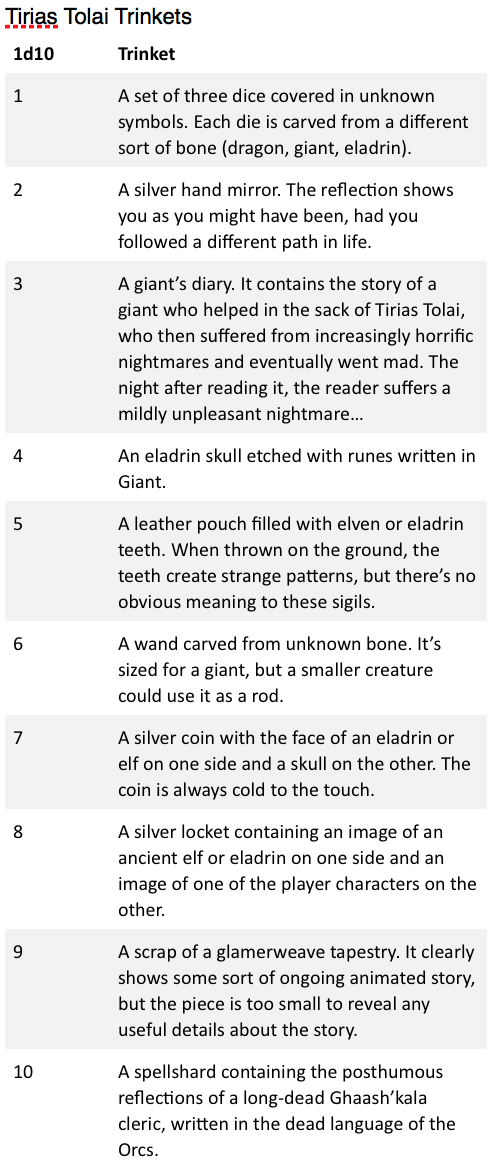
  • The party discovers a trinket from Shae Tirias Tolai. It could be carried by an enemy, found in a villain’s hoard, or simply discovered in a flea market or the trash heaps of Sharn. The trinket yearns to be returned to the City of Silver and Bone, and whoever holds it will have visions of the ancient city and its final battle. The trinket serves as a compass, and the party that carries it can ignore the Traveler’s Curse. Will they follow where it leads? A table of possible trinkets is included at the end of this article.
  • The Order of the Emerald Claw is searching for Shae Tirias Tolai. There are secrets in the City of Silver and Bone that are critical to the plans of the Queen of the Dead. Perhaps she can raise an army of lingering giant ghosts and bind them to her will. Possibly a crumbling dragon demilich knows the secret of restoring her lost mark. Whatever power she seeks, the PCs must find a way to reach Tirias Tolai before the Queen of the Dead… or if they arrive too late, to turn the lingering ghosts of the city against the Emerald Claw.
  • When a previously unknown undead force (Acererak? A Qablarin arch-vampire? A sinister being directly channeling the power of Mabar and Dolurrh?) threatens the world, the key to understanding this villain may lie in Shae Tirias Tolai. It could be held in a crumbling scroll in the library, found on a tattered tapestry, or contained in the cracked skull of an ancient demilich.
  • Someone who has been raised from the dead finds that they hear whispers, and are haunted by nightmares when they sleep or trance. Even though they have returned from death, a piece of their spirit has been trapped in Shae Tirias Tolai… and unless it can be released, their soul will eventually be torn from their body and pulled down into the haunted city. Play this a horror movie: the player character returned from the dead, but they came back incomplete and that hole in their soul is growing; if they can’t find the city they see in their visions, they will either die again or become some sort of undead monster.
  • Consider a variation of the Eye of Vecna. The giants couldn’t destroy the archfey of Shae Tirias Tolai, but they took pieces of the archfey and scattered them across the world. Each of these pieces grants great power, but the pieces yearn to be reunited and to return to the fallen feyspire. The spirit may not be evil in the traditional sense, but all mortals are as dust to it, and all that it cares about is its restoration and the restoration of its citadel. One possibility is that the sentience of the archfey doesn’t communicate directly with those who bear the pieces… but that they all know that ultimate power awaits in the haunted city.

These are just a few ideas. The point is that the City of Silver and Bone can serve many roles. It could be a haunted dungeon that adventurers stumble into once while exploring Xen’drik. It could the the ultimate capstone in the plans of the Emerald Claw. Or it could be a mystery that develops over time, a slow burn tied to the visions of a resurrected hero or the whispers of a powerful artifact.

Here’s a few ideas for trinkets tied to Shae Tirias Tolai. Even if the adventurers never go to the City of Silver and Bone, one of these trinkets could add interesting color to a story.

If you have questions or ideas tied to the City of Silver and Bone, share them below! Thanks as always to my Patreon supporters, who keep this website going. I’ll be at DragonCon, and I’ll post my schedule tomorrow!

Dragonmarks: The Aurum

Khorvaire is shaped by two powerful forces. The power of the aristocracy rests on land and tradition. The dragonmarked houses have used their gifts to carve out economic monopolies. How can a common person challenge these forces? If you don’t possess noble blood or a dragonmark, are you ultimately doomed to serve one of these forces?

The Aurum is a fraternal order that began in the Mror Holds; over the last century it’s spread across the Five Nations. Members of the Aurum are drawn from different religions, nations, races, and social classes. However, the order is highly selective in those that it allows to join. Notably, despite a general image as being a society of the wealthy and powerful, the Aurum rarely admits members of major noble families or dragonmarked heirs. Founder Anton Soldorak maintains that members of the Aurum must earn their place in the world, not simply stumble into it.

The Aurum is split into four levels, called concords. New members are admitted to the Copper Concord. While many believe that membership in the Aurum requires wealth, what the recruiters actually look for is influence and potential. To gain membership in the Copper Concord—the lowest level of the Aurum—you need to possess influence that will make you useful to other members. You could be a soldier, a member of the city watch, a prosperous merchant, a renowned actor, a respected sage in Morgrave, a member of a powerful criminal organization, a successful barrister… it’s a matter of impressing a patron with your talent, your influence, and most of all, your potential. Do you have skills or connections that will benefit the society? Or could you, with a little help? To move up in the ranks, you have to prove your talents and increase your influence. Members of the Gold Concord aren’t just actors, soldiers, or criminals; they’re crimelords, superstars, and generals. Members of the upper concords ARE invariably wealthy… but they’ve gained that wealth through their influence.

So what does the Aurum do? It’s a social club, with a hall in every major city in the Five Nations. It’s a philanthropic organization that supports local communities and arts. It’s a place where people with different political and religious beliefs can set those differences aside and talk; according to Soldorak, many of the most important negotiations of the Last War took place around a golden table. But ultimately, at the end of the day, it’s an organization that exists to increase the wealth and power of its members. Members of the Aurum are encouraged to assist one another and to exchange favors. Individually, Aurum concordians may not have the power of royalty or dragonmarked barons, but acting together they can accomplish great things.

So: the Aurum isn’t a SECRET society. It’s private, certainly; outsiders aren’t allowed into the halls. But even if the existence of the Aurum isn’t a secret, there are a host of conspiracy theories and stories about its hidden rituals and secret agendas. The most dramatic rumors speak of a cabal hidden within this cabal… a Shadow Cabinet of the most powerful individuals in Khorvaire. According to these stories, these concordians aren’t content to merely increase their own power; they are actively using the resources of the Aurum to undermine the Dragonmarked Houses and the old nobility of Galifar. On the surface this could seem to be a noble act. But the members of the Shadow Cabinet aren’t idealists working for the common good; they are simply determined to remove all obstacles to their personal power.

At its base, the Aurum is a society of wealthy and influential people. While the Aurum works together for the common good of its members, it’s not a tight-knit conspiracy like the Lords of Dust or the Dreaming Dark; it’s mainly a way to further justify the power of a few very powerful individuals. As such, there’s a few primary ways to use the Aurum.

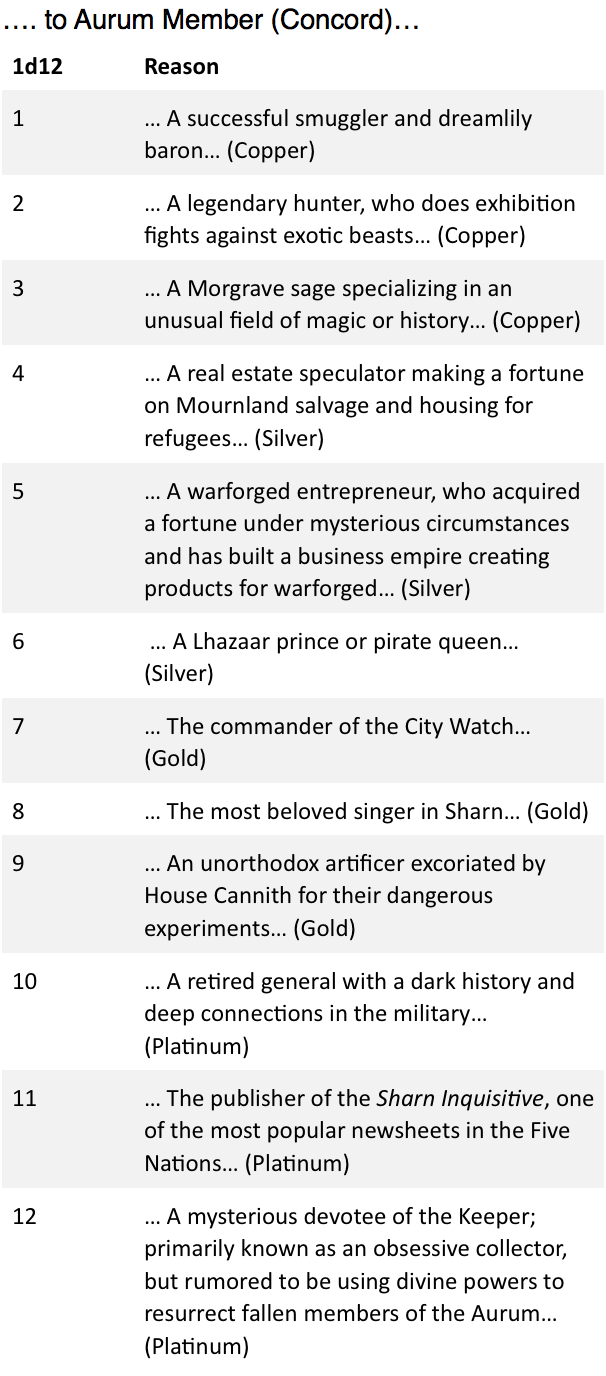
  • As an enemy. Need a powerful foe for the players… who’s not TOO powerful? An Aurum concordian has power and influence, but can be driven by entirely selfish or eccentric goals. They aren’t trying to conquer the world; they’re trying to drive down property values in High Walls so they can buy a block of tenements on the cheap. If an Aurum concordian wants the Orb of Dol Azur it probably ISN’T because they’ll use it to kill everyone in Sharn; it’s just that they need it to complete their collection. Kaspar Gutman, the “Fat Man” of The Maltese Falcon, would definitely be in the Aurum if he lived in Eberron.
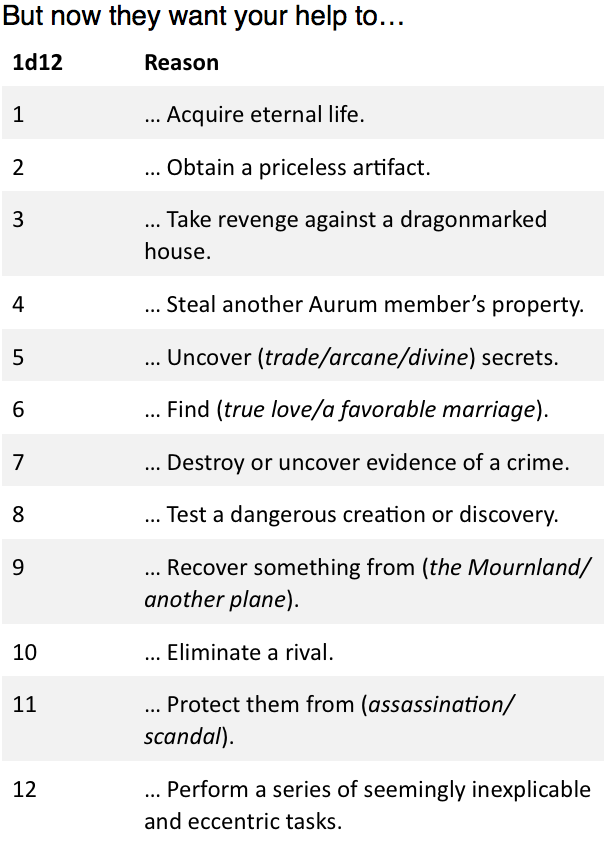
  • As an ally. All the things that make a concordian a useful enemy also make them good patrons for player characters. They have wealth, influence, and they’re generally not attached to any massive agenda; they’re driven either to increase their own wealth and influence, or simply to pursue their own interests. A concordian could be an eccentric collector seeking a rare artifact, an inventor who needs a priceless component only produced by House Cannith and reserved for the use of its heirs, or a ruthless criminal who’s going to draw the PCs into a web of intrigue. But again, they aren’t tied to any nation, any faith, or any vast and ancient force; they’re just people with money and things they want.
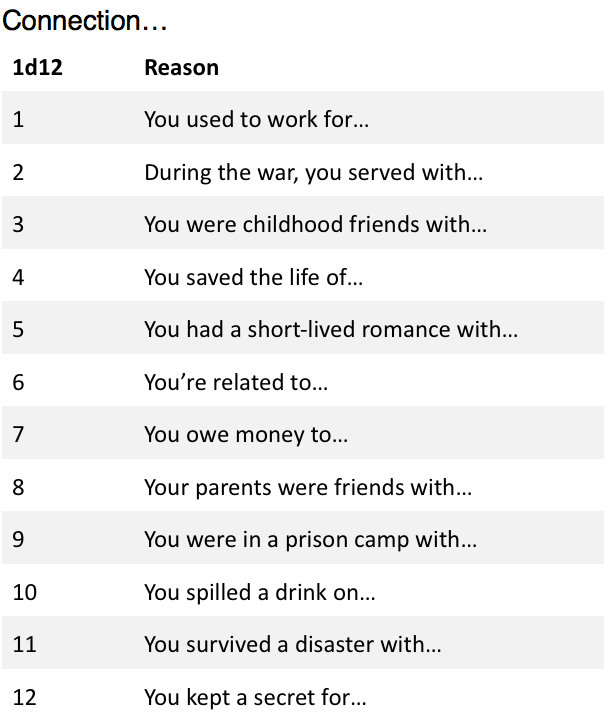
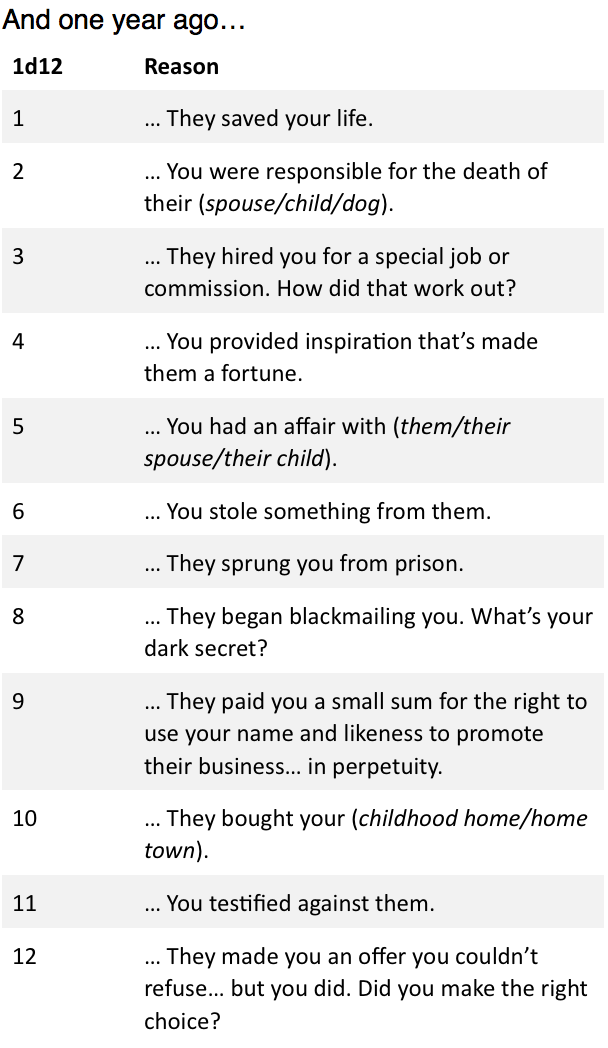
  • As an organization. An ambitious player character could be an aspiring member of the Aurum. Someone with the Criminal background could take the Aurum as their “criminal connection”—it’s not exactly a criminal organization, but it has criminal members and a great deal of shady influence. The Noble background couldreflect a character with a hereditary path into the Aurum… though again, Aurum membership must be earned. While members of the society will treat you with respect if you’re the child of a Platinum Concordian, and while that connection will get you past a lot of obstacles, you’ll have to prove yourself before you can wear the rings of a concordian.
  • The Shadow Cabinet. Part of the appeal of the Aurum is that it’s a society of individuals without a deep agenda. But what if there IS a group of shadowy masterminds pulling the strings from deep within, using the resources of its influential members to shatter the status quo? This storyline can be more compelling if players have already become entangled with the society in another way… if what appeared to be a club of eccentric and self-centered people are now revealed to be evil masterminds.

What’s my connection to the Aurum?

In the novel The City of Towers, the protagonist Daine has previously worked as a bodyguard for Alina Lorridan Lyrris, an Aurum concordian with great wealth and questionable morality. Daine doesn’t like or trust Alina, but when he and his companions are down on their luck, Alina is willing to offer them work. With the approval of the DM, any character could have a connection to an Aurum concordian. The first three tables establish a past connection to a member of the Aurum, while the DM can use the fourth table to determine the concordian’s current agenda.

Thanks as always to my Patreon backers, who keep this website going! And if you’re not up to date on Eberron in fifth edition, check out the Wayfinder’s Guide to Eberron and Curtain Call!

Q&A

What kind of economic sectors are not monopolized enough by Dragonmarked Houses (and the feudal nobility) to justify an Aurum concordian’s wealth?

First off, even within the fields monopolized by the houses, not everyone works directly for the house. Most people within a field are licensed by the house. They may receive training from the house; they pay a percentage to the house; they agree to meet house standards or follow certain practices (thus, standardized pricing for a longsword); and in exchange they can use the house seal. The Aurum includes many people whose businesses are licensed by a house. The most beloved singer in Sharn, from the list above, is surely licensed and booked by Phiarlan or Thuranni; but they aren’t necessarily an heir of the house, which means they will always be an outsider.

Beyond that, the house monopolies themselves aren’t absolute. Cannith dominates manufacturing, but they don’t control fashion or construction. Property management and real estate are options in places where the feudal monarchy has sold off land (which is certainly the case in parts of Breland and other nations). The houses have no role in the military, in religion, in crime, or in civic administration (examples of all those being given above). Anton Soldorak derives his wealth from mines, as do many concordians from the Mror Holds. Though by the principles of the Aurum, to rise to the upper concords you’d have to do more than inherit a mine; it’s Soldorak’s business accumen that turned those mines into an empire and founded the largest mint in Khorvaire.

So is the Shadow Cabinet a real thing, or not?

I think it is, but ultimately that’s up to each DM. The important thing is that even if it is real, most members of the Aurum itself don’t know about it. They may be tools of its schemes, and they might even support it if they did know about it, but it’s a secret society within a semi-secret society.

Druids in Eberron

A druid draws their power from Eberron. All natural life—from the druid, to the wolf, to the tree—is connected, all part of Eberron. The druid can use this connection to assume the form of other natural creatures, to manipulate the weather and other natural phenomena, to influence plants and animals.

With that said, what does it mean to be a druid? To most of the people in Eberron, the word “druid” conjures an image of mysterious sects conducting rituals in the deep wilds, of Ashbound avengers and Wardens of the Wood. Such druidic orders certainly exist, but a critical point is that not all of their members are druids.

In Eberron, the classes used by player characters reflect a remarkable degree of talent and potential. Most priests of the Silver Flame aren’t clerics or paladins. The same holds true with the members of druidic sects. Consider a few tiers of mystical talent.

  • Many of those who follow the Eldeen traditions are hunters, farmers, or initiates in the mysteries who have yet to unlock mystical powers. A hunter might be proficient in Survival and Stealth. An Initiate would likely be proficient with Survival and Nature, and perhaps Medicine, Insight, or Persuasion—useful skills for advising a community and helping to resolve disputes. These people are competent and devoted, but they don’t have all the talents of player characters.
  • Player characters and champions of a sect may have classes, but they won’t all be druids. Rangers play an important role in all of the Eldeen sects. Barbarians can be found in many of them, and there are Greensinger bards and warlocks. It’s a druidic tradition, but not restricted to druids.
  • Other NPCs fall between these two extremes. An initiate might know a few cantrips, spells, or rituals—druidcraft, speak with animals—without having the full scope of a true druid. You might meet an initiate with the Wild Shape ability… but who can only use it to assume a narrow range of shapes (local birds, for example).

So: you can follow one of the druidic traditions without having any levels in the druid class. Conversely, you can have druid as your class without being tied to any of these traditions.

What is the Druidic Language? 

What I’m suggesting here is that druids aren’t all bound by common traditions, and that you can take level in the druid character class without sharing any traditional druidic beliefs. But if that’s the case, what’s the Druidic language? How is it that a Talenta maskweaver and a shifter weretouched master—two people with absolutely no cultural overlap—somehow know this secret language unknown to the rest of the world? And furthermore, once it’s that widespread, why don’t MORE people know it? Shouldn’t rangers in the Wardens of the Wood learn to speak Druidic?

There’s two ways to approach this. One is to treat Druidic as a mundane language—exotic, certainly, but as a mundane language that anyone could learn. If I were to do this, I’d definitely make it available to anyone in an Eldeen sect regardless of class. But it still raises the question of why a Qaltiar drow druid in Xen’drik—someone whose culture has never had any contact with Khorvaire—would share a language with both the Talenta Maskweaver and the Warden of the Woods.

A second option is to say that Druidic is a fundamentally magical language. It’s not some sort of secret code: it is literally the language of Eberron. If you embrace this idea, you can extend this to say that the ability to perform druidic magic is integrally tied to knowledge of the Druidic language—that the two are one and the same. Think of Druidic as the source code of the natural world; when you perform a druid spell with verbal components, you are simply speaking in Druidic. Depending on YOUR beliefs, you might see this as petitioning the spirits for aid or you could see it as simply operating the “machinery” of nature. But the idea remains that the Druidic language is the tool used to perform magic. All druids understand it because mastering it is a fundamental part of what it means to be a druid. Even if you’re a hermit who learned your druidic abilities by listening to the wind, when you meet another druid you’ll find you both speak the same language—the language you learned from the wind. The idea here is that while Druidic can be considered to be a language for purposes of spells like comprehend languages—which is to say, magic can reveal its meaning—only someone who can cast spells from the druid spell list can fully learn the language.

With THAT in mind, I’d probably drop Druidic from some of my variant “druid-who’s-not-a-druid” ideas… allowing them to learn another language in its place. And I might allow another character (a Nature cleric casting themselves as a variant druid, a spellcasting ranger or Greensinger bard with spells that can be found on the druid spell list) to learn Druidic. Here again, the point isn’t that they learn it like any other language; it’s that knowledge of the language is an inherent part of their connection to druidic magic.

Druidic Traditions

The broad idea of druids as a servants of nature, tied to ancient traditions and serving as spiritual guides and protectors—can be seen across Khorvaire. It’s most obvious in the Eldeen Reaches, where every major community has a druidic advisor. The Gatekeeper tradition of the Shadow Marches is older still, and Gatekeeper initiates and wardens have been protecting Eberron from unnatural forces for thousands of years. Halfling druids guide the nomadic tribes of the Talenta Plains. The Tairnadal elves worship the spirits of the past, but there are warrior druids among their ranks; the Valenar capital of Taer Valaestas is protecting by a living wall of thorns.

How do these traditions map to 5E? If you’re a Warden of the Woods, should you take the Circle of the Land or Circle of the Moon? Personally, I prefer to avoid concrete restrictions. In particular, Land druids focus on spellcasting while Moon druids enhance their shapeshifting talents. To me, this can easily reflect the aptitude of an individual. Most Wardens of the Wood may be Land druids… but if your WotW shifter Wolf excels at shapeshifting and prefers to be in lupine form, I have no problem with her being a Moon druid and a Warden. In the descriptions below I suggest common classes, but there’s nothing to prevent you from making an uncommon character.

The Wardens of the Wood

Common Classes: Cleric (Nature), Druid (Land), Ranger (Hunter, Beast Master)

The Wardens of the Wood are the largest of the sects of the Eldeen Reaches, with thousands of active members. The primary purpose of the Wardens is to protect the innocent: which includes protecting the people of the region from the dangers of the wild, but simultaneously protecting the innocent creatures of wood and wild from dangers posed by civilization. The Wardens ensure that the dangers of the Towering Wood don’t spill out into the farmlands of the Eldeen Reaches, while also dealing with brigands and poachers. The Wardens work with the farmers of the Reaches, and every Eldeen village has a Warden advisor who helps ensure that the farmers are working with the land instead of harming it, and who seeks to peacefully resolve disputes within their village or with other communities.

The Wardens serve as the militia of the Eldeen Reaches. While they are the largest sect, most of their members are hunters or advisors. Among the druids, the Circle of Land is the most common path; however, druids with a knack for shapeshifting might take the Circle of the Moon, and those who guard the deep woods may follow the Circle of the Shepherd.

As a Warden, one question is why you’ve left your community behind. The Wardens act to protect the wild from the world and vice versa; how are your adventures advancing that goal?

The Ashbound

Common Classes: Barbarian (Beast Totem, Berserker, Storm Herald); Druid (Moon, Shepherd)

Where the Wardens of the Wood believe that nature and civilization must be kept in balance, the Ashbound believe that they are at war—and the Ashbound are the champions of nature. Ashbound seek to defend the natural world from the depredations of civilization. In frontier regions, this often involves guerilla strikes against encroaching settlements or making brutal examples of poachers. However, the Ashbound also see arcane magic as a dangerous and corrupting force. Ashbound have made strikes against the holdings of dragonmarked houses and released bound elementals, often causing chaos in the process.

Barbarians are common among the Ashbound. This doesn’t reflect savagery; it’s about drawing on the fury of the natural world, which may manifest through the Storm Herald archetype. Ashbound druids are warriors, and many follow the Moon Circle so they can fight with tooth and claw.

While the Ashbound believe that arcane magic is a corrupting force and that divine spellcasters are little better (clearly bargaining with alien forces that have no place in the natural world), it’s still possible to play a moderate Ashbound as a PC. You want to emphasize the reason you are out in the world—to stop the Mourning from spreading, to find allies to bring down the dragonmarked houses. If your party is serving this greater cause, you can overlook the actions of the party wizard—but you’d still want to encourage them to limit the use of unnatural magic, using it only when absolutely required.

The Children of Winter

Common Classes: Barbarian (Zealot), Druid (Spores, Twilight), Ranger (Gloom Stalker, Monster Slayer)

The Children of Winter see death, disease, and decay as part of the natural order. They believe that if the natural order is bent too far the world will retaliate with a terrible cleansing fury (the metaphorical “Winter” of their name)… and many in the sect believe that the Mourning is the first stage of that destruction. On the positive side, the Children of Winter despise undead as creatures that defy the cycle of life and death, and many of the are dedicated to hunting down and destroying undead. On the darker side, some believe that the benefits of civilization also defy the natural order, allowing the weak and infirm to survive when they’d never survive in the wilds. They see disease as an important tool that weeds out the weak and may spread disease in large cities or towns; but they may also push other situations that force conflict and ensure the survival of the fittest. However, not all Children approve of these methods. Likewise, some extremists among the Children believe that the apocalyptic Winter has already begun and should be welcomed, and that great cities should be torn down; while others fervently believe that the Mourning is a warning and that there is still time to stop this cataclysm. Such Children seek to contain contaminated regions, such as the Mournland and the Gloaming.

The Children of Winter are a small sect, but have a high percentage of elite individuals. They are comfortable in darkness, thus leading some to following the path of the Gloom Stalker ranger or the Twilight Druid. Monster Slayer rangers specialize in hunting down the undead. The Spore druid is a good match for the Children who embrace decay and disease, and its temporary ability to create a spore zombie (for one hour) is acceptable within the sect, but Children wouldn’t cast animate dead. 

As a Child of Winter PC, you are trying to protect the world from the coming apocalypse. You do this by fighting undead, by investigating the Mourning, and when possible by pushing situations that test the weak. You may  oppose extremists among the sect engaging in actions you believe are unjustified. While death is part of the natural cycle, you’re still able to heal your allies. You oppose using magical healing to sustain creatures who could never survive in the wild. But healing the fighter after he chooses to battle a pack of vampires—an unnatural situation he could have easily avoided—is entirely justified.

The Gatekeepers

Common Classes: Barbarian (Ancestral Guardian, Beast Totem); Druid (Land, Shepherd); Ranger (Horizon Walker, Monster Slayer)

The primary mission of the Gatekeepers is to protect the natural world from unnatural forces. They are best known for fighting aberrations, but they are equally concerned about fiends and other things that do not belong in the natural world.  The Gatekeepers have their roots in the Shadow Marches, and there are many in the Shadow Marches who support the “Old Ways”; but they have a presence across Khorvaire, often in the shadow of House Tharashk. Gatekeepers are constantly vigilant for extraplanar incursions, and also work to maintain existing seals that hold the Daelkyr in Khyber.

While Land and Shepherd are sound circles for Gatekeeper Druids, the Circle of the Moon is entirely appropriate for Gatekeepers who prefer to fight with tooth and claw. It’s believed that ancient Gatekeepers created the first horrid animals, and it’s thought that some Gatekeepers could assume horrid forms. The ranks of the Gatekeepers include passionate barbarians and more strategic rangers; the Horizon Walker is an especially appropriate path for Gatekeeper rangers.

As a Gatekeeper PC, are you simply keeping an eye out for trouble or do you have a particular task in hand? You might be pursuing a particular threat—a Cult of the Dragon Below, a Daelkyr agent. Or you could be protecting something: a location or an artifact that needs to be kept safe.

The Greensingers

Common Classes: Bard (Glamour); Druid (Dreams); Ranger (Horizon Walker); Warlock (Archfey)

The Greensingers believe that the magic of the fey compliments and enhances nature, and they encourage close ties between Thelanis and Eberron. They work to improve relations between mortals and the fey, teaching people how to safely interact with the fey and serving as ambassadors to the faerie realms. While the bards and druids draw the most attention, many Greensingers are simply people who learn the stories of the fey and follow their traditions, seeking to live in harmony with their fey neighbors.

Any path that touches the Fey has a place among the Greensingers. The Dream druid is the archetypal Greensinger, but their ranks include quite a few bards and a handful of warlocks. One critical point is that while the Greensingers are united by core principles, many Greensingers are aligned with a particular archfey—a patron who has ties to their region—and they may work to advance the specific agenda of their patron in the world. This can lead to feuds between Greensingers working for different archfey. This is expected and understood, though Greensingers will try not to kill rivals in the sect. This also leads to the image of Greensingers as a source of mischief and chaos; their actions are unpredictable, as they serve the agendas of different fey.

In creating a Greensinger druid, you should decide if you follow the general principles of the sect or if you have a tie to a specific archfey. If so, work with your DM to work out the story of your patron and the role they might play in the campaign.

Siyal Marrain

Common Classes: Cleric (Nature), Druid (Land, Shepherd)

The Siyal Marrain are the druids of the Tairnadal, descended from heroes who unleashed the force of nature against the giants of Xen’drik. The Siyal Marrain see nature as a tool and a weapon, and don’t have the same sort of devotion to the natural world found among the Eldeen sects. Members of this order care for and protect the famed horses of the Tairnadal; legends say that the first of these Valenar warhorses were druids trapped in wild shape by a giant’s curse, and that this is the source of their remarkable abilities. Aside from this, the Siyal Marrain are warriors who ride with warbands and use their powers in battle.

The Siyal Marrain revere their ancestors, just like other Tairnadal; their patron ancestors were druid heroes. With this in mind, when a Siyal Shepherd druid conjures their beast totem, it could actually manifest as an aspect of a Tairnadal hero as opposed to being a purely primal beast spirit. Meanwhile, a Nature cleric is a path for a Siyal who’s more focused on direct combat—relying on armor as opposed to shapeshifting. Rangers and other classes aren’t listed as the Siyal aren’t a broad tradition like the Eldeen sects; being one of the Siyal Marrain means being a primary spellcaster.

As with any Tairnadal elf, in creating a Siyal druid you should work with your DM to develop the story of your patron ancestor and to consider your relationship with Tairnadal culture. Why aren’t you serving with a warband or protecting the herds? Is your career as an adventurer driven by the actions of your ancestor?

Talenta Maskweavers

Common Classes: Druid (Dreams, Moon, Shepherd)

The halflings of the Talenta Plains believe that the world around them is filled with spirits—spirits of nature, spirits of their ancestors, and more. A number of details of this tradition can be found in this article. A maskweaver guides their tribe and serves as an intermediary for the spirits: part medium, part ambassador. They help warriors forge bonds to their mounts, and as the name implies, they help to create the masks that serve as important tools when dealing with the spirits.

Like the Greensingers, the Talenta druids often deal with the fey. Unlike their Eldeen counterparts, the maskweavers see no distinction between fey, purely natural spirits, or the ghosts of their ancestors. As far as the druid is concerned, all of these things are part of the spirit world, and all should be treated with respect. Talenta druids may also show respect for the Sovereigns Balinor and Arawai; however, they generally assert that these Sovereigns were Talenta heroes—that Balinor was a legendary hunter—and revere them in the same way as the other spirits.

The three common classes described above reflect different paths. The Moon druid focuses on working with dinosaurs, and excels at assuming dinosaur shapes. The Shepherd deals first and foremost with natural and ancestral spirits. Generally their totems reflect common beasts of the Plains: the Bear is the Hammertail (ankylosaurus), the Eagle is the Glidewing (pteranodon), and the Wolf is the Clawfoot Raptor. However, a druid devoted to heroes of the past—or Arawai and Balinor—could conjure spectral traces of those heroes as their totems. Meanwhile, the Dreams druid focuses on the fey spirits and manifest zones. This is specifically a druidic tradition (though it could apply to a Nature cleric). There are many barbarians and rangers in the Plains, and a few Archfey warlocks; while these champions may respect the spirits, only the druids perform the duties of the maskweavers.

Druids That Aren’t Druids

Mechanically, a druid is primarily defined by spellcasting abilities, limited armor, and Wild Shape. Here’s a few quick ideas for characters that use the druid class withoutbeing spiritual devotees of nature.

Changeling Menagerie

Normally, a changeling can only assume humanoid forms. But a changeling who devotes themselves to the art of shapeshifting can transcend this limitation, mastering the ability to assume a wide array of shapes. At its core, a menagerie is a Moon druid focused on their shapeshifting powers.

You could play this as a character in touch with primal forces, in which case you could speak Druidic and cast any spells on the druid list. however, if you want to play the character as a master-of-shapes without delving into the primal connection, you could swap Druidic for a standard language and focus on spells that fit either shapeshifting abilities or changeling powers. Barkskin, darkvisionjump, longstrider, meld into stonepoison spray, resistance, and similar spells could all tie to shapeshifting mastery. Charm person, guidance, hold person, and the like could reflect enhanced psychic abilities. And healing spells, enhance abilityprotection from energy and such could reflect an ability to alter the forms of others; I could see cure wounds being a sort of disturbing thing where you touch someone and scar over their wounds using your own body tissue.

Vadalis Monarch

The Mark of Handling gives a character a mystical connection to the natural world. But this gift isn’t something the heir earns; it is their birthright. A Vadalis heir could present druidic magic as a symptom of their dominion over nature. The same connection that lets you influence the behavior of animals could allow you to assume their forms… or even to control a wider range of creatures with charm person and hold person.

A Vadalis monarch could function as a normal druid and could even potentially understand Druidic, but I’d play up the flavor that this is a power of your mark and something you demand as opposed to a petition to spirits or natural forces.

Weretouched Master

Shifters are well suited to primal paths and to being traditional druids or rangers, and shifters can be found in most of the Eldeen sects. However, you could play a shifter druid as an expert in shapeshifting as opposed to being a servant of nature. As with the changeling menagerie, I’d make this a Moon druid and encourage spells that reflect control of shape. A shifter might not take charm person or hold person, but even without druidic faith, speak with animals, animal friendship, and similar spells could be justified as being a manifestation of the shifter’s lycanthropic heritage.

These are just a few ideas, but hopefully you understand the concept! If you have questions post them below. As always, thank you to my Patreon supporters, who make it possible for me to spend time on this site.

Q&A

What exactly is the difference between a Nature cleric and a druid? Does a follower of the Sovereign Host have to be a cleric? Could I play a Warden of the Woods as a Nature cleric? 

Well, let’s look at the concrete mechanical differences between the two.

  • A Nature cleric can wear any sort of armor, including heavy armor. A druid isn’t proficient with heavy armor, and the PHB states that “druids will not wear armor or use shields made of metal.”
  • Wild Shape is an important element of the druid. A Nature cleric doesn’t shapeshift.
  • A Nature cleric has a different selection of combat spells. Sacred flame has a better range than any druid cantrip, and guiding bolt is a strong, long range attack; by contrast, the druid can unleash a thunderwave or lash enemies with a thorn whip.
  • Generally speaking, the druid is more of a close range combatant. As noted above, most of their battle magic is relatively close range, and Wild Shape generally drives them towards melee combat.
  • A Nature cleric doesn’t know Druidic.

It’s certainly simple to say that as a general rule, priests of the Sovereign Host are clerics and spellcasters in the Eldeen Reaches are druids. However, I always believe in putting story first. If someone wants to play a priest of Balinor who excels at assuming the forms of wild beasts, I see no reason not to make that character a druid. Likewise, if someone wants to be a Warden of the Wood but doesnt’ want to deal with shapechaning, I’m fine with making them a Nature Cleric. The main issue to me is Druidic. If I feel the character IS essentially a druid from the story side, I’d let them swap out one of their current languages for druidic. On the other hand, I’m fine with the idea that the typical priest of Arawai doesn’t speak Druidic. Per my idea above, Druidic is something you learn as part of directly engaging with the natural world… while a typical Sovereign priest reaches out to a deity, not to the world itself.

In my Q’barra campaign, I had a player who really liked the idea of being a Greensinger druid, but who had no interest in shapeshifting and preferred being able to use long-ranged magic in combat. So we made her character a Nature cleric instead of a druid. I allowed her to swap a language for Druidic. Beyond this: She had heavy armor proficiency, but wearing heavy armor really didn’t fit the image of the character. We agreed that she had received a gift from her Archfey patron: mystical tattoos across her body. She had an amulet, and when she wore the amulet the tattoos hardened her skin and protected her… essentially, barkskin. While active, the tattoos shimmered and glowed slightly—not providing useful illumination, but giving her disadvantage on Stealth checks (just like wearing heavy armor). The net result of this was to give her the AC that her class proficiencies allowed, while still having limitations (Stealth penalty, obvious to observers, it could be “removed” by taking away the amulet). Now, YOUR DM might not be willing to go that far, and that’s entirely reasonable. I’m a fan of this sort of reskinning to fit an interesting story—but it does add complexity and potentially balance questions, and it’s always up to each DM to decide what they’re comfortable with.

Why use the existing archetypes instead of making new archetypes for the Eldeen sects? 

The Eberron IP belongs to Wizards of the Coast, and legally you can’t post new Eberron material. So I’m looking at the best match within existing material. The Horizon Walker ranger is a solid option for a Gatekeeper, and the Twilight druid is a good match for the Children of Winter. If Eberron is unlocked for 5E I might explore archetypes that are more directly tied to the concepts of a particular tradition, but it’s currently not an option.

The Raven Queen in Eberron

The Raven Queen is trapped by her fascination with the past. She sits in her fortress, amidst all the memories of the world, looking at the ones that please her the most as though they were glittering jewels. 

—From Mordenkainen’s Tome of Foes

The Raven Queen was introduced in 4th edition Dungeons&Dragons. In her original form she’s a mortal who attained godhood after death. She’s the goddess of death, but specifically she’s a psychopomp—her role is to safeguard the soul’s passage to its final destination. She is also presented as a goddess of fate and winter. Her tenets include the idea that death is the natural end of life and that her followers should bring down the proud who cast off the chains of fate. So: She’s a shadowy goddess of death, but presented in a positive light—and specifically being opposed to Orcus and the undead. She’s also presented as being able to spare worthy mortals from death if they will perform services for her.

Mordenkainen’s Tome of Foes brings her to 5th edition, and in the process changes up her story. In 5th edition, she was originally an elf queen, a contemporary of Lolth and Corellon. She sought to attain godhood and in the process was pulled into the Shadowfell with her followers. She became an “entity composed of symbols, images, and perceptions.” She sustains herself by drawing on mortal memories, and thus created her Fortress of Memories. Those who go to her realm are “transported to a strange fairy tale world pulled from their experiences, filled with metaphors, parables, and allegories.” People might seek her out to free themselves from a dark past; to learn the secrets of the dead; or to find answers that only she possesses.

In both incarnations, she is served by the shadar-kai. In 5th edition, these servants are immortal; if they die, she will cloak them in new bodies to return to her service. She sends them out to uncover secrets or memories the Queen wishes to acquire.

So: we have a goddess of natural death who despises undead and seeks to safeguard soles and the natural course of fate. We have an Elven keeper of secrets who collects tragic memories. Both dwell in the Shadowfell, have shadowy servants, and may deal with mortals. How does this translate to Eberron?

Lest it go without saying, Eberron doesn’t have incarnate gods. So we know one thing she’s NOT, and that’s a god. She is a powerful extraplanar entity who can serve as a patron for warlocks. Perhaps it’s even possible for a cleric or paladin to gain power in her service, but if so, the power isn’t coming from her directly; it’s power gained in service to her ideals.

There’s a lot of different ways you could go with this. Here’s a few quick takes.

THELANIS. The archfey of Thelanis embody epic faerie tales, and that’s explicitly what the 5E version of the Raven Queen is: a fairy tale about a queen who sought power, was consumed by shadows, and now feeds on tragedy. It’s a simple matter to take her exactly as presented in MToF and simply place her Fortress of Memories in a shadowy layer of Thelanis. In this case, the shadar-kai are essentially immortal fey spirits temporarily housed in mortal forms to play their role in her story. She continues to seek memories and tragedy because that’s her story; it’s simply the case that when you deal with her, you want to think of her as a character in a faerie tale, to bear in mind that her goals and the logic driving her actions aren’t the same as those of mortals. If you want to follow this path, I’d check out my post on Thelanis. Note that this doesn’t incorporate any of the “Goddess of Death” aspect.

MABAR. In my article on Mabar I discuss the idea that realms are consumed by the Endless Night. The MToF story of the Raven Queen fits that idea well; it’s a tale of a mighty queen who seeks godhood and is consumed by her hubris, dragging herself and her followers into shadows from where she continues to feed on tragedy. You could certainly make the Raven Queen the ruler of a domain within Mabar. However, if this is the case, it would definitely play to presenting her as a more sinister and dangerous figure as opposed to being a possible ally or patron.

DOLURRH. The basic principle of Dolurrh is that it draws in the spirits of the dead and consumes their memories, leaving behind only forlorn shades. Most of the major religions assert that this is a side effect: that the memories aren’t being LOST, but rather they’re transitioning to a higher form of existence… either bonding with the Silver Flame or reaching the realm of the Sovereigns. Nonetheless, memories are lost. You could combine the two approaches and say that the Raven Queen is a powerful being who dwells in Dolurrh and saves the memories of the dead from being lost. This plays to the idea of people seeking her out to learn long-lost secrets from the memories of the dead. It also fits with the idea that she could restore ancient champions to life—that she preserves their spirits from the dissolution of Dolurrh so they can potentially be restored at a future time. This also fits with the idea that she could offer resurrection to a dead player character in exchange for their services in the mortal world, or that her shadar-kai are spirits restored to mortal bodies. In my mind, this is the best way to combine the two versions of her: she is a powerful entity who works to preserve the natural order of Dolurrh, encourages the natural cycle of death and despises undead, yet who also preserves the memories of the dead and could grant resurrection.

THE CHILDREN OF WINTER. If you work with the idea that “death is the natural end of life,” the Raven Queen could be the patron of the Children of Winter. This likely works best if she’s tied to Dolurrh, but it could work with any option. This would justify mixing a few warlocks among the druids and rangers.

ELVEN ORIGINS. Playing off the idea that she is connected to the history of the elves; that she hates those who defy fate; and that she collects memories, there’s another interesting path you could take: she could oppose the elves of Aerenal and Valenar. The elves seek to preserve their greatest souls from being lost to Dolurrh. The Raven Queen could seek the downfall of Tairnadal champions in order to claim the spirits of the patron ancestors they are sustaining; she could also oppose the Undying Court and its agents.

GUARDIAN OF FATE. In Eberron, fate is determined by the Draconic Prophecy. One option is to say that the Raven Queen knows the path the Prophecy is supposed to follow. When forces on Eberron—the Lords of Dust, the Chamber, the Undying Court—seek to change that path, the Raven Queen seeks to set things right, either using shadar-kai or pushing player characters onto the right path.

All of these are valid options, and you can mix and match them: She rules a layer of Mabar, but she was once an elf queen and seeks to destroy the Undying Court. She’s a power in Dolurrh and served by the Children of Winter. But there’s a final option that’s MY personal favorite, as it brings a number of different ideas together: tragic Elven backstory, mortal who’s become a godlike being, guardian of the natural cycle of death, mysterious motives and ties to fate, specific tie to Eberron. And that’s ERANDIS VOL.

THE ONCE AND FUTURE QUEEN OF DEATH

Erandis Vol was the product of experiments conducted by dragons and elves, experiments designed to produce a godlike being with power over death. But she was killed before she could unlock the powers of her apex dragonmark. She was brought back as a lich, but as an undead being she can’t access the power of her dragonmark and achieve her destiny. Her phylactery is hidden even from her; she can’t truly die, even if she wants to. For thousands of years she has tried to achieve her destiny. She’s done terrible things in pursuit of this goal. She raised ann army of undead champions and fanatics. Perhaps she’s gone mad. But at the heart, she’s trying to achieve her destiny: to become the Queen of Death.

One option is to say that there IS no Raven Queen… yet. Erandis is trying to BECOME the Raven Queen. But if it was me? I’d push things one level further. I’d use the Dolurrh version of the Raven Queen: the enigmatic spirit who preserves the experiences of the dead in her Fortress of Memories, who has the ability to catch the spirits of the dead and restore them if they serve her. This Raven Queen can be a mysterious ally for the PCs. She despises undead and those who seek to cheat and manipulate fate. She can point the PCs in directions that bring them into conflict with the Emerald Claw. And yet, even if they fight the Emerald Claw, these battles might also push Erandis towards her goals. On the surface, it seems like the Raven Queen and Erandis are the bitterest enemies, opposed in every way. But in fact, Erandis IS the Raven Queen… or will be. The process of ascension isn’t a simply thing; it transcends our normal understanding of time and reality. The Raven Queen has dwelt in her Fortress of Memories for eons: but at the same time, she is Erandis, and she still has to ascend. So the ascended Erandis despised the actions of the lich and helps those who oppose her; and yet, she also has to ensure that the ascension takes place.

Simple, right? And you can easily add the Raven Queen hating the Undying Court into that mix: not only do they defy the natural order of life and death, they also killed her family and HER, back when she was mortal.

So: there’s my thoughts on the Raven Queen in Eberron. Any questions?

As always, thanks to my Patreon supporters: I couldn’t keep doing this without you!

Q&A

How do you see Raven Queen cultists as behaving in Eberron?

Have you met the Children of Winter? Seriously, though: it depends on how you interpret her. If you embrace the 4E direction, she’s about sustaining the natural cycle of life and death and enforcing fate, and as such being strongly opposed to the undead. You could easily play up these aspects of the Children of Winter. Currently they focus on how the tools of civilization interfere with the natural cycle, but they are presented as despising undead and you could choose to play this up. As suggested above, I’d see Raven cultists as being opposed to the Elven faiths and anyone seeking to shift the direction of the Draconic Prophecy. Beyond that—and with whichever version of the Queen that you use—as she is a powerful outsider as opposed to an abstract god, she can give concrete directives to cultist, whether that’s digging up a secret, killing someone who’s escaped their fate, or what have you.

With the Raven Queen’s emphasis on death being the natural and fated end, how might you see her interactions with maruts? Would she pluck them from Daanvi to guard her fortress of memories or deploy them against those who would cheat death?

Per the 3.5 ECS, maruts are normally found in Dolurrh. Personally I see Dolurrh as being very mechanical in nature (philosophically, not necessarily visually). The process of drawing souls in and processing them isn’t done by hand; normally you don’t get some sort of cosmic judge reviewing your actions, it’s just “Souls come in, rinse, repeat.” I see maruts as being part of that machine—in essence, the antibodies of Dolurrh. If you come in and try to drag a soul out, you’ll have to deal with maruts. And as I called out in City of Stormreach, any time you use resurrection to return someone who isn’t fated to return, there’s a chance you’ll draw the attention of a marut; which is why Jorasco will generally perform an augury before they’ll do a resurrection.

With this in mind, I’d personally say that the Raven Queen DOESN’T employ maruts. I prefer to say that she is living IN the machine, grabbing memories before they’re lost forever, but she’s not actually OPERATING the machine. Largely this is because I prefer her to have to work through mortal agents—be they temporarily mortal shadar-kai, Children of Winter, or player characters—than to have an army of maruts at her disposal.

If one were to utilize the Crucible from Phoenix (specifically the Dhakaani Phoenix strike force version) in Eberron as well, how might the Raven Queen tie in to the Crucible?

If you’re adapting Phoenix to Eberron, you could certainly present the Raven Queen as being the force that created the Crucibles — saving spirits from the dissolution of Dolurrh so they can return as champions. In a sense, this mirrors the 5E concept of the shadar-kai, with the added ideas that power grows with each reincarnation and that they only get seven lives. The main question is how the Phoenixes interact with the Raven Queen. Traditionally, the only being a Phoenix interacts with in the Crucible is their mentor, the spirit of a prior Phoenix of their school. If you chose, you could say that ever mentor is in fact an aspect of the Raven Queen herself.

In Phoenix itself, you don’t have elves or gods. Personally, I’d make the Raven Queen one of the Fallen Folk — a Faeda spirit created to preserve the memories of the dead. Over the ages, she’s built her fortress of memories in the Deep Dusk, and could be a source of information or guidance for Phoenixes.

Shavarath and the Blood War

An icy storm swirls around the Fortress of Frozen Tears. The bitter winds are mirrored by the flurry of activity on the ground. Overseers crack blazing whips, driving the hordes of lemures as they haul siege towers carved from glacial ice. Gelugons perform gruesome sacrifices, harnessing power for the horrific war magics they will soon unleash. The Fortress of Frozen Tears has withstood all enemies for a thousand years. Tonight it will fall into the hands of the Legion of the Long Winter. And tomorrow the Battalion of the Coming Dawn will arrive, beginning a siege that could last for centuries. 

Mordenkainen’s Tome of Foes (MToF) explores the Blood War, the conflict between devils and demons that plays an important role in the default planescape of Dungeons&Dragons. If it’s in D&D, there’s a place for it in Eberron… so how does the Blood War fit into Eberron?

One obvious answer would seem to be Shavarath, the plane of war. This was essentially the approach that was suggested in the 4E version of Eberron, where Shavarath was presented as a battleground between forces coming from other planes. But it’s not the approach I’d take. As I’ve discussed in other articles—such as my articles on Mabar and the Planes of Hope and Peace—I see the planes as being both iconic and self-contained. Shavarath isn’t *A* war. It embodies the IDEA of war, in all its many aspects. It began at the dawn of time and it will continue as long as reality exists. The beings that fight in it may have the statistics of devils and demons, angels and archons, but they are first and foremost incarnations of war. A Shavaran archon embodies courage, hope, war fought for a just cause and carried out nobly. A Shavaran devil embodies tyranny, cruelty, war fought to conquer and enslave. The lesser spirits of the war fight because they literally can’t conceive of any other existence; they exist as symbols as much as anything else. If you ask them why they are fighting—what point there is to a war that has continued for tens and thousands of years, in which there is clearly no hope of permanent victory—they will tell you that their war is reflected across all realities. They believe that the balance of justice and tyranny, hope and despair, honor and treachery—all of these things are shaped by their battle. If the Long Winter seizes the Fortress of Frozen Tears, the balance of the universe will shift slightly towards tyranny. The celestial soldier knows they can never WIN the war; but they believe that simply by fighting and holding a line, they are maintaining a balance that must be maintained.

So as a general rule, the conflict of Shavarath doesn’t DIRECTLY affect the material plane. The generals aren’t recruiting mortals for the battle, any more than the fiends of Fernia are running around lighting fires in Eberron. It can affect a campaign when a manifest zone or coterminous period causes the endless war to spill into Eberron, when an unusual spirit does go rogue, when a party of adventurers are trapped in the Plane or have to go there to obtain a celestial weapon. But in my mind, it’s not the right match for the Blood War—where you want fiends actively harvesting souls or recruiting mortals, where you could have the possibility of a dramatic upset.

So… if not Shavarath, how would I adapt the Blood War to Eberron? Here’s three ideas.

THE LEGIONS OF KHYBER

In a previous article about the Ghaash’kala, I mention the idea that Khyber is comprised of layers of demiplanes.

The Demon Wastes are peppered with passages to Khyber… not simply the physical underworld, but a host of demiplanes and demonic realms. Fiends emerge from these paths to prey on the weak… and the Ghaash’kala venture into them to find what they need. The Maruk hunt balewolves in the Abyssal Forests of Khar, and wield weapons taken from the corpses of the demon foot soldiers of the Ironlands. 

In the past I’ve suggested that these demiplanes would be an excellent place to use archdevils and demon princes—beings weaker than the Overlords, but still mighty enough to rule a domain and command fiendish hordes. Notably, this was my suggestion for incorporating Demogorgon into Eberron in converting the Savage Tide adventure path. Here’s a piece of that conversion…

As spawn of Khyber, the demons of Eberron are not tied to any planar agenda, nor bound to the great war of Shavarath. Instead, they embody Khyber’s wrath and hatred of the world above. They seek to corrupt and destroy the children of Eberron.

And what of the Abyss? Again, it could be grafted onto Shavarath, with each layer being one more battlefield. But it can also be bound to Khyber. Eberron is a magical world, and it does not have to obey the laws of logic. An adventurer who ventures too far beneath the surface of Eberron will be amazed by the horrors that lurk below. A deep cavern can open into the endless maze of Baphomet. A whirlpool can draw unwary travelers into the abyssal ocean. Many people think Xen’drik is the ultimate destination for the pulp adventurer. But the most exotic and terrifying realms are not across the water; they lie beneath it, in the very heart of the Dragon Below. While these are not outer planes, they exist beyond normal space and cannot be reached by normal forms of teleportation; travelers must either find the proper path between the realms or employ planar magic to step into these demiplanes.

So: the Blood War could exist exactly as presented, fought between demon and devil… but fought within Khyber itself. The River Styx is a portal that connects these demiplanes. Just as the Silver Flame holds the Overlords at bay, it prevents this evil from spilling out into the world en masse. It could be that it’s always been possible for a few of the fiends to venture out and seek aid among the mortal world, but if it was ME, I’d say that this is a recent thing—that the Mourning fundamentally shook up the mystical balance of the world, and it is only in the last four years that these fiends have been able to send agents into Eberron. The advantage this has is that they aren’t simply continuing to do what they’ve been doing for tens of thousands of years: this is both a new opportunity for the fiends and a new threat to Eberron. The fiends themselves are still figuring out what they can do with mortals and mortal souls. This is a new threat that’s not recorded in the Library of Korranberg, one even the Chamber knows little about. The greatest experts would likely be the Ghaash’kala, who have encountered the Blood War in their expeditions into Khyber. This allows the goals of the fiends to be mysterious and the player characters to be on the tipping point of figuring things out… and to have it be something that ALL the powers of Eberron are concerned about.

STRANGERS ON A PLANE

A twist on this is to have the Blood War be the same Blood War encountered elsewhere, but to have it only just spilling into Eberron. The cosmology of Eberron is self-contained, with the planes surrounding the material in its own corner of the Astral. One possibility is that the Progenitors intentionally created Eberron in isolation from the rest of the multiverse; it could even be that the Ring of Siberys actively blocks contact to or from other realities. If this is the case, this protection could finally be fading… allowing forces from the broader multiverse to touch Eberron.

This keeps the same basic concept as mentioned above: the idea of the Blood War being an entirely new threat that the powers of Eberron know little about. It’s primarily useful if you WANT to have traffic between Eberron and other settings; now there’s a path, but it’s an extremely dangerous one. It’s not the route I’d personally take, but it could be interesting.

THE MOURNLAND

What if the Blood War was being fought in the Mournland? This could be a variation of either of the two previous ideas; the Mourning could have opened a breach into Khyber, causing the conflict to spill into the world in the Mournland. On the other hand, this could be an opportunity to dramatically reduce the SCALE of the Blood War, but have it be a new and ongoing thing. The demons and devils were literally brought into existence with the Mourning; they might even be formed from the souls of humans caught in the Mourning and transformed. If this is the case, the archfiends could themselves have once been mortals, possibly generals from the Last War itself. What if Zuggtmoy was the horribly transformed Queen Dannel of Cyre?

Q&A

If we do the “strangers on a plane” route, how would you approach the planes of Eberron? As the actual moons, or related to them in a specific way? Demiplanes made by the progenitors?

There’s definitely a relationship between the moons and the planes, but I personally wouldn’t say that the moons ARE the planes. With that said, let’s take a quick look at the original  Eberron Campaign Setting and what it says about cosmology.

Eberron spins within its own Material Plane, enfolded by three coexistent transitive planes: the Astral Plane, the Ethereal Plane, and the Plane of Shadow, just as in the core D&D cosmology (see Chapter 5 of the Dungeon Master’s Guide). Within Eberron’s Astral Plane, thirteen planes revolve in a complex orbit around the Material Plane. These planes are a combination of features of Inner Planes and Outer Planes…

I see Eberron as its own pocket of creation. Each plane is an isolated concept; a layer of reality embodying a particular idea. The material plane is the nexus where all these come together: a place of life and death, war and peace, light and darkness. I see “orbit” as a metaphorical concept, reflecting the fact that the planes move into and out of alignment with the material. I’ve never actually played Spelljammer, so I don’t know how this concept meshes there, but to me, think of Eberron as a galaxy surrounded by a vast void, but in this case the void is astral. If you can find a way across that vast void, perhaps you can find another galaxy. PERSONALLY, I’m not interested in mixing settings; but from the very beginning it was suggested that the way to do it would be to slip through the Plane of Shadow.

I would also say that Eberron’s equivalent of the blood war was it’s creation, Siberys and Khyber’s fight, whether allegory or literal.

It’s an interesting approach, but in my opinion it doesn’t really fit the Blood War… at least following the classical mythology. Part of the point of the Blood War—and a reason I don’t map it to Shavarath—is that it’s specifically a conflict of evil fighting evil. As decent people we don’t identify with EITHER side. If you make it a fight between good and evil, heroes have a reason to WANT to take part; as is, it’s just a bloody mess of a war between two equally unpleasant factions. Beyond that, looking to the metaphorical conflict of the Progenitors, the fight between Khyber and Siberys is OVER, and Siberys lost. The conflict between Eberron and Khyber continues, but it’s a passive struggle: Eberron can’t defeat Khyber, but Khyber can’t escape from Eberron.

I’m not very familiar with the concept of Blood War… but couldn’t the Mourning be caused by the Blood War itself?

If you WANT it to be, sure. You could say that some sort of dramatic action in the Blood War caused it to spill out into Cyre and triggered the Mourning. Personally, I prefer to have the Mourning be in some way related to the Last War—whether directly caused by it, or the result of Cannith testing weapons, or others tampering with dangerous forces to try to create an edge—than to say that it just randomly happened to occur while the war was going on. But it’s certainly an approach you could take if you wanted.

Some planes have a deep impact on eberron. Some of the main villains come from outer plains: Xoriat, Khyber, Dal Quor. How would you use Shavarath if you want it to have a bigger impact on your campaign?

The main issue is that you need a REASON for the beings of the plane to take an interest in Eberron. The Quori interest is directly tied to their survival, due to the Turning of the Age. The Daelkyr are largely depicted as explorers and artists… and we’ve called out a number of times that they aren’t the most powered spirits of Xoriat, they’re simply the ones that have taken an interest in other realms. So you COULD have an expeditionary force from Shavarath conducting military operations in Eberron, but the question is why now? Why are they suddenly taking an interest when they never have before?

The most logical answer to the question is the event that defines the age: The Mourning. Whatever caused it, you could say that the Mourning caused some sort of tear between Eberron and Shavarath. Perhaps Shavarath is literally bleeding into Eberron and will continue to do so unless the Mourning is undone. While this could occur in the Mournland itself, it would be more dramatic if this “bleed” occurred in random places around Khorvaire. The Fortress of Frozen Tears is superimposed onto one of the towers of Sharn, and now a legion of devils are assaulting it; can the PCs find a way to break the alignment before everyone dies?

That’s just one idea, but really the possibilities are infinite. Pursuit of a deserter. Planar convergence. “We had to seize reality to save it.” I’d just want to know WHO is leading the incursion; WHY it’s happening now when it hasn’t happened before; and WHAT their objective is.

Can you share a small sample list of the names and titles of prominent demons, devils, and archons on Shavarath? Just like two or three of each?

Personally, I tend to focus on titles rather than names. Aside from the idea of names having power, the position is eternal even if the specific spirit that holds it changes. Title meanwhile we be a reflection of the aspect of war that the spirit embodies. Here’s a few entirely random ideas.

Archons: The Last Bastion, The Sword of Hope, The Pillar of Justice

Devils: The Fourth Dominion, The Bringer of Chains, The End of Hope

Demons: The First Terror, The Gray Butcher, The Bloody Tide

All of these would go along with a direct title. So a full name would be something like Malecarius, Bringer of Chains, First Lord of the Legion of Winter. Meanwhile, a rank and file soldier would be Fifth Spear, Third Cohort, Battalion of the Coming Dawn. 

How would you describe a typical landscape in Shavarath that does not involve archons, demons or devils in constant fight? Something that you could explore? Or, perhaps, you see Shavarath more as a contiguous landscape rather than a cluster of layers of reality?

Some of regions described in the Blood War section seem to map pretty well to various actual planes: Stygia/Risia, Phlegos/Fernia, Cania/Irian. What do you think about using those various sections as sections of those planes where relevant?

I’m answering these together because they are reflections of one another. As with the other planes, I don’t see Shavarath as a single contiguous landscape. I see it as being layers, each reflecting a different aspect of war and conflict. The environment that surrounds those conflicts can be extremely varied, because war is extremely varied. Look to the paragraph I wrote at the start of this article; it presents an icy tower buffeted by bitter winds. To me, this is an eternal reflection of a siege in a long winter, a battle in which the weather itself takes a toll on both sides. Which is to say that you don’t have to actually go to Risia to have a battlefield in Shavarath that is brutally cold. Essentially, the question to me is what the most defining aspect of the situation is. If this is a movie, is the focus of the movie on the ice and winter? If so, you might be in Risia. But if the focus is the SIEGE, and the ice and winter is something that adds flavor to this particular siege and differentiates it from a hundred others, then you’re in Shavarath; the fact that this is the endless winter siege is important, but still secondary.

In regards to what else is out there, in Shavarath everything is going to in some way be connected to a battle. It’s not that every square foot is occupied by fiends and celestials in direct conflict. But if you don’t have that direct conflict, you’re going to have a maze of trenches that lies between battlelines, or a vast field strewn with mangled corpses and the wreckage of siege machines, or fire pits where lemure slaves toil endlessly forging weapons. If the situation doesn’t involve an actual battle, it deals with the aftermath of one or the build-up of it. So what could you explore? You could be thrown into the trenches, trying to find your way out or find someone else lost somewhere in this maze. You could need something that’s in one of the many fortresses. You could come across a small village where people are pinned down by an arcane sniper. Essentially, if you can imagine a location as a scene in a war movie—regardless of whether there’s actively war—then it could be a place in Shavarath.

I’m going to stop here, but feel free to add your questions and thoughts about the Blood War and Shavarath below. Next week I’ll share my thoughts on the Raven Queen in Eberron. As always, thanks to my Patreon supporters, who make it possible for me to spend time on this blog!

Sorcerers and Manifestations of Magic!

Sorcerers carry a magical birthright conferred upon them by an exotic bloodline, some otherworldly influence, or exposure to unknown cosmic forces. One can’t study sorcery as one learns a language, any more than one can learn to live a legendary life. No one chooses sorcery; the power chooses the sorcerer.

— 5E Player’s Handbook

Wizards and artificers approach magic as a science. A warlock makes a bargain to gain arcane power. Magic is part of a sorcerer. It’s possible to inherit such power, but as the PHB suggests, it could just as easily be something entirely unique to the character. Later in this article I’ll discuss sorcerous origins tied to Eberron. But first, let’s consider what magic means for a sorcerer.

Manifestations of Magic

You’re a sorcerer. Your magic is a part of you. But it is still arcane magic… and at the end of the day, when you use that power you are still casting a spell. Unless you use the Subtle Spell metamagic feature, your sorcerer spells require all the same components—verbal, somatic, and material—as when a wizard casts that spell. In some ways this seems to clash with the whole idea of being a sorcerer. If your ability to cast a fireball comes from your draconic heritage, why do you still need to speak a word of power and throw a ball of bat guano to make it work?

One way to think about this is that arcane magic is a science… that as a sorcerer, the principles of magic come to you by instinct, but you ARE still casting a spell in the same way that a wizard is. But this doesn’t work with a lot of different character concepts. So let’s take a look at each of the different sorts of components and think about what they may mean for a sorcerer.

Verbal Components

Verbal components require the character to make a sound. Per the PHB a “particular combination of sounds, with specific pitch and resonance, sets the threads of magic in motion.” In my mind, a verbal component needs to be clearly connected to a casting oa spell: it can’t be something that could be mistaken for conversation. With that said, I feel that the exact form can vary from class to class and character to character. For example, I could see any of the following as being verbal components for a fireball.

  • A forceful phrase (“Consuming flames!”) in a variant of Abyssal or Draconic. The words feel hot in the ears of anyone who hears them. While this is in a language, it’s the thought behind it that triggers this searing effect; you don’t actually burn people or convey this power when casually speaking in Draconic.
  • A series of syllables that might feel like they’re based on Abyssal, Draconic, Giant, or Elvish (“Talash zash harkala!”), but that don’t form any actual words in those languages. This is the “machine code” of reality, triggering access to the forces the wizard channels in the rest of the spells.
  • An invocation of specific forces that will be channeled to power the spell. A divine caster might specifically call on an individual (“Dol Arrah, let your searing light lay my enemies low!”), while an arcane caster might invoke a power source, such as one of the eternal firepits of Fernia or the blade storms of Shavarath. On the other hand, a Warlock could specifically call on their patron by name.
  • A straightforward but clear description of the effect you are trying to create (“Let my fiery lash burn you to ash!”).
  • A bard might sing a song to cast a spell—but as with the first example, the song should feel clearly magical (unless Subtle Spell is used). As the words are spoken they might take shape in the air, or echo in the ears, or otherwise feel like there is a power behind them.
  • This would be a place to work in naming. Perhaps your sorcerer innately sees the true names of things, and you call out that name and an effect.

The point being: You could be syllables infused with arcane might to channel power into your spell. You could be naming powerful entities or cosmic forces whose power produces your effect. You could simply describe exactly what you want to have happen to your victims, essentially making a demand the universe will obey. But whatever it is, if you’re casting spells with verbal components, you’re producing sounds that are clearly tied to the magical effects you produce… so what are those sounds?

Somatic Components

Somatic components are gestures involved with the spell. Per the PHB, the most critical detail is that “the caster must have a free hand to perform these gestures.” Like verbal components, a requirement I apply is that it must be obvious that the hand gestures are tied to the spell. Someone watching you understands that there is a purpose to your gestures and that if they immobilized you, you would stop. So what forms can somatic gestures take?

  • As a wizard, you could follow the model of the recent Doctor Strange—tracing patterns of energy in the air, essentially drawing glyphs or writing out an arcane formula.
  • Taking away the lightshow, it can still be about precise hand and finger movements that trigger and focus mystical energy.
  • On the other hand, you could combine both these things without any finesse. You need a free hand and it needs to be clear that you’re using that hand to cast a spell. You could simply conjure a ball of fire that you physically throw at your enemy… or dramatically point at them, at which point the fireball emerges from your palm.
  • Another option is the Harry Potter approach: the wand. According to the PHB, the hand you use to access an arcane focus can be the same hand you use to perform somatic components. To me, this implies that my gestures could simply be some fancy wand-work. Again, the critical things are that it requires a hand and that it’s clear I’m using that hand to cast a spell.
  • If someone’s playing a warforged sorcerer, I’d be fine with them stating “Activate artillery mode” (verbal component) and turning their hand into a cannon (somatic component)—as long as it’s understood that they require freedom of movement to do this.

So again: the point is that you require a free hand and that it is obvious to an observer that you’re using that hand to produce a magical effect. But as long as those two conditions are met, you’ve got some room to move.

Material Components

Material components fall back into the realm of “If my sorcerer isn’t performing magic like a wizard, while do I still need a ball of bat guano to cast my spell?” Once again, it’s worth taking a moment to think about the impact of material components. Free material components—like the ball of guano—are primarily important because they can be taken away. If you’re trapped in a cell, whether you’re a sorcerer or a wizard, there’s an easy way for them to stop you from casting a fireball. Expensive material components—like the 100 gp pearl required to cast identify—prevent you from casting the spell casually, especially at low levels.

Starting with free components, it’s worth noting that you can ignore free components if you are holding a spellcasting focus (holy symbol, wand, rod, orb, etc) or if you have a component pouch. Personally, if these conditions are met, I’m entirely fine with a player either defining a unique arcane focus or changing what’s IN the component pouch. So looking at examples…

  • A component pouch is a great way to define a unified set of components that fit your presentation of magic. Perhaps you perform sympathetic magic, creating a model of your victim and the effect you’re producing. Maybe you have a set of crystals, and you combine the crystals in different ways for different effects (“Fireball? I’ll need a sliver of Fernian basalt amplified with the Irianic lens”). Perhaps you literally assemble a wand tied to the specific effect you want to produce. If you want to get weird about it, you could have a component pouch full of liquids… you assemble a one-use potion from the pouch, drink it (somatic component) and then belch out the spell effect (verbal component). As a warforged sorcerer, I could have a pouch filled with little mini-wands that I attach to my hand. The critical point here is that the component pouch is a set of tools: what do your tools look like?
  • A spellcasting focus needs to cost between 5-25 GP to replace. It needs to be something that is clearly associated with the spell when it is cast. It can’t be used for another purpose (IE it can’t be a useable weapon unless your class gives you that option) and it requires a free hand to use. But personally, as long as all those conditions are met, I’m fine with that being unique to the character. A few exotic ideas for a spellcasting focus…
    • The rune-engraved skull of an ancestor. This could be a wand carved from an ancestor’s bone, or something similar.
    • The polished horn of a beast—either something I hunted and killed, or a creature that was close to me. A Talenta caster could use the fang of a former dinosaur mount.
    • An exotic mask I hold in front of my face.
    • A strange machine I’ve assembled myself.

With any unique or exotic focus, there’s two critical questions. How can you replace it? If you lose your grandfather’s skull, how do you get a new one? Normally, a player can simply go to the store in a big city and buy a new focus, so the point to me is that I’d allow a player with time and money to replace a lost focus, regardless of the form. Perhaps you can perform a ritual that reconstitutes your grandfather’s skull—it’s just that the ritual takes components that cost 10 gp, the same cost as buying a wand. Second: can you perform magic using the standard components? Normally, a wizard can use a wand or component pouch to cast a fireball, but if they lose the focus, they can whip up a ball of bat guano. Can use use guano in an emergency?

The final topic is expensive components. Chromatic orb requires a diamond worth 50 gp. It doesn’t matter what kind of a caster you are, you need that diamond. Personally, the only thing I generally care about is the cost. I’m fine with the idea that chromatic orb requires a unique focus that costs 50 gp and is only used for this one spell, but I don’t personally care if it’s something that is likewise unique to the way your character performs magic. Likewise, in my Eberron, Eberron dragonshards can take the place of any expensive component. Whether it’s the 5,000 gp cost of resurrection or the 100 gp cost of identify, that amount of refined dragonshards will do the trick; this emphasizes the idea that dragonshards are the basic fuel of the magical economy. The only reason I’d restrict a spell to a concretely specific component is if I want to play up a particular region or individual as having a monopoly on that resource… if diamonds are consistently a thing, who has the diamonds? In Eberron, this is the role of Eberron dragonshards, which is why Q’barra and House Tharashk are important.

In Conclusion…

So putting all of this together, the question is: whether you’re a wizard or a sorcerer, what form does your magic take? Does your sorcerer have a magic musket with components they swap out (IE, exotic component pouch)? Do you carry around your grandfather’s skull (focus), hold it up (somatic) and ask it to produce magical effects (verbal)? Do you have henna tattoos (focus, as long as they can be removed) that you trace with a finger (somatic) while reciting words you learned in a dream (verbal)? If your power comes from exposure to the Mourning, do you wave (somatic) a piece of your house from Cyre (focus) while calling out the names of your friends who died (verbal)? You can have a unique style… but  you need to figure out how it meets the requirements of casting a spell.

Sorcerers in Eberron

So: this is an article about sorcerers, remember? While the previous section could apply to all sorts of casters, the point is to think about how your sorcerous origin is reflected in the way that you cast magic. With that said, I’m just going to dive in and look at some possible ways to justify sorcerers in Eberron.

Child of Khyber

Sorcerous Origin: Any

Aberrant dragonmarks are an unpredictable and dangerous form of dragonmark. For many centuries the aberrant marks that have been seen have been limited in power… but in the days of the War of the Mark, the Children of Khyber wielded marks that could destroy cities. You could justify your sorcerous powers as being tied to an aberrant dragonmark, with that mark growing in both size and power as your level increases.

Now: aberrant dragonmarks are specifically called out as being dangerous—channeling destructive or aggressive powers. This is your character, so this is a limitation you’re applying to yourself; but if you want to fit the IDEA of the mark, you should limit your spell selection to powers that fit this vision. You could play a divine soul as a character with an aberrant mark, but if so, you shouldn’t be using it to produce healing effects. One way to handle this is to suggest that you are essentially a crappy wizard or magewright who ALSO has an aberrant mark. So your one or two NON-aggressive spells are the spells you cast in a traditional arcane manner… and the aggressive spells are the ones tied to your mark. This also ties to the idea that an aberrant dragonmark is supposed to be a burden to its bearer, either mentally or physically. The mark could cause you pain every time you use it. It could be an effort for you to contain its power and to keep from accidentally hurting the people around you. It could whisper to you. None of these things have concrete mechanical effects; this is all about flavor and how you choose to present it. You are amazingly tough and focused and you overcome these things; but if it’s an aberrant mark, you want to keep the story idea that it is a burden.

Aberrant marks take many forms, as long as they are aggressive in nature. As a result, you could tie this to any sorcerous origin. If you justify your draconic bloodline with an aberrant mark, you aren’t ACTUALLY descended from a dragon… and the effects of your draconic bloodline could take other forms. Draconic bloodline provides you with high AC and resistance to a particular damage type. It could be that your mark actually acts as armor and absorbs the damage; the mark could even extend from your body in the form of wings. But it could also be that the mark is mutating your body in a disturbing way.

The secondary issue here is components. Your power is supposedly coming from your mark… and yet, you still need those components! One approach is to say that your mark extends to one of your hands, and you have to point that hand at the target to perform somatic components. For material components, you could use a “crystal” arcane focus—in your case, a Khyber dragonshard that amplifies the power of the mark. Which just leaves verbal components. Perhaps you shout arcane syllables that come to your mind unbidden. Perhaps you have to tell the mark what you want it to do. The critical point is it needs to be clear that you have to be able to speak, and that your words are tied to the effect.

Divine Soul

Sorcerous Origin: Divine Soul (duh)

A divine soul casts clerical magic as a sorcerer. What does that mean? Well, first of all, it doesn’t HAVE to be connected to a divine source. It could simply be that you have an aberrant dragonmark that produces traditionally clerical effects, or that you have an exceptional Mark of Healing; these are covered by my other suggestions.

But what if you DO have a connection to a divine power source? What does that mean? How does it work?

There’s a few paths I could see. First of all, the idea in Eberron is that we don’t know for certain that the gods exist. But we know that divine power sources exist. And people do have divine visions and such. So: as a divine soul, you have a connection to a divine power source. One option is that you’re hacking this power. You don’t BELIEVE in the religion; you’ve just figured out how to use arcane techniques to connect to the Undying Court or the Silver Flame and draw on its power. The power is unquestionably there, and it’s not like your using a bit of it will somehow drain the Silver Flame. Such a character could be a bit of a smug jerk—in your face, people of faith! The question would be how people OF that faith would feel about you. Your actions might not actually threaten to drain with Undying Court of its power, but that won’t stop the Deathguard from kicking your @$$ if they ever come across you.

A second path is that you have faith, you simply don’t know the rituals normally associated with it. You have connected to the Silver Flame in a weird and unique way, but you still understand what the Silver Flame is all about. You acknowledge it as the source of your power and invoke it in your verbal components, and you may use a holy symbol as your spellcasting focus. You’re NOT a cleric, but you are a person of faith.

A path that lies between these is that of the chosen one. You know nothing about the divine. You don’t know where your powers come from. And yet, you have visions that are driving you on your quest. The power has chosen YOU… but you don’t know why. Imagine your power comes from the Silver Flame. You don’t know this. You don’t believe in the Flame. But you have visions of yourself fighting supernatural evil. Perhaps a couatl whispers to you. Essentially, the Flame believes in YOU, and seems to have a purpose for you. Will you discover faith along the way? Or are you just a vessel? In this case, verbal and somatic components could be confused invocation (“Um, strange power, can you help my friend?”), or it could be that they come to you instinctively; you never know what you’re going to say when you open your mouth, but the words just come out.

Draconic Bloodline

Sorcerous Origin: Draconic Bloodline (duh)

So what if you WANT a draconic bloodline? There’s nothing wrong with that; dragons exist in Eberron and are a source of powerful magic. In standard Eberron, draconic bloodlines aren’t a defined thing. The primary magical bloodlines in the world are the Dragonmarked Houses. But there’s a few ways to do it. Perhaps you are part of a noble house that claims draconic heritage; I’d just be inclined to say that it’s very rare for a member of the family do develop powers beyond those of a first or second level sorcerer. Perhaps you’re a first generation draconic bloodline; which of your parents was a dragon, and what does it mean? Or perhaps you’re not LITERALLY descended from dragons, but rather the result of a Vadalis experiment that attempted to infuse humans with dragon’s blood. Are you the only success out of this program, or are there a number of dragon-blood super-soldiers out in the world? Are you working with House Vadalis, or are you a fugitive?

As a dragon-blooded sorcerer, you still run into the “What does my magic look like?” question. When you perform verbal components, do you instinctively speak draconic words of power? Or is it that the magic is in your blood, and you’ve jury-rigged some sort of spell system that lets you unleash it?

Dragonmarked

Sorcerous Origin: Divine Soul, Storm Sorcery, Shadow Magic

Along the same lines as an aberrant mark, if you’re of the proper race and bloodline to have a dragonmark, you can say that your unusually strong connection to your dragonmark is the source of your sorcerous abilities. Essentially, it’s clear that you have the potential to develop a Siberys Dragonmark, but rather than it manifesting all at once, it is emerging over time.  A halfling divine soul with healing abilities could attribute the power to the Mark of Healing; a Phiarlan or Thuranni elf could have access to shadow magic; a Lyrandar heir could be a storm sorcerer. Like the Child of Khyber, you’re entirely on the honor system to choose spells that make sense with your mark. Or, like I suggest for the Child of Khyber, you could present yourself as a minor wizard or general sorcerer who ALSO has a powerful mark—so the spells that don’t fit with your Dragonmark are tied to this secondary path. A Siberys dragonshard would be a logical spellcasting focus, but you could also have an object that incorporates a Siberys shard—a tool designed by your house to channel this sort of power.

Mad Artificer

Sorcerous Origin: Any

Like a wizard, an artificer approaches magic in a scientific manner. But what if they didn’t? What if they create magic items that should never actually work, yet somehow do? The point with this character would be to present all of their magic as coming from strange devices that they create. From a mechanical perspective, they’d have a component pouch—but that pouch would be filled with lint, shards of broken glass, and so on. Part of the concept—what differentiates this character from an actual artificer—is for their explanations of their magic to make no sense. “We just saw three doves in the sky. So if I pour the yoke of this dove egg on this magnifying lens, it will triple its ability to focus the light of the sun and create a deadly beam of heat. Simplicity itself!”

The mad artificer could follow any path, representing their “arcane field of study.” A draconic bloodline sorcerer who follows this path would “artifice” as an explanation for the benefits of the class. Their natural armor could be the result of mystical tattoos that channel a low-grade repulsion field; their dragon wings would be an Icarus-like set of artifical wings.  

Manifest Magic

Sorcerous Origin: Any

Manifest zones are places where the energies of the planes flow into Eberron. A character born in a manifest zone could justify their magical abilities as being based on an innate bond to that plane. A character with an innate connection to Mabar could possess shadow magic. Irian could grant the powers of a divine soul. Kythri or Thelanis could be a source of wild magic. As with other examples, you’d either need to voluntarily limit your magic to powers tied to your plane of choice, or come up with an explanation for where your other spells come from. Alternately, you could play a character who’s found a way to channel the energies of different planes—a form of the mad artificer, using spells that open up temporary portals to the planes you need. This would fit with the idea of verbal components calling out specific sources of extraplanar power, or material components tied to artifacts from the planes in question.

Mournborn

Sorcerous Origin: Any

In the City of Stormreach sourcebook we present a gang of people who survived the Mourning and emerged with strange arcane powers. While you could use this as the explanation for any sort of ability, it’s generally tied to the idea of disturbing abilities, not unlike the Child of Khyber. It could be that the Mourning is now a part of you, and you unleash its powers on your enemies. A Mourborn sorcerer with a “draconic bloodline” could be twisted into a monstrous shape. Or it could be that your magic has a secondary connection to the Mourning: you were the only survivor of your family, and now the spirits of those slain in the Mourning cling to you… demanding vengeance, but granting you the power you need to take that vengeance. This could be the sorcerer whose material focus is the bones of fallen friends, whose verbal components involve calling on them for aid.

Other

This is a deep as I can go in the time I have available, but there’s many other possibilities.

  • The warforged created as a “walking wand.”
  • A changeling who weaves glyphs and mystic sigils into their skin.
  • A Vadalis experiment, magebred to harness mystical power.
  • A creation of the daelkyr.
  • An Aundairian duelist who specializes in wandcraft

… and so on!

Q&A

I recall that in the Eberron setting dragons do not mingle freely with mortals. There’s the entire tragedy with Erandis Vol’s parents marking her status as a half dragon something unique. So how is draconic ancestry justified for a PC? Wouldn’t the dragons of Argonessen have hunted down their entire bloodline ages ago? 

The line of Vol wasn’t exterminated because of half-dragons; it was exterminated because Erandis Vol developed an apex Dragonmark, something that was likely only possible because she was a half-dragon.

The issue with dragons not mingling freely with normal races is because in a dragon you have a being that can live for thousands of years, who possesses tremendous physical and magical power and a civilization that is tens of thousands years old and has a deeper understanding of reality than most races… and then you have a human. Humans and other standard races are literally like housepets to dragons: The don’t live very long, they aren’t as smart as we are, it’s kind of cute when they act like they think they’re dragons. You might feel affection for one, but the idea of actually producing some sort of CHILD with one is simply bizarre. It’s not that the child has to be hunted down; it’s a question of WHO WOULD DO THAT? The only particularly logical reason is if it’s necessary to pursue a particular path of the Prophecy, or to achieve a specific end that absolutely requires it—both of which were the case with Erandis Vol.

So on the one hand, I suggest that you might have first-generation dragonic heritage; this would mean that you were created for a specific reason, and your draconic parent likely has an agenda involving you. On the other hand, I suggested that you might be part of a family that claims to have draconic heritage; odds are good that they’re mistaken. Either way, it definitely wouldn’t be a common thing, but neither is it something requiring immediate extermination.

Also, how common is it for celestials to mingle with humanoids in Eberron? Is it common (or at least, known to be possible) for a divine soul sorcerer to obtain their powers from celestial ancestry?

It depends what you mean by “mingle.” Celestials almost never casually interact with mortals. When they are encountered, it’s worth noting that immortals in Eberron don’t reproduce; there’s a finite number of them, and when one dies, the energy reforms to create a replacement. So if you’re suggesting that a celestial sires a child, it would be very unusual. On the other hand, what I suggested with aasimars is that the mortal is touched by or connected to an immortal. So the divine soul wouldn’t literally be the physical child of an immortal, but if there was a purpose for it, some celestial could have marked the child in the womb, or even worked magic to cause it to be born.  But again, such things are extremely rare.

Do you consider spells to be discrete things that can be recognized? Like if an Aberrant Marked Sorcerer uses Burning Hands and a classically trained wizard cast the same spell would trained observers know they were both using “Burning Hands as isolated by Bob the Pyromaniac in year 1082…” or would they just notice bursts of flame that are superficially similar?

It’s a little hard to say. I would allow an observer trained in Arcana an opportunity to identify the spell being cast (“That’s burning hands“). But no, they aren’t doing the same thing. If a divine soul tied to the Silver Flame casts burning hands, I’d probably make the flames silvery. If an Child of Khyber does it, they might actually project dragonmark-like tendrils of energy from their skin… even if I said those tendrils inflicted fire damage. Meanwhile, I’d personally allow a Storm Sorcerer to learn a version of burning hands that inflicts lightning damage instead of fire damage, but otherwise behaves the same. So the common spells are essentially benchmarks of common effects that can be produced with magical energy, and what the Arcana check ACTUALLY tells you is “They just generated a 15-foot cone of fire, inflicting a base of 3d6 damage.”

So it’s not that the spell is literally recognized because it’s the exact same spell; it’s that the trained observer can identify and evaluate the effects. With that said, an Arcana expert could potentially identify the technique—so “That’s burning hands, and they learned it from the Arcane Congress” or “That’s burning hands, but they’ve got no magical technique whatsoever; they’re just ripping open a portal to Fernia and spilling it out.”

To elaborate a little on my question about spells as discrete things, I meant along the lines of Burning Hands being like electron energy levels, a basic part of reality, or like steel, contingent convergences of simpler natural principles.

Good way to distinguish! To me it’s like steel. We recognize the end result, but they’re achieving it in different ways with a range of cosmetic effects.

Do you see Dragons, and other “natural sorcerers” as all being the same where their magic is concerned? At least along species lines.

If a species possesses natural sorcery—like 3.5 dragons, who universally gain sorcerer ability over time—then I usually depict that as taking the same form. So you wouldn’t have one dragon who’s a divine soul and another one with “draconic ancestry.” With that said, some 3.5 dragons have class levels in addition to their natural powers. And if you had another species with innate sorcerer levels I might present that in a different way.

What have YOU done with sorcerers or arcane components? If you have questions or ideas, share them below. As always, thanks to my Patreon backers, who make this website possible!

Dragonmarks: Halflings

Halflings have a variety of compelling roles in Eberron. At the same time, they are shrouded in mystery. Where did halflings come from? How do the subraces of Fifth Edition map to their roles in Eberron? Here’s my thoughts on the matter. As always, these are my personal thoughts, and may contradict canon sources; notably, my thoughts on subraces are certainly at odds with the Player’s Guide to Eberron.

WHAT’S A HALFLING?

In dealing with any nonhuman race, one of the first questions to ask is how are they different from humans? How is a halfling rogue fundamentally different from a human rogue? What does it mean to be a halfling?

At the end of the day, halflings are more like humans than most races. They don’t have darkvision. They don’t have inherent mystical abilities like the forest gnomes. They live slightly longer than humans—5E has them live to around 150 years—but that’s not such a dramatic difference that it’s going to shape a culture as it does for the elves. So on a basic, fundamental level, what does it mean to be a halfling and how might this affect you?

The first critical element is sizeHalflings are small. For a Talenta halfling in the Plains, this doesn’t have much impact; you’re the primary humanoid race of your region and what civilization exists is designed to accommodate you. But a halfling in the Five Nations is a small creature in a medium world. Even Ghallanda designs its inns to accommodate medium creatures, though they at least have furniture and a few rooms designed specifically for small creatures. But as a rule, everything around you is annoyingly oversized. While humans are rationally used to dealing with halflings and gnomes, on a subconscious level many are still likely to treat you as children or to dismiss you as a physical threat. How do you react to all these things? Is it a constant source of irritation? Is it something you embrace and use, taking advantage of the human tendency to underestimate you?

Next up is speedDue to their small size, halflings are literally slower than humans (25 ft walking speed). But they are quick, something reflected both by their high Dexterity and the Halfling Nimbleness ability that allows them to pass through the squares of larger creatures. Combine this with the Naturally Stealthy trait of the Lightfoot halfling—which as I note below, is my default halfling—and you have a creature with a natural ability to outmanuever and outwit their enemies. Halflings live in a world of clumsy giants. When it comes to battle, rather than matching strength to strength, halflings are naturally going to lean towards mobility and finesse. Looking to the Talenta Plains, this ties to the fact that they don’t forge heavy armor. Their warriors aren’t plate-armored fighters; they’re rogues, barbarians, and rangers. Skill and speed are important; even the barbarian is going to make use of their fast movement to outmaneuver their foes.

Beyond this you have bravery and luck. How is it that every halfling is lucky? Who can say. Maybe it’s Eberron’s blessing; maybe it’s an aspect of the Prophecy. But it’s there; halflings are luckier than other creatures, and it’s hardly surprising that luck would breed bravery. Despite their small size, halflings tend to be bold and more willing to take chances than creatures of other races. In contrast to the staid hobbits of Tolkein, I generally see halflings as being innately curious and inclined to take chances. But again, this ties to the quick wit mentioned above. Just because a halfling is brave doesn’t mean that they’re stupid. They aren’t oblivious to risk; it’s just that on a fundamental level, they are generally more willing to take risks than members of other species.

SUBRACES

What sort of halflings do you find in the Talenta Plains? My answer is “all of them.” Unless a subrace is concretely distinct from the core race—like drow or duergar—I prefer to use subraces as a reflection of individual aptitude or unique qualities as opposed to linking biology and culture. I’d rather look at the story of a particular character and if it feels like that character should be Lightfoot, then make them Lightfoot regardless of where they are from. So looking at this, what does subrace mean?

  • Lightfoot halflings combine a natural talent for stealth with remarkable charisma. To me, this is the default for Eberron’s halflings. Naturally Stealthy is a boon for a Talenta hunter or a Boromar enforcer, while Charisma serves Ghallanda barkeep and Boromar grifter alike.
  • Stout halflings sacrifice charm and stealth for resilience. I’m happy to simply see this as a possible expression of being a halfling; hunters tend to be more stealthy, while other members of the community are more durable.
  • I see Ghostwise halflings as rare anomalies, a trait that may be as much mystical as biological. The halflings believe that spirits shape the world. In the Plains, a Ghostwise halfling is seen as touched by the spirits, and is likely to become a druid or shaman. In the Five Nations, a Ghostwise halfling would be seen as a curiosity or even a freak.

CHARACTER ROLES

So you’re making a halfling character. Where are you from? What’s your role in the story? What does being a halfling mean for you? Here’s a few ideas.

The Talenta Halfling

The halflings of the Talenta Plains hold to a way of life that has sustained them for thousands of years. Most are content to follow their ancient ways, but the world has been shrinking. Between the stories of the dragonmarked houses, the growth of Q’barra and Valenar, and the general impact of the war, an increasing number of halflings have been drawn into the outside world. Consider the following possibilities…

  • You served as a mercenary scout in the Last War. You’ve stayed with your comrades in arms since then, hoping to find fortune and adventure.
  • Some force—Emerald Claw? Aurum? Lords of Dust?—wiped out your tribe. You have ventured to the Distant Lands to learn more about your foe and to determine how you can take your revenge.
  • The Treaty of Thronehold declared the Talenta Plains a sovereign nation, but this concept is still strange to the people of the Plains. Your tribe has sent you to the Distant Lands to learn more about them and to find allies that can help your tribe and the Plains overall if there is trouble in the days ahead.
  • The spirits have marked you for a purpose. You have visions that guide you. You don’t yet know what they mean, but you know that you have a destiny you must fulfill, and you won’t turn your back on adventure.
  • You’re simply curious. You’ve always wondered what lies beyond the Plains, and you’re on a journey of discovery. You’re thrilled with ANY adventure… and you find adventure in things that others see as quite mundane.

As a Talenta halfling in the Five Nations, you’re a stranger in a strange land. Cities, airships, lightning rails—these are wondrous things, and it’s amazing what the people of these places take for granted. You are also unaccustomed to the myriad laws and customs of these places; your culture is simpler and more open. Outlander and Hermit are both logical backgrounds, reflecting your relative isolation from civilization. Barbarians, rangers, and rogues are all possible paths for Talenta hunters and warriors. Bards exist, entertaining and carrying news between tribes; I see the flamboyant College of Blades as a good path for the Plains. Spiritual leaders tend to be druids or nature clerics; their faith is a blend of ancestor worship and respect for primal spirits, with a layer of the Sovereign Host (notably, Balinor is thought to have been a great Talenta hunter). If you have XGtE, the Circle of the Guardian is a good choice for the druids of the Plains. Otherwise, both the Circle of Land and Moon are perfectly appropriate, with the Land druid caring for the Plains themselves and the Moon druid bonding with its creatures (and reveling in dinosaur shapes!). If you have a dinosaur companion, bear in mind that you believe your spirit is connected to theirs; they aren’t simply a mount, they are the closest thing you have to family in these foreign lands.

The Dragonmarked Halfling

House Jorasco and House Ghallanda are major institutions in the Five Nations. Ghallanda has maintained stronger ties to the Plains than Jorasco, but for the house members who live in the Five Nations, the Plains are more a part of your peoples’ colorful past than something you particularly embrace yourself.

An immediate question to consider is your role in your house. Are you a workin’ stiff—in which case you might that the Guild Artisan or Entertainer background? Or are you a child of a matriarch, or otherwise connected to the heart of the house… making you for all intents and purposes a Noble? Here’s a few random ideas.

  • You’re an heir to one of the wealthiest families in your house. You’ve never had to work for anything in your life, and your family even bought you magic powers from an archfey (you’re not sure exactly how they managed it, but that’s not your concern). Are you slumming with adventurers just to see how the little people live? Or has your family finally cut you off so you will learn to survive on your own? (Archfey Warlock with the Noble background)
  • You’re a healer, with a remarkable connection to the Mark of Healing. You served as a mercenary medic during the Last War, but after all the suffering you saw you couldn’t bear to work only for gold. Now you’re trying to use your abilities to help the innocent—and since you started down the path, your powers have grown. (This character is technically a Life domain Cleric, but they are drawing their spells and powers through their dragonmark instead of through devotion to a deity.)
  • You used to own a nice little inn in Cyre. It might have been lost in the Mourning or just destroyed in the war. Now you’re on the road with a few of the unusual characters who used to hang out in your bar. Perhaps you’re hoping to raise the funds and find the right place to start a new inn. Or perhaps you’re determined to unlock the mystery of the Mourning, or take vengeance on the Karrnathi commander who destroyed your place. (Rogue with the Guild Artisan background)

Incidentally, all of these are characters I’ve seen or used in my own adventures and campaigns.

The Boromar Clan

The Boromar Clan has dominated the criminal underworld of Sharn for centuries. For the most part, Boromar focuses on non-violent crime… theft, smuggling, gambling… but the halflings are willing to get their hands dirty when they have to. And recently, they’ve had to. Refugees from Cyre and the monstrous forces of Daask are shaking up the established order in Sharn, and your family is going to have to fight to hold onto its kingdom. Where do you stand in all of this?

The Boromar Clan is an easy story for any halfling with the Criminal or Charlatan background. The question is if you’re still connected with the Clan, or whether you’ve left that life behind. Either way, do you still have rivals or allies? A close connection with the Clan can be a benefit in Sharn, but a strong Boromar connection can be a curse as well; you may be called upon to do missions for your family, or you may be targeted by Daask or other enemies.

While it’s easy enough to have a single character with a Boromar connection—the equivalent of the classic thief with a tie to a guild—another option for a noir campaign is to have an entire party tied to the Boromar Clan. While halflings are the foundation of the organization, they hire people of any race and background. With that said, it could be interesting to have an all-halfling crew trying to hold a chunk of territory against Daask: a whisper bard as the mastermind, an assassin rogue and a barbarian (or ranger) as the muscle, maybe a dino-wildshaping druid as your eccentric mystical support. If Sharn doesn’t suit you, this same crew could be sent to Stormreach or even Q’barra to spearhead a new operation!

The Five Nations

Not every halfling is an innkeeper or a criminal. Halflings are spread across the Five Nations, and they can follow any path a human might. Your halfling could have studied magic at Arcanix or felt Boldrei’s call to become a cleric. As with most races in Eberron, ultimately culture is more important than species; you can embrace one of the ideas I’ve suggested above, but don’t be limited by them!

ORIGINS

One question that’s come up in the past is where are halflings FROM? Humans come from Sarlona. Dwarves migrated from the Frostfell and had an empire below the surface. Elves started in Xen’drik. What’s the story of halflings?

The short form is that no one knows. The Talenta halflings have primarily relied on oral traditions. Their culture has existed for thousands of years, but there are no concrete records of exactly how it began or what came before. Currently canon leaves this a mystery, and I doubt that’s going to change; as such, if you want the ancient history of the halflings to be a part of your story, it’s something you’ll have to develop. A simple answer is that halflings share a common ancestor with gnomes; perhaps gnomes evolved on a divergent path due to long-term exposure to Thelanian manifest zones, or perhaps gnomes are the descendants of halflings who immigrated TO Thelanis, returning as something entirely new. Or perhaps halflings are simply children of Eberron, created by the Progenitor herself according to a divine plan. In any case, it seems likely that the Talenta halflings have held their land and their traditions for thousands of years. The Player’s Guide to Eberron suggests that chokers are halflings warped by the Daelkyr, which would place the halflings into the Age of Monsters; as noted in previous posts, the Dhakaani had little interest in enslaving other races and would have simply driven the halflings to the edges of the empire. So you can certainly ADD more details—explore epic conflicts with Dhakaani and Dragonborn—but in general, they’ve simply been following the same path throughout history.

Q&A

Are there any strong arcane traditions amongst the Talentans?

It depends how you define “arcane.” The Talenta halflings don’t have a strong inclination towards scientific inquiry, which is reflected by the fact that their culture hasn’t really changed over the course of thousands of years. So I think wizards and artificers are entirely unknown there. Bards definitely have a role in the Plains, but I’d be somewhat inclined to paint their magic as calling on the spirits for favors, or as tricks they’ve learned from the spirits. This is the same path I’d take for an Archfey warlock, which would be the type of warlock that seems most likely in the Plains… though I could see a Celestial warlock who’s found a couatl patron in Krezent. Sorcerers are as possible in the Plains as they are anywhere, but we’ve never talked about powerful lines of sorcerers in Talenta, and I’d consider them to be rare and remarkable; as with the warlock, I could see a divine soul being touched by the power of Krezent.

Have Eberronian halflings ever had wars where they weren’t somehow squashed “because small”? Do you have any ideas for what sorts of tactics they would use?

I don’t think the halflings have every been “squashed.” Largely they’ve chosen to avoid combat; they’re nomadic, and they’re simply moved out of the way of conflict. Looking to the ECS, it notes:

With the coming of the humans and the rise of the Five Nations, the halflings found their territory shrinking as human settlements encroached on the wide-open plains.

It’s not that the halflings were defeated in battle; it’s that they simply moved out of the way of the settlers, eventually discovering that they were running out of space. Which leads to the next section…

At times, the halflings attempted to hold their position and drive the humans away, and a number of bloody battles punctuate the shared history of the two races. In the end, the two races found common ground and eventually discovered a way to peacefully coexist (the Last War not withstanding).

Again: the halflings weren’t defeated. There were bloody battles, and in the end they reached common ground (and notably, the halflings held onto the Talenta Plains). Now, during the Last War, it’s noted that both Karrnath and Cyre began claiming land in the Plains. The ECS says that “the halfling tribes were permitted to wander their ancestral lands as long as they paid tribute to the Galifar king” and for a time they did that. But during the Last War…

With the coming of war, the halfling tribes began to cooperate in unprecedented ways to protect the Plains that all the tribes revered. Warriors of different tribes banded together, repelling invaders from Karrnath and Cyre by using their knowledge of the ways of the Plains to confuse and confound the invaders.

Ultimately the issue of the the Plainsfolk isn’t their small stature; it’s their small NUMBERS and limited military resources. From a strategic perspective they’re guerrilla warriors who will use mobility and knowledge of the region to outmanuever their enemies. But when you set the Talentans against Karrnath, you are essentially talking about the Ewoks fighting the Empire; they don’t have the numbers, the resources, or the martial or arcane discipline that the Karrns have (not to mention undead). The fact that they HAVE won battles against Karrn forces is a testament to their innovation and their guerrilla tactics.

One thing I’d say here: Talenta forces lack the power and discipline of, say, Dhakaani or Valenar—both cultures that are ENTIRELY FOCUSED on martial excellence. However, I would say that the general harsh environment would likely produce a higher than average number of Talentans that have a level of a player character class than you normally see in Eberron. So most Talentan forces will be made of up 1st level rogues, rangers, or barbarians as opposed to warriors or commoners. And you’ll have heroes who are higher level and potentially druids, clerics, or paladins (such as Holy Uldra). So one-on-one, the halflings are probably tougher than the average Brelish soldier – but when it comes to a war, they still lack the numbers and the military/arcane machinery of the Five Nations.

Why have they never been seen as a threat to other nations? Is it their culture and lack of large scale unification, or generic fantasy underestimation by the big folk?

Lack of large scale unification, lack of population, and essentially, lack of any compelling reason to go on the offensive. By their nature, the halflings have always been the stream that flows around obstacles instead of a force that tries to conquer them. I see no problem with presenting legends of a Lathon who DID unite tribes and wreak havoc in a previous age, and these would be stories Holy Uldra would be invoking now as she rallies warriors to her banner; it’s just not something that’s happened any time recently.

Is there much conflict between urban halflings, Talenta halflings and Dragonmarked halflings? And for that matter, between criminal Boromar and other urban halflings? Criminal halflings and the nomads?

In the world itself, these things aren’t so easily divided. Sharn: City of Towers notes that the Boromar Clan still has ties to the Talenta Plains and has a squad of barbarians—the Clawfoots—they use for brute force operations. So you can be sure that there’s Boromars who take pride in their heritage and Plainsfolk proud to work with them, Boromars who think halflings from the Plains are bumpkins, and Talentans who think the Boromars are city slickers who wouldn’t survive a day in the Plains. Likewise there are specific Jorasco and Ghallanda heirs who work closely with the Boromar Clan, and others who despise criminals and anyone who works with them. As for urban halflings, as I’ve said, many will put their national identity before their racial identity. Dragonmarked halflings won’t fault anyone for this; it’s not like they’re inviting unmarked halflings to join their house. Boromar halflings essentially ARE urban halflings, they’ve just formed a common bond. And Talentans might see urban halflings as creeps for abandoning their traditions, or they might not care – it depends on the individual.

What does the Boromar clan of the Talenta plains think of their Sharn counterpart?

I don’t think the Boromars of the Plains have a very clear concept of what Sharn IS, let alone the precise role of the Boromar Clan there. We know that there is some ongoing connection, because of the presence of the Clawfoot enforcers. My guess is that once a year, Saiden Boromar sends a delegation to the Plains with gifts and supplies for the old family; if there’s talented people who want to join the Clawfoots, they travel back with that delegation.

In general I think they understand Sharn to be a tower of the big folk, and the Boromar Clan to be a group of clever hunters who use their wits to profit off the big folk. I’m sure there’s some who think that their city cousins have lost their way and who don’t want their gifts, and others who think it sounds like a grand adventure. This would likely mean that this tribe is one of the best-equipped tribes in the Plains, in terms of forged weapons, armor, potions, and gifts they might receive.

 Is the above statement about “not all halflings being either innkeeps or criminals” a stereotype that has traction in Eberron?

Ghallanda and Jorasco are the PUBLIC face of halflings in the Five Nations; the Boromar Clan (and thus, the criminal stereotype) is specific to Sharn. So “Innkeeps and Healers” for sure, “Criminals” mainly in Breland. Unlike goblins, I don’t think halflings in the Five Nations are broadly forced into criminal paths.

Are some dinosaurs feathered in Khorvaire and if so do the Talenta incorporate these feathers into their dress/ceremonies?

We haven’t seen any in canon artwork, but it seems appropriate – especially given the couatl. And if they ARE feathered, I’d expect those feathers to be used in rituals, yes.

Would a halfling from the Talenta Plains be as capable (from a fluff perspective) of connecting with dinosaurs from Q’Barra, Xen’drik or Argonnessen if raised there?

The bond is a cultural thing, not genetic. If a Talenta halfling went to Q’barra, the same techniques they use to work with dinosaurs in the Plains should work on dinosaurs in Q’barra, and they could form a connection. But a halfling child raised by humans in Stormreach and then dropped in the middle of Xen’drik doesn’t have some sort of innate magical bond; it’s part of Talenta tradition.

My player is planning to open a brothel and I ruled that Ghallanda has control over that, but do they or is that more a Phiarlan/Thuranni entertainment field?

Per canon prostitution has been presented as “legal but shady”, and generally falls into the domain of the underworld, not something that is licensed and sanctioned by a Dragonmarked House. In Sharn, for example, prostitution is primarily the domain of the Tyrants. So I’d say it’s handled on a more local level as opposed to being part of a house guild.

Are there paladin traditions among the Talenta halflings, devoted to Balinor or other sovereigns?

Sure, I think you could find an Oath of the Ancients paladin tied to Balinor in the Plains. But bear in mind that the Talenta tradition maintains that Balinor was a great halfling hunter, so it’s essentially woven together WITH ancestor worship and general veneration of nature spirits.

These questions are about the mask weavers, the Talenta druids. What visages do the masks of the mask weavers tend to reflect? Are there any specific paths for the mask weavers, from the newer editions point? Could a mask weaver also serve as lath?

The masks are spirit masks. They aren’t made to represent a particular creature or totem; they are a vessel for the spirit of the wearer or their mount. As such, I think there is an extreme variety; it is about creating a mask that reflects the spirit of the wearer. Within a particular tribe you’d have a common general style, but the subject of the mask will vary and in many cases will be more abstract than concrete. A spiritual leader could certainly serve as lath; while she’s a cleric, I’ll point out that Uldra is a lath. As for paths, as suggested above, the Circle of the Guardian is a logical path, but Moon or Land can both work.

Can you expand more on the classes and subclasses you think fit Talenta Halflings, and other halflings, like aren’t there Ghallandan assassins? Do you see a place for Talentan Monks, Warlocks (5e needs a “Primal Spirits” style warlock patron), Cavalier Fighters, etc?

The Ghallandan assassins you’re thinking of are the Black Dogs, who specialize in the use of poison (and are covered in Dragonmarked). The short form is that there’s a way to do almost anything. Personally, I DON’T see an order of Talenta monks; like wizards and artificers, to me the monk implies a static development of a tradition that feels at odds with the nomadic lifestyle of the plains. But if I WANTED to play a Talenta monk, I’d 100% introduce the idea of an Open Hand tradition that is all about fighting like a dinosaur. Take this Hammertail Kick, villain!” Looking to Warlocks, I already suggested options for Archfey and Celestial warlocks earlier. Again, this is a way to look at trappings. The Talenta believe that there are spirits in the world, and they may view the fey through that lens; I’ll point to Xu’sasar in Gates of Night, who is perfectly happy to see Vulkoor in Thelanis. The Archfey approach can also be seen as tying to the Talenta love of stories, which also blends with ancestor worship. A SCHOLAR may look at it and say “You’re dealing with some sort of archfey.” A Talenta Warlock may say “I’m talking with the Voice of the Winds, who guided Lathon Jhelan when he needed to fool the scale-king.”

As for others, I don’t really have time to run down every possible subclass. I generally prefer rogue, ranger, and barbarian as Talenta warriors, but if you want a fighter the cavalier definitely makes sense; likewise, you can certainly have a paladin (Ancients seems sound) with a celestial dino-mount. Ultimately, anything is possible; some paths just make more sense than others.

If you have questions or thoughts, share them below! Thanks as always to my Patreon supporters, who make these articles possible.

Dragonmarks: Monks in Eberron

There is a simple truth in Eberron: people can channel powers that bend the laws of reality. Artificers and wizards use scientific methods to harness powers of arcane magic. Clerics and paladins rely on faith and a connection to a higher power. A psion uses the power of their mind, often enhanced by a connection to Xoriat or Dal Quor. Other creatures in the world are inherently magical. The blink dog doesn’t cast a spell; it simply steps through space, defying physics through instinct and biology. The medusa’s gaze, the harpy’s voice; creatures can be magical. The monk lives in the intersection of these things. Beginning with a foundation of strict mental and physical discipline, the monk learns how to channel a force that lets them perform impossible actions… from moving with superhuman speed to striking with fists of fire. Ki is a power the monk finds within, but it is magic all the same. The wizard shapes the energy that is all around; the monk focuses the power that is already within, combining this with martial discipline.

Other the course of thousands of years, many cultures have developed monastic traditions. It’s not a common path in Khorvaire; while the Silver Flame has multiple monastic traditions, the common templar is an armored warrior. But most people have at least heard of monks, and won’t be entirely mystified when they see one.

Here’s a few of the monastic traditions of Eberron!

THE ORDER OF THE BROKEN BLADE

Traditions: Way of the Kensei

Typical Skills: Athletics, Religion

Dol Dorn stands between the treacherous Mockery and the honorable Dol Arrah. He is the Sovereign of the simple warrior, of anyone who pits their strength and skill against another in a fair fight. Legend says that when a soldier was set upon by three ogres who sundered his sword, he called on Dol Dorn for guidance and miraculously slew his foes using only his hands, feet, and the hilt of his broken blade. He founded the order that continues to this day.

The Order of the Broken Blade is a religious order. Its devotees respect all the Sovereigns and honor them in their moments, but it is Dol Dorn who they look to for inspiration. While a Monk of the Broken Blade trains to become a weapon, they also honor the Sovereign of Strength and Steel through mastery of the longsword, and thus follow the Kensai path. The order teaches that their Sovereign speaks to them in battle, and while they learn the basics of their tradition in a monastery, it is only in true combat that they can learn directly from Dol Dorn. As such, monks of the Broken Blade wander Khorvaire in search of worthy struggles. Some followers of the Sovereigns welcome the presence of one of the Broken Blades and may ask the monk to help overcome a threat to their community. Others—especially followers of the Three Faces of War—see the Broken Blades as dangerous loners who are unwilling to work within the greater structure of an army. Dol Dorn is the Sovereign of Strength, and while the monks certainly recognize the value of speed, they are more prone to hone their Athletics than their acrobatic abilities, and they rarely rely on Stealth (that being more a tool of the Mockery).

THE SILVER FORGE

Traditions: Way of the Sun Soul

Typical Skills: Religion, Acrobatics

The Silver Flame empowers all those who would fight to protect the innocent from supernatural evil. The Silver Forge draws on the flame to transform the devotee into a weapon, striking with both fists and bolts of radiant flame. Few people can master this discipline. Devotees of the order typically serve the Church as templars and are recognized for that rank. However, those followers of the Silver Flame who know of the order (Religion check DC 14) will show respect to a student of the Forge.

The Silver Forge is a religious order and its members are charged to use their power to protect the innocent from supernatural evil and to inspire common folk towards virtuous behavior. While there is only a single Silver Forge monastery in Khorvaire, this was originally developed by the Shulassakar and could be encountered in that way. Certainly, a Shulassakar will be impressed by any human who has mastered this path.

Beyond the Silver Forge, there are some exceptional templars who follow the Kensai tradition, focusing on the use of the Longbow. There is also the Order of the Argent Fist, an elite force comprised of monks who have also been called as paladins.

SHADOW DANCERS

Traditions: Way of Shadow, Way of the Drunken Master

Typical Skills: Acrobatics, Stealth

House Phiarlan and House Thuranni walk a line between the role of entertainer and covert operative. There is an ancient path among the Phiarlans that brings both of these together, combining physical grace and performance with deadly martial discipline. When the Mark of Shadows evolved, it was incorporated into this tradition; adherents draw more deeply on their marks than their kin, learning to leap between shadows. When playing such a Shadow Dancer, you might work shadow and illusion into descriptions of your mundane techniques. When you deflect missiles, it may be because your enemy is striking at an illusion as opposed to you deflecting the missile with your hand. Your increased unarmed damage could reflect your crafting talons of shadow as opposed to stronger physical blows. Such things don’t change the way that these abilities FUNCTION, but it adds flavor to your descriptions.

Not all heirs of the house possess the Mark of Shadow, and some who do choose not to use it in this way. There is a separate tradition that focuses on disarming foes with performance, a path reflected by the Way of the Drunken Master. This is in many ways a deadly perfection of the art of the clown, a rolling dance that amuses and entertains while allowing a master to outmanuever baffled enemies.

Both of these are traditions as opposed to orders. They are ancient techniques a modern elf might master, but the tradition is all that binds monks of this path together. Some monks may join the Serpentine Table or serve Thuranni as assassins; others simply find their own way in the world.

THE FLAYED HAND

Traditions: Way of Shadow

Typical Skills: Insight, Stealth

The Mockery is the lord of pain and vengeance, the deceiver who destroys. His monks embrace suffering; through ritual torture, they overcome weakness of body and mind. As part of this training, a monk flays strips of her skin, treating the muscle below with an alchemical substance that toughens it. Once an initiate has learned to endure pain, she is taught to inflict it. The monks of the Flayed Hand are master torturers and deadly warriors. A monk of the Mockery seeks communion with her god through violence and treachery. Many members of the order sell their services as mercenaries and assassins. Others cause pain in more subtle ways by destroying hopes and dreams instead of spilling blood.

Monks of the Flayed Hand are most likely to be found as antagonists. However, there is a critical factor here: the Mockery advocates treachery and terror, but nothing says that these tools can’t be deployed for a good cause. A Flayed Hand monk could be a mysterious figure—never seen without her mask and long gloves—who inflicts pain and terror only on vile and evil people. There’s a touch of Dexter or the general idea of “fighting fire with fire.”

OTHER PATHS

There are many other paths a monk can follow in Eberron, and unfortunately I don’t have time to go into such depth for all of them. But here’s a quick overview of some of these traditions.

  • The Path of Shadows is a Kalashtar technique, a martial discipline that helps focus the mind. Despite the name, it is primarily a physical tradition and lends itself first and foremost to the Way of the Open Hand, though practitioners often train in Stealth and Acrobatics.
  • The Quori Nightmare is another Kalashtar technique, which draws on the quori spirit tied to the Kalashtar to strike at an opponent’s mind. If the DM is willing to adjust classes, you can reflect this by adding Intimidate to the list of monk proficiencies and changing the abilities of the Way of the Sun Soul to inflict psychic damage instead of fire or radiant damage. The special attacks of the Quori Nightmare take the form of a ghostly manifestation of the Quori, striking a foe with tendrils of terror.
  • The Shaarat’Khesh goblins are a Dhakaani order of assassins whose techniques transform a goblin into a deadly weapon. The Shaarat’khesh are ascetics devoted to their traditions and their vows. Most follow the Way of the Open Hand, focusing on the physical arts; however, some may have mastered the more mystical technique of the Way of Shadows. Stealth and Acrobatics are also common among this path, as the goblin favors speed over strength.
  • Claws of Eberron. While primarily a shifter technique, this is a path that can be followed by other races; it is known among the shifter communities of the Eldeen Reaches and sometimes used by the Ashbound. A Claw of Eberron draws on primal strength and instinct. When wielded by a shifter, the increasing unarmed damage reflects a minor physical transformation in battle. A monk of another race could still beneift from such a transformation, growing claws or fangs in a shifter-like fashion… or they could just strike with a feral boost to strength or instinctually find vulnerable points. This is most typically reflected by the Way of the Open Hand, and both Acrobatics and Athletics are common skills.
  • The Tairnadal. The Tairnadal elves devote themselves to martial excellence, working to become avatars of their legendary ancestors. Tairnadal techniques often focus on speed, skill, and precision over force, and there are ancestors who have inspired monastic paths. The Way of the Open Hand and the Path of the Kensei are the most common paths, but Shadow, Four Elements, or even Drunken Master could be justified with a logical story about the ancestor in question.

There are many more possibilities. Aereni monks drawing on the power and techniques of Deathless ancestors. Monks devoted to the Blood of Vol, who draw their Ki from their divinity within. Changeling mourners, who adopt the form of their victims for a day, giving the fallen’s spirit time to peacefully transition. Warforged monks who physically transform their body into weaponry. Beyond this, some of the Dark Lanterns learn the based skills of the monk—rarely harnessing the potential of Ki, but learning the skills that provide a deadly unarmed strike.

That’s all I have time for now, but share your thoughts and questions below! My thanks as always to my Patreon supporters, who keep this blog going.

Q&A

What would you say defines the monk mechanically and what sort monks that aren’t MONKS might you pitch with that mechanical chassis?

Physical abilities—Armor class, unarmed strike damage, speed—that build over time; abilities restricted by use of armor. Different traditions can push the class in different directions; a Kensei uses weapons, a Sun Soul has a ranged attack. Over time, you gain immunity to disease, poison, and age.

The focus on unarmed combat is a pretty specific thing, and it would be weird to ignore it. But that doesn’t have to reflect being part of a martial or monastic tradition. I mentioned a few ideas above, and just didn’t call out that they didn’t have to be tied to monastic traditions. Expanding on these….

  • A warforged whose enhanced abilities reflect physical evolution. Increasing unarmed strike damage would be reflected by evolving weaponry. Ki would reflect internal reserves of energy allowing the warforged to push beyond its limits or to activate embedded enchantments (for Element, Sun Soul, Shadow monks).
  • A follower of the Blood of Vol who’s drawing on their own Divinity Within—reflected by their Ki—to boost their physical abilities. This isn’t about monastic tradition; it’s enhanced speed and reflexes combined with skill at unarmed combat.
  • A Vadalis experiment: a magebred human whose class abilities reflect the ongoing manifestation of their physical evolution. If you’re using the lore from 4E, this character could be part of the program that developed the Mournland Magebred.
  • A creation of the Daelkyr or Mordain the Fleshweaver. Your evolving physical abilities could reflect physical mutation. Your Unarmored Defense could be armored skin, and your increased damage some form of symbiont-like grafted weapon.
  • A gladiator who focuses on martial arts, but isn’t part of a monastic tradition.

Essentially you have someone who can kill with their bare hands and possesses exceptional speed and a limited ability to boost their physical abilities or generate supernatural effects. You simply need something that explains those concepts, but as noted with the magebred human, this doesn’t have to be something that someone else could replicate.

Would Sora Maenya be aware of any ancient or primal paths that might be passed on to her war trolls?

In the past I’ve suggested that Sora Maenya might be the master of the Tiger Claw discipline from the Book of Nine Swords. She could thus be a master of a monastic discipline, but I would likely make it AN ENTIRELY UNIQUE TRADITION — not simply saying she’s an Open Hand monk, but designing a new tradition that someone can ONLY LEARN FROM HER. This could also be reflected by a feat that a monk could only get from training with her.

With that said, I personally WOULDN’T have her war trolls know these techniques. The war trolls are exceptionally disciplined for trolls, but to me the point of Sora Maenya knowing a secret technique is that IT’S SECRET AND AWESOME and that most people just don’t have the talent to master it; if you convince her to train you, you might be the first person in centuries to learn this technique. War trolls are heavily armored and talented for trolls, but I don’t think I’d make them THAT special.

I was wondering if you could touch on the Order of the Radiant Flame, the Brotherhood of the Mystic Fist, and the Long Arm school (and why the Long Arms were persecuted). Or is Long Arm one of the Phiarlan/Thuranni traditions mentioned above?

To be clear: many authors have worked on Eberron and added their own sects and ideas. None of these are things I created, so I can’t tell you what the creator intended. I’m actually embarrassed to say that I DIDN’T think to check the Player’s Guide to Eberron before I wrote this; as I usually say, what I write in these articles is what *I* do, not necessarily canon. I can add a few thoughts:

  • Order of the Radiant Flame. Faiths of Eberron states that the OotRF is a contemplative order that seeks spiritual union with the flame. In mentions that they “ponder the mysteries of the cosmos from their monasteries and shrines” but I don’t feel that this necessarily means they are PC-classed monks; I see “monastaries” in this case as simply being the abode of a community of cloistered faithful. So I would personally say that the Order of the Radiant Flame could involve characters of ANY class — including “classless” NPCs trained in Religion and Arcana, who are contemplating mysteries. I could IMAGINE a PC-class-monk of this order, but I could also see a cleric tied to this order.
  • Brotherhood of the Mystic Fist. The idea of this school is that it focuses on multiclassed sorcerer-monks. It’s mentioned in the PGtE, but they give no indication of its history or location. The idea of a school that seeks to develop “physical skill and arcane potential” suggests Aundair to me, but Aundair leans more towards wizardry than sorcery. So if I were to use this, I might go WAY exotic and say that it’s an old Sarlona technique from pre-Sundering kingdoms, and give them a lone monastery in the Lhazaar Principalities. They’ve preserved their tradition ever since the Sundering; they could be waiting to take vengeance on the Inspired, or for some chosen student to arrive.
  • The Long Arms. Again, this isn’t mine, so I don’t know the original intent. It’s said that they have close ties to Phiarlan, which to me says that it’s either a direct Phiarlan tradition, or that they were licensed performers, which allows this to be a human (or other race) tradition developed more recently. As for why they were persecuted, to me this reads more like a local issue —bandits or a vendetta with a local lord (perhaps a local tyrant being mocked by the troupe) than some sort of massive large-scale persecution. But you can certainly add more depth and scope if you’d like!

In the ECS is there’s is the image of a monk follower of the Mockery… That looks a bit strange thinking that monks have to be lawful. Any thought on that?

We’ve never been too fixated on alignment in Eberron. The order in question is The Flayed Handand I’ve added an entry for them in the main article. But looking to alignment in this case: as I discussed when talking about good and evil, personal alignment is primarily about the manner in which you conduct your affairs, not the end goal. A lawful person can pursue an unlawful act; but they will do so in a disciplined, organized way. Lawful doesn’t mean “obeys the laws” — laws are a cultural construct and one nation’s laws may be abhorrent to someone from another culture. It means that they value structure, tradition, order, discipline, strategy — while a chaotic person is more driven to innovation, personal expression, acting without thinking of the consequences.

In 3.5 monks are lawful because their lives and traditions are extremely structured. They are entirely about mastering an ancient tradition and following an established path. In 5E I’d be happy to abandon this and present a monastic order connected to the Fury that is driven by ecstatic motion and spontaneous action. But I don’t mind the limit on the 3.5 monk. In the case of the Flayed Hand, again, the monks revere a god who encourages treacherous behavior on the battlefield… but that doesn’t mean chaotic behavior. That betrayal will be carefully planned and calculated.. and again, this is tied to tradition and extreme discipline.

What about pacifist monks? I like Mohists and I want to explore moral dilemmas (they are inherent when you teach pacifism during the time of war), counter-siege techniques and the like. Where would you put the Way of Tranquility in Eberron? 

First of all, I do just want to note that when people in Eberron use the term “monk”, they are generally referring to cloistered ascetics associated with a religious or philosophical tradition—but that very few of these individuals actually have levels in the monk class. It’s the same way that the vast majority of priests in Eberron are not clerics. There are surely monasteries tied to every religion in Eberron and every deity in the host. Aureon has monasteries where monks transcribe ancient tomes of law and contemplate mysteries of arcane law. But these monks AREN’T martial artists who can kill people with their bare hands. So my first point is that there are SURELY pacifist monks in Eberron… but most of those pacifist monks, being pacifists, aren’t actually trained in deadly arts of unarmed combat.

With that said, there’s absolutely nothing wrong with the idea that some ARE. Eberron has been through a century of war, and I think it’s highly plausible to have an order that uses the traditions of the Way of Tranquility to try to intervene and bring an end to conflict when they can. Boldrei is an option for this, as suggested online. But I’d personally call them Syraniansan order that has long contemplated the mysteries of Syrania, which as I note in this article is fundamentally the Plane of Peace. Rather than acting on behalf of a deity, they draw on the power of Syrania (reflected by their supernatural abilities) to enhance their efforts at mediation and conflict resolution.

 My players are about to pass Angwar Keep, which Five Nations (I know you didn’t write it) suggests is inhabited by warforged monks who defected from Cyre, and now serve the Church of the Silver Flame. Any thoughts on what a big group of war-veteran warforged monks would do close to the border of the Mournland?

They’re defending Thrane from threats that emerge from the Mournland, for starters. I’d imagine that they patrol the border of the mists, as well as occupying the fort.

Beyond that, they are contemplating the Flame and their connection. Do they have souls as mortals do? If not, does serving as a vessel of the Flame essentially fill them with a soul? Could they become vessels for couatl spirits or other spirits that have joined with the Flame? Plus, given the whole “no sleep” thing you’ve got 24 hour chants, etc.

How would you deal with a small town in Q’barra where a monk of the Mockery is the spiritual leader of the community? 

This is tied to my idea for a Q’barra Campaign. The point of having a character as the Faith of a town is that the majority of the people in the town share that faith and look to the spiritual leader for guidance. So this is a town founded by people who revere the Mockery. Which means they don’t have to hide their faith… but also, that the way the faith is enacted needs to take the overall good of the community into consideration. So, something like this.

Betrayal is a small mining town on the edge of Hope. It was founded by followers of the Mockery disgusted with the Last War; had one of Jarot’s children simply assassinated the others, Galifar would still stand and innocents would have been spared the losses of the war. This is a faith that has lingered in the shadows in the Five Nations, but in founded their own community in Q’barra the faithful finally had a chance to build a town openly driven by their faith. While many assume that Betrayal is a chaotic place where the strong dominate the weak, Dol Dorn is the Sovereign of Strength; the Mockery teaches how cunning and terror can overcome strength. The leaders of Betrayal have to earn the respect and fear of the community. The Sheriff of Betrayal is there to enforce order… and if anyone thinks they could do a better job, they’re welcome to assassinate the sheriff and take his place. But with that said, the sheriff DOES enforce order. The principle the town was founded on is that *assassination could have prevented the needless death of innocents* in the Last War. This isn’t a place where random violence is encouraged or accepted; if someone does get rowdy in the bar, the bartender will poison their next drink. It’s a place where people are expected to use their cunning to succeed — but to also consider the overall strength of the community. If a miner can salt a claim and trick someone else into paying a foolish price for it, so be it: that’s a legitimately victory of cunning, a lesson taught to the loser. And it can be expected that the loser will take vengeance on the person who tricked them, if they can find a way to do it; but that vengeance should only target the person who harmed them, not bring harm to innocents.

It’s understood that a wronged party will seek vengeance in Betrayal, and as long as that vengeance only targets the wrongdoer that’s accepted. So deception and trickery is accepted, and if you’re smart enough to get away with something, congratulations; if you’re not smart enough to pull it off without the other person realizing what you’ve done, now they are entitled to pursue vengeance. So haggling is a fine art in Betrayal, but no one will BLATANTLY take advantage of others… because such obvious predatory behavior invites retaliation from those who’ve been wronged, and as long as it’s legitimate vengeance, the sheriff will allow it.